CultureMonkey ResearchEmployee EngagementBuyer's Guide · July 2026
Best third-party survey companies, honestly compared.
ResearchQualtrics XM, Workday Peakon, and CultureMonkey are the top picks in this seven-platform comparison of anonymity, analytics, pricing, and buyer fit.
What we found3 verdicts from evaluating 7 providers
01
Neutrality changes the data
Employees respond more honestly to a third party. The gap between internal and external survey results is not marginal.
02
Benchmarking is the real differentiator
The tools that show how you compare to industry peers are worth more than those that only show your own trend line.
03
Action cadence matters most
The platforms that push managers to act within days of results, not weeks, are the ones that actually move engagement scores.
Organizations use third-party survey companies to collect unbiased feedback employees trust. 3rd party survey providers protect anonymity, increase participation, benchmark engagement results across industries, and convert employee feedback into actionable insights leaders can use.
The #1 reason companies switch to external providers
It's trust. Employees are often hesitant to be fully honest when surveys are run in-house. By acting as a neutral third party, these providers create a safe environment that encourages transparency — ensuring leaders receive genuine feedback instead of filtered responses. For enterprises managing large and diverse teams, switching to an external partner isn't just about convenience; it's about building a culture of openness where leaders get data they can confidently act on.
Only 20% of employees worldwide are engaged at work, and lost productivity from disengagement now costs the global economy around $10 trillion a year, roughly 9% of global GDP.
Gallup, State of the Global Workplace 2026
Why Third-Party
Top 10 benefits of hiring a third party for employee feedback
When companies try to manage surveys internally, they often miss out on depth, neutrality, and participation.
01
Improved trust and honesty
External partners act as neutral channels — employees share openly without fear of consequences.
02
Anonymity by design
Guaranteed anonymity transforms surveys from a formality into a powerful truth-telling tool.
03
Stronger participation rates
Employees respond more when they believe surveys are secure and handled independently.
04
Access to benchmarks
Industry comparisons give context to your scores — and reveal where competitors are excelling.
05
Advanced analytics
Dashboards turn raw feedback into patterns, trends, and engagement hotspots across teams.
06
Unbiased reporting
Results are presented neutrally — no internal politics shading how data gets interpreted.
07
Time and resource savings
External providers handle design, distribution, and analysis so HR can focus on strategy.
08
Multilingual capabilities
Surveys in 100+ languages ensure every employee can respond in the language they're comfortable with.
09
Customizable templates
Pre-built, research-backed question sets adapted to your engagement, performance, or culture needs.
10
Scalability for growth
As headcount grows, automated distribution and reporting scale seamlessly without overwhelming HR.
7 Platforms Reviewed
How we evaluated these 7 third-party survey companies
Each platform was assessed on G2 rating, survey types, pricing transparency, and the company sizes each serves best.
Enterprise engagement analytics in Microsoft ecosystem
4.6
Engagement, pulse, lifecycle
1,000+
Contact sales
Case Study · Aujan Coca-Cola
86.2%
Participation across all regions
41,436
Data points captured in one cycle
8.3
Engagement score baseline
"In just seven days, CultureMonkey designed and launched our survey to 2,000 employees across multiple geographies and in five languages. A feat that would normally take 45 days."
Source: CultureMonkey People Science Team — analysis across ~11M responses, 19 industries globally.
Platform Reviews
Top 7 third-party survey companies for employee feedback
Each entry covers features, G2 score, pricing, who it's best for, and where it falls short.
Nº 01 / 7
Qualtrics XM
★ 4.4 G2
G2 Rating
4.4 / 5
Pricing
Contact sales
Best For
Enterprise benchmarking
Company Size
1,000+ employees
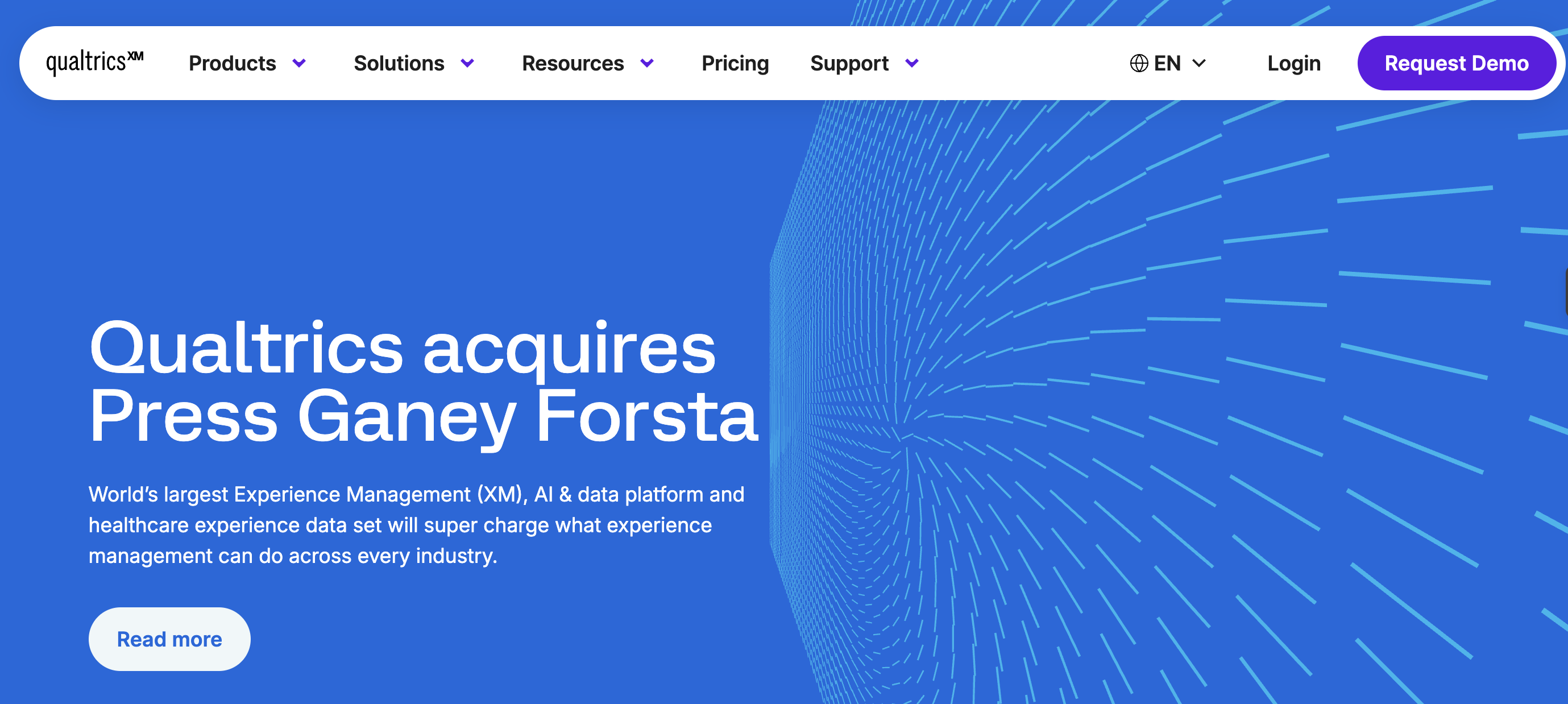
Qualtrics XM · Interface preview
Qualtrics XM is a familiar name in the employee experience space, offering tools that support feedback collection across the entire employee lifecycle. Known for its broad feature set and integrations, the platform helps HR teams design and distribute surveys, track sentiment, and analyze results to inform engagement strategies at scale.
Feature
What it gives you
Comprehensive feedback types
Pulse, onboarding, exit, lifecycle, and satisfaction surveys covering the full employee journey
Deep question library
Benchmarkable items and expert-validated content to support rigorous EX design
Real-time listening
Frequent, agile pulse surveys that capture evolving sentiment at scale
AI-powered insights
Generative and predictive AI to summarize trends and guide follow-up action
Integrated EX platform
Connects feedback, analytics, and HR workflow with Experience Management tools
Best for
Large organizations needing deep benchmarking and advanced engagement survey dashboards. Provides enterprise benchmarking and advanced reporting for analyzing results at scale.
Watch out for
Platform navigation can feel complex for new users, and implementation typically requires a significant professional services investment via G2
Standout
Cross-industry benchmark database
Qualtrics sits on one of the largest EX benchmark datasets available — useful for enterprises that need to contextualize scores against sector peers.
Nº 02 / 7
Workday Peakon
★ 4.6 G2
G2 Rating
4.6 / 5
Pricing
Contact sales
Best For
Workday ecosystem
Company Size
500–5,000 employees
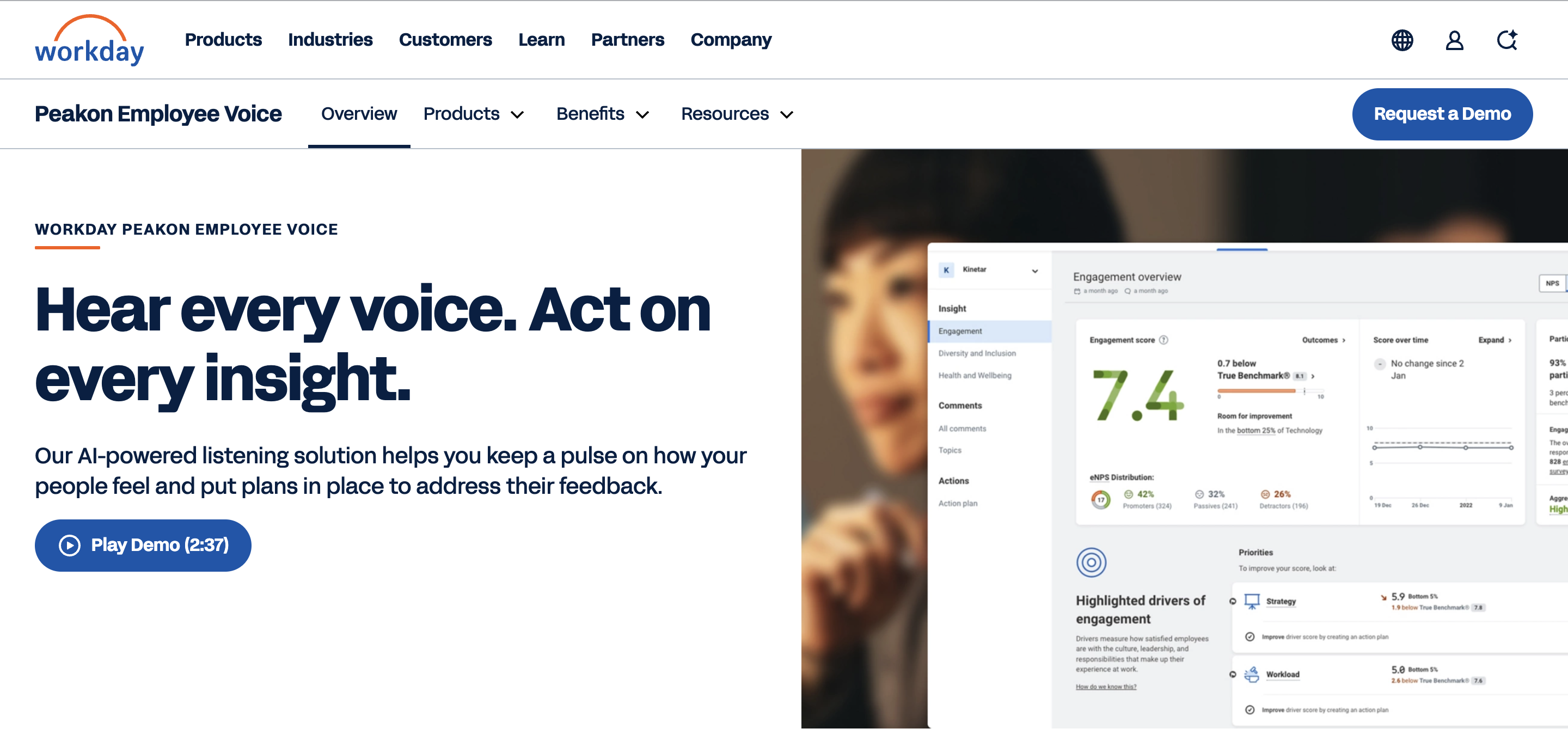
Workday Peakon · Interface preview
Workday Peakon, now called Workday Employee Voice, is designed to capture continuous feedback across the employee lifecycle. The platform blends AI, benchmarks, and analytics to help leaders understand engagement trends and turn employee sentiment into actionable insights.
Feature
What it gives you
Intelligent survey flows
Follow-up questions adapt based on earlier responses, surfacing richer qualitative data
Industry benchmarking
Adjusted comparisons help organizations measure engagement accurately against sector peers
Attrition risk forecasts
AI identifies turnover risks early, enabling proactive retention strategies
NLP-powered insights
Natural language processing surfaces trends and sentiment drivers from open text
Science-based question libraries
Built-in behavioral science ensures question validity across the employee lifecycle
Best for
The natural fit for enterprises already running Workday HCM — org hierarchy and employee data sync automatically, eliminating manual maintenance every survey cycle.
Watch out for
Value diminishes significantly outside the Workday ecosystem, and pricing is high relative to standalone alternatives via G2
Standout
Native Workday HCM integration
No CSV uploads, no manual maintenance. Org hierarchy, manager assignments, and employee data sync automatically — saving HR teams hours every survey cycle.
CultureMonkey is an enterprise employee survey platform combining secure anonymous feedback delivery, AI-powered text analytics, heatmap reporting, benchmarking, and structured action planning. Supports role-based access controls, configurable anonymity thresholds, and 17+ HRIS integrations for enterprise engagement programs.
Feature
What it gives you
Enterprise-grade anonymity
SOC 2 compliance, GDPR-aligned data controls, and encrypted storage keep employee data secure
Benchmarking engine
Industry benchmark datasets and historical comparison models evaluate engagement scores over time
AI sentiment analysis
NLP models classify open-text feedback into themes and sentiment trends automatically
Heatmap analytics
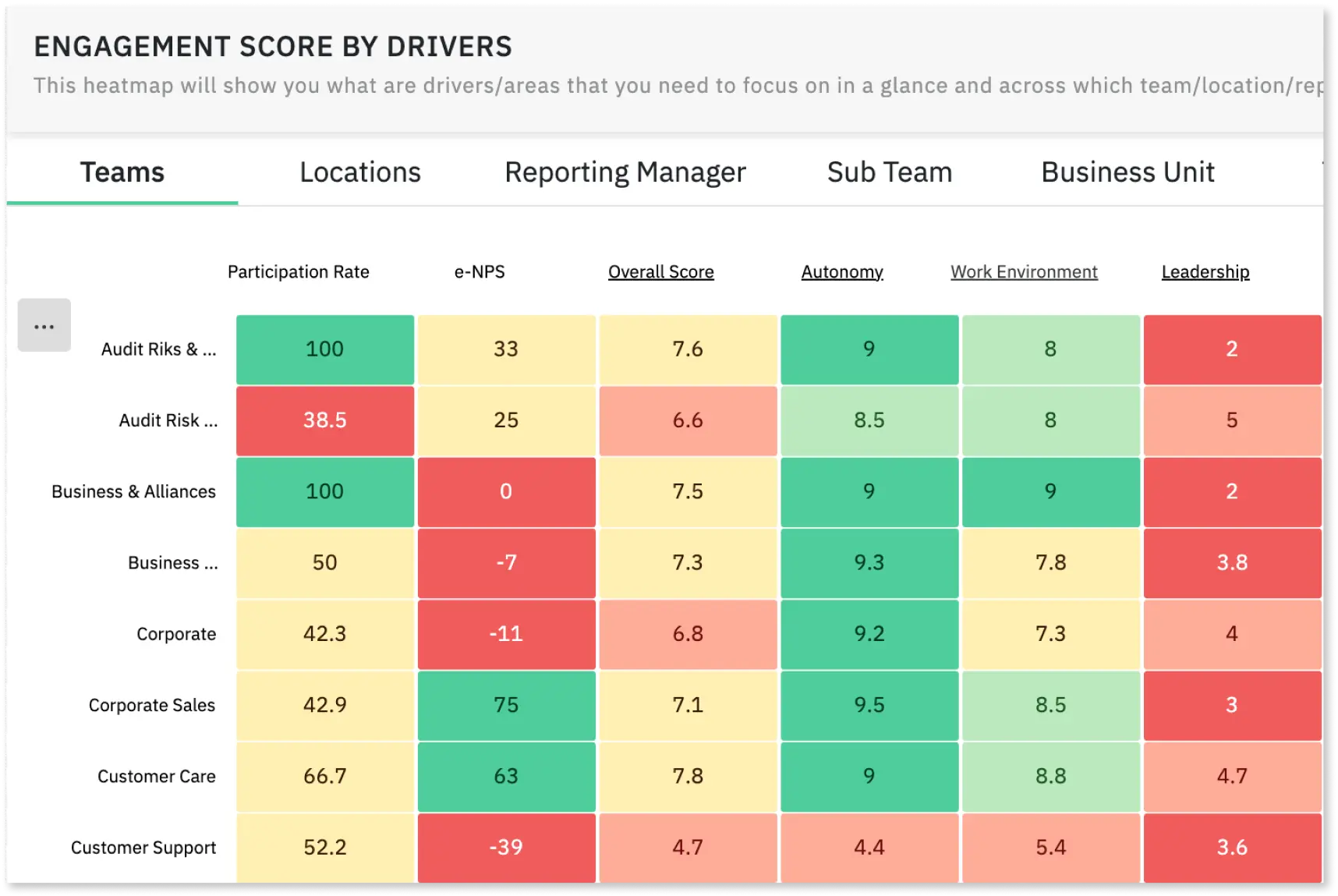
Team-level dashboards and visual heatmaps reveal engagement patterns across departments and managers
Action planning system
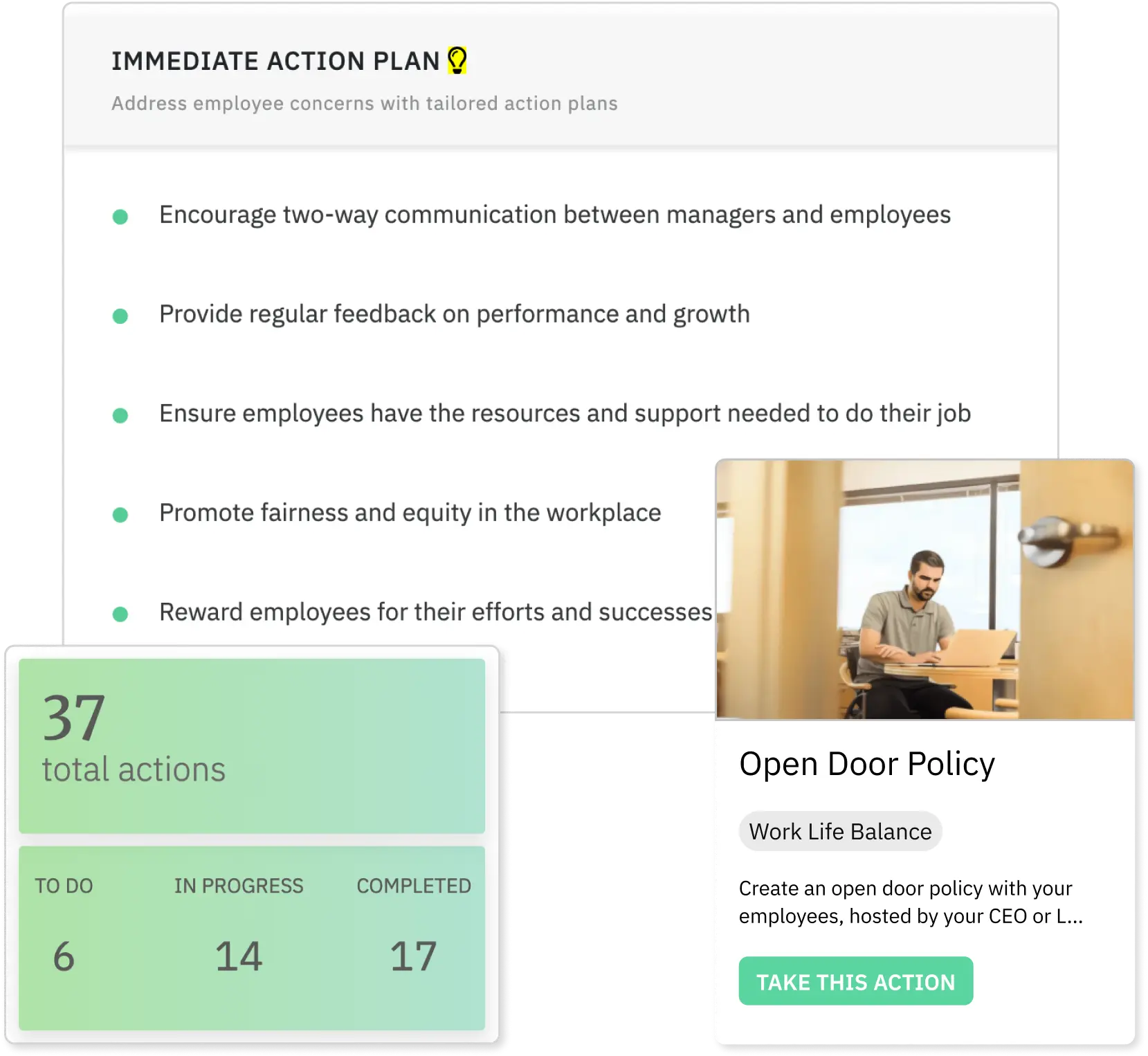
Workflow tools assign owners, track initiatives, and monitor improvements after each survey cycle
Best for
Enterprise organizations that need anonymous third-party employee surveys with strong confidentiality controls, AI analytics, benchmarking, and structured action planning. Multi-channel delivery extends reach to frontline employees as one additional use case.
Watch out for
Some users report wanting deeper self-serve analytics customization for niche reporting needs via G2
Standout
Trust · Anonymity · AI Analytics · Action Planning · 100+ Languages
Configurable anonymity thresholds, AI text analytics, benchmarking, and a structured action planning loop. Multi-channel delivery (WhatsApp, QR, kiosk) extends reach to frontline employees.
"
CultureMonkey's platform gave us a venue to do that, as well as for utilizing some AI knowledge within the platform to suggest some action plans that may work for them. And that was very helpful so that we were not trying to reinvent the wheel for our managers.
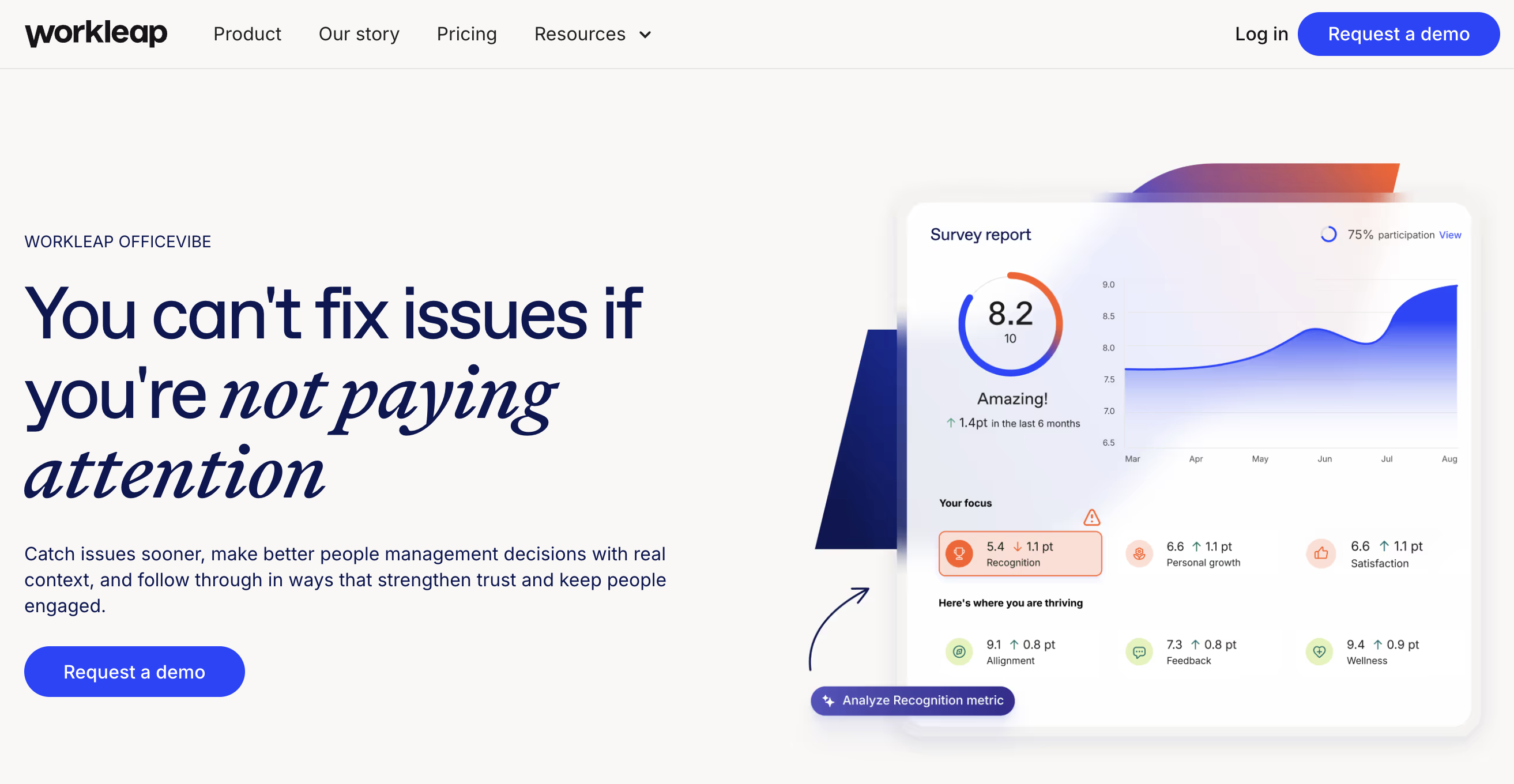
Workleap (formerly Officevibe) delivers an engaging, modular survey and feedback platform built on simplicity and AI-led insights. Designed to create ongoing dialogue, it helps HR and people teams measure morale, pulse key engagement metrics, and encourage meaningful interactions across teams.
Feature
What it gives you
Automated pulse surveys
Frequent, compact check-ins using sliders, ratings, and multiple choice for quick team insights
Anonymous messaging follow-up
Continued anonymous conversation after initial feedback, deepening qualitative data
AI-summarized insights
Highlights trends and themes in real time, making ongoing improvement workflows effortless
Feedback reporting dashboard
Trends and usage metrics in one place so managers can track engagement activity easily
Peer recognition tools
'Good Vibes' cards and prompts that reinforce positive behaviors within teams
Best for
Teams that want simple pulse surveys and real-time engagement reporting at the most accessible price point on this list.
Watch out for
Survey customization and analytics depth feel limited compared to enterprise-tier platforms via G2
Standout
$5/user/month with no enterprise commitment
Purpose-built for team leads and SME HR teams who need structured feedback without procurement cycles. Note that the $5/user/month rate is billed annually and carries a 10-user minimum, so budget for at least 10 seats.
Nº 05 / 7
15Five
★ 4.6 G2
G2 Rating
4.6 / 5
Pricing
$4/user/month
Best For
Continuous feedback + check-ins
Company Size
50–500 employees
15Five · Interface preview
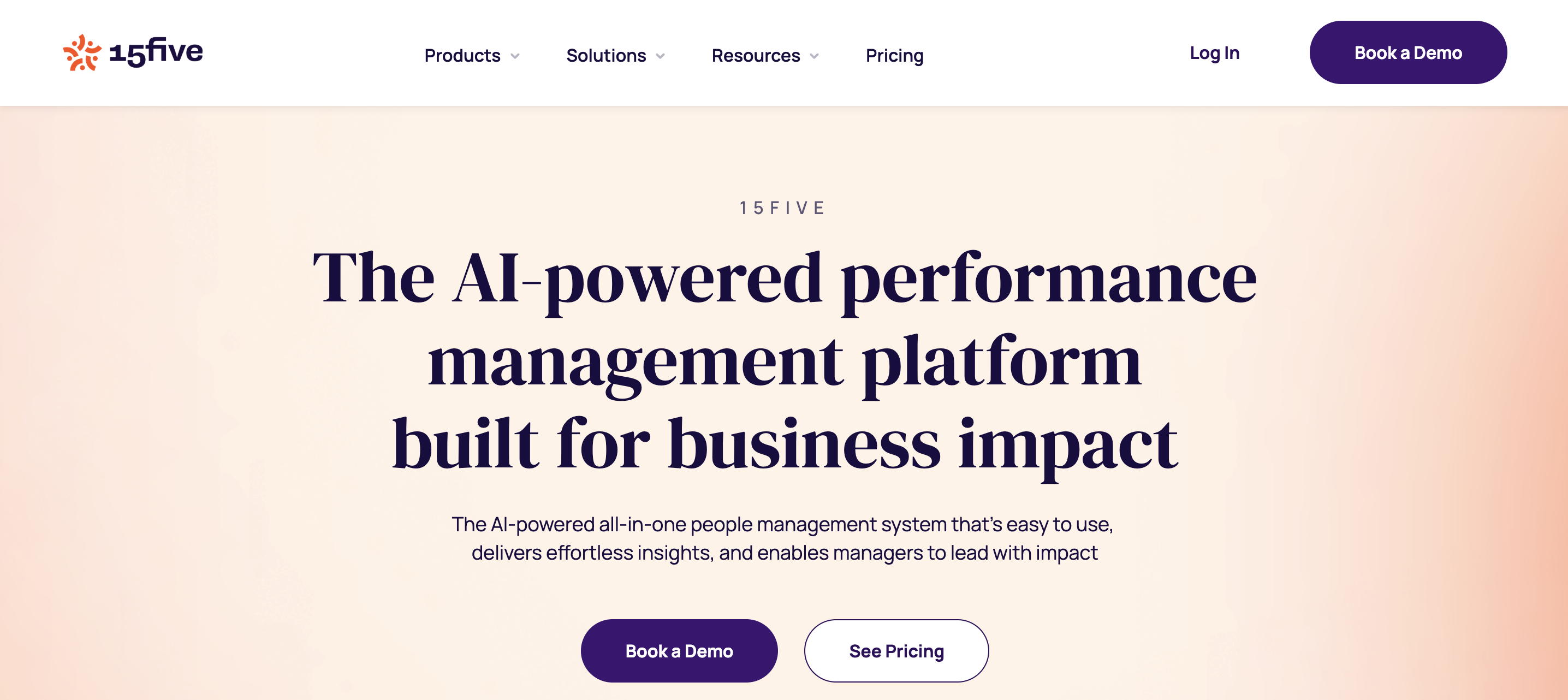
15Five centers around continuous feedback and engagement, combining pulse surveys with lifecycle tracking and check-ins. Built to guide HR and people teams, it helps surface sentiment, identify trends, and support ongoing culture development, without overwhelming managers or teams.
Feature
What it gives you
Pulse in check-ins
Quick sentiment check-ins integrated into regular workflows to capture real-time employee mood
Automated lifecycle surveys
Feedback surveys at key career stages — onboarding, milestones, exit — with minimal admin
Adaptive engagement campaigns
Prebuilt, research-backed engagement surveys and custom topic-based assessments
Pulse dashboard analytics
Team sentiment trends in real time with average scores and group visibility filters
AI-powered action planning
Predictive analytics and action plan tools to help HR close the feedback loop
Best for
Organizations wanting simple feedback tools and guided manager check-ins at the lowest per-user cost of any platform on this list.
Watch out for
Survey data can feel less granular for complex orgs, and HRIS integration depth is limited vs. enterprise platforms via G2
Standout
$4/user/month — lowest cost on the list
Combines weekly check-ins with structured pulse surveys — ideal for people teams that want continuous listening without a dedicated engagement platform budget.
Case Study · Robertshaw
4×
eNPS growth (9.21 → 38.11)
71%
Reduction in actively disengaged
8.7
Engagement score
Year 1→2
Measurable YoY improvement
Heather Kane
Change Management & Employee Engagement Lead · Robertshaw
The problem CultureMonkey solves is getting to a mostly frontline workforce in nine different languages — half a dozen of which aren't common. It makes it really easy, so we can spend more of our time on the output that actually matters.
Nº 06 / 7
Culture Amp
★ 4.5 G2
G2 Rating
4.5 / 5
Pricing
Contact sales
Best For
Engagement with trend tracking
Company Size
200–2,000 employees
Culture Amp · Interface preview
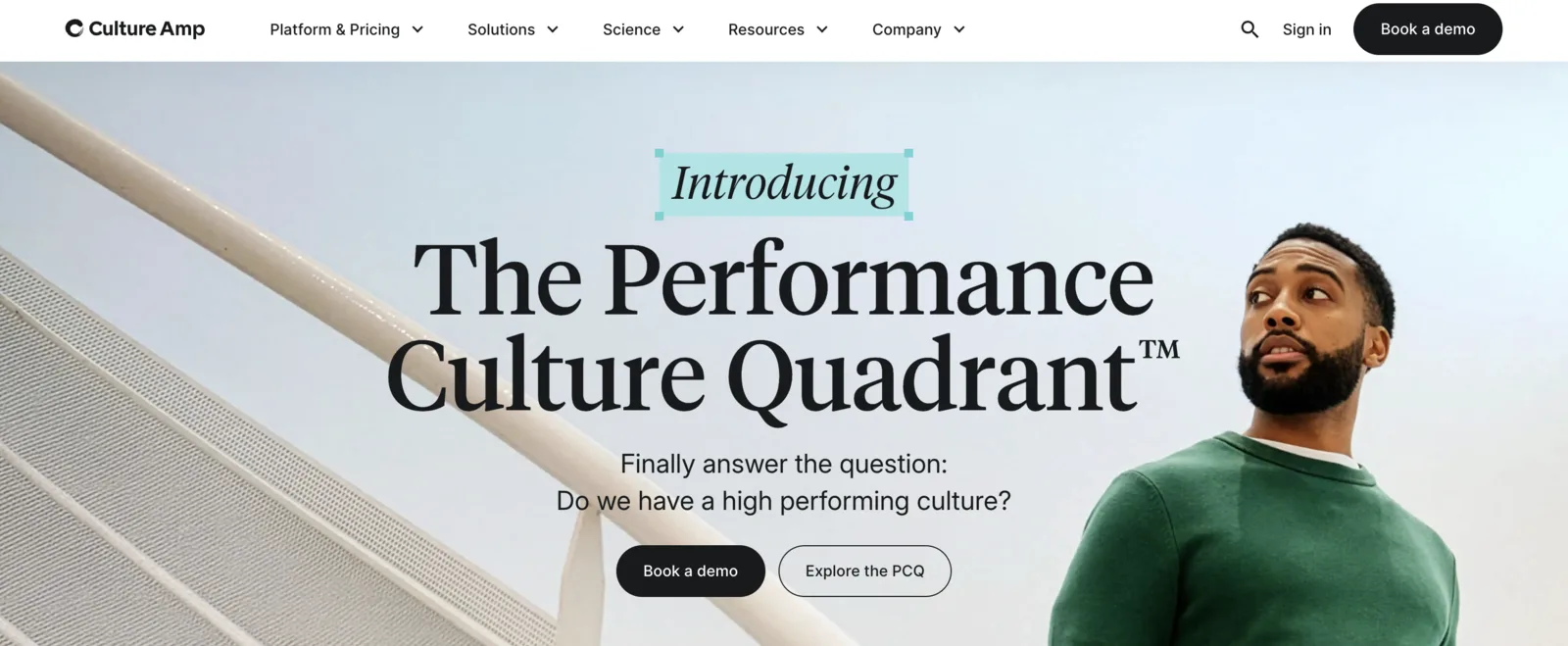
Culture Amp is an all-in-one platform offering tools to measure and improve employee experience across engagement, performance, and development. Known for its behavioral science foundation and breadth of survey formats, the platform empowers HR teams to gather insights and turn them into measurable action.
Feature
What it gives you
Science-backed templates
40+ research-backed survey templates that ensure credibility and reduce guesswork
AI comment analysis
Summarizes open-text feedback using AI, making large-scale qualitative data digestible
Industry benchmarking
Compare results with thousands of organizations using collective data insights
Holistic performance feedback
Integrates 360-degree reviews, goals, and well-being into an engagement-first feedback system
Survey summary transparency
Share high-level results securely across teams including favorability and demographic breakdowns
Best for
Organizations wanting easy engagement surveys and long-term score tracking. Practical tools with clear tracking over time — strongest for mid-market desk-based workforces.
Watch out for
Support response times can feel slow during urgent situations, and frontline/deskless employee support is limited via G2
Standout
40+ behavioral-science survey templates
Built by I/O psychologists — Culture Amp's template library is among the most research-validated on the market, reducing the design burden for first-time formal engagement programs.
"
Switching to CultureMonkey and connecting to our real HR data has just been a game changer for us. Now I can see engagement information down to the manager level, which is just a completely different world.
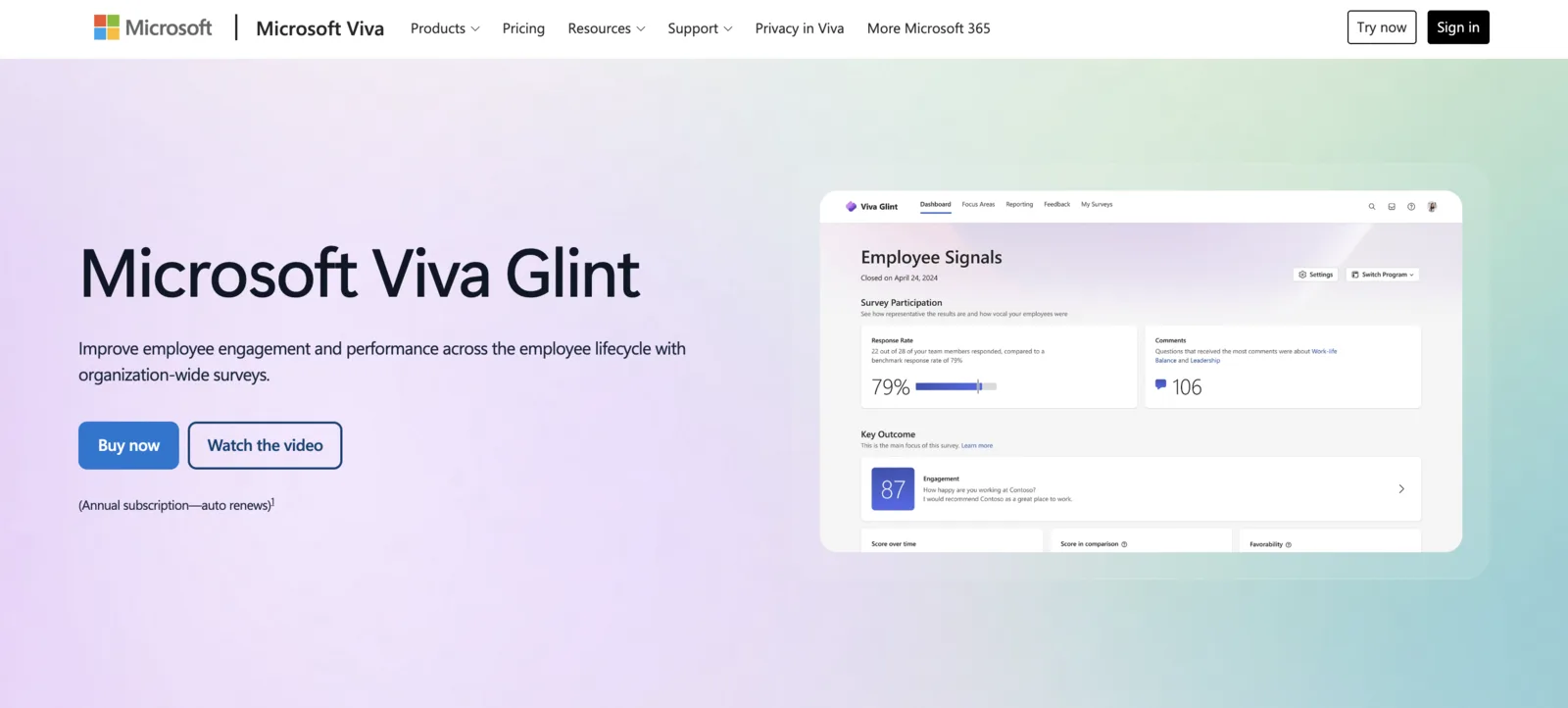
Microsoft Viva Glint is part of the Microsoft Viva suite and focuses on collecting employee feedback through surveys. It provides different survey formats, from quick pulse checks to lifecycle surveys, to help organizations understand employee sentiment and identify areas for improvement. One buyer note: Microsoft has been trimming the Viva suite, retiring Viva Goals on December 31, 2025 and winding down Viva Topics, but Viva Glint itself remains active and continues to ship feature updates in 2026.
Feature
What it gives you
People science-based templates
Research-backed templates covering engagement, lifecycle, and special topics for reliable data
Always-On feedback
Continuous access to feedback through surveys that employees can submit at any time
Copilot-powered insights
AI (Copilot) summarizes comments and highlights trends quickly across large datasets
Flexible benchmarking
Internal, external, and trend-based comparisons for robust contextual analysis
Configurable privacy thresholds
Sets response thresholds to protect anonymity in insights and manager-level reporting
Best for
The natural fit for organizations already invested in Teams, SharePoint, and Microsoft 365 — Glint surfaces engagement data natively within the productivity tools employees already use daily.
Watch out for
Heavily dependent on the Microsoft ecosystem — limited value outside it, and navigation can feel complex without deeper platform familiarity via G2
Standout
Microsoft 365 + Teams native integration
Survey nudges, results, and action plans surface directly inside Teams — removing the context switch that typically kills manager adoption of standalone engagement platforms.
Case Study · United Bank
"CultureMonkey made it easy to automate our employee engagement surveys while still giving us the flexibility to customize them. Their real-time data analysis helped us uncover key focus areas and align our strategy with industry benchmarks."
Built manually with limited expertise and generic tools.
Research-backed templates and proven frameworks by design.
Analytics & insights
Reporting is basic, often limited to raw data or charts.
Advanced analytics deliver benchmarks, trends, and actionable insights.
Scalability
Becomes harder to manage as the workforce grows.
Scales seamlessly with automated distribution and reporting.
Resource demand
HR teams spend significant time on setup and analysis.
External partners streamline survey creation and feedback analysis.
Exceptions
When NOT to hire a third party survey company
External providers aren't always the right choice. Consider these scenarios before committing to a vendor.
01
Very small teams
Direct conversations may be more effective than formal surveys. The overhead of a third-party platform may not be justified.
02
Limited budgets
If resources are tight, free tools like Google Forms may be sufficient for basic feedback needs.
03
Simple feedback needs
When gathering quick input on a single topic, a basic internal tool is often enough.
04
Lack of leadership readiness
If leadership isn't committed to acting on feedback, a vendor won't create impact. The platform is only as valuable as the organization's willingness to respond.
05
Short-term projects
For temporary initiatives, building a long-term vendor relationship may not add value.
Evaluation Framework
HR checklist: How to evaluate the best third-party survey companies in 2026
The best solutions balance ease of use, security, and advanced analytics while aligning with your organization's scale and culture goals.
01
Proven expertise
Deep experience in employee engagement and survey design — frameworks that are tried, tested, and effective.
02
Anonymity and trust
The platform must prioritize anonymity. Employee confidence directly impacts survey accuracy.
03
Customization options
Surveys tailored to your company's unique culture and goals — flexible as priorities evolve.
04
Multilingual support
Language inclusivity ensures feedback from every corner of the workforce, not just HQ.
05
Integrations
Works with your HRMS, communication tools, and existing workflows without friction.
06
Analytics depth
Heatmaps, sentiment analysis, and benchmarks that let leadership act on data, not just review it.
07
Ease of use
Intuitive for both HR teams and employees — a user-friendly design boosts adoption and participation.
08
Scalability
Grows with your organization's size and complexity — no vendor switches as headcount increases.
09
Action planning tools
Features that help managers translate survey insights into concrete next steps and accountability.
10
Support and onboarding
Strong customer success and onboarding resources to maximize value from day one.
After the Survey
How to interpret and act on results from third-party surveys
Gallup finds that managers account for 70% of the variance in team engagement, which means the value of any survey lives or dies in how manager-level engagement data gets interpreted and acted on. Here's how to get full value from your survey investment.
01
Segment the data
Break down results by department, role, or location to identify patterns. Address problems at the right level — not just organization-wide.
02
Spot recurring themes
Consistent feedback trends — positive or negative — often highlight systemic gaps that one-off interventions won't fix.
03
Prioritize critical issues
Focus first on areas that directly impact engagement, retention, and well-being. Quick wins build momentum for the broader program.
04
Benchmark against industry
External comparisons reveal whether challenges are internal or market-wide — which changes the intervention strategy entirely.
05
Share results transparently
Transparency shows employees their voices truly matter — and determines whether the next survey gets higher participation.
06
Link insights to action
Turn survey outcomes into concrete plans with assigned responsibility. Feedback only creates value when someone is accountable for acting on it.
07
Track progress over time
Regular follow-up surveys make feedback a continuous cycle — not a one-off event that fades from the calendar.
Global Readiness
Can a third-party survey provider help with global teams and multilingual surveys?
For multinational organizations, running surveys that resonate across diverse cultures and languages is one of the hardest challenges. Internal tools often struggle with inclusivity. Here's where third-party providers deliver:
100+ language delivery: employees respond in the language they're most comfortable with.
Cultural sensitivity: questions are adapted so feedback is accurate and respectful across geographies.
Centralized reporting: one dashboard for global comparison, with regional breakdowns preserved.
Global benchmarks: comparative data across industries and regions gives leaders genuine context.
Enterprise scalability: automated distribution for thousands of employees, with no HR overhead as headcount grows.
Spotlight
The role of CultureMonkey as a hybrid feedback platform + strategic survey partner
Among the best third-party survey companies, CultureMonkey stands out by combining the neutrality of external providers with the depth of an enterprise-ready engagement platform.
01
Customizable survey templates
Prebuilt templates or fully custom designs tailored to your company's unique culture and needs.
02
Multilingual surveys
Reach global teams by delivering surveys in 100+ languages, ensuring inclusivity at scale.
03
People science–backed reporting
Every survey insight is grounded in behavioral science, providing context HR leaders can trust.
04
Benchmarking
Compare your engagement data with internal and external benchmarks to identify gaps and strengths.
05
Seamless integrations
Connect with HRMS and communication tools, streamlining distribution and reporting across your tech stack.
06
In-depth visual heatmaps
Spot trends across teams and regions instantly with intuitive, color-coded heatmaps.
07
AI-powered action planning
Transform survey insights into concrete steps with AI-driven action plans for managers and leaders.
08
Anonymous feedback guarantee
Configurable anonymity thresholds and third-party anonymization ensure employees speak freely — improving both participation and data quality.
09
Dedicated people science support
HR and behavioral science experts guide survey design, cadence, and action planning from kickoff through review — not just a SaaS tool.
FAQ
Frequently asked questions
What is a third party survey company in HR?
A third party survey company is an independent provider that designs, distributes, and analyzes employee surveys for organizations. These employee survey companies help HR teams run employee engagement surveys, protect anonymity, and generate structured employee insights. CultureMonkey is a third party employee survey company that handles the full cycle: survey design from validated templates, anonymous distribution over email, Slack, Teams and WhatsApp in 100 or more languages, platform-enforced anonymity thresholds, and AI analysis of open-text responses.
Why do companies hire third-party vendors for employee feedback?
Organizations hire third party survey companies to collect unbiased employee feedback employees trust. Independent employee engagement survey vendors improve anonymity, increase participation, provide benchmarking data, and turn employee survey results into actionable insights that leadership can use to improve engagement.
What's the best third party survey platform for employee feedback?
The best third party survey companies provide secure survey platforms, benchmarking, and actionable analytics. Leading employee engagement survey platforms such as CultureMonkey help HR teams run company surveys for employees, protect anonymity, and convert employee feedback into actionable insights on engagement.
Can third party surveys be customized for different teams?
Yes. Most employee engagement survey vendors allow customization by department, location, or role. Modern employee survey companies enable HR teams to adapt survey questions, distribution methods, and reporting dashboards so company surveys reflect different team needs and workplace contexts.
Do third party surveys really boost employee engagement?
Yes. Third party survey companies boost employee engagement because survey responses are handled independently. Many employee engagement survey vendors also provide benchmarking, analytics, and action planning tools that help leaders translate survey employee engagement data into measurable workplace improvements.
How does CultureMonkey compare to traditional third party survey vendors?
CultureMonkey combines the strengths of third party survey companies with modern analytics and continuous listening tools. Unlike traditional employee survey vendors, the platform supports pulse surveys, AI-driven insights, and structured action planning to convert employee feedback into continuous improvement.
How do third-party survey companies ensure data security and compliance?
Third party survey companies ensure data security and compliance through encrypted survey platforms, strict access controls, and regulated data storage. Leading employee engagement survey vendors also follow standards like ISO 27001, SOC 2, and GDPR to keep employee data and responses confidential and legally compliant.
What is the average employee engagement score by industry in 2026?
According to CultureMonkey's Employee Engagement Benchmarks, Q3 2026, APAC and LATAM lead global engagement at 8.22 on the 0 to 10 scale, followed by MEA at 8.14, North America at 7.90, and Europe at 7.67. By company size, enterprises (2000+ employees) score 8.16, SMBs score 8.09, mid-market organizations score 8.07, and micro companies score 7.70.
What is the difference between a third-party survey company and an internal survey tool?
Internal survey tools are run by HR teams using generic platforms, which can reduce employee trust and participation. Third-party survey companies act as neutral intermediaries — they guarantee anonymity, provide industry benchmarking, and deliver richer analytics that internal tools typically cannot match.
How much do third-party employee survey companies cost?
Pricing varies by platform tier. Budget-friendly tools like 15Five start at $4/user/month billed annually, and Workleap Officevibe at $5/user/month billed annually with a 10-user minimum. Enterprise platforms like CultureMonkey, Qualtrics XM, and Microsoft Viva Glint use contact-sales pricing based on employee count, features, and HRIS integrations.
What HRIS systems do third-party survey platforms integrate with?
Leading third-party survey platforms integrate with major HRIS systems. CultureMonkey supports 17+ HRIS integrations including Workday, SAP SuccessFactors, Darwinbox, and BambooHR. Workday Peakon integrates natively with Workday HCM. Microsoft Viva Glint integrates with Microsoft 365 and Azure AD.
Can third-party survey companies support multilingual and global teams?
Yes. Enterprise-tier third-party survey companies support multilingual surveys. CultureMonkey delivers surveys in 100+ languages. Qualtrics XM and Microsoft Viva Glint also support global distribution. Multilingual delivery ensures every employee — regardless of location — can respond in their preferred language, improving participation and data accuracy.
What types of surveys do third-party employee survey companies offer?
Third-party employee survey companies typically offer: employee engagement surveys, pulse surveys (weekly or biweekly), onboarding surveys, exit surveys, lifecycle surveys, 360-degree feedback, and culture assessments. Enterprise platforms like CultureMonkey and Qualtrics XM cover the full employee lifecycle in one platform.
How often should companies run employee surveys through a third party?
Best practice depends on organization size and culture maturity. Most HR experts recommend annual engagement surveys supplemented by quarterly pulse surveys. High-performing organizations also add lifecycle touchpoints at onboarding, six-month milestones, and exit. Continuous listening platforms like Workday Peakon and CultureMonkey support always-on feedback cadences.
What is anonymous survey benchmarking and why does it matter?
Anonymous survey benchmarking compares your organization's engagement scores to anonymized industry or peer data collected by a third-party survey company. It matters because internal scores alone give no context — benchmarking reveals whether your 4.1/5 score is above or below sector norms, helping HR prioritize initiatives that close real gaps.
How do you evaluate a third-party employee survey vendor before signing a contract?
When evaluating a third-party employee survey vendor, assess: (1) anonymity guarantees and data security certifications (SOC 2, GDPR, ISO 27001) — see the full vendor security checklist for the questions to ask; (2) benchmarking database depth; (3) HRIS integration compatibility; (4) survey customization capabilities; (5) analytics and heatmap reporting quality; (6) action planning tools for managers; (7) multilingual support for global teams; and (8) customer success and onboarding quality.
What makes CultureMonkey a third-party survey company?
CultureMonkey operates as an independent third-party survey provider by acting as a neutral data processor between employees and management. Survey responses are anonymized, encrypted, and aggregated before results reach HR teams — ensuring employees cannot be identified. This structural independence is what makes CultureMonkey a trusted third-party employee survey company rather than just an internal HR tool.
What is the global employee engagement benchmark for 2026?
Based on CultureMonkey's Employee Engagement Benchmarks, Q3 2026, the global median engagement score is 8.09 on the 0 to 10 scale. APAC and LATAM lead at 8.22, followed by MEA at 8.14, North America at 7.90, and Europe at 7.67. SMBs (100–500 employees) show the strongest momentum, up 0.28 year over year.
Which third-party survey company is best for frontline and deskless workers?
CultureMonkey is the strongest third-party survey company for frontline and deskless employees. It supports multi-channel delivery including WhatsApp, QR codes, and kiosk mode — ensuring warehouse, retail, healthcare, and field workers can participate without corporate email. This makes it uniquely suited for manufacturing, logistics, and service-sector organizations with large frontline workforces.
Last reviewed July 2026. Engagement benchmarks, billing terms, and vendor status updated.
Build the trust that gets you honest answers
Guaranteed anonymity, omni-channel reach, and AI-driven action planning. Everything you need to earn employee trust, raise response rates, and act on feedback that's genuinely honest.