


eNPS across employee lifecycle: A practical guide

eNPS across employee lifecycle refers to measuring employee sentiment at key stages such as onboarding, tenure, transitions, and exit. Instead of a one-time survey, it is used as a stage-based signal to capture how employee experience evolves over time. Each lifecycle point reveals different drivers, from early expectations to retention risks and exit intent.
This approach combines employee net promoter score, employee engagement, and employee sentiment to generate actionable insights from continuous employee feedback. This guide outlines tested frameworks organizations use to operationalize lifecycle-based eNPS.


- eNPS across employee lifecycle measures sentiment at onboarding, tenure, transitions, and exit to track engagement changes over time.
- Sentiment shifts at each stage, making lifecycle-based measurement more accurate than one-time surveys.
- Stage-specific signals reveal early risks, friction points, and experience gaps across the journey.
- Trigger-based and pulse eNPS together enable continuous, context-driven employee feedback.
- CultureMonkey enables lifecycle eNPS with trigger surveys, segmentation, and actionable insights across every stage.
What is a lifecycle-based eNPS?

Lifecycle-based eNPS is an approach where an eNPS lifecycle survey is conducted at key employee stages, such as onboarding, tenure, transitions, and exit to track how sentiment changes over time. Unlike one-time surveys, employee lifecycle eNPS captures stage-specific feedback, helping organizations identify when sentiment shifts and what drives it.
It uses eNPS surveys and employee NPS survey methods to gather feedback, analyze employee responses, and track eNPS score changes across stages. eNPS scores can range from -100 to 100, with higher scores indicating more positive employee sentiment. A score above 0 indicates that there are more Promoters than Detractors, suggesting a generally satisfied workforce.
Why eNPS should be measured across the employee lifecycle
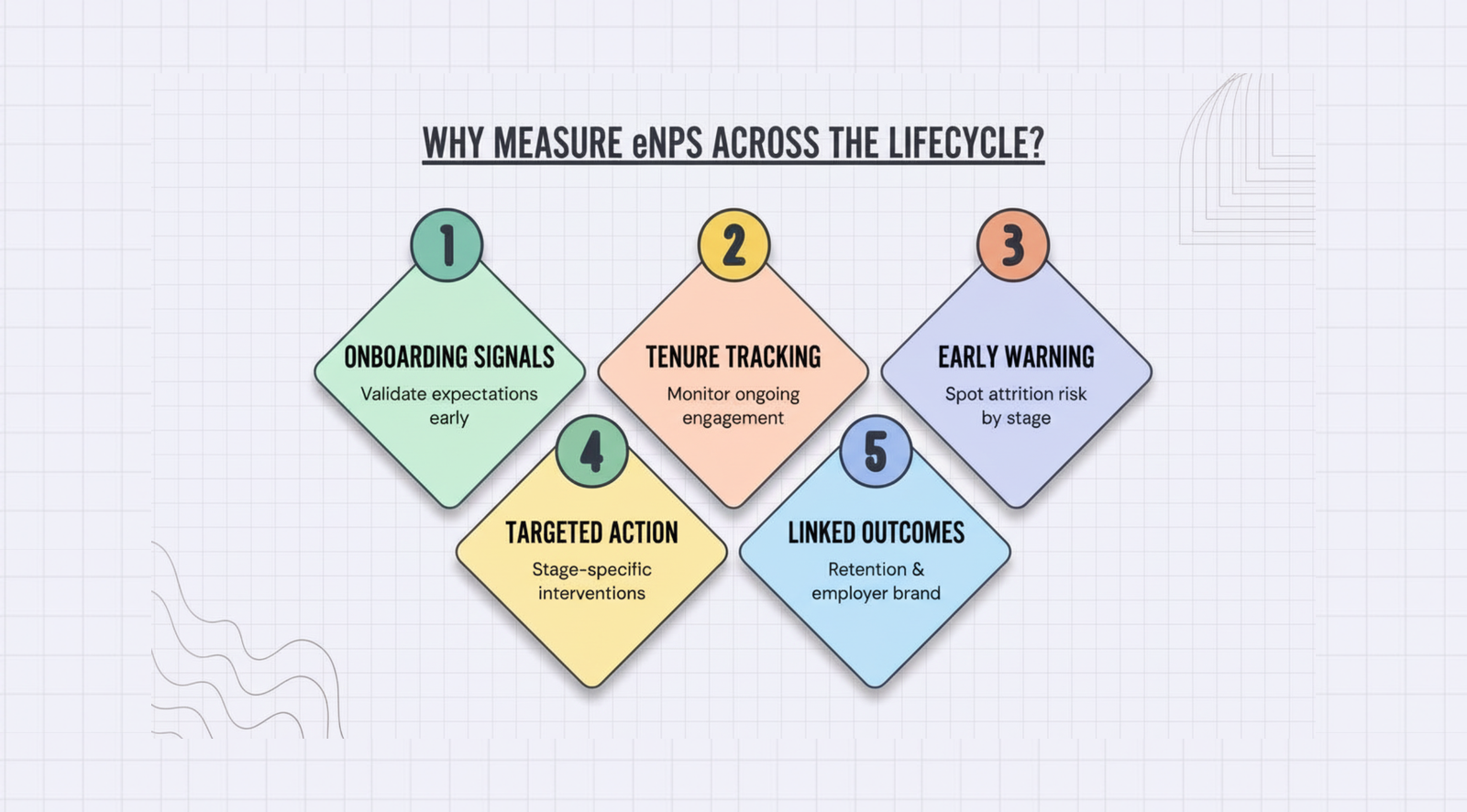
eNPS should be measured across the employee lifecycle because employee sentiment shifts at specific moments, and a single survey cannot capture these changes. It isolates signals from onboarding, tenure, transitions, and exit, making sentiment time-bound and actionable.
- Captures sentiment at critical moments: Onboarding validates expectations, tenure tracks engagement, transitions reveal friction, and exit exposes underlying issues.
- Acts as an early warning system: Stage-level detractors indicate attrition risk early, while passives highlight groups that can be improved before disengagement.
- Enables targeted action, not generic fixes
Lifecycle employee feedback eNPS allows interventions based on stage-specific issues instead of broad, ineffective programs. - Links sentiment to outcomes: Stage-wise feedback improves retention, strengthens employer perception, and supports better operational decisions.
The eNPS score is calculated by subtracting the percentage of Detractors from the percentage of Promoters. By combining eNPS data with engagement metrics, organizations can track trends, identify engagement drivers, and improve employee satisfaction and employee experience.
How to use eNPS during onboarding?

Onboarding eNPS is used to measure early employee sentiment at key milestones to validate expectations, identify gaps, and improve first experiences. It captures whether the joining experience matches what was promised and highlights early risks before disengagement sets in.
Key strategies for using eNPS during onboarding:
1. Time it at critical onboarding milestones
- Week 1: Captures early sentiment and initial impressions.
- Day 30: Evaluates expectation vs reality alignment.
- Day 90: Validates overall onboarding experience and integration.
2. Keep the measurement consistent
- Use a standard structure across all onboarding checkpoints.
- Maintain comparability of sentiment over time.
3. Add qualitative context for experience validation
- Capture why employees feel a certain way.
- Identify specific gaps in onboarding experience.
4. Segment onboarding signals
- Analyze by team, role, or hiring manager.
- Detect patterns in onboarding quality.
5. Classify and prioritize responses
- Detractors indicate early dissatisfaction. Detractors are employees who score 0-6 and are generally disengaged and dissatisfied with the organization.
- Passives suggest incomplete experience alignment. Long-term employees (5+ Years) may experience rising eNPS if they feel valued and have professional autonomy.
- Promoters confirm a strong onboarding experience. Promoters are employees who score 9-10 and are highly engaged and enthusiastic about the organization.
6. Act quickly on early signals
- Fix gaps in training, communication, or role clarity.
- Improving onboarding before early disengagement leads to first-90-day attrition.
7. Ensure anonymity for honest feedback
- Encourage candid responses during the early stages.
- Improve the reliability of onboarding insights.
How to use the signal effectively:
- Track early detractors closely to prevent first-90-day attrition.
- Identify patterns across teams or managers instead of isolated feedback.
- Prioritize quick fixes where the onboarding experience breaks early.
New hires often report high eNPS during the onboarding phase due to excitement and positive experiences. Early-stage insights help improve employee morale, align employee perceptions, and support better career growth opportunities from the start.
How to use eNPS during employee tenure?
To use eNPS during employee tenure, run ongoing pulse eNPS at regular intervals, segment results by tenure and team, and act on group-level signals to prevent disengagement and attrition. This makes ongoing eNPS a continuous engagement diagnostic, not a one-time check.
How to use it effectively:
- Run ongoing pulse eNPS: Use quarterly or periodic surveys to track engagement trends over time.
- Measure at key tenure moments: Capture signals during steady-state work and after manager or organizational changes.
- Segment by tenure and team: Compare new, mid-tenure (18–36 months), and long-tenured employees to detect engagement dips.
- Act based on eNPS groups: Detractors signal attrition risk, passives indicate stagnation, promoters validate strong teams.
- Close the loop visibly: Show what actions are taken to build trust and improve participation.
Segmenting employee populations helps analyze engagement levels, detect disengaged employees, and strengthen team dynamics and workplace culture.
How to measure eNPS during role or manager changes?

To measure eNPS during role or manager changes, trigger pulse eNPS after the change, segment results by the transition, and compare with pre-change scores to detect friction early. This isolates the impact of the change, not overall engagement.
How to measure it effectively:
- Trigger surveys based on change events: Run eNPS after manager changes, role shifts, or promotions.
- Measure at the right moments: Capture feedback ~30 days after change and during new role onboarding.
- Segment by change context: Break results by manager, team, or role to identify where friction exists.
- Compare with pre-change baseline: A drop in score signals transition-related issues even if overall scores look stable.
(Source: McKinsey & Company)
- Interpret eNPS groups for action: Detractors indicate friction with the change, passives show adjustment gaps, promoters signal stability.
- Capture reasons behind scores: Identify whether issues come from leadership, workload, or role clarity.
- Ensure anonymity during transitions: Improve honesty when employees may hesitate to share openly.
Employee Net Promoter Score (eNPS) measures how likely employees are to recommend their organization as a good place to work. Comparing eNPS trends during changes helps identify low eNPS scores, assess workplace dynamics, and address challenges impacting employee loyalty.
How to use eNPS at the exit stage?
To use eNPS at the exit stage, integrate it into the exit process, capture sentiment at resignation, categorize responses to identify why employees leave, and convert patterns into retention actions. Exit eNPS provides high-signal feedback on attrition drivers.
How to use it effectively:
- Integrate eNPS into the exit process: Include it in exit surveys or exit interviews as a standard step.
- Trigger at the right time: Capture feedback during resignation or final interaction while experience is fresh.
- Ensure anonymity for honest insights: Improve reliability of sensitive feedback.
- Capture reasons behind scores: Identify drivers such as management, growth, compensation, or culture.
- Classify responses for signal clarity: Detractors reveal systemic issues, passives show missed retention opportunities, promoters help validate if exits are external or internal.
- Identify recurring exit patterns: Detect trends across teams, roles, or managers.
- Share insights and act on them: Inform leadership and fix root causes to improve retention.
Exit insights reveal dissatisfied employees, improve employee retention, and highlight gaps in work-life balance, employee development, and job satisfaction. Organizations that continuously measure eNPS, analyze feedback, and focus on continuous improvement are more likely to build a highly engaged workforce and achieve business success.
How to design a lifecycle-based eNPS strategy?
To design an eNPS lifecycle strategy, define when to trigger eNPS across employee stages, combine event-based and pulse signals, and align actions to stage-specific insights. This turns eNPS into a continuous listening system, not a one-time survey.
How to structure it:
- Map lifecycle trigger points: Run eNPS at onboarding (30–90 days), tenure (ongoing pulse), transitions, and exit.
- Use event-based + pulse signals: Combine trigger-based surveys with periodic pulse eNPS to capture both moment and trend data.
- Segment by stage, tenure, and team: Separate signals to avoid mixing onboarding, mid-tenure, and exit feedback. The eNPS question should remain consistent across surveys to ensure reliable data collection.
- Assign action ownership to managers: Enable team-level action instead of relying only on centralized HR responses.
- Align actions to lifecycle stages: Fix onboarding gaps, address mid-tenure stagnation, and resolve transition friction. eNPS should be part of a broader employee listening strategy to effectively drive improvements based on feedback.
- Leverage promoters and prioritize detractors: Use promoters as advocates, act quickly on detractors, and improve passives.
- Pair eNPS with supporting metrics: Combine with retention, performance, and wellbeing data for better decisions. A good eNPS score typically ranges from 10 to 30, indicating acceptable employee support.
- Close the loop consistently: Communicate actions taken to maintain trust and participation. It is important to ask follow-up questions in eNPS surveys to gain qualitative insights into employee feedback.
A strong eNPS lifecycle strategy should pair eNPS data with engagement surveys, qualitative feedback, and engagement data for deeper analysis. Similar to net promoter score in customer satisfaction and customer loyalty, lifecycle eNPS helps measure customer satisfaction indirectly through employee experience.
What are common mistakes in lifecycle-based eNPS?

Common mistakes in lifecycle-based eNPS occur when organizations ignore stage context, mis-time surveys, or treat eNPS as a standalone metric instead of a lifecycle signal. These issues reduce accuracy and lead to poor decisions.
Key mistakes to avoid:
- Using the same approach across all stages: Applying identical surveys for onboarding, tenure, and exit removes stage-specific insight.
- Over-surveying or inconsistent timing: Too frequent or irregular surveys cause fatigue and break trend tracking.
- Ignoring context behind scores: Relying only on numbers without understanding why sentiment changed.
- Not segmenting lifecycle data: Aggregated results hide team-level and tenure-specific issues.
- Treating eNPS as a standalone metric: Not pairing it with retention, performance, or other signals.
- Ignoring passives and detractors: Missing early warning signs and opportunities to improve engagement.
- Failing to ensure anonymity: Reduces honesty and skews feedback, especially for negative responses.
- Failing to act or close the loop: Collecting feedback without visible action reduces trust.
- Over-focusing on benchmarks: Prioritizing external scores over internal improvement trends.
- Misreading short-term changes: Ignoring external or temporary factors affecting sentiment.
Promoters drive employee advocacy, improve employee referrals, and contribute to a positive workplace culture and stronger business outcomes. Over-surveying leads to survey fatigue, reduces survey response, and impacts the reliability of eNPS measures and eNPS score calculation.
Conclusion
eNPS across the employee lifecycle is most effective when used as a stage-based signal, not a one-time survey. Measuring sentiment at onboarding, tenure, transitions, and exit helps identify when engagement shifts and what drives those changes. This approach improves decision accuracy, reduces blind spots, and enables timely action before issues turn into attrition.
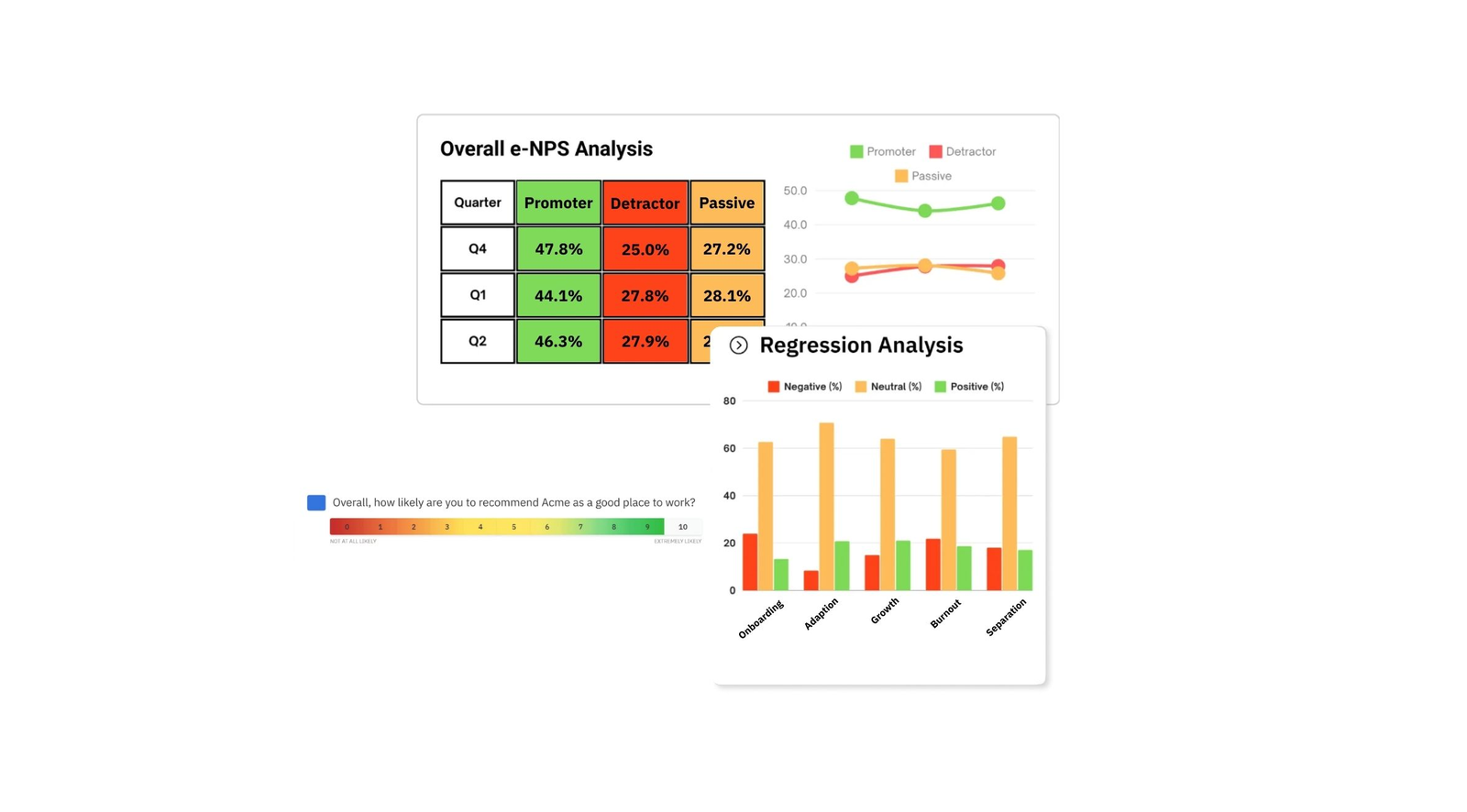
CultureMonkey supports lifecycle-based eNPS with trigger-based surveys, segmentation, anonymity controls, and actionable dashboards that help teams capture and act on employee sentiment at every stage.
Book a demo with CultureMonkey.
FAQs
1. What is a lifecycle eNPS?
Lifecycle eNPS measures employee sentiment at stages like onboarding, tenure, transitions, and exit. It tracks how experience changes over time instead of relying on a single survey, helping identify when engagement shifts and enabling teams to take timely, stage-specific actions based on real feedback.
2. When should you run eNPS surveys across the lifecycle?
Run eNPS surveys at key lifecycle moments such as onboarding milestones, during regular pulse intervals, after role or manager changes, and at exit. This ensures you capture stage-specific sentiment, track changes over time, and identify when engagement shifts across the employee lifecycle.
3. Can eNPS be used during onboarding?
Yes, eNPS can be used during onboarding to capture early sentiment, validate expectations, and identify gaps in the joining experience. It helps detect issues in role clarity, manager support, and onboarding processes before they lead to early disengagement or attrition.
4. Should you use eNPS at the exit stage?
Yes, eNPS should be used at the exit stage to capture honest feedback on why employees leave. It helps identify patterns in management, growth, or culture issues and provides clear insights that can be used to improve retention and employee experience.
5. How is a lifecycle eNPS different from regular eNPS?
Lifecycle eNPS measures sentiment at specific employee stages like onboarding, tenure, transitions, and exit, while regular eNPS is run periodically as a single survey. Lifecycle eNPS provides stage-specific insights, making feedback more contextual and actionable.
6. How often should lifecycle eNPS be run?
Lifecycle eNPS should be run at key stages such as onboarding, during regular pulse intervals, after major changes, and at exit. Frequency depends on stage, but combining event-based triggers with periodic pulses ensures continuous and relevant sentiment tracking.
7. What insights can lifecycle eNPS provide?
Lifecycle eNPS provides insights into how employee sentiment changes across onboarding, tenure, transitions, and exit. It helps identify key drivers of engagement, detect friction points, highlight attrition risks, and show exactly where employee experience breaks over time. High eNPS scores correlate with increased productivity and financial performance.
8. Can lifecycle eNPS replace engagement surveys?
Lifecycle eNPS cannot replace engagement surveys. It captures quick sentiment signals across stages, but lacks depth on drivers. It should be used alongside engagement surveys to understand both what employees feel and the underlying reasons behind those experiences.