


How to Improve Employee Net Promoter Score & Loyalty

An employee Net Promoter Score reflects how likely employees are to recommend your workplace, indicating engagement, trust, and loyalty. Knowing how to improve employee net promoter score starts with using an eNPS survey template and running an effective eNPS survey to capture honest, actionable feedback.
Improving eNPS is not about tracking a score. It requires listening to employee feedback, addressing key concerns, and creating visible changes. When organizations act on insights, they build trust, strengthen engagement, and turn employees into long-term advocates.
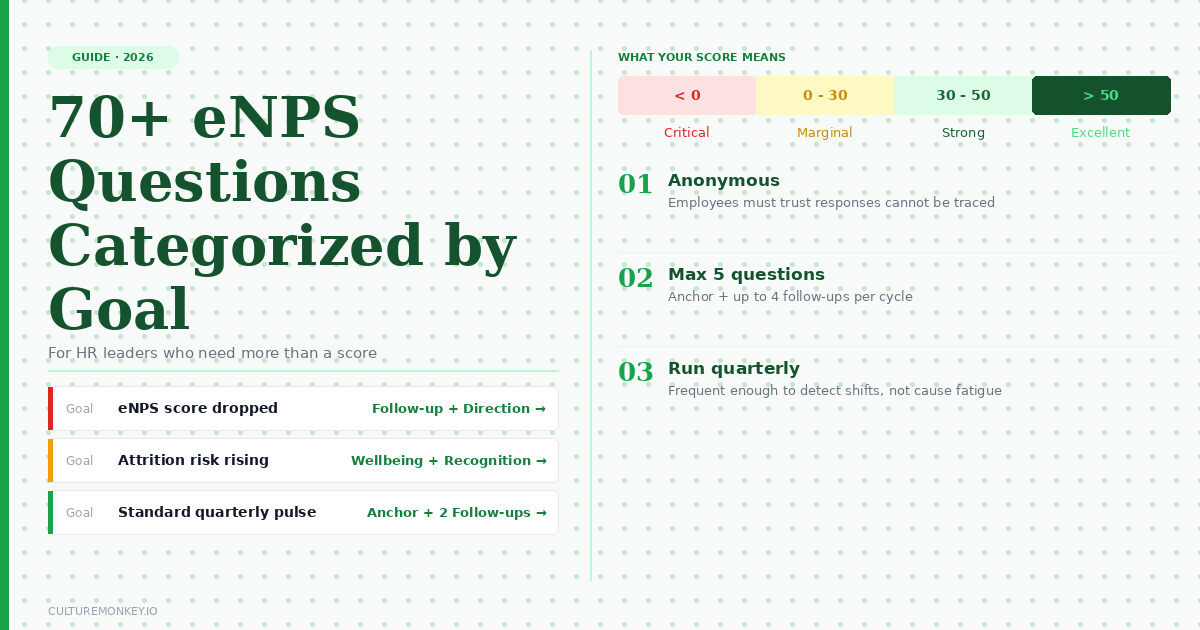
An improvement target works better as a position than as a number. CultureMonkey’s Q2 2026 benchmarks put the median company at +27 and the top quartile at +44, so moving from +20 to +45 means crossing into the best quarter of companies measured rather than simply adding 25 points. The eNPS score range guide covers what each band signals.


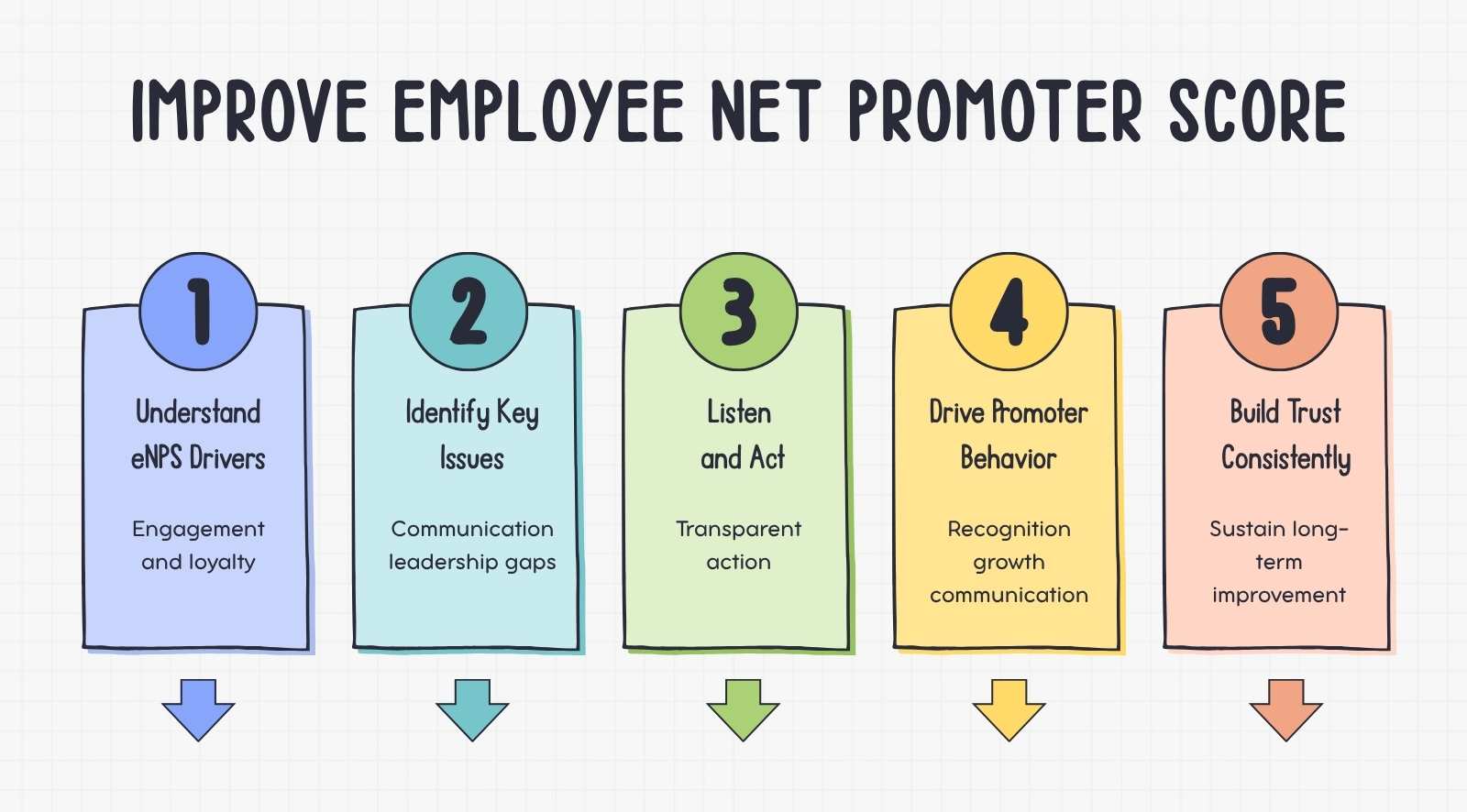
- eNPS measures how likely employees are to recommend their workplace, reflecting engagement and loyalty.
- Low eNPS scores often point to issues like poor communication, weak recognition, or leadership gaps.
- Improving eNPS starts with listening to feedback and acting transparently on employee insights.
- Recognition, growth opportunities, and open communication drive promoter behavior and retention.
- Consistent action on feedback and clear communication of changes help build trust and sustainably improve eNPS over time.
What is employee Net Promoter Score (eNPS)?
Employee Net Promoter Score measures how likely employees are to recommend their workplace, indicating engagement, loyalty, and overall experience. It uses a simple rating question to collect responses and convert survey responses into clear insights that help identify a good eNPS score and areas to improve employee satisfaction.
Organizations use eNPS to track trends, understand what drives highly engaged employees, and identify risks early. By analyzing survey responses and acting on feedback, teams can improve employee satisfaction, strengthen trust, and build a more engaged and loyal workforce over time.
What causes a low employee Net Promoter Score?

A low employee Net Promoter Score doesn’t just happen overnight, it’s usually a reflection of ongoing issues that slowly chip away at trust, motivation, and connection. When unhappy employees don’t feel heard, valued, or aligned with leadership, even the most well-intentioned engagement efforts fall flat. Here’s what often drives those low eNPS scores:
Low eNPS often stems from poor communication, weak leadership connection, burnout, and lack of recognition are factors that erode trust and motivation.
When employees feel unheard or undervalued, engagement drops, leading to dissatisfaction, disengagement, and declining loyalty across teams.
1. Lack of communication
When communication feels one-sided or inconsistent, employees start to feel disconnected from the company’s goals. Without clarity on expectations or updates, rumors fill the gaps and morale dips, leading to disengagement and a drop in employee net promoter score.
2. Leadership disconnect
If leaders seem out of touch or rarely interact with their teams, employees lose confidence in direction and decision-making. A visible, empathetic leadership presence can significantly improve eNPS meaning by building trust and inclusion.
3. Burnout and overwork
Burnout doesn’t just affect performance; it reshapes how employees view the entire workplace. When deadlines keep stacking and personal time disappears, enthusiasm fades quickly. Overworked employees often disengage not because they don’t care, but because they feel stuck in survival mode.
Regular breaks, balanced workloads, and promoting work-life balance can prevent burnout, helping rebuild motivation and raise your employee engagement score.
4. Absence of recognition
Recognition isn’t a nice-to-have; it’s a basic human need at work. When efforts go unnoticed, employees begin to question whether their contributions matter. Even small acts of appreciation, like personal thank-you messages or public shoutouts, can lift employee morale and engagement.
5. Poor feedback loops:
When feedback flows only top-down, employees feel excluded from decision-making. A lack of response to their input breeds frustration and detachment. Building open feedback loops, where suggestions are heard, acknowledged, and acted upon, makes people feel genuinely included. Collecting specific feedback is crucial, as it provides more actionable and nuanced insights than broad metrics alone.
How can you rebuild trust and engagement once the score drops?
10 Ways to improve your employee Net Promoter Score (eNPS)

Improving your employee Net Promoter Score doesn’t come from one grand gesture; it’s built through consistent, meaningful actions that show employees their opinions count. The secret lies in listening, adapting, and creating a workplace where people feel trusted and valued. Here are ten practical ways to improve your eNPS and boost employee morale and workplace loyalty:
Improving eNPS takes consistent, meaningful action—listening to feedback, acting transparently, and nurturing trust. It’s about turning surveys into dialogue that drives real change, not temporary boosts.
Regular feedback cycles, leadership alignment, and visible action build credibility, helping employees feel valued and connected—fueling long-term engagement, advocacy, and workplace loyalty.
- Collect and analyze employee feedback: Start with understanding what your team actually feels. Regular eNPS surveys and open-ended employee net promoter score questions give insights into engagement, culture, and morale. Gathering feedback helps measure engagement levels and provides valuable insight into employee sentiment.
- Implement actionable changes from survey results: Feedback without follow-up is worse than no feedback at all. Once you identify key pain points, turn them into concrete improvements. Whether it’s updating policies, enhancing communication, or improving workloads, visible action shows employees their voices shape the company, which directly helps improve nps score.
- Maintain a continuous cycle of improvement: Improving eNPS isn’t a one-time task. Keep measuring, learning, and iterating. Regularly check how changes impact engagement and adapt as new challenges arise. This ongoing rhythm of reflection and action builds trust and drives long-term employee net promoter score improvement.
- Tailor your approach to your own organization’s culture: There’s no universal eNPS playbook; what works for one company might flop for another. Align your strategies with your organization’s culture and values. For instance, a creative agency might thrive on flexible feedback sessions, while a large enterprise may prefer structured eNPS surveys. Using focus groups can help you get a complete picture of employee sentiment and company culture, allowing for open discussions and more nuanced insights.
- Get leadership and employees on board together: A high eNPS happens when leadership and employees move in sync. Leaders must model transparency, listen actively, and communicate openly. When everyone feels like part of the same mission, engagement strengthens, often lifting both employee engagement score and retention rates.
- Respond thoughtfully to all feedback, not just the positives: It’s tempting to celebrate glowing feedback and ignore criticism, but negative comments often hold your biggest opportunities. Acknowledging tough input and addressing it with honesty shows integrity. Over time, even detractors start to trust leadership’s commitment to real change.
- Be transparent and honest in your communication: Transparency fuels credibility. Share eNPS benchmarks, survey insights, and even the steps you’re taking to improve weak areas. When employees see honest communication instead of polished updates, it builds mutual respect — a key ingredient in sustainable eNPS growth.
- Engage with your detractors to rebuild trust: Detractors aren’t lost causes — they’re signals for growth. Reach out personally to understand their concerns, validate their experiences, and collaborate on solutions. Turning one detractor into a neutral or promoter can have a ripple effect across your eNPS scores for top companies comparison.
- Celebrate and give attention to your promoters: Your promoters are your cultural champions. Recognize and celebrate them through shoutouts, leadership opportunities, or growth pathways. Offering development opportunities such as training programs, mentorship, and clear career pathways can further engage and retain top talent.
- Continuously track and review your eNPS over time: Trends tell the real story. Continuously tracking and reviewing your employee net promoter score calculation helps you understand what’s improving and where to focus next. Regular measurement ensures your progress isn’t just reactive but strategic, keeping your eNPS meaning strong and relevant as your workplace evolves.
After learning how to improve eNPS, let’s see what makes promoter-heavy teams thrive.
What employee promoters want: Patterns across high-scoring teams

Employee promoters consistently stay, contribute, and recommend their workplace, signaling strong engagement and loyalty. By analyzing patterns across teams with higher eNPS scores, organizations can identify the primary reason employees remain engaged and replicate those drivers across different employee populations.
1. Clarity in the primary eNPS question
High-scoring teams ensure employees clearly understand the primary eNPS question, reducing confusion in employees' responses and capturing honest feedback that reflects true sentiment rather than surface-level agreement or strongly disagree extremes.
2. Action on honest feedback
Promoters expect visible change when they share honest feedback, and when leaders act consistently, it reinforces trust, reduces strongly disagree sentiment, and becomes a primary reason behind higher eNPS scores.
3. Access to career growth opportunities
Teams with higher eNPS scores provide clear career growth opportunities, helping employees see long-term value, which directly influences positive employee responses and strengthens promoter behavior across diverse employee populations.

Organizations that continuously listen to employees and act on feedback build stronger trust, which directly improves engagement and long-term retention.
Josh Bersin

CEO of The Josh Bersin Company
4. Balanced survey frequency
High-performing teams avoid survey fatigue by spacing surveys effectively, ensuring employees' responses remain thoughtful, relevant, and aligned with real workplace experiences rather than rushed or disengaged inputs.
5. Consistent communication and transparency
Promoters value regular updates on what is changing and why, as this clarity reduces strongly disagree sentiment and reinforces the primary reason employees continue to stay engaged and recommend their workplace.
What are the benefits of tracking employee net promoter scores?

Tracking eNPS helps in understanding employee satisfaction and employee engagement levels, providing quick insights that enable immediate action to improve workplace culture and retention. When done consistently, eNPS data helps leaders identify what’s working, what’s broken, and where engagement efforts are paying off. Here are some key benefits of tracking employee net promoter scores over time:
Tracking eNPS uncovers engagement levels, helping leaders detect morale dips early, benchmark progress, and make data-driven decisions that strengthen culture and retention.
It links employee sentiment directly to business outcomes—improving productivity, reducing turnover, and driving a loyal, high-performing workforce that champions the organization’s success.
- Early detection of engagement issues: Regularly reviewing eNPS benchmarks helps you catch drops in morale before they turn into resignations. If scores decline, you can quickly pinpoint problem areas like workload, communication gaps, or leadership disconnect, allowing for proactive solutions instead of reactive fixes.
- Stronger leadership decision-making: Employee net promoter score calculation offers leaders data-backed insights into employee sentiment. These insights help shape policies, benefits, and work structures that actually align with what employees value most, improving nps score across the organization.
- Improved retention and loyalty: Tracking eNPS scores over time helps you see whether your initiatives are working. When employees notice consistent action based on their feedback, trust grows — leading to happy employees, reducing turnover, and boosting long-term loyalty.
- Competitive insights through benchmarking: Comparing your eNPS scores for top companies or by industry helps set realistic goals. Understanding eNPS benchmarks by industry gives context to your results and highlights where your company stands in terms of culture and engagement.
- Tangible link to business performance: High employee engagement score trends often correlate with better productivity, innovation, and customer satisfaction. Tracking eNPS meaningfully shows how improving internal sentiment can directly impact business success — turning your workforce into a true competitive advantage.
“Isn’t the Employee Net Promoter Score (eNPS) just a number?”
Absolutely. Some leaders worry that focusing on a single number (the eNPS) might feel like putting a band-aid on a larger culture problem. Without context or action, it runs the risk of being just a pretty dashboard metric.
But recent data shows that eNPS can be a meaningful indicator when used as part of a broader employee engagement strategy. A journal study of 6,020 employees in the Swedish public sector found that motivation and leadership were significantly and positively correlated with eNPS (e.g., higher motivation → higher eNPS).
So yes, it’s not just a number. When paired with follow-up and targeted action, eNPS becomes a strong signal of how your organization is perceived and recommended by its people.
With the benefits established, it’s time to understand how to measure eNPS effectively.
How to measure employee net promoter score (eNPS)?
Measuring eNPS is a practical way to measure employee satisfaction and employee experience, offering a direct reflection of how likely your team members are to recommend your company as a great place to work. Here’s a clear, actionable guide on how to measure eNPS effectively and interpret the results meaningfully:
1. Create a clear eNPS survey question: Start with the core question: “On a scale of 0–10, how likely are you to recommend this company as a great place to work?” This simple yet powerful question encourages honest feedback. It’s crucial to keep it short and neutral so employees focus on their real experience, not on how they think management wants them to respond.
2. Segment respondents into promoters, passives, and detractors: Once responses come in, divide employees into three groups: promoters (scores 9–10), passives (7–8), and detractors (0–6). This segmentation helps identify your strongest advocates and those at risk of disengagement. Measuring eNPS in this way helps track changes in employee engagement levels over time. Understanding this mix provides clarity on overall sentiment and where improvement efforts should be focused.
3. Calculate your employee net promoter score: To calculate eNPS, use the employee net promoter score calculation formula: subtract the percentage of detractors from the percentage of promoters. Calculating eNPS gives you your company's eNPS, which can range from -100 to +100. A positive eNPS means you have more promoters than detractors — a healthy sign that employees believe in the company and its direction.
4. Collect qualitative feedback alongside scores: Numbers alone don’t reveal the full story. Always pair your eNPS survey with open-ended employee net promoter score questions. Ask employees to explain why they gave a specific rating. These written insights reveal emotional drivers behind the scores and offer clear direction for future changes.
5. Analyze trends over time: A single eNPS survey gives a snapshot, but long-term tracking provides the real value. Compare results across months or quarters to identify patterns. If your eNPS meaning shifts after leadership changes, new policies, or culture initiatives, those insights can guide smarter engagement decisions and employee net promoter score improvement.
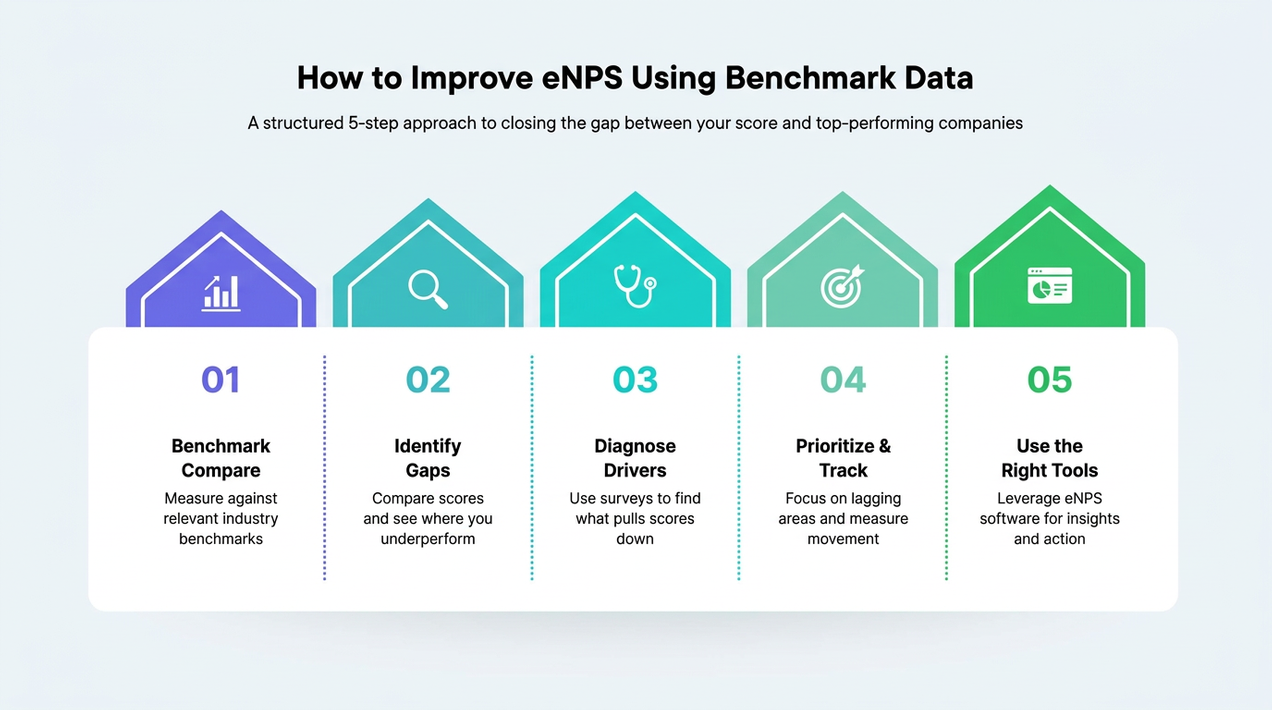
6. Compare results with eNPS benchmarks: Finally, put your score into context by comparing it with eNPS benchmarks by industry. Use the average eNPS, enps benchmark, and the overall eNPS benchmark to see how your company's eNPS stacks up. Knowing how your company performs next to eNPS scores for top companies helps set realistic goals.
Now that we’ve covered how to measure eNPS, let’s clarify how it differs from NPS and why both matter.
What's the difference between eNPS and NPS?

While both NPS and eNPS measure loyalty, they focus on very different audiences. NPS evaluates how customers feel about your brand, while eNPS reflects how employees feel about working for your company. The company's values, culture, and environment play a significant role in shaping employee engagement and eNPS. Understanding this difference helps you track both external reputation and internal culture effectively.
Having understood the core of eNPS, it’s time to see how CultureMonkey helps you transform insights into action.
Improving employee Net Promoter Score with CultureMonkey

Improving employee Net Promoter Score requires structured feedback loops and timely action on insights. When organizations capture feedback consistently, they understand what keeps employees satisfied, identify gaps early, and build a clear action plan to strengthen work culture and drive sustained improvements in engagement.
- Structured feedback with open-ended questions: CultureMonkey combines rating inputs with open-ended questions, helping teams capture context behind scores, reduce time-consuming analysis, and build an action plan that reflects real employee needs and improves overall work culture.
- Driving higher response rates: Multi-channel distribution ensures strong response rates across employee populations, making feedback more representative and helping leaders identify what keeps employees satisfied without relying on fragmented or incomplete data.
- Reducing time-consuming processes: Automated workflows reduce time-consuming manual effort, allowing teams to focus on interpreting feedback, building an action plan, and improving work culture instead of managing scattered survey processes.
- Turning insights into action: CultureMonkey helps translate feedback into a clear action plan, ensuring leaders act on insights quickly, improve employee experience, and create conditions where employees feel heard, valued, and satisfied.
- Built on proven methodologies: Inspired by principles from Satmetrix Systems, CultureMonkey applies structured feedback models to improve response rates, capture meaningful insights, and strengthen work culture through consistent and scalable listening practices.
Conclusion
Improving employee Net Promoter Score is essential for understanding how employees feel about their workplace and predicting retention, engagement, and advocacy.
It helps organizations move beyond assumptions by turning employee feedback into clear, actionable insights. When teams consistently act on these insights, they build trust, improve workplace experience, and strengthen long-term loyalty.
CultureMonkey enables this by capturing real-time feedback, analyzing sentiment, and helping leaders close the loop with structured action. By making feedback continuous and actionable, it ensures organizations don’t just measure eNPS, but actively improve it through informed, timely decisions that enhance employee experience at scale.
Book a demo with CultureMonkey.
FAQS
1. What is an eNPS survey?
An eNPS survey is a low effort method used by hr teams to measure employee loyalty using a simple rating scale. It acts as a leading indicator of engagement and helps organizations understand how employees feel supported and connected to a positive work culture.
2. What is eNPS?
eNPS, or employee Net Promoter Score, measures how likely employees are to recommend their workplace. It uses a rating scale to categorize responses and helps HR teams assess sentiment, track trends, and benchmark against industry benchmarks for improving a positive culture.
3. What is an example of an eNPS question?
A typical eNPS question asks: “How likely are you to recommend this company as a place to work?” It uses a rating scale and is often paired with follow-up questions to understand why employees strongly agree or feel differently about their experience.
4. What are good questions for an employee engagement survey?
Good engagement surveys include follow-up questions that explore leadership, growth, and communication. They help employees understand expectations, feel supported, and give hr teams deeper insights beyond the rating scale to improve a positive work culture.
5. Are eNPS surveys anonymous?
Yes, eNPS surveys are usually anonymous to encourage honest feedback. This helps employees feel supported when sharing concerns, allowing hr teams to collect accurate insights and build a positive culture without fear of identification or bias.
6. Which industries use eNPS?
eNPS is widely used across industries, including SaaS, healthcare, manufacturing, and retail. Hr teams rely on it as a leading indicator to track engagement, compare against industry benchmarks, and improve employee experience in diverse work environments.
7. How do eNPS types differ?
eNPS types differ based on survey frequency, audience, and design. Some focus on quick pulse checks, while others include follow-up questions. These variations help hr teams capture insights across employee groups and align feedback with specific business goals.
8. What exactly should an eNPS survey template include?
An eNPS survey template should include the primary rating scale question, follow-up questions, anonymity assurance, and demographic filters. It helps hr teams collect structured feedback, ensure employees understand the purpose, and compare results with industry benchmarks.
9. Which industries use ENPS?
ENPS is used across sectors like technology, finance, logistics, and services. It helps hr teams measure engagement as a leading indicator, track improvements over time, and build a positive work culture aligned with industry benchmarks and employee expectations.