


Measuring engagement across multi-site construction projects

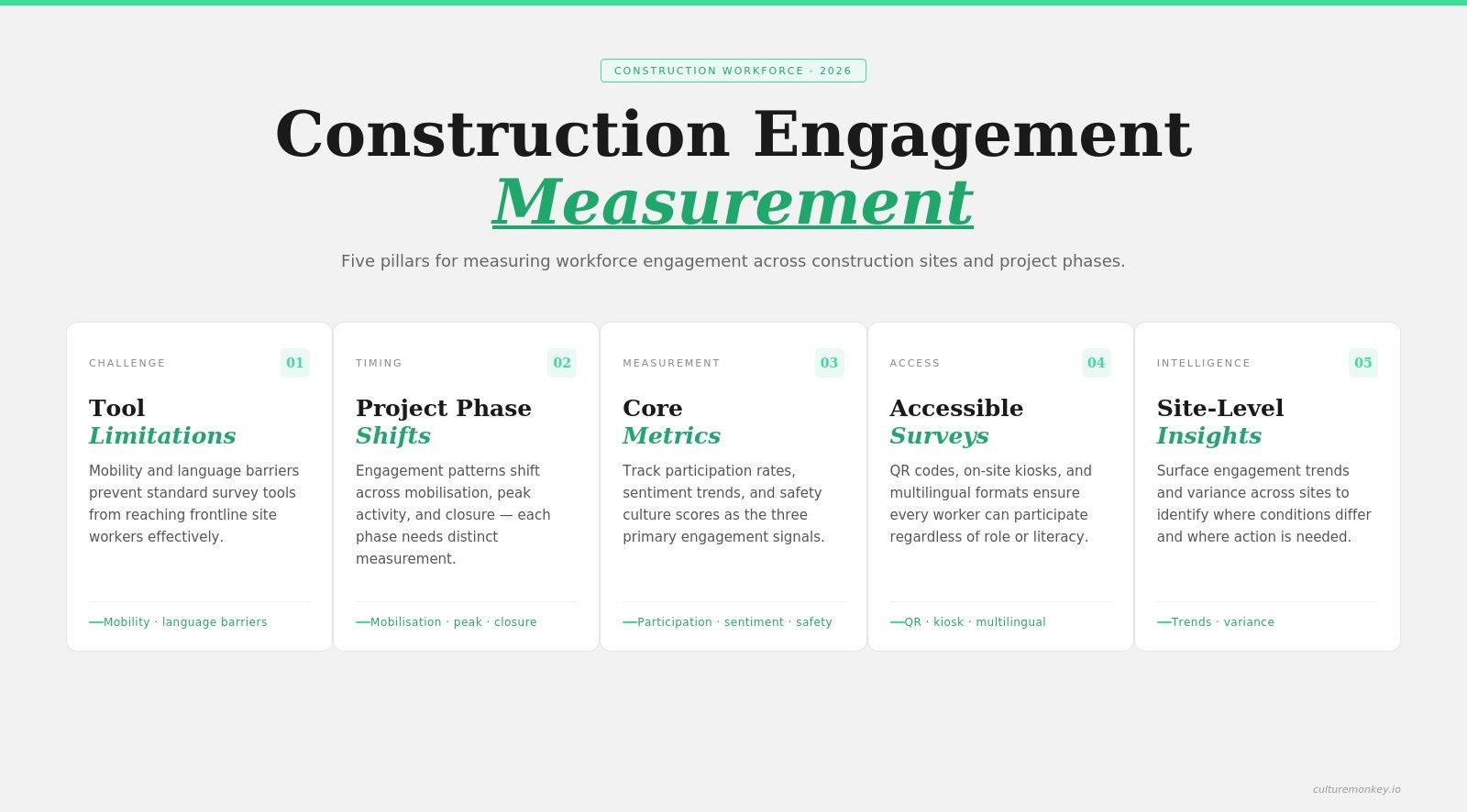
Measuring engagement across multi-site construction projects is fundamentally different when you’re operating with 5 active sites, 3 workforce types, and crews rotating every 6 months. Standard tools fail because construction workforces aren’t at desks, aren’t always literate in the survey language, and experience engagement differently across project phases.
This guide builds a measurement system that actually works for construction.


- Measuring engagement across multi-site construction projects requires tracking sentiment, behavior, and risk signals across rotating crews.
- Standard engagement tools fail in construction due to mobility, language barriers, and non-desk workforce realities.
- Project-based engagement decay reveals morale shifts across mobilization, peak work, and project closure phases.
- Four behavioral metrics reveal engagement clearly: toolbox attendance, near-miss reporting, absenteeism by trade, and re-engagement rate.
- Pulse surveys must be short, multilingual, and accessible via QR codes, kiosks, or supervisor-assisted formats.
- CultureMonkey enables real-time multilingual surveys, site-level tracking, and workforce insights across multi-site construction environments.
Why does standard engagement measurement fail in construction?
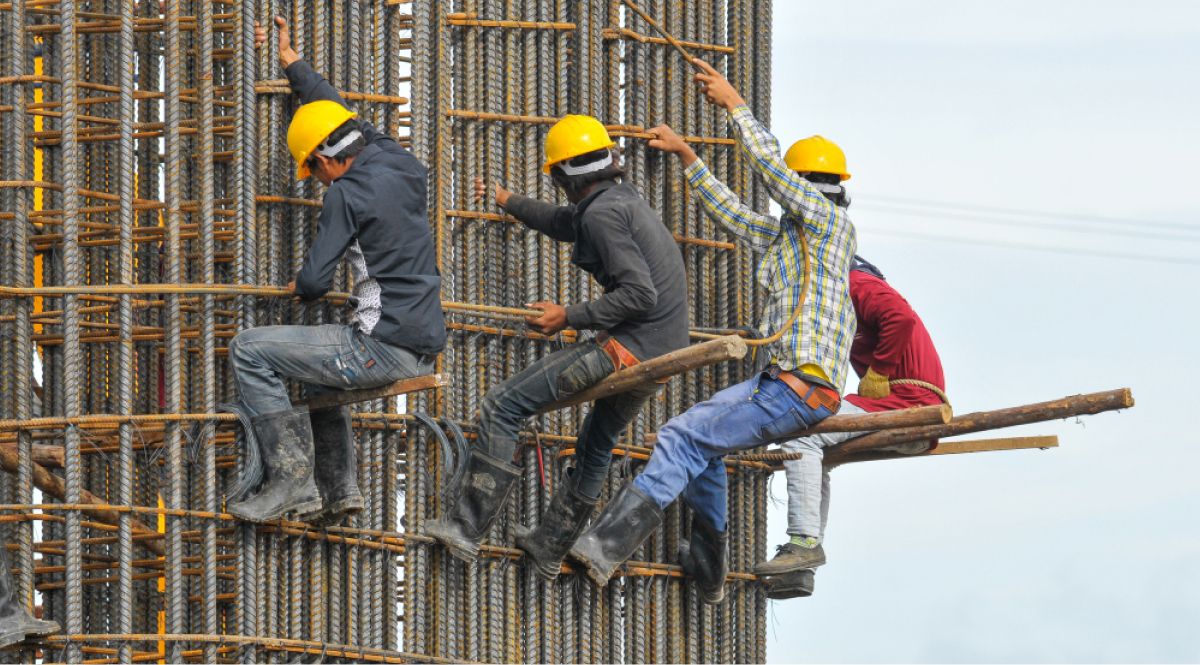
Standard employee engagement approaches fail in construction because they assume stable, desk-based workforces. According to McKinsey’s 2023 research on frontline workers, 80% of the global workforce is deskless, yet most survey platforms are still designed for office environments.
Construction workers lack consistent access, shifts vary, and workplace culture differs by site. These gaps expose survey limitations and make it difficult for construction companies to measure engagement reliably.
The failure comes from three structural blockers: limited digital access, fragmented shifts, and literacy variance. Construction managers cannot reach all groups equally, skilled workers face language barriers, and safety programs lack accurate input, weakening how employee engagement is understood and acted on across construction sites.
Where standard engagement tools break down in construction
Standard engagement tools used in office environments fail in construction for three specific reasons. Annual surveys assume stable teams, but construction crews rotate every project phase.
Digital-only delivery assumes device access, but many frontline workers lack it. Single-language formats assume literacy, but multilingual and low-literacy workforces require adapted formats. The comparison below shows where standard approaches break down.
- Annual surveys vs pulse surveys in construction: Annual surveys assume stable teams and fixed schedules, which do not reflect rotating crews and project-based work. Pulse surveys align with construction site realities by capturing feedback at key project phases, improving accuracy and response rates across changing workforce conditions.
- Direct hire vs subcontractor vs labour-hire engagement measurement: Direct hire employees can be tracked over time using structured surveys, while subcontractors require project-based measurement, and labour-hire workers need fast, accessible feedback methods. A single measurement approach fails because workforce relationships differ across construction projects.
- Edge cases in construction engagement measurement: Remote sites, international crews, short-term projects, and high subcontractor ratios create additional challenges. These environments require offline surveys, multilingual formats, and rapid feedback cycles to ensure engagement data remains accurate and usable.
What is project-based engagement decay?
Project-based engagement decay explains why construction employee engagement declines as projects progress from early stages to extended delivery phases.
Construction teams do not remain equally engaged across a construction project timeline from mobilization to project completion, making employee engagement measurement in construction more effective when it tracks changes over time instead of static scores.
- Early-project energy is usually high: Construction teams often begin with stronger optimism, clearer direction, and better attention from construction leaders. Early engagement surveys may look healthy, but that starting point can hide future drop-offs in construction employee engagement across longer project timelines.
- Engagement declines as pressure builds: As deadlines tighten, fatigue rises, communication tools break down, and routines become repetitive. This pattern weakens company culture, reduces engaged employees, and shifts construction workforce survey responses across active construction environments.
- The decay curve follows project stages: Employee engagement measurement in construction should map sentiment across mobilization, mid-project strain, and closeout uncertainty. Mapping engagement to project stages allows construction leaders to compare engagement data accurately, rather than assuming engagement remains stable from mobilization through to project completion.
- Static averages hide the real pattern: A single construction workforce survey score can miss whether engagement is falling month by month. Tracking project-based engagement decay produces more actionable insights by showing where construction employee engagement starts slipping before bigger morale or retention issues appear.
- Different signals drop at different times: Trust, recognition, communication, and confidence in planning do not decline together. Engagement surveys should track these separately so construction leaders can read engagement data properly and act on the earliest signs of decline within construction environments.
- The model improves the timing of intervention: Understanding project-based engagement decay allows teams to place listening points and manager actions earlier. Early intervention provides construction leaders with actionable insights, improves measurement accuracy, and strengthens company culture across mobilization, delivery, and project closeout stages.
What are the 4 engagement metrics that matter in construction?

Construction engagement metrics must reflect real job site behavior, not delayed opinions. For frontline workers and construction employees, engagement in construction is visible through attendance, reporting, return intent, and absence patterns. These signals help construction projects convert engagement efforts into measurable improvements.
The STAR measurement model for construction engagement:
The STAR model structures construction engagement measurement into four behavioral signals that reflect real site conditions and workforce behavior across construction projects.
- S - Safety voice: Voluntary near-miss reporting rate
- T - Toolbox participation: Attendance in daily site briefings
- A - Absenteeism by trade: Pattern tracking across workforce groups
- R - Return rate at mobilization: Re-engagement signal across project phases
1. Toolbox attendance
Toolbox attendance is a behavioral engagement metric that measures worker participation in daily site briefings and indicates alignment with safety expectations and communication standards. High attendance means construction workers are attentive, connected to site routines, and aligned with daily priorities.
Low attendance means disengagement among experienced workers, weak attention during briefings, and early breakdowns in coordination and trust. Toolbox attendance matters because it directly affects safety culture, task clarity, and performance consistency on active construction sites.
2. Voluntary near-miss reporting
Voluntary near-miss reporting is a behavioral engagement metric that measures whether construction workers trust the safety system enough to raise concerns without fear of repercussions and indicates psychological safety on-site. High reporting means workers feel safe to speak up and actively contribute to risk prevention.
Low reporting means hesitation, lack of trust, or fear of consequences, which reduces early risk detection. Voluntary near-miss reporting matters because it strengthens safety culture, improves engagement quality, and prevents avoidable incidents across construction environments.
(Source: Gallup)
3. Absenteeism by trade
Absenteeism by trade is a behavioral engagement metric that measures attendance patterns across different worker groups and indicates where pressure, fatigue, or dissatisfaction is building on construction sites. Low absenteeism means stable engagement, manageable workloads, and consistent participation across trades.
High absenteeism means specific groups are disengaging due to physical strain, poor supervision, or low job satisfaction. Absenteeism by trade matters because it reveals early warning signs of operational risk and helps target engagement efforts before performance issues escalate.
4. Re-engagement rate at mobilization
Re-engagement rate at mobilization is a behavioral engagement metric that measures how many construction workers return ready to reconnect at the start of a new project phase and indicates the quality of past site experience. High return rates mean strong trust, satisfaction, and positive engagement outcomes from previous projects.
Low return rates mean unresolved issues, weak engagement, or poor site conditions that discourage workers from returning. Re-engagement rate at mobilization matters because it predicts workforce stability, retention risk, and the effectiveness of past engagement efforts.
How do you run pulse surveys on construction sites?
Running pulse surveys on construction sites requires a structured process that accounts for access, literacy, and shift-based work patterns. Construction teams must use multiple delivery methods and align surveys with site realities to ensure consistent participation and accurate engagement data across all worker groups.
Step 1: Place QR codes at site entry and exit points
Place QR codes at site gates and break areas so construction workers can access surveys during natural movement without interrupting active work. QR-based access solves timing and device access barriers for frontline workers without email access.
Step 2: Enable WhatsApp and mobile-first delivery
Set up WhatsApp and mobile-first survey delivery to reach construction workers on personal devices. Mobile delivery solves accessibility and adoption barriers by using familiar tools, increasing participation across distributed and multi-site construction teams.
Step 3: Use foreman-led verbal check-ins
Train foremen to run short, structured verbal check-ins where survey questions are explained, and responses are recorded. Foreman-led check-ins solve literacy and digital access barriers for workers who cannot engage with written or mobile surveys.
Step 4: Provide offline paper survey fallbacks
Keep paper surveys at supervisor stations for sites with limited connectivity or device access. Offline paper surveys solve infrastructure barriers and ensure construction workers without smartphones or mobile data can still participate in feedback collection.

The way your employees feel is the way your customers will feel.


Step 5: Keep surveys short and context-based
Limit surveys to 3–5 focused questions tied to safety, communication, and return intent. Short surveys solve fatigue and time constraints, improving completion rates and ensuring feedback remains actionable during active work schedules.
Step 6: Close the loop with visible action
Share visible changes within two weeks of each survey round to show that employee feedback leads to outcomes. Closing the loop solves trust barriers, increases participation, and strengthens engagement across construction sites.
How do you benchmark engagement across multiple construction sites?
Benchmarking construction engagement across sites requires three adjustments: normalizing scores by project phase, accounting for workforce mix, and controlling for local site conditions. Without these adjustments, comparisons produce misleading results that reflect structural differences between sites rather than actual engagement gaps.
- Normalise by project phase: Project-phase normalisation adjusts engagement scores to account for differences between mobilization, active delivery, and project completion stages. This matters because engagement levels naturally change as projects progress. Without project-phase normalisation, comparisons create misleading conclusions that reflect project stage differences instead of true engagement gaps.
- Adjust for workforce mix: Workforce mix adjustment calibrates engagement data based on differences in trade composition, skilled labor presence, and construction crew structures across sites. This matters because workforce composition directly affects engagement patterns. Without workforce mix adjustment, engagement benchmarks reflect structural workforce differences rather than actual engagement performance.
- Control for site conditions: Site condition controls adjust engagement data for external factors such as weather, location, and living conditions that influence worker experience. This matters because environmental factors directly affect safety practices, safety incidents, and employee listening. Without site condition controls, engagement data becomes distorted by external variables instead of true engagement issues.
- Standardise measurement methods: Measurement standardisation ensures consistent survey timing, definitions, and data collection methods across all construction sites. This matters because comparable data requires uniform measurement. Without standardisation, differences between sites reflect measurement inconsistencies rather than real engagement changes.
- Interpret variance as a signal: Variance interpretation analyzes differences in engagement scores across sites to identify underlying issues such as leadership quality, career growth opportunities, or local conditions. This matters because variation highlights hidden risks. Without interpreting variance, engagement gaps remain unexplained and unresolved across construction projects.
- Link benchmarks to action: Action-linked benchmarking connects engagement data to practical strategies that improve site performance and workforce experience. This matters because data only creates value when it drives change. Without linking benchmarks to action, engagement tracking remains passive and fails to improve project outcomes.
How do you survey low-literacy and multilingual construction workers?
A multilingual construction workforce survey must adapt to language gaps, low literacy levels, and physically demanding work conditions. Standard formats reduce survey responses and accuracy. Literacy-inclusive engagement improves participation, strengthens open communication, and helps teams collect reliable data to drive measurable improvements across multiple sites.
- Use visual and symbol-based questions: Visual and symbol-based survey questions help low-literacy construction workers respond accurately without relying on written text. Replacing text-heavy formats with icons, emojis, and color scales removes reading barriers and improves survey response rates across construction sites.
- Enable multilingual survey delivery: Multilingual survey delivery helps construction workers who do not understand the primary survey language respond accurately in their native language. Providing surveys in multiple languages reduces confusion, improves comprehension, and increases participation across diverse workforce groups.
- Leverage supervisor-assisted responses: Supervisor-assisted responses help low-literacy construction workers provide feedback through verbal explanations instead of written surveys. Supervisors explain questions during team meetings and record responses, ensuring accurate feedback collection in physically demanding work environments.
- Keep surveys short and context-based: Short, context-based surveys help construction workers with limited time and attention capacity complete surveys during active work schedules. Focusing on a few relevant questions reduces fatigue, improves participation, and ensures feedback remains actionable on construction sites.
- Use offline and hybrid collection methods: Offline and hybrid survey methods help construction workers without smartphone access, mobile data, or reliable connectivity participate in feedback collection. Combining paper forms, kiosks, and mobile tools ensures consistent feedback capture across all worker groups.
- Build consistent feedback loops: Consistent feedback loops help construction workers who may hesitate to share feedback build trust over time through repeated engagement opportunities. Regular check-ins improve open communication and ensure issues are identified early across construction sites.
- Close the loop with visible action: Visible action on feedback helps construction workers who feel unheard trust the survey process and continue participating. Acting on feedback strengthens open communication, improves engagement, and ensures feedback leads to measurable improvements across construction projects.
What should a construction engagement dashboard include?
A construction engagement dashboard gives group HR a clear view across 5–20 active sites. Without structure, engagement data construction remains fragmented and delayed. A well-designed system helps teams measure morale, identify engagement issues early, and turn survey insights into actions that support motivated teams and higher productivity.
- Site-level engagement score visibility: Site-level engagement score visibility provides a clear construction site engagement score for each location, enabling group HR to compare performance across multiple sites. This feature helps leaders measure morale consistently, identify engagement issues early, and understand how project-based conditions affect motivated teams.
- Trend tracking across project timelines: Trend tracking across project timelines monitors engagement data construction over time, allowing teams to analyse changes across different project phases. This feature helps leaders identify key drivers behind rising or falling engagement and act before performance or morale declines.
- Workforce segmentation view: Workforce segmentation view breaks engagement data by role, trade, or workforce type to identify where engagement issues exist across construction sites. This feature helps leaders understand how physical intensity and role differences affect teams and act on key drivers instead of relying on overall averages.
- Actionable insights and alerts: Actionable insights and alerts highlight sudden changes in construction site engagement score, enabling group HR to detect risks early. This feature helps teams respond quickly to engagement issues, support higher productivity, and reduce disruption across construction projects.
- Linking engagement to operational signals: Linking engagement data construction to operational signals such as absenteeism, safety incidents, and project delays connects engagement trends to real outcomes. This feature helps leaders understand how engagement issues affect performance and identify key drivers that influence both morale and project results.
- Communication and visibility layer: The communication and visibility layer shares company news, updates, and actions through the dashboard to improve transparency across construction sites. This feature helps teams see progress, build trust, and stay aligned with engagement efforts across project-based environments.
- Manager-level ownership views: Manager-level ownership views give site leaders access to their own engagement data, enabling local decision-making and accountability. This feature helps managers measure morale, act on survey insights, and address engagement issues quickly based on site-specific conditions.
- Focus on simplicity and usability: A simple and user-friendly dashboard design presents engagement data through clear visuals and focused metrics for quick interpretation. This feature helps teams identify key drivers, respond to engagement issues faster, and maintain higher productivity without being overwhelmed by complex data.
Conclusion
Measuring engagement across multi-site construction projects is essential to maintaining consistency, safety, and performance across distributed teams. Without it, engagement issues remain hidden, leading to delays, higher risks, and lower workforce stability. A structured approach helps leaders understand site-level realities, act early, and improve outcomes across projects.
CultureMonkey enables organisations to capture real-time feedback from frontline workers using accessible, multilingual tools. CultureMonkey dashboards provide clear visibility into engagement trends across sites, roles, and timelines.
Real-time visibility helps teams identify risks early, track improvements, and take targeted actions to build stronger, more engaged construction workforces.
FAQs
1. How do you measure employee engagement in construction?
Measure construction engagement using four behavioral signals: toolbox attendance, near-miss reporting rates, trade-level absenteeism, and re-engagement at mobilization. Use QR surveys, WhatsApp delivery, text messages, and foreman check-ins to capture all workers across shifts, literacy levels, and site conditions.
2. What engagement metrics matter most in construction?
The four most predictive construction engagement metrics are toolbox attendance, voluntary near-miss reporting, absenteeism by trade, and re-engagement rate at mobilization. Each directly signals psychological safety, team cohesion, or attrition risk before issues become visible in performance data.
3. Can you run effective pulse surveys on construction sites?
Yes. Pulse surveys work in construction when adapted for site conditions. Place QR codes at gates and break areas, use WhatsApp for mobile workers, run foreman-led verbal check-ins for low-literacy teams, and keep paper fallbacks for sites without reliable connectivity. Keep surveys short.
4. What is project-based engagement decay?
Project-based engagement decay describes how construction worker engagement declines across a project timeline. Teams begin with high energy at mobilization, then fatigue builds through peak work phases, and uncertainty rises at project closure. Measuring decay by phase helps leaders intervene early.
5. How do you benchmark engagement across multiple construction sites?
Benchmark construction engagement across sites by normalizing scores for project phase, workforce composition, and site conditions. Comparing sites at different phases distorts results. Adjust for workforce mix and physical demands to ensure comparisons reflect true gaps, not structural differences.
6. How does workforce type affect engagement measurement in construction?
Direct hire, subcontractor, and labor-hire workers engage differently in construction. Direct-hire workers are more integrated with site culture; subcontractors prioritize contract completion; labor-hire staff often show lower security scores. Segmenting data by workforce type reveals where to act.
7. What should a construction engagement dashboard track?
A construction engagement dashboard should display site-level engagement scores, trend lines across project phases, workforce segmentation by role and trade, absenteeism alerts, and pulse survey participation rates. Linking these to operational data like safety incidents helps leaders act on early signals.
8. What is a good employee engagement benchmark score for construction?
Construction engagement benchmarks vary by project phase, not a fixed score. Mobilization typically runs highest, reflecting early energy. Mid-project scores drop as fatigue builds. A drop of 15–20 points below your mobilization baseline signals disengagement risk requiring a leadership review.