


Pulse survey participation in factory workers: Practical ways to increase response rates in 2026

Pulse survey participation in factory workers increases when surveys are short, anonymous, easy to access, and followed by visible action. In manufacturing environments, time is tight and production pressure is real. If surveys feel long or irrelevant, factory worker survey response rates drop.
If employees see change, employee participation improves. Low pulse survey participation in factories is usually a design issue, not a motivation issue. When surveys fit shift routines and protect anonymity, manufacturing employee survey participation improves steadily.
In this guide, we explain what improves pulse survey participation in manufacturing and how to boost survey response rates among factory workers.


- Pulse survey participation in factory workers shows whether survey feedback represents the full factory workforce.
- Participation drops due to access barriers, shift pressure, anonymity concerns, and weak follow-through.
- Short, mobile-first pulse surveys with QR access and smart timing improve shop floor response rates.
- Supervisor support, clear purpose, and visible action sustain long-term participation.
- CultureMonkey pulse surveys increase pulse survey participation in factory workers through mobile access, anonymity safeguards, and plant-level reporting.
Why pulse survey participation is a challenge in factory environments

Factory engagement risk rarely appears in daily production reports. Output targets may be met while morale, workload strain, and not addressing concerns of safety quietly grow across the shop floor. For management, pulse survey participation in factory workers determines whether employee feedback from survey data is reliable or distorted. When participation is low, insights become incomplete, and decisions are made on partial sentiment.
Pulse survey participation in factory environments refers to the percentage of frontline workers who complete short engagement surveys. High participation ensures constructive feedback reflects real workforce sentiment, helping plants identify morale, safety, and workload issues accurately.
In manufacturing settings, factory worker survey response rates are shaped by key factors of structural and behavioral realities that affect production floor survey engagement.
- Workers lack desk access and corporate email connectivity.
- Limited time between shifts reduces survey completion rates.
- Fear of identification or retaliation lowers honest participation.
- Survey fatigue from repetitive initiatives decreases response rates.
- Lack of visible action after feedback reduces trust.
Why participation matters for manufacturing decision-making
In manufacturing, decision quality depends on data accuracy. Pulse survey participation in factory workers determines whether engagement data reflects the full workforce or only a small segment of respondents. In plant environments, low response rates directly affect operational clarity.
Low participation reduces factory worker survey response rates and weakens frontline survey engagement in plants. This limits how accurately leaders interpret workforce conditions.
- Incomplete engagement survey insights: Low manufacturing employee survey participation prevents full visibility into morale, workload, and communication issues.
- Misleading plant-level data: Weak shift worker survey response rates distort trends across departments and shifts.
- Hidden safety or morale risks: Low pulse survey participation in factories hides early warning signals that affect performance and retention.
- Poor action planning decisions: Limited production floor survey engagement results in decisions based on partial feedback.
- Reduced trust in survey programs: When employee feedback participation in factories feels ineffective, response rates decline further and lead to voluntary turnover.
Higher participation improves reporting accuracy. Improving survey participation on the shop floor improves employee engagement and strengthens manufacturing decision-making.
Common barriers preventing factory workers from taking surveys
Manufacturing plants operate on tight timelines, rotating crews, and output pressure. Most frontline roles lack desk access, and communication flows through supervisors. These structural realities shape how manufacturing employee survey participation behaves on the shop floor.
The lack of effective employee pulse surveys ignores these conditions and pulse survey participation in factory workers drop. Low shift worker survey response rates weaken frontline survey engagement in plants and distort factory worker survey participation strategies across locations.
- Limited smartphone or digital access during shifts: Without easy on-floor access, shift-based workforce survey participation remains uneven.
- Surveys available only via email: Gathering employee feedback through email-only distribution lowers factory worker survey response rates in non-desk roles.
- Language barriers in diverse workforce: Lack of multilingual surveys reduces production floor survey engagement.
- Distrust about anonymity: Unclear confidentiality decreases actionable feedback participation in factories.
- No visible changes after surveys: Weak follow-through after answering an annual engagement survey reinforces low pulse survey participation in factories.
- Supervisor discouragement or indifference: Limited leadership support slows manufacturing survey response optimization efforts.
How to design pulse surveys that factory workers actually complete
Manufacturing teams work within fixed shifts, output targets, and physical production constraints. If surveys interrupt workflow or feel complicated, pulse survey participation in factory workers drops quickly.
Improving survey participation on the shop floor depends on access, clarity, and timing. When surveys fit daily routines, factory worker average response rates and frontline survey engagement in plants improve steadily.
Survey design must reduce effort while increasing relevance. Questions should be easy to answer on mobile devices and directly linked to safety, workload, or communication concerns that matter in plant operations.
Core survey design principles
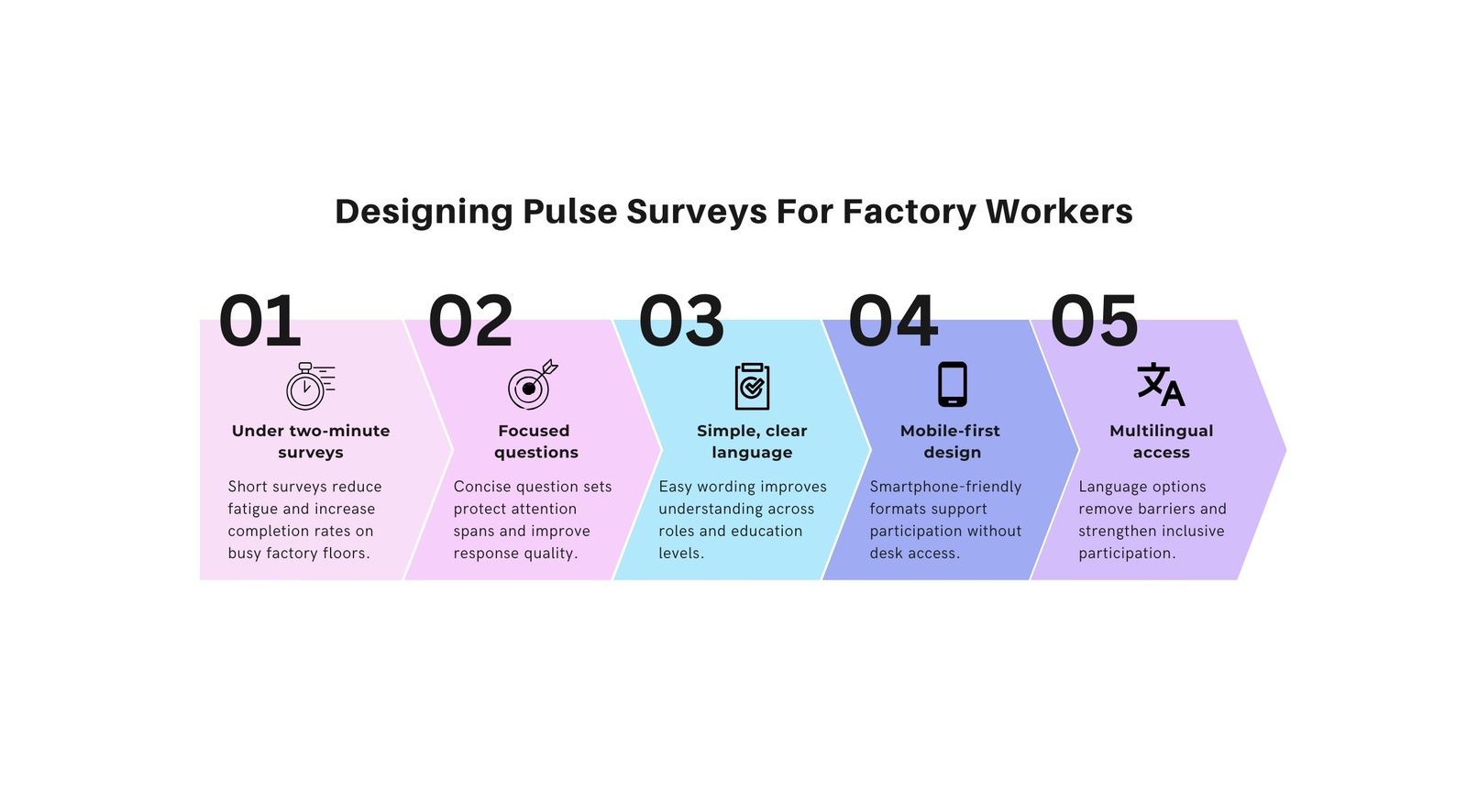
- Keep surveys under two minutes to increase pulse survey response rates in manufacturing and reduce drop-offs.
- Use 5–8 focused questions to protect shift worker survey response rates and prevent fatigue.
- Write in simple language with minimal text to improve production floor survey engagement.
- Build with a mobile-first design to support shift-based workforce survey participation.
- Offer multilingual options to strengthen employee feedback participation in factories.
Optimize survey timing
- Launch surveys near shift end when primary tasks are complete.
- Avoid peak production periods that reduce attention and response quality.
- Provide short participation windows to encourage quick completion.
- Align surveys with break periods to improve manufacturing survey response optimization.
What are the best ways to distribute pulse surveys on factory floors?
The survey's ease of access determines the factory floor participation of feedback responses. If distribution channels are inconvenient, pulse survey participation in factory workers declines regardless of survey quality.
Improving survey participation on the shop floor starts with physical and digital accessibility. When surveys are easy to find and quick to open, factory worker survey response rates and production floor survey engagement improve across shifts.
Recommended distribution methods
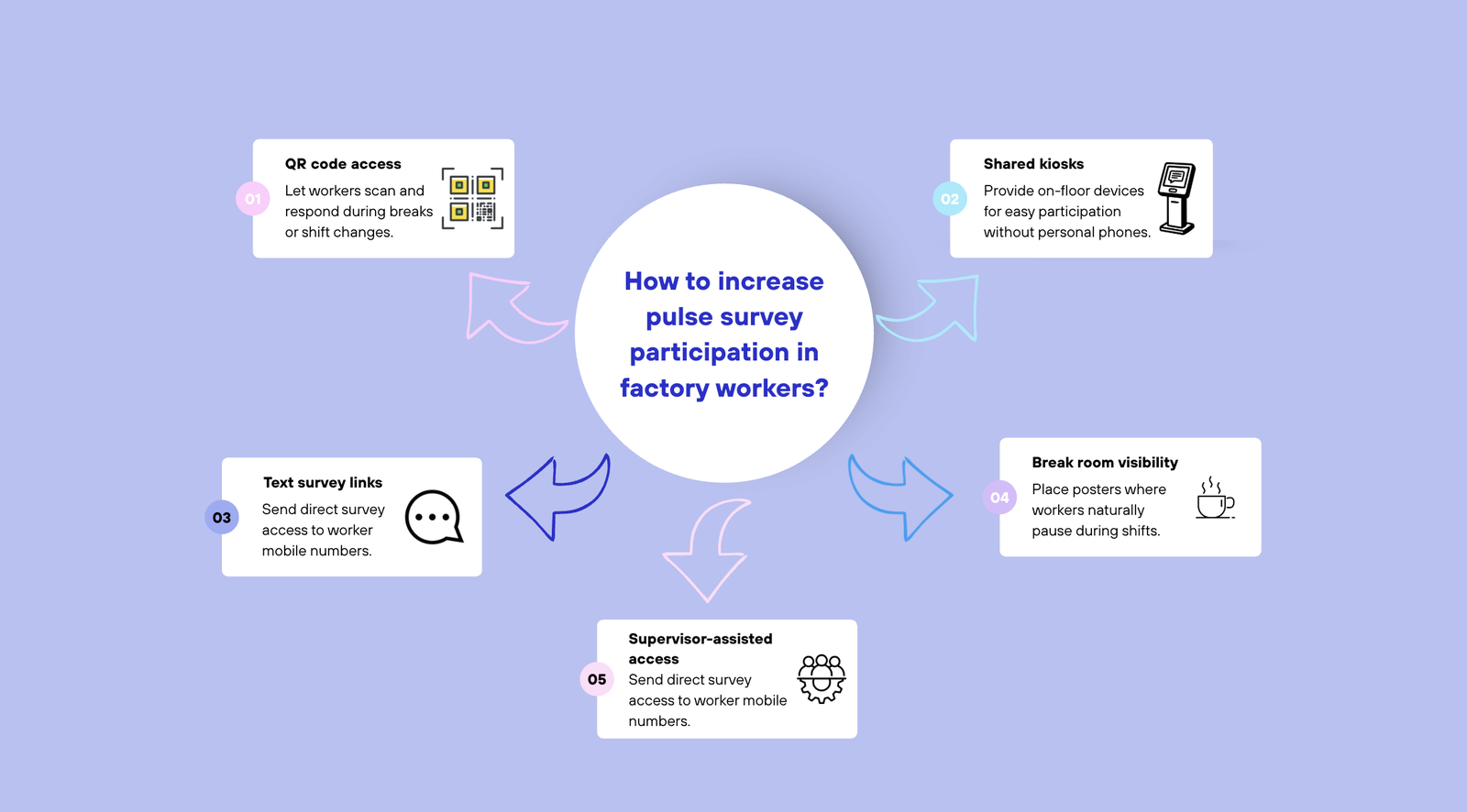
- Use QR codes in break rooms so workers can scan and respond during breaks.
- Provide shared kiosks or tablets to support shift-based workforce survey participation without personal devices.
- Send text message survey links to increase pulse survey response rates in manufacturing environments.
- Enable supervisor-assisted participation while reinforcing anonymity to protect employee feedback participation in factories.
- Place posters and physical reminders near high-traffic areas to boost frontline survey engagement in plants.
Recommended distribution methods by factory setting
| Factory setting | Recommended distribution method | Participation impact |
|---|---|---|
| Large multi-shift plants | QR codes + shared kiosks | Expands access across rotating shifts |
| Small production units | Supervisor-assisted access + tablets | Reduces digital barriers for workers |
| Contract-heavy workforce | Text message survey links | Removes email dependency for access |
| Multilingual teams | QR codes linked to language-select pages | Improves access across language groups |
| High-noise production areas | Break room kiosks + posters | Increases visibility during downtime |
Building trust so factory workers feel safe participating

In manufacturing environments, trust directly influences pulse survey participation in factory workers. When anonymity feels unclear or past feedback led to no visible change, factory worker survey response rates decline. Building credibility improves manufacturing employee survey participation and strengthens frontline survey engagement in plants over time.
- Explain anonymity clearly: Clearly describe how responses are protected and reported in aggregate to reduce low pulse survey participation in factories.
- Share aggregated results: Present plant-level meaningful insights without identifying individuals to reinforce employee feedback participation in factories.
- Demonstrate action from feedback: Communicate changes made after surveys to improve survey participation on the shop floor.
- Maintain senior leadership neutrality: Ensure managers encourage participation without influencing responses to support shift worker survey response rates.
- Avoid targeting small teams: Combine small groups in reporting to protect confidentiality and maintain production floor survey engagement.
Trust sustains pulse survey response rates in manufacturing and supports long-term factory worker survey participation strategies.
Role of supervisors and plant managers in driving participation
Supervisor behavior directly shapes pulse survey participation in factory workers. When leaders treat surveys of the entire workforce seriously, frontline employee survey participation strengthens.
Manager involvement therefore determines how to increase pulse survey participation in factory workers and address why factory workers don’t complete surveys during busy production cycles.
Supervisors encouraging participation
Supervisors set the tone during daily briefings and shift handovers. When participation is positioned as part of operational improvement rather than an HR task, workers respond more openly. Casual or inconsistent messaging weakens credibility and leads to employee disengagement.
Leaders should:
- Reinforce that surveys improve safety and workload conditions.
- Encourage honest responses without monitoring individual answers.
- Normalize participation as routine operational practice.
This helps boost engagement survey participation in plants without pressure tactics.
Allowing survey time during shifts
Production targets often compete with survey completion. If workers must choose between output and feedback, participation suffers. Structured time removes this conflict and supports consistent engagement.
Leaders should:
- Allocate short, defined survey windows during shifts.
- Align participation time with natural workflow pauses.
- Communicate that survey time is officially supported.
This is often the best way to improve survey participation on the shop floor.
Explaining purpose of surveys
Without context, surveys feel administrative. Workers are more likely to participate when they understand how key insights will be used. Clear communication increases trust and strengthens participation consistency.
Leaders should:
- Explain how results connect to plant decisions
- Share examples of past improvements from feedback.
- Clarify how anonymity is protected.
This helps increase pulse survey participation in manufacturing over time.
Sharing improvement actions
Participation grows when workers see change. If feedback disappears into reports, future response rates decline. Visible follow-through builds credibility and long-term engagement.
Leaders should:
- Share action plans based on survey findings
- Provide updates on progress during team meetings.
- Close the loop after each survey cycle.
Consistent follow-through after conducting previous surveys sustains frontline worker survey participation across future surveys.
Using participation insights to improve engagement programs
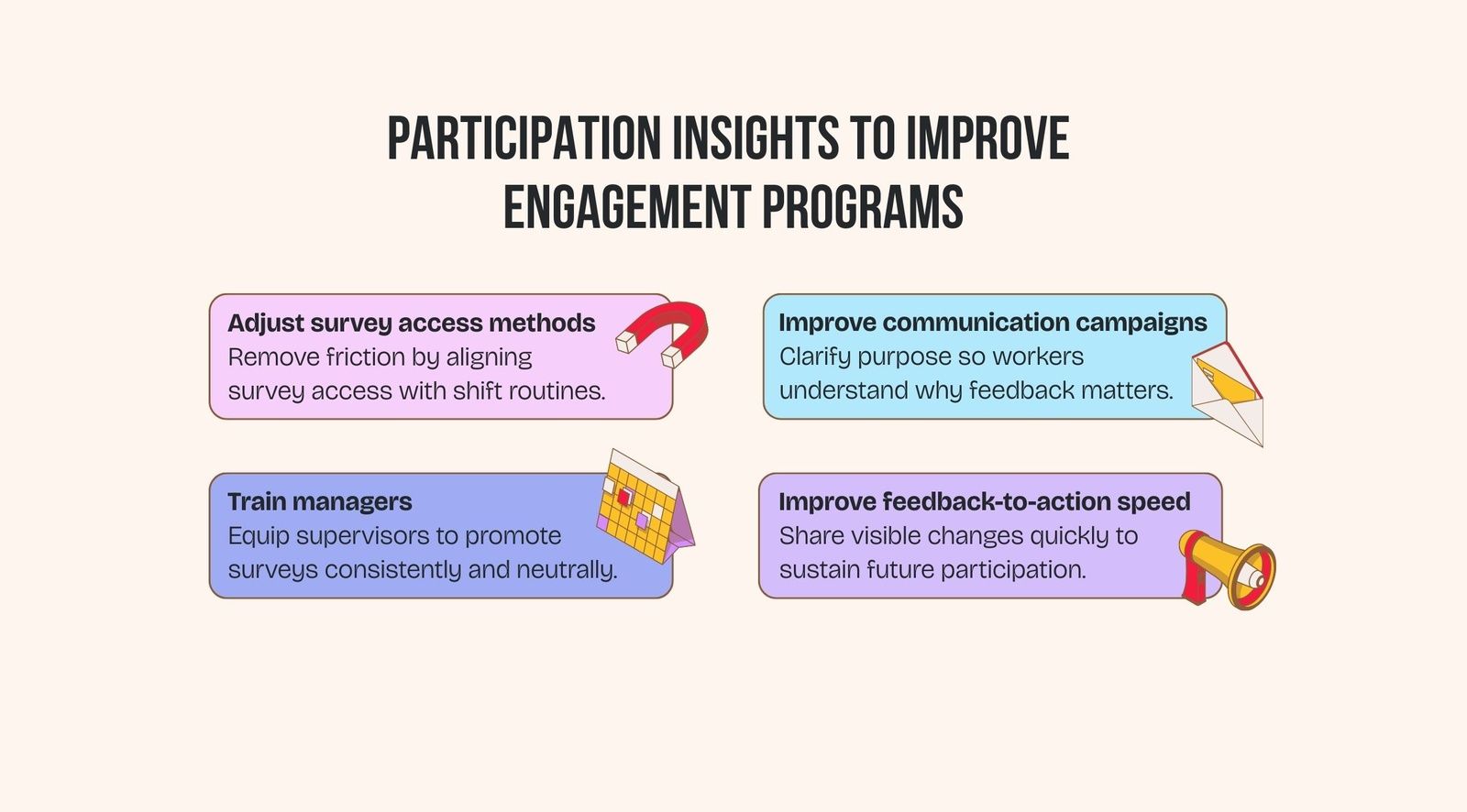
Participation trends are not just response numbers. They show where access fails, where communication weakens, and where trust breaks down. When organizations study participation patterns closely, they can redesign engagement programs instead of repeating the same survey cycle.
Participation strengthens when insights lead to structural changes. The action cycle below turns the employee data of response into measurable improvement.
Adjust survey access methods
Response gaps often point to operational friction rather than lack of interest. When certain shifts or teams consistently under-respond while conducting pulse surveys, access design needs review.
What participation patterns reveal:
- Lower responses in specific shifts signal timing conflicts.
- Certain units may lack easy survey access.
- Repeated non-response suggests structural barriers.
Improve communication campaigns
Participation levels reflect how clearly the survey purpose is communicated. When messaging feels generic or unclear, response momentum slows.
What participation patterns reveal
- Drop-offs after launch indicate survey fatigue.
- Uneven participation shows inconsistent communication.
- Low early response suggests unclear survey value.
Train managers
Participation differences across departments often link back to leadership behavior. Supervisors and the management team influence whether surveys feel important or optional.
What participation patterns reveal
- Consistent low response under specific supervisors.
- Participation spikes when leaders actively reference surveys.
- Team-level gaps linked to internal communications style differences.
Improve feedback-to-action speed
Response levels are closely tied to visible outcomes from prior surveys. When honest feedback does not lead to change, participation declines in future cycles.
What participation patterns reveal
- Falling response after previous cycles signals delayed action becaus eof the lack of employee recognition.
- Stable participation where outcomes were shared.
- Higher response in teams that saw clear improvements.
Participation improves when results of effective pulse surveys are visible, timely, and clearly connected to work environment improvements.
How CultureMonkey’s pulse surveys increases participation among factory workers
Choosing survey software in manufacturing is about removing friction that lowers frontline worker survey participation and solving why factory workers don’t complete surveys in busy plant environments. CultureMonkey’s features are designed specifically to address these barriers and increase pulse survey participation in factory workers.
- Mobile-first participation enables quick responses on personal devices, helping increase pulse survey participation in factory workers during shifts.
- QR and kiosk access options remove email dependency and improve survey participation on the shop floor across rotating crews to share safety awareness feedback without limited access.
- Anonymous participation safeguards build trust through response thresholds and protected reporting, addressing why factory workers don’t complete surveys.
- Multilingual survey delivery reduces comprehension barriers and helps boost engagement survey participation in plants with diverse teams.
- Plant and shift reporting identifies low-response areas, helping leaders identify trends and increase pulse survey participation in manufacturing with targeted action.
CultureMonkey is suited for manufacturing organizations aiming to improve pulse survey participation in factory workers through a continuous listening system that integrates into plant operations without disrupting production.
.webp)
Improve Pulse Survey Participation in Factory Workers with CultureMonkey
- Multi-lingual Surveys
- Mobile-First Distribution
- Shift-Level Reporting
- Enterprise Grade Security
Conclusion
Pulse survey participation in factory workers is an operational design issue. When surveys respect shift patterns, protect anonymity, and show visible results, participation becomes consistent rather than occasional.
Manufacturing environments demand practical systems that remove friction instead of adding reminders. Leaders who focus on access, clarity, supervisor alignment, and faster action cycles see stronger frontline engagement over time. Participation improves when workers trust the process and see real workplace improvements.
CultureMonkey supports pulse survey participation in factory workers through mobile-first access, QR distribution, multilingual delivery, anonymity safeguards, and plant-level reporting built for factory realities.
Book a demo with CultureMonkey.
FAQs
1. How can factories increase survey participation?
Factories can increase pulse survey participation in factory workers by removing access barriers and building trust. Mobile-first surveys, QR codes, multilingual options, and structured shift time reduce friction. Participation improves when results are shared and linked to visible workplace changes.
2. Why do factory workers avoid surveys?
Factory workers avoid surveys when they feel time pressure, lack easy access, become disengaged employees or doubt anonymity. If previous feedback led to no visible action, frontline worker survey participation declines further. Clear purpose and follow-through reduce hesitation.
3. How long should factory pulse surveys be?
Factory pulse surveys should take under two minutes and include five to eight focused questions. Short, simple surveys are the best way to improve survey participation on the shop floor without interrupting production schedules.
4. Do anonymous surveys improve participation?
Yes, anonymous surveys improve participation when confidentiality is clearly explained and enforced. Workers are more likely to respond honestly when responses are aggregated and protected with a good survey frequency, helping increase pulse survey participation in manufacturing over time.
5. How often should plants survey workers?
Unlike traditional surveys, plants should run quick surveys monthly or quarterly, depending on operational intensity. A steady survey cadence of pulse surveys paired with visible action helps increase pulse survey participation in manufacturing to get deeper insights while avoiding survey fatigue, unlike annual surveys.