


Pulse survey vendors vs engagement survey vendors guide 2026

Organizations comparing pulse survey vendors vs engagement survey vendors are deciding how to capture employee feedback in ways that strengthen organizational culture and reinforce employee trust. The difference extends beyond survey frequency to listening philosophy and decision speed.
Pulse surveys focus on continuous sentiment signals that help leaders respond quickly to workforce changes. Pulse surveys provide real-time direction that supports agile action and sustains engaged employees. Engagement surveys, in contrast, deliver structured, periodic evaluation of experience drivers and long-term workplace dynamics.
This guide clarifies when to choose pulse surveys for responsiveness and early risk detection, and when engagement surveys generate valuable insights that inform strategic planning, leadership review, and broader organizational transformation initiatives.


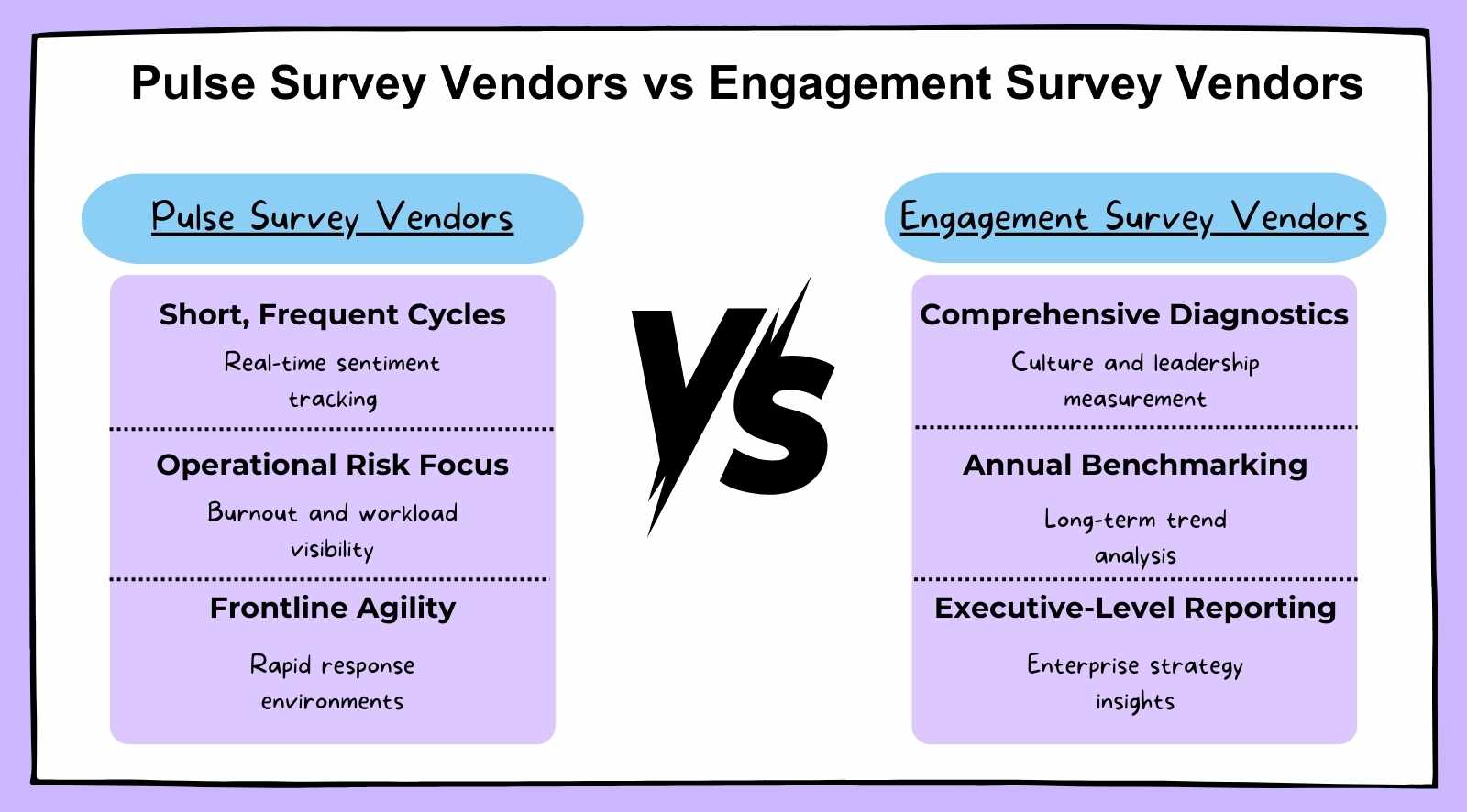
- Pulse survey vendors focus on short, frequent surveys that track real-time employee sentiment and operational risks.
- Engagement survey vendors provide comprehensive, annual diagnostics that measure culture, leadership, and long-term engagement drivers.
- Pulse systems work best for fast-changing, high-turnover, or frontline-heavy environments needing rapid feedback.
- Engagement suites are better suited for large or complex organizations requiring benchmarking and executive-level reporting.
- Many organizations adopt a hybrid model combining annual engagement surveys with recurring pulse cycles for balance.
What are pulse surveys and engagement surveys?

Pulse surveys are short, recurring employee feedback surveys used by HR and business leaders to monitor workforce sentiment in near real time, and also respect employees' time. Annual engagement surveys are comprehensive assessments conducted once a year to measure engagement drivers across the organization.
Pulse surveys focus on frequent tracking of morale, workload, and leadership trust. They enable faster course correction and localized action planning. Organizations use them during change cycles, restructuring, or high-growth phases to detect emerging risks early.
Annual engagement surveys provide structured, enterprise-wide benchmarking and strategic alignment insights. They assess core engagement dimensions such as recognition, leadership confidence, growth opportunities, and culture consistency. Results inform long-term workforce planning, leadership development, and enterprise performance management.
When do pulse surveys win?
Pulse survey vendors win when organizations need rapid insight into emerging workforce risks or operational pressure. They are most effective in environments where engagement levels shift quickly, and leadership requires frequent, decision-ready data rather than annual diagnostics.
Pulse survey vendors are particularly effective when:
- Organizations operate in fast-moving markets where quarterly change cycles outpace annual surveys
- Pulse surveys can be used as pulse checks or frequent check-ins, and are often conducted weekly to monitor ongoing changes and employee sentiment
- Frontline employees experience fluctuating workload, customer pressure, or shift variability
- Hotspot detection is required to identify burnout or attrition risk early
- Workforce turnover exceeds 15 to 20 percent annually, requiring closer sentiment tracking
- Mergers, restructuring, or policy changes demand near-term feedback validation
- Leadership needs monthly trend data to correlate engagement with productivity or service metrics
- SME teams lack the capacity for complex annual survey administration
- Enterprise divisions require segmented, branch-level visibility without long survey fatigue
Employee pulse survey software providers support shorter surveys, higher response frequency, and quicker reporting cycles, making them suited for operationally dynamic teams.
When do engagement surveys win?
Engagement survey suites win when organizations require deep, structured diagnostics that evaluate leadership effectiveness, culture drivers, and long-term engagement patterns. They are most suitable for enterprise environments where governance, benchmarking, and executive review processes require statistically robust data.
These platforms are preferred when leadership needs:
- Comprehensive understanding of workforce engagement through in-depth surveys
- Generation of engagement metrics to measure and monitor employee motivation, morale, and productivity
- Action plans developed from survey feedback to drive continuous improvement and demonstrate responsiveness
- Comprehensive driver analysis to identify root causes behind engagement decline
- Executive and board-level reporting aligned to annual planning cycles
- Benchmark comparisons across industry, geography, or business units
- Structured leadership effectiveness assessments tied to performance reviews
- Statistically significant data sets for large workforce populations
- Integrated succession, talent, and performance analytics inputs
- Organization-wide culture measurement at scale rather than localized hotspot detection
- Standardized diagnostics to support compensation, promotion, and policy decisions
In the vendors in pulse survey vs engagement survey decision, engagement suites provide deeper diagnostic breadth, whereas pulse systems prioritize speed and frequency. Enterprise organizations with complex hierarchies typically require this structured diagnostic layer.
What is the hybrid pulse and engagement survey model?

The hybrid pulse and engagement survey model combines annual diagnostics with recurring pulse cycles to measure employee engagement, strengthen employee voice, and enable continuous listening. Many organizations use it to collect feedback, improve employee satisfaction, and generate actionable insights.
- Annual core for structural measurement: Annual engagement surveys measure leadership trust, inclusion, career clarity, and employee satisfaction, helping organizations benchmark trends, measure employee engagement, and align insights with company values while capturing statistically reliable survey responses across teams and geographies.
- Rotating pulse modules for emerging risks: Pulse surveys focus on time-sensitive themes such as workload, change adoption, and manager effectiveness, enabling continuous listening, amplifying employee voice, and helping many organizations detect emerging issues early before they impact engagement or performance.
- Balanced data architecture: Combining annual diagnostics with pulse cycles strengthens the feedback loop, allowing organizations to collect feedback at different intervals, compare key differences in trends, and transform survey responses into actionable insights that guide leadership decision-making.
- Improved action prioritization: Engagement surveys highlight structural gaps while pulse cycles validate intervention impact, helping leaders measure employee engagement progress, reinforce employee trust, and sustain a positive work environment through faster and more evidence-based action planning.
- Reduced survey fatigue with higher relevance: Short, focused pulse cycles between comprehensive surveys improve participation consistency, encourage employee voice, and help many organizations collect feedback without overwhelming employees, resulting in more reliable survey responses and stronger engagement signals.
- Scalable across maturity stages: Organizations often choose pulse surveys for agility before expanding into hybrid programs that measure employee engagement depth, align listening with company values, and generate valuable insights supporting evolving governance, reporting, and organizational culture priorities.
This model supports both operational responsiveness and executive oversight without compromising data integrity.
What capabilities separate real pulse vendors from simple short survey tools?
Real pulse survey vendors provide structured listening systems with analytics depth, governance controls, and scalability. Simple short survey tools only reduce question count without delivering operational insight. In the pulse survey vendors vs engagement survey vendors comparison, capability depth determines long-term value.
1. Analytics depth and trend intelligence
SHRM and Glint data shows 72% of U.S. employers use pulse tools, underscoring demand for continuous insight.
Real pulse systems and engagement survey platforms use survey data and pulse survey data to track trends and monitor engagement metrics over time, providing organizations with the ability to visualize changes and make data-driven decisions, especially when they leverage well-designed employee survey questions tailored to engagement, culture, and well-being.
2. Segmentation and scalability
We evaluated whether vendors support role, location, and business-unit segmentation without manual data handling. Enterprise-ready employee engagement platforms allow automated mapping to HRIS structures and scale beyond 5,000 employees without performance issues.
3. Integration ecosystem
We reviewed integration with HRIS, payroll, collaboration tools, and BI dashboards. Leading survey platforms and online survey platforms facilitate seamless integration with HRIS and analytics tools, enabling automatic synchronization of employee data and streamlined data flow. Mature pulse platforms synchronize employee data automatically and allow export to analytics systems. Short survey tools often require manual uploads and limited API connectivity.
4. Security and governance controls
We assessed encryption standards, access permissions, audit logs, and compliance alignment. Real pulse vendors and engagement survey platforms ensure anonymity in surveys to encourage honest feedback from employees, making it a key security feature and aligning with best practices for anonymous employee survey questions.
5. Ease of deployment and adoption
We tested survey creation workflows, dashboard usability, and response experience. Effective pulse vendors enable deployment within days and maintain mobile responsiveness. Complex setup or poor UI reduces participation rates.
6. Evidence from user validation
We reviewed implementation case studies and long-term user feedback. Platforms that sustained high response rates across multiple cycles demonstrated structured listening maturity. Short survey tools showed declining participation after repeated use.
What should you ask vendors in each category?

Evaluation questions must differ when assessing pulse survey vendors vs engagement survey vendors. Each category supports distinct listening objectives. Buyers should evaluate different survey types and assess the capabilities of survey platforms and online survey platforms when selecting a vendor.
Test operational fit, governance readiness, scalability, and analytics depth before committing to employee pulse survey software providers or enterprise engagement suites.
What to ask pulse survey vendors?
Pulse platforms must prove they enable structured, repeatable listening with actionable analytics. Questions should validate speed, automation, and risk detection capability, as well as how the system supports collecting anonymous feedback online without compromising trust.
- How quickly can we launch a pulse cycle across 2,000+ employees?
- Can survey cycles be automated monthly without manual configuration?
- How are trend shifts tracked across multiple pulse rounds?
- Does the platform flag early burnout or attrition risk indicators?
- What segmentation options exist for frontline, shift, or branch teams?
- How does the system maintain anonymity in teams under 10 employees while still enabling identification of employee strengths and weaknesses at an aggregate level?
- Can dashboards update in real time for leadership visibility?
- What integrations exist with HRIS and workforce systems?
- How are participation rates monitored and improved over time?
Example: A logistics firm may require biweekly hotspot detection during seasonal demand spikes.
What to ask engagement survey vendors?
Engagement suites must demonstrate diagnostic rigor, benchmarking reliability, and executive reporting alignment. Questions should validate statistical robustness and governance structure.
- What engagement model or framework underpins your driver analysis?
- How do you ensure statistical validity across global divisions?
- What external industry benchmarks are available?
- Can results link to leadership scorecards or succession planning?
- How are executive summaries structured for board review?
- What sampling thresholds support meaningful segmentation?
- Can historical engagement data be compared across multiple years?
- What governance controls restrict access by role or region?
- How are open-text responses analyzed at scale, and can the platform support manager feedback survey questions that surface leadership strengths and gaps objectively?
Example: A multinational enterprise may require multi-year comparability to support compensation review cycles.
Thorough questioning ensures the selected platform aligns with organizational size, reporting expectations, and workforce complexity. In the pulse survey vendors vs engagement survey vendors decision, mismatched evaluation criteria often result in underutilized systems, low participation, or inadequate analytics.
What survey cadence is recommended by organizational maturity?

Pulse surveys are often conducted weekly as pulse checks or frequent check-ins, providing real-time feedback and ongoing insights that can be paired with employee engagement activities and presentations to guide leaders on where to focus energy.
In contrast, engagement surveys are typically conducted annually or biannually to track long-term trends and organizational health. As companies scale, listening frequency shifts from reactive pulse tracking to structured annual diagnostics supplemented by targeted pulses.
- Early-stage and SME organizations: Smaller organizations with under 500 employees benefit from monthly or bi-monthly pulse cycles due to rapid change and direct leadership access. Annual surveys may add limited value. Forbes reported U.S. engagement fell to 32% in 2024, with Gen Z dropping 5 points, reinforcing the need for frequent feedback.
- Scaling mid-market organizations: Organizations between 500 and 2,000 employees typically adopt quarterly pulses with an annual engagement survey. Growth introduces manager layers and geographic spread, requiring both rapid monitoring and structured diagnostics, often supported by lighter fun employee engagement questions to maintain survey participation and morale.
- Mature enterprise organizations: Enterprises above 2,000 employees should combine an annual engagement survey with monthly or quarterly pulse modules. Governance reviews, benchmarking, and board reporting require longitudinal data stability, which is especially critical in high-stress environments like hospitals, where healthcare employee engagement activities must be guided by reliable data.
- Highly regulated or complex enterprises: Financial, healthcare, or multi-national enterprises often require quarterly pulse tracking alongside annual diagnostics. Risk exposure, workforce segmentation, and compliance oversight increase the need for continuous sentiment monitoring, including focused team collaboration survey questions to ensure cross-functional alignment.
In the pulse survey vendors vs engagement survey vendors decision, cadence maturity often determines whether organizations prioritize employee pulse survey software providers or comprehensive engagement suites.
Where should you start vendor evaluation, and how do you choose within each type?
A vendor shortlist hub is a structured comparison resource that groups pulse and engagement platforms by category, use case, and maturity level. When building your shortlist, ensure it covers different survey types, such as pulse surveys and engagement surveys, and carefully assess the capabilities of various survey platforms and online survey platforms.
This helps buyers narrow options before entering formal evaluation, especially in the pulse survey vendors vs engagement survey vendors decision process. Shortlists prevent comparing tools built for different listening goals and reduce procurement complexity.
How to choose among pulse survey vendors?
- Define monitoring objective: Clarify whether you need burnout tracking, frontline hotspot detection, or change adoption monitoring, especially in environments where bad leadership drives employee attrition.
- Assess automation capability: Confirm recurring cycles can run monthly or quarterly without manual setup.
- Validate analytics continuity: Ensure the system tracks multi-cycle trends and supports role or location segmentation, so you can quantify how poor leadership impacts company culture over time.
- Confirm integration readiness: Review HRIS sync, API support, and dashboard export options.
- Verify anonymity controls: Check minimum response thresholds and access permissions for small teams.
How to choose among engagement survey vendors?
- Define diagnostic depth requirement: Confirm whether leadership review, workplace culture survey insights, or succession inputs are required.
- Evaluate benchmarking framework: Review industry comparisons and transparency of engagement models, and consider how an annual employee engagement calendar will align with your survey and action-planning cycles.
- Check statistical robustness: Ensure segmentation works across business units and geographies.
- Assess executive reporting quality: Confirm board-ready summaries and leadership dashboards are supported, including visibility into leadership recognition efforts and their impact on engagement.
- Review governance architecture: Validate structured access control across HR and leadership roles.
How to run a structured vendor evaluation process?
- Create weighted criteria: Assign scoring weight to analytics depth, scalability, security, integration, and support for core employee engagement initiatives.
- Request live workflow demonstrations: Evaluate real dashboard navigation instead of static presentations, and see how the tool powers employee engagement workshops and follow-up actions.
- Test data import accuracy: Run a pilot upload to assess HRIS mapping precision and ensure historical employee survey questions and responses map correctly for trend analysis.
- Review how insights fuel engagement programs: Confirm the platform can translate survey signals into creative employee engagement activities across remote, hybrid, and onsite teams.
- Review compliance documentation: Examine encryption standards, data hosting, and audit controls.
- Conduct stakeholder review sessions: Involve HR, IT, and leadership before final selection.
A structured evaluation approach ensures employee pulse survey software providers and engagement suites are assessed against relevant criteria, reducing long-term implementation risk.
Conclusion
Choosing between pulse survey vendors vs employee engagement survey vendors depends on organizational maturity, workforce volatility, and governance expectations. Pulse systems deliver speed and operational visibility, while engagement suites provide structured diagnostics and depth in benchmarking. The right investment aligns listening infrastructure with decision frequency and leadership oversight requirements.
Organizations that evaluate employee pulse survey software like CultureMonkey providers alongside engagement platforms gain clearer insight into scalability, analytics capability, and reporting needs. A disciplined selection process ensures survey systems support workforce stability, leadership accountability, and measurable performance improvement rather than adding administrative complexity.
FAQs
1. What is the difference between pulse survey vendors and engagement survey vendors?
Pulse survey vendors deliver short, recurring surveys focused on real-time sentiment and risk signals. Engagement survey vendors provide comprehensive annual diagnostics that measure culture, leadership, and structural drivers. The difference lies in frequency, depth, and reporting complexity rather than just survey length.
2. Are pulse surveys the same as employee engagement surveys?
No. Pulse surveys and employee engagement surveys are different survey types with distinct purposes and frequencies. Pulse surveys are frequent, targeted check-ins designed to track short-term shifts such as workload or morale. In contrast, engagement surveys are broader diagnostic assessments conducted less frequently to analyze long-term cultural and leadership effectiveness drivers.
3. When should a company use pulse survey software instead of a full engagement platform?
A company should use pulse survey software when rapid organizational change, frontline volatility, or rising attrition risk requires continuous monitoring. SMEs and fast-scaling teams often prioritize employee pulse survey software providers because they offer quicker deployment and lower administrative complexity than enterprise engagement suites.
4. Can pulse surveys replace annual engagement surveys?
Pulse surveys generally cannot replace annual engagement surveys in large enterprises because they lack full diagnostic benchmarking and year-over-year structural comparability. However, smaller organizations with limited governance requirements may rely primarily on pulse cycles until organizational complexity increases.
5. What features should real pulse survey vendors offer?
Real pulse survey vendors should provide automated recurring cycles, trend analytics across multiple rounds, role-based segmentation, HRIS integration, and anonymity controls. Basic short survey tools without analytics depth do not qualify as structured pulse systems.
6. What capabilities distinguish full engagement survey suites from simple survey tools?
Full engagement survey suites provide validated engagement frameworks, advanced driver analysis, statistical segmentation across divisions, industry benchmarking, and executive-level reporting dashboards. Simple survey tools typically lack governance controls, multi-year comparability, and structured analytics required for enterprise decision-making.
7. Which is better for frontline teams: pulse surveys or engagement surveys?
Pulse surveys are generally better for frontline teams because they capture frequent workload, service pressure, and morale shifts. Engagement surveys provide strategic diagnostics but may not detect short-term operational stress quickly.
8. How often should pulse surveys be run?
Pulse surveys are typically run monthly or quarterly based on organizational volatility. High-turnover or frontline environments often require monthly tracking to monitor rapid shifts, while stable teams with lower operational pressure may benefit from quarterly survey cycles to balance insight and fatigue.
9. Can organizations combine pulse and engagement surveys in one strategy?
Yes, organizations often combine an annual engagement survey with recurring pulse modules. This hybrid strategy allows leadership to maintain benchmarking stability while tracking emerging risks, change adoption, and short-term sentiment shifts across teams and business units.
10. How do you choose between pulse survey vendors and engagement survey vendors?
Selection depends on maturity, workforce size, and governance needs. SMEs often prioritize employee pulse survey software providers for agility, while enterprises with board reporting requirements typically invest in structured engagement survey suites.