


What is an employee feedback tool? Types and how they work

An employee feedback tool is a structured digital system that helps organizations collect, analyze, and act on employee input in a consistent way. For management teams, it replaces guesswork with visibility. Instead of relying on scattered conversations or annual surveys alone, leaders gain real-time insight into sentiment, concerns, and ideas across teams.
As organizations scale, informal listening breaks down. A feedback tool centralizes input, protects anonymity where needed, and turns responses into measurable trends, helping leaders make informed cultural and operational decisions.


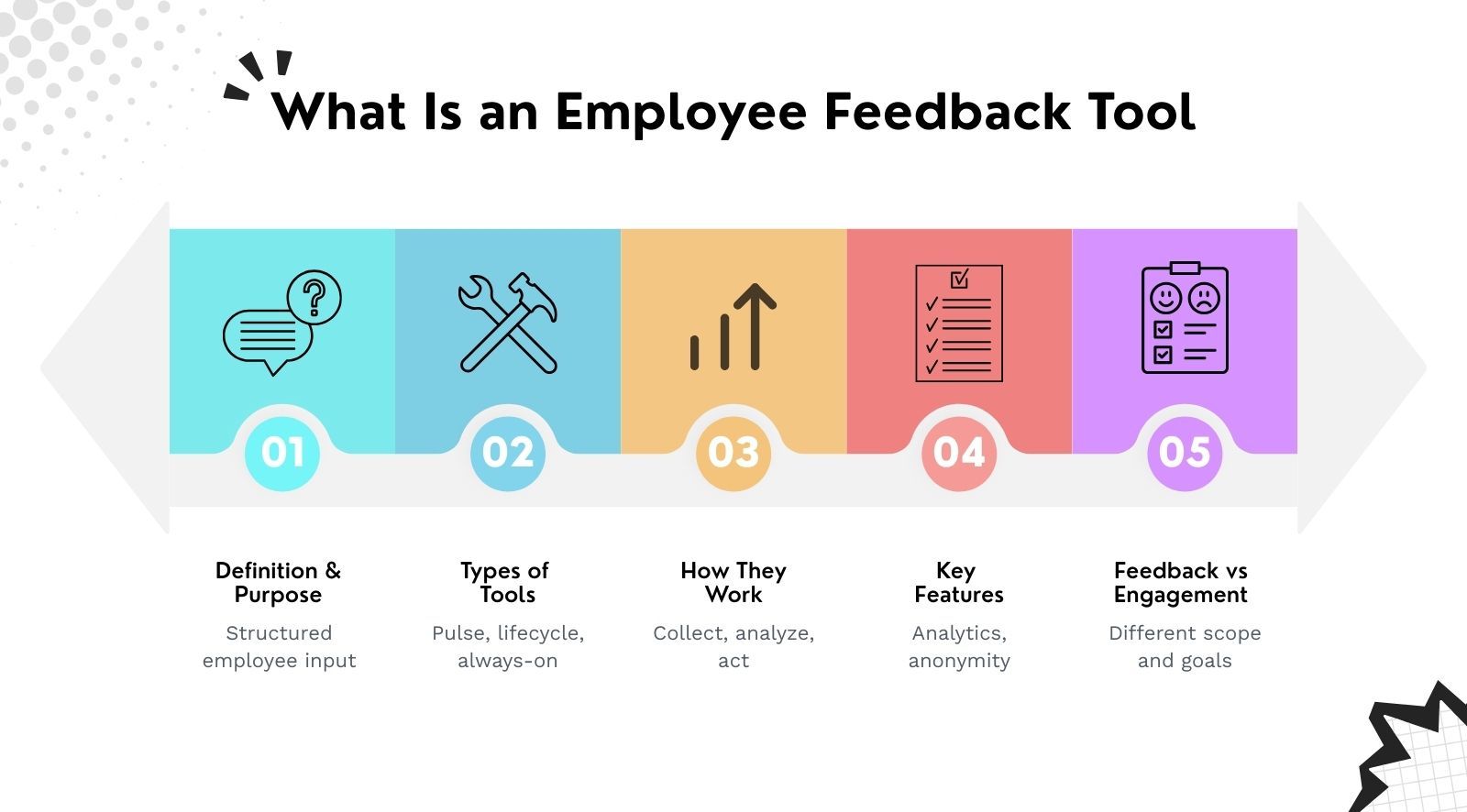
- Defines what an employee feedback tool is and how it structures employee input into measurable insights.
- Explains the different types of employee feedback tools organizations can use.
- Breaks down how employee feedback tools work step by step, from collection to analysis.
- Highlights the key features leaders should evaluate before selecting a tool.
- Clarifies the difference between employee feedback tools and employee engagement software, and who needs them.
What is an employee feedback tool?
An employee feedback platform is a structured system that captures employee sentiment and employee performance data in a consistent format. Instead of relying on informal conversations, employee feedback software centralizes continuous feedback and improves employee experience through regular feedback loops.
In practical terms, an employee feedback tool uses employee feedback surveys and pulse surveys to collect real-time feedback across teams. The best employee feedback tools convert continuous employee feedback into dashboards that help leaders monitor trends and act with clarity.
Types of employee feedback tools
Employee feedback solutions are built to solve different listening challenges across organizations. A single performance review cannot measure employee engagement or boost engagement consistently.
Modern digital employee feedback tools support collecting employee feedback in structured formats, helping leaders identify trends, generate actionable insights, and drive continuous improvement through purpose-built systems.
1. Pulse survey tools
Pulse survey tools measure employee engagement and job satisfaction through short, recurring check-ins. These digital employee feedback tools help collect employee feedback quickly, identify trends early, and provide actionable insights that support continuous improvement without waiting for a formal performance review cycle.
2. Continuous feedback & performance systems
Continuous feedback and performance management platform systems support ongoing conversations between managers and direct reports. They enable continuous performance improvement, help engage employees consistently, and generate valuable insights that connect everyday feedback with structured performance review processes.
3. 360-degree feedback tools
These tools gather structured input from managers, peers, and direct reports. Integrated within a performance management platform, it helps measure employee engagement from multiple perspectives and supports continuous performance improvement using balanced, development-focused feedback.
4. Suggestion boxes & anonymous feedback tools
Anonymous feedback tools allow employees to share concerns or ideas safely. These digital employee feedback tools improve the collection of employee feedback in sensitive situations, help boost engagement, and provide actionable insights that leaders can act on without compromising trust.
5. Engagement & recognition platforms
Employee engagement tools focused on recognition help engage employees through appreciation and rewards. Many employee engagement platform systems combine feedback with recognition data to measure employee engagement, strengthen job satisfaction, and support continuous improvement initiatives.
6. Survey & data analysis tools
Survey and analytics-focused employee feedback solutions specialize in measuring employee engagement at scale. These digital employee feedback tools analyze responses, identify trends, and convert raw feedback into valuable insights that inform leadership decisions and support customer success team alignment.
How employee feedback tools work (Step-by-step)

An employee experience platform follows a defined process to manage user feedback effectively. Without clear stages, user feedback becomes scattered and disconnected from company values. Continuous employee feedback tools create a structured flow that helps teams move in the same direction, using employee data to collect feedback, analyze feedback, and generate actionable feedback consistently.
Step 1: Diagnosis and goal setting
Organizations define objectives before launching employee surveys or engagement surveys. Leaders align goals with company values, clarify desired employee benefits, and decide how ongoing feedback will improve employee development and overall employee experience across teams.
Step 2: Choosing and configuring the tool
Teams select employee feedback survey tools or broader employee engagement and feedback tools that fit their needs. Continuous employee feedback tools are integrated with systems, configured for honest feedback, and aligned to workplace feedback tools already in use.
Step 3: Deployment and data collection
The platform rolls out monthly pulse surveys, engagement surveys, and peer-to-peer recognition features. These workplace feedback tools collect feedback across teams, capture instant feedback, and centralize employee data for structured review.
Step 4: Real-time analysis and insights
Leaders analyze feedback through dashboards that surface trends from employee surveys and user feedback. By converting raw employee data into actionable feedback, managers identify gaps and ensure teams move in the same direction.
Step 5: Acting on feedback (closing the loop)
Managers use actionable feedback to improve employee development and adjust employee benefits where needed. Honest feedback leads to targeted actions, reinforcing company values and strengthening employee experience across functions.
Step 6: Continuous monitoring and improvement
Continuous employee feedback tools help track progress over time. Ongoing feedback cycles ensure engagement surveys remain relevant, workplace feedback tools evolve with needs, and teams consistently align in the same direction.
Key features to look for
Selecting the right employee feedback tool requires clarity on the features that protect and strengthen the feedback loop. Without the right structure, hr teams struggle with engagement tracking and performance tracking. Strong survey platforms help gather feedback consistently, motivate employees, and support visibility across the employee lifecycle.
- Anonymity: Anonymous surveys encourage honest input without fear of exposure. For hr teams and even a sales team, psychological safety strengthens the feedback loop, improves engagement tracking, and helps gather feedback that reflects real concerns rather than filtered responses.
- Segmentation: Segmentation allows leaders to break employee data by department, tenure, or role across the employee lifecycle. This helps multiple tools connect insights, supports performance tracking, and enables hr teams to boost performance using targeted actions.
- Analytics: Advanced survey platforms convert raw responses into clear dashboards. Engagement tracking, performance tracking, and trend analysis help hr teams gather feedback efficiently and make faster decisions that strengthen the feedback loop.
- Action planning: Features that turn insights into structured next steps help motivate employees and boost performance. A defined feedback loop ensures hr teams move from anonymous surveys to measurable changes that improve outcomes across the employee lifecycle.
- Integrations: Seamless integrations reduce reliance on multiple tools and connect survey platforms with existing systems. This is critical for employee feedback tools for large enterprises in 2026, where engagement tracking and performance tracking must align across hr teams and business functions.
Employee feedback tools vs employee engagement software

Employee feedback tools and employee engagement software serve related but distinct purposes. One supports continuous development and meaningful conversations, while the other measures engagement drivers at scale. Understanding the difference between employee feedback tools and engagement survey software helps leaders reduce survey fatigue and make data driven hr decisions.
Who needs an employee feedback tool?
An employee feedback tool provides a structured system for collecting and organizing input across teams. When feedback stays inside existing tools, leaders miss patterns and lose visibility. The best employee feedback software centralizes input, helps spot issues early, and turns feedback into informed decisions across the organization.
- Growing teams scaling fast: When headcount grows, informal listening breaks. The best employee feedback software creates consistency, improves visibility across departments, and reduces blind spots that appear when feedback stays fragmented inside existing tools.
- HR teams managing culture change: During change, HR needs reliable listening systems. Centralized feedback helps track concerns over time and prevents overreliance on scattered notes across existing tools.
- Managers with distributed direct reports: Structured check-ins help managers stay aligned. A feedback tool keeps conversations organized and prevents important input from disappearing inside communication platforms.
- Organizations facing retention risk: When attrition rises, leaders need clarity. The best employee feedback software surfaces recurring themes early, enabling proactive action rather than reactive damage control.
Why do they need them?
- Real-time insights: Leaders gain immediate visibility into patterns instead of waiting for annual reviews.
- Boosted engagement & retention: Early signals help address friction before it turns into disengagement or exits.
- Anonymity & safety: Safe channels increase honest participation and reduce filtered responses.
- Structured recognition: Recognition data becomes visible, measurable, and tied to performance conversations.
- Support for DE&I: Trends can be analyzed across groups to ensure fairness, inclusion, and equitable experience.
Conclusion
An employee feedback tool plays a critical role in modern workplaces by turning everyday input into structured insight. It helps leaders move beyond assumptions and make decisions on real employee data. When feedback is organized, tracked, and acted upon, organizations improve clarity, strengthen communication, and create a more responsive culture.
CultureMonkey supports this shift by offering a comprehensive employee feedback platform designed for continuous listening. From pulse surveys to real-time analytics and anonymity safeguards, it enables organizations to capture honest feedback, track trends, and drive meaningful action. The result is better alignment, stronger engagement, and sustained organizational growth grounded in data.
FAQs
1. What is the best employee feedback tool?
The best employee feedback tool depends on organizational size, goals, and maturity. Platforms like CultureMonkey and Culture Amp combine pulse surveys, continuous feedback, analytics, and anonymity safeguards. The right choice should centralize input, reduce survey fatigue, and turn feedback into measurable, actionable insights leaders can consistently act upon.
2. Are employee feedback tools anonymous?
Many employee feedback tools offer anonymity settings to encourage honest responses. Anonymous feedback increases participation and psychological safety, especially for sensitive topics. However, anonymity rules vary by platform, so organizations should review visibility controls, reporting thresholds, and data access permissions before deployment.
3. How often should feedback be collected?
Feedback should be collected consistently but not excessively. Many organizations use monthly pulse surveys combined with ongoing feedback conversations. The ideal cadence balances insight with participation, ensuring leaders receive timely data without causing survey fatigue or overwhelming employees with repeated requests.
4. How is an employee feedback tool different from engagement survey software?
An employee feedback tool supports ongoing conversations and real-time input, while engagement survey software focuses on periodic measurement of engagement drivers. Feedback tools enable faster course correction, whereas engagement platforms provide broader organizational benchmarks and trend analysis for long-term strategy.
5. Can employee feedback tools improve retention?
Yes, when used consistently, employee feedback tools help leaders identify recurring concerns early. By acting on patterns and closing the feedback loop, organizations address friction before it leads to disengagement, ultimately improving retention and strengthening trust across teams.
6. Do employee feedback tools replace performance reviews?
No, employee feedback tools complement performance reviews. They provide continuous input between formal evaluations, enabling managers to address issues sooner, support development conversations, and ensure performance discussions are based on ongoing data rather than isolated annual snapshots.
7. What features should organizations prioritize in a feedback tool?
Organizations should look for anonymity controls, real-time analytics, segmentation, action planning workflows, and integration capabilities. These features ensure feedback is not only collected but also translated into measurable improvements that support culture, performance, and employee experience goals.
8. How long does it take to implement an employee feedback tool?
Implementation timelines vary by organization size and integration complexity. Many platforms can be configured within weeks, especially when goals are clearly defined. A phased rollout, starting with pilot groups, often ensures smoother adoption and higher participation rates.