



What is eNPS (employee Net Promoter Score)?

eNPS (employee Net Promoter Score) is a metric used to measure how likely employees are to recommend their workplace. It helps organizations understand employee loyalty, sentiment, and overall experience.
This guide explains how eNPS works, how to interpret it, and how to use it effectively. Built on tested frameworks applied across real organizational contexts, it focuses on clarity over complexity and shows how eNPS fits into a structured employee feedback strategy.


- Understand what eNPS is and why it’s more than just a single number in your engagement toolkit.
- Discover the biggest benefits eNPS brings for retention, morale, and overall business performance.
- Learn the differences between eNPS and NPS, plus the limitations you’ll need to watch out for.
- Explore benchmarks, employee net promoter scoring ranges, and examples to see how your organization stacks up.
- CultureMonkey helps you improve eNPS and integrate it into a broader employee experience approach.
What is eNPS (employee Net Promoter Score)?

eNPS (employee Net Promoter Score) is a metric that measures how likely employees are to recommend their workplace. It captures employee sentiment using a single question and expresses it as a score between -100 and 100.
The employee net promoter score (eNPS) groups responses into promoters (9–10), passives (7–8), and detractors (0–6). eNPS measures employee sentiment but also connects directly to employee morale and overall company culture. A strong, positive work environment often reflects in higher eNPS scores and more consistent employee responses.
What’s the difference between eNPS vs NPS?
eNPS measures employee loyalty and engagement, while NPS measures customer loyalty and satisfaction, helping organizations understand internal workforce sentiment versus external customer perception.
| Aspect | eNPS (Employee Net Promoter Score) | NPS (Net Promoter Score) |
|---|---|---|
| Audience | Employees | Customers |
| Purpose | Measure employee loyalty and engagement | Measure customer loyalty and satisfaction |
| Core question | Likelihood to recommend workplace | Likelihood to recommend product or service |
| Use case | Internal experience and culture tracking | External brand and product perception |
| Insight type | Workforce sentiment and retention signals | Customer advocacy and growth signals |
| Action focus | Improve engagement and employee experience | Improve customer experience and retention |
| Frequency | Quarterly or lifecycle-based surveys | Transactional or periodic surveys |
| Ownership | HR and People teams | Marketing, CX, or Product teams |
What question is asked in an eNPS survey?
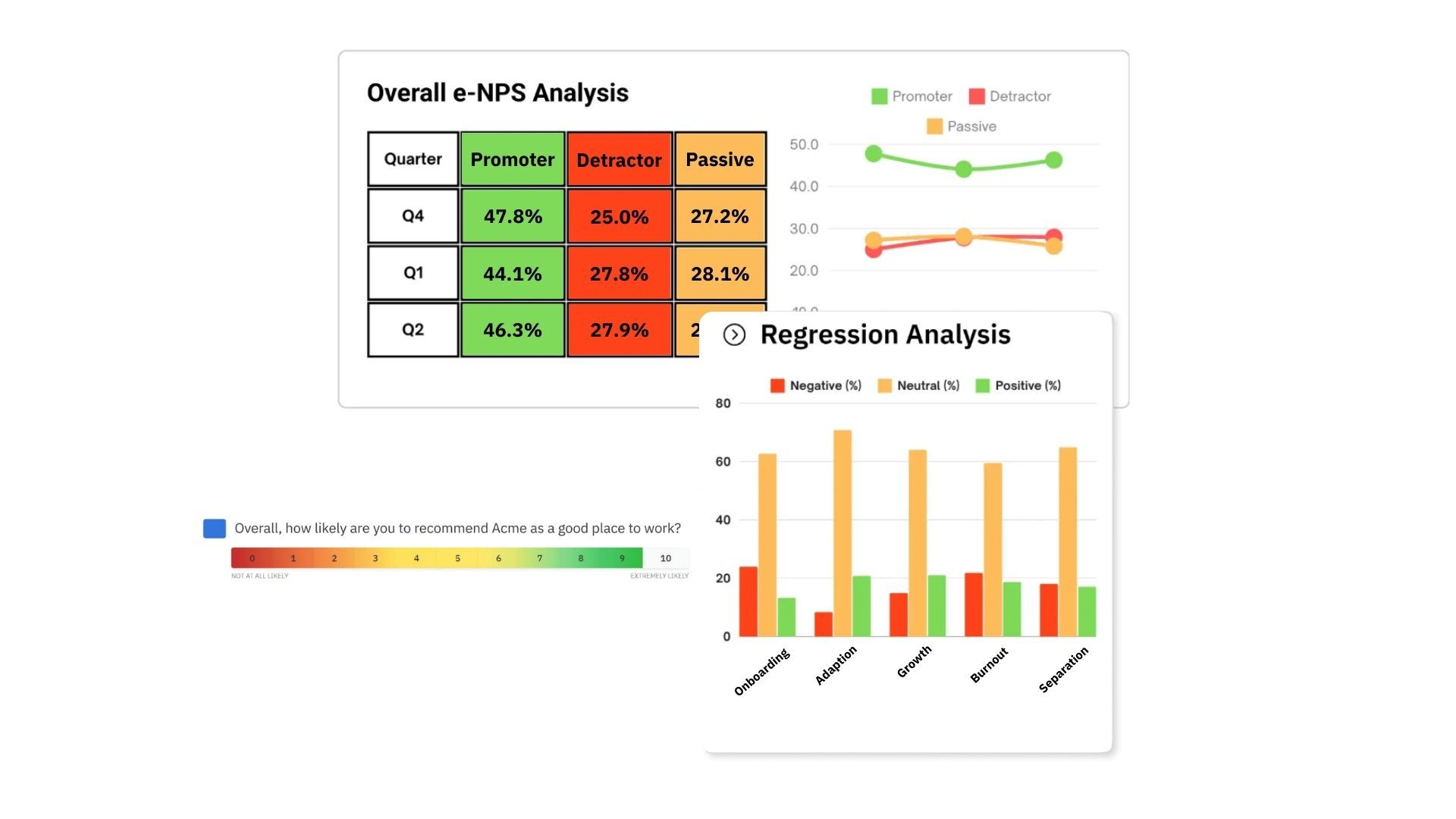
The question asked in an eNPS survey is: “On a scale of 0 to 10, how likely are you to recommend our company as a place to work?”. It is designed to capture employee sentiment through a single, standardized question. eNPS questions act as a quick, high-level measure of workforce sentiment.
In most eNPS surveys, the wording may vary slightly, but the focus remains on likelihood to recommend. Responses are grouped into promoters (9–10), passives (7–8), and detractors (0–6), which form the basis of the eNPS score. Well-designed eNPS questions reduce survey fatigue and improve the quality of survey responses.
(Source: Ivanti)
What are promoters, passives, and detractors in eNPS?
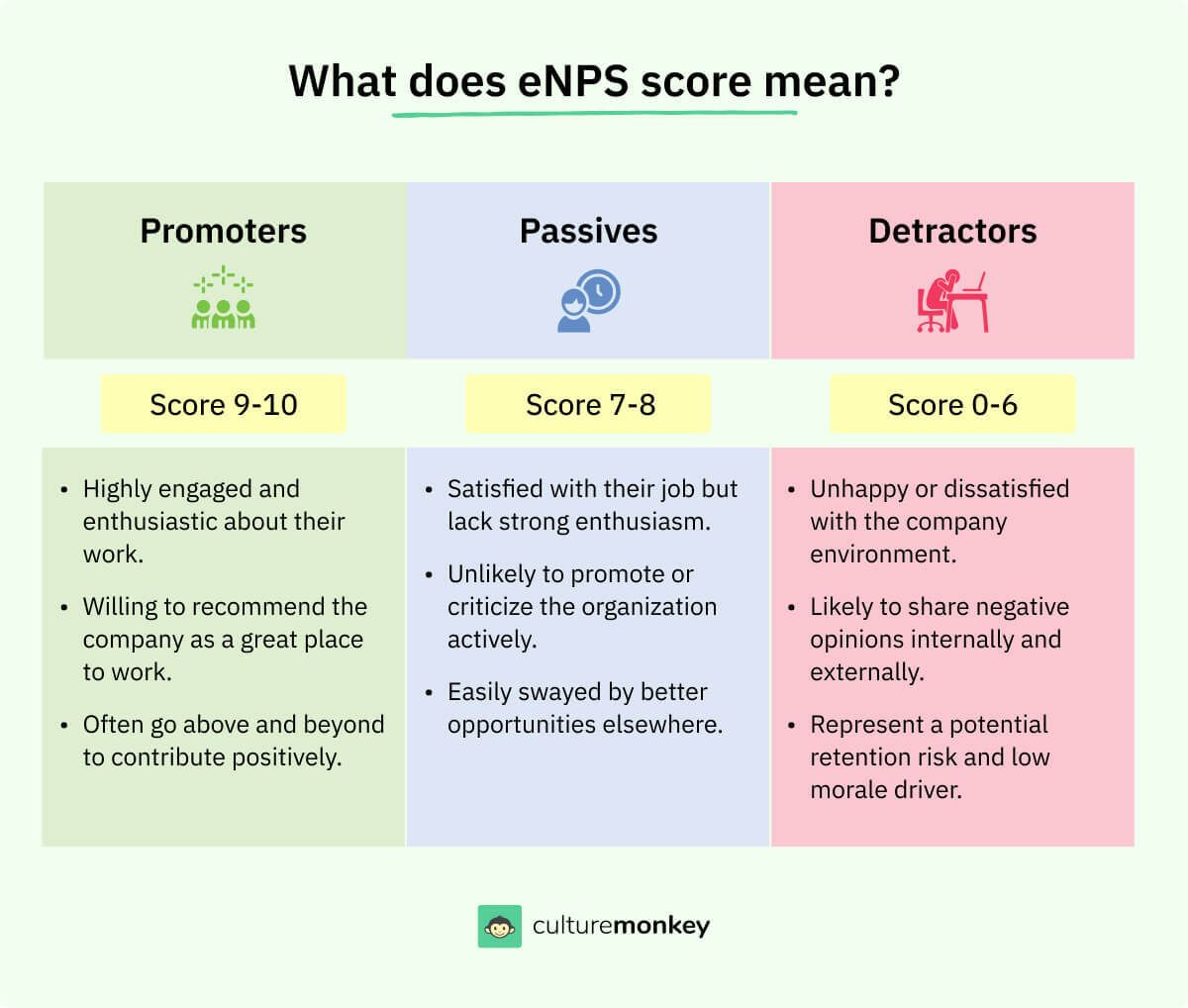
Promoters, passives, and detractors in eNPS are the three employee response groups used to classify answers on a 0–10 recommendation scale. They help explain how the employee net promoter score is calculated and what the response mix says about workforce sentiment.
Promoters (9–10)
Highly satisfied employees who actively recommend the company and strengthen advocacy. Passives are generally satisfied but represent the biggest opportunity to improve employee satisfaction and move toward higher eNPS scores.
Passives (7–8)
Satisfied but not strongly committed employees. They do not affect the eNPS calculation directly, but they signal room for improvement.
Detractors (0–6)
Dissatisfied employees who are unlikely to recommend the organization and may increase morale or retention risk. These eNPS metrics track employee loyalty and signal employee NPS useful as a quick sentiment model.
This classification helps identify areas where employees feel disengaged or at risk. Only promoters and detractors are used to calculate eNPS, while passives add context. This classification is what makes employee NPS useful as a quick sentiment model.
How do you calculate eNPS?
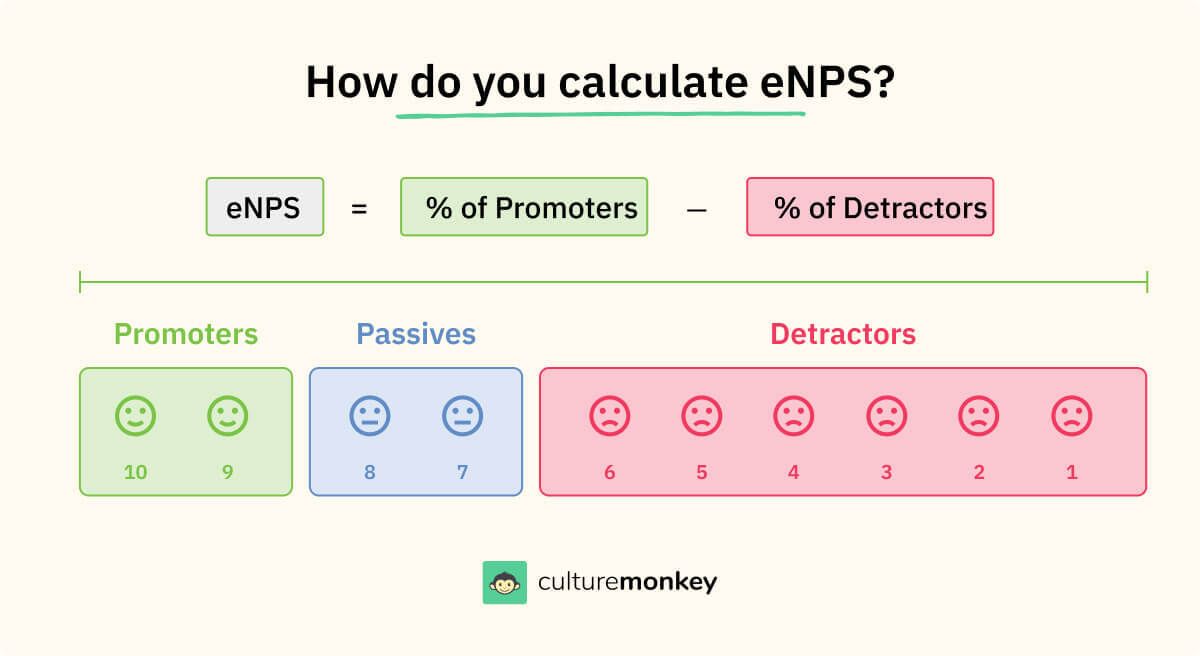
eNPS is calculated by subtracting the percentage of detractors from the percentage of promoters. This simple method produces an employee net promoter score between -100 and +100. Understanding eNPS score calculation helps HR teams consistently track changes in employee sentiment.
Step 1: Ask the question
Use a 0–10 scale to measure likelihood to recommend the company.
Step 2: Categorize responses
- Promoters: 9–10
- Passives: 7–8
- Detractors: 0–6
Step 3: Convert to percentages
Divide each group by total responses to get their respective percentages.
Step 4: Apply the formula
% Promoters − % Detractors = final score
Passives are excluded from the calculation, and the result is a whole number, not a percentage.
Example
If 60% are promoters and 20% are detractors, the employee net promoter score is +40.
Regularly measuring eNPS helps track trends and reduces reliance on one-time survey results.
What does your eNPS score mean?
Your eNPS score shows whether employee sentiment is positive, neutral, or negative based on the balance between promoters and detractors. It helps indicate the overall strength of workplace advocacy and employee loyalty.
How to read the score
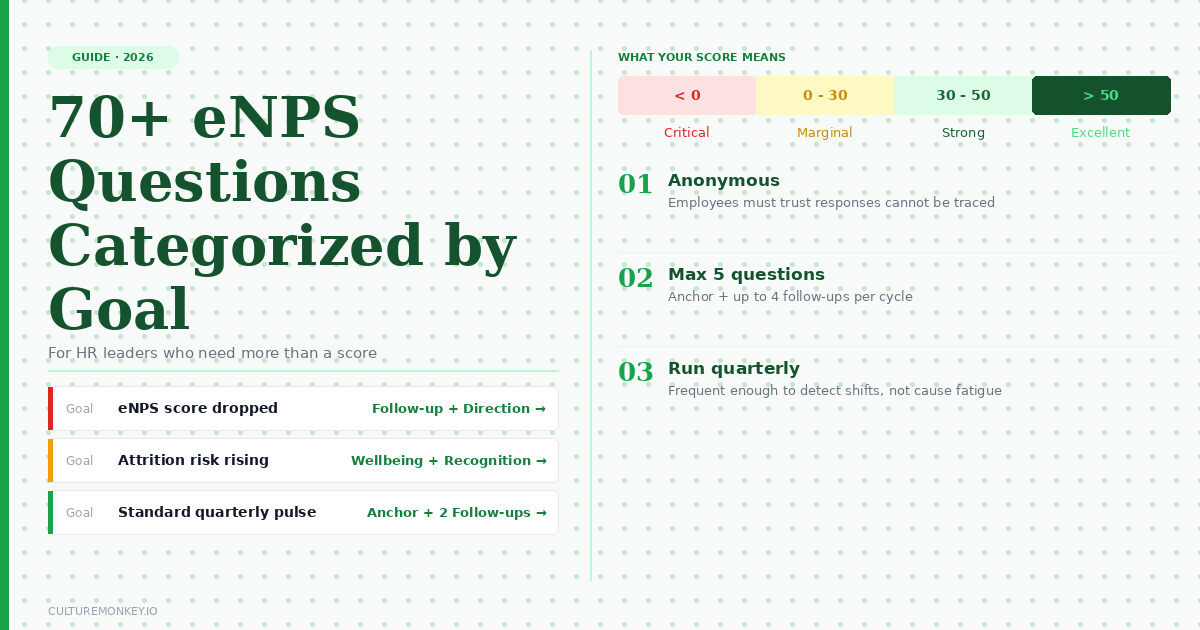
- Above 50: Strong advocacy and high engagement
- 30 to 50: Healthy and stable sentiment
- 10 to 30: Positive but still improvable
- 0 to 10: Weak positive sentiment
- Below 0: More detractors than promoters, signaling a problem
What the score tells you
The answer to “what is eNPS score?” is best understood through the response mix. More promoters suggest stronger advocacy, while more detractors point to dissatisfaction and higher retention risk.
Important context
A net promoter score eNPS of 0 is not strong because promoters and detractors are equal. The score should also be read over time, not in isolation, to understand whether employee sentiment is improving or slipping. Low eNPS scores often correlate with higher employee attrition and unhappy employees.
A positive eNPS score indicates more promoters than detractors, while a negative eNPS score signals dissatisfaction.

Always treat your employees exactly as you want them to treat your best customers.
Stephen R. Covey



Global Practice Leader at FranklinCovey
What is a good eNPS score?

A good eNPS score typically falls between 10 and 30 on a scale from -100 to +100. eNPS scores above 30 are strong, and above 50 indicate high employee advocacy.
eNPS scoring ranges
- -100 to 0: Needs improvement
- 0 to 10: Acceptable
- 10 to 30: Good
- 30 to 50: Very good
- 50+: Excellent
The average eNPS varies by industry, and comparing against an overall eNPS benchmark provides better context.
What affects a “good” eNPS score
A strong eNPS score benchmark depends on industry, workforce type, and timing. What is considered good in one environment may not apply in another.
How to use benchmarks
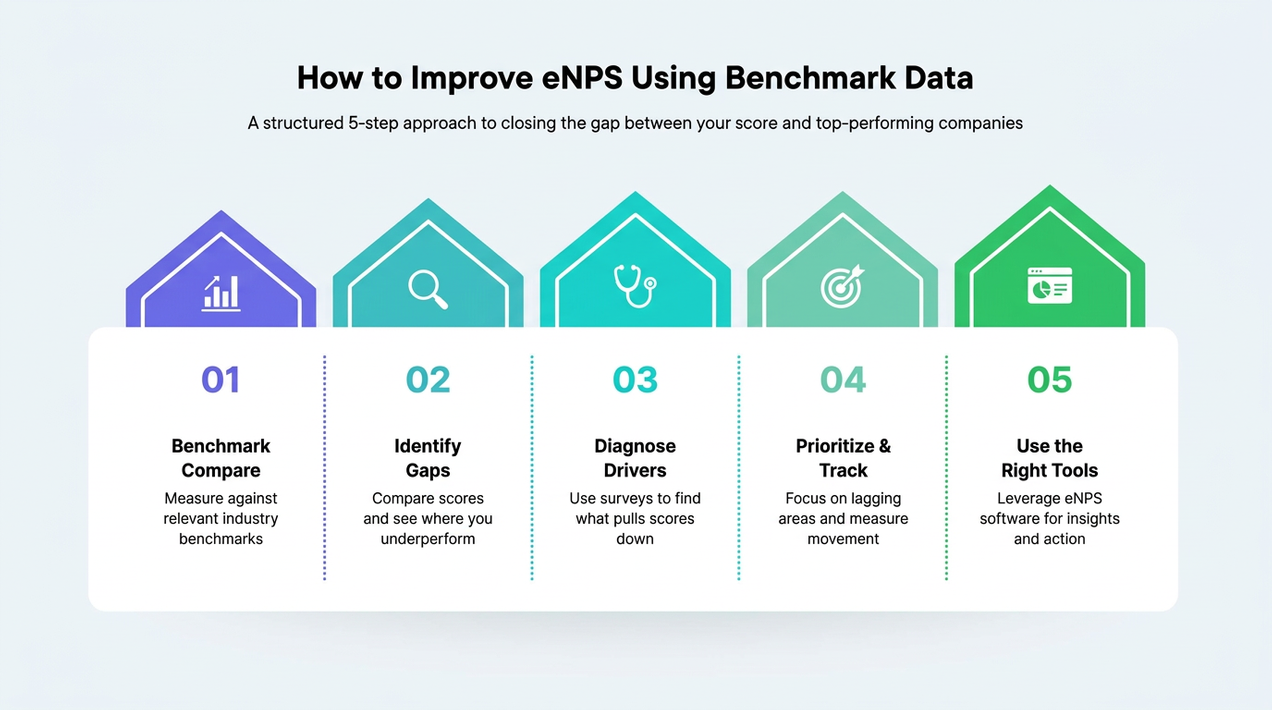
Use benchmarks as reference points, not targets. Comparing trends over time is more reliable than relying only on static eNPS benchmarks by industry.
Tracking higher eNPS scores over time is more valuable than comparing against static benchmarks.
To note
A positive eNPS score does not guarantee strong engagement. Moving passives toward promoters and understanding employee feedback is key to improving outcomes. A score alone is not enough; follow-up questions in employee NPS survey are needed to understand who are engaged employees and the eNPS score meaning.

See how Bristlecone increased eNPS by 34.8% with CultureMonkey
See howWhy do companies use eNPS?
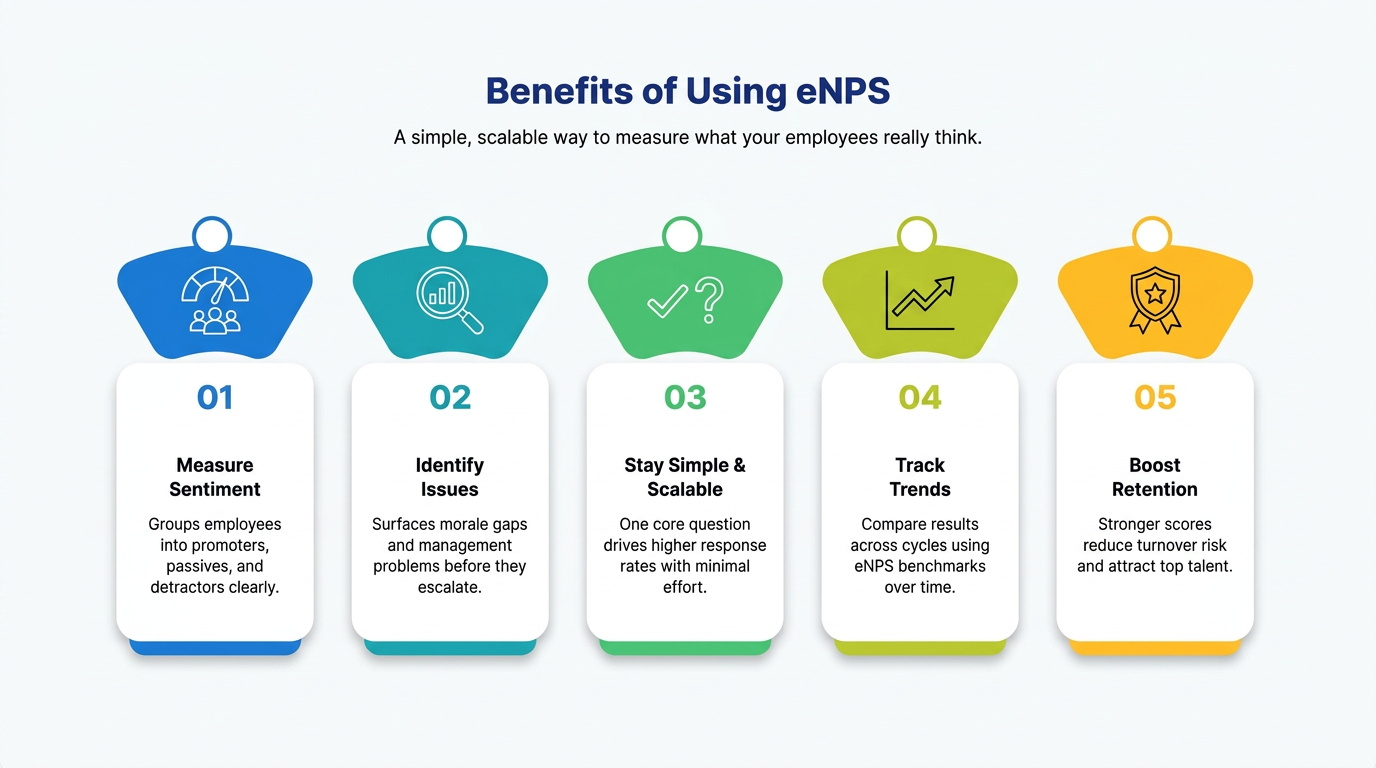
Companies use eNPS to measure employee sentiment, identify issues, and track engagement trends over time. eNPS overview provides a simple way to understand how employees feel without complex surveys and survey fatigue. It helps HR teams align employee voice with business outcomes and better business performance.
Key reasons companies use eNPS:
- Measure employee sentiment: The net promoter score employee engagement approach groups employees into promoters, passives, and detractors, giving a clear view of workforce sentiment.
- Identify improvement areas: Insights from an eNPS survey help surface issues such as low morale or management gaps before they affect retention.
- Keep measurement simple and scalable: With one core question, eNPS tools require minimal effort and typically see higher response rates.
- Track trends over time: Using an eNPS benchmark, companies compare results across cycles to evaluate whether changes are improving employee experience.
- Support retention and employer brand: Stronger eNPS scores often reflect better workplace experience, which helps reduce turnover risk and attract talent. Strong eNPS is often linked to improved employee retention and stronger employer brand.
- Enable continuous feedback loops: Regular use of an eNPS survey tool allows teams to collect feedback consistently and act on it quickly.
Continuous improvement in workplace culture depends on acting on eNPS insights and qualitative feedback.
What is eNPS architecture and how does it work?
eNPS architecture is a system that captures employee feedback, processes it through data pipelines, and turns it into actionable insights using continuous feedback loops.
Introduction to eNPS Architecture
eNPS architecture shows how employee feedback is collected, processed, and used to improve engagement across the organization.
Key components of eNPS systems
eNPS systems work through four core layers that ensure eNPS functionality delivers insights:
- Survey engine and response capture.
- Data processing and analytics.
- Reporting dashboards.
- Action and follow-up workflows.
Data pipelines: Building the flow
Data pipelines convert raw responses into usable insights:
- Collect and clean survey data.
- Segment by team, role, or location.
- Deliver real-time insights to dashboards.
Survey distribution mechanisms
Survey distribution ensures feedback reaches all employees. Effective eNPS for HR departments depends on accessibility:
- Email, Slack, mobile, kiosks, intranet.
- Multi-channel reach to improve response rates.
Feedback loop optimization
Feedback loops turn insights into action and build trust:
- Share results with managers and teams.Act on feedback and communicate changes.
What are the limitations of eNPS?
The limitations of eNPS are that it lacks context, oversimplifies employee sentiment, and does not provide clear direction for action. It works as a pulse check, not a complete diagnostic.
Key limitations of eNPS:
Lack of context
An eNPS explains whether sentiment is positive or negative but does not show the reasons behind it. Without qualitative feedback, eNPS does not provide a complete picture of employee experience.
Oversimplification of sentiment
As one of common eNPS issues, reducing responses into three groups with an overall eNPS benchmark can miss nuance and hide underlying issues. To improve employee engagement, organizations must combine eNPS data with deeper insights and follow up questions.
Passives are underutilized
Employees in the middle group are excluded from the eNPS score, even though they represent a key opportunity for improvement.
Limited actionability
Low eNPS scores signals a problem but does not indicate what needs to change or where to act without follow up questions.
Not a full measure of engagement
The net promoter score for employees reflects advocacy, not daily engagement or productivity. It does not capture factors like career growth, career advancement, or manager effectiveness.
Limited segmentation
Results are not detailed enough to identify issues across specific teams, roles, or groups without additional analysis.
Susceptible to bias
Scores can be influenced by timing, context, or recent events, which may not reflect long-term sentiment.
What is eNPS compliance and how do you ensure it?
eNPS compliance ensures feedback is collected, stored, and reported securely with anonymity, clear consent, and controlled access, while enforcing data protection standards to maintain trust, accuracy, and confidentiality.
eNPS compliance:
eNPS compliance defines how feedback data is handled with:
- Consent-based collection.
- Secure storage and access control.
- Aggregated, non-identifiable reporting.
How is eNPS data kept secure?
Strong eNPS security protects response confidentiality through:
- Encryption in transit and at rest.
- Role-based access controls.
- Anonymity thresholds.
Common eNPS problems:
Common eNPS problems reduce trust and accuracy with:
- Weak anonymity safeguards.
- Inconsistent data handling.
- Low participation due to distrust.
eNPS not working:
Reasons why eNPS fails is usually execution-related if there is:
- No action on feedback.
- Poor communication.
- Irregular survey cadence.
To improve eNPS accuracy:
Improve outcomes with clear, consistent practices by:
- Standardize data handling.
- Communicating privacy clearly.
- Acting on feedback quickly.
5 Best eNPS tools
The best eNPS tools measure employee loyalty, ensure anonymous feedback, and provide actionable insights. Here are five eNPS software to buy that stand out for accuracy, analytics, and scalability.
1. CultureMonkey
CultureMonkey is built for enterprises that need reliable eNPS employee sentiment measurement. Unlike basic survey tools, it improves eNPS accuracy using anonymity thresholds and deeper insights.
eNPS tool Verdict:
Best for enterprises prioritizing anonymity and actionable insights.
2. Culture Amp
Culture Amp is an employee engagement platform that includes eNPS measurement. Compared to standalone eNPS tools, it offers stronger benchmarking but less focus on anonymity depth.
eNPS tool Verdict:
Better for benchmarking-driven teams than tools focused purely on continuous feedback.
3. Qualtrics XM
Qualtrics XM is an enterprise experience platform that includes eNPS. Unlike dedicated eNPS tools, it positions eNPS within a broader EX framework.
eNPS tool Verdict:
Stronger than most tools for enterprise EX, but less focused if eNPS is the primary goal.
4. Lattice
Lattice includes eNPS as part of performance management. Compared to dedicated eNPS tools, it prioritizes HR workflows over deep survey analytics.
eNPS tool Verdict:
More suitable than standalone surveys for HR-led workflows, but weaker for deep eNPS analysis.
5. Workleap
Workleap is a lightweight feedback tool with eNPS. Unlike enterprise tools, it focuses on simplicity over advanced analytics.eNPS tool Verdict:
Better than complex tools for quick setup, but less capable for advanced use cases.
Conclusion
eNPS is a simple and effective way that helps organizations track sentiment, identify risks, and monitor changes over time without complex survey structures. While it does not replace deeper employee feedback systems, it acts as a strong starting point for understanding employee experience.
With the right eNPS software, teams can go beyond basic measurement by capturing feedback through structured workflows, analyzing trends, and closing the loop with action. eNPS survey tools like CultureMonkey help operationalize eNPS by combining surveys, insights, and follow-ups into a continuous feedback system.
Book a demo with CultureMonkey.
FAQs
1. What does eNPS mean?
eNPS meaning refers to a metric that measures how likely employees are to recommend their workplace as a place to work. It reflects overall employee sentiment by grouping responses into promoters, passives, and detractors, helping organizations quickly understand workforce experience and advocacy.
2. What is an eNPS survey?
An eNPS survey is a short feedback method that asks employees how likely they are to recommend their workplace. It uses a single 0–10 scale question and is often run as part of eNPS surveys to capture sentiment quickly and consistently across teams. Organizations often survey employees regularly to maintain consistent feedback loops.
3. What is a good employee net promoter score?
A good employee net promoter score typically falls between 10 and 30, indicating more promoters than detractors. However, a reliable eNPS score benchmark varies by context, so organizations should compare eNPS data and survey results over time rather than rely only on static ranges.
4. How to calculate eNPS?
If you want to know how to calculate eNPS, subtract the percentage of detractors from the percentage of promoters based on a 0–10 rating scale. This eNPS calculation produces a score between -100 and +100, where passives are excluded but still useful for understanding overall sentiment trends.
5. What are the benefits of employee net promoter score?
The employee NPS helps organizations quickly measure sentiment, identify risks, and track changes over time. Using eNPS survey software, teams can capture feedback at scale, improve retention, and strengthen workplace experience through consistent listening and action. Using eNPS survey software helps turn survey results into valuable and actionable insights.





%3F)