


Worker engagement through text message surveys for frontline teams in 2026

Worker engagement through text message surveys delivers pulse and engagement questionnaires directly to employees via text messages instead of email.
HR leaders evaluating employee engagement survey vendors pricing are not only comparing feature lists. They are assessing participation lift, anonymity thresholds, HRIS integrations, segmentation controls, multilingual capability, and total cost per employee.
This guide uses tested frontline deployment frameworks to help institutions determine when text messaging improves response rates, when it creates risk, and how methodology connects to platform pricing.


- Worker engagement through text message surveys delivers pulse questions via mobile text to increase frontline participation.
- Email-first surveys underperform in shift-based teams; text messaging improves reach and response rates.
- Multilingual access and anonymity thresholds protect trust and data accuracy.
- Supervisor micro-actions convert feedback into measurable frontline improvements.
- CultureMonkey supports worker engagement through text message surveys with multi-channel delivery and anonymity controls.
Why does email fail for frontline worker engagement?

Email underperforms in frontline settings because it assumes desk access and routine inbox usage. Shift-based and hourly workers often lack both, making distribution dependent on infrastructure rather than intent.
Worker engagement through text message surveys removes that dependency. Text messaging for employees reaches personal devices without logins, portals, or shared terminals.
For HR leaders evaluating employee pulse survey software providers, channel strategy directly influences participation rates, data reliability, and cost efficiency.
- Email-first fails frontline engagement due to low inbox access.
- Shared terminals reduce survey via text alternatives.
- Shift workers ignore non-urgent email notifications.
- Text message survey links fail to remove login and VPN friction.
Segmenting survey audiences by department, shift, or location helps keep questions relevant for them to provide feedback on employees' experiences.
When do text message surveys improve worker engagement?
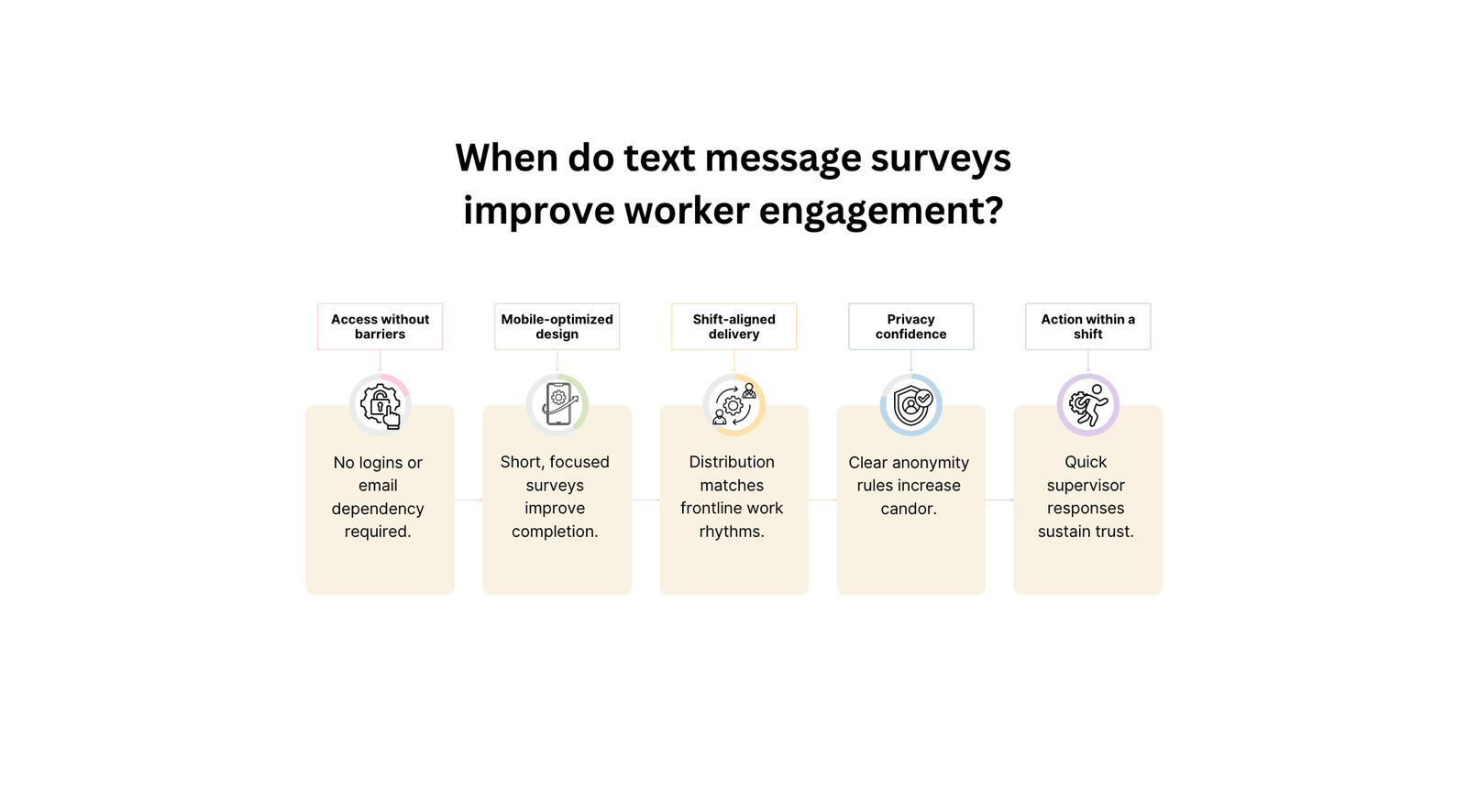
Text message surveys enhance employee engagement when access is the primary barrier, not willingness. In frontline environments, text messaging reaches employees instantly without logins, apps, or email dependency and drive engagement. Response rates typically rise when employee satisfaction surveys are short, mobile-friendly, and timed around shifts.
However, text messaging does not fix poor survey design or weak follow-through. If anonymity thresholds are unclear, questions are long, or managers ignore results, participation drops quickly.
- Ideal frontline environments: Shift-based, deskless, mobile-first teams.
- Survey design: Short pulse surveys under two minutes.
- Distribution timing: Before, after, or between shifts.
- Design choices that affect engagement: Long surveys exceeding mobile attention span.
- Operational gaps that damage trust: No visible action after feedback submission.
Personalizing messages by using recipients' names can increase trust and response rates in text surveys and foster a better workplace.
How do text message pulse surveys compare to kiosk and QR methods?

Text message pulse surveys deliver engagement questions directly to employee phones. Kiosk and QR methods depend on physical placement and voluntary participation. The channel choice affects anonymity perception, repeat participation stability, and operational overhead.
Mobile-friendly text message surveys are particularly effective for engaging deskless and remote workers who may not frequently check email surveys.
How can you run multilingual text surveys for hourly workers?
Multilingual text surveys for hourly workers require intentional design. Translation alone is insufficient. Language clarity, literacy sensitivity, and device compatibility directly affect participation and data quality. Frontline engagement improves only when workers can understand, trust, and complete surveys without assistance to create a more engaged workforce.
Hourly workforces often include varied education levels and limited digital familiarity. Accessibility must address reading simplicity, mobile device usability, timing, and anonymity assurance of an engaged workforce. Text messaging reduces distribution barriers and improve employee engagement, but inclusion depends on execution discipline.
Language clarity and multilingual accessibility
Multilingual text message surveys must account for reading levels, device compatibility, and cultural clarity. Worker engagement through text message surveys improves only when employees fully understand what is being asked in order to create a positive work environment.
- Offer instant language selection in the first text message.
- Use plain wording suitable for varied literacy levels.
- Keep text surveys short and single-question focused.
- Check if surveys are older Android version friendly.
- Clearly explain anonymity before the first response.
- Avoid app downloads requirements or portal logins.
Real-time detailed analytics from text message surveys enable organizations to swiftly identify trends and address potential issues.
Inclusion, device access, and participation equity
Text messaging for employees must consider shared devices, limited data plans, and shift variability. Accessibility gaps distort frontline engagement data and reduce survey via text reliability.
- Confirm surveys load on low-bandwidth connections.
- Send during predictable shift transition windows.
- Allow opt-out and rejoin options easily.
- Prevent duplicate submissions from shared devices.
- Ensure text messaging systems integrate employee surveys with HRIS data.
- Monitor response gaps across segments.
Incorporating visuals, videos, and interactive elements in text messages can make them more engaging and memorable.
How do you segment shifts without breaking anonymity?

Shift-based segmentation is necessary in frontline environments, but it creates privacy risk if not designed carefully. When organizations run text message surveys across shifts, workers must trust that responses cannot be traced to a small crew or individual.
Poor segmentation erodes participation and weakens frontline engagement. Effective controls combine structural safeguards with clear text message employee communications so survey via text programs produce honest, usable data without compromising anonymity.
Structural safeguards for shift-based segmentation
Shift-based segmentation in text message surveys must prevent re-identification while preserving useful and continuous insights. If workers believe a survey via text can be traced back to a specific shift or supervisor, honest responses decline.
Leaders must:
- Apply response minimums before publishing shift-level text surveys.
- Suppress results when small crews answer a text survey.
- Combine adjacent shifts if survey via text participation is low.
- Restrict supervisor access to aggregated text message surveys data.
- Audit segmentation rules inside text-based engagement tools anonymous feedback for staff.
Regular and relevant communication through text messages can keep employees informed about company updates, events, and opportunities.
Privacy communication in text message employee communications
When using text message employee communications for frontline engagement, anonymity must be explained clearly. Workers will not participate in text surveys unless they understand how their identity is separated from responses.
Leaders should:
- State how text messaging systems that integrate employee surveys with HRIS data separate identity fields.
- Confirm that text message surveys do not display phone numbers in reports.
- Reinforce that only aggregated shift data is visible to managers.
In most companies, texting can be used to send reminders, updates, and educational materials related to company benefits to increase employee engagement.
What actions help supervisors close the feedback loop fast?
Collecting feedback through text message surveys is only the first step. Frontline industries increase employee engagement when supervisors act quickly on patterns workers raise. Delayed action weakens trust and reduces participation in future text surveys.
Action loops must fit within a single shift. Micro-actions, not long projects, sustain momentum. When supervisors respond visibly and promptly, worker engagement through text message surveys produces measurable operational change.
Micro-actions that fit inside one shift
Small, visible changes signal that feedback is taken seriously. Supervisors should focus on actions that can be discussed, implemented, and acknowledged within normal shift flow.
- Share one survey insight during daily shift huddle.
- Clarify one confusion raised in text surveys.
- Adjust break rotation if workload imbalance appears.
- Remove one minor process bottleneck immediately.
- Thank teams for participation in text message surveys.
Acting on feedback and sharing results leads to increased trust and future participation in surveys.
Reinforcement actions that sustain trust
Closing the employee feedback loop requires repetition. Workers must see that feedback through survey via text leads to consistent follow-up, not one-time announcements.
- Post one update on actions taken this week.
- Track one metric tied to frontline engagement improvement.
- Invite follow-up comments using text messaging for employee communication.
This proactive approach not only boosts employee retention but also strengthens an organization's reputation as a company that values and acts on employee feedback.
How do you drive adoption of text-based engagement tools across shifts?

Adoption of text-based engagement tools to gather employee feedback requires structured rollout, not one-time announcements. Workers must understand purpose, frequency, and privacy before they respond to a survey via text. Without disciplined communication and reinforcement, participation declines after initial curiosity.
Frontline engagement stabilizes when communication is clear, shift champions model behavior, and reinforcement shows visible impact. Adoption is operational, not promotional.
Clear communication before launch
Workers must understand why you use text message surveys and how responses influence decisions. Ambiguity reduces participation and trust.
Leaders should:
- Explain how using text messages to communicate with employees improves reach.
- Clarify how often you will send a survey via text.
- Describe how text messaging systems that integrate employee surveys with HRIS data protect anonymity.
Employee engagement increases customer satisfaction because people who are passionate about their work are often the best people to interact with customers.
Shift champions who normalize participation
Peer validation increases response stability across crews, improving retention. Text messaging for employee communication spreads faster when trusted workers model participation.
Supervisors should:
- Identify respected team members to encourage coworkers to text staff feedback.
- Ask champions to complete the first text surveys publicly.
- Encourage leaders to model texting employees participation behavior.
To reduce high turnover rates in a work environment, HR leaders should come up with employee engagement strategies since engaged employees are committed to their work and goals.
Reinforcement that sustains momentum
Initial adoption fades without visible outcomes. Workers continue responding to text message surveys only when they see consistent action.
Managers should:
- Share one change made based on text surveys.
- Post updates tied to frontline engagement improvements.
- Remind teams when you send a survey via text again.
Employee engagement is crucial in today's workplace as it directly boost productivity, job satisfaction, and overall organizational success. Engaged employees are often more productive and loyal and have greater job satisfaction.
Which employee pulse survey software providers support frontline text message surveys?
For frontline and shift-based environments, distribution channel, multilingual access, and anonymity controls directly affect participation and data quality.
The employee pulse survey software providers below streamline operations by supporting text message surveys as part of their engagement suites, helping HR teams reach workers where they are and convert feedback and productivity into actionable frontline outcomes.
1. CultureMonkey
CultureMonkey is an employee engagement platform that supports distributing surveys through text messages, multilingual surveys, and configurable anonymity thresholds, making it suitable for shift-based and distributed workforces.
Key Takeaways
- Pricing: Talk to sales
- G2 Rating: 4.7/5
- Why we picked CultureMonkey: Combines text message survey delivery, multilingual access, and shift-level anonymity controls.
- Cons: Reporting customization may feel limited.

2. TINYpulse
TINYpulse is an employee pulse platform focused on recurring feedback cycles, anonymous responses, and lightweight engagement tracking across teams.
Key Takeaways
- Pricing: Talk to sales
- G2 Rating: 4.4/5
- Why we picked TINYpulse: Supports recurring anonymous pulse surveys that can complement text message survey strategies.
- Cons: May have limited customization and reporting flexibility.
3. Culture Amp
Culture Amp is an employee engagement suite known for survey customization, driver analysis, and structured action planning workflows.
Key Takeaways
- Pricing: Talk to sales
- G2 Rating: 4.5/5
- Why we picked Culture Amp: Provides strong analytics and action planning to operationalize insights from text message surveys.
- Cons: Reporting flexibility may feel limited for some advanced use cases.
Read more on Culture Amp alternatives here.
4. Qualtrics
Qualtrics is an enterprise experience management platform supporting multi-channel survey distribution and advanced segmentation controls.
Key Takeaways
- Pricing: Talk to sales
- G2 Rating: 4.4/5
- Why we picked: Enables text message surveys within a robust enterprise engagement suite.
- Cons: Platform complexity may require training for full utilization.
Read more on Qualtrics alternatives here.
5. Quantum Workplace
Quantum Workplace is an engagement platform offering automated pulse surveys and structured reporting across organizational units.
Key Takeaways
- Pricing: $4.00 per employee per month
- G2 Rating: 4.3/5
- Why we picked: Delivers structured pulse programs that can support text message survey deployment strategies.
- Cons: AI suggestions may require refinement in complex environments.
.webp)
Reach Every Shift With Text Message Surveys
- Multi-lingual Surveys
- White Glove Onboarding
- Omni Channel Distribution
- Enterprise Grade Security
Conclusion
Worker engagement through text message surveys improves participation when surveys reach employees in the language they understand, and with clear anonymity protections to improve workplace culture.
For frontline environments, the right employee engagement tool strengthens trust, stabilizes response rates, and enables supervisors to act quickly within each shift for the entire workforce.
CultureMonkey supports multi-channel delivery, multilingual survey distribution across shifts, and configurable anonymity thresholds, helping organizations increase participation and convert frontline feedback into consistent, actionable outcomes.
Book a demo with CultureMonkey.
FAQs
1. What are text message surveys for workers?
Text message surveys for workers are short engagement or pulse questionnaires delivered directly to employees’ phones. They remove email dependency and portal logins, making it easier for frontline and shift-based teams to respond quickly and consistently across locations.
2. Do text message surveys increase participation rates?
Yes. Text message surveys typically increase participation because they reach employees on devices they already use. By reducing login friction and timing surveys around shifts, organizations often see faster response rates compared to email-based distribution models.
3. Are text message surveys anonymous?
They can be anonymous if the platform enforces anonymity thresholds and data suppression rules. Proper segmentation controls ensure responses are aggregated before reporting, preventing identification of individuals within small shift teams.
4. How do multilingual text message surveys improve frontline engagement?
Multilingual text message surveys allow workers to respond in their preferred language. This reduces misunderstanding, improves comfort, and increases participation across diverse hourly workforces, leading to more accurate and representative engagement insights.
5. Can text message surveys integrate with HRIS systems?
Yes. Many employee pulse survey software providers offer integrations that map employee data, shifts, and departments while separating identity fields from survey responses to maintain anonymity and structured reporting.
6. How often should you send a survey via text?
Most organizations run short pulse surveys monthly or quarterly. The key is consistency without over-messaging. Short, focused pulse surveys sent around shift cycles maintain participation without creating survey fatigue.
7. What features matter most in frontline text message survey tools?
Key features include multi-channel delivery, multilingual support, anonymity thresholds, shift-level segmentation controls, and supervisor action dashboards. These directly impact participation, trust, and operational follow-through.
8. Are text message surveys better than kiosk or QR surveys?
Text message surveys often provide more consistent employee reach because they do not depend on physical placement or voluntary scanning. Kiosk and QR methods can work, but participation may fluctuate based on visibility and shift timing.
9. How do supervisors act on text message survey results?
Supervisors close employee feedback loops by gathering insights and sharing them during shift huddles, implementing small process improvements, and communicating visible updates. Quick micro-actions within a shift reinforce trust and encourage continued participation.
10. Which employee pulse survey software providers support text message surveys?
Some employee engagement suites support text message surveys as part of multi-channel distribution. When evaluating vendors, look for multilingual delivery, anonymity controls, and segmentation safeguards to ensure reliable frontline engagement outcomes.