



Anonymous engagement surveys for logistics workforces: A practical guide for warehouse and supply chain leaders (2026)

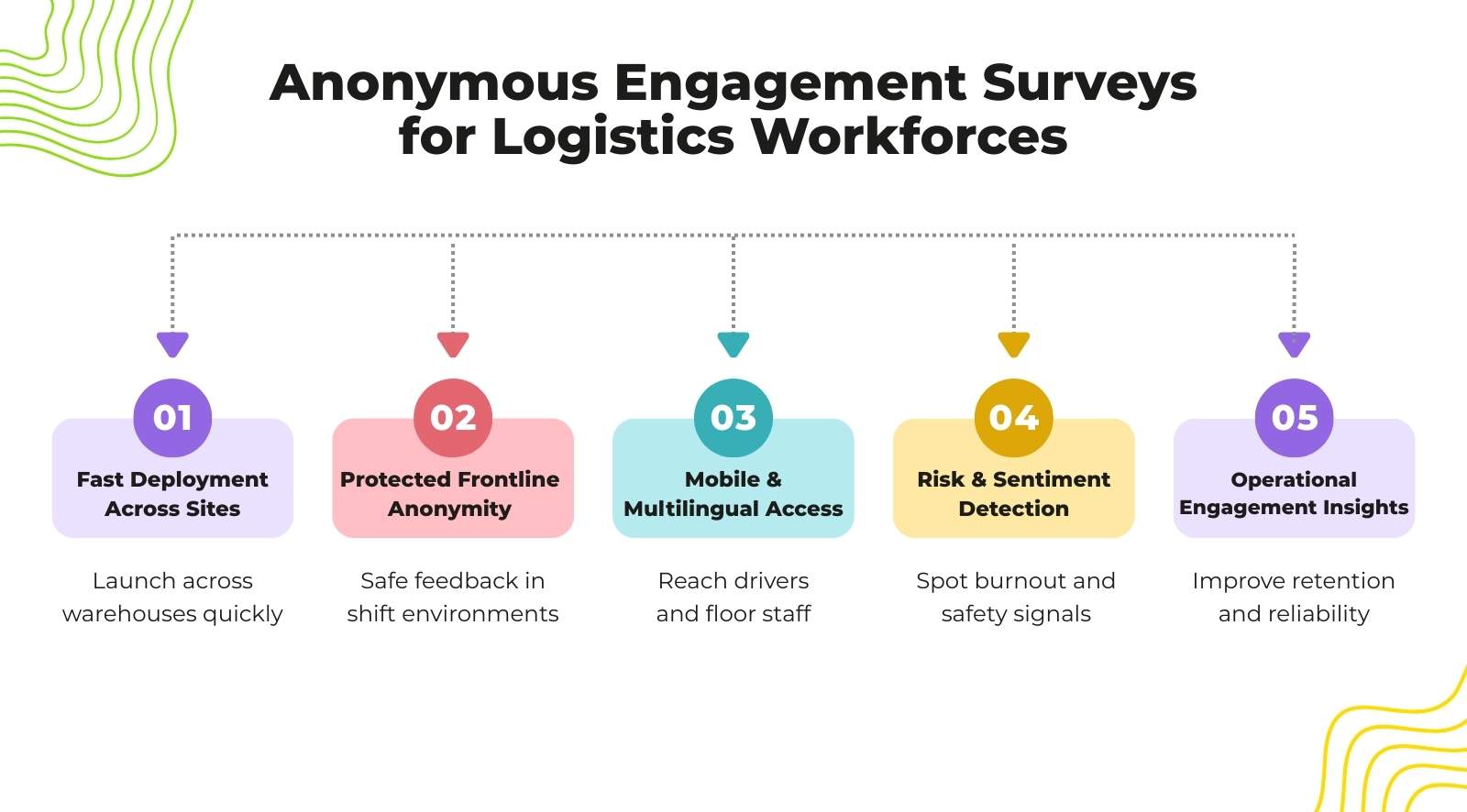
In logistics, leadership often relies on operational dashboards to judge performance. Routes are dispatched, warehouses move volume, and service levels appear stable. Yet numbers rarely capture how people actually experience workload pressure, communication gaps, or shift coordination challenges across sites.
That blind spot can quietly grow. Fatigue, safety concerns, and fairness perceptions may build across terminals and delivery networks without ever surfacing in formal reviews. By the time attrition rises or errors increase, the signals are already there.
Anonymous engagement surveys for logistics give management a structured way to detect those signals early, before operational stability is affected.


- Anonymous engagement surveys in logistics help surface scheduling, safety, and supervision risks before they affect retention or service reliability.
- Employees hesitate to share concerns without credible anonymity, especially in shift-based and supervisor-dependent environments.
- Poor listening leads to burnout, safety gaps, absenteeism, and declining delivery performance across warehouses and routes.
- Effective programs require mobile-first access, strong identity protection, and logistics-specific engagement themes.
- Acting quickly on survey insights improves morale, stabilizes operations, and strengthens workforce trust over time.
Why anonymous listening is crucial in logistics and warehouse operations?

In logistics environments, employees often hesitate to raise concerns due to power dynamics, dependency on shifts, and job security pressures. Without protected listening mechanisms, critical operational signals remain hidden. Anonymous engagement surveys create a structured, low-risk channel for surfacing scheduling, safety, and supervision issues before they affect performance or retention.
- Fear of shift reassignment or route changes: In distributed logistics networks, anonymous surveys encourage honest feedback without fear of reassignment. When leaders collect feedback safely, survey responses reveal scheduling friction early. This improves employee engagement and stabilizes workforce planning before small frustrations become operational setbacks.
- Contract and gig workers feeling replaceable: Anonymous employee surveys create parity across full-time, contract, and gig roles. Anonymous employee feedback helps organizations identify gaps in belonging and fairness. Clear survey distribution across sites ensures employee surveys capture voices that often remain excluded from formal engagement processes.
- Concerns about supervisor retaliation: Anonymous engagement surveys reduce perceived retaliation risk. When anonymous feedback is protected, employee engagement survey participation increases. Leaders gain cleaner survey data about communication breakdowns and leadership behavior, enabling timely course correction across warehouse and fleet operations.
- High operational pressure discourages complaints: Fast-paced supply chain environments often suppress honest feedback. Anonymous employee surveys provide structured listening channels that surface workload and safety concerns. When survey responses are reviewed consistently, organizations can act before pressure impacts morale, retention, or service reliability.
- Limited HR access for frontline teams: In large logistics footprints, HR visibility is uneven. Anonymous surveys bridge that gap by enabling continuous employee engagement tracking. Digital survey distribution methods help collect feedback across terminals and warehouses, ensuring anonymous employee feedback reaches decision-makers without barriers.
Why logistics employees often distrust traditional feedback channels?
Traditional feedback mechanisms in logistics often lack perceived confidentiality. When surveys appear traceable or tied to supervisors, employees self-censor. Past inaction further reduces trust. Without credible anonymity safeguards, engagement surveys produce guarded responses rather than accurate operational insights.
- Feedback seen as flowing straight to supervisors: When engagement surveys appear tied to line managers, anonymous responses drop. People doubt confidentiality and question the survey's purpose. Without an anonymous employee feedback tool, survey results reflect caution, not reality, weakening company culture insights.
- Temporary or contract roles feel exposed: Contract teams often avoid engagement surveys because job security feels fragile. Anonymous employee survey tools reduce that hesitation. When employee engagement surveys provide protected channels, gathering feedback becomes inclusive, leading to more reliable employee engagement survey results.
- Past survey results produced little visible change: If earlier pulse surveys led nowhere, credibility erodes. Employees disengage from future engagement surveys. An anonymous employee feedback form provides clarity, visible follow-through, and transparent communication rebuild trust in survey results over time.
- Limited access to HR decision-makers: Distributed sites rarely interact with HR directly. Anonymous employee survey questions submitted through structured platforms help bridge that gap. Anonymous responses allow leadership to gather feedback across locations without fear of shaping the narrative.
- Fear of being labeled difficult or uncooperative: In high-pressure operations, speaking up can feel risky. Anonymous employee survey tools reduce perceived exposure. When employee engagement surveys provide safe channels, company culture becomes more open, and survey results reflect honest operational realities.
Operational risks of not capturing honest feedback in logistics teams
When frontline concerns are not captured early, operational instability increases. Scheduling friction, safety gaps, and supervisor behavior issues compound over time. Without trusted anonymous channels, leadership identifies problems only after attrition rises, incidents occur, or service reliability declines.
- Burnout turns into resignations: When job satisfaction drops, teams stop raising issues until they leave. A satisfaction survey with clear survey questions can surface strain earlier. Without it, employee satisfaction declines quietly, and staffing gaps hit service levels during peak periods.
- Safety issues stay unreported: If people fear personally identifiable information exposure, hazards go unshared. When surveys are really anonymous, frontline teams flag risks faster. Without protected channels, small safety problems grow into incidents, investigations, and avoidable downtime.
- Supervisor behavior escalates unchecked: Negative feedback about unfair treatment often never reaches leaders. A survey platform that protects anonymity helps gather employee feedback on day-to-day conduct. Without that input, workplace culture erodes, and conflicts become harder to correct.
- Absenteeism rises and output drops: Low employee satisfaction shows up as no-shows and a slower pace. Regular survey questions help locate root causes like scheduling, fatigue, or unclear work. Without meaningful data, managers' guesses and fixes miss the mark.
- Delivery reliability slips: When job satisfaction and workplace culture weaken, handoffs break down. Employee feedback reveals where coordination fails across docks, routes, and shifts. Without structured listening, leaders spot problems only after customer complaints and missed SLAs.
Designing anonymous engagement programs for warehouse and delivery workforces
Anonymous engagement programs in logistics must be built for distributed, shift-based, and non-desk environments. Survey length, mobile access, language support, and timing directly influence participation. Effective design focuses on operational practicality, not corporate formality.
- Keep surveys short and mobile-first: Survey employees with 5 to 8 questions that load fast on any phone. Short formats reduce drop-offs and improve honest responses. This makes survey feedback easier to compare across shifts, sites, and weeks without losing context.
- Build anonymity safeguards up front: Explain how data collection works, what is tracked, and what is not. When employees feel protected, they share more survey feedback. Clear safeguards reduce fear and improve the quality of survey findings.
- Make distribution work for non-desk teams: Use QR codes in break areas, SMS links, and shared kiosks. Strong access increases participation and improves data collection coverage. More reach means more valuable insights from different roles and locations.
- Offer multilingual participation options: Provide surveys in the languages your workforce uses daily. When employees feel understood, they give clearer survey feedback. This reduces misreads and improves survey findings, especially on safety and workload topics.
- Optimize cadence for shift-based realities: Schedule surveys around shift start or end, not mid-peak. Smart timing improves honest responses and reduces rushed answers. Over time, steady participation generates actionable insights you can trust.
Deployment methods that work in logistics environments
Survey success in logistics depends on access. Warehouse and delivery staff require mobile-first, omnichannel distribution methods. QR codes, SMS links, shared devices, and supervisor-supported participation time increase reach and completion rates across dispersed teams.
- QR codes in warehouse rest zones: Place clear posters with a simple survey template and rating scales. Easy scanning improves survey completion between shifts. This method helps send anonymous surveys quickly while limiting demographic data exposure, increasing trust in confidential surveys.
- Text message links for delivery staff: SMS links reach drivers who rarely access desktops. Short formats based on previous surveys improve completion rates. A structured survey process ensures actionable data without overloading mobile users during routes.
- Shared devices or tablets in facilities: Secure kiosks allow controlled survey completion on-site. Clear instructions protect demographic data and reinforce confidential surveys. This setup supports consistent employee experience tracking across shifts.
- Supervisor-supported participation time: Allocate five minutes at shift end for survey completion. Visible endorsement increases trust when you send anonymous surveys. Structured timing improves actionable data collection and drives organizational improvement.
- Messaging platform reminders: Use internal apps to nudge completion without pressure. Reminders tied to previous surveys improve continuity. A consistent survey template helps compare trends and strengthen employee experience insights.
Protecting employee identity in distributed logistics operations

Anonymity protection must be explicit and technically enforced. Minimum response thresholds, aggregated reporting, metadata removal, and restricted data access are essential. Without visible safeguards, participation declines and survey data becomes unreliable.
- Minimum team size reporting thresholds: Set a clear minimum response threshold before sharing results. This protects anonymity in small groups. When employees see that data analysis only happens above safe numbers, response rates improve, and future surveys gain credibility.
- Aggregated warehouse-level reporting: Share results at warehouse or region level, not by tiny teams. Aggregation strengthens data analysis while reducing identification risk. This approach builds trust, encourages engaged employees, and supports more honest participation in every annual survey.
- Removing identifiable metadata: Strip IP data, device details, and timestamps from each feedback form. Limiting traceable information helps protect anonymity and reassures teams. When privacy controls are clear, future surveys receive more candid responses.
- Secure data access controls: Restrict who can view raw survey results and net promoter score breakdowns. Clear access rules reduce misuse concerns. Strong governance increases response rates and helps involve employees in follow-up conversations.
- Avoiding reports for very small groups: Do not publish insights for teams below the minimum response threshold. This protects anonymity and strengthens confidence in the survey process. Over time, engaged employees participate more consistently in future surveys.
Engagement themes that matter most in logistics workforces
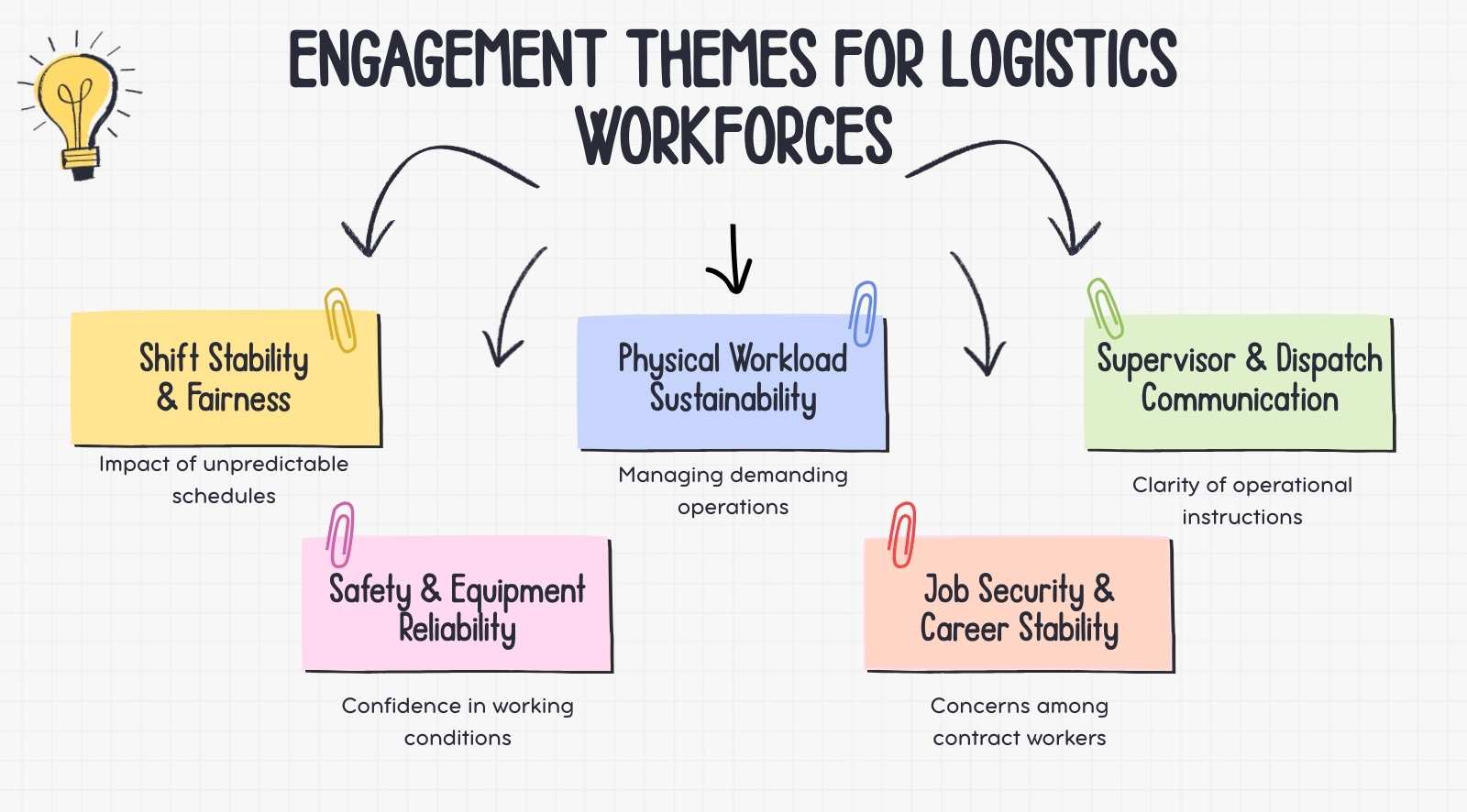
Logistics engagement surveys must reflect operational realities. Shift stability, workload sustainability, supervisor communication, safety confidence, and job security are core themes. Generic engagement frameworks often miss these logistics-specific drivers.
1. Shift stability and scheduling fairness
Unpredictable rosters affect psychological safety and work-life balance. Ongoing feedback helps surface concerns before burnout rises. When responses collected are grouped through statistical analysis, patterns appear without exposing individual responses.
2. workload sustainability
Physically demanding tasks require regular review beyond exit surveys. Consistent ongoing feedback highlights strain points early. With identity protection in place, employees speak freely, and statistical analysis reveals where support or redesign is needed.
3. Supervisor and dispatch communication
Clear instructions impact daily execution. Ongoing feedback and structured responses collected uncover gaps in tone, clarity, or escalation paths. Protecting individual responses improves honesty and reinforces the survey's importance.
4. Safety and equipment reliability
Faulty tools or unclear protocols weaken trust fast. Identity protection increases transparency in reporting issues. When responses collected undergo statistical analysis, leaders see systemic risks rather than isolated complaints.
5. Job security and career stability
Contract and gig workers often hesitate without psychological safety. Ongoing feedback channels replace reliance on exit surveys alone. Aggregated responses collected protect individual responses while revealing broader workforce sentiment.
Interpreting anonymous engagement trends across logistics operations
Trend analysis is critical in distributed logistics networks. Leaders should compare sites, shifts, and operational cycles to identify patterns. Consistent data collection improves data quality and enables proactive intervention rather than reactive correction.
- Compare morale across warehouses and routes: Use consistent questions to identify trends by site and route type. Good data quality helps separate local issues from network-wide signals. This turns employee sentiment into clear priorities for an engaged workforce.
- Detect operational hotspots early: Look for drops that repeat in the same lane, shift, or facility. When you collect responses weekly or monthly, the trend becomes visible fast. Candid feedback highlights what is driving friction.
- Spot recurring supervisor patterns: Cluster comments and scores by team size and tenure bands. This reveals management effectiveness issues without exposing identities. Strong data quality keeps you from overreacting to one-off complaints.
- Track engagement across operational cycles: Map employee sentiment to peak season, schedule changes, or policy shifts. When you collect responses around key events, you identify trends with context. This supports a steadier, more engaged workforce.
Converting anonymous feedback into operational improvements

Anonymous feedback creates value only when it leads to action. Leaders must prioritize recurring themes, assign clear ownership, and communicate updates transparently. Visible follow-through strengthens participation and reinforces credibility.
- Adjust scheduling fairness: Use survey patterns to spot uneven shifts, overtime loading, or last-minute changes. Update rules, publish them, and review monthly with site leads for teams. When people see predictable rotas, trust grows, and future feedback becomes sharper.
- Improve communication channels: If dispatch updates get lost, fix the channel before blaming compliance. Standardize where instructions live, set escalation paths, and confirm receipt at shift start. Cleaner comms reduce rework and make anonymous feedback about “confusion” drop quickly.
- Upgrade safety practices: Treat repeated safety comments as leading indicators, not noise. Prioritize quick wins like lighting, PPE availability, and equipment checks, then log closures publicly. When hazards are addressed fast, near-miss reporting rises, and operational downtime falls.
- Train supervisors on engagement leadership: Share site-level themes, then coach supervisors on daily habits: fair tasking, respectful tone, and follow-through. Tie improvements to behaviors, not slogans. Better frontline leadership reduces churn signals and lifts response rates next cycle.
- Address recurring workforce concerns: Group comments into the top three repeat issues in operations, assign an owner per site, and set a 30-day check-in. Close the loop with a short update: what changed, what did not, and why this month.
Case example: anonymous surveys improving retention in logistics teams
This case illustrates how structured anonymous listening identified dissatisfaction drivers tied to route changes and dispatch communication. By acting quickly on survey findings, leadership stabilized engagement and reduced delivery turnover within two cycles.
- Scenario spotted early: A delivery network saw rising dissatisfaction and a spike in resignations after route reshuffles. Traditional check-ins stayed polite. Once surveys were really anonymous, teams described unclear dispatch updates and unpredictable schedules as the real trigger, not pay.
- Actions taken fast: Leaders standardized dispatch messages, added a clear escalation path, and published scheduling rules two weeks ahead. They also trained supervisors on daily clarity. Because surveys are really anonymous, the next cycle showed sharper, more specific input.
- Results after two cycles: Engagement improved within two survey cycles, and delivery turnover reduced. Site leaders saw fewer no-shows and smoother handoffs. Most importantly, participation stayed steady because teams believed surveys really anonymous and worth the time.
CultureMonkey capabilities that are needed for anonymous engagement in logistics
Logistics organizations require platforms built for distributed, high-pressure operations. Anonymous participation safeguards, omnichannel access, mobile-first design, multilingual support, role-based controls, and workforce integrations are essential for scalable, credible engagement programs.
- Anonymous participation protection: Strong anonymity rules, minimum group thresholds, and safe reporting views prevent identity guessing. This drives higher participation across sites and makes feedback more direct, especially in small warehouses and route teams.
- Omnichannel surveys: QR codes, SMS links, kiosks, and messaging reminders ensure every role can respond. Omnichannel access improves reach across non-desk workforces and reduces bias caused by who has email.
- Mobile-first survey accessibility: Fast-loading surveys built for phones improve completion during shift breaks. Mobile-first design reduces drop-offs, supports short formats, and keeps the experience consistent across devices.
- Multilingual support: Language options reduce confusion and improve response clarity. Multilingual surveys help global and mixed-language sites share detailed feedback without translation loss.
- Role-based access control: Limit who can view results and what level they see. Role-based control reduces misuse risk and keeps sensitive themes from being traced back to individuals.
- Workforce system integrations: Integrations with HRIS, scheduling, and site structures keep segments accurate. Clean mapping improves analysis by location and shift without manual spreadsheet work.
Conclusion
Anonymous engagement surveys for logistics workforces are critical in warehouse and supply chain environments where operational dashboards rarely capture frontline realities. They give leaders early visibility into scheduling friction, safety risks, supervisor gaps, and morale shifts before these issues affect retention or service reliability.
In distributed, shift-based operations, protected listening builds trust and stability. When teams believe feedback is truly anonymous, participation improves, and insights become more accurate. This allows management to act before small concerns turn into costly disruptions.
CultureMonkey enables this with strong anonymity safeguards, mobile-first access, multilingual surveys, and role-based reporting tailored for logistics. By converting protected feedback into clear trends and structured action plans, organizations strengthen workforce trust, performance, and long-term operational resilience.
FAQs
1. What are anonymous engagement surveys in logistics?
Anonymous engagement surveys in logistics are structured feedback tools that allow warehouse, fleet, and delivery teams to share concerns without revealing identity. They capture insights on scheduling fairness, workload, safety, supervision, and communication. The goal is to surface operational risks early while protecting individuals from retaliation or unintended exposure.
2. Why do warehouse workers hesitate to share feedback?
Warehouse workers may hesitate due to fear of shift changes, route reassignment, or supervisor backlash. In high-pressure environments, speaking up can feel risky. If past feedback led to no visible change, trust drops further. Without clear anonymity safeguards, employees often choose silence over potential consequences.
3. How can logistics companies ensure survey anonymity?
Logistics companies can ensure anonymity by setting minimum response thresholds, removing identifiable metadata, and limiting access to raw results. Reporting should be aggregated by site or function rather than by small teams. Clear communication about data handling builds trust and reassures employees that responses cannot be traced back.
4. Do anonymous surveys increase participation rates?
Yes, when employees believe surveys are truly anonymous, participation typically increases. Workers are more likely to share honest feedback when identity is protected. Visible action on results further strengthens trust, making future survey cycles more credible and improving response consistency across shifts and locations.
5. Can anonymous feedback reduce warehouse attrition?
Anonymous feedback can reduce attrition by identifying dissatisfaction before employees resign. Patterns around scheduling, supervisor behavior, or safety concerns often emerge early. When leadership responds with clear operational changes, morale stabilizes, and turnover risk decreases across warehouses and delivery networks.
6. How often should logistics companies run engagement surveys?
Most logistics organizations benefit from quarterly surveys, with shorter pulse check-ins monthly during peak seasons or operational changes. The frequency should match business cycles. Regular listening helps track trends over time and ensures emerging risks are addressed before they affect performance or retention.
7. Who should review anonymous survey results?
Senior operations leaders, HR teams, and site managers should review aggregated results together. Role-based access controls are important to protect anonymity. Reviewing trends collaboratively ensures accountability while preventing misuse of sensitive feedback at the individual level.
8. How can logistics companies act on anonymous feedback?
Companies should prioritize recurring themes, assign clear owners, and communicate action steps publicly. Quick operational wins build credibility. Sharing what changed, what is under review, and expected timelines demonstrates that feedback influences real decisions, encouraging continued participation.
9. Can anonymous surveys improve safety performance?
Yes, anonymous surveys often surface unreported hazards, equipment concerns, or unsafe practices. When workers feel protected, they are more willing to flag risks early. Acting on these insights reduces incidents, strengthens compliance, and reinforces a culture of safety across facilities.
10. What software capabilities support anonymous logistics surveys?
Effective platforms offer minimum group reporting thresholds, mobile-first access, multilingual support, and role-based permissions. Omnichannel distribution through QR codes, SMS, and kiosks improves reach. Secure data handling and clear audit controls ensure anonymity is preserved while enabling detailed trend analysis.
)