


8 Best employee survey tools for construction companies: 2026 guide

The best employee survey tools for construction companies are the ones that can actually reach your workforce and workers without corporate email, rotating across sites, speaking multiple languages, employed through a mix of direct hire, subcontract, and labour-hire arrangements.
Most survey platforms were built for office or factory environments and fail in construction for predictable reasons.
This guide evaluates 8 tools, introduces the Site-Worker Accessibility Gap framework, and gives a construction-specific verdict for each tool so you can select with confidence.


- Best employee survey tools for construction companies: CultureMonkey — QR/WhatsApp delivery, multi-workforce segmentation, project-level dashboards, multilingual support
- Best for small construction companies: Workleap Officevibe — simple setup, manager nudges, affordable pricing
- Best for enterprise Tier 1 contractors: Qualtrics XM — advanced analytics, HRMS integration, custom survey logic
- Best for manager-led engagement: 15Five — coaching workflows paired with pulse surveys
- Most important criteria for construction: Site-worker accessibility, multi-workforce segmentation, project-level reporting, offline delivery capability
- Biggest mistake in tool selection: Choosing a tool based on feature count rather than whether it can physically reach your site workforce.
Why do most employee survey tools fail in construction?
Most employee survey tools fail in construction because they ignore mobile workers, language barriers, low trust, and site-based engagement realities by using an office survey tool. This is called the site-worker accessibility gap. These limitations of survey tools for construction come down to four structural reasons:
- No corporate email: Subcontractors and labour-hire workers rarely have a company email.
- No fixed workstation: Workers on active sites are mobile. There is no device to log into between tasks, becoming one of core survey tools challenges in construction.
- Project rotation: Workers cycle between sites and projects. Many leave before a survey cycle closes. Baseline data never gets built.
- Mixed employment types: Direct hire, subcontractor, and labour-hire workers share the same site but sit in different HR systems. One delivery channel misses at least one group every time.
For context on why construction workforces are uniquely difficult to engage, read our guide on workforce engagement challenges in construction.
Why does your workforce mix matter when choosing a survey tool?
Workforce mix matters because survey tools must fit desk, frontline, multilingual, and shift-based employees to ensure participation, accuracy, and actionable insights and a tool feature that works for a direct-hire-only workforce will not work in a workforce that is 60% subcontractor and labour-hire.
Before selecting a tool, define your workforce mix across three types:
- Direct hire: Your permanent employees. They have company emails, sit in your HRMS, and are reachable through standard survey delivery channels.
- Subcontractors: Engaged through a contracting firm. They are on your site but not in your HR system. Email delivery does not reach them without a subcontractor survey tool.
- Labour-hire: Placed by a third-party agency. They may not speak English as a first language, rotate frequently, and have no digital touchpoint with your organization.
Each workforce type needs a different delivery method. If your tool only supports one, you are only surveying part of your site. Working with an employee engagement survey provider brings a level of expertise and objectivity that in-house assessments often lack.
Here is what your workforce mix makes non-negotiable:
- Majority direct hire: Construction HRMS integration survey and email delivery are sufficient. Standard tools work. High turnover rates in construction are often linked to low employee engagement and burnout.
- Majority subcontractor: You need a subcontractor survey tool that supports QR code or WhatsApp delivery without requiring system access.
- Mixed or majority labour-hire: Multilingual support and offline delivery capability are non-negotiable. A tool without both will not produce valid data. Safety improvements can result from early identification of hazards through worker feedback.
Before selecting a tool, it helps to understand what a labour-hire workforce feedback culture looks like. Read about building a feedback culture in construction first.
8 Criteria evaluation framework that matter in a construction survey tool
The 8 criteria evaluation framework that matter in a construction survey tool are site accessibility, segmentation, reporting, multilingual support, anonymity, offline delivery, workflows, integration. These 8 criteria define what construction workforce survey tools need to function on active sites, across mixed workforces, and at project level.
Measuring engagement provides key insights into motivation, goal alignment, and overall morale which has a direct effect on productivity. To understand what to measure once your tool is deployed, see our engagement KPIs for construction operations framework.
The construction survey readiness score
The construction survey readiness score is an 8-point self-assessment framework that tells construction HR teams whether they are operationally ready to deploy a survey tool and get valid data from their workforce.
When construction companies learn how to use survey tools in construction environments, skipping it is why many rollouts fail in the first 90 days. Answer each question with a yes or no. Your score at the end tells you where you stand.
1. Do you know your workforce mix?
- Can you state the approximate percentage split between your direct hire, subcontractor, and labour-hire workers?
- If you cannot, your survey segments will be inaccurate from day one.
2. Can you reach workers without a corporate email?
- Do you have an alternative delivery method such as QR code, WhatsApp, or text message ready for workers not in your email system?
- If not, a significant portion of your site workforce will never see the survey.
3. Do your workers have a primary language other than English?
- If yes, does your chosen tool support their language natively?
- A survey your workforce cannot read is a survey they will not complete.
4. Are your crews regularly smaller than 10 people?
- Small crews require configurable anonymity thresholds.
- If your tool cannot protect identity at this scale, workers will not respond honestly.
5. Do your sites have reliable internet connectivity?
- If connectivity is inconsistent, your tool needs offline mode with automatic sync.
- Without it, you will lose responses on every low-signal site.
6. Do your site foremen have capacity to support a rollout?
- A site worker survey tool deployed without foreman buy-in will achieve low participation.
- Foremen are the primary trust bridge between the tool and the site workforce.
7. Are your HR systems integrated or siloed?
- If your direct hire, subcontractor, and labour-hire data sits in separate systems, your tool needs API or SFTP integration to automate segmentation.
- Manual data management at scale is not sustainable.
8. Do you have a plan to act on survey results within 30 days?
- Deploying a workforce engagement survey construction without a response protocol destroys trust faster than not surveying at all.
- Workers who see no action after feedback stop responding permanently.
Your score
You are operationally ready. Select your tool and begin deployment.
Address the gaps before full deployment or you will get incomplete data.
Do not deploy yet. Fix the structural gaps first. A survey tool will not solve problems your workforce infrastructure cannot support.
To understand how to apply these criteria consistently across projects, read our guide on measuring engagement across multi-site construction.
8 Best employee survey tools for construction companies
The best employee survey tools for construction companies in this list are evaluated with the features and publicly available data about these tools. Construction employee survey tools pricing, fit scores, and limitations are all covered so you know exactly where each tool stands before you talk to a vendor. These are the employee feedback tools construction sites actually use.
1. CultureMonkey
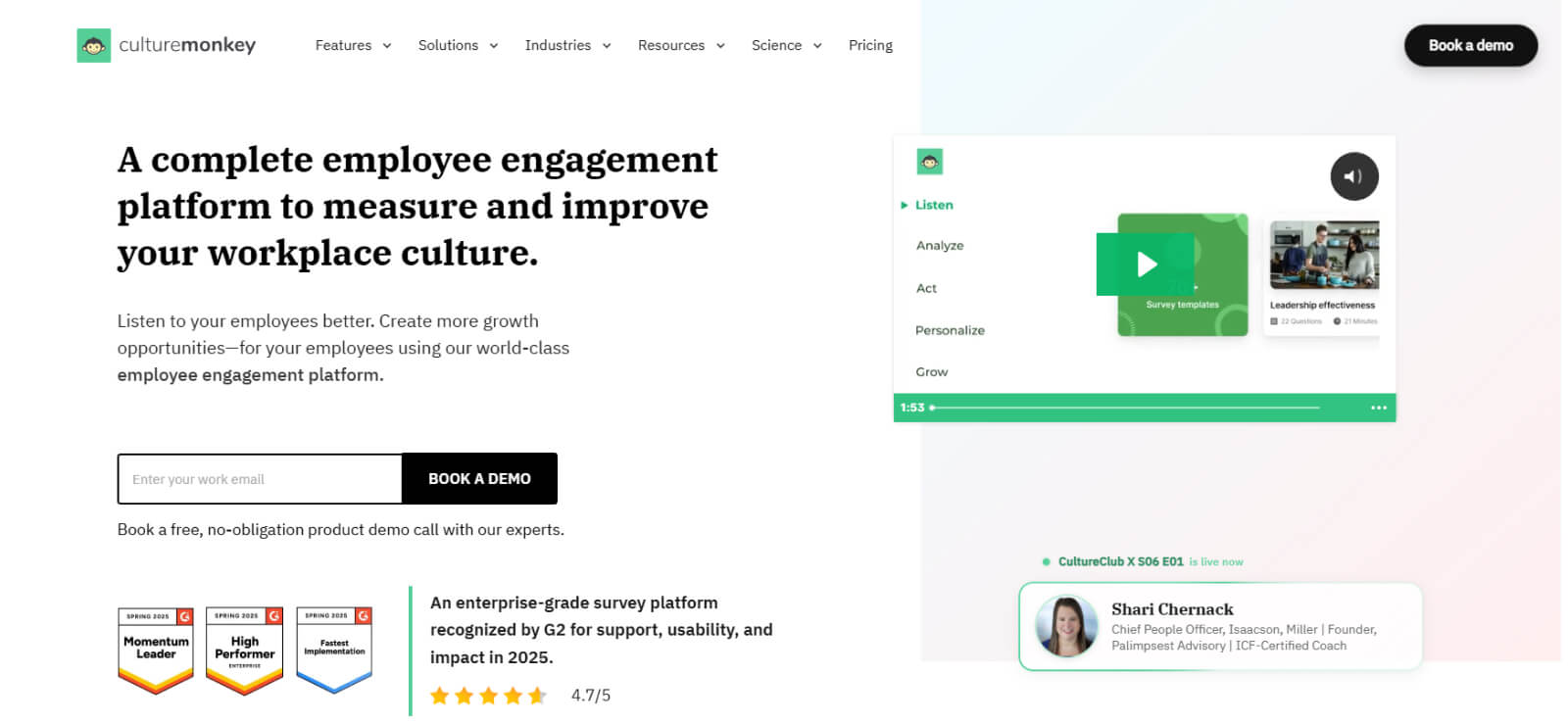
CultureMonkey is an enterprise employee engagement software for mid-market to enterprise construction firms that need to reach mixed workforces across multiple active sites.
Best for: Enterprise construction firms with diverse workforce types across multiple sites
Pricing: Contact sales
G2 score: 4.7.
Construction-specific limitation: Requires configuration for construction-specific segments before deployment.
Construction-specific verdict: For firms with a significant subcontractor or labour-hire workforce, as one of the best pulse survey tools for construction, it can function on an active site without relying on email.

2. Culture Amp

Culture Amp is an employee experience platform suited for mid-to-large construction groups with established HR teams and structured listening programs.
Best for: Mid-to-large construction groups with strong HR teams and structured engagement programs
Pricing: Contact sales
G2 score: 4.5.
Construction-specific limitation: No construction-specific templates and office-first design.
Construction-specific verdict: Works as a construction HR survey platform for head office and salaried construction workforce segments. For site-based workers, subcontractors, and labour-hire, it may not reach them without workarounds.

See how Astra recorded a 7.5/10 engagement score with CultureMonkey
See how3. Qualtrics XM
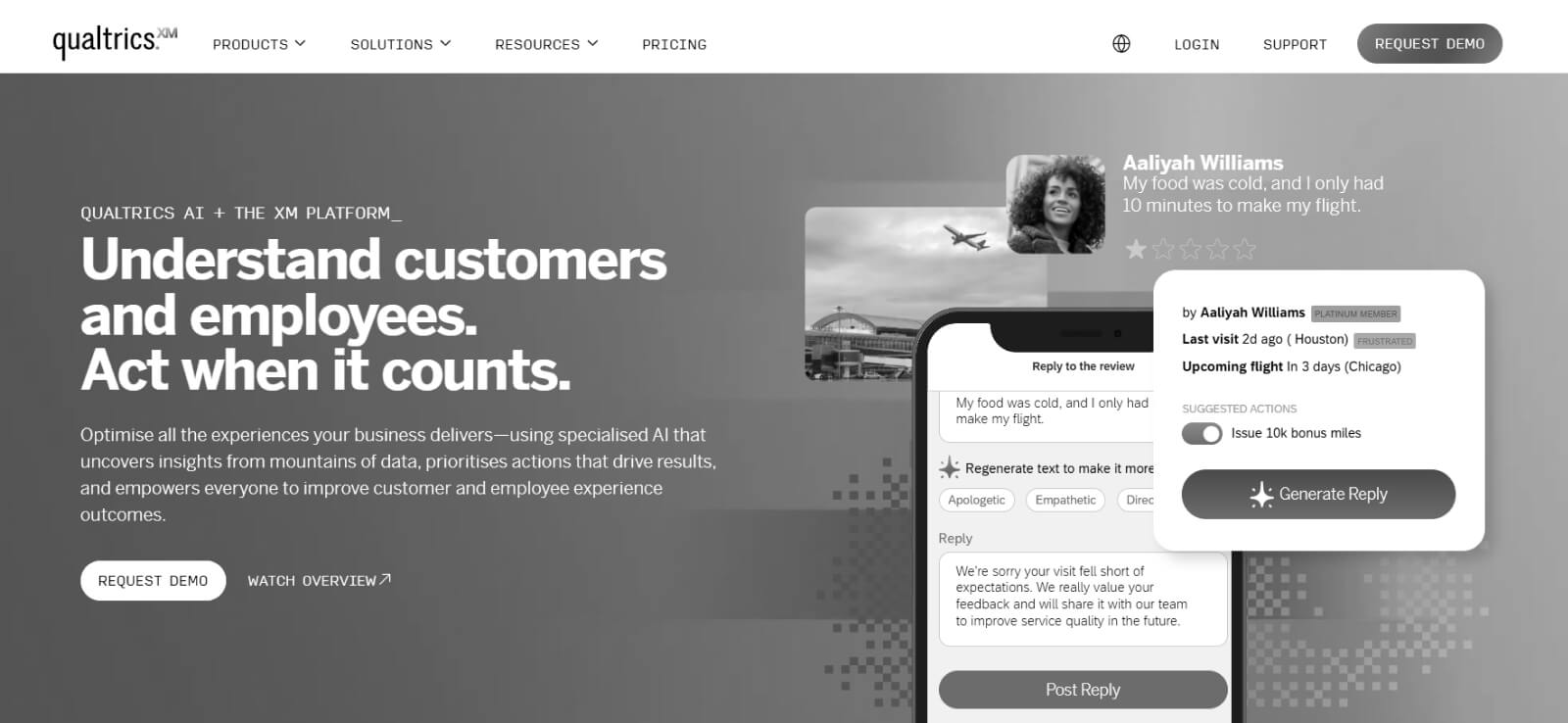
Qualtrics XM is an experience management platform suited for Tier 1 contractors with large-scale analytics requirements and dedicated HR technology teams.
Best for: Enterprise Tier 1 contractors with large analytics requirements and dedicated HR technology resources.
Pricing: Contact sales.
G2 score: 4.4.
Construction-specific limitation: Complex setup may be over-engineered for most construction HR teams without dedicated analytics support.
Construction-specific verdict: Qualtrics XM is one of the survey tools for construction industry with a possibly complex setup and the cost may outweigh the analytics depth it offers.
4. Workleap Officevibe
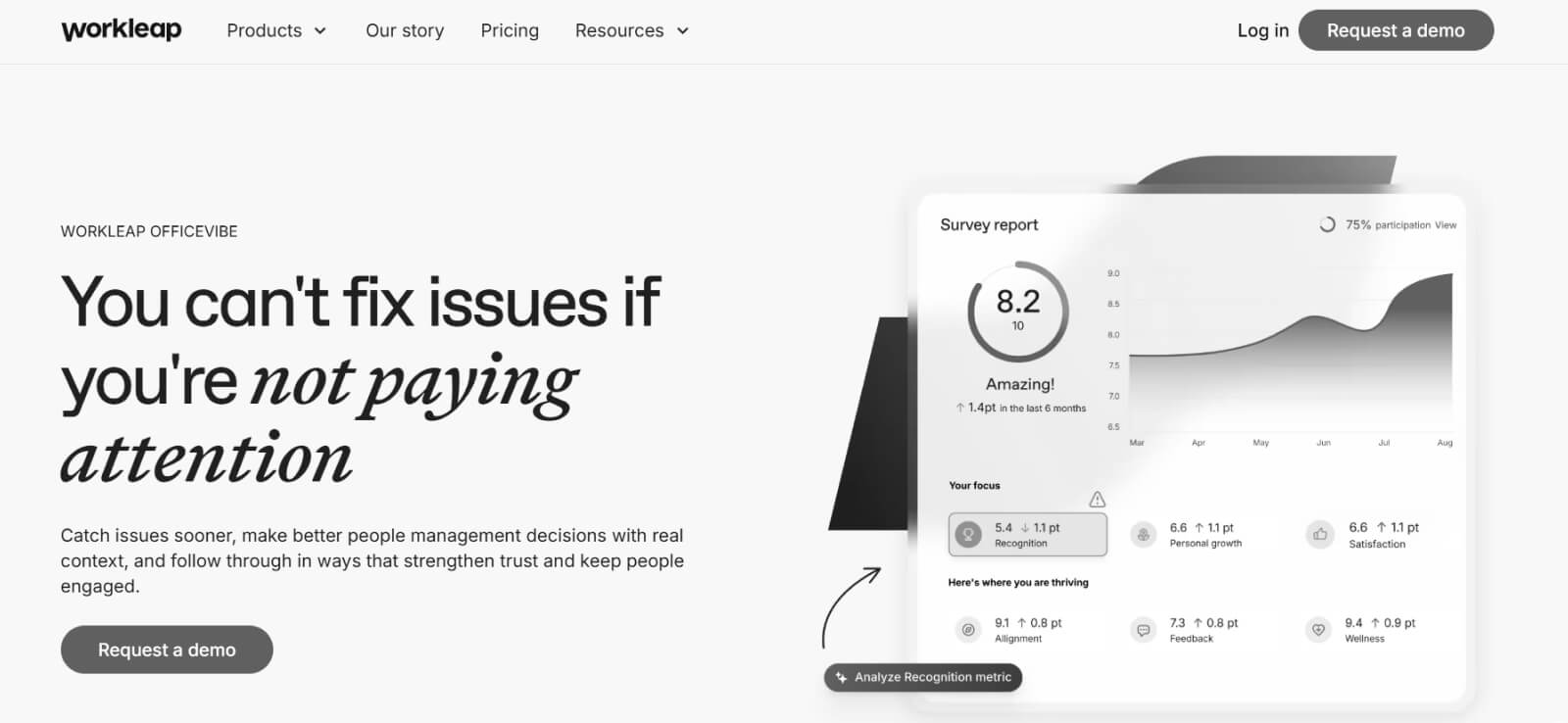
Workleap Officevibe is an employee engagement platform built for small-to-mid construction companies that need a simple, low-friction survey tool without complex setup or configuration.
Best for: Small-to-mid construction companies wanting a simple, manager-led engagement tool with minimal setup.
Pricing: Starts from $5 per user per month.
G2 score: 4.3.
Construction-specific limitation: Limited multi-site segmentation may make it challenging to track engagement across multiple active sites.
Construction-specific verdict: For small construction companies with a predominantly direct-hire workforce, Workleap Officevibe may be one of the best pulse survey tool for construction at this price point, but its delivery reach may not be sufficient.
(Source: Gallup)
5. SurveyMonkey Workforce
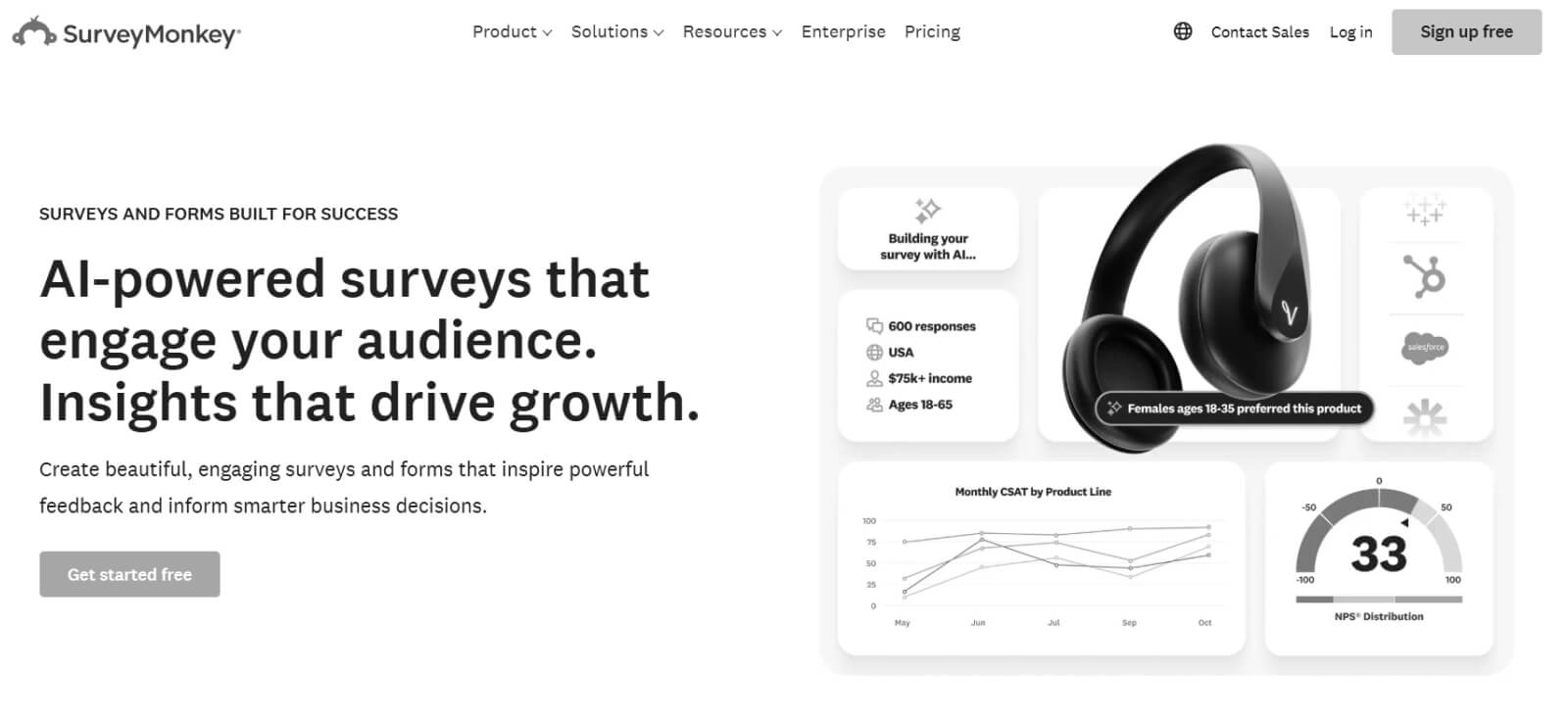
SurveyMonkey Workforce is a general-purpose survey platform suited for construction companies that need a low-cost entry point into structured employee feedback.
Best for: Construction companies needing a low-cost entry point into employee feedback with a familiar interface.
Pricing: Starts from $30 per user per month.
G2 score: 4.4.
Construction-specific limitation: No construction-specific features or templates with insufficient anonymity thresholds for small crews.
Construction-specific verdict: SurveyMonkey Workforce may work for construction companies surveying office staff on a limited budget, but its delivery architecture and anonymity controls may fall short of what construction environments require.
6. TINYpulse
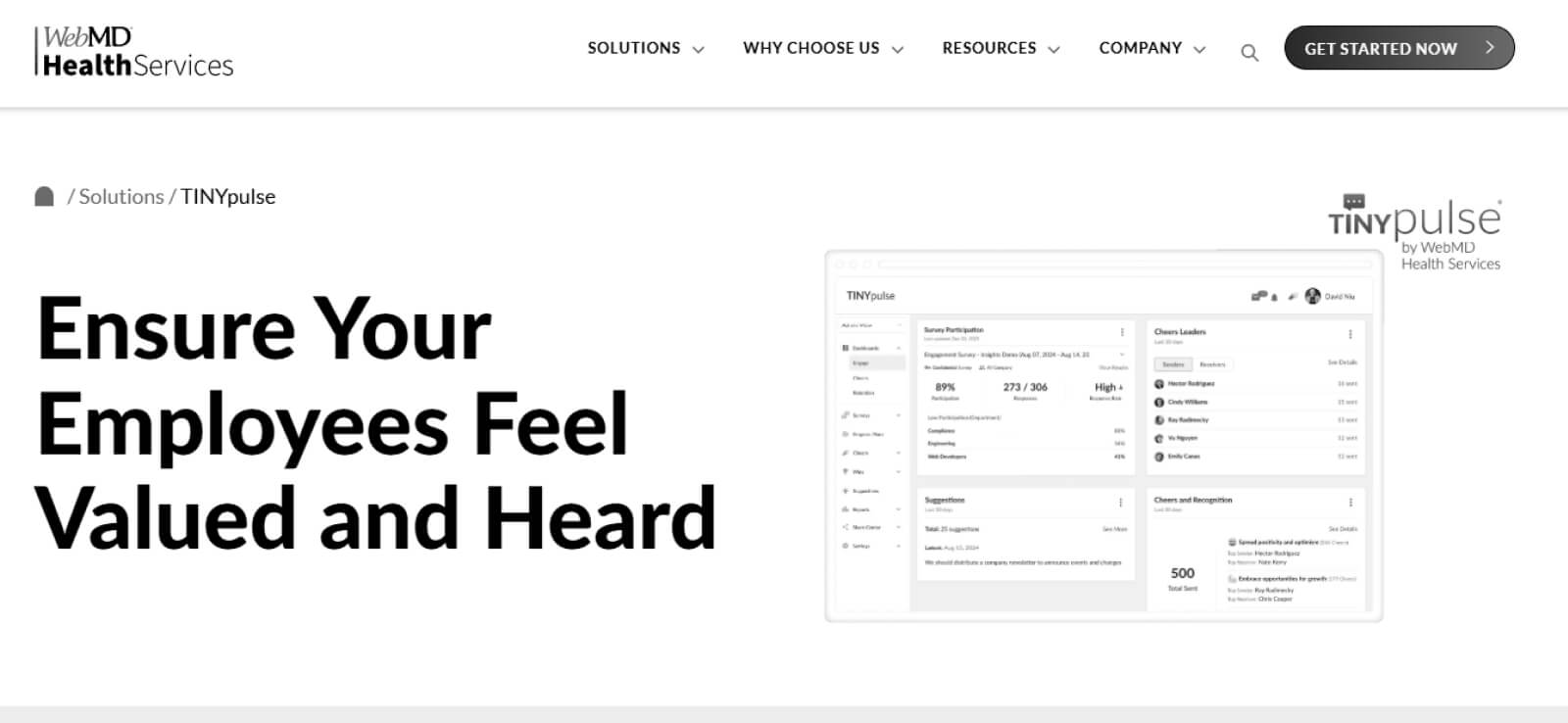
TINYpulse is an employee feedback platform suited for construction HR teams that need frequent, lightweight pulse check-ins across direct-hire workforces.
Best for: Construction HR teams wanting frequent lightweight check-ins across direct-hire workforces.
Pricing: Contact sales.
G2 score: 4.4.
Construction-specific limitation: Limited analytics depth and no project-level reporting may make it challenging to track engagement across multiple sites.
Construction-specific verdict: TINYpulse may work as a construction HR survey platform for smaller firms running pulse checks with direct-hire workforces. But for companies with labour-hire workers, its segmentation and analytics depth may not be sufficient.
How Astra Built Construction Workforce Listening with CultureMonkey

7. Lattice
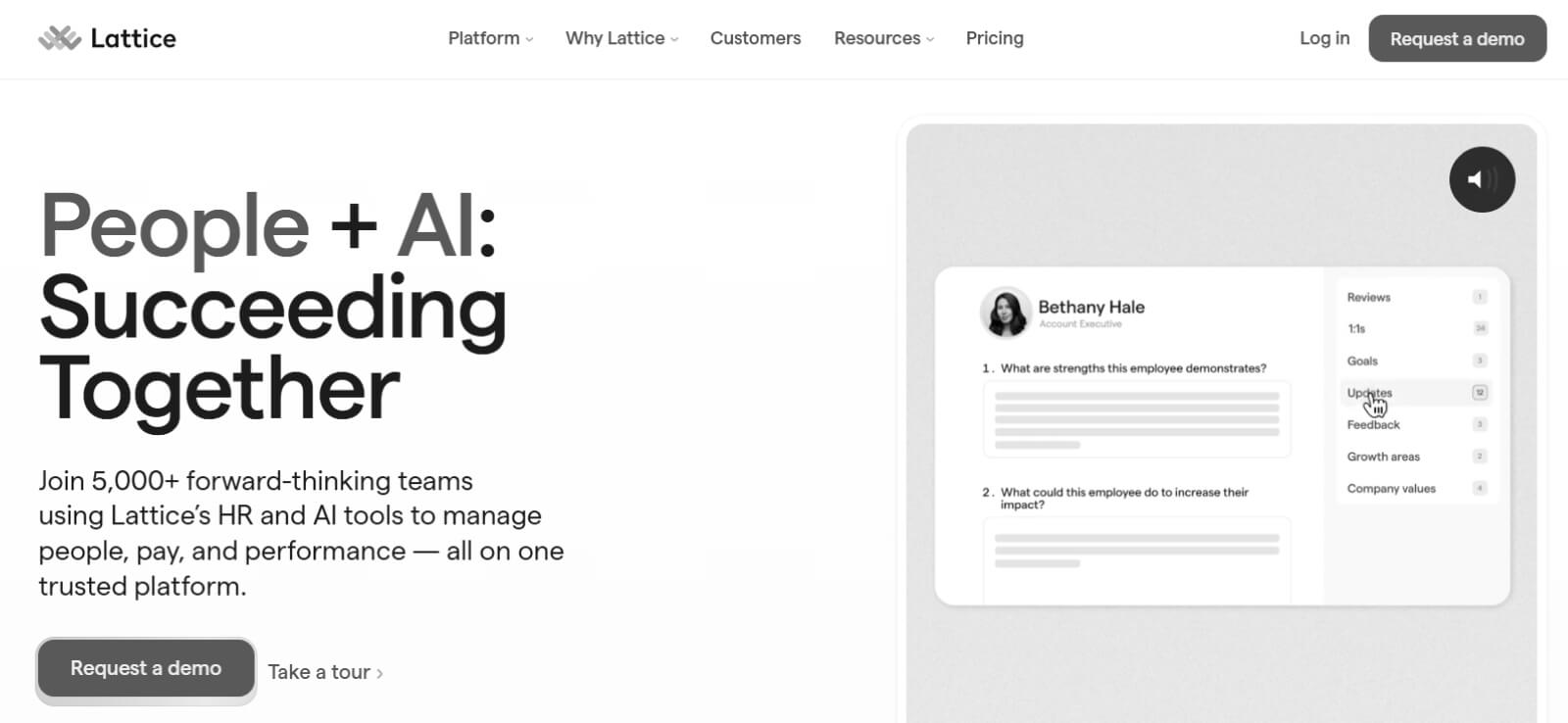
Lattice is a people management platform suited for construction firms that want to connect employee engagement data directly to performance management workflows.
Best for: Construction firms tying employee engagement to performance management.
Pricing: Starts from $11 per user per month.
G2 score: 4.7.
Construction-specific limitation: Performance management focus means engagement features may be secondary. Site-worker accessibility and project-level reporting are not native capabilities.
Construction-specific verdict: Lattice may work to connect engagement to performance outcomes, but for construction companies prioritising site-worker reach and multi-workforce segmentation over performance management, other tools in this list may be a stronger fit.
8. 15Five
15Five is a performance and engagement platform suited for construction companies investing in manager development and coaching workflows across salaried and office-based workforces.
Best for: Construction companies investing in manager development and coaching workflows.
Pricing: Starts from $4 per user per month.
G2 score: 4.6.
Construction-specific limitation: Desk-centric design means site-based worker reach may be limited.
Construction-specific verdict: For companies where site-worker reach and multi-workforce segmentation matter more than coaching workflows, other tools than 15Five in this list may be a stronger fit.
Switching to CultureMonkey and connecting to our real HR data has just been a game changer for us. Now I can see engagement information down to the manager level, which is just a completely different world.

How do construction companies deliver surveys on site?
Construction companies deliver surveys on site through QR codes, kiosks, supervisor-assisted forms, mobile links, and offline modes for low connectivity environments. The right survey tool architecture for construction is built around how workers’ prefer to work through multi-workforce segmentation.
QR code gate stations:
- Put QR codes at site entry points, crib sheds, and amenity blocks.
- Workers scan and respond in under 2 minutes as part of their normal site movement. Real-time insights from employee surveys help managers address issues quickly on-site.
WhatsApp delivery:
- Send survey links to workers' personal numbers via WhatsApp.
- No corporate email, no app download, no login needed. Mobile-first design is essential for survey tools used by construction field employees.
Foreman-administered verbal pulse:
- Foremen ask 2 to 3 questions verbally during toolbox talks or shift handovers as a data driven strategy.
- Responses are recorded anonymously in aggregate.
Shift handover survey moments:
- Send surveys during the natural pause between shifts when workers are stationary. Aligning your project-phase survey cadence to site milestones gives you phase-comparable data across projects.
- Participation is highest when surveys fit an existing site routine.
Offline paper fallback:
- On remote or low-signal sites, paper QR sheets capture responses until connectivity returns.
- Results sync automatically once the device reconnects. Anonymity in survey tools is crucial for honest feedback regarding safety protocols.
These surveys provide valuable employee insights into workforce sentiments, helping you improve morale.
Which survey tool is right for your construction company?
The right survey tool for your construction company depends on three variables: company size, workforce mix, and site complexity. Choosing a construction company engagement platform comes down to three variables: company size, workforce mix, and site complexity.
Employee engagement survey vendors specialize in conducting surveys to measure engagement, satisfaction, and motivation within organizations.

Treat employees like they make a difference and they will.
Jim Goodnight

Founder and CEO at TalentCulture
What happens in the first 90 days after you deploy a survey tool?
The first 90 days of survey tool implementation in construction, teams drive adoption, collect baseline data, identify risks, activate managers, and begin closing feedback loops consistently. Participation rates start low, data quality builds over time, and manager adoption is what makes or breaks the survey software for site-based workforce.
Days 1 to 30: Setup and first response
- Complete your onboarding survey tool configuration with workforce segments, delivery channels, and language settings.
- Deploy your first pulse survey to a single site or team before rolling out org-wide.
- Participation starts low in the first cycle and builds as trust develops. Workers do not trust a new tool until they see a response to their feedback.
- Do not draw conclusions yet. The data is too thin. Pulse surveys repeat a shorter group of questions on a regular basis to address concerns or morale in a more responsive timeframe.
Days 31 to 60: Data quality ramp-up
- Participation rates typically climb as workers see the tool is consistent and anonymous. Customized surveys and timelines allow HR managers to create unique questions as well as a schedule of employee check-ins.
- Foremen and site managers begin reviewing team-level results. This is where manager adoption either takes hold or stalls.
- Workers who see one visible action taken from their feedback are significantly more likely to respond in the next cycle.
- Check which sites or workforce segments have low participation and address delivery method gaps before the next cycle.
Days 61 to 90: Baseline established
- By day 90, you have enough data collection to establish a site-level engagement baseline.
- Check which managers have not reviewed or acted on results yet.
- Review your Construction Survey Readiness score gaps identified before deployment and assess which ones are now resolved.
- Set your survey cadence for the next quarter based on what the first 90 days revealed about your workforce's response patterns.
Knowing how to use survey tools in construction is not just about the survey software for site-based workforce suggesting you exactly what to do. It is about the 90-day window where habits, trust, and data quality are built or lost.
.webp)
Make every crew voice count, on every site survey with CultureMonkey
- Mobile Friendly Distribution
- 100+ Multi-lingual Surveys
- People Science Backed Reports
- Enterprise Grade Security
Conclusion
The best employee survey tools for construction companies reaches every worker, segments every employment type, and reports at site level. When construction companies use the right survey tools, they improve engagement, reduce turnover, strengthen safety outcomes, and make better workforce decisions.
From omni-channel delivery that reaches subcontractors and labour-hire workers to project-level dashboards that track engagement by site, CultureMonkey acts as the best survey tool for frontline construction workers, built to solve the exact problems construction HR teams face.

Book a demo with CultureMonkey.
FAQs
1. What is the best employee survey tool for construction companies?
The best tool for construction depends on workforce mix and site complexity. CultureMonkey is the best pulse survey tool for construction companies with QR/WhatsApp delivery and multi-workforce segmentation. Workleap Officevibe works for smaller companies. Qualtrics XM fits Tier 1 contractors needing deep analytics.
2. How do you survey construction workers who don't have email?
Construction workers without email can be surveyed using QR codes at site gates, WhatsApp links, text message pulse checks, or foreman-led verbal questions recorded anonymously. Tools that rely only on email consistently see lower participation on active construction sites. Delivery method determines reach.
3. What features should a construction survey tool have?
A construction survey tool needs 8 must-have features: QR/WhatsApp/text message delivery, multilingual support, multi-workforce segmentation, project-level reporting, anonymity in small crews, offline survey tool construction, foreman-level dashboards, and HRMS integration. Most generic tools meet only 2 or 3 of these criteria.
4. Can you run anonymous surveys with small construction crews?
Yes, you can run anonymous surveys with small construction crews, but the tool needs correct configuration first. For crews under 10, use response threshold controls so results only display at 5 or more responses. Tools without configurable anonymity thresholds should not be deployed in crews this small.
5. How do employee survey tools help reduce construction attrition?
Employee survey tools reduce construction attrition by surfacing early warning signs before exits occur. Declining engagement scores, dropping supervisor trust, and low participation are signals that tools with project-level segmentation can detect and act on before workers decide to leave the site.
6. What is the difference between a pulse survey and an engagement survey for construction?
A pulse survey is short, 3 to 8 questions sent weekly or fortnightly, measuring immediate site sentiment like morale, workload, and supervisor trust. An engagement survey is a comprehensive annual survey measuring deeper workforce drivers. Construction workforces need both to manage sites effectively.
7. How do construction companies measure engagement across multiple sites?
Construction companies measure engagement across multiple sites using a tool with site-level segmentation and project-phase reporting. Site-level benchmarks always work better than org-wide standards since each site scores differently depending on its project phase and workforce mix at any given time.