


Employee feedback tools for healthcare organizations: What to look for

Employee feedback tools for healthcare organizations are systems that collect staff input across clinical and non-clinical teams and convert it into operational insight. In healthcare settings, these tools must support frontline participation, protect psychological safety, and meet strict compliance expectations.
Hospitals operate with shift work, clinical hierarchies, and high-stress environments where feedback and employee experience signals burnout, safety concerns, and operational friction.
This guide outlines tested frameworks healthcare leaders use to evaluate healthcare employee engagement software and determine which capabilities actually work in complex care environments.


- Employee feedback tools for healthcare organizations collect staff insights to detect burnout, safety risks, and operational issues across clinical teams.
- Healthcare systems need anonymous, frontline-friendly feedback channels for shift-based and distributed workforces.
- Compliance safeguards must protect patient information and sensitive workforce feedback data.
- AI analysis helps surface burnout patterns, safety concerns, and turnover risk early.
- CultureMonkey enables secure, anonymous, frontline-friendly employee feedback tools for healthcare organizations with AI insights and action planning.
What workforce challenges affect employee feedback in healthcare organizations?
Healthcare workforce challenges affect employee feedback because hospitals operate under operational and regulatory pressure. Employee feedback tools must capture frontline insight without disrupting or exposing staff to risk.
Healthcare providers operate through rotating shifts and strict regulatory oversight. These conditions increase the consequences of missed signals, such as burnout, safety concerns, or communication breakdowns across units.
When designed correctly, effective feedback systems track progress and help leaders detect frontline barriers.
- A distributed clinical workforce spreads staff across hospitals and care locations.
- High-stress environments require early burnout signals to reduce care risks.
- Rotational shifts limit feedback reach without shift-aware distribution.
- Regulatory sensitivity requires feedback systems that avoid patient data exposure.
- Psychological safety allows staff to report concerns without retaliation.
Regular employee feedback increases morale and retention by showing team members that the organization is invested in their growth.
What workforce challenges affect employee feedback in healthcare organizations?

Healthcare organizations depend on fast communication across roles, departments, and care settings. Healthcare providers face unique challenges that require tailored employee engagement software to address high-pressure environments and complex shift patterns.
When staff feedback is difficult to collect or unsafe to share, operational issues often stay hidden until they affect workforce stability or care delivery.
- Shift-based scheduling: Irregular hours reduce survey participation unless feedback distribution aligns with staff shifts.
- Clinical hierarchies: Power distance can discourage junior staff from sharing honest feedback without strong psychological safety.
- Burnout and compassion fatigue: Feedback tools must detect early stress signals before they affect workforce stability.
- Multi-location systems: Hospitals, clinics, and long-term care facilities require consistent feedback collection across sites.
Effective engagement software must include features like real-time communication, feedback tools, and analytics to meet the diverse healthcare employee needs. Involving staff in the development of new patient care strategies can lead to higher engagement and satisfaction.
Compliance and data security requirements for healthcare employee feedback systems
Healthcare employee feedback systems must operate within strict regulatory boundaries. Unlike general workplace survey tools, healthcare platforms must protect clinical context, prevent accidental disclosure of sensitive data, and maintain clear auditability of access and reporting.
HIPAA compliance
Healthcare feedback platforms must ensure staff comments and survey responses never expose protected patient information.
- Prevent staff from sharing identifiable patient details.
- Secure storage and encrypted data handling.
- Role-based access to sensitive responses.
Employee feedback can enhance communication and improve job satisfaction among staff, which in turn can attract new patients.
Protected health information boundaries
Employee feedback tools must clearly separate workforce feedback from patient-related information.
- Block fields that capture patient identifiers.
- Train staff to avoid PHI in comments.
- Flag risky language in open responses.
Employee feedback can enhance communication and improve job satisfaction among staff, which in turn can attract new patients.
GDPR for multinational hospital systems
Global healthcare systems must manage employee feedback data under international privacy regulations.
- Ensure lawful employee data processing.
- Support regional data residency requirements.
- Provide employee data access rights.
A happy and empowered workforce directly translates to the quality of care. Getting employee feedback using quality improvement initiatives can help healthcare leaders garner vital clinician insights to boost patient satisfaction scores.
Audit trails and access logging
Healthcare organizations require visibility into who accessed staff engagement feedback data and when.
- Track access to survey responses.
- Maintain logs for compliance reviews.
- Enable monitoring of sensitive insights.
A culture of continuous feedback can enhance employee performance and create a sense of community within healthcare organizations.
Vendor data processing agreements
Healthcare providers must confirm vendors meet contractual and regulatory data protection responsibilities.
- Define vendor data handling obligations.
- Establish breach notification procedures.
- Clarify data retention and deletion policies.
Sharing feedback results with all healthcare staff can help maintain morale and ensure employees feel heard and appreciated.
(Source: Deloitte)
Why is anonymous feedback critical in healthcare work environments?
Anonymous feedback is critical in healthcare because staff must be able to report risks, stress, and operational problems without fear. Employee feedback tools for healthcare organizations must create safe channels where frontline employees can share concerns honestly.
In care environments, missed signals can escalate into workforce burnout or patient safety issues. Anonymous feedback systems therefore act as protective mechanisms that surface sensitive issues early while protecting the people reporting them.
- Safe reporting of safety concerns helps staff raise patient needs and safety issues without fear.
- Ability to protect employee identity in small teams through anonymous thresholds in small departments.
- Preventing retaliation fears builds trust so employees share honest feedback.
- Provide controlled visibility of confidential responses to handle sensitive open-text comments.
Exit surveys capture critical insights of staff engagement from departing staff to reduce future turnover. One-on-one meetings are structured, regular check-ins that facilitate open dialogue on career development and job satisfaction.
How can healthcare organizations collect employee feedback from frontline staff?

Healthcare feedback systems often fail when they rely on email or desktop portals. Employee feedback tools for healthcare organizations must reach frontline staff through fast, accessible channels that fit shift-based workflows.
Text message-based surveys
Text message surveys reach frontline healthcare staff instantly on personal mobile devices. They remove login friction and improve participation among shift-based employees who rarely access corporate email systems.
Look for:
- Direct survey links sent through secure text messages.
- Shift-aware timing for distribution.
- Two-minute pulse surveys optimized for mobile.
Pulse surveys are short, frequent surveys to measure real-time employee satisfaction on specific issues. Employee engagement software can help healthcare organizations build a culture of continuous feedback, which is crucial for employee development and satisfaction.
QR code distribution in break rooms
QR codes allow healthcare workers to access surveys quickly during shift breaks without logging into internal systems. This approach supports rotating teams and temporary staff across hospital units.
Consider various features such as:
- Posters with secure QR survey links.
- Access without mandatory login credentials.
- Mobile-friendly survey interfaces.
Improved safety culture proactively measures and improves the organizational commitment to safety.
Kiosk-based feedback in hospital units
Kiosks allow staff to submit feedback quickly using shared devices placed inside hospital units to understand the company culture. They help capture input from employees without personal smartphones during or after shifts.
Platforms should support:
- Secure shared-device survey access.
- Fast response interfaces for short surveys.
- Automatic session reset after each response.
360-degree feedback gathers input from peers, managers, and direct reports for comprehensive development.
Mobile-first interfaces for non-desk staff
Mobile-first design ensures surveys are usable on smartphones, the primary device for many frontline healthcare employees working across hospital floors, clinics, and long-term patient care facilities.
Key areas include:
- One-click survey access on smartphones.
- Short, scroll-friendly survey layouts.
- Low-bandwidth performance for hospital networks.
Increased engagement boosts morale through peer recognition and transparent communication. Reduced burnout identifies burnout hotspots in real-time, allowing for rapid intervention.
How does AI improve employee feedback analysis in healthcare organizations?
Healthcare organizations generate large volumes of employee feedback across survey and pulse checks. Employee engagement software is essential for improving staff retention, morale, and patient care quality in healthcare organizations.
AI in employee feedback tools for healthcare organizations helps convert this data into operational insights to boost employee satisfaction and provide insights that leaders can act on before issues escalate.
- Sentiment detection for burnout risk: Employee comments and tone patterns are reviewed by AI to identify early signs of stress, exhaustion, or workload pressure.
- Pattern recognition in safety concerns: AI groups repeated feedback themes across units to surface hidden operational risks affecting care delivery.
- Early-warning signals for turnover: Changes in feedback trends that indicate disengagement, resignation intent, or rising dissatisfaction can be tracked by AI.
- Predictive engagement analytics: AI connects feedback trends with workforce behavior with real time insights to anticipate engagement decline before performance or retention issues appear.
Effective healthcare employee engagement software prioritizes accessibility for deskless staff. The best employee engagement software for healthcare should be HIPAA-compliant and support user-friendly mobile access for frontline workers.
How to evaluate employee feedback tools for healthcare organizations?
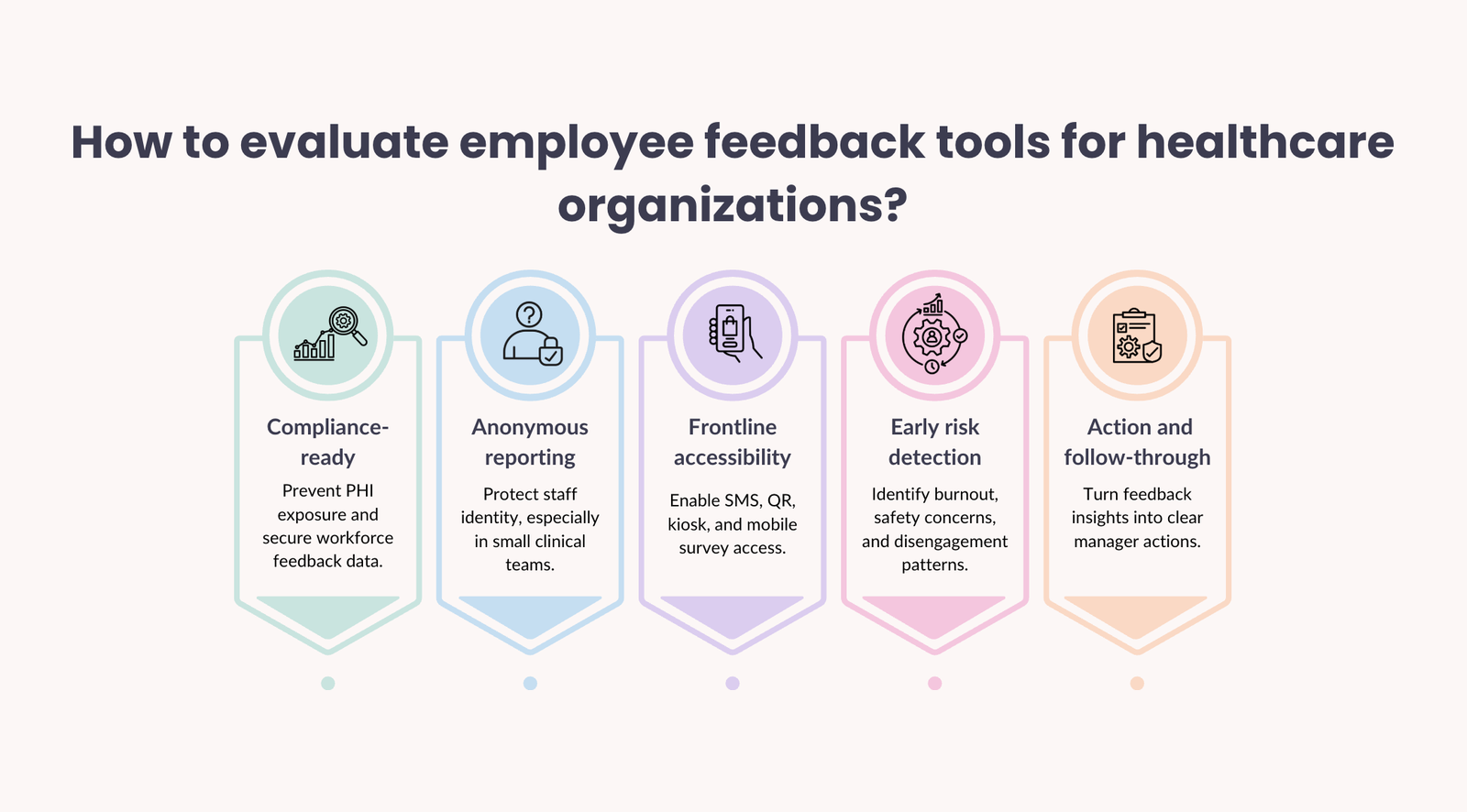
Healthcare organizations cannot evaluate employee feedback tools using generic HR software checklists. Hospitals operate with strict compliance obligations, frontline participation constraints, and sensitive workforce data.
The evaluation process must therefore prioritize healthcare-specific safeguards, operational accessibility, and risk detection capabilities rather than surface-level survey features.
| Evaluation question | Healthcare-ready capability | Risk if missing |
|---|---|---|
| Does the platform prevent patient data exposure in staff feedback? | HIPAA-ready architecture with encryption and PHI safeguards | Patient data exposure and compliance violations |
| Can staff report concerns without fear in small clinical teams? | Anonymous controls with identity protection and aggregated reporting | Employees avoid sharing safety or workplace concerns |
| Can frontline staff access surveys during shifts easily? | SMS surveys, QR codes, kiosks, mobile-first access | Low participation from nurses and technicians |
| Can the system detect workforce risks early? | AI pattern detection for burnout, safety concerns, disengagement | Burnout and safety signals remain hidden |
| Can feedback be analyzed by clinical role or unit? | HRIS integration syncing roles, departments, locations | Insights cannot be segmented by care team |
| Can the tool be deployed without disrupting care operations? | Phased rollout across hospitals and facilities | Implementation delays and operational disruption |
Large healthcare networks often use robust platforms for deep analytics and organization-wide listening strategies. Integration with existing HR systems is a key feature for employee feedback tools to streamline processes and data management.
Employee feedback benchmarks for healthcare organizations

Healthcare workforce research highlights several structural risks that employee feedback tools must detect early. These benchmarks help healthcare leaders understand why continuous listening systems matter for operational stability and workforce safety.
- 50%+ of physicians report at least one burnout symptom, per the AMA National Physician Burnout Survey.
- 18% of healthcare workers left their roles last year, according to Press Ganey’s Nurse Experience.
- 46% of health workers often felt burned out in 2022, up from 32% in 2018, per The Joint Commission.
- 17% of nurses left their roles last year, also reported in Press Ganey’s Nurse Experience.
- 0.02 points engagement decline occurred on a 5-point scale, based on 1.4M employees in Press Ganey’s Employee Experience.
- 20% better performance is linked to engaged employees, based on evidence summarized in a PubMed Central paper.
.webp)
Build Safer Healthcare Teams with CultureMonkey
- Quick Pulse Surveys
- Omni Channel Distribution
- AI Sentiment Analysis
- Enterprise Grade Security
Actionable data converts qualitative, anonymous feedback into data-driven strategies for improvement. Employee feedback tools should include flexible survey options to gain insights from various employee experiences.
Conclusion
Employee feedback tools for healthcare organizations function as operational infrastructure rather than simple surveys. Effective healthcare listening systems must balance compliance safeguards, psychological safety, operational accessibility, and predictive risk detection that surfaces burnout or employee well being concerns early.
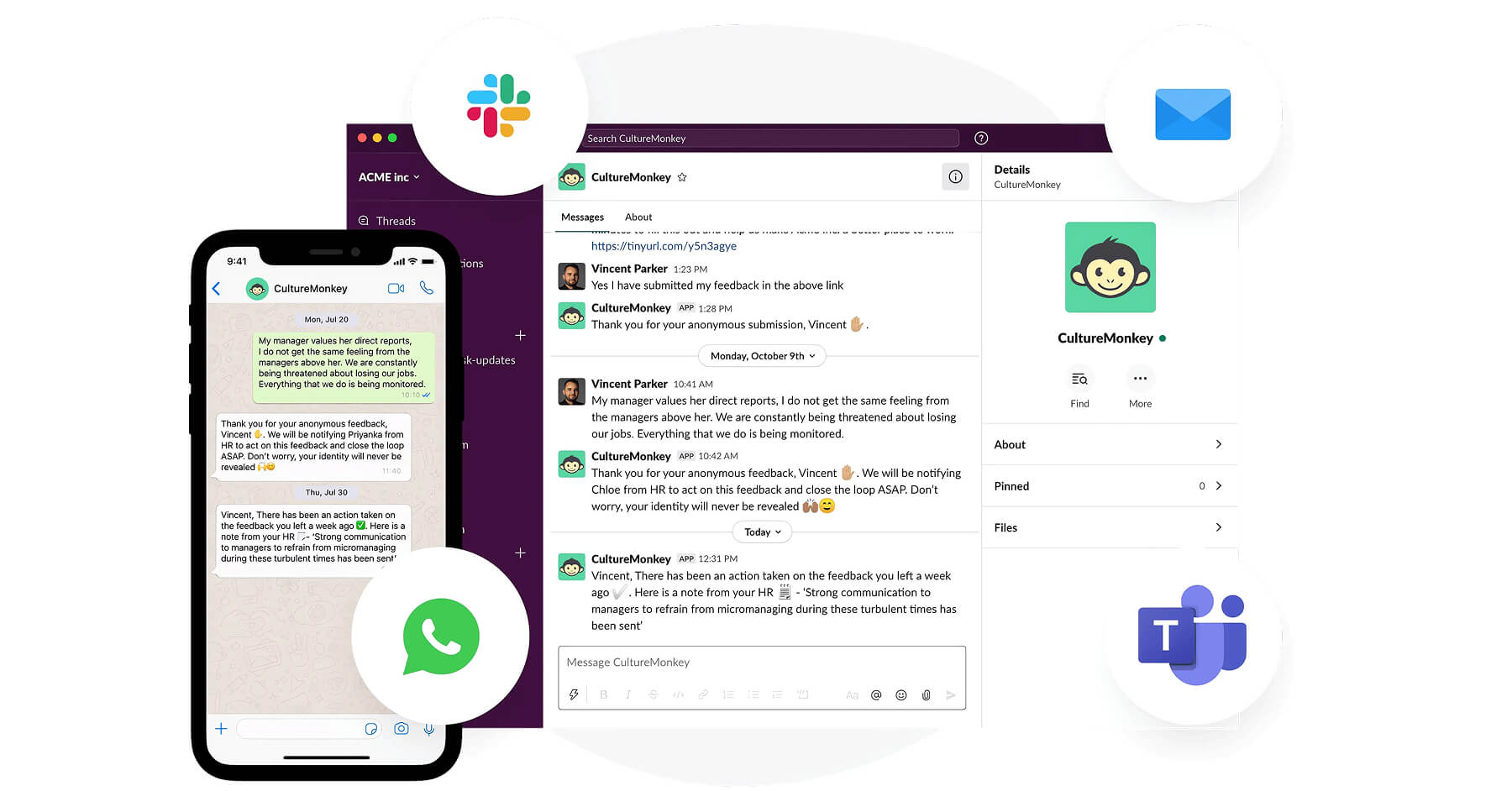
When feedback systems capture signals from across clinical environments, analytics features are important to visualize and interpret feedback data effectively. CultureMonkey supports this approach by enabling anonymous pulse survey employee feedback, frontline-friendly multi-channel survey distribution, AI-driven insight detection, and structured action planning across healthcare teams.
Book a demo with CultureMonkey.
FAQs
1. What are the best employee feedback tools for healthcare organizations?
The best employee feedback tools for healthcare organizations enable hospitals to collect staff input securely. These platforms support anonymous reporting, frontline-friendly survey distribution, AI-powered insights, and compliance-ready security to identify burnout, safety concerns, and workforce risks early.
2. How do hospitals collect anonymous employee feedback safely?
Hospitals collect anonymous employee feedback through secure survey platforms designed for healthcare environments. These tools use identity protection, aggregated reporting, and access controls so staff can report safety concerns, operational issues, or workplace challenges without fear of retaliation.
3. Are employee surveys in healthcare subject to HIPAA regulations?
Employee surveys are not typically governed by HIPAA unless protected health information appears in responses. However, healthcare organizations must ensure feedback platforms prevent staff from sharing patient identifiers and protect sensitive workforce insights through secure data handling.
4. How can healthcare organizations protect anonymity in small departments?
Healthcare organizations protect anonymity by applying response thresholds, aggregated reporting, and role-based access controls. These safeguards ensure that feedback collected from small clinical teams cannot be traced back to individuals, encouraging staff to share honest concerns safely.
5. What is the best way to collect feedback from shift-based staff?
The best way to collect feedback from shift-based healthcare staff is through mobile-first surveys, SMS links, QR codes placed in staff areas, and kiosks within hospital units. Choosing the right employee engagement software is a high-stakes decision that can significantly impact employee retention and performance.
6. Can AI detect burnout in healthcare employees?
Yes. AI can analyze patterns in survey responses, sentiment trends, and open-text feedback to detect early signs of burnout, workload stress, or disengagement among healthcare staff. These insights help leaders identify workforce risks and intervene before retention or care quality declines.
7. How often should hospitals run employee engagement surveys?
Most hospitals run a comprehensive engagement survey annually and supplement it with short pulse surveys during the year. Frequent but focused feedback cycles help leaders monitor burnout risk, staffing pressures, and operational challenges across clinical teams.
8. What features should healthcare feedback software include?
Healthcare feedback software should include anonymous reporting controls, secure data architecture, frontline-friendly survey channels, AI-driven insights, and integration with HR systems. These features help hospitals analyze feedback by role, department, and facility location.
9. How do frontline workers participate in digital feedback systems?
Frontline healthcare workers participate through mobile-accessible surveys delivered via SMS, QR codes in break rooms, and shared kiosks within hospital units. These participation methods remove email dependency and allow staff to share feedback during or between shifts.
10. How does employee feedback impact patient care outcomes?
Employee feedback helps hospitals detect operational issues such as staffing shortages, communication gaps, and workflow barriers. When leaders act on these insights, organizations improve workforce stability, reduce burnout risk, and strengthen the quality and safety of patient care.