


eNPS vs employee engagement surveys: Key differences

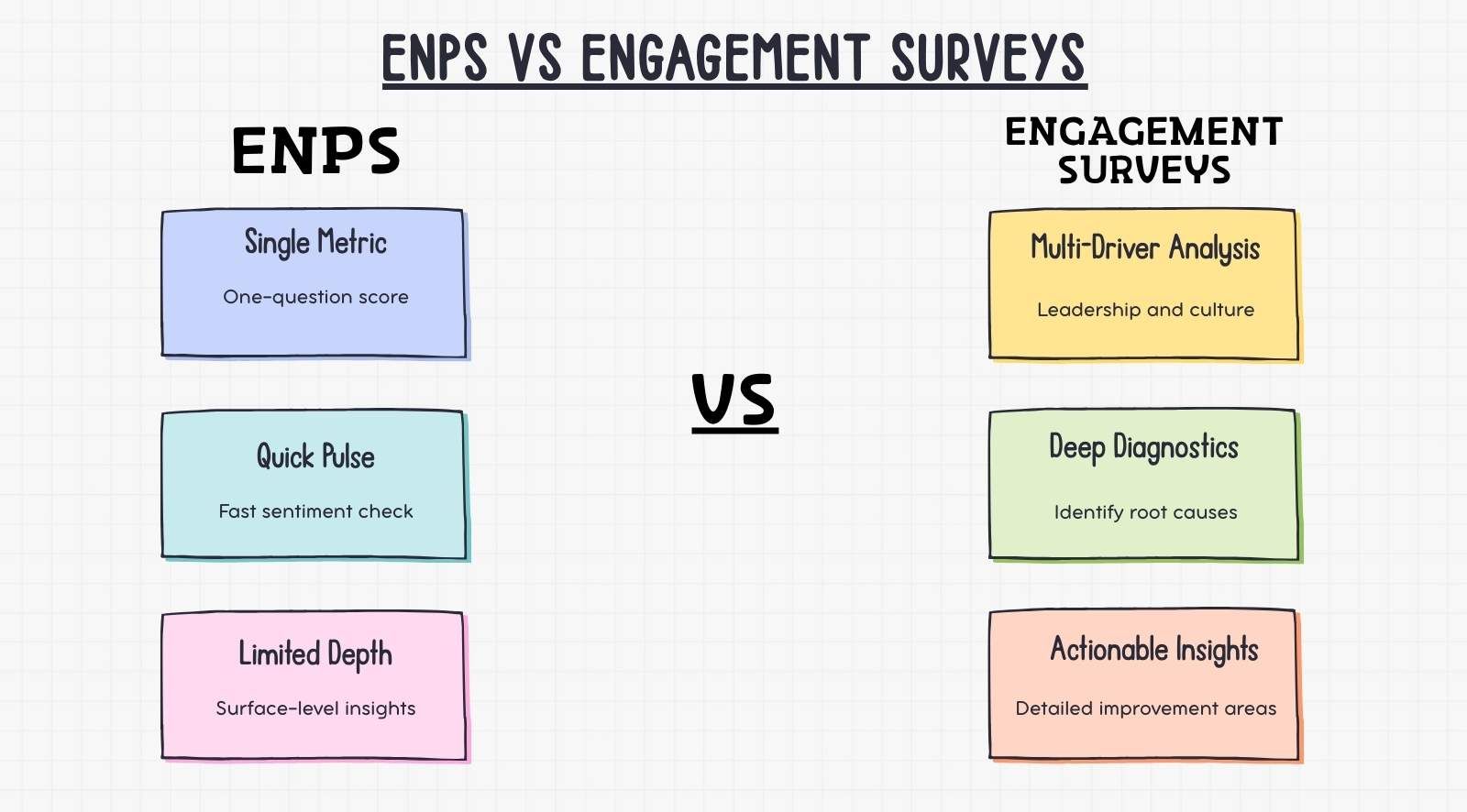
eNPS and employee engagement surveys serve different purposes. eNPS provides a quick snapshot of employee loyalty through a single recommendation question, while engagement surveys explore the deeper drivers behind motivation, experience, and workplace culture.
Understanding the difference helps leaders choose the right method for the right situation. When used correctly, both tools complement each other and give organizations a more complete view of how employees feel about their workplace.


- eNPS measures employee loyalty through a single recommendation question, offering a quick pulse of workplace sentiment.
- Employee engagement surveys measure workplace experience, capturing multiple drivers like leadership, communication, recognition, growth, and culture.
- Key differences between eNPS and engagement surveys lie in depth, purpose, data richness, and actionable insights.
- Use eNPS for quick sentiment checks, while engagement surveys help diagnose underlying workplace issues and engagement drivers.
- eNPS cannot replace engagement surveys, but together they create a balanced employee listening strategy with faster insights.
What is eNPS?

Employee Net Promoter Score (eNPS) is a simple metric organizations use to measure employee satisfaction and loyalty. It asks employees one question: how likely they are to recommend their workplace to others. The result gives leaders a quick signal of overall sentiment and whether teams feel positive, neutral, or dissatisfied about their employee experience.
What are employee engagement surveys?
Employee engagement surveys are structured questionnaires organizations use to understand employee sentiment, workplace experience, and overall satisfaction. They ask employees about topics like leadership, communication, recognition, and growth opportunities. The goal is to measure how employees feel about their roles, teams, and the organization.
Key differences between eNPS and engagement surveys

Organizations often compare eNPS vs engagement survey approaches when deciding how to measure employee sentiment. Both methods collect feedback, but they differ in purpose, depth, and the type of insights they produce. Understanding these differences helps leaders choose the right method for measuring employee engagement and improving employee retention.
When to use eNPS vs engagement surveys
Organizations often choose between eNPS and engagement surveys based on the type of insight they need. eNPS works well for quick sentiment checks, while engagement surveys help diagnose deeper workplace issues. Knowing when to use each method helps leaders measure employee happiness, reduce survey fatigue, and improve employee engagement.
1. Use eNPS for quick sentiment checks
Organizations run eNPS to capture a fast measure of employee happiness. Because the survey is short, it reduces survey fatigue and helps leaders quickly detect unhappy employees or shifts in workplace culture.
2. Use engagement surveys for deeper diagnostics
Engagement surveys help leaders understand the drivers behind employee happiness, workplace culture, and career growth. The insights help organizations improve employee engagement through targeted strategies.
3. Use eNPS to monitor trends frequently
Many net promoter companies run eNPS regularly to track whether teams include promoters, passive employees, or unhappy employees. Frequent checks help leaders react quickly when employee sentiment changes.
4. Use engagement surveys for strategic improvement
Engagement surveys provide a deeper measure of employee experience. Leaders can analyze engagement data to design initiatives that improve workplace culture, support career growth, and address concerns raised by employees.
Can eNPS replace engagement surveys?
Replacing engagement surveys with eNPS is like judging a full conversation from one sentence. The signal may be useful, but it cannot explain the full picture. That is why leaders should treat eNPS as a quick indicator, not a complete substitute for deeper employee feedback and diagnosis.
- No, because eNPS shows only one signal: eNPS reflects overall advocacy through one recommendation question, but it does not explain the reasons behind it. Even when calculating eNPS is simple, leaders still need broader engagement surveys to understand what shapes employee experience.
- No, because eNPS cannot diagnose root causes: Low eNPS scores can indicate dissatisfaction, but they do not show whether the issue is leadership, workload, communication, or growth. Engagement surveys help leaders go beyond eNPS metrics and identify the actual drivers behind negative feedback.
- No, because score trends need context: High eNPS scores or a high eNPS rating may look encouraging, but they can still hide unresolved issues. In the same way, low eNPS scores need context before leaders decide what actions to take.
- No, because eNPS lacks topic-level depth: The eNPS scale is useful for measuring advocacy quickly, but it does not cover areas like recognition, trust, career growth, or manager support. Engagement surveys provide the details needed to make informed workplace decisions.
- No, because follow-up methods still matter: When eNPS ratings reveal concern, organizations often need engagement surveys or focus groups to explore what employees mean. That added depth turns quick eNPS stats into clearer actions leaders can use to improve workplace experience.
- No, because eNPS was not built for full diagnosis: The model comes from the net promoter score NPS framework, which measures recommendation. That makes eNPS useful as a snapshot, but not strong enough to replace a full engagement survey on its own.
How eNPS and engagement surveys work together

Organizations often use both eNPS and employee engagement surveys to understand employee sentiment more effectively. While eNPS provides quick feedback signals, engagement surveys explain the factors shaping employee experience. Together, they help leaders see the wider engagement puzzle and improve company culture and development opportunities.
- eNPS captures quick signals: eNPS helps leaders quickly understand whether an engaged staff member would recommend the organization. This simple check offers an early indicator of company culture and the company's reputation before leaders explore deeper workplace factors.
- Engagement surveys explain the drivers: Engagement surveys go beyond quick sentiment and explore work-life balance, leadership support, and development opportunities. These insights help organizations understand why employees thrive or disengage within different employee populations.
- Together they connect sentiment with action: When leaders combine eNPS with engagement surveys, they can track quick signals while also diagnosing deeper workplace issues. This approach helps organizations improve their employer brand and strengthen their company culture.
- Supports continuous listening strategies: Many organizations use eNPS frequently and run engagement surveys periodically. Together, these survey tools help leaders monitor employee sentiment, identify challenges early, and build training programs that support employee growth.
- Links employee experience to business outcomes: In a customer-driven world, employees thrive when workplace systems support them. Strong listening strategies improve company culture, strengthen employer brand, and positively influence how the employer sells its values internally and externally.
Common mistakes when comparing the two

Comparing eNPS and engagement surveys is like judging a complex workplace conversation from one headline. Leaders sometimes oversimplify what each method measures. This confusion leads to the misuse of metrics and prevents organizations from gaining meaningful insights into employees, team morale, and the broader employee experience.
- Assuming eNPS measures full engagement: Many organizations treat company enps as a complete measure of employee engagement. In reality, it captures only one facet of employee sentiment. This oversimplification prevents leaders from identifying areas that influence team morale and overall employee experience.
- Ignoring qualitative feedback behind scores: Numbers alone rarely explain employee sentiment. Without qualitative feedback, leaders miss detailed insight into what employees actually experience. Comments from employees often reveal context that helps organizations identify areas affecting engagement and satisfaction.
(Source: Gallup)
- Misreading positive scores as strong engagement: When employees talk positively about their workplace, leaders may assume engagement is strong. However, high company eNPS scores do not always mean employees feel supported, motivated, or satisfied in their daily work.
- Using metrics without deeper analysis: Some organizations collect survey results but fail to interpret them carefully. Without examining what employees gave as feedback, leaders struggle to convert engagement data into meaningful insights that improve workplace culture.
Conclusion
Understanding eNPS vs employee engagement surveys helps organizations build a stronger employee listening strategy. While eNPS provides a quick signal of employee sentiment and loyalty, engagement surveys reveal the deeper drivers behind employee experience, job satisfaction, and workplace culture.
These tools are complementary, not interchangeable. eNPS helps leaders track sentiment frequently, while engagement surveys provide the detailed insights needed to understand why employees feel the way they do.
CultureMonkey helps organizations bring both approaches together. With tools for running eNPS and engagement surveys, the platform helps leaders analyze feedback, uncover meaningful insights, and improve engagement through data-driven decisions that strengthen workplace culture.
Book a demo with CultureMonkey.
FAQs
1. What is the difference between eNPS and engagement surveys
The difference between eNPS and employee engagement surveys lies in depth and purpose. eNPS provides a numerical score that acts as a performance metric, while engagement surveys explore engagement levels and employee experience, helping hr teams generate actionable insights aligned with the company's goals.
2. Is eNPS enough to measure engagement
eNPS alone is not a complete performance metric for engagement levels. It provides a quantifiable statistic and a good measure of employee sentiment, but hr teams still rely on engagement surveys and pulse surveys to collect deeper feedback and generate actionable insights.
3. Can eNPS replace employee engagement surveys
No, eNPS cannot replace engagement surveys. The numerical score shows employee advocacy, but it does not explain engagement levels. Engagement surveys provide deeper actionable insights that help hr teams align employee feedback with the company's goals.
4. Which is better eNPS or engagement surveys
Neither tool is universally better. eNPS works as a quick performance metric and a good measure of employee sentiment, while engagement surveys provide detailed insights. Hr teams often use both to understand engagement levels and support the company's goals.
5. When should you use eNPS
Organizations use eNPS when they need a fast pulse metric to monitor engagement levels. As a quantifiable statistic, it helps hr teams track changes quickly, especially between larger engagement surveys and pulse surveys that collect broader employee feedback.
6. How often should engagement surveys be run
Many organizations run engagement surveys annually or twice a year to analyze engagement levels and collect actionable insights. Hr teams often use pulse surveys and eNPS between survey cycles to monitor employee sentiment and keep feedback aligned with the company's goals.
7. Do companies use both eNPS and engagement surveys
Yes, many organizations combine both tools. eNPS provides a quick, quantifiable statistic, while engagement surveys deliver deeper, actionable insights. Hr teams use them together to track engagement levels and support engaged employees across the organization.
8. Why is eNPS considered a pulse metric
eNPS is considered a pulse metric because it provides a quick numerical score reflecting employee sentiment. The method is inspired by the net promoter score model used to track customer loyalty and customer experience, where net promoter companies thrive by measuring advocacy.