



How to create and conduct anonymous surveys to enhance workplace culture?

Organizations rely on feedback to understand sentiment, identify concerns, and improve workplace culture. But when surveys ask people to attach their names, responses often become cautious or incomplete. An anonymous survey removes that barrier by allowing individuals to share honest opinions without worrying about identification.
Learning how to create anonymous survey processes correctly is essential for gathering reliable insights. Poorly designed surveys can accidentally expose identity through questions, metadata, or reporting formats.
When anonymity is structured properly, participation improves, and feedback becomes more candid. In this guide, we’ll explain how to design, launch, and manage anonymous surveys that protect respondent identity while helping organizations collect meaningful, actionable feedback.


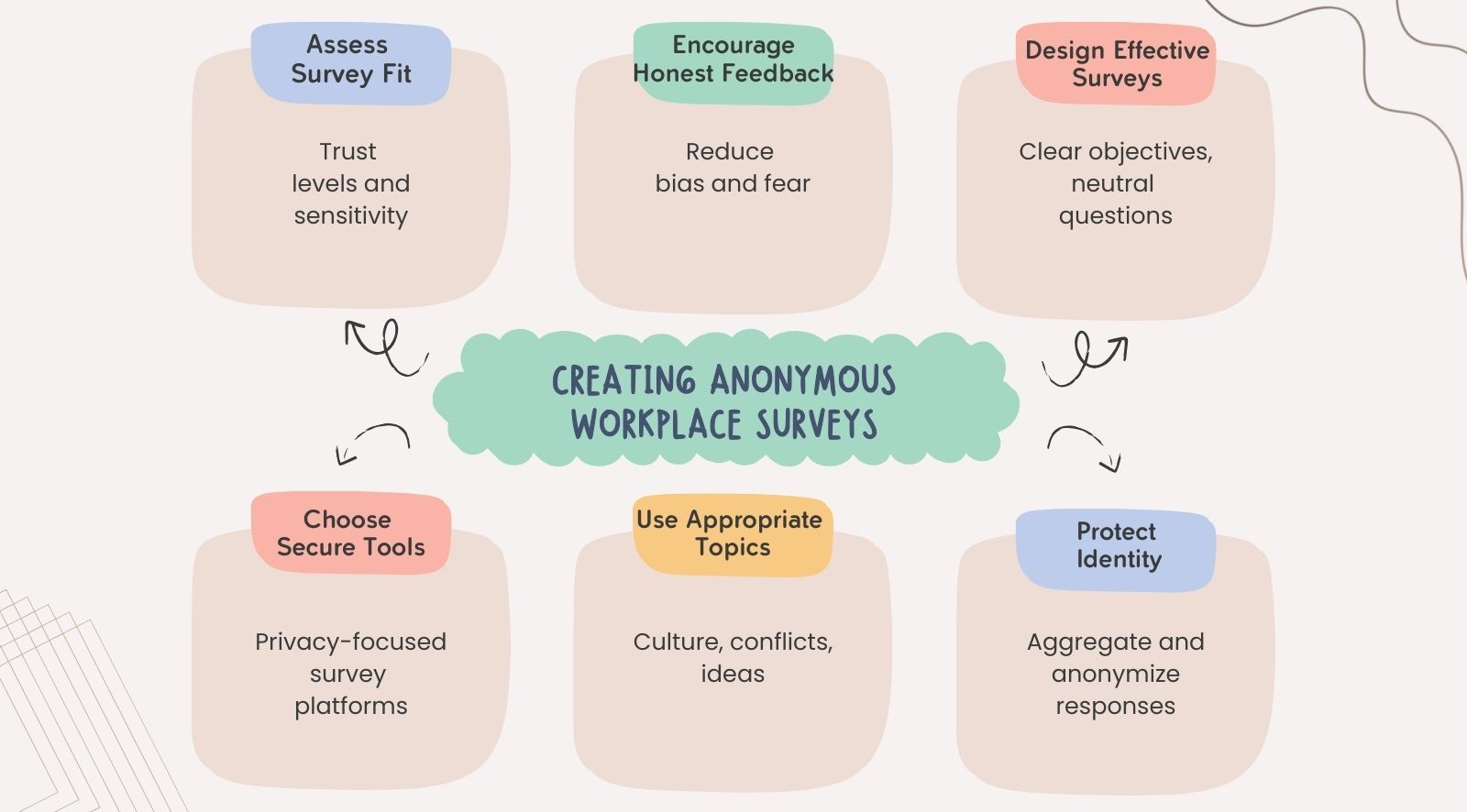
- Decide if an anonymous survey fits your organization by assessing feedback sensitivity, trust levels, and need for follow-up.
- Anonymous surveys encourage honest responses, reduce bias, increase participation, and reveal genuine employee perspectives about workplace culture.
- Create anonymous employee surveys by defining objectives, writing neutral questions, choosing secure survey tools, and testing before launch.
- Use anonymous surveys for sensitive topics, culture assessments, feedback collection, idea generation, and effective resolution of workplace conflicts.
- Anonymize survey responses by separating identifiers, aggregating results, and protecting respondent identity through secure survey design.
Is an anonymous survey right for you?
Selecting the right survey method directly affects the quality of responses you receive. When anonymity is guaranteed, anonymous surveys collect responses without linking identities to answers. This encourages honest input and improves the reliability of survey data used to understand sentiment and guide better decisions.
- Sensitive feedback scenarios: Anonymous surveys work best when topics involve trust, fairness, leadership behavior, or policies. Removing personal identifiers and identifying data encourages honest answers and candid feedback that may not surface through standard employee feedback channels.
- Need for authentic sentiment signals: If your goal is to uncover real opinions rather than polite responses, anonymous feedback helps. Anonymous mode reassures participants that personally identifiable information will not appear in survey results.
- Early-stage culture diagnostics: When running an employee engagement survey to understand workplace culture, anonymity helps participants speak freely. The absence of identifying data increases participation and improves the quality of employee feedback.
- Focus on trend analysis rather than individuals: Anonymous surveys are useful when organizations want patterns instead of individual follow-ups. Aggregated survey data reveals recurring concerns, making it easier to generate actionable insights.
- Structured and compliant survey design: Proper architecture of anonymous surveys ensures anonymous survey compliance by separating responses from personal identifiers. This design protects confidential information while maintaining reliable survey results.
- Well-designed question formats: Clear multiple-choice questions and concise prompts improve participation. Strong components of anonymous surveys focus on simplicity, ensuring the feedback process captures meaningful input without risking respondent identification.
Why should a survey be anonymous?

We've already touched on the importance of anonymity when it comes to conducting surveys, but let's dive deeper into why it's a crucial element for gathering accurate and honest feedback.
Here are some key reasons why a survey should be anonymous:
- Encourages honesty: Anonymity eliminates the fear of judgment or negative consequences, enabling survey participants to provide candid anonymous survey responses. People are more likely to share their true thoughts, opinions, and experiences when they know their identity is protected.
- Reduces bias: When respondents know their answers won't be attributed to them personally, they are less likely to tailor their responses based on what they believe the surveyor wants to hear. Anonymity helps minimize social desirability bias and provides a clearer picture of the participants' genuine perspectives.
- Fosters trust and confidence: By assuring participants that their responses will remain anonymous, you build trust and enhance their confidence in the survey process. This, in turn, increases the likelihood of higher participation rates and more authentic feedback.
- Promotes equal representation: Anonymity creates a level playing field for all participants, regardless of their position, background, or personal circumstances. It empowers individuals who may feel intimidated or marginalized to voice their opinions without fear of bias or discrimination.
- Mitigates groupthink: In group settings, individuals may hesitate to express divergent viewpoints due to social pressure or the desire to conform. Anonymity breaks down these barriers, allowing for a wider range of perspectives and a more comprehensive understanding of the subject matter.
- Enhances data quality: Anonymous surveys often yield more reliable data, as respondents are motivated to provide accurate and thoughtful responses. The absence of social influences and the freedom to express oneself truthfully contribute to the overall quality and validity of the collected data.
By leveraging the power of anonymity in your surveys, you create an environment that promotes openness, trust, and inclusivity. Participants can freely express their opinions, leading to richer insights and actionable outcomes.
Remember, a survey is only as valuable as the honesty of its responses, and anonymity is the key that unlocks the true potential of your data.
Why are anonymous surveys better?
Anonymous feedback is like a suggestion channel where responses travel without labels attached. When people know their identity is not linked to answers, hesitation drops. In an anonymous workplace survey, responses are not tied to identifying details, which opens space for unfiltered responses that often remain unspoken.
- Encourages honest participation: When responses cannot be tied to identifying details or IP addresses, people share more openly. Anonymous survey responses help organizations capture unfiltered responses that reveal real team dynamics, improving the quality of survey questions and overall feedback collection.
- Reduces response bias: Anonymous formats reduce social desirability bias because participants do not feel pressure to answer in a certain way. Without tying responses to individuals, survey questions capture genuine opinions that might otherwise remain unspoken.
- Improves data reliability: Anonymous surveys allow organizations to analyze results with fewer distortions. When feedback is detached from identifying details, responses reflect actual sentiment, making meaningful analysis easier and helping leaders detect patterns in team dynamics and workplace challenges.
- Supports deeper insights through patterns: Anonymous survey responses help teams focus on trend tracking instead of individual responses. Reviewing patterns across specific groups allows leaders to understand common issues, workload balance concerns, and collaboration challenges more clearly.
- Protects identity through survey design: Proper reporting thresholds prevent small groups from exposing identifying details. Combined with careful demographic questions and secure platforms like Google Forms, the architecture of an anonymous workplace survey protects privacy while still enabling organizations to analyze results effectively.
- Simplifies feedback collection at scale: When organizations create anonymous survey workflows using rating scale questions and structured formats, it becomes easier to gather large volumes of responses and analyze results consistently across departments and teams.
How do I create an anonymous survey for work?
Creating an anonymous employee survey for work requires careful planning and consideration. Let's explore the essential steps you need to follow to ensure a successful and confidential survey experience:
Clearly define your objectives
Start by identifying the purpose of your survey. What specific insights or feedback are you seeking? Having a clear objective will help you craft targeted questions and ensure your survey remains focused.
Determine your target audience
Understand who will be participating in the survey. Are you targeting all employees or specific departments? Tailoring your survey questions to the right audience will yield more relevant and actionable data.
Craft unbiased questions
Write your questions in a neutral and unbiased manner to avoid leading or influencing respondents' answers. Strive for clarity and avoid jargon or ambiguous language that may confuse participants.
Prioritize brevity and clarity
Keep your survey concise and easy to understand. Long surveys can lead to participant fatigue and lower response rates. Be mindful of your respondents' time and make sure each question adds value to your overall objective.
Offer response options
Provide a variety of response formats, including multiple-choice, rating scales, and open-ended questions. This allows participants to choose the response that best fits their experience and provides flexibility in their feedback.
Choose the right survey platform
Select a reliable survey tool that offers anonymous response options. Platforms like CultureMonkey provide built-in features to ensure the confidentiality of respondents' identities.
Customize your survey design
Brand your survey to match your organization's visual identity, making it more engaging and professional. However, be mindful that an overly branded survey may compromise anonymity, so strike a balance between customization and confidentiality.
Assure anonymity in your survey instructions
Clearly communicate to participants that their anonymous survey responses will remain anonymous. Reiterate that their identities will not be linked to their answers in any way, fostering trust and encouraging honest feedback.
Test your survey before launch
Before sending out your survey, conduct a test run to ensure everything functions correctly. Check for any errors, broken survey link, or formatting issues. Testing helps guarantee a smooth and seamless experience for participants.
Follow up with gratitude and action
Once you've collected responses, express gratitude to participants for their time and valuable input. Analyze responses thoroughly, identify key patterns and insights, and take action based on the feedback received. Share the results and subsequent steps with participants to demonstrate their voices were heard.
Creating an anonymous online survey for work requires a thoughtful approach that prioritizes participants' confidentiality and promotes open, honest feedback. By following these steps, you'll be able to design a survey that respects privacy, captures valuable insights, and empowers your workforce or stakeholders.
Remember, anonymity is the cornerstone of a successful anonymous survey. Strive to create an environment where employees feel safe to express their opinions openly, without fear of repercussions.
When to use an anonymous survey?
While anonymous employee surveys offer numerous benefits, it's important to know when it's appropriate to use this approach. Here are a few scenarios where anonymous surveys are particularly valuable:
- Sensitive topics: When you're addressing sensitive subjects like workplace harassment, discrimination, or mental health concerns, anonymity becomes crucial. It allows individuals to share their experiences honestly and without fear of reprisal, fostering a safe and supportive environment.
- Feedback collection: Anonymous surveys are highly effective when you need to gather feedback on specific policies, procedures, or management practices. Employees may hesitate to criticize openly, but anonymity encourages them to provide constructive feedback that can drive positive change.
- Culture assessment: If you want to gauge the overall sentiment and employee satisfaction within your organization, anonymous surveys can provide an accurate representation. They allow employees to express their opinions freely, shedding light on potential issues and areas for improvement.
- Idea generation: Anonymous surveys can be a valuable tool for crowdsourcing ideas. By encouraging employees to submit suggestions or innovative solutions anonymously, you create an environment that promotes creativity and diversity of thought.
- Conflict resolution: In situations where there is ongoing tension or conflict within teams or departments, anonymous surveys can help identify the root causes and provide insights for resolution. Participants can express their concerns without fear of exacerbating the situation or being singled out.
Remember, anonymous feedback surveys aren't the answer to every situation. There may be times when identifiable data is necessary for follow-up or clarification. Assess the context, objectives, and sensitivity of the topic to determine if an anonymous survey is the most appropriate approach.
By using anonymous surveys strategically, you can gather authentic and valuable feedback, improve organizational culture, and address critical issues.
Benefits of creating anonymous surveys

Anonymous surveys offer a range of benefits that can significantly impact the success and effectiveness of your data collection efforts. Let's explore the advantages of incorporating anonymity into your survey strategy:
Honest and open feedback
Anonymity encourages participants to provide honest and open feedback without the fear of judgment or repercussions. By removing the barriers associated with self-identification, respondents feel more comfortable sharing their true thoughts, experiences, and opinions.
Increased participation rates
When respondents know their identities will remain confidential, they are more likely to participate in the survey. Anonymity eliminates concerns about potential biases or consequences, resulting in higher response rates and a more representative sample.
Unbiased insights
Anonymous surveys help mitigate social desirability bias, which occurs when respondents alter their answers to align with societal norms or expectations. By assuring anonymity, participants feel freer to express their genuine perspectives, providing more accurate and unbiased insights.
Safe environment for sensitive topics
Sensitive topics like mental health, workplace issues, or personal experiences require a safe and confidential space for individuals to share their thoughts. Anonymous surveys create an environment that respects privacy, allowing participants to disclose sensitive information without fear of judgment or negative consequences.
Confidentiality in organizational surveys
Within an organizational context, anonymous surveys can be especially valuable. They enable employees to provide feedback on management practices, work culture, and organizational policies without concerns about potential backlash or retaliation.
Increased employee engagement
Anonymity in surveys signals that an organization values employee input and encourages them to participate actively. When employees feel that their opinions matter and will be treated confidentially, they are more likely to engage in surveys and feel a sense of ownership and involvement.
Enhanced trust and transparency
By assuring anonymity, organizations build trust and foster transparency. Employees recognize that their voices are heard and respected, leading to a stronger bond between management and staff.
Diverse perspectives
Anonymous surveys empower individuals who may feel marginalized or hesitant to speak up in a non-anonymous setting. This inclusivity fosters a broader range of perspectives, enriching the data and providing a more comprehensive understanding of the topic at hand.
Improved decision-making
The insights gained from anonymous feedback can inform better decision-making. With accurate and unbiased employee feedback, organizations can identify areas for improvement, implement targeted interventions, and drive positive change.
By leveraging the benefits of anonymous surveys, organizations can unlock a wealth of invaluable insights and foster a culture of openness, trust, and continuous improvement. Remember to assess the appropriateness of anonymity for each specific survey and tailor your approach accordingly.
Anonymous survey examples
To give you a better understanding of how anonymous surveys can be used in various contexts, let's explore a few examples:
Employee satisfaction survey
An anonymous survey can assess workplace satisfaction, employee engagement levels, and overall job satisfaction. By ensuring anonymity, employees can provide honest feedback on aspects such as workload, communication, work-life balance, and opportunities for growth.
Diversity and inclusion assessment
Anonymous surveys are instrumental in gathering insights on diversity and inclusion within an organization. Employees can share their experiences, observations, and suggestions for creating a more inclusive workplace without fear of being identified, leading to a more accurate representation of the organization's diverse landscape.
Customer feedback survey
Anonymous surveys are widely used to collect feedback from customers, allowing businesses to gain valuable insights into customer satisfaction, preferences, and pain points. Customers can express their opinions honestly, enabling organizations to improve their products, services, and overall customer experience.
Training evaluation survey
Anonymous surveys can be employed to evaluate the effectiveness of training and development programs. Participants can provide feedback on the content, delivery, and impact of the training without reservation, enabling organizations to enhance future training initiatives.
Event feedback survey
When organizing conferences, workshops, or corporate events, anonymous surveys can gather feedback from attendees on various aspects such as speakers, content, logistics, and overall satisfaction. Anonymity promotes candid responses, helping event organizers identify areas of improvement and enhance future events.
Remember, these are just a few examples of how anonymous surveys can be utilized. The versatility of anonymous surveys allows them to be applied in a wide range of scenarios where honest and unbiased feedback is crucial.
How do you anonymize survey responses?
Protecting identities in surveys is like locking confidential files in a shared office cabinet. Everyone can contribute information, but access stays controlled. In workplace feedback programs, the design of the survey decides whether responses remain private. Careful survey structure ensures anonymous employee feedback can surface honestly while individual privacy stays protected.
- Remove personal identifiers from responses: Avoid collecting names, emails, or identifying details when gathering anonymous employee feedback. A well-configured anonymous survey tool separates identifying data from individual responses, helping protect privacy and ensuring information is private enough for people to discuss sensitive issues honestly.
- Design questions carefully: Poorly written questions can reveal identity indirectly. During anonymous survey design, avoid demographic details that could expose individuals in small groups. When teams design questions carefully, anonymous survey questions capture useful insights without compromising individual privacy.
- Use aggregated reporting thresholds: When reporting results from an anonymous online survey, apply thresholds so feedback appears only after enough responses are collected. This prevents managers from identifying individuals in small groups while still allowing teams to analyze patterns in anonymous staff survey results.
- Avoid tracking metadata: Some tools capture hidden identifiers such as IP addresses or device information. Configuring an anonymous survey tool to remove these traces helps protect privacy and ensures anonymous employee feedback cannot be linked back to specific individual responses.
- Choose secure feedback platforms: Many teams rely on a dedicated anonymous feedback form or anonymous survey tool to manage the feedback process safely. These systems separate response data from identifying information while supporting an anonymous survey design that keeps individual privacy intact.
- Focus on aggregated insights instead of individuals: Anonymous online survey results should highlight trends across teams rather than individuals. This approach allows managers to identify growth opportunities, prioritize issues requiring immediate attention, and address sensitive issues without exposing personal responses.
Conclusion
Anonymous surveys help organizations collect honest feedback that people might otherwise hesitate to share. When respondents know their identity cannot be traced, participation increases, and answers become more candid. Learning how to create anonymous survey processes correctly ensures reliable survey data that reflects real workplace sentiment.
However, anonymity requires careful survey design. Questions should avoid identifying data, and reporting methods must prevent responses from being traced back to individuals.
CultureMonkey helps organizations implement secure anonymous surveys with privacy safeguards, structured reporting thresholds, and advanced analytics. This allows leaders to analyze survey results confidently and turn anonymous employee feedback into clear, actionable insights that improve communication, engagement, and workplace culture.
Book a demo with CultureMonkey.
FAQs
1. How do you create an anonymous survey for employees?
To create an anonymous employee feedback survey, remove fields that collect names, emails, or identifiers. Use neutral questions, avoid traceable demographic details, and apply anonymous survey best practices. A workplace anonymous survey should focus on anonymous response collection and secure anonymous survey data collection.
2. What is the best way to collect anonymous employee feedback through surveys?
The best approach is to use a secure survey platform that separates responses from identifying information. Anonymous survey confidentiality should be clearly communicated to participants. This improves anonymous survey participation and ensures the anonymous employee feedback survey gathers honest workplace insights.
3. How can you ensure a survey is truly anonymous?
To ensure anonymity, disable IP tracking, avoid collecting personal identifiers, and use reporting thresholds that prevent identifying individuals in small groups. Strong anonymous survey confidentiality practices protect respondent identity while supporting reliable anonymous survey data collection.
4. What questions should be included in an anonymous employee survey?
Include questions about workplace experience, communication, leadership support, workload balance, and growth opportunities. Use rating scales and open-ended prompts to capture insights. A well-designed anonymous employee feedback survey focuses on meaningful feedback while protecting anonymity.
5. When should organizations use anonymous surveys in the workplace?
Organizations should use a workplace anonymous survey when collecting feedback on culture, leadership, policies, or sensitive issues. Anonymous response collection encourages honest participation and helps organizations uncover concerns that employees might hesitate to raise openly.
6. How to create anonymous survey on Google Forms
To create an anonymous survey in Google Forms, disable email collection, remove login requirements, and avoid questions requesting identifying details. Following anonymous survey best practices ensures anonymous survey data collection while encouraging higher anonymous survey participation.
7. How to create anonymous survey on Microsoft Forms
In Microsoft Forms, disable name recording and avoid collecting identifiable information in questions. Review form settings carefully to support anonymous survey confidentiality and ensure anonymous response collection for workplace anonymous survey initiatives.
8. Why use anonymous surveys?
Anonymous surveys encourage honest responses by removing the fear of identification. They help organizations collect candid insights through anonymous response collection, improving anonymous survey participation, and providing reliable anonymous survey data collection for workplace decisions.
9. What are the types of anonymous surveys?
Common types include employee engagement surveys, culture surveys, pulse surveys, and anonymous employee feedback surveys. Each workplace anonymous survey format focuses on anonymous survey data collection to understand employee sentiment, workplace challenges, and improvement opportunities.