


Employee engagement survey vendors pricing: A complete guide in 2026

Employee engagement survey vendors pricing refers to the cost structure, pricing models, and included capabilities offered by vendors when delivering an employee engagement survey platform. This pricing varies based on analytics depth, segmentation flexibility, benchmarking access, integrations, and action planning tools.
HR leaders comparing employee engagement survey costs must look beyond headline figures and choose a tool that provides valuable insights in real time and take action to improve company culture as an engagement strategy.
This guide applies tested evaluation frameworks to explain the reason behind the average cost of employee engagement surveys and what determines whether that investment fits your organization to improve employee experience.


- Employee engagement survey vendors pricing is the cost structure for platform access, modules, analytics, integrations, and support based on workforce scope.
- Pricing varies by contract terms, headcount tiers, feature depth, integrations, and renewal mechanics.
- Proper comparison requires normalizing multi-year totals and separating one-time from recurring costs.
- Higher spend is justified only when added depth materially improves decision quality and reduces risk.
- CultureMonkey delivers transparent employee engagement survey vendors pricing with scalable employee survey tools and practical support.
What does employee engagement survey vendors pricing include?

Employee engagement survey vendors pricing is a structured commercial model that defines how access, scale, and capability are billed inside an employee survey platform. Most employee survey vendors separate foundational access from advanced functionality, which is why survey cost varies significantly across providers.
When HR leaders ask how much do employee engagement surveys cost, the answer depends on what is being licensed, who is using it, and which capabilities are activated. The average cost of employee engagement surveys reflects architecture depth, not just survey distribution and survey results.
- Platform license pricing covers base platform access and dashboards.
- User seat pricing depends on employee volume or admin count.
- Module-based pricing adds pulse surveys, lifecycle, anonymous feedback and advanced analytics features.
- Analytics-tier pricing determines insight depth and benchmarking access.
- Integration pricing covers HRIS sync, SSO, security compliance and standards.
360-Degree feedback surveys collect opinions from peers, managers, and direct reports to understand an employee's performance and teamwork abilities.
How do employee engagement survey vendors price their platforms?
Employee engagement pricing is typically structured around how organizations deploy and scale their survey programs. Instead of a single survey pricing model, employee survey companies use different billing approaches depending on workforce size, feature complexity, and support requirements.
When evaluating engagement survey vendors, it is important to understand how pricing structure affects the total cost of employee engagement over time. The way a vendor packages features can significantly influence how much it cost to run a survey annually.
- Per employee pricing: Annual engagement fee calculated per employee included in survey employee engagement cycles.
- Per module pricing: Separate billing for add-ons like pulse surveys, lifecycle, or advanced reporting features.
- Tiered pricing: Structured bundles with progressive access to analytics, benchmarks, and support levels.
- Subscription-based pricing: Recurring annual contracts covering defined usage limits and platform access.
- Consultative pricing: Pricing influenced by employee engagement survey consultants and customization scope.
The survey platform should integrate with existing HR information systems and communication tools to enhance engagement. Selecting an employee engagement survey vendor involves balancing user experience, data security, and action-oriented reporting capabilities.
What drives the cost of employee engagement surveys?
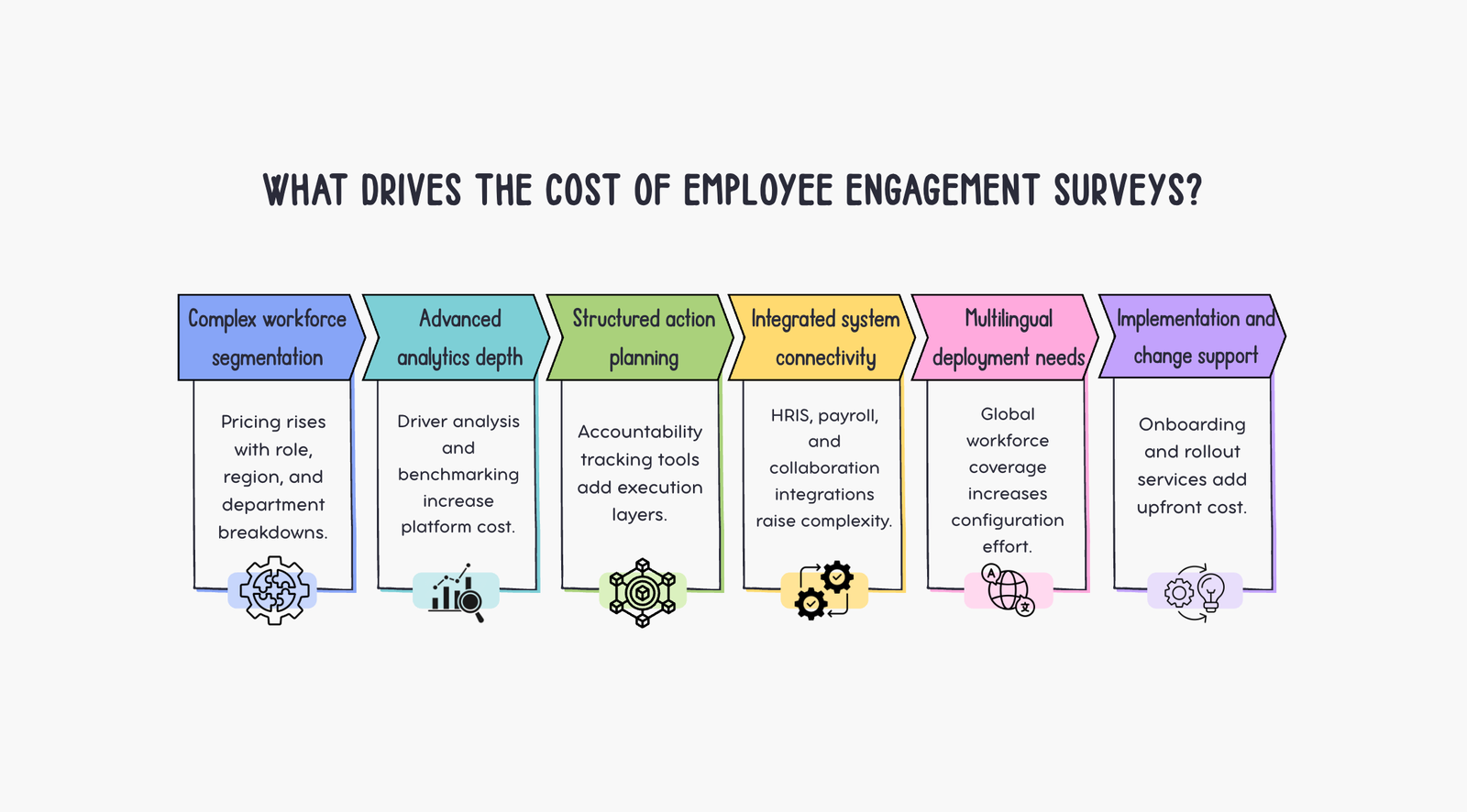
The cost of employee engagement surveys depends on structural complexity, not just survey frequency. Many organizations focus on survey rollout while overlooking configuration depth and operational scale.
Employee engagement survey cost increases when platforms support advanced analysis, integrations, and structured follow-through. These factors largely help organizations to determine the average cost of employee engagement surveys across different workforce environments.
- Complex workforce segmentation across roles, regions, departments.
- Advanced analytics depth including driver and benchmark analysis.
- Structured action planning with data driven, accountability tracking tools.
- Integrated HRIS, payroll, and collaboration system connectivity.
- Multilingual global deployment across diverse employee populations.
- Dedicated implementation support and change management services.
What enterprise vs mid-market pricing usually includes
Enterprise and mid-market employee engagement pricing reflects organizational complexity. The contract structure typically aligns with governance requirements, internal HR bandwidth, and reporting expectations. When evaluating employee engagement survey vendors pricing, the question is which structure matches your operational scale and decision-making needs.
Understanding what is included helps you evaluate employee engagement survey vendors pricing based on commercial structure, not brand perception.
Engaged workers are more invested in the company's success, more productive, and less likely to quit. Employee engagement surveys serve as both strategic and diagnostic tools that draw attention to strengths and reveal problems.
What hidden costs should you not miss in employee engagement survey pricing?
Employee engagement survey vendors pricing often focuses on license fees and visible subscription charges. However, the true employee engagement survey cost can increase when operational and internal resource factors are not accounted for upfront.
When evaluating survey pricing, buyers should examine not only vendor quotes but also execution impact. These several indirect costs help organizations to influence how much it cost to run a survey across multiple cycles.
- Implementation effort including survey configuration, hierarchy mapping, and system setup time.
- Change management investment required for communication, manager enablement, and adoption support.
- Survey data validation, follow-ups, and cycle coordination come under internal administrative load.
- Interpretation of survey results and leading action planning discussions for manager training requirements.
- Data governance oversight covering compliance reviews, audit checks, and security approvals.
Some vendors may charge additional fees for setup, advanced analytics, and consulting services. Real-time dashboards and AI-powered analytics typically represent premium features in employee engagement survey platforms.
Employee engagement survey budgeting framework: Direct vs indirect cost view
| Cost component | Cost type | Budget impact pattern |
|---|---|---|
| Platform subscription and modules | Direct vendor cost | Recurring annual or multi-year contract |
| Implementation and configuration | Direct + internal effort | Higher in Year 1, minimal afterward |
| Change management and communication | Internal operational cost | Recurring per survey cycle |
| Manager enablement and training | Internal capability cost | Recurring, scales with manager count |
| Administrative coordination | Internal workload cost | Recurring every survey cycle |
| Integration and compliance oversight | Shared IT + governance cost | Periodic reviews and maintenance |
What pricing questions should you ask employee survey vendors?
Employee survey vendors' pricing often appears comparable on paper, but contract language and scope definitions vary significantly. Asking structured, comparable questions helps you get survey results, which in turn helps you evaluate engagement survey vendors objectively and understand the real cost of employee engagement before committing a budget.
Contract structure and Transparency
- How clearly is total employee engagement pricing defined in the proposal?
- Are renewal increases and pricing escalations explicitly documented?
- Does the contract clearly define included features versus billable add-ons?
Select a platform that integrates easily with your existing HR tools, such as payroll and performance management.
Feature inclusion and Depth
- Are lifecycle and pulse surveys included in base survey pricing?
- Is advanced analytics bundled or priced separately?
- Are benchmarking capabilities included within the core contract?
Choose a provider that offers comprehensive data collection tools, including instant reporting.
Operational responsibility and Hidden cost exposure
- Is implementation support included in employee engagement survey pricing?
- Is manager training covered within the contract scope?
- Are integration and compliance reviews included without additional fees?
Look for a platform that allows you to design surveys or customize survey templates to suit your organization's needs.
Scalability and Long-term cost control
- Does pricing scale predictably as employee count increases?
- Are multi-year pricing protections or caps clearly defined?
- Can contract cost adjust fairly during workforce changes?
Choose a vendor with a proven track record in employee engagement and workplace culture.
Strategic alignment and Accountability
- Are SLAs clearly defined and tied to service accountability?
- Is advisory support included beyond platform access?
- Does the proposal explain the total cost of employee engagement across multiple cycles?
Companies that prioritize employee engagement often see higher performance, reduced turnover, and increased employee loyalty. Surveys can provide actionable insights for HR teams and executives to use to boost morale, improve retention, and create a more positive work environment.
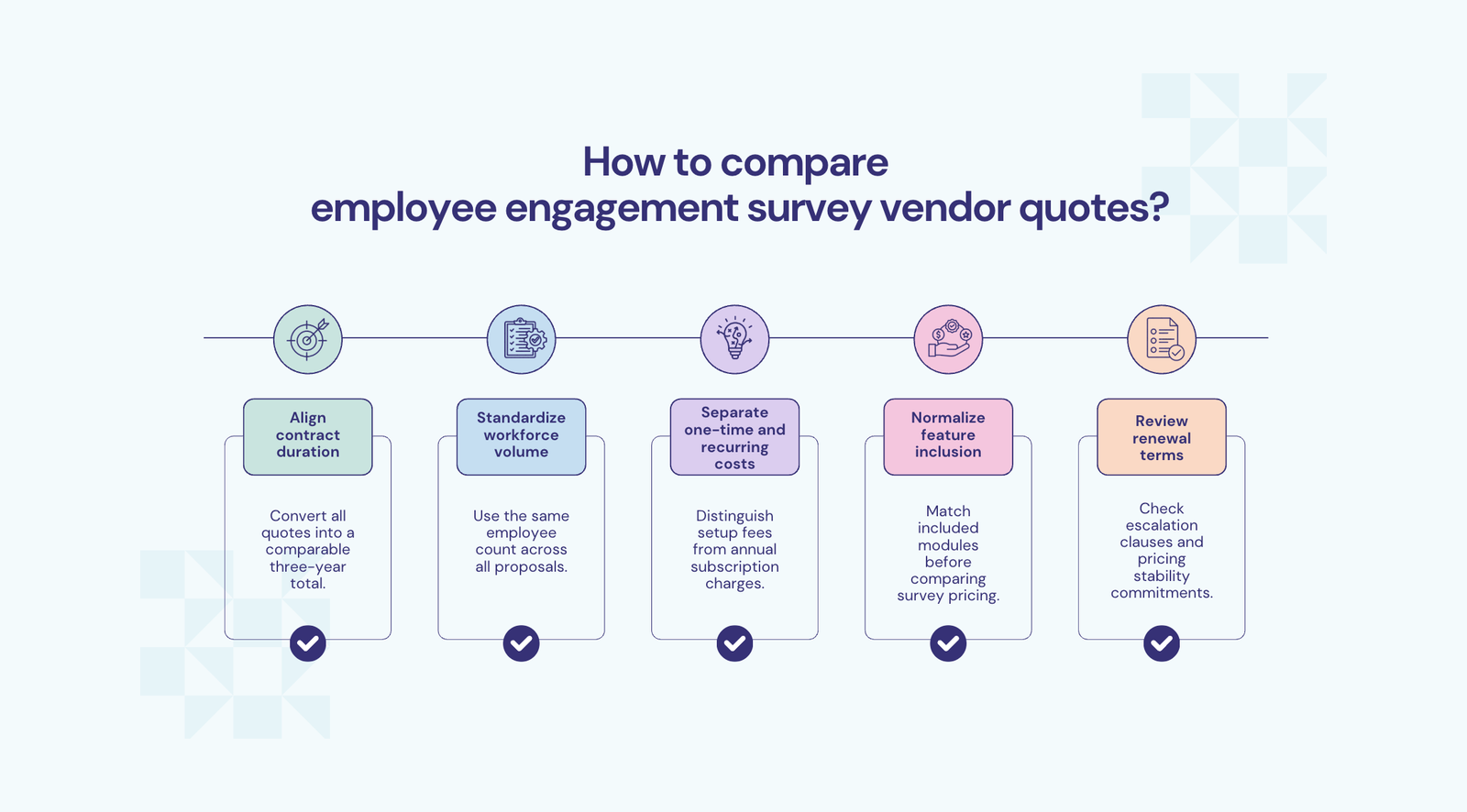
How to compare employee engagement survey vendor quotes?

Employee engagement survey vendors pricing often appears similar until contract structure and scope are aligned. Without normalization of survey templates, HR teams risk comparing packaging rather than the true employee engagement survey cost.
Use the following framework to standardize proposals from employee survey vendors before evaluating employee engagement pricing.
Contract duration and pricing horizon
Vendors present pricing across different timeframes, which distorts comparison. Some emphasize discounted multi-year commitments, while others quote annual subscription totals.
Convert all proposals into a consistent multi-year view before evaluating survey pricing.
When reviewing this area, look for:
- Conversion of all quotes into a comparable three-year total.
- Clear separation of one-time versus recurring cost layers.
- Explicit documentation of renewal escalation terms.
Measuring employee engagement provides key insights into motivation, goal alignment, and overall morale.
Workforce volume assumptions
Engagement survey vendors often calculate pricing using different employee thresholds. Standardize workforce volume assumptions before comparing employee engagement survey tools.
In this category, verify:
- The exact employee count used for pricing calculations.
- Cost adjustments for projected workforce growth or reduction.
- Tier changes triggered by headcount movement.
Engaged employees show higher satisfaction with their role, their team, and the organization, which directly affects productivity.
Feature and module inclusion
Employee survey companies package modules with base pricing excluding analytics or benchmarking in some proposals. Align feature scope before comparing employee engagement survey cost.
For accurate comparison, confirm:
- Which modules are included versus separately billed.
- Whether benchmarking access is bundled in base pricing.
- The depth of analytics included at each pricing tier.
Vendors should provide intuitive, real-time dashboards, including features like heatmaps, trend analysis, and text analytics for survey insights.
Implementation and support scope
Implementation and advisory layers are often described broadly, not contractually defined. Compare how vendors allocate responsibility across rollout and support.
To assess operational impact, evaluate:
- Ownership of implementation tasks and configuration setup.
- Inclusion of manager enablement within contract pricing.
- Availability of advisory support beyond platform access.
Employee anonymity is crucial for survey participation and must comply with data protection regulations like GDPR.
Scalability and future expansion cost
Employee engagement pricing must reflect organizational growth. Expansion into new regions or additional survey cycles can alter cost exposure. Standardizing future-state assumptions prevents underestimation.
When modeling future cost, analyze:
- Pricing adjustments tied to workforce expansion.
- Financial impact of adding regions or business units.
- Cost implications of increasing survey frequency annually.
Employee survey tools are often customizable, allowing organizations to tailor questions, formats, and reports. Enterprise-level solutions for employee engagement surveys can run into several thousand dollars annually.
How do you choose the right employee engagement survey vendors for your organization?

Employee engagement survey vendors should reflect the level of insight precision and operational structure your organization requires. Many leaders focus on the question of “How much does it cost to run a survey?”, but cost alone does not determine fit.
The more relevant question is whether the pricing level matches the analytical depth and support structure your environment demands.
When higher pricing is structurally justified
Higher pricing is appropriate when organizational requirements demand deeper capability and reduced execution friction.
- Complex workforce structures require advanced modeling beyond standard employee survey tools.
- Multi-cycle programs benefit from structured involvement of employee survey consultants.
- Leadership requires advanced segmentation and benchmarking to support strategic decisions.
When higher pricing adds limited incremental value
Additional investment may not create proportional benefit when structural requirements remain straightforward.
- Workforce hierarchy and segmentation needs are operationally simple.
- Survey cycles are limited and do not require extensive modeling layers.
- Core reporting from employee survey tools sufficiently supports leadership decisions without external employee survey consultants.
Some platforms charge a per-employee price structure that scales with the size of the staff, while others charge a flat annual fee that includes unlimited surveys.
.webp)
Get Employee Engagement Surveys With Transparent, Scalable Pricing
- Multi-lingual Surveys
- White Glove Onboarding
- People Science Backed Reports
- Enterprise Grade Security
Conclusion
Employee engagement survey vendors pricing should never be evaluated at face value. Quotes vary because cost structures, feature bundling, implementation scope, and long-term commitments differ across providers.
This guide translates those variations into a comparable cost model so you can evaluate what you are truly paying for.
CultureMonkey helps you move from pricing uncertainty to practical clarity by including advanced analytics, structured action planning, and configurable segmentation without hidden module layers by aligning with your workforce structure and long-term engagement goals.
If you want to apply this framework directly to shortlisted providers, revisit our employee engagement survey vendors list, where tools are categorized and evaluated using consistent commercial and capability criteria.
Book a demo with CultureMonkey.
FAQs
1. How much does an employee engagement survey cost?
Basic plans for employee engagement surveys can start as low as $2 to $5 per employee, while more advanced solutions may cost $10 to $15 per employee or more. Enterprise deployments may exceed this range. The total cost of employee engagement includes both vendor license fees and internal operational effort across survey cycles.
2. What is included in employee engagement survey vendors pricing?
Employee engagement survey vendors pricing usually includes platform access, reporting dashboards, action plans and defined survey modules. Some vendors bundle pulse surveys, analytics, and benchmarking within base pricing, while others charge separately, so contracts should clearly define scope.
3. How much does it cost to run a survey annually?
The cost to run a survey annually depends on workforce size, number of survey cycles, and feature inclusion. In addition to vendor subscription fees, organizations should factor in implementation time, administrative coordination, and manager enablement. Running multiple pulse cycles increases recurring cost exposure.
4. Why does employee engagement pricing vary between vendors?
Employee engagement pricing varies because vendors package analytics, segmentation, integrations, and support differently. Some employee survey tools offer basic reporting within standard pricing, while others include predictive analytics and benchmarking. Contract length, workforce size, and implementation complexity also influence pricing differences.
5. Do employee survey vendors charge per employee or per module?
Most employee survey vendors use per-employee pricing, tiered pricing, or modular pricing structures. Per-employee pricing scales with workforce size, while modular pricing charges separately for analytics, pulse surveys, or benchmarking features. Tiered pricing bundles capabilities into defined packages.
6. What hidden costs should you consider in survey pricing?
Hidden costs may include implementation, change management, manager training, internal administrative, and integration. While not always listed in vendor proposals, these factors contribute to the overall cost of employee engagement and should be budgeted. Engagement companies ensure data security by prioritizing reliability and best practices.
7. Are employee survey consultants necessary?
Employee survey consultants are not always required but may be valuable for complex deployments. Organizations with multi-region workforces or governance-heavy environments often benefit from advisory support. Smaller teams with straightforward survey cycles may not require external consulting layers.
8. How do you compare employee engagement survey vendor quotes?
To compare vendor quotes, normalize contract duration, employee volume assumptions, feature inclusion, and implementation scope. Convert all proposals into a consistent multi-year cost model and separate one-time setup fees from recurring subscription costs. This creates an apples-to-apples comparison framework.
9. Does employee engagement survey pricing increase as headcount grows?
Yes, most employee engagement survey vendors pricing models scale with employee count. Per-employee pricing tiers adjust as workforce size changes. Some vendors offer volume-based discounts or pricing caps under multi-year agreements.
10. When is higher employee engagement survey pricing justified?
Higher pricing is justified when advanced analytics, complex segmentation, governance controls, or executive reporting materially influence business decisions. If additional features do not change decision quality or operational control, incremental pricing may not produce proportional value.