


AI in employee feedback tools: How it works, use cases, and risks

AI in employee feedback tools helps to analyze employee opinions, survey responses, and workplace sentiment. Instead of manually reviewing large volumes of feedback, AI helps identify patterns, common concerns, and engagement trends.
This enables HR teams to understand employee experiences faster and respond to issues more effectively.
In this guide, we explain how AI in employee feedback tools works, the insights it can uncover, and how organizations can use it to improve engagement and workplace culture.


- AI in employee feedback tools uses machine learning and NLP to analyze surveys, detect sentiment, and identify engagement drivers.
- AI analyzes open-text employee feedback at scale using sentiment scoring, theme clustering, and anomaly detection.
- Organizations use AI for comment summarization, engagement driver detection, risk prediction, and attrition forecasting.
- Over-automation risks include bias, loss of context, dashboard over-reliance, and data privacy concerns.
- CultureMonkey uses AI-powered surveys, automated theme detection, and manager-ready dashboards to turn employee feedback into clear engagement insights.
What does AI mean in employee feedback tools?

AI in employee feedback tools refers to the use of machine learning and natural language processing to analyze survey responses, especially open-text comments, and detect patterns, sentiment, themes, and risk signals automatically. Unlike static reporting, AI systems learn from data over time and improve classification accuracy across survey cycles.
AI solutions are now integral tools for enhancing employee engagement and driving organizational transformation, especially when embedded in a comprehensive employee engagement platform.AI goes further by interpreting unstructured feedback, identifying engagement drivers, and generating predictive insights instead of only displaying historical metrics.
How does AI analyze open-text employee feedback?
AI in employee feedback tools analyzes open-text responses using language models that classify tone, detect themes, and extract engagement drivers at scale. Instead of manual tagging, AI processes thousands of comments instantly and converts qualitative input into structured, measurable insight for HR and leadership teams.
These AI capabilities not only streamline analysis but also empower employees by providing timely and actionable information.
Natural language processing (NLP)
Natural language processing enables AI tools and systems to understand grammar, context, and intent in employee comments. NLP models identify keywords, phrases, and contextual meaning rather than relying on simple word counts, improving interpretation accuracy across diverse response styles.
Sentiment scoring
Sentiment scoring assigns emotional value to comments, such as positive, neutral, or negative. Advanced models also detect intensity levels. Industry benchmarks show automated sentiment models often reach around 80–85% accuracy on polarity tasks, similar to human agreement levels.
Theme clustering
Theme clustering groups similar comments into categories such as workload, leadership trust, or communication gaps. Instead of pre-defined tags, AI technology dynamically identifies recurring topics. This reduces manual bias and improves trend detection across survey cycles.
Driver extraction
Driver extraction identifies which themes most strongly influence engagement or job satisfaction scores. AI correlates text signals with structured survey ratings to highlight impact areas. This helps leaders prioritize interventions based on statistical influence rather than assumptions.
Anomaly detection
Anomaly detection flags unusual spikes in negative sentiment or emerging issues within specific teams or regions. This allows early identification of burnout risk or morale decline before it appears in annual survey results.
Context normalization
Context normalization adjusts for slang, abbreviations, or regional language differences. In multinational organizations, this improves consistency in analysis and reduces misclassification of feedback due to linguistic variation.
What are the key AI use cases in employee feedback tools?

AI in employee feedback tools is primarily used to convert large volumes of survey data into predictive, prioritized, and manager-ready insights. As a powerful tool, AI enables organizations to unify feedback systems and empower staff with actionable information.
Leveraging AI can help support summarization, risk detection, engagement modeling, and decision-focused dashboards across SME and enterprise environments, helping to boost employee satisfaction and deliver an improved employee experience when combined with structured employee engagement initiatives.
Comment summarization
AI automatically reviews thousands of open-text employee comments and summarizes key themes, helping HR teams quickly understand sentiment without manual analysis.
- Condenses thousands of open-text responses into executive summaries.
- Highlights dominant themes without manual review.
- Reduces analysis time for HR teams by up to 60 percent in enterprise deployments.
- Enables faster board-level reporting without losing qualitative context.
Engagement driver detection
Survey responses and engagement scores are analysed together by AI to identify the workplace factors that most strongly influence employee motivation, satisfaction, and participation.
- Identifies which themes statistically influence engagement scores.
- Uses regression or machine learning models to rank impact factors.
- Distinguishes high-noise comments from true employee performance drivers, especially when paired with well-designed employee survey questions.
- Supports targeted action planning instead of broad interventions.
Risk prediction
AI detects patterns in employee feedback that may signal burnout, morale decline, or workplace issues, enabling organizations to intervene early.
- Detects patterns linked to burnout, compliance risk, or morale decline that often stem from a broader lack of support at work.
- Flags teams with sustained negative sentiment shifts across cycles.
- Supports early intervention before performance or conduct issues escalate.
- Helps risk leaders align workforce signals with operational metrics.
(Source: McKinsey & Company)
Attrition forecasting
Employee sentiment trends and historical turnover patterns are collectively analysed by AI to identify individuals or teams that may be at higher risk.
- Correlates sentiment trends with historical turnover data.
- Identifies employees or teams at higher voluntary exit risk.
- Supports retention planning through data-backed risk prioritization and helps surface signs of bad leadership that drive attrition.
Manager insight dashboards
AI transforms complex feedback data into simple dashboards that help managers clearly understand team concerns, priorities, and actions needed to improve engagement.
- Translates complex analytics into role-based actionable insights for managers.
- Provides action cues linked to workload, leadership trust, or recognition gaps that can be reinforced through creative employee engagement activities.
- Prevents data overload by prioritizing statistically significant themes.
- Aligns manager accountability with measurable engagement indicators.
How does AI compare with traditional survey analytics?
AI in employee feedback tools differs from traditional survey analytics in how it processes data, detects patterns, and supports decisions.
Traditional reporting summarizes historical scores, while AI applies machine learning to interpret text, detect risk signals, and generate predictive insights at scale.
| Dimension | Traditional survey analytics | AI in employee feedback tools |
|---|---|---|
| Text analysis method | Manual tagging | Machine learning classification |
| Open-text processing | Sample-based review | Full dataset processing |
| Insight type | Lagging metrics | Predictive signals |
| AI-powered sentiment analysis | Not available or manual | Automated sentiment scoring |
| Theme identification | Pre-defined categories | Dynamic theme clustering |
| Driver analysis | Basic correlation | Advanced driver extraction models |
| Risk detection | Reactive reporting | Early anomaly detection |
| Attrition insight | Historical turnover reports | Forecasting using feedback patterns |
| Scalability | Limited by analyst capacity | Scales across enterprise datasets |
| Reporting speed | Days to weeks | Near real-time dashboards |
| Bias exposure | Human interpretation bias | Model bias if poorly trained, including risks of algorithmic bias that can result in biased outputs if not properly managed. |
| SME deployment cost | Lower upfront cost | Higher upfront cost, scalable ROI by deployment tier ($ / € / ₹) |
AI replaces manual categorization and static score reporting with continuous pattern detection and predictive modeling. However, outcomes depend on data quality, model training, and responsible oversight.
It is essential to find the right balance between AI automation and human interaction to ensure fairness, equity, and optimal employee experience.
Can AI predict disengagement or attrition?
AI in employee feedback tools can estimate disengagement and attrition risk by analyzing sentiment trends, engagement drivers, and historical turnover data. It identifies probability patterns that signal elevated workforce risk across teams or functions.
- Evidence from engagement research: AI assistant models apply engagement variables, combining survey scores, open-text signals, and performance data to identify risk clusters early, allowing organizations to detect potential attrition patterns.
- Accuracy limits: Predictive accuracy depends on data quality, historical depth, and model training. Performance drops when datasets are small or inconsistent, or when underlying signals, such as signs of an unstable employee, are not consistently captured.
- False positives risk: AI may flag employees as high risk who do not leave. Over-reliance on automated scoring can create misdirected interventions. Human validation and contextual review are required before acting on predictive flags.
- Data dependency and bias exposure: Models trained on biased or incomplete historical data may replicate structural issues. If past turnover reflected leadership inequities, predictions may reinforce those patterns instead of correcting them.
- Predictive scope boundaries: AI detects risk probability, not intent. External factors such as compensation changes, personal decisions, or market conditions are outside model visibility. Predictive analytics supports decision-making but does not replace managerial judgment.
What are the risks of over-automation in feedback systems?

Over-automation in AI in employee feedback tools can create analytical blind spots if AI outputs replace human judgment. While automation improves scale and speed, unchecked reliance may introduce bias, reduce contextual depth, and increase governance risk.
Bias in sentiment models
AI sentiment models can reflect biases from historical training data, potentially misinterpreting language patterns and inaccurately scoring feedback from diverse employee groups.
- Models trained on historical data may inherit demographic or structural bias.
- Cultural language differences can distort sentiment classification accuracy, making well-structured, anonymous survey questions for employees important for capturing nuanced feedback.
- Underrepresented employee groups may be mis-scored due to limited training data.
Loss of contextual interpretation
AI may struggle to understand sarcasm, cultural nuances, or role-specific language, which can cause important context in employee feedback to be missed.
- AI journey may misread sarcasm, indirect criticism, or role-specific terminology, so organizations still need clear feedback mechanisms in the workplace.
- Organizational history and situational factors are often invisible to algorithms.
- Complex compliance concerns can be reduced to generic negative sentiment labels.
Over-reliance on dashboards
Relying heavily on automated dashboards can create false confidence, where leaders trust summarized metrics without validating insights through deeper analysis.
- Risk scores may create false certainty in leadership decisions.
- Automated alerts can lead to unnecessary escalation without validation.
- Managerial insight may be sidelined in favor of visual heatmaps.
Limited transparency in predictive models
Some AI systems provide engagement or attrition scores without explaining calculation methods, making it difficult for HR teams to audit accuracy.
- Some vendors do not disclose how engagement or attrition scores are calculated.
- HR and risk teams may struggle to audit model logic.
- Opaque scoring weakens governance oversight in regulated environments.
Data privacy and regulatory exposure
Handling identifiable employee feedback through AI systems can increase privacy risks if organizations lack strong data protection, anonymization, and governance practices.
- Processing identifiable comments increases GDPR and data protection risk, which is why many organizations start with anonymous employee feedback using Google Forms or similar tools.
- Weak anonymization thresholds can reduce employee trust.
- Secure encryption, access controls, and retention limits are mandatory safeguards alongside robust anonymous feedback collection processes.
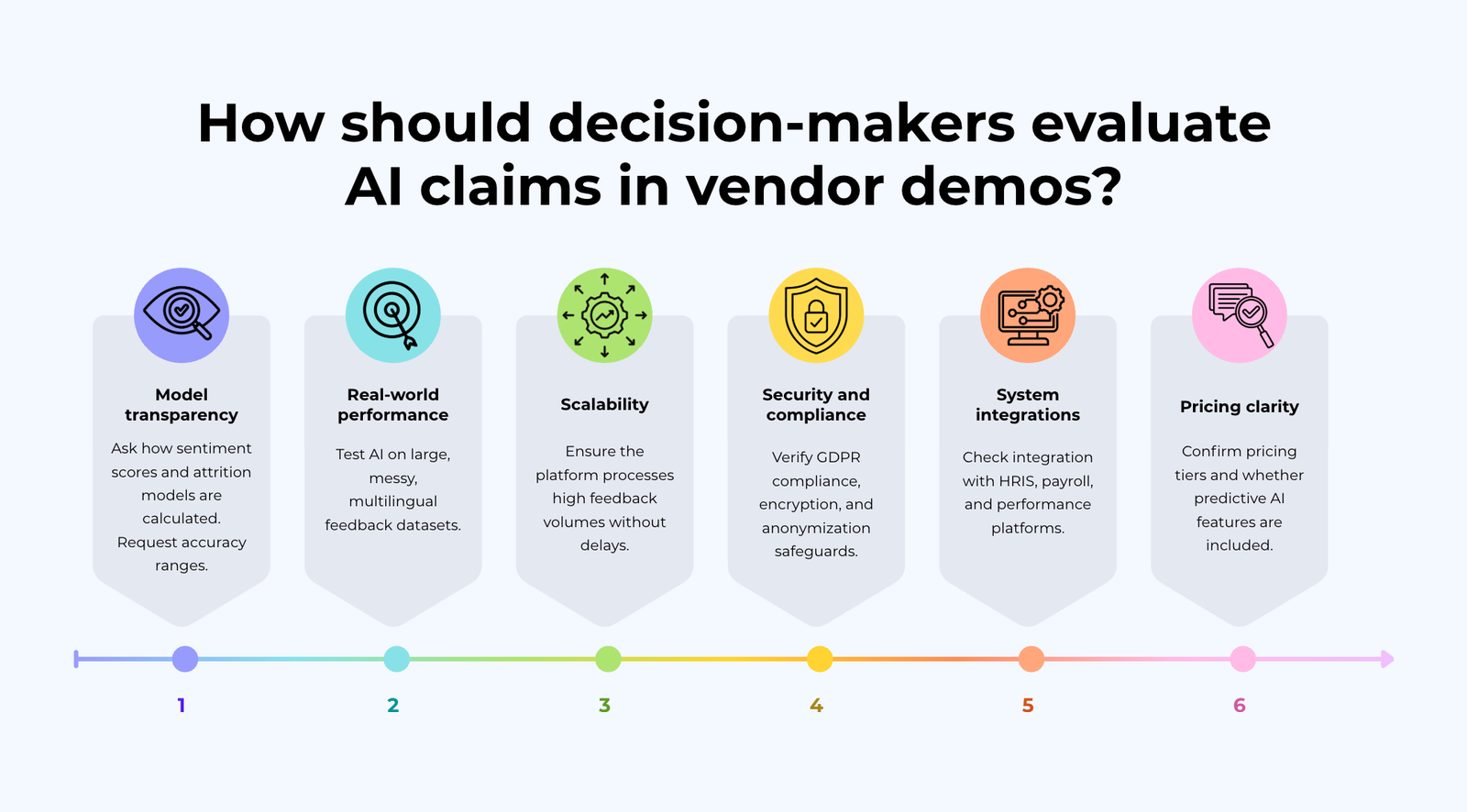
How should decision-makers evaluate AI claims in vendor demos?
AI claims in vendor demos should be assessed through validation evidence, transparency, scalability, and compliance safeguards. Decision-makers must verify whether AI in employee feedback tools delivers measurable insight or relies on scripted demonstrations and surface-level dashboards.
- Model transparency and predictive validity: Decision-makers should request a clear explanation of how sentiment scoring, engagement drivers, and attrition risk models are calculated. Vendors must provide documented accuracy ranges and false positive rates.
- Real-world performance demonstration: Demos should use large, anonymized datasets instead of curated samples. Leaders should evaluate how the system processes messy, multilingual, and unstructured comments under realistic enterprise conditions.
- Scalability across SME and enterprise environments: The platform must process high comment volumes without latency. It should support multi-country structures, distributed teams, and varied organizational hierarchies without performance degradation.
- Security, privacy, and compliance readiness: Vendors must demonstrate GDPR compliance, encryption standards, and anonymization thresholds. Role-based access controls and audit logs should support governance oversight and regulatory accountability.
- Integration and data ecosystem alignment: The system should integrate with HRIS, payroll, and performance platforms. APIs must enable automated employee data synchronization without repeated manual uploads or structural mapping issues.
- Commercial structure and deployment clarity: Pricing tiers in $ / € / ₹ should align with workforce size and deployment scale. Decision-makers must confirm whether predictive AI capabilities are included in core plans or sold as premium modules.
Conclusion
AI in employee feedback tools is transforming how organizations understand workforce sentiment and respond to employee concerns. By analyzing large volumes of feedback quickly, AI helps leaders identify engagement drivers, detect risks early, and make informed workplace decisions. However, organizations must balance automation with human judgment to ensure insights remain accurate and meaningful.
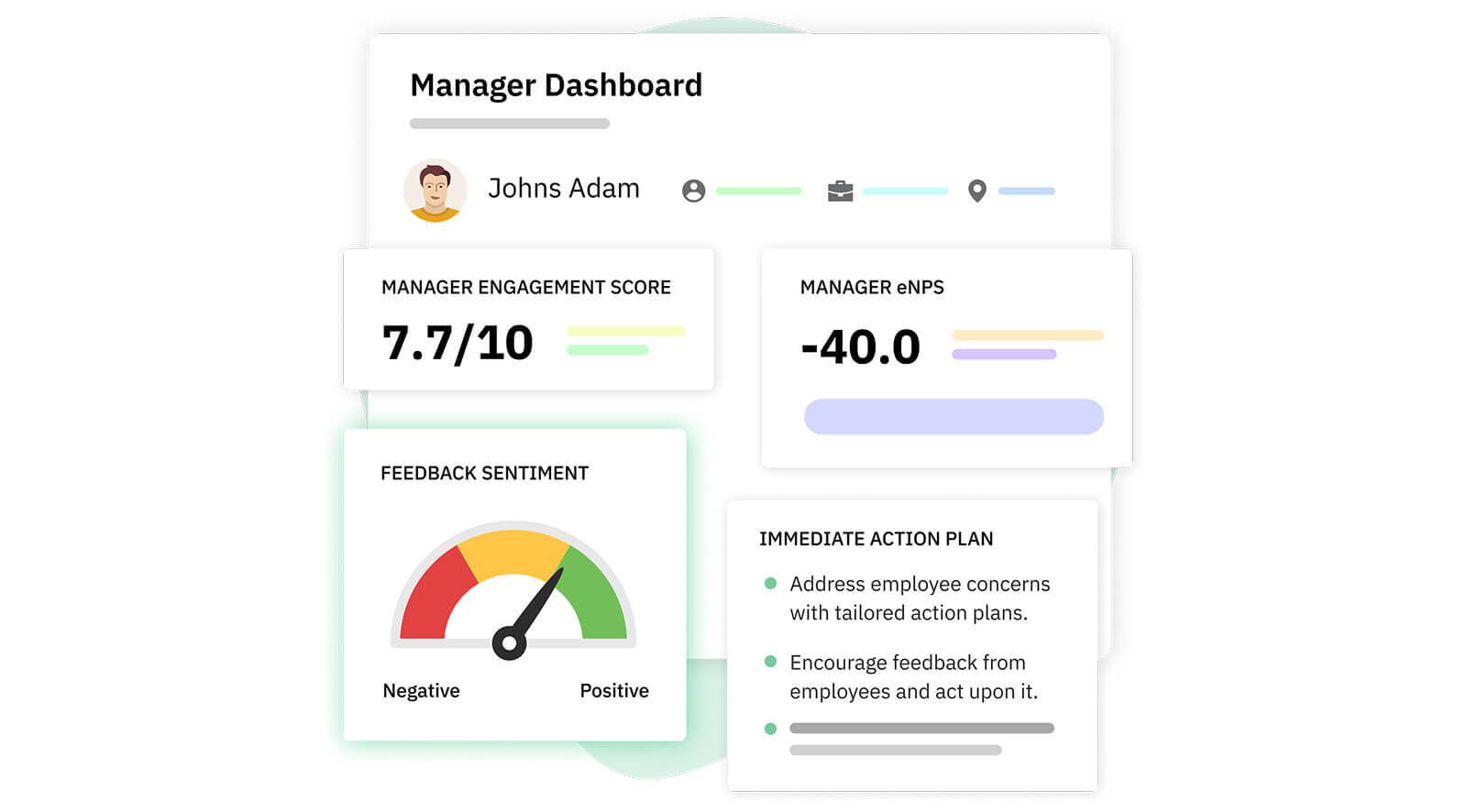
CultureMonkey combines AI-powered analytics, automated theme detection, and manager-ready dashboards to help organizations turn employee feedback into clear, actionable insights that strengthen engagement and workplace culture.
Book a demo with CultureMonkey.
FAQs
1. How accurate is AI sentiment analysis in employee surveys?
Today's AI maturity can easily lead sentiment analysis in employee surveys to be around 85 to 95 percent accurate, depending on model training and data quality. Accuracy improves with datasets and domain-specific tuning. Results should be validated with human review to reduce misclassification and errors.
2. Can AI detect burnout?
AI can detect burnout risk by identifying sustained negative sentiment, workload complaints, and declining engagement trends across survey cycles. It flags probability patterns rather than medical diagnosis. Managers must validate signals with contextual discussion before intervention.
3. Is AI in employee feedback tools compliant with GDPR?
AI in employee feedback tools can comply with GDPR when vendors implement strong encryption, anonymization thresholds, RBAC, and strict data retention limits. Compliance also requires transparent data processing policies, secure hosting environments, and proper configuration by the organization.
4. What is predictive engagement analytics?
Predictive engagement analytics uses machine learning to identify patterns in survey data that indicate future disengagement or performance decline. It moves beyond historical scores by modeling risk probabilities based on sentiment, drivers, and behavioral trends.
5. What is AI in employee feedback tools?
AI in employee feedback tools refers to machine learning and NLP systems that analyze survey responses, especially open-text comments, to detect sentiment, themes, engagement drivers, and potential risk indicators automatically at scale.
6. How does AI analyze open-text employee feedback?
AI analyzes open-text feedback using natural language processing, sentiment scoring, and clustering themes. It transforms unstructured employee comments structured, then correlates those themes with engagement scores and historical patterns to identify impact areas, workforce risks, and shifting sentiment trends.
7. What is sentiment analysis in employee surveys?
Sentiment analysis in employee surveys assigns emotional tone, such as positive, neutral, or negative, to written responses. Advanced models also measure intensity, helping organizations track morale shifts across teams and survey cycles.
8. How accurate is AI-powered sentiment analysis in employee feedback tools?
Accuracy generally ranges between 70 and 85 percent in enterprise settings. Performance depends on language complexity, training data quality, and contextual tuning. Human oversight improves reliability and reduces cultural or linguistic misinterpretation.
9. What is predictive analytics in employee engagement software?
Predictive analytics in employee engagement software applies machine learning to historical survey data and behavioral trends to estimate future outcomes such as disengagement, turnover risk, or performance decline. It identifies probability patterns across teams, helping leaders prioritize preventive action.
10. Is AI in employee feedback tools compliant with GDPR and data privacy laws?
Implementing AI systems can be made compliant with GDPR and other data privacy laws when they use encrypted storage, anonymized reporting thresholds, controlled access permissions, and transparent data processing policies aligned with regulatory requirements.
11. What is the difference between AI analytics and traditional survey reporting?
Traditional survey reporting focuses on summarizing historical scores, averages, and basic trend comparisons. AI analytics goes further by interpreting open-text comments, detecting hidden patterns, identifying engagement drivers, and generating predictive signals that support forward-looking decisions.
12. Can AI predict employee attrition using feedback data?
AI can estimate attrition probability by analyzing engagement trends, sentiment shifts, and historical turnover correlations. It identifies high-risk groups rather than certain exits. Predictions require continuous validation and should support, not replace, managerial judgment.