


The CultureMonkey employee listening maturity model: Predictive engagement intelligence

Many organizations believe they are listening to their people because they run surveys once or twice a year. But collecting feedback alone does not mean an organization truly understands what its workforce is experiencing. Without a structured approach, feedback often remains scattered across surveys, comments, and dashboards, leading to inconsistent action or meaningful change.
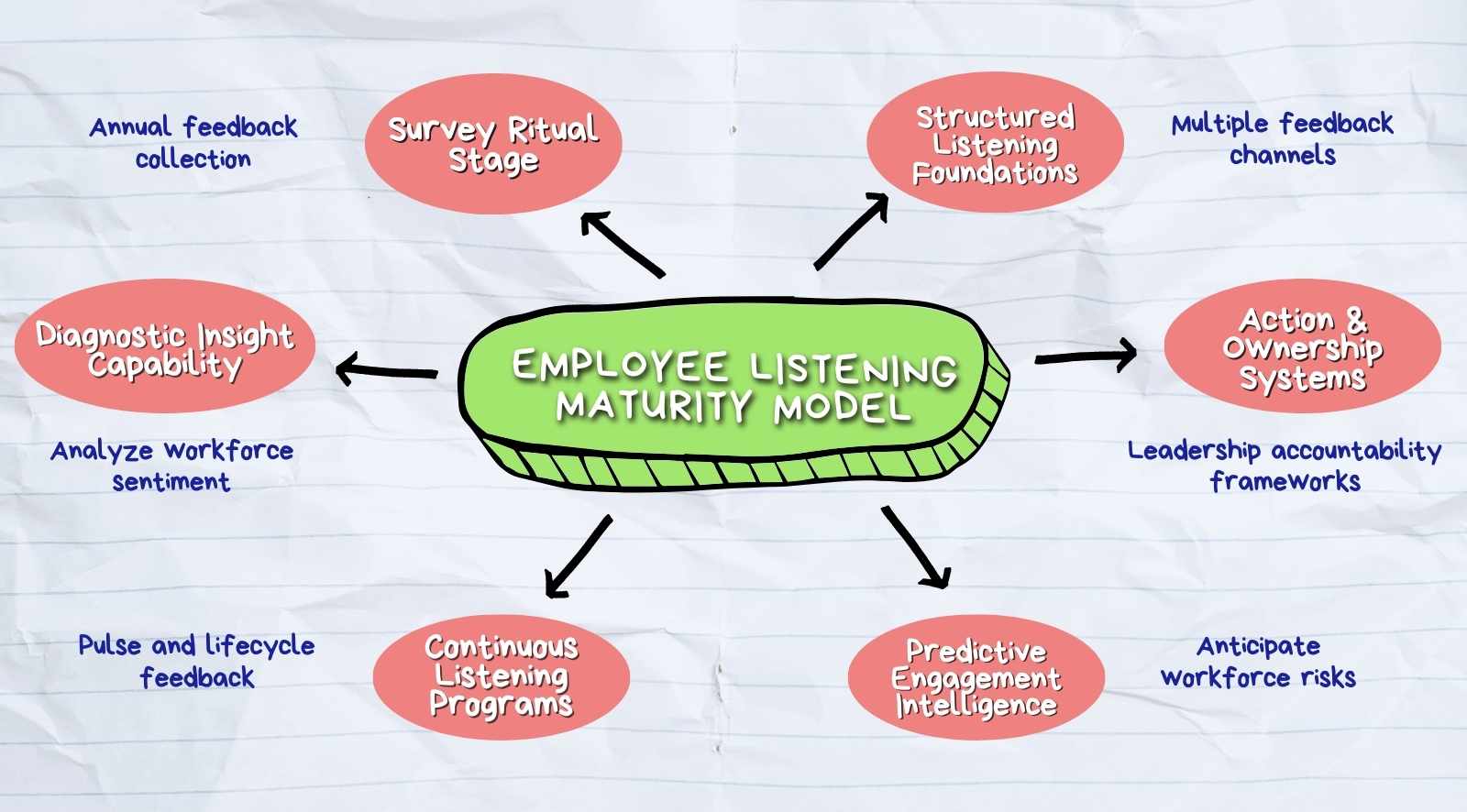
The CultureMonkey employee listening maturity model helps organizations move beyond basic feedback collection. It outlines a clear progression of listening capabilities, from ad hoc surveys to a fully integrated listening strategy. By understanding where they stand today, leadership teams can systematically strengthen how they capture insights, interpret sentiment, and act on employee feedback.


- The employee listening maturity model explains the structured stages organizations follow to capture, interpret, and act on workforce feedback.
- Many organizations plateau because surveys become rituals without diagnostics, continuous listening systems, or structured action frameworks.
- The five maturity levels progress from survey rituals to predictive engagement intelligence that anticipates sentiment and workforce risks.
- Assessing listening maturity requires evaluating feedback channels, analytics capabilities, leadership ownership, and action accountability systems.
- Advancing maturity shifts organizations from reactive surveys toward predictive listening that enables proactive leadership decisions and sustained engagement.
What is an employee listening maturity model?

An employee listening maturity model explains how organizations evolve from basic feedback collection to a structured listening strategy. It helps business leaders understand how employee listening supports employee engagement, strengthens employee experience, and aligns workforce insights with business priorities.
Instead of treating feedback as occasional input, the model positions listening as an ongoing management capability.
In simple terms, the employee listening model explained shows how organizations move beyond standalone employee engagement surveys toward continuous listening across the employee lifecycle.
A strong employee listening framework connects different listening channels, feedback moments, and leadership actions so that insights translate into meaningful decisions rather than isolated reports.
Why most organizations plateau in their listening strategy
Many organizations collect feedback but struggle to turn it into action. Listening efforts often stall when data lacks ownership, follow-up systems, or consistent listening channels. Without structured processes at key moments, insights remain unused, and the listening strategy stops progressing beyond basic feedback collection.
- Annual-only cadence: Employee engagement drops when listening channels go quiet between employee engagement surveys. Without continuous conversations, leaders miss early signals, then overreact to old listening data. The result is rushed fixes that don’t match what people need now.
- No closed-loop follow-up: When key insights appear, they often die in slides because no employee listening tool turns them into assigned actions. Listening efforts stay “collect and report.” Teams repeat the same focus groups, yet nothing changes, so participation fades.
- Data without ownership: Listening maturity stalls when dashboards lack a named owner and a deadline. Without linking listening data to business priorities, meetings end with “interesting” and no next step. Over time, organizational listening maturity becomes reporting theater, not change.
- Manager muscle never builds: An effective employee listening strategy fails when managers aren’t coached to run follow-ups after key moments. Strategic listening becomes an HR project, not a leadership habit. Managers avoid talking, so issues leak into turnover and satisfaction.
- Fragmented across the lifecycle: When listening channels aren’t mapped to the employee lifecycle, teams run random polls, then focus groups, then surveys. The stages of employee listening maturity need rhythm and reuse. A simple employee feedback maturity model keeps listening consistently everywhere.
The five levels of employee listening maturity

Employee listening maturity describes how organizations progress from basic employee surveys to structured listening programs. Early stages focus on collecting feedback, while advanced stages use continuous listening and analytics to connect employee voice with business objectives and address business problems proactively.
Level 1 - survey as ritual
- Annual engagement surveys dominate: Organizations rely mainly on annual engagement surveys to collect feedback. These traditional surveys capture employee opinions but rarely influence decisions. Over time, employees feel their voice disappears into dashboards, creating survey fatigue and weakening trust in the engagement survey process.
- Focus on participation over action: Leaders track response rates and completion metrics instead of acting on insights. Employee surveys become reporting exercises rather than change tools. Without structured follow-up, listening events feel symbolic, and the listening program fails to influence real workplace improvements.
Level 2 - diagnostic measurement
- Segmentation reveals patterns: Teams begin analyzing employee perceptions by department, location, or role. This diagnostic view helps identify business problems earlier. Employee listening analytics start surfacing drivers behind engagement scores, giving leaders a clearer understanding of trends across the employee journey.
- Still a reactive feedback strategy: Despite better analysis, organizations still depend on episodic listening through traditional surveys. Managers rarely receive guidance on how to act. Without consistent listening channels, the feedback strategy highlights problems but struggles to create lasting improvement.
Level 3 - continuous listening
- Pulse surveys expand listening frequency: Organizations introduce pulse surveys and additional listening events across the employee journey. These tools provide timely feedback, helping leaders detect shifts in employee opinions sooner and respond faster to issues affecting employee experience.
- Stable participation and stronger signals: Continuous listening strengthens the listening program by maintaining engagement with employees. Regular feedback builds trust and produces a deeper understanding of workforce sentiment. Over time, the organization develops more effective employee listening practices.
Level 4 - action-oriented leadership
- Managers drive follow-up actions: Listening insights move beyond dashboards into manager-led discussions. Leaders connect employee voice with business strategy and operational priorities. Structured action planning ensures feedback leads to visible improvements that strengthen workplace culture and employee engagement.
- Accountability loops sustain progress: Teams measure follow-up results and revisit key themes. This creates a continuous improvement cycle where listening outcomes align with business objectives. The listening program becomes a leadership tool rather than an isolated HR initiative.
Level 5 - predictive engagement intelligence
- Predictive analytics anticipate risk: Advanced organizations use employee listening architecture and predictive models to forecast engagement changes. Signals from listening data help leaders detect potential challenges before they escalate, allowing earlier intervention.
- Strategic workforce insights guide decisions: Insights from the employee listening capability model support business strategy and long-term planning. Instead of reacting to survey results, organizations proactively shape employee experience and maintain higher levels of engaged employees.
How to assess your organization’s listening maturity
Assessing listening maturity helps leaders understand how effectively feedback informs decisions. Organizations that use continuous feedback identify issues earlier and drive meaningful change. When relying only on survey results, gaps remain hidden. A structured diagnostic helps generate targeted insights and clarify leadership priorities.
- Run a 10-question diagnostic: Ask if you practice topical listening, use continuous feedback, and act on survey results. Include items on manager effectiveness and response follow-through. Keep it simple so executive leaders can answer fast, then compare patterns across teams for targeted insights.
- Score and map to levels: Turn answers into score bands and map them to maturity stages. This makes data analysis easy and reveals where listening breaks down. Use the score to align talent priorities with business needs, not opinions, then share it with leaders.
- Validate with proof points: Cross-check diagnostic scores with key milestones like turnover spikes, delayed actions, or manager effectiveness gaps. Compare themes in survey results with operational signals. This contrast shows whether feedback is trusted and whether it drives meaningful action or stops at reporting.
- Spot gaps and owners: List the top three gaps that block meaningful change, then assign an owner and deadline for each. Pick one gap tied to talent priorities and one tied to manager effectiveness. A valuable tool is one that creates action, not just more data analysis.
- Link listening to outcomes: Connect targeted insights to financial performance and customer indicators, then set a few financial targets that reflect improvement. When leaders see the line from feedback to business impact, they commit resources, and follow-through becomes easier to sustain.
Common barriers to advancing maturity levels

Employee listening maturity often stalls when ownership, alignment, and trust are weak. In large organizations, HR teams may collect regular feedback, but unclear business questions and poor coordination with other departments limit action. These gaps prevent real-time insights from turning into actionable improvements.
- Cultural resistance: Employees hold back when past feedback led nowhere. HR department rollouts that skip maintaining trust steps create silence. Without active listening habits across managers, regular feedback becomes surface-level, and HR leaders lose unique insight into what is actually happening.
- Data overload: HR teams may collect exit interviews, surveys, and comments, yet struggle to turn them into actionable insights. When business questions are vague, analysis feels endless. Real-time insights get buried, so leaders delay decisions, and the enterprise employee listening model stays stuck.
- Tool fragmentation: Listening data sits across different systems owned by other departments. HR department teams spend time stitching reports instead of acting. This slows response, weakens the maintenance of trust, and breaks the employee listening journey because teams cannot see one source of truth for employees.
- Leadership misalignment: Hr leaders may push listening, but executives prioritize different outcomes. When leaders disagree on which business questions matter, actions stall. The stages of the employee listening maturity model in organizations require shared goals, or progress resets after each cycle.
- No clear stage roadmap: Many programs skip a simple “four stages” map and jump to advanced analytics. Without pacing, HR teams miss basics like follow-up routines and manager ownership. That slows employee listening transformation and makes employee listening best practices feel optional.
Moving from reactive surveys to predictive listening
Moving from reactive surveys to predictive listening is like shifting from reporting problems to preventing them. When you only focus on gathering feedback after issues surface, teams stay in catch-up mode. This employee listening maturity model for HR leaders and people teams helps build the habits that protect a positive employee experience.
- Cadence: Replace one-off surveys with a steady rhythm of listening moments. Regular check-ins reduce blind spots and keep signals fresh. A predictable cadence also improves response rates because people know when and why you are gathering feedback, not just reacting to bad news.
- Governance: Set clear owners, timelines, and decision rules so feedback does not stall. Governance keeps actions moving across teams and prevents “HR-only” execution. With accountability in place, leaders can protect a positive employee experience by making follow-through visible and consistent.
- Analytics depth: Go beyond averages and look for patterns by team, role, and time. Deeper analysis shows where issues start and how they spread. This makes gathering feedback useful because insights point to specific fixes instead of broad statements that leaders cannot act on.
- Manager enablement: Give managers simple prompts, action steps, and follow-up questions so they can close loops fast. Predictive listening fails when only HR interprets data. Manager support turns insights into conversations that improve trust and sustain a positive employee experience.
- AI readiness: Standardize questions, clean data, and tag themes consistently so models can learn over time. AI works better when inputs are stable, and actions are tracked. This strengthens the employee listening maturity model for HR leaders and people teams without turning it into a tech project.
Conclusion
The CultureMonkey employee listening maturity model helps organizations move beyond isolated surveys toward a structured system for understanding workforce sentiment. As organizations grow, relying only on occasional feedback creates blind spots that affect engagement, decision-making, and long-term business outcomes. A maturity model provides a clear path from ritual surveys to predictive listening, where insights guide leadership actions consistently.
CultureMonkey, an employee feedback tool, supports this progression by helping organizations capture feedback across the employee lifecycle, analyze trends in real time, and translate insights into accountable action plans. With continuous listening, analytics, and structured follow-through, organizations can strengthen trust, improve employee experience, and build a scalable listening system that drives sustainable engagement and performance.
FAQs
1. What is an employee listening maturity model?
An employee listening maturity model explains how organizations progress from basic feedback collection to structured listening systems. It defines stages where companies evolve from occasional surveys to continuous listening, analytics, and leadership action that help understand workforce sentiment and improve engagement outcomes.
2. How do you measure employee listening maturity?
Employee listening maturity is measured by evaluating feedback channels, survey cadence, analytics depth, and action accountability. Organizations review how feedback is collected, analyzed, and acted upon. Higher maturity levels show continuous listening practices and clear leadership ownership for follow-up decisions.
3. What is the difference between surveys and continuous listening?
Employee surveys capture feedback at fixed intervals, such as annual or quarterly engagement surveys. Continuous listening gathers feedback more frequently through pulse surveys, check-ins, and lifecycle listening points. This approach helps organizations detect sentiment changes earlier and respond quickly.
4. What are the five levels of listening maturity?
The five levels of listening maturity typically include survey ritual, diagnostic measurement, continuous listening, action-oriented leadership, and predictive engagement intelligence. Each stage represents stronger listening systems, deeper analysis, and clearer accountability for converting employee feedback into action.
5. How can organizations move beyond annual engagement surveys?
Organizations move beyond annual engagement surveys by introducing pulse surveys, always-on feedback channels, and structured action planning. Leaders must assign accountability for follow-up and integrate listening throughout the employee lifecycle to ensure insights consistently lead to improvements.
6. What defines predictive engagement intelligence?
Predictive engagement intelligence refers to using advanced analytics and AI to identify patterns in employee feedback and forecast engagement risks. Instead of reacting to past survey results, organizations analyze trends to anticipate problems earlier and guide proactive leadership decisions.
7. Why do companies struggle to act on employee feedback?
Companies struggle to act on feedback because listening programs often prioritize data collection over action. Without clear ownership, follow-up systems, and leadership alignment, insights remain unused. Effective listening requires structured accountability that converts feedback into visible workplace improvements.
8. How does AI support advanced listening maturity?
AI supports advanced listening maturity by analyzing large volumes of feedback quickly and identifying hidden sentiment patterns. It highlights engagement drivers, risk signals, and emerging themes. These insights help leaders prioritize actions and respond more effectively to workforce concerns.
9. What is continuous listening in employee engagement?
Continuous listening is an approach where organizations collect employee feedback regularly rather than relying only on periodic surveys. It includes pulse surveys, lifecycle listening points, and always-on channels that help leaders track engagement trends and address issues sooner.
10. How do manager dashboards improve feedback impact?
Manager dashboards convert survey insights into clear team-level data with recommended actions. They help managers understand engagement trends, identify concerns affecting their teams, and track follow-up progress. This visibility improves accountability and ensures feedback leads to meaningful change.