What an employee satisfaction survey is

An employee satisfaction survey is a structured assessment of how people feel about their job, work environment, leadership, compensation and growth prospects. It gathers feedback through standardised questions so strengths and concerns can be compared rather than debated.
The purpose is to measure job contentment and detect the patterns that affect morale, productivity and retention. Designed properly it produces reliable data; designed carelessly it produces a number that feels authoritative and means very little.
Opinion, satisfaction or engagement: which survey to run

These three get treated as synonyms and are not. An opinion survey collects views on policy and leadership decisions. A satisfaction survey measures job contentment. An engagement survey measures emotional commitment. Each answers a different question, and running the wrong one produces a clean result to a question you were not asking.
| Survey type | Purpose | Focus areas | Outcome | Frequency |
|---|---|---|---|---|
| Employee opinion survey | Collects views on policies and leadership decisions | Policies, leadership, processes, culture | Improves organisational decisions | Annual or change-based |
| Employee satisfaction survey | Measures job and workplace satisfaction | Compensation, work-life balance, leadership support | Identifies dissatisfaction and turnover risk | Semi-annual or annual |
| Employee engagement survey | Measures emotional commitment | Motivation, alignment, discretionary effort | Improves retention and productivity | Annual, with pulse follow-ups |
Use an opinion survey during policy change. Use a satisfaction survey when you need to locate dissatisfaction. Use an engagement survey when you are assessing long-term commitment and retention risk.
2026 employee satisfaction benchmarks

A satisfaction score with nothing to compare it against is a number, not a finding. These are the current reference points, and several of them should change how you write the questionnaire rather than just how you read the result.
- 70%of employees feel satisfied with their work at least once a week, 22% daily. Stress is present alongside it, so a single satisfaction number needs deeper analysis.PwC
- 57.4%of US workers under 25 report job satisfaction, against 72.4% of those aged 55 and over. Segment by age or the average will mislead you.The Conference Board
- 70.5%of recent job switchers reported satisfaction in 2024, just above the 69.6% of stayers. Mobility is not the clean signal it is assumed to be.The Conference Board
- 63%of employees would trade existing benefits for more choice over them. Autonomy items belong in the questionnaire, not just the benefits review.Aon
- 89% / 92%of Gen Z and millennials say purpose drives job satisfaction. If your survey has no purpose item, it is silent on the largest driver for most of your workforce.Deloitte
- 91% vs 44%satisfaction among employees who believe workplace needs are addressed, against those who do not. Operational responsiveness is the variable most surveys never ask about.SHRM
Read together, these say a question set has to account for age, autonomy, purpose and operational responsiveness. A questionnaire silent on all four will produce a satisfaction figure that does not predict anything.
The four types of job satisfaction

Satisfaction is not one thing and it is certainly not just the paycheque. These four operate independently, which is why someone can be well paid and still leave.
Intrinsic job satisfaction
The enjoyment and fulfilment that comes from the tasks themselves. Work that is intellectually stimulating and personally rewarding produces it; no amount of external reward substitutes for it.
Extrinsic job satisfaction
External rewards: salary, bonuses, benefits, job security. These are the factors people notice most when they are missing and least when they are adequate.
Social job satisfaction
Relationships with colleagues, supervisors and teams. Supportive workplace relationships are one of the strongest predictors of whether someone stays.
Life satisfaction
Overall personal happiness, which shapes how people experience work regardless of the job itself. A balanced life outside work improves the attitude brought into it.
Why measure employee satisfaction at all

- Employee retention
Satisfaction and retention move together. Measuring it identifies the factors driving turnover early enough to address them, which is considerably cheaper than the recruitment and training that follows a resignation.
- Productivity and performance
Measuring surfaces where people are blocked or dissatisfied in ways that hold back their work. Gallup puts the gap at 21% higher profitability for organisations with engaged, satisfied employees.
- Engagement and motivation
Satisfaction is closely tied to engagement. Measuring it shows which drivers are actually operating here, rather than which ones the literature says usually operate.
- Organisational culture and climate
The survey shows whether people feel supported, valued and included. That is the difference between a stated culture and a lived one.
- Feedback and continuous improvement
It gives people a channel for concerns and suggestions, and gives you a way to track whether an intervention did anything over time.
- Customer satisfaction
Satisfied employees deliver better service. The link between internal experience and customer experience is direct enough that measuring one tells you something about the other.
The KPIs worth tracking

- Response rate
The first sign of a working survey. Low participation usually signals disengagement or disbelief rather than busyness. Aim for at least 70%.
- Overall satisfaction score
The headline number, tracked over time. Its value is entirely in the trend; a single reading has no context to sit in.
- Engagement
Look at responses on enthusiasm, commitment and emotional connection. Engaged employees are more productive and less likely to leave.
- Employee net promoter score
How likely people are to recommend the organisation as a place to work. A blunt instrument, but a hard one to argue with.
- Action plan effectiveness
Whether scores moved in the areas you deliberately targeted. This is the KPI that tells you if the whole exercise worked.
78% of employees know what motivates them, yet only 33% strongly believe their organisation does (Deloitte 2025 Human Capital Trends). That gap is the entire argument for asking rather than assuming.
Signs you need to survey employees now
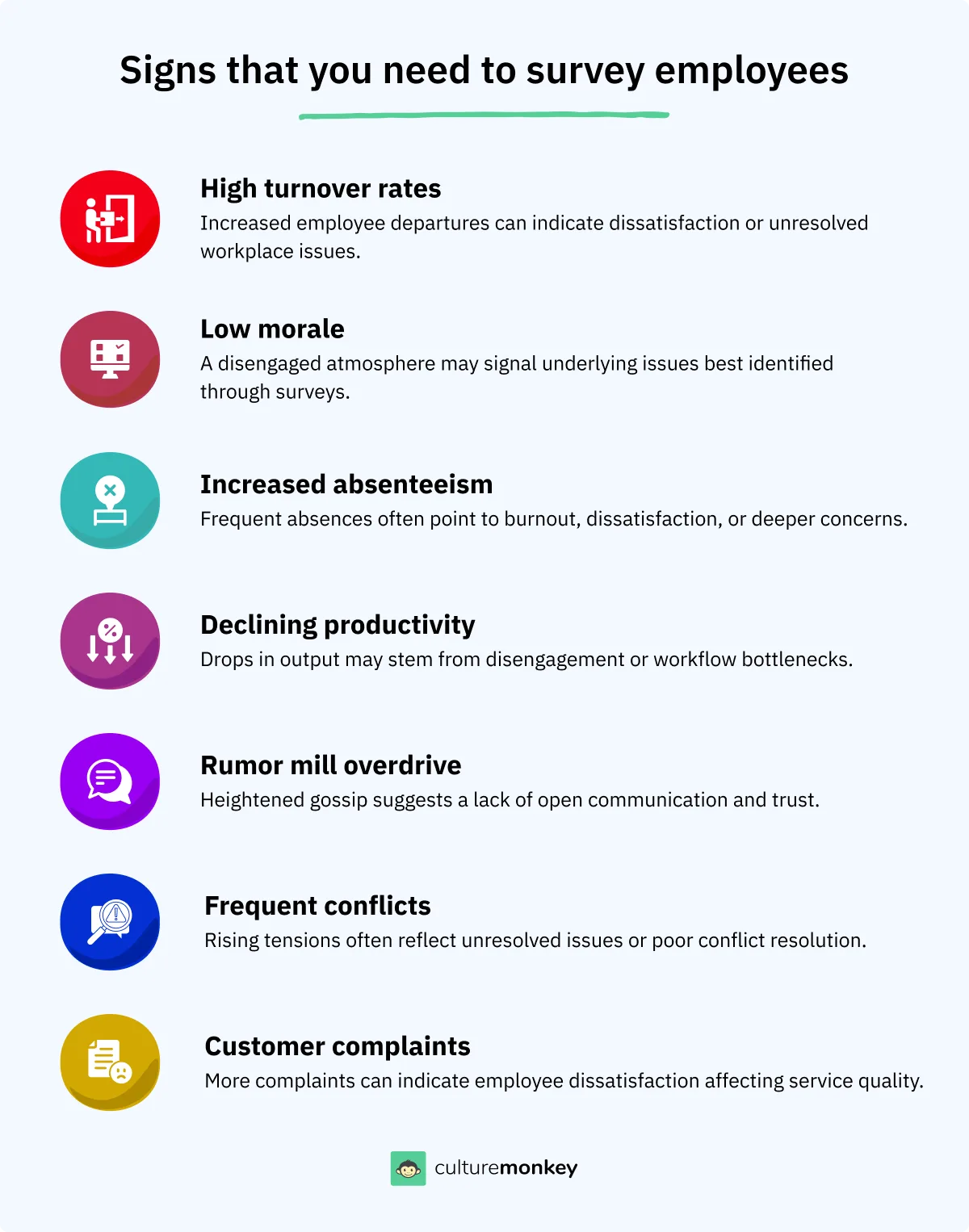

- High turnover rates
An uptick in departures is the loudest signal available. A survey tells you whether it is management, growth or something you have not considered.
- Low morale
When the room feels flat, a survey pinpoints the source, whether that is workload, communication breakdown or something more specific.
- Increased absenteeism
Frequent sick days and unexplained absence often precede disengagement. The survey finds the root cause before the resignation does.
- Declining productivity
A dip in output usually has a process explanation before it has a people explanation. Feedback surfaces the bottleneck.
- Rumour mill overdrive
Active gossip means the official channels are not carrying information. A survey identifies where the gaps are.
- Lack of innovation
A team that has stopped proposing ideas has usually learned that proposing them does not go anywhere.
- Customer complaints
Rising complaints often trace back to employees who lack the support or training to deliver.
- Frequent conflicts
Persistent conflict points at structural tension, not personality. The survey finds the structure.
- Stagnant growth
Organisational drift is often dissatisfaction that nobody has measured yet.
- Competitors surpassing you
Falling behind can mean your people are not engaged or empowered enough to move at the pace required.
30 employee satisfaction survey questions

Grouped by what each set measures. The final group, key metrics, should stay identical every cycle: those five are the trend line, and rewording them resets it.
Job satisfaction and role
The baseline: does the job make sense to the person doing it?
- How satisfied are you with your current job responsibilities and role?
- Does your role match your skills and strengths?
- Do you clearly understand what is expected of you?
- Are your daily responsibilities manageable?
- Would you recommend your role to others based on your experience?
Management and leadership
The single largest controllable driver of whether someone stays.
- Do you feel supported by your immediate manager?
- Does leadership communicate decisions clearly?
- Do you trust leadership to act in employees' best interests?
- Are performance expectations set fairly?
- Does your manager provide constructive feedback regularly?
Work-life balance and environment
Conditions rather than feelings. These are the items you can act on fastest.
- Are you able to maintain a healthy work-life balance?
- Do you feel comfortable in your work environment?
- Is your workload reasonable for your role?
- Do workplace policies support your well-being?
- Do you feel psychologically safe at work?
Growth and recognition
Where people decide whether there is a future here worth staying for.
- Do you see clear professional growth opportunities in this organisation?
- Are promotions handled fairly?
- Do you receive recognition for good work?
- Does the organisation invest in your professional development?
- Do you feel your contributions are valued?
Open-ended questions
The qualitative depth. Five of these will teach you more than fifty scales.
- What is one change that would improve your job satisfaction?
- What prevents you from performing at your best?
- What does the organisation do well?
- What should leadership improve in day-to-day work?
- What benefits matter most to you and why?
Key metrics
Keep these five identical every cycle. They are your trend line.
- How satisfied are you with your job overall?
- How likely are you to stay with this organisation for the next two years?
- How likely are you to recommend this organisation as a workplace?
- How satisfied are you with your compensation and benefits?
- How satisfied are you with communication across the leadership team?
How to structure the survey

- Introduction
Explain the purpose, reassure on confidentiality and give an honest time estimate. An underestimated completion time costs you the second half of the responses.
- Demographic information
Collect role, department and tenure up front. Without them you cannot segment, and without segmentation the results are one undifferentiated average.
- Multiple choice and Likert items
Structured responses give you the quantitative backbone. Keep the scale consistent across the whole survey.
- Open-ended questions
These surface the issues your closed questions did not anticipate, which is precisely the value they add.
- Specific categories
Group by compensation, balance, development, leadership and culture so respondents can hold one context at a time.
- Balanced format
Alternate positively and negatively framed statements. Uniform framing produces acquiescence bias, which reads as satisfaction.
- Order and flow
General before specific, related items together. A survey that jumps topics is a survey that gets skimmed.
- Avoid jargon and ambiguity
Clear language, no internal shorthand. Every ambiguous word is variance you cannot explain later.
- Optional sections
Leave room for anything the survey did not ask about. Some of the most useful input arrives here.
- Closing and thank you
Close by acknowledging the time given. It costs nothing and it is noticed.
What goes wrong, and what to do about it
Measuring satisfaction looks straightforward and rarely is. These six account for most of the cases where the exercise produces a number nobody trusts.
Low response rates
People hesitate through time pressure, disinterest, or the belief that feedback changes nothing.
Communicate the purpose, guarantee anonymity and make it accessible on any device. Reminders help; visible follow-through helps more.
Lack of honest responses
Fear of repercussion, or no trust that confidentiality will hold, produces polite and incomplete answers.
Use genuinely anonymous surveys and say so clearly. Build a culture where feedback is acted on, because that is what makes the promise credible.
Poorly designed questions
Ambiguous, leading or irrelevant items produce responses that cannot be acted on.
Write specific, unbiased questions aligned to a stated objective. Mix Likert scales with open text for balance.
Misinterpretation of results
Without context or segmentation, results get read wrong and the resulting action misses.
Segment by demographic, role and department. Involve HR and managers in the analysis rather than presenting a finished conclusion.
Survey fatigue
Frequent or long surveys erode both participation and answer quality over time.
Limit frequency, keep them short, and use pulses instead of another comprehensive round. Visible change is what sustains interest.
Cultural barriers
In diverse workplaces, cultural difference shapes how questions are read and whether they are answered at all.
Design inclusively: language options, regional norms, multilingual delivery, and input from people who know the context.
The science behind the questions

Good satisfaction questions are not written by intuition. They sit on measurement science that is roughly a century old, and most survey design errors are already named problems in that literature.
- Motivation theory foundation
Herzberg's two-factor theory holds that satisfaction and dissatisfaction are driven by different factors. A good question set measures hygiene factors and growth drivers separately. Herzberg, F. (1959). The Motivation to Work
- Needs-based measurement
Maslow's hierarchy supports including safety, belonging and growth items rather than treating satisfaction as one undifferentiated feeling. Maslow, A. (1943). A Theory of Human Motivation
- Construct validity
Psychometric standards require each question to measure one defined concept. This is why double-barrelled items are a design fault, not a style preference. AERA, Standards for Educational and Psychological Testing
- Reliability through scaling
A consistent scale improves statistical reliability and makes comparison across cycles meaningful rather than approximate. Likert, R. (1932). A Technique for the Measurement of Attitudes
- Longitudinal tracking
Repeating core items enables trend analysis and early detection of risk patterns. Changing the wording resets the trend line to zero.
The common objection is that employees avoid honest feedback. The evidence points the other way: clear anonymity safeguards and visible follow-through improve both candour and response quality substantially.
How to implement the survey
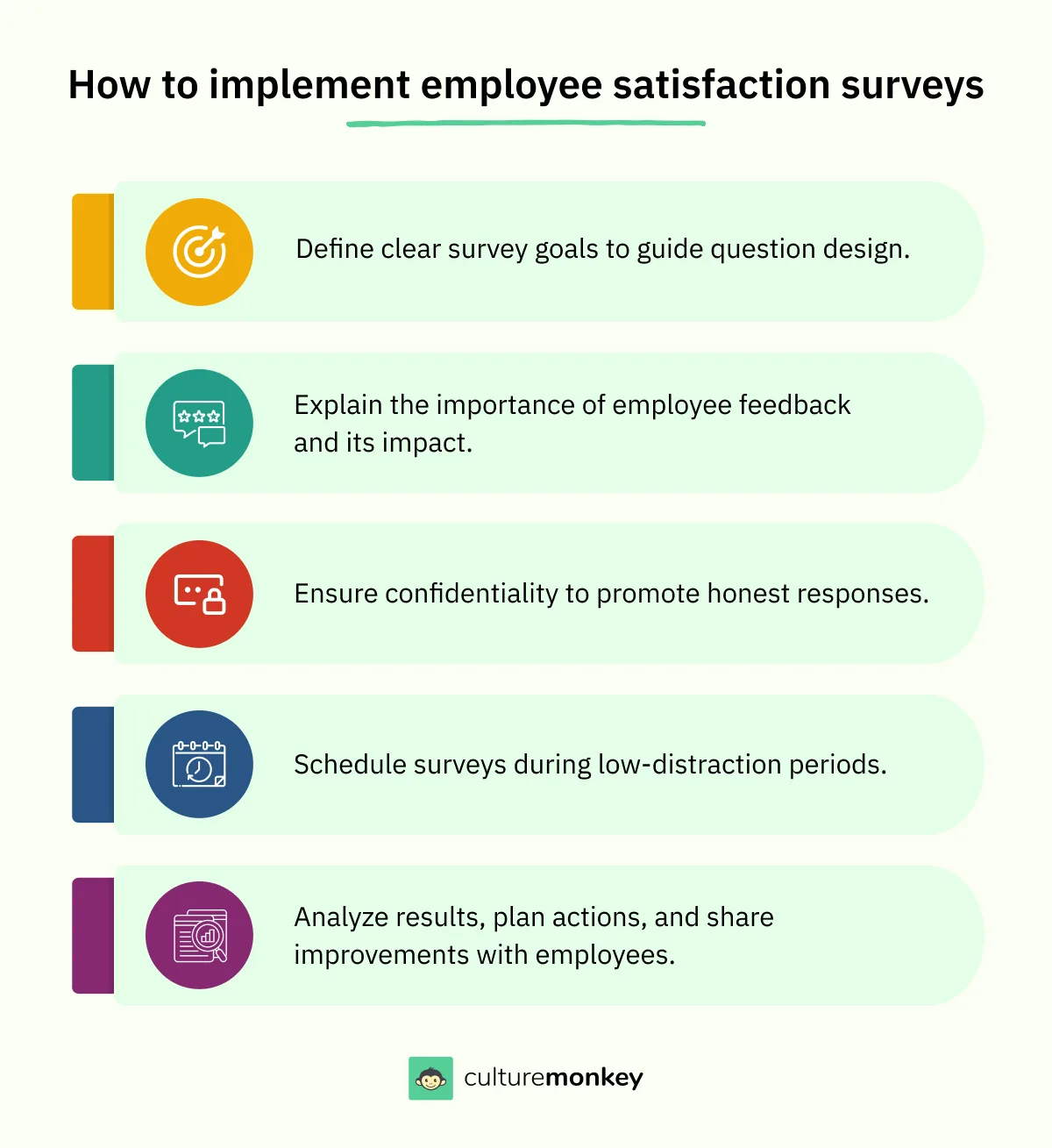

- Define objectives
Outline what the survey is for and which areas it must cover. These objectives are what the design gets judged against later.
- Determine survey method
Choose online, paper or a mix based on workforce size, technology access and confidentiality needs.
- Design the survey
Build the questionnaire against the objectives. Mix closed and open items, and keep every question clear, unbiased and relevant.
- Ensure anonymity and confidentiality
State that responses are anonymous and that the purpose is improvement, not individual performance assessment.
- Communication and introduction
Explain the purpose to both management and employees, and announce it in advance with the timeline and method.
- Pilot testing
Run it past a small group first. Ambiguities that are obvious to a pilot group are invisible to the person who wrote the questions.
- Launch the survey
Distribute with clear access instructions and a stated deadline.
- Follow-up and reminders
Remind people through the channel they actually use, and offer help where access is the blocker.
- Data collection and analysis
Compile responses and analyse for trends, using the quantitative and qualitative data together.
- Action planning
Build the plan with HR, managers and employee representatives. Set goals, assign owners and publish timelines.
Raising participation

Participation follows trust, not reminders. People answer when they have seen the process produce something before.
- Ensure survey transparency
Explain how results will be used. People participate when they can see the mechanism by which their answer matters.
- Keep surveys anonymous
Anonymity is what makes candour safe. Without it you measure caution rather than satisfaction.
- Send friendly reminders
Personal, gentle reminders that name the deadline and the value of the individual response.
- Make surveys easy to access
Mobile-friendly, quick links, no login friction. Every extra step costs responses.
- Share results and action plans
Publish the findings and the steps being taken. This is the single highest-leverage move for next cycle's response rate.
- Create a positive feedback loop
Run surveys regularly and act on them. People participate in a process they have seen work before.
Reading the results and acting on them

- Segment the data
Break results down by department, role and tenure. Disparities across segments are usually more actionable than the headline number.
- Prioritise areas of concern
Identify what needs immediate attention, focusing on the drivers with most influence over the overall experience.
- Analyse open-ended responses
Read the qualitative feedback for recurring themes and specific examples explaining the scores.
- Seek clarification if needed
Where a trend is unclear, run a follow-up discussion or focus group rather than guessing at an interpretation.
- Collaborate with stakeholders
Involve HR, managers and employee representatives. Their context is what turns a number into an explanation.
- Develop an action plan
Set realistic goals, assign responsibility and create timelines, aligned to what the organisation can actually resource.
- Implement and monitor progress
Execute, then assess impact and adjust. Track with follow-up surveys so effectiveness is measured rather than assumed.
Do satisfaction surveys actually change anything?
The objection that surveys produce reports rather than results is fair whenever there is no accountability attached. Gallup's State of the Global Workplace 2025 puts global engagement at 21%, which is a persistent gap by any reading. Where organisations measure systematically and act on the findings, engagement and performance move. The failure mode is design and follow-through, not the instrument.
HR analytics and AI on large data sets

- Data organisation
Analytics tools categorise large data sets so satisfaction, performance and turnover patterns are analysable without manual sorting.
- Identifying trends
Patterns across many data points become visible, which is how you understand behaviour over time rather than at a moment.
- Predictive analytics
Turnover risk and engagement levels can be forecast from historical data, which turns retention from reactive into proactive.
- Sentiment analysis
Natural language processing reads open-ended responses at scale, detecting sentiment that manual coding would miss or take weeks to find.
- Real-time feedback
Instant analysis means decisions can be made on current data rather than on a quarter-old snapshot.
- Customised reporting
Complex data becomes a summary a manager can act on, which is where most analytics projects succeed or fail.
- Identifying skill gaps
Performance and learning data together point at where development investment is actually needed.
- Benchmarking
Comparison against industry data gives your own numbers a context they otherwise lack.
- Automation of repetitive tasks
Collection and analysis get automated, which frees HR time for the work only people can do.
- Diversity and inclusion monitoring
Demographic tracking assesses whether inclusion initiatives are having the effect they were funded for.
Frequently asked questions
What is a job satisfaction survey?
A job satisfaction survey is a structured questionnaire used to measure how employees feel about their role, leadership, pay, and work environment. It gathers standardized feedback to identify satisfaction levels, workplace concerns, and retention risks, helping organizations make informed decisions.
How to create an effective job satisfaction survey?
To create an effective job satisfaction survey, define clear objectives and the areas you want to measure, such as workload, leadership, and professional growth. Use neutral, single-focus employee survey questions with consistent rating scales. Test the survey before launch and ensure confidentiality to encourage honest responses.
What are the best questions to include in a job satisfaction survey?
The best survey questions for employee satisfaction measure leadership support, workload, compensation fairness, recognition, and career development. Use clear rating-scale statements to collect measurable data and include a few open-ended questions to better understand the reasons behind employee responses.
Why is a job satisfaction survey important for organizations?
A job satisfaction survey provides structured insight into how employees feel about their work and workplace. It helps leaders detect dissatisfaction early, reduce turnover risk, improve morale, and make evidence-based decisions. Regular surveys strengthen communication and support more informed workforce planning.
What are the key benefits of conducting a job satisfaction survey?
Conducting a job satisfaction survey improves transparency, strengthens communication and operational gaps. It enables targeted action plans, builds employee trust, and supports workforce stability. Regular surveys also help organizations track progress over time and adjust strategies based on measurable feedback.
How can companies improve employee satisfaction based on survey results?
Companies can improve employee satisfaction by analyzing survey results to identify priority issues. Focus on high-impact areas such as leadership clarity, workload balance, or recognition. Create survey action plans, communicate changes transparently, and track progress through regular follow-up surveys.
How often should you conduct employee satisfaction surveys?
Most organizations conduct employee satisfaction surveys quarterly, biannually, or annually. The ideal frequency depends on company size, pace of change, and business priorities. What matters most is consistency, timely action on results, and clear communication after each survey cycle.
How can survey feedback improve company culture?
Survey feedback helps identify trust gaps, communication, leadership issues and if the company recognizes employees enough. Acting on results with clear action plans and constant updates builds credibility. Over time, consistent follow-through strengthens accountability, improves employee trust, and supports a healthier workplace culture.