


What an effective eNPS survey template should look like in 2026


Imagine booking a hotel in a new city. You scroll past polished photos, but one traveler’s simple line catches your eye: “I’d stay here again tomorrow.” Suddenly, the choice feels easier. Not because the lobby looks nice, but because real sentiment cuts through the noise and tells you what actually matters.
That same quiet influence shapes how people perceive your organization every day. Impressions circulate organically, guiding how others talk about you long before any official message reaches them. A well-crafted eNPS survey template helps you tap into that undercurrent instead of guessing where it is flowing.
With the right structure, you can spot patterns, understand enthusiasm or hesitation, and act before the narrative drifts off course.


- eNPS offers a simple way to measure employee loyalty, sentiment, and advocacy using a 0–10 recommendation score.
- Effective templates stay short, focused, and consistent, with one core question plus a concise follow-up.
- Follow-up prompts uncover causes behind scores, turning raw numbers into practical, actionable insights.
- Structured analysis, visible communication, and repeatable feedback loops strengthen trust and engagement.
- Clear design, timing, anonymity, and purpose are essential to avoid misleading results and survey fatigue.
What is employee net promoter score, and what does it measures

Employee net promoter score is like checking the temperature of a room before you walk in. You instantly sense whether the environment feels warm, cold, or somewhere in between. A structured staff survey template plays the same role by helping you gauge how people instinctively feel about recommending your workplace to others based on their everyday experience.
At its core, employee net promoter score measures how strongly someone would stand behind your organization if a friend asked for an honest opinion. It uses a simple 0 to 10 scale, just like a formulario NPS, to sort responses into promoters, passives, and detractors. This creates a clear picture of loyalty, advocacy, and sentiment without drowning leaders in complex data.
What makes this metric valuable is its ability to condense wide emotional signals into a single trend line that leaders can track with confidence. You see whether enthusiasm is rising, trust is slipping, or the culture stays steady over time. When combined with your staff survey template, the score becomes a practical guide that helps refine decisions around engagement, retention, and employee experience.
The core question every eNPS survey template must include
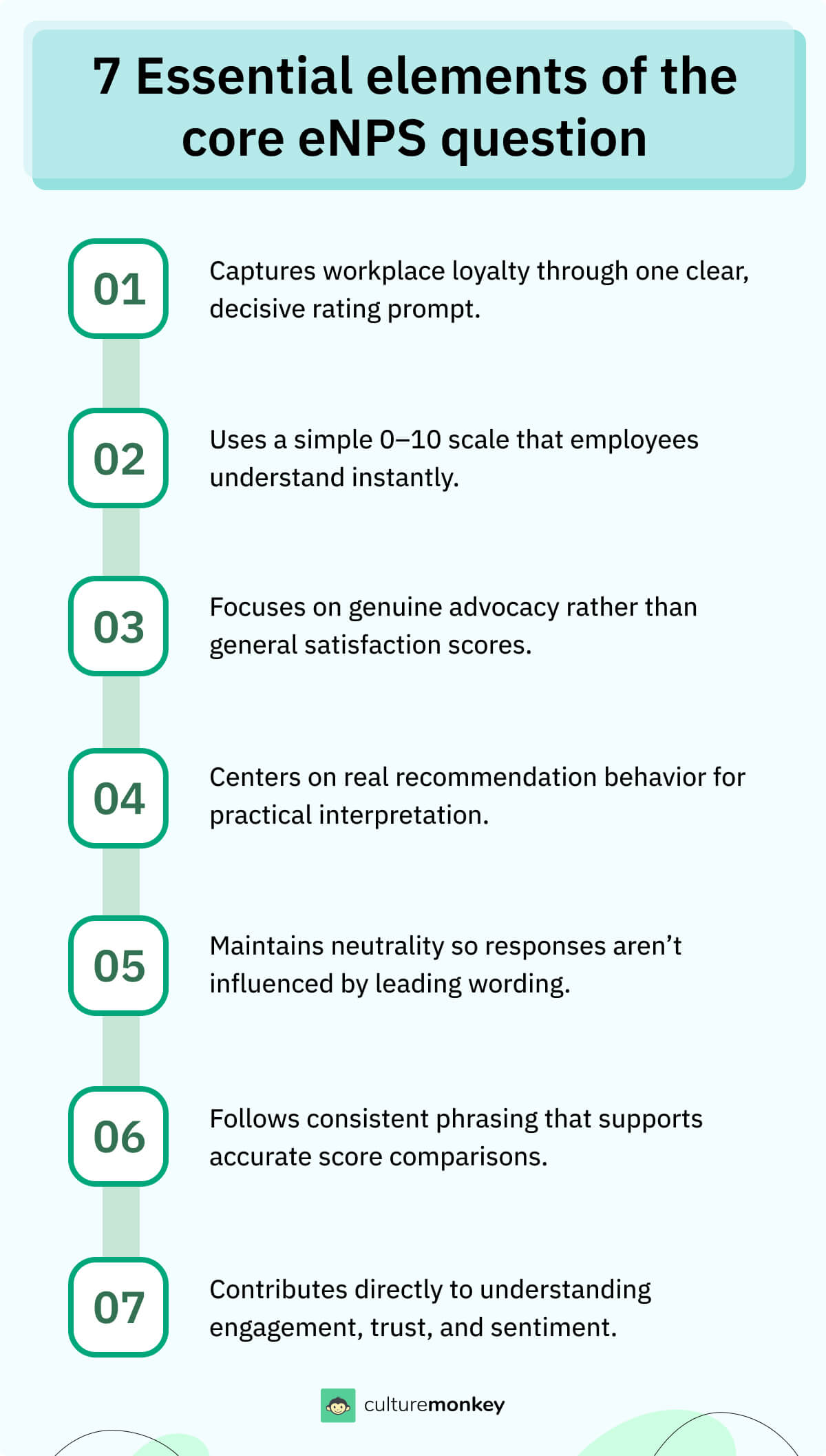
Your main employee net promoter score prompt is like the one decisive question you ask before signing a major hire. Everything else is helpful detail, but this single line carries real weight. In any employee net promoter score survey template, that decisive question must sit at the center of every eNPS survey.
- The recommendation question itself: Ask, "How likely are you to recommend this company as a place to work?" on a 0–10 scale. This anchors your employee net promoter score survey template and keeps each eNPS survey template consistent across roles.
- Why it reveals loyalty: This single prompt turns feelings into a net promoter score signal for employee loyalty and employee retention. It separates engaged employees from neutral groups faster than long employee engagement surveys packed with opinion scales.
- Why wording stays neutral: Asking about a recommendation, not happiness, keeps the focus on real behavior instead of mood. It blends employee satisfaction, employee experience, and workplace culture into one practical decision, "Would you actually tell someone to join us?"
- How it connects to customers: Strong scores mirror customer satisfaction and customer loyalty, because engaged employees treat people differently. Over time, your eNPS survey questions become an early warning light for slipping service quality and weaker brand relationships.
- Where it sits in your templates: The core item anchors an eNPS questionnaire template, from a simple pulse to an employee engagement survey. Around it, you add follow up prompts that explain why satisfied employees promote you while others hesitate.
Once you are confident that this core item is consistent and trusted, the next step is packaging it inside the right eNPS survey template so every team collects accurate, actionable feedback without reinventing the wheel each time.
7 eNPS templates designed for accurate, actionable feedback

Building the right set of eNPS survey examples is like choosing the right tool before fixing a system issue at work. The wrong tool slows everything down while the right one gives you clarity fast. Each survey template below helps you gather feedback that reflects how employees feel and what shapes a positive employee experience inside your culture.
1. Basic eNPS Template
- Straightforward recommendation focus: A simple net promoter score survey that measures employee loyalty through the core item and a short explanation prompt. It helps you improve employee engagement by tracking how employees feel before adding deeper layers.
- Quick sentiment read: Ideal for leaders who want a fast way to measure employee engagement and increase employee satisfaction without overwhelming people with long employee surveys.
2. eNPS With Driver Questions Template
- Adds clarity behind scores: This template connects the main item with follow up prompts about work life balance, leadership, and support. These eNPS question examples help you understand the primary reason behind a low or high score.
- Better action planning: It links employee net promoter score with practical insights that help teams improve employee engagement and strengthen positive company culture.
3. Onboarding eNPS Template
- Early experience insight: It reveals how new hires feel during their first weeks and whether their early impressions match the company’s promise. It helps measure employee engagement from day one.
- Predictive retention signal: These eNPS survey examples help leaders spot onboarding gaps that impact employee loyalty and the company’s long-term success.
(Source: Gallup)
4. Pulse eNPS Template
- Frequent sentiment tracking: A short survey template that monitors employee satisfaction shifts over time. It is perfect for fast cycles where employees feel changes quickly.
- Agile improvement loop: Helps teams gather feedback often so they can adjust communication, workload, and support without waiting for annual employee surveys.
5. Manager-Level eNPS Template
- Leader influence check: Measures how employees feel about their direct manager’s support, clarity, and coaching. It ties the employee net promoter score to daily team conditions.
- Targeted interventions: Useful when you want to improve employee engagement by strengthening leadership practices and fixing small issues that affect morale.
6. Annual eNPS Review Template
- Comprehensive culture snapshot: Blends the core item with wider prompts around work life balance, development, and environment. It creates a full picture of employee experience and satisfaction.
- Year-over-year insight: Helps you measure employee loyalty, assess progress, and align people programs with the company’s success.
7. Exit eNPS Template
- Honest final feedback: Captures how exiting employees feel and what shaped their choice. The structure reveals gaps that affect employee retention and workplace culture.
- High-value learning: These eNPS survey examples help you gather feedback that prevents recurring turnover and builds a more positive company culture.
When these templates are paired with clear follow-ups, you get sharper insight into why people choose their scores and where your culture needs real attention next.
Now it is time to explore the follow-up questions that strengthen your eNPS template and turn every rating into actionable guidance.
The follow-up questions that strengthen your eNPS template

Great follow-ups in an eNPS form template are like asking a candidate one clarifying question after a strong interview answer. You already know the headline, but the extra detail shows what really shaped it. When your eNPS survey format includes the right prompts, you turn raw scores into clear, honest feedback you can actually use.
- What influenced your score the most? This uncovers the primary factor behind a promoter score eNPS survey result. It reveals whether people want changes that improve employee satisfaction, reduce employee attrition, or strengthen a positive workplace culture.
- What should we continue doing? This helps you spot what already works before measuring eNPS again. It reveals habits and behaviors that improve workplace culture and reinforces actions that keep momentum strong across teams.
- What should we change or fix first? This request for honest feedback turns vague comments into actionable insights. Leaders see which issues impact your eNPS score and how to address them before small concerns become bigger morale risks.
- What made you hesitate before choosing your score? This question helps you understand uncertainty inside the employee experience. It reveals concerns that slow progress and helps teams refine systems so survey results improve steadily.
- What one change would make your experience better? This gives people a clear way to suggest direct improvements. It blends employee feedback with everyday needs, so your eNPS form template supports real improvements, not guesswork.
- Do you feel supported in your role today? This helps identify gaps that influence cooperation, stress, and confidence. It ties support patterns directly to your net promoter score and creates early signals that leaders can address quickly.
When these follow-ups are used consistently, every number becomes a story leaders can act on confidently. Now let us look at how to structure your eNPS survey template for higher response rates, so clarity and participation rise together.
How to structure your eNPS survey template for higher response rates

Structuring your eNPS survey template is like planning a focused project meeting instead of a vague catch-up. When people know the goal, format, and time needed, they engage more fully. The same clarity turns quick survey responses into reliable, valuable insights that leaders can act on quickly with confidence and consistency.
- Lead with the core item: Start with the 0–10 scale of 0 recommendation question, then follow with one open text field. This keeps focus sharp, boosts completion, and gives you actionable feedback without overwhelming people early every time.
- Keep it short and scannable: Limit your eNPS survey template to a handful of focused prompts. Short sequences feel respectful, increase survey responses, and align with eNPS survey best practices for busy teams juggling deadlines, meetings, and context switches.
- Use logical sections, not clutter: Group the rating item, follow-ups, and optional context questions together. Clear flow helps people respond faster and gives you more valuable insights into loyal employees and their everyday experience across locations and roles.
- Explain how you will use responses: Add one line about improving work life, leadership, or support, not policing people. When teams understand purpose, they answer honestly, just as customers do when measuring customer loyalty and protecting long-term customer relationships.
- Respect time and timing: Send the survey at predictable moments, like after milestones or reviews, not during peak chaos. When timing feels thoughtful, people give more complete answers and richer, actionable feedback without feeling drained, rushed, or distracted.
Once your structure supports fast, honest answers, the next step is sharpening what you do with the numbers. That is where best practices to improve insights from your eNPS survey turn basic scores into real, everyday change.
Best practices to improve insights from your eNPS survey

Improving an effective eNPS survey is like tuning a sound system before a big presentation. The message may be solid, but clarity decides whether people truly hear it. When your setup supports honest employee sentiment and steady participation, every score reveals what business leaders need to keep employees happy and confident.
- Share the purpose clearly: Tell people how the results guide decisions that support employee well-being and workplace satisfaction. When teams see why the company invests in listening, they offer stronger input that reflects job satisfaction and long-term employee sentiment accurately.
- Add light context questions: Pair the main item with short prompts about workload, expectations, or support. This strengthens your eNPS scoring guide and gives richer detail, so happy employees and concerned employees feel equally understood without forcing long forms that drain interest.
- Review trends, not snapshots: Compare each employee NPS cycle with earlier patterns to see real progress. This helps leaders track employees' happy signals, spot early friction, and connect scores with practical shifts that improve workplace satisfaction and steady momentum.
- Close the loop fast: Share insights and next steps quickly so people see their input shaping decisions. This reinforces trust, boosts participation, and mirrors how customer experience improvements stay visible to users when they share feedback regularly.
- Align with other touchpoints: Pair results with onboarding notes, your candidate experience checklist, or team surveys. This builds a fuller narrative so leaders link workplace satisfaction with systems, timing, and context instead of treating scores as standalone numbers without depth.
When these habits become routine, your insights turn sharper and more dependable. Next, let us look at ways to use the eNPS survey template so every cycle supports action that strengthens your culture steadily.
Ways to use the eNPS survey template

Using an eNPS survey template is like running a quick diagnostic before a major release. One fast check reveals what is smooth, what needs tweaking, and what might fail if ignored. When teams collect responses consistently, leaders get valuable feedback that shapes a thriving workplace and a stronger company culture.
- Track culture health regularly: Use it to understand how to measure eNPS over time and compare results against eNPS benchmarks. This shows whether the culture strengthens or struggles and keeps the evaluation process grounded in real, everyday patterns people actually feel.
- Identify early risks: When scores dip, follow ups reveal concerns before they spread widely. This helps address concerns early and gives you constructive feedback that prevents turnover and stabilizes momentum inside teams facing pressure.
- Improve professional development plans: Pair eNPS feedback with growth conversations. Strong results show what supports development, while weaker signals reveal where confidence slips. This helps shape learning plans that reflect real experience instead of assumptions.
- Enhance your employer brand: Share positive culture signals with potential employees to show how teams feel about their environment. This links the net promoter system with hiring moments and highlights strengths that attract confident, aligned talent.
- Detecting service-impacting issues: Consistent declines sometimes mirror patterns seen with unhappy customers. Because emotional tone spreads across roles, early eNPS feedback becomes a warning sign that internal stress might soon affect service quality.
- Reduce survey fatigue: Use short, clear cycles that focus on essentials. This keeps participation steady and makes the process feel respectful, not repetitive or heavy, even during busy seasons.
When you apply your template in these ways, every cycle turns scattered feelings into practical insight. Now, let us explore 10 mistakes to avoid when designing your eNPS template so your process remains clear, fair, and consistently effective.
10 Mistakes to avoid when designing your eNPS template

Designing your eNPS template is like wiring a control panel for your culture. One loose connection can distort every signal, even when the dashboard looks polished. Avoiding common design gaps keeps scores accurate, themes clearer, and responses genuinely worth analysing across cycles.
1. Asking too many questions
Overloading the form hides your core rating and slows completion. A tight eNPS calculation method encourages faster participation, clearer sentiment, and stronger follow up question quality, helping people provide insights without feeling overwhelmed or pulled into an unnecessary, time consuming list.
2. Posing the wrong questions
If questions feel vague or misaligned, people offer cautious replies. Focus on recommendation and drivers so qualitative insights stay honest and specific, giving leaders a clearer read on how the organization met expectations and what needs improvement in everyday experience.
3. Not setting clear survey goals
Launching without defined goals makes results harder to interpret. Decide whether you’re benchmarking, testing a change, or trying to boost engagement. When purpose stays explicit, leaders can link scores to meaningful actions and improve decision making across teams.
4. Breaking confidentiality
Even a hint of traceability lowers honesty immediately. Protect anonymity at every step so people feel safe sharing candid thoughts, allowing leaders to gather insights they’d never hear in meetings or performance conversations where hesitations normally shape behaviour.
5. Timing surveys poorly
Sending surveys during peak stress or right after negative news distorts outcomes. Choose calmer windows so results reflect steady sentiment rather than temporary frustration and allow meaningful, continuous improvement grounded in true, everyday employee experience.
6. Failing to communicate the purpose
If people don’t know why the company invests in surveys, participation drops. Clearly explain how results guide decisions and strengthen culture. This transparency boosts engagement and helps employees understand how their input shapes future choices.
7. Making participation difficult
Clunky access, long login steps, or device issues reduce participation instantly. Keep the experience fast and mobile-friendly so busy teams respond comfortably between tasks, ensuring your insights reflect the real organization rather than a small patient group.
8. Ignoring participation rates
High scores mean little if only a small group responds. Track participation alongside the eNPS calculation method so leaders know whether results reflect broad sentiment or a narrow set of voices, ensuring decisions stay accurate and fair.
9. Rushing the analysis
Skimming numbers without reviewing comments weakens understanding. Combine numerical shifts with qualitative insights to uncover themes, tone changes, and repeating pain points, allowing leaders to prioritise actions based on a complete view rather than surface readings.
10. Failing to act on feedback
Requesting input without visible follow-through damages trust. Share chosen priorities, track progress, and connect improvements to continuous improvement efforts like career growth or support, proving that insights lead to change rather than disappearing after each cycle.
When analysis and follow-through stay consistent, your results reflect reality rather than design flaws. Now it’s time to understand how to calculate eNPS from your survey responses so every score becomes a dependable signal for long term decisions.

Access a customizable eNPS survey template designed for clearer employee feedback
Download nowHow to calculate eNPS from your survey responses
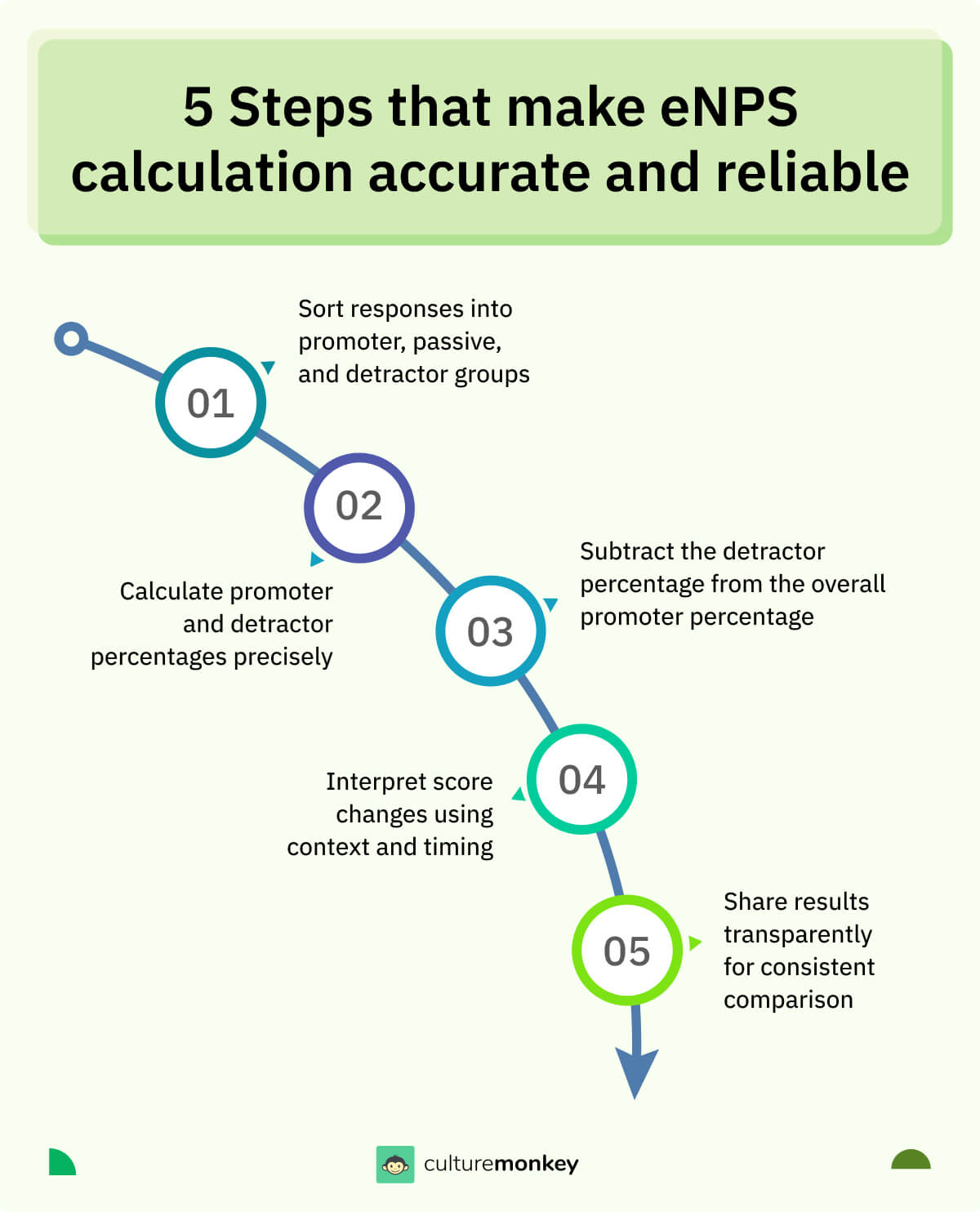
Calculating your eNPS score is like running a project retro that everyone actually attends and speaks in openly. The hard work is done, yet one clear recap shows what worked, what slipped, and where to improve together. That recap begins with how you organise, group, and read survey responses carefully.
- Separate promoters, passives, and detractors: Count how many people scored 9–10, 7–8, and 0–6. This split turns raw answers into clear segments, so you instantly see support, hesitation, and risk inside one eNPS survey cycle across teams and locations.
- Convert each group into percentages: Divide each segment count by total responses and multiply by 100. Working in percentages helps you compare cycles fairly, even when participation changes as projects, seasons, or interview styles shift across the organisation.
- Apply the standard eNPS formula: Subtract the percentage of detractors from the percentage of promoters. The result is your single eNPS score, which can range from –100 to +100 and gives leaders one simple, shareable, comparative culture signal.
- Compare against your own benchmarks: Use early cycles as your baseline rather than chasing generic industry benchmarks immediately. This keeps focus on progress, not perfection, and shows whether recent changes genuinely move the needle inside your unique environment.
- Pair scores with comments for context: Read open responses alongside each segment. Comments explain why promoters praise you and why detractors struggle, turning the same calculation into richer stories that highlight meaningful priorities and tradeoffs for upcoming quarters.
Once you understand the numbers behind your score, the real work begins. Turning eNPS calculations into visible change depends on a structured feedback loop that closes the gap between survey insights, everyday decisions, and team experience.
How to act on eNPS results with a structured feedback loop

Acting on your eNPS results is like turning a strategy meeting into a concrete rollout plan with owners, timelines, and check-ins. Insights reveal friction, but only a structured feedback loop decides whether changes stick, build trust, improve everyday work, and keep progress visible, believable, and widely shared across teams over time.
- Start with a clear readout: Share headline scores by group, then show a simple eNPS trend over time. This anchors the story before discussion, so people align on reality instead of guessing from isolated comments or hallway conversations.
- Turn themes into priorities: Cluster comments into three focus areas, then assign owners and timelines. Treat findings like project work, not abstract sentiment, so progress reviews feel as normal as tracking deliverables, budgets, and outcomes each quarter.
- Involve managers in conversations: Share team-level results with leaders, then coach them on simple listening routines. Borrow from strong interview styles, using open questions and pauses so people explain context honestly without feeling cornered, defensive, or blamed.
- Communicate actions visibly: Summarise what you heard, what you will change now, and what waits. Share updates in town halls, emails, and manager huddles so people see eNPS results turning into real, specific, trackable commitments they can recognise.
- Build a repeatable cadence: Lock in a clear rhythm for surveying, sharing, acting, and re-measuring. A predictable loop makes feedback feel safe and normal, supports continuous improvement, and shows you treat culture work as ongoing, not one off content.
Once your feedback loop is working reliably, the next question is scale. This is where a dedicated platform like CultureMonkey simplifies eNPS survey templates for HR teams, keeping cycles consistent, secure, and easy to run globally.
How CultureMonkey simplifies eNPS survey templates for HR teams?
Running eNPS with CultureMonkey is like switching from scattered spreadsheets to a live, connected dashboard. HR teams stop wrestling with formats and formulas, and start focusing on what the scores mean. The platform quietly handles structure, delivery, reminders, analysis, and secure reporting in the background for every survey cycle globally.
- Ready-to-use eNPS templates: Pre-built templates inside CultureMonkey’s employee engagement survey software make setup instant, not manual. HR teams launch consistent, science backed cycles in minutes and keep wording aligned globally without rebuilding an eNPS survey template every single time.
- Secure, anonymous feedback by default: Encrypted surveys and anonymous feedback settings protect employee voice automatically. HR leaders gather candid eNPS feedback while meeting enterprise security needs, so people trust the process and share what they actually experience every day.
- Automated, omnichannel delivery: CultureMonkey sends eNPS surveys via email, text messages, Microsoft Teams, Slack, QR codes, and other channels with smart reminders. HR teams reduce admin work, avoid survey fatigue, and reach frontline, remote, and hybrid employees without manual chasing or fragmented tools everywhere.
- Instant analytics and benchmarks: Real-time dashboards turn scores and comments into clear patterns. HR teams compare segments, track trends, and use benchmarks to see whether eNPS sits meaningfully ahead of, or behind, similar organizations in their industry.
- Science backed insights for action: CultureMonkey’s People Science Technology links eNPS results with driver analysis and manager dashboards. HR teams move from scores to priorities, guiding leaders on where to intervene, communicate, or redesign experiences for real engagement gains.
- Connected with every engagement touchpoint: eNPS templates sit beside lifecycle, pulse, and annual engagement surveys in one employee experience platform. HR teams see clearly how recommendation scores align with onboarding, inclusion, performance, and retention signals, not isolated metrics.
- Built for enterprise scale and control: Role-based access, white-label branding, and enterprise survey software controls help HR teams govern who sees what. Global organizations keep eNPS cycles consistent across countries while respecting local structures, leaders, and compliance needs.
Conclusion
An effective eNPS survey template gives organizations a simple, reliable way to understand how people truly feel beneath the day to day work surface. It cuts through long forms and vague conversations to show whether employees feel proud to recommend the company, hesitant, or quietly disengaging.
When leaders treat this score as an early signal rather than a final verdict, they can act faster, improve support systems, strengthen culture, and prevent issues from growing into turnover or morale dips.
CultureMonkey makes this entire process easier, clearer, and far more actionable. With ready templates, automated delivery, secure anonymity, and real-time analytics, HR teams spend less time on setup and more time improving employee experience.
CultureMonkey’s People Science insights translate raw scores into practical priorities that managers can act on immediately. In turn, organizations build stronger trust, better communication, and a workplace where people genuinely want to stay and grow.
Book a demo with CultureMonkey!
FAQs
1. What is an eNPS survey?
An eNPS survey measures how likely employees are to recommend their workplace using a simple 0–10 rating. It shows loyalty, sentiment, and early engagement risks in one clear metric. Repeated regularly, it helps leaders compare teams, track culture trends, and focus support where people might disengage, stay neutral, or actively advocate for the organisation.
2. What is an example of an eNPS question?
A classic example is: “How likely are you to recommend this company as a place to work?” rated on a 0–10 scale. This single question captures loyalty, while an optional open text follow up explains the score so leaders understand exactly what is driving strong support, hesitation, or frustration across different groups and locations.
3. What are good questions for an employee engagement survey?
Good engagement survey items focus on clarity, support, recognition, and growth. Examples include: “Do you have what you need to do your job well?” “Do you feel recognised for good work?”, and “Do you see realistic growth opportunities here?” Each question uncovers daily experiences that either strengthen or weaken long term commitment, motivation, and trust.
4. Are eNPS surveys anonymous?
They should be anonymous. When employees know their answers cannot be traced back to them, they are far more likely to be honest about problems, wins, and everyday friction. Anonymous surveys build trust in the process and give leaders accurate insight, not filtered comments shaped by fear, politics, or guesswork about potential consequences later worldwide.
5. Can I put my NPS survey on my website?
Yes, you can host an NPS style survey on your website to collect quick sentiment from visitors or customers. For employee listening, though, it is smarter to use a dedicated engagement platform that protects anonymity, enables segmentation, supports follow up, and tracks trends across different locations, roles, seniority levels, and time periods reliably and consistently.
6. What is a good eNPS score?
Benchmarks vary by industry, but generally anything above zero is positive, because it means more promoters than detractors in your workforce overall. Scores between +10 and +30 usually indicate healthy sentiment, while scores above +40 suggest very strong loyalty and advocacy. More important than any single number is whether your score improves consistently across repeated cycles.
7. What exactly should an eNPS survey template include?
A strong template includes the main 0–10 recommendation item, a short open text follow up, clear instructions, and a brief explanation of how results will be used and shared. Together, these pieces help employees answer quickly and honestly, while giving leaders both numeric data and context to shape concrete next steps confidently and transparently.
8. Can you use the same eNPS survey template for remote and on-site teams?
Yes, you can keep one core template for everyone, because the main recommendation item stays identical across groups and job types. To increase usefulness, add a few optional follow up prompts tailored to remote or on-site realities. That way you spot shared themes while still understanding environment specific challenges, blockers, and bright spots clearly and consistently.