


Employee engagement action plan: Definition, examples, and best practices


Remember those group projects in school where one person carried the weight while others just nodded along? You’d plan, delegate, and hope everyone pulled their weight, but without structure, things quickly fell apart. It wasn’t about who worked hardest, but whether everyone felt part of something that mattered.
Leading a modern team without an employee engagement action plan feels eerily similar. You can have the brightest minds in the room, but without clarity, ownership, and shared motivation, energy drops.
A well-crafted engagement plan isn’t busywork, it’s your blueprint to turn scattered effort into collective drive and purpose.
Blog Highlights


- Mistakes HR makes in action planning
- 75+ Employee engagement action plan ideas to try in 2026
- 9 Employee engagement action plan examples to give you a better idea
- 5 Best practices to execute employee engagement action plan at work
- Why creating an employee engagement action plan matters and the benefits it brings
What is an employee engagement action plan?

An employee engagement action plan is a structured strategy designed to improve and enhance employee engagement within an organization. It outlines specific initiatives, goals, and steps that the company intends to take to create a more engaged workforce.
This plan typically includes activities such as regular employee surveys to assess engagement levels, identifying areas of improvement, setting clear objectives for enhancing engagement, implementing targeted initiatives (e.g., training programs, recognition schemes, and communication strategies), assigning responsibilities to individuals or teams, and establishing measurable metrics to track progress.
The action plan serves as a roadmap to guide the organization in its efforts to create a workplace environment where employees are motivated, committed, and aligned with the company's mission and values. It is a dynamic tool that evolves with changing workforce needs and organizational goals, with the ultimate aim of fostering a more engaged and productive workforce.

There are only three measurements that tell you nearly everything you need to know about your organization’s overall performance: employee engagement, customer satisfaction, and cash flow.
Jack Welch

Former CEO - General Electric
Why creating an employee engagement action plan matters and the benefits it brings
Rolling out engagement without a plan is like planning a town hall with no agenda — people show up, but nothing meaningful happens. An employee engagement action plan gives structure, timing, and proof.
Here’s why documenting it turns good intentions into engagement that actually moves numbers for teams and leadership alike.
- Gives direction to engagement efforts: A written employee engagement strategy tells managers what to do first, what to stop, and how to improve employee engagement over time, instead of running scattered activities that nobody can measure with real clarity.
- Connects goals to reality: Turning employee engagement goals into actions means you base priorities on employee engagement survey results, not guesses. That way, every initiative ladders to a clear outcome leadership cares about and can report on each quarter.
- Filters the right ideas: A plan helps you pick employee engagement ideas and employee engagement initiatives that solve actual problems, like recognition or manager coaching, instead of trendy perks. It saves budget and makes HR look intentional, not reactive.
- Improves day-to-day experience: When engagement tasks become repeatable employee engagement activities, managers know what to run monthly, and employees start seeing change. Consistency builds trust faster than one-off campaigns and keeps teams participating in future surveys and programs as well.
- Makes improvement measurable: A structured plan shows how to improve employee engagement in steps, survey, prioritize, act, communicate. Because results are tracked, leaders can compare teams, celebrate wins, and double down on what actually lifts engagement scores over time.
- Links engagement to performance: When people see engagement tied to customer metrics or project delivery, participation jumps. Leadership can prove the plan isn’t HR fluff but a business lever, which protects budget for future engagement work and investment.
Now that you know what it is, let’s explore why it matters. A well-defined action plan doesn’t just improve morale, it strengthens accountability, boosts productivity, and gives leaders a tangible way to measure cultural progress across teams.
Common mistakes to avoid in your engagement strategy
Building engagement without checkpoints is like launching a new policy nobody reads, people smile, then go back to what’s familiar. To make your HR employee engagement plan actually move needle metrics, spot these silent blockers before you scale it across teams or locations.
- Treating engagement as perks-only: Focusing only on gifts, events, or days off ignores the employee engagement framework you designed. People want clarity, growth, and feedback. Perks can support engagement, but they can’t replace planned steps to increase employee engagement across teams consistently.
- Not equipping managers: Rolling out surveys without teaching managers what to do next makes the plan stall at team level. Share a sample employee engagement plan, talking points, and timelines so every manager knows how to respond to scores after each cycle.
- Setting fuzzy goals: Setting fuzzy goals like ‘boost morale’ makes tracking impossible. Tie engagement to employee engagement objectives and key results (OKRs) such as response rate, manager 1:1s, or recognition frequency, so progress looks real in leadership reviews each quarter easily.
- Ignoring segmentation: Treating the whole company as one audience ignores role, location, and tenure differences. Employee engagement best practices say: fix what hurts each group first, then scale. Segmenting keeps actions relevant and prevents survey fatigue from building over time.
- Launching too much at once: Launching ten initiatives at once makes your HR employee engagement plan look busy but shallow. Phase actions, communicate wins, and retire low-impact ideas. Controlled rollouts make adoption higher and help employees see what’s actually working in their teams.
- Not logging decisions: Running good engagement conversations but not documenting decisions means the momentum dies in month two. Log actions in your employee engagement framework, assign owners, and review progress in ops meetings to keep the plan visible for everyone involved.
Even the most thoughtful engagement plans can miss the mark if common pitfalls slip in. Before launching yours, learn what mistakes to steer clear of so your strategy drives consistent, visible results across every team and manager.
Mistakes HR makes in action planning
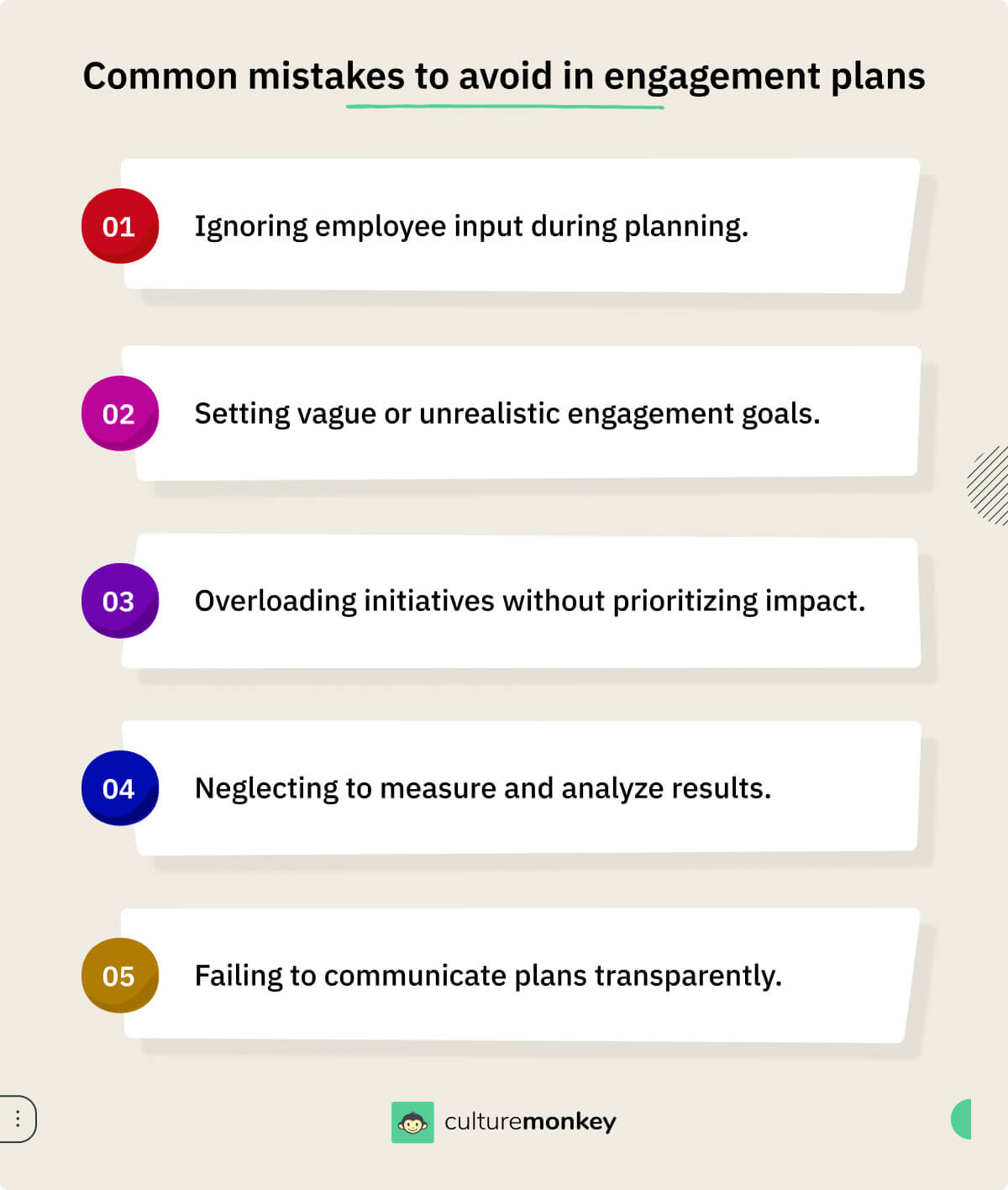
Developing an effective employee engagement action plan is crucial for organizational success. However, HR professionals often encounter common pitfalls that can undermine these initiatives. Key mistakes include:
- Lack of employee involvement: Failing to engage employees in the planning process can lead to initiatives that don't resonate with the workforce, reducing their effectiveness.
- Overlooking individual needs: Implementing one-size-fits-all solutions without considering diverse employee preferences and roles can result in disengagement.
- Neglecting continuous feedback: Not establishing mechanisms for ongoing feedback prevents timely adjustments to the action plan, hindering its relevance and impact.
- Insufficient training for managers: Without proper training, managers may lack the skills to effectively implement engagement strategies, leading to inconsistent application across the organization.
- Ignoring organizational culture: Introducing initiatives that conflict with the existing culture can create resistance and diminish the plan's success.
- Setting unrealistic goals: Establishing unattainable objectives can demotivate employees and erode trust in the engagement process.
- Inadequate resource allocation: Failing to provide necessary resources, such as time and budget, can impede the execution of engagement activities.
- Lack of transparency: Not clearly communicating the purpose and benefits of the action plan can lead to skepticism and reduced participation.
How do you create an action plan for employee engagement?

Employee engagement is an ongoing process, and the action plan should evolve to meet changing needs and challenges. Communication is crucial throughout the process, as involving employees in the development and implementation of the plan can lead to higher engagement levels and more effective solutions.
By following these six steps, you can create a robust action plan that fosters a more engaged and motivated workforce.
1. Assessment and analysis:
Begin by assessing the current state of employee engagement within your organization. Conduct surveys, interviews, and focus groups to gather feedback from employees. Analyze the data to identify areas that need improvement and understand the specific challenges.
2. Set objectives:
Define clear and measurable objectives for your employee engagement action plan. These objectives should be closely aligned with the organization's goals and the feedback gathered from employees. For example, you might aim to increase overall employee engagement survey scores by a certain percentage within a specific timeframe.
3. Identify targeted initiatives:
Based on your assessment of key engagement drivers and objectives, identify specific initiatives and activities that will address the identified engagement issues. These initiatives can include training programs, communication enhancements, recognition schemes, wellness programs, or changes in work processes.
4. Assign responsibilities:
Determine who within the organization will be responsible for implementing each initiative. Assign clear roles and responsibilities to individuals or teams to ensure accountability. It's essential to have dedicated champions for each aspect of the plan.
5. Develop a timeline and resources:
Create a timeline that outlines when each initiative will be launched and completed. Allocate the necessary resources, including budget, technology, and personnel, to support the successful execution of the plan.
6. Measurement and evaluation:
Establish key performance indicators (KPIs) and metrics to measure the success of your action plan. Regularly assess progress and make adjustments as needed. Continuously gather feedback from employees to gauge the impact of the initiatives and identify any new issues that may arise.
Knowing what not to do is one thing, knowing how to build an effective plan is another. This section breaks down simple, structured steps you can take to turn insights into actionable engagement programs that last.
75+ Employee engagement action plan ideas to try in 2026



The best engagement ideas are the ones that feel personal, practical, and purposeful. From wellness programs to recognition systems, every initiative should make employees feel seen, supported, and connected to the company’s bigger mission.
These 75+ employee engagement action plan ideas offer creative, culture-first ways to spark motivation, boost belonging, and build trust across hybrid and in-office teams throughout 2026.
Here are 75+ creative and unique employee engagement action plan ideas to consider implementing in 2026:
- Innovation hackathons: Organize regular innovation hackathons where employees from different departments collaborate to generate creative solutions to company challenges.
- Personalized learning paths: Create individualized learning and development paths for employees, allowing them to choose courses and training relevant to their career goals.
- Peer-to-peer recognition program: Establish a peer-to-peer recognition system where employees can nominate and reward their colleagues for outstanding contributions.
- Reverse mentoring program: Implement a reverse mentoring program where younger employees mentor senior leaders on emerging technologies, trends, and perspectives.
- Culture ambassadors: Appoint culture ambassadors from various teams who champion the company's values and organize culture-building events and initiatives.
- Employee podcasts: Launch an internal podcast series featuring employee stories, insights, and discussions on workplace topics.
- Remote work wellness packages: Provide remote employees with wellness packages that include items like ergonomic office equipment, stress relief tools, and healthy snacks.
- Weekly inspiration challenges: Encourage employees to participate in weekly inspiration challenges, such as sharing motivational quotes or personal achievements.
- Gamified feedback system: Implement a gamified feedback system where employees earn points or rewards for providing constructive feedback and suggestions.
- Community volunteering days: Organize community volunteering days where employees can spend paid work hours giving back to local charities or causes they care about.
- Employee-designed office spaces: Allow employees to contribute to the design and layout of office spaces, fostering a sense of ownership and comfort in the workplace.
- Flexible "Focus Time" blocks: Introduce dedicated "focus time" blocks in the workweek when team meetings are restricted, allowing employees uninterrupted time for deep work.
- Employee book clubs: Launch employee book clubs that encourage reading and discussion of literature related to personal and professional development.
- Wellness workshops: Conduct regular wellness workshops addressing physical and mental health topics, providing employees with practical tools to enhance their overall well-being.
- Inclusive diversity training: Implement inclusive diversity training programs to foster a workplace culture that values and respects individual differences, promoting a sense of belonging.
- Leadership shadowing opportunities: Introduce leadership shadowing programs, allowing employees to shadow leaders in different departments to gain insights into leadership styles and organizational strategies.
- Flexible work schedules: Offer flexible work schedules, enabling employees to better balance their professional and personal commitments, contributing to improved work-life harmony.
- Employee-driven CSR initiatives: Encourage employees to propose and lead corporate social responsibility initiatives, empowering them to make a positive impact in the community.
- Mindfulness and meditation sessions: Organize mindfulness and meditation sessions to help employees manage stress, enhance focus, and promote overall mental well-being.
- Cross-functional collaboration events: Arrange cross-functional collaboration events to facilitate interaction among employees from diverse departments, fostering teamwork and innovative thinking.
- Professional development stipends: Provide employees with professional development stipends, allowing them to invest in courses, certifications, or workshops aligned with their career growth.
- Internal mentorship program: Establish an internal mentorship program where seasoned employees guide and support their colleagues in navigating challenges and achieving career milestones.
- Recognition wall: Create a digital or physical recognition wall to publicly acknowledge and celebrate individual and team accomplishments, fostering a positive and appreciative work culture.
- Employee exchange programs: Develop employee exchange programs where employees can temporarily work in different departments or locations to broaden their skills and perspectives.
- Family-friendly events: Host family-friendly events such as picnics, sports days, or movie nights to help employees balance work and family life while building a sense of community.
- Sustainability initiatives: Involve employees in sustainability projects, such as recycling programs or green energy use, to promote environmental responsibility and engage those passionate about these causes.
- Pet-friendly office days: Introduce pet-friendly office days where employees can bring their pets to work, reducing stress and increasing workplace satisfaction.
- Skill-sharing workshops: Organize skill-sharing workshops where employees can teach and learn new skills from their colleagues, fostering a culture of continuous learning.
- Virtual team-building activities: Implement virtual team-building activities to strengthen relationships and team cohesion among remote employees.
- Recognition lunches: Hold regular recognition lunches where employees who have gone above and beyond are celebrated in a relaxed, social setting, enhancing morale and camaraderie.
- Outdoor retreats: Organize outdoor retreats or team-building trips that offer employees a break from the office environment, promoting relaxation, creativity, and stronger team bonds.
- Employee art exhibitions: Host art exhibitions where employees can display their artistic talents, encouraging creativity and providing a platform for self-expression.
- Wellness challenges: Implement wellness challenges that promote physical activity, healthy eating, and mental well-being, fostering a culture of health and wellness.
- Virtual reality training sessions: Use virtual reality for immersive training sessions, providing employees with innovative learning experiences.
- Interactive town hall meetings: Make town hall meetings interactive with live polls, Q&A sessions, and breakout discussions to keep employees engaged.
- Employee appreciation day: Dedicate a day to celebrating employees with special events, awards, and fun activities to show appreciation for their hard work.
- In-house career fairs: Host internal career fairs where employees can explore new roles and career opportunities within the company.
- Anonymous suggestion box: Set up an anonymous suggestion box (physical or digital) to encourage employees to share ideas and feedback without hesitation.
- Quarterly wellness check-ins: Conduct quarterly wellness check-ins to address employees' mental and physical health needs, providing necessary support.
- Creative brainstorming sessions: Organize regular brainstorming sessions for employees to contribute creative ideas for company projects and initiatives.
- Monthly "lunch and learn" sessions: Host monthly "lunch and learn" sessions where employees can enjoy lunch while learning about new topics from guest speakers.
- Career development workshops: Offer workshops focused on career development skills like resume writing, interview preparation, and networking strategies.
- Employee-led training sessions: Encourage employees to lead training sessions in their areas of expertise, promoting knowledge sharing and leadership development.
- Holiday celebrations: Celebrate various holidays with themed office events, decorations, and activities to create a festive and inclusive atmosphere.
- Collaborative goal setting: Involve employees in the goal-setting process, ensuring their input is considered and aligning their personal goals with company objectives.
- Tech-free breaks: Introduce tech-free break times to encourage employees to disconnect from screens and engage in face-to-face interactions or relaxing activities.
- Job rotation programs: Implement job rotation programs that allow employees to experience different roles within the company, enhancing their skills and understanding of the business.
- Employee wellness apps: Provide access to wellness apps that offer personalized health tips, workout routines, and mental health resources.
- Cultural celebration days: Celebrate the diverse cultures within your organization by hosting cultural celebration days with food, music, and activities representing different backgrounds.
- Open-door policy: Establish a robust open-door policy where employees feel comfortable approaching leadership with ideas, concerns, and feedback.
- Innovation incubators: Create innovation incubators where employees can work on passion projects and new ideas, fostering a culture of creativity and continuous improvement.
- Lunch with leadership: Organize informal lunch sessions where employees can dine with company leaders, fostering open dialogue and stronger relationships.
- Well-being stipend: Offer a well-being stipend that employees can use for fitness memberships, mental health services, or wellness-related expenses to support their overall health.
- Skill development sabbaticals: Provide employees with short-term sabbaticals for intensive skill development or certification programs.
- Employee idea marketplace: Create a platform where employees can pitch and vote on new ideas for business improvements, with use of AI for pitch decks and concept visualization.
- Cultural immersion programs: Offer opportunities for employees to work temporarily in international offices, fostering cultural exchange.
- Weekly gratitude circles: Hold weekly sessions where employees share appreciation for colleagues' contributions.
- Custom wellness plans: Develop personalized wellness plans tailored to individual employees’ health and fitness goals.
- Employee social networks: Build an internal social network where employees can connect, share hobbies, and organize group activities.
- Onboarding buddy system: Pair new hires with experienced employees to ease their transition into the company culture.
- Feedback-driven change initiatives: Act on employee feedback by initiating specific, measurable changes in policies or practices.
- Open mic sessions: Host regular open mic events where employees can share stories, talents, or perspectives.
- Interactive training gamification: Design training programs with gamified elements like leaderboards and rewards.
- Eco-friendly office practices: Encourage sustainable practices by setting up recycling stations and energy-saving campaigns.
- Employee advisory board: Form a board of employees to advise leadership on workplace improvements and initiatives.
- Healthy recipe contests: Organize contests where employees share and vote on their favorite healthy recipes.
- Virtual reality wellness experiences: Introduce VR-based mindfulness and relaxation programs.
- Rotational leadership assignments: Rotate leadership roles for team projects to help employees develop managerial skills.
- Social impact hackathons: Conduct hackathons focused on creating solutions for societal or environmental challenges.
- Seasonal employee newsletters: Share updates, achievements, and personal stories in a visually engaging newsletter format.
- Quiet work zones: Establish quiet zones for employees who need a distraction-free environment for focused tasks.
- Mobile learning platforms: Provide access to learning platforms optimized for mobile devices, enabling learning on the go.
- Daily stand-up meetings: Implement short, daily team meetings to align goals and encourage open communication.
- Celebration of milestones: Recognize and celebrate employee milestones like work anniversaries or personal achievements.
- Pop-up cafés: Create temporary themed cafés in the office to provide a refreshing and fun break for employees.
- Recognition coins: Introduce physical or virtual coins that employees can exchange as tokens of appreciation.
- Time-banking system: Allow employees to earn and bank extra time off for their contributions to company projects.
These action plan ideas blend creativity, personalization, and innovation to engage employees in unique ways, fostering a vibrant and motivated workforce in 2026. Tailor these initiatives to align with your organization's culture and objectives for maximum impact.
9 Employee engagement action plan examples to give you a better idea

Real change comes from seeing what good looks like in action. These employee engagement action plan examples show how structured initiatives turn feedback into measurable improvements across communication, recognition, well-being, and growth.
Each example breaks down objectives, ownership, timelines, and outcomes, giving HR teams a clear, repeatable framework to strengthen engagement and drive consistent results organization-wide.
Here are nine employee engagement action plan examples to provide you with a better understanding of how to structure your employee engagement plan:
1. Communication Enhancement Action Plan:
Objective: Improve internal communication to boost employee engagement rates.
Initiatives: Implement regular town hall meetings, create a company-wide newsletter, and establish a digital communication platform.
Responsibilities: Internal Communications Team.
Timeline: Quarterly town hall meetings, monthly newsletters, and digital platform launch within six months.
Evaluation: Measure employee satisfaction with communication channels, assess employee feedback on the newsletter's content and relevance, and track engagement with the digital platform.
2. Recognition and Rewards Action Plan:
Objective: Increase employee recognition and appreciation.
Initiatives: Launch an employee recognition program, create a "Kudos" board for peer recognition, and introduce spot bonuses for outstanding performance.
Responsibilities: HR and Management.
Timeline: The recognition program launched within three months, the "Kudos" board established immediately, and spot bonuses introduced on an ongoing basis.
Evaluation: Monitor the frequency of recognition submissions, track the number of spot bonuses awarded, and survey employees about their satisfaction with the recognition initiatives.
3. Professional development action plan:
Objective: Enhance career growth opportunities and skill development.
Initiatives: Provide access to online learning platforms, establish mentorship programs, and set up a skills assessment and development framework.
Responsibilities: Learning and Development Team.
Timeline: Online learning platform access granted immediately, mentorship programs launched within six months, skills assessment framework implemented within one year.
Evaluation: Measure employee participation in online courses, assess the success of mentorship pairings, and track skill development progress through the assessment framework.
4. Wellness and work-life balance action plan:
Objective: Support employee well-being and work-life balance.
Initiatives: Offer wellness workshops, promote flexible work arrangements, and introduce "Wellness Days" where employees can take a day off for self-care.
Responsibilities: Wellness Committee and HR.
Timeline: Wellness workshops scheduled monthly, flexible work arrangements available immediately, and "Wellness Days" introduced within three months.
Evaluation: Survey employees on their participation in wellness activities, assess the utilization of flexible work arrangements, and gather feedback on the impact of "Wellness Days."
5. Feedback and continuous improvement action plan:
Objective: Create a culture of feedback and continuous improvement.
Initiatives: Launch regular employee engagement surveys, establish cross-functional improvement teams, and implement a feedback-driven recognition system.
Responsibilities: Employee Engagement Team and Managers.
Timeline: Employee engagement surveys conducted quarterly, cross-functional teams formed within two months, feedback-driven recognition system in place within six months.
Evaluation: Analyze survey results and track changes in engagement scores, monitor the progress of improvement teams, and measure the effectiveness of the feedback-driven recognition system through employee feedback and participation rates.
6. Diversity and inclusion action plan:
Objective: Foster a more inclusive workplace by promoting diversity and ensuring all employees feel valued.
Initiatives: Implement diversity training programs, establish employee resource groups, and conduct awareness campaigns celebrating cultural diversity.
Responsibilities: Diversity and Inclusion Committee.
Timeline: Diversity training initiated within three months, employee resource groups formed within six months, and cultural awareness campaigns ongoing throughout the year.
Evaluation: Assess employee feedback on the effectiveness of diversity training, monitor engagement within employee resource groups, and measure the impact of cultural awareness campaigns on workplace culture.
7. Social connection initiatives:
Objective: Strengthen social connections among employees to enhance team cohesion and collaboration.
Initiatives: Organize team-building events, facilitate virtual coffee breaks, and launch an internal social platform for casual interactions.
Responsibilities: Employee Engagement Team and HR.
Timeline: Team-building events scheduled quarterly, virtual coffee breaks initiated monthly, and internal social platform launched within three months.
Evaluation: Collect feedback on the effectiveness of team-building events, measure participation in virtual coffee breaks, and track engagement on the internal social platform.
8. Sustainability engagement action plan:
Objective: Instill a sense of environmental responsibility and sustainability among employees.
Initiatives: Introduce eco-friendly workplace practices, organize sustainability awareness campaigns, and establish a green team for ongoing initiatives.
Responsibilities: Sustainability Committee.
Timeline: Eco-friendly practices implemented within three months, sustainability campaigns throughout the year, and the green team formed within six months.
Evaluation: Monitor the adoption of eco-friendly practices, assess employee engagement in sustainability campaigns, and measure the success of the green team's initiatives.
9. Career pathing and advancement support:
Objective: Provide clear career paths and support for professional advancement.
Initiatives: Conduct career development workshops, offer advancement mentorship programs, and create a transparent career progression framework.
Responsibilities: Human Resources and Leadership.
Timeline: Career development workshops scheduled quarterly, mentorship programs launched within six months, and a career progression framework implemented within one year.
Evaluation: Measure employee participation in career workshops, assess the effectiveness of mentorship pairings for career advancement, and gather feedback on the clarity of the career progression framework.
These action plan examples demonstrate how organizations can address specific aspects of employee engagement by setting clear objectives, defining initiatives, assigning responsibilities, establishing timelines, and implementing evaluation methods to measure success.
Tailor your action plan to employee engagement and align it with your organization's unique goals and challenges.
Ideas are helpful, but examples turn theory into practice. These real-world employee engagement action plan examples show how different organizations translate goals into measurable outcomes, helping you tailor strategies to your own workforce.
How to create your employee engagement action plan template?
Creating your employee engagement action plan template involves several key steps to ensure it aligns with your organization's unique goals and needs. Here's a step-by-step guide:
- Identify key initiatives: Based on your objectives, identify the key initiatives or activities that will help you achieve those goals. These can include training programs, recognition strategies, communication improvements, and more.
- Set measurable metrics: Establish clear and measurable metrics or Key Performance Indicators (KPIs) that will allow you to track the progress and success of each initiative. For example, you might measure employee engagement scores, retention rates, or participation in training programs.
- Assign responsibilities: Determine who within your organization will be responsible for executing each initiative. Assign clear roles and responsibilities to individuals or teams to ensure accountability.
- Develop a timeline: Create a timeline that outlines when each initiative will be launched, how long it will run, and when it will be evaluated. Having a timeline helps you manage resources and track progress effectively.
- Allocate resources: Identify the resources required for each initiative, including budget, technology, and personnel. Ensure that you have the necessary resources in place to support the successful execution of your plan.
- Include communication Strategies: Incorporate communication strategies within your template to ensure that your action plan is effectively communicated to all stakeholders. This should include how you will share updates, gather feedback, and involve employees in the process.
- Feedback mechanisms: Integrate feedback mechanisms within your template to regularly assess the effectiveness of each initiative and make necessary adjustments. This can include employee surveys, focus groups, or regular check-ins.
- Customize your template: Customize the template to reflect your organization's branding and culture. Make it visually appealing and easy to understand.
- Training and rollout: Consider providing training or guidance on how to use the template effectively within your organization. Ensure that all relevant stakeholders understand how to fill it out and follow the plan.
- Regular review: Set a schedule for regularly reviewing and updating your action plan template to ensure it remains relevant and effective.
By following these steps, you can create a comprehensive and tailored employee engagement action plan template that serves as a valuable tool for enhancing employee engagement within your organization.
Engagement survey action planning best practices

Engagement surveys serve as valuable tools for gauging employee satisfaction, identifying areas of improvement, and fostering a positive workplace culture. However, the true impact lies in the thoughtful and strategic action planning that follows.
Here are 10 best practices for effective engagement survey action planning:
- Inclusive feedback gathering: Encourage open and honest feedback from employees during the survey process. Ensure anonymity to promote transparency and increase the likelihood of candid responses.
- Data analysis: Thoroughly analyze employee survey results, identifying key themes and trends. Categorize feedback into actionable insights, distinguishing between areas of strength and those requiring improvement.
- Establish clear objectives: Define specific and measurable objectives based on survey findings. Clearly articulate the desired outcomes and milestones for improvement, aligning them with organizational goals.
- Prioritize action items: Prioritize identified areas for improvement based on their impact on overall employee engagement and the organization's strategic priorities. Focus on high-impact, high-feasibility initiatives.
- Cross-functional collaboration: Engage representatives from various departments to form cross-functional teams. This ensures diverse perspectives and expertise are leveraged in crafting and implementing employee engagement action plans.
(Source: People Managing People)
- Employee involvement: Involve employees in the action planning process. Seek their input, ideas, and suggestions to ensure the initiatives resonate with their needs and expectations.
- SMART goals: Formulate action plans with SMART (Specific, Measurable, Achievable, Relevant, Time-bound) goals. This ensures clarity, accountability, and a clear framework for assessing progress.
- Communication strategy: Develop a comprehensive communication strategy to keep employees informed about the survey results, action plans, and ongoing progress. Transparency builds trust and demonstrates commitment to improvement.
- Continuous monitoring: Implement a system for continuous monitoring and feedback. Regularly assess progress against established goals, adapting strategies as needed to address emerging challenges or opportunities.
- Celebrate successes: Acknowledge and celebrate achievements resulting from the employee engagement action plans. Positive reinforcement enhances morale, demonstrating the organization's commitment to recognizing and valuing employee input.
Collecting feedback is just the first half of the equation. The real power lies in how you act on it. Let’s unpack the best practices for transforming employee survey data into meaningful engagement action plans.
Importance of proper employee engagement action plan communication at work
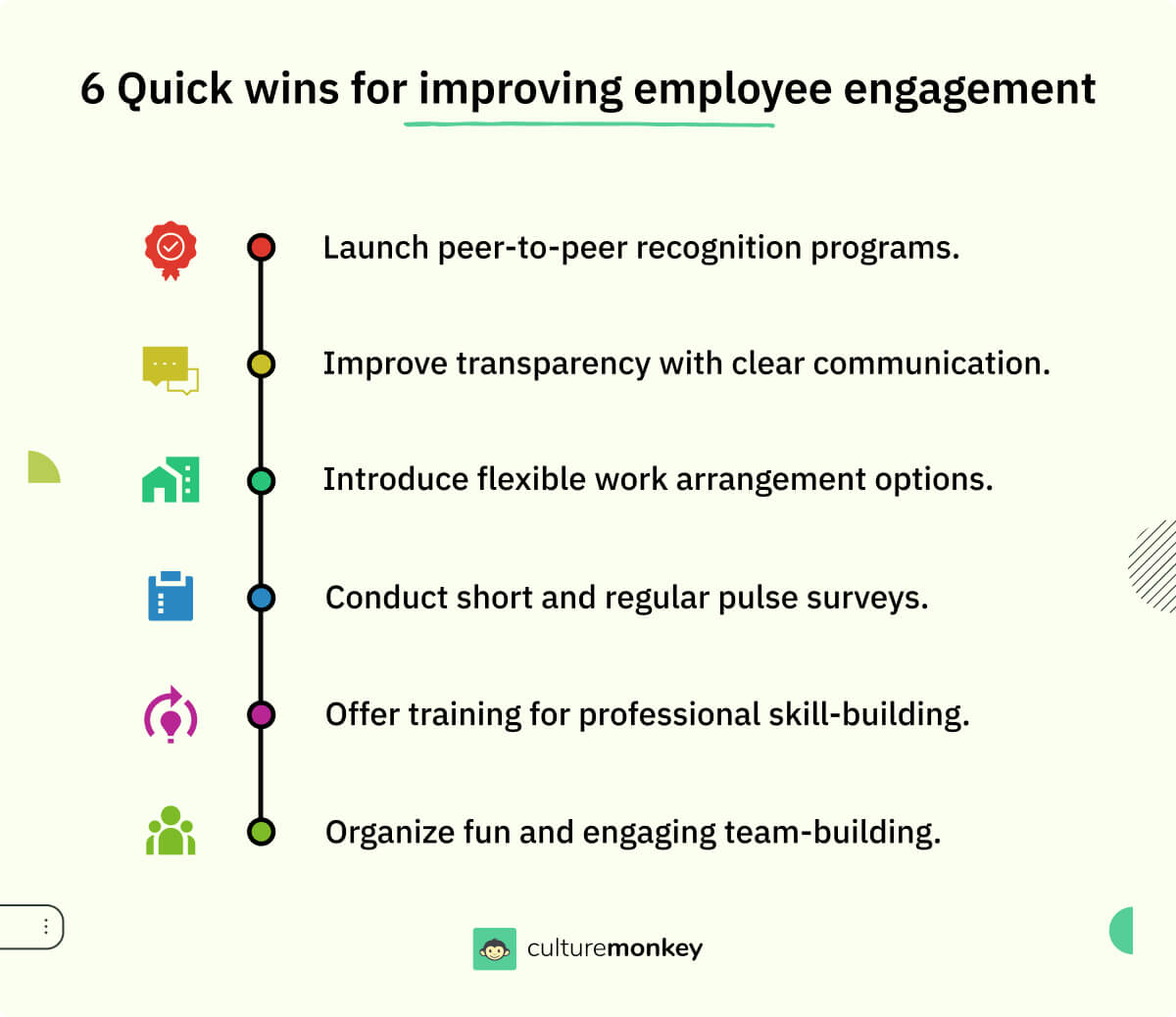
Communicating an engagement plan is like showing builders the blueprint before they start. Everyone may be skilled, but without the plan in front of them, effort scatters. A simple, transparent rollout makes people see the why behind changes and act on it. That’s where communication becomes your real engagement tool.
- Builds shared understanding: When people hear the goals, timelines, and owners, they know how to contribute. This turns an engagement action plan into daily behavior, not just a document HR emailed once and keeps teams moving together toward outcomes.
- Connects survey insights to action: Explaining how scores become steps shows employees the employee engagement survey action plan is real. People see pain points addressed, not ignored, so trust increases and participation stays high in future pulses as well.
- Makes examples tangible: Sharing employee engagement action plan examples or even one employee action plan example helps teams visualise change. Concrete stories beat theory, especially for managers rolling plans out across hybrid or frontline teams without extra training.
- Standardizes delivery: A clear message plus an engagement survey action plan template means every department communicates in the same way. That consistency reduces confusion, speeds adoption, and makes results easier to compare across business units over each quarter.
- Highlights what matters first: When leaders explain priority focus areas and action plan examples for employees, people know where effort should go. Clear sequencing prevents random initiatives and keeps engagement resources tied to business goals without scope creep.
- Creates accountability loops: Stating who owns which part of the engagement action plan makes follow-ups simple. Teams can report progress in town halls, managers can unblock issues faster, and employees can see leadership following through on stated promises.
Even the best action plans fail without clear communication. Here’s how thoughtful, transparent sharing of engagement initiatives builds trust, aligns teams, and turns plans into everyday behavior that sticks across the workplace.
Common challenges in implementing your employee engagement action plan

Implementing an employee engagement action plan can be a transformative process, but it also comes with its share of challenges. Here are five points to consider:
Resistance to change fairy tales:
Just like classic fairy tales where heroes face resistance from dragons and monsters, organizations may encounter resistance to change when implementing their action plans.
Employees comfortable with existing practices may resist new initiatives, viewing them as disruptive dragons. Overcoming this challenge involves effective storytelling, where leaders communicate the benefits of change, much like heroes in tales explaining the greater good.
The multiverse of communication:
In a diverse workforce, communication can resemble navigating a multiverse with different languages and preferences. Meeting the challenge involves tailoring communication strategies to various employee segments.
Just as superheroes adapt to different dimensions, organizations need to adapt their messaging to resonate with employees of varying backgrounds and preferences.
Innovation black holes:
Just as black holes devour everything in their path, bureaucratic structures can stifle innovation within organizations. Employees may hesitate to share creative ideas due to fear of rejection or the perception that their suggestions will be sucked into a bureaucratic black hole.
Addressing this challenge means creating a culture where innovation is encouraged and ideas are nurtured, much like exploring the cosmos for new possibilities.
Time-traveling priorities:
Priorities in the workplace can sometimes feel like a time-traveling adventure, with urgent matters displacing long-term engagement efforts.
Organizations must balance immediate needs with long-term engagement strategies, ensuring that short-term crises don't overshadow the importance of sustained employee engagement initiatives.
Feedback ghosts from the past:
Just as ghosts from the past can haunt us, unresolved issues and lack of closure from past employee engagement efforts can linger. Organizations should acknowledge and address past shortcomings transparently, ensuring that employees don't carry the ghosts of previous failures into new initiatives.
A fresh start, combined with learning from the past, can be the key to overcoming this challenge.
Much like navigating fantastical realms, organizations can successfully overcome these challenges with a combination of strategic thinking, open communication, and a commitment to continuous improvement.
Rolling out engagement initiatives isn’t always smooth sailing. From resistance to resource gaps, this section explores the common challenges organizations face, and how to navigate them while keeping your engagement goals intact.
5 Best practices to execute employee engagement action plan at work
Executing an employee engagement action plan effectively requires a strategic approach that incorporates unique and creative best practices. Here are five such practices:
1. Peer engagement ambassadors:
Designate "Peer Engagement Ambassadors" from different teams or departments who act as champions of engagement. These ambassadors serve as go-to individuals for engagement-related questions, ideas, and activities. They organize team-building events, share best practices, and facilitate communication between employees and management.
2. Engagement challenges with incentives:
Create engagement challenges that encourage healthy competition among employees. For instance, launch a "Wellness Challenge" where employees compete to achieve wellness goals. Offer incentives such as additional time off or personalized development opportunities for top performers. These challenges not only boost engagement but also promote a culture of well-being.
3. Cross-departmental hackathons:
Organize cross-departmental "Innovation Hackathons" where employees from various functions collaborate to solve real business challenges. This not only fosters creativity and teamwork but also empowers employees to contribute directly to the organization's success.
4. Employee-driven innovation labs:
Establish "Employee-Driven Innovation Labs" that allocate time and resources for employees to work on their innovative ideas. This practice encourages intrapreneurship, where employees can explore and develop innovative solutions to workplace challenges, ultimately contributing to business growth.
5. Employee storytelling platform:
Create an internal platform where employees can share their personal and professional stories, experiences, and accomplishments. This storytelling platform humanizes the workplace, highlighting the diverse talents and backgrounds of employees. This can boost morale, inspire others, and strengthen the sense of belonging.
These best practices inject creativity and innovation into the execution of an employee engagement action plan, making it more dynamic, inclusive, and tailored to the evolving needs of the workforce. They empower employees to take an active role in engagement efforts, fostering a culture of ownership and collaboration.
Who is responsible for employee engagement action planning?

Employee engagement action planning is a collaborative effort that involves various stakeholders within an organization, each contributing their expertise and perspectives. The primary responsibility for this crucial task often falls on the shoulders of several key players:
Leadership and management
Top-level executives, including CEOs and other leaders, play a fundamental role in shaping the overarching vision and employee engagement strategy. Their responsibility extends to providing the necessary resources, support, and endorsement for the action plans devised.
Middle managers are crucial in implementing these plans within their respective teams, ensuring alignment with organizational goals.
Human Resources (HR) department
HR professionals are at the forefront of employee engagement action planning. They spearhead the collection and analysis of engagement survey data, identify areas for improvement, and collaborate with other departments to formulate targeted initiatives.
HR's role includes communicating action plans to employees, tracking employee engagement progress, and providing ongoing support for the successful implementation of engagement strategies.
Employee engagement team
Dedicated employee engagement teams or committees are increasingly common in organizations. Comprising individuals from various departments, these teams work closely with HR to develop, execute, and monitor action plans.
Their responsibilities may include organizing engagement events, gathering employee feedback, and serving as a bridge between management and staff.
Cross-functional representatives
Engaging representatives from different departments ensures a holistic approach to action planning. Cross-functional teams contribute diverse perspectives, allowing for a more comprehensive understanding of the organization's dynamics.
These representatives actively participate in crafting initiatives that address the specific needs and challenges faced by different functional areas.
Wellness committees and specialized teams
For action plans related to employee well-being, wellness committees, and specialized teams come into play.
Comprising professionals with expertise in health and wellness, these committees design initiatives such as wellness workshops, flexible work arrangements, and mental health support programs.
Engagement isn’t a one-person job, it’s a team effort. Let’s look at who truly owns the process, from HR to leadership to cross-functional teams, and how shared responsibility ensures lasting engagement success.
The role of HR Leaders in action planning
Great HR is like a good stage manager: the audience only sees the performance, but HR runs cues, timing, and backstage fixes. Action planning works the same way, leaders translate survey noise into steps, owners, and timelines people can actually follow. That’s how engagement plans stop being theory and become practice.
- Set the direction: HR leaders map the employee engagement roadmap from survey insights, prioritize themes, and tell managers what happens first. This keeps engagement initiatives aligned with business goals instead of scattered wellness or celebration ideas across teams.
- Turn data into actions: They read employee experience surveys and pulse survey action plan results, pick quick wins, and assign owners. That way engagement activities become repeatable, not one-off HR events nobody tracks after launch in reports and reviews.
- Standardize the toolkit: HR creates the employee engagement action plan template, sample messages, and workplace engagement ideas managers can plug in. Standard tools help new managers run the steps to create an employee engagement plan without slowing delivery.
- Connect engagement to satisfaction: By linking every action plan for employee satisfaction to real employee engagement examples, HR shows impact. People see how recognition, growth, or flexibility changes scores, so leaders keep funding engagement in future cycles and budgets.
- Coach managers to deliver: HR’s HR engagement plan includes training on conversations, timelines, and employee engagement activities plan. When managers know what to say and when, participation rises and fewer teams ignore surveys during rollout and follow-ups too.
- Report up and across: HR leaders package results for execs, showing which employee engagement initiatives worked and where blockers sit. Clear reporting keeps engagement visible and makes renewal of budget and headcount an easier conversation with data-backed stories.
Behind every thriving engagement initiative is an HR leader connecting strategy with action. This section dives into how HR leaders shape the employee engagement roadmap, coach managers, and sustain motivation across every level.
How an employee experience platform strengthens your engagement action plan

An Employee Experience Platform (EXP) like Culture Monkey can significantly streamline and enhance the development and implementation of your employee engagement action plan in several ways:
- Centralized data and insights: EXPs collect and consolidate employee data, feedback, and engagement metrics from various sources. This centralized repository offers valuable insights into employee sentiment, preferences, and engagement levels, allowing you to make data-driven decisions when crafting your action plan.
- Real-time feedback: EXPs enable real-time feedback collection through surveys, pulse checks, and sentiment analysis. This immediate feedback loop helps you identify engagement issues as they arise, facilitating swift intervention and adjustment of your action plan.
- Personalization: EXPs allow you to personalize engagement initiatives based on individual employee needs and preferences. You can tailor your action plan to address specific concerns or aspirations, leading to more effective engagement strategies.
- Communication hub: These platforms serve as a communication hub where you can disseminate information about your action plan, share updates, and gather employee input effortlessly. They provide channels for two-way communication, ensuring that employees are well-informed and have a voice in the process.
- Automation and workflows: EXPs often come equipped with automation capabilities, making it easier to execute engagement initiatives. Whether it's automating recognition programs, scheduling training sessions, or setting up reminders, these platforms streamline the implementation process, saving time and reducing administrative burdens.
- Analytics and reporting: EXPs offer robust analytics and reporting tools that help you track the progress and impact of your action plan. You can measure engagement metrics, assess the effectiveness of initiatives, and make data-backed adjustments to your strategy.
- Employee self-service: Many EXPs empower employees to take ownership of their engagement journey by providing self-service options. Employees can access resources, training materials, and support through the platform, enhancing their engagement experience.
- Integration capabilities: EXPs can integrate with various HR systems, making it seamless to align your action plan with other HR processes, such as performance management and talent development.
- Cultural alignment: These platforms can help ensure that your engagement initiatives align with your organization's culture and values. By reinforcing cultural aspects that resonate with employees, you can enhance their sense of belonging and engagement.
- Scalability: EXPs are designed to scale with your organization's growth. Whether you're a small startup or a global enterprise, these platforms can adapt to your changing engagement needs.
By leveraging data, personalization, communication tools, automation, and analytics, you can create a more agile, effective, and employee-centric engagement strategy that fosters a motivated and committed workforce.
Link between employee engagement survey results and action plan
Connecting survey results to real work is like turning restaurant feedback into a better menu, listening isn’t enough until you change something. When teams watch their comments become programs, trust climbs, engagement feels specific, and leaders get clearer priorities to act on for each department and manager in the organization today.
- Shows cause-and-effect: Survey scores tell you where people struggle; an action plan to improve employee engagement shows what you’ll fix first. That clear link proves feedback matters and keeps response rates high next cycle for everyone involved consistently.
- Turns data into tasks: A staff engagement action plan translates low communication or recognition scores into owners, timelines, and touchpoints. People like seeing problems broken into steps instead of vague promises from senior leadership in real time during rollouts.
- Helps teams localize actions: One employee engagement action plan sample rarely fits all. Tying results to team engagement action plan versions lets managers pick what matches their reality while still following the companywide engagement framework and reporting rhythm.
- Improves accountability and reporting: When every action plan for employees improvement cites survey questions, leaders can review progress by driver. That makes quarterly engagement reviews faster and shows which managers actually closed the loop visibly across locations and functions.
- Creates a repeatable engine: Linking surveys to employee engagement action plans gives you an engagement survey action plan template you can reuse. Measure, act, communicate, repeat, employees start trusting the cadence over time and share feedback widely.
- Keeps benefits visible: Sharing employee engagement action plan examples from teams that improved scores shows momentum. Wins from one unit encourage others to follow the same path and keeps engagement from stalling after initial launch and review cycles.
Conclusion
An employee engagement action plan is the backbone of a healthy workplace. It transforms employee feedback into clear, actionable steps that improve morale, productivity, and retention. Without one, engagement efforts stay surface-level, and real change never takes off. A well-built plan helps leaders focus on the right priorities, assign accountability, communicate progress, and measure success. It ensures that engagement isn’t a one-time activity but an ongoing practice that drives business growth and employee satisfaction together.
CultureMonkey helps organizations make this process seamless and effective. Its employee engagement platform empowers HR teams and leaders to collect real-time feedback, uncover hidden engagement gaps, and design tailored action plans that align with company goals. With built-in analytics, templates, and workflows, CultureMonkey turns insights into meaningful action. The result? Employees feel genuinely heard, managers stay accountable, and engagement becomes a measurable, lasting part of workplace culture
FAQs
1. How can employee feedback be incorporated into the action plan?
Employee feedback can be integrated into the action plan by collecting input through surveys, focus groups, and one-on-one meetings. Analyzing feedback allows for the identification of areas needing improvement, which can then be addressed through specific action items in the plan, ensuring alignment with employee needs and fostering a culture of inclusivity and collaboration.
2. How often should the employee engagement action plan be reviewed and updated?
The employee engagement action plan should be reviewed and updated regularly, ideally on a quarterly or biannual basis. This allows organizations to assess progress, gather new feedback, and adapt strategies accordingly to ensure continued relevance and effectiveness. Regular reviews ensure that the action plan remains dynamic and responsive to changing employee needs and organizational priorities.
3. How can communication be improved as part of the employee engagement action plan?
Improving communication as part of the employee engagement action plan involves implementing clear channels for information dissemination, fostering open dialogue between management and employees, and providing regular updates on organizational developments and initiatives. Incorporating feedback mechanisms and encouraging two-way communication ensures that employees feel heard, valued, and informed, leading to enhanced engagement and morale.
4. What role do training and development play in enhancing employee engagement?
Training and development initiatives are integral to enhancing employee engagement as they provide opportunities for skill enhancement, career advancement, and personal growth. By investing in employee development, organizations demonstrate their commitment to employees' professional success and well-being, leading to increased job satisfaction, higher morale, and greater loyalty. Training programs also empower employees to contribute more effectively to organizational goals, driving overall productivity and performance.
5. How do you assess current employee engagement levels?
Assessing current employee engagement levels involves using surveys, feedback tools, and one-on-one interviews to gather insights directly from employees. Regular pulse surveys and engagement questionnaires can identify areas of concern and satisfaction. Additionally, analyzing metrics such as turnover rates, absenteeism, and productivity can provide valuable data. Combining qualitative and quantitative approaches ensures a comprehensive understanding of employee engagement.
6. How can technology support an employee engagement action plan?
Technology supports an employee engagement action plan by providing platforms for communication, feedback, and recognition. Tools like intranet portals, collaboration software, and employee engagement apps streamline interactions and keep employees informed. Gamified feedback systems and virtual wellness programs enhance engagement, while data analytics platforms track progress and identify trends. Technology enables a more connected, responsive, and adaptable engagement strategy, catering to the diverse needs of the workforce.
7. How can you measure the success of an employee engagement action plan?
The success of an employee engagement action plan can be measured through survey response rates, engagement score improvements, retention data, and productivity levels. Regular pulse surveys, feedback reviews, and performance metrics help track progress. Comparing results over time reveals trends, proving whether initiatives improve employee satisfaction, workplace culture, and overall organizational engagement outcomes effectively.
8. What should an employee engagement action plan include?
The success of an employee engagement action plan can be measured through survey response rates, engagement score improvements, retention data, and productivity levels. Regular pulse surveys, feedback reviews, and performance metrics help track progress. Comparing results over time reveals trends, proving whether initiatives improve employee satisfaction, workplace culture, and overall organizational engagement outcomes effectively.
9. What is a 5-minute action plan?
A 5-minute action plan helps managers respond quickly to employee feedback without overcomplicating things. It focuses on identifying one issue, setting one goal, and assigning one accountable person. This simple structure ensures small wins happen fast, keeping engagement active between larger initiatives and proving that every voice matters and every improvement can start immediately.
10. What are the 5 areas of an action plan?
The five key areas of an employee engagement action plan are assessment, goal-setting, action steps, accountability, and measurement. These elements guide HR and leaders from understanding engagement gaps to tracking improvements. When executed consistently, they build a structured, repeatable approach to improving employee satisfaction, trust, and performance organization-wide over time.