


Employee satisfaction survey tools: A practical evaluation framework in 2026

Employee satisfaction survey tools are platforms used to measure how employees perceive their roles, managers, policies, and work environment. A good employee satisfaction survey tool goes beyond basic HR satisfaction survey formats.
It should support anonymous feedback, provide structured segmentation, enable clear action workflows, and prevent flawed question design that distorts results. Strong employee satisfaction measurement tools also maintain governance discipline and reporting integrity.
This guide draws on tested institutional frameworks to help you evaluate what satisfaction trends should exist inside an employee satisfaction software platform before you invest.


- Employee satisfaction survey tools are platforms that measure how employees perceive work conditions, policies, and leadership.
- Satisfaction differs from engagement; measure comfort first, then commitment and performance drivers.
- Strong tools require anonymity controls, segmentation discipline, action workflows, and validated question design.
- Benchmarks and dashboards help only when paired with ownership, governance, and structured follow-through.
- CultureMonkey’s employee satisfaction survey tools combine anonymity safeguards, AI analytics, and manager action workflows to turn feedback into measurable improvement.
What is the difference between employee satisfaction and employee engagement?
Employee satisfaction and employee engagement are often used interchangeably, but they measure different realities. Employees' workplace satisfaction reflects how content employees feel about pay, policies, workload, and environment. Employee engagement surveys measure commitment, discretionary effort, and alignment with goals.
Confusing the two leads to shallow conclusions. Many HR satisfaction survey programs stop at comfort engagement metrics without getting comprehensive feedback.
Before selecting an employee satisfaction survey tool, decide what you need to measure and why to improve your company culture.
Employee satisfaction is a core indicator of workforce health and is often tracked through surveys. Higher employee satisfaction supports stronger engagement and better performance.
What types of employee satisfaction survey tools exist?

Employee satisfaction survey tools fall into three structural categories. Each category differs in analytics depth, governance strength, scalability, and reporting maturity. Understanding these differences helps you evaluate what kind of employee satisfaction platform aligns with your measurement goals.
Below are the primary categories HR leaders assess when comparing employee satisfaction survey softwares.
1. Standalone survey tools
Standalone survey tools are built primarily for structured data collection. They support HR satisfaction survey programs, staff satisfaction survey questionnaire formats, and periodic job satisfaction surveys.
These tools focus on distribution and reporting. They are often positioned as entry-level employee satisfaction software but may lack deeper analytics, segmentation discipline, or embedded action frameworks.
What this category implies:
- Designed for survey for employees satisfaction cycles.
- Basic employee satisfaction measurement tools.
- Limited integration beyond reporting dashboards.
Focus groups can reveal common themes and concerns of highly engaged employees that may not emerge through traditional surveys or one-on-one interviews.
2. Engagement platforms
Employee engagement tools combine employee satisfaction survey tools with engagement drivers and pulse measurement. They move beyond static staff satisfaction surveys toward continuous listening.
These systems support segmentation, trend analysis, and manager dashboards. Many organizations evolve from standalone employee satisfaction tools into engagement platforms to gain performance-linked insight.
What this category implies:
- Combines satisfaction and engagement measurement.
- Advanced analytics and segmentation capabilities.
- Supports action planning and direct manager accountability.
Surveys are one of the most effective ways to measure employee satisfaction, allowing for both quantitative and qualitative data collection.
3. Employee experience suites
Employee experience suites function as comprehensive employee satisfaction software platforms. They integrate satisfaction tracking, lifecycle surveys, performance data, and workforce analytics into a unified system.
These platforms are often positioned by larger employee satisfaction survey companies serving enterprise needs. They emphasize governance controls, scalability, and predictive employee insights rather than standalone measurement.
What this category implies:
- Unified employee satisfaction platform ecosystem.
- Enterprise-grade governance and compliance controls.
- Strategic workforce insight beyond basic surveys.
Ease of use and mobile accessibility ensure high participation rates across all employee levels. Integration with HR systems streamlines administration. Mobile compatibility is critical for high response rates, especially for employees who do not work at a desk.
What features should employee satisfaction survey tools include?
A credible employee satisfaction survey tool protects anonymity, supports structured segmentation, and maintains reporting integrity. Without these controls, job satisfaction surveys risk producing unreliable employee insights.
Many HR satisfaction survey efforts fail at execution. Data is gathered, but action ownership is unclear.
Before selecting an employee satisfaction software platform, assess governance strength, analytics depth, and accountability mechanisms. Strong employee satisfaction measurement tools convert employee feedback into disciplined workforce decisions.
- Anonymity: Enforce thresholds and protect respondent confidentiality.
- Action enablement: Embed manager workflows beyond reporting dashboards.
- Segmentation: Allow analysis without re-identification risk.
- Question integrity: Validated staff satisfaction survey questionnaire design.
- Analytics depth: Trend tracking across employee satisfaction tools.
Key features to prioritize in employee satisfaction survey tools include anonymity, real-time reporting dashboards, pulse survey capabilities, benchmark reporting, and user-friendly, mobile-accessible interfaces.
Common question design mistakes that may produce misleading employee satisfaction results

Poor question design is a major reason employee satisfaction survey tools produce misleading results. When surveys prioritize agreeable language over diagnostic clarity, they create artificial stability. Overall satisfaction scores look healthy, but underlying risks remain unexamined.
Many job satisfaction surveys measure comfort instead of structural drivers. A disciplined employee satisfaction survey software platform must prevent inflated results and surface real workforce friction to know how and when employees feel supported.
- Leading wording creates artificial agreement and inflated scores.
- Employee satisfaction measurement tools get distorted results due to vague scale anchors.
- Performance-linked risk indicators get ignored without comfort-focused questions.
- Double-barreled items confuse survey for employees satisfaction.
- Infrequency in the distribution of staff satisfaction surveys prevents trend validation.
Surveys are one of the most effective ways to measure employee satisfaction, and leadership effectiveness allowing for the collection of both quantitative data and qualitative employee feedback. Customization allows tailoring questions to your organizational culture.
How to turn employee satisfaction survey data into real action?
Employee satisfaction survey tools generate value only when data leads to ownership and measurable change. Reports alone do not improve workplace culture. Managers must translate employee satisfaction survey data into clear responsibilities and timelines.
Strong employee satisfaction software platforms embed follow-through. Action requires clarity, prioritization, and accountability, not more dashboards.
- Assign clear ownership: Each issue must have a responsible leader, deadline, and measurable outcome.
- Prioritize high-impact themes: Focus prevents dilution and increases credibility of employee satisfaction tools.
- Convert survey findings into discussions: Managers validate results, gather context, and define practical next steps.
- Track progress visibly: Use employee satisfaction measurement tools to show movement, not static scores.
- Close the employee feedback loop: Communicate actions taken to reinforce trust in the employee satisfaction platform.
Employee engagement software can help HR teams gauge how employees feel in real time and track employee feedback to help structure performance reviews. Real-time analytics and reporting provide immediate insights through dashboards rather than waiting for manual reporting.
Should you use benchmarks in employee satisfaction measurement tools?

Benchmarks in employee satisfaction measurement tools can provide context, but they are often misunderstood. Used correctly, they sharpen interpretation. Used poorly, they distort priorities. The value depends on how they are applied.
When benchmarks help interpretation
Benchmarks are useful when they guide inquiry, not replace analysis. They should support internal insight, not override it.
- Provide external context for overall job satisfaction surveys.
- Highlight outliers requiring deeper diagnostic review.
- Support executive communication with structured comparison data.
- Validate internal trends across employee satisfaction tools.
- Calibrate expectations during the first HR satisfaction survey cycle.
Employee engagement software helps HR teams gauge how employees feel in real time. Actionable reporting dashboards should suggest specific focus areas and action plans for managers.
When benchmarks mislead decision-making
Benchmarks mislead when they become the primary goal. External comparison cannot replace internal drivers of performance.
- Ignore organizational context and workforce structure differences.
- Encourage score chasing over meaningful cultural improvement.
- Mask declining internal trends behind industry averages.
- Overgeneralize data from unrelated employee satisfaction survey companies.
- Reduce complex satisfaction data into simplistic ranking positions.
Employee engagement software simplifies the launch of expert-backed surveys and delivers real-time sentiment insights. Employee engagement tools enable ongoing organizational culture monitoring and integrate tools for recognition and performance.
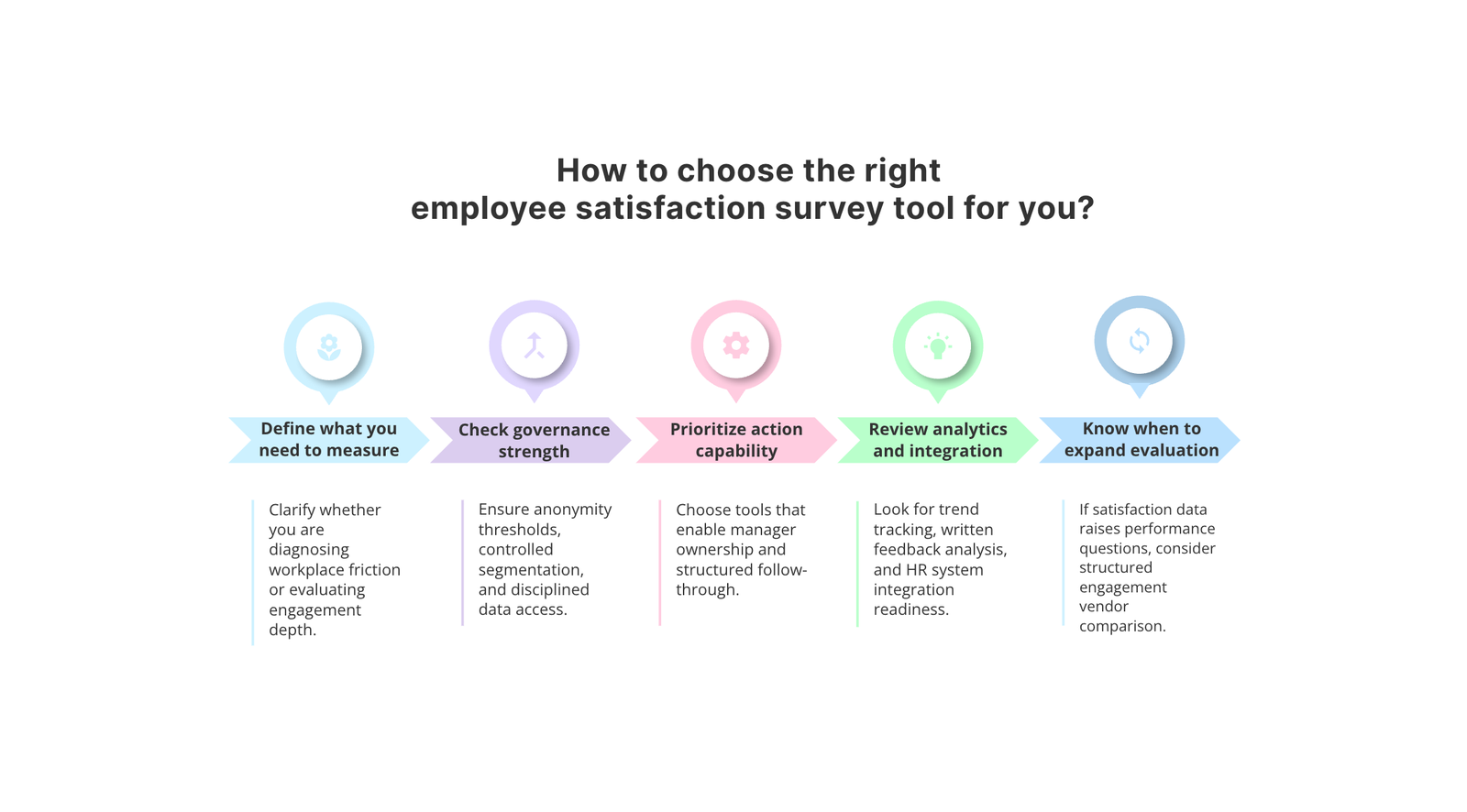
How to choose the right employee satisfaction survey tool for you?
Choosing the right employee satisfaction survey tool requires clarity about what you are solving. Not every employee satisfaction software platform is built for the same maturity level. Selection should follow structured evaluation, not feature comparison alone.
Define your measurement objective first
Before reviewing employee satisfaction survey companies, determine whether you are diagnosing workplace friction or preparing for broader engagement measurement. The tool must match your stage.
Key evaluation questions:
- Clarify whether you need satisfaction tracking or engagement depth.
- Identify key workforce risks you want to detect.
- Decide frequency if it’s annual staff satisfaction surveys or pulses.
- Define anonymity thresholds required for your structure.
- Align survey goals with business performance priorities.
Using employee engagement tools can lead to improved company culture and the creation of high-performance team insights.
Evaluate governance, action, and scalability
Once objectives are clear, assess whether the employee satisfaction platform can support disciplined execution. Valuable tools must enable action, not just reporting and boost engagement.
Core capability checks:
- Assess embedded manager action workflows beyond dashboards.
- Verify segmentation without compromising anonymity integrity.
- Review analytics depth of written feedback across survey cycles.
- Confirm integration capability with HR systems.
- Examine scalability before transitioning toward engagement platforms.
Higher employee engagement is linked to increased productivity and lower attrition costs.
Know when to explore engagement survey vendors
If satisfaction measurement reveals deeper performance questions of the company's values, standalone employee satisfaction tools may become insufficient. This is where structured vendor comparison becomes necessary to get actionable feedback.
Signals that indicate broader platform evaluation:
- Evaluate readiness to move beyond basic satisfaction measurement tools.
- Compare vendors offering engagement-linked analytics.
- Review long-term roadmap beyond HR satisfaction survey needs.
- Use a vendor comparison framework for structured evaluation.
- Explore the engagement survey vendors hub for deeper analysis.
AI-powered sentiment analysis automatically categorizes open-ended responses into themes and emotional tones.
Conclusion
Employee satisfaction survey tools are only as valuable as you use them. Selecting tools to measure employee satisfaction requires clarity about what you want to detect, how you will protect anonymity, and who will own action. Without governance, segmentation logic, and follow-through, results remain reports, not decisions.
If you are evaluating satisfaction tools, the more important step is determining whether standalone measurement is enough or whether you need a broader engagement vendor framework.
CultureMonkey, an employee engagement survey vendor, helps bridge that shift with strong anonymity controls, structured manager action workflows, controlled segmentation, and analytics designed to convert employee feedback into sustained performance improvement.
Book a demo with CultureMonkey.
FAQs
1. What are employee satisfaction survey tools?
Employee satisfaction survey tools are structured survey systems that assess how employees perceive workload, leadership, policies, and work conditions. They collect standardized meaningful feedback, analyze trends, and help organizations detect friction areas that may affect employee morale, employee retention, and workplace stability.
2. How are employee satisfaction surveys different from engagement surveys?
Employee satisfaction surveys measure employees feelings about pay, policies, employee benefits and environment. Engagement surveys assess commitment, effort, and alignment with goals. Satisfaction identifies comfort gaps in honest feedback, while engagement evaluates performance energy and long-term organizational attachment to take data driven decisions.
3. How often should employee satisfaction surveys be conducted?
Most organizations conduct satisfaction surveys annually, supported by frequent surveys designed for shorter quarterly pulses. Frequency should match the pace of change within the organization. Regular measurement improves key benefits of trend reliability, professional growth, provided results are reviewed, communicated, and followed by structured action.
4. What features should tools to measure employee satisfaction include?
They should include anonymity thresholds, structured segmentation, validated employee survey questions design, trend tracking, and embedded action workflows. Without these safeguards, tools to measure employee satisfaction may collect data but fail to generate reliable insight or consistent managerial follow-through.
5. Can employee satisfaction surveys improve retention?
Yes, but only when results trigger visible corrective action. Satisfaction surveys reveal friction in workload, management quality, clarity, and fairness. When leaders address these issues systematically, trust strengthens and preventable attrition declines over time.
6. Are benchmarks necessary in satisfaction surveys?
Benchmarks provide useful context, especially during early measurement cycles. However, external averages cannot replace internal trend movement. Sustainable improvement is better judged by consistent progress within your own organization rather than industry comparison scores.
7. How do anonymity thresholds work in satisfaction tools?
Anonymity thresholds prevent reporting when responses fall below a minimum group size. This protects confidentiality within small teams and strengthens participation trust. Proper threshold enforcement is essential for credible tools to measure employee satisfaction.
8. What mistakes reduce the accuracy of satisfaction surveys?
Leading wording, vague scales, double-barreled questions, and comfort-focused items distort results. These flaws inflate scores and hide structural risk. Careful design ensures survey responses reflect reality rather than polite agreement.
9. Who should own action after survey results?
Managers and senior leaders must own corrective actions, not just HR. Clear accountability, defined timelines, and transparent updates ensure survey findings translate into measurable improvements rather than remaining static reports.
10. When should organizations move beyond satisfaction surveys?
If leadership requires meaningful insights into commitment, discretionary effort, and performance alignment, satisfaction measurement alone may be insufficient. At that stage, expanding evaluation toward broader engagement frameworks supports deeper workforce analysis.