

CultureClub X · S03 E09
Data-Driven DEI: Policies That Attract and Retain
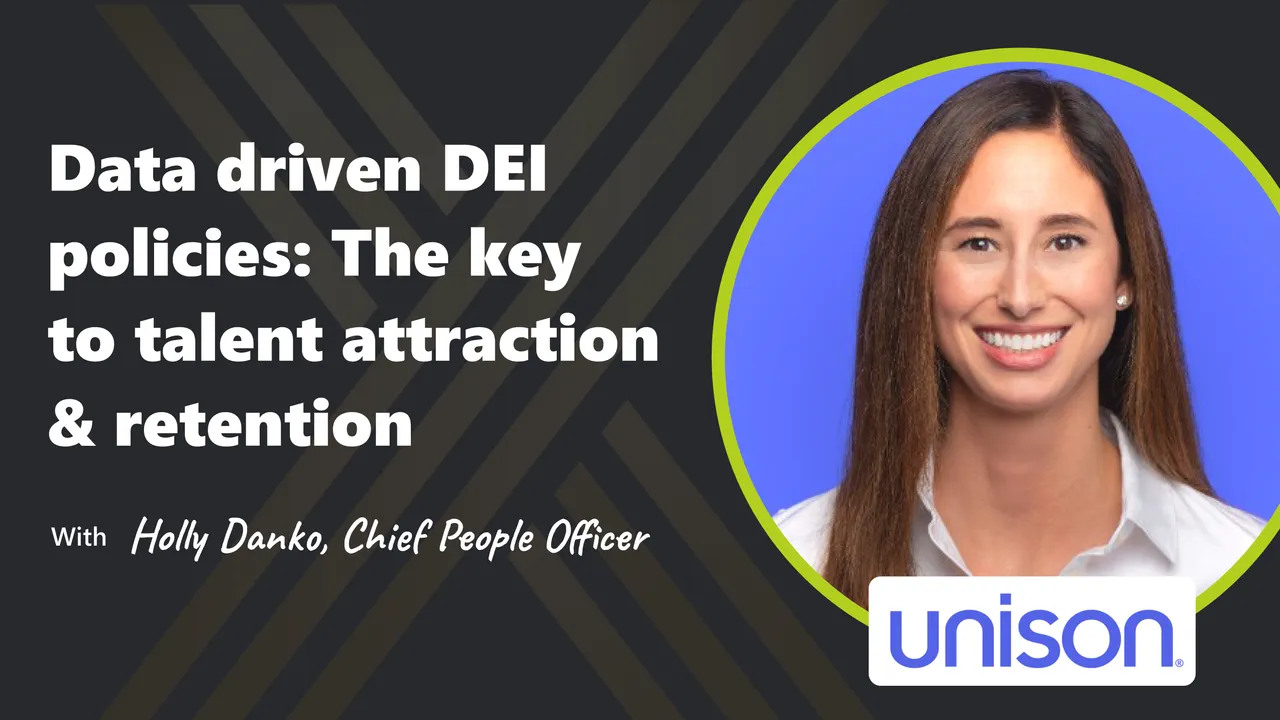
In this episode, Holly Danko reveals why DEI must be strategic and data-backed, showing how leadership alignment, employee feedback, and authentic culture practices help attract and retain talent in today’s workforce.
TL;DR
What you need to know from this episode
- Culture is a strategy, not a byproduct. Holly argues it should be planned as deliberately as business operations, starting with the founder, CEO, and executive team defining the vision, mission, and values before the whole people strategy is aligned behind them.
- Perks are not culture. A ping pong table and snacks are perks. Real culture is how you make decisions, how you treat people, and how you hold employees accountable to performance.
- Put company values into performance reviews. Holly's most concrete tactic is asking, in the performance conversation, whether an employee is living the values, which signals that culture is measured rather than just talked about.
- A DEI strategy is table stakes. Candidates now interview leaders about their DEI approach, so a company without one struggles to attract or retain talent, and in Holly's view does not deserve to succeed.
- Listen with numbers and with comments. Quarterly surveys, eNPS, and end of year check ins matter, but Holly reads team members' comments to get the real pulse, and a Google form works when budgets are tight.
Holly Danko has spent more than a decade in HR, and she has firm opinions about the gap between culture and perks. As Chief People Officer at Unison, a company in the residential real estate industry that helps homeowners access their equity without taking on additional debt or monthly payments, she has spent about four years building the kind of workplace people actually want to join and stay in. In the ninth episode of Season 3 of CultureClub X, host Nicole Patrick sat down with her to talk about diversity, equity, and inclusion in the modern workplace.
The conversation rests on Holly's core belief: culture is not something that happens to a company by accident, and DEI is not a box you tick once a year. Both have to be intentional, strategic, and backed by data. Holly has had her thoughts on DEI featured in Forbes, Quora, and on several podcasts, and throughout the episode she keeps returning to one practical test for whether a culture is real: are you willing to hold people accountable to it?
The central question is deceptively simple. How do people leaders build a culture and a DEI strategy that genuinely attracts and retains talent, rather than one that just looks good on a careers page? Holly's answers move from the executive team down to the individual performance review, and back out to the tools leaders use to listen.
Why culture has to be intentional from the top
For Holly, the starting point is a mindset shift. Culture should never be a byproduct of how a company happens to operate. It deserves the same deliberate planning as any other part of the business, with a strategic plan of its own.
She argues that the work begins with the founder, the CEO, and the executive team deciding what kind of culture they want, then developing the vision, mission, and values and aligning the entire people strategy behind them. A high growth startup will land somewhere very different from a large established company, and that is the point: there is no default setting to inherit.
Leadership cannot delegate this. Holly is clear that the leader has to live culture and exemplify it every single day, while the people and HR teams instill it through onboarding, policies, procedures, and the way the company recognizes and rewards its team. In her framing it is a team effort, built on a plan and the discipline to work through that plan.
How do you scale culture without a copy paste framework
There is no company culture that can be lifted wholesale from another organization. Holly acknowledges that proven frameworks exist, pointing to McKinsey's 7S model and the iceberg model, but she insists they only work once they are customized for a specific company and its people.
More important than any framework is a distinction she wants every leader to internalize. Perks are not culture. A ping pong table and free snacks are pleasant, but they are not the thing itself. For Holly, culture is really about how you make decisions, how you treat people, and how you hold employees accountable to performance, and that is the foundation everything else sits on.
What holding people accountable to culture actually looks like
The most concrete idea in the episode, and the one Nicole singled out as the first time a guest had raised it, is building culture into performance reviews. Holly wants managers to ask, right in the performance conversation, whether an employee is living the company values and how they are instilling them across the company.
When people know they are being measured on values, the message lands: this matters, and it is not something the company says it likes and then sweeps under the rug for the rest of the year. Accountability, though, is the end of a long road. You cannot simply announce a set of values and start grading people. It takes an education process and an entire system to reach that point.
Why a DEI strategy is table stakes, not a nice to have
Holly does not hedge on DEI. A lack of DEI initiatives, or even a strategy, is in her view truly detrimental to a company, and never more visibly than today. The data on diverse workforces is abundant, she notes, covering profitability, diversity of thought, and reaching different customers, but the strongest reason is simpler: it is the right thing to do.
having a DEI strategy, having DEI initiatives, it's table stakes right now. You cannot succeed as a company if you don't have that, nor should you, in my opinion.
The talent market makes the stakes concrete. Holly says candidates now interview her, asking about the DEI strategy, whether there is a DEI committee, and what the executive team and board look like. People want to work somewhere they feel respected, heard, and able to be their true self, a shift she has watched accelerate through the pandemic and the move to working from home. Without a strategy, a company cannot attract talent, and it certainly cannot retain it.
She closes the point on education. Leaders cannot assume everyone already knows what to do, so teaching through outside speakers, community groups, and volunteering, alongside creating a safe space, is essential to making inclusion real.
How people leaders can keep listening despite the workload
Employees want to be heard and not feel like a cog in the machine, and Holly meets that with a deliberately data centric approach to people strategy. Surveys are the minimum. She tracks engagement and eNPS style metrics, but she is adamant that the qualitative data can matter just as much as the quantitative.
I love reading our team members' comments because that's where I truly get the pulse of the company.
At Unison, that listening runs from quarterly company surveys to an end of year people check in, where the people team divides and conquers to hold one on ones with team members and feeds what they learn into yearly planning. Holly treats collecting employee sentiment and engagement as table stakes, the same phrase she uses for DEI. And budget is no excuse: a Google form or an Excel spreadsheet will do when a team cannot afford a dedicated tool. With so many people working from home, the water cooler conversations are gone, and leaders have to embrace technology to get that feedback.
Are policies or culture the real driver of retention
Asked what leaders should focus on to avoid DEI related attrition, Holly gives an answer she admits could be controversial: policies are the least important thing. Anti discrimination and anti retaliation rules are a legal baseline every company should already have, so they are, again, table stakes.
What actually retains people is culture: an inclusive environment where employees feel respected, enjoy their work, and see different mindsets embraced. Differences, she says, are what bring new innovation and ideas to a company and its product. When Nicole raises authenticity and the dreaded check the box exercise, Holly does not hold back, calling it one of her pet peeve phrases.
I just feel like you're better off not doing anything if you're not really gonna commit to it and honestly ingrain it as part of your company culture.
Employees can tell the difference. A check the box initiative, far from retaining people, turns out to be a great way to lose them.
Who owns culture when HR are only the custodians
Nicole asks whether HR are the custodians of engagement and culture rather than the owners, and Holly agrees precisely. Custodians, yes; owners, no. Her role as Chief People Officer is to hold everyone accountable and to have the difficult conversations when the culture slips, but ownership has to sit with the whole company.
Culture initiatives fail, she warns, when they are treated as an HR initiative. It has to run from the top down and from the bottom up, with every manager, every leader, and every team member owning it and living it every single day. Leadership and HR educate the team on what the culture is and how it should be lived; everyone else has to carry it.
What continuous listening means for the modern workplace
The thread running through the whole conversation is listening. Holly's culture is intentional, her DEI is strategic, and her accountability is real precisely because she keeps collecting signal from her people and acting on it. The pandemic and remote work have only raised the stakes, pushing continuous listening further into the spotlight.
That is where an employee listening platform earns its place. When the informal cues of an office disappear, a structured pulse survey gives leaders a reliable way to hear sentiment, spot where culture and DEI are slipping, and turn comments into action. For Holly, the goal is never the survey itself. It is a workplace where people feel respected, heard, and able to be their true self, and the data is simply how leaders keep proving they mean it.

About the guest
Holly Danko
Chief People Officer, Unison
Holly is a people leader, employee development expert and an up and coming HR influencer who has a proven track record of building strong teams, and company culture. Prior to Unison, She has worked with organizations like Morgan Stanley, Novation Ventures, and SmithBucklin & Information, Inc. Holly is a seasoned HR professional with more than 10 years of experience in Talent Acquisition, People Operations, and Learning and Development.
She is also extremely passionate about diversity, equity, and inclusion and has had her thoughts on DEI featured in Forbes, Quora, and on several podcasts. She is an alumni of University of Maryland and Penn State University.
Full episode transcript
Season 03, Episode 09 · Holly Danko with Nicole Patrick · 21 min
Frequently asked questions
How should companies build a strong culture from the top?
Holly Danko argues that culture has to be intentional rather than a byproduct of how a company happens to operate, so it needs a strategic plan just like business operations. That plan should start with the founder, CEO, and executive team deciding what kind of culture they want, then developing the vision, mission, and values and aligning the entire people strategy behind them.
Leaders also have to live the culture and exemplify it every day, while the people and HR teams instill it through onboarding, policies, procedures, and how the company recognizes and rewards its team.
What is the difference between company culture and perks?
Holly warns that many people confuse culture with perks like a ping pong table or free snacks. Those are perks, not culture.
In her view, culture is really about how you make decisions, how you treat people, and how you hold your employees accountable to performance. That, she says, is the true foundation of culture.
Why is a DEI strategy important for attracting and retaining talent?
Holly says a lack of DEI initiatives or strategy is truly detrimental, both because the data shows diverse workforces perform better and because it is simply the right thing to do. Candidates increasingly interview leaders about their DEI strategy, DEI committee, executive team, and board, so a company without one will not be competitive.
People want to work where they feel respected, heard, and able to be their true self, so without a strategy a company cannot attract talent and certainly cannot retain it. In her words, it is table stakes.
How can people leaders listen to employees despite a heavy workload?
Holly takes a data centric approach and treats surveys as the minimum, tracking engagement and eNPS while also reading team members' comments to capture qualitative sentiment. At Unison she runs quarterly company surveys plus an end of year people check in with one on ones that feed into yearly planning.
She stresses that budget is not an excuse. If a company cannot afford a dedicated tool, a Google form or an Excel spreadsheet is enough to start collecting employee sentiment and engagement.
Who owns company culture, HR or everyone?
Holly describes HR as the custodians of culture and engagement, but not the owners. Her role as Chief People Officer is to hold everyone accountable and have the difficult conversations when the culture slips.
Overall culture has to be owned by the entire company, from the top down and the bottom up, with every manager, leader, and team member living it every day. Culture initiatives fail, she warns, when they are treated as an HR initiative.
More from CultureClub X



Never miss an episode
New conversations with people leaders, plus the takeaways that matter, on your LinkedIn feed as soon as they drop.
Free on LinkedIn. Unsubscribe anytime.