

S06 E18
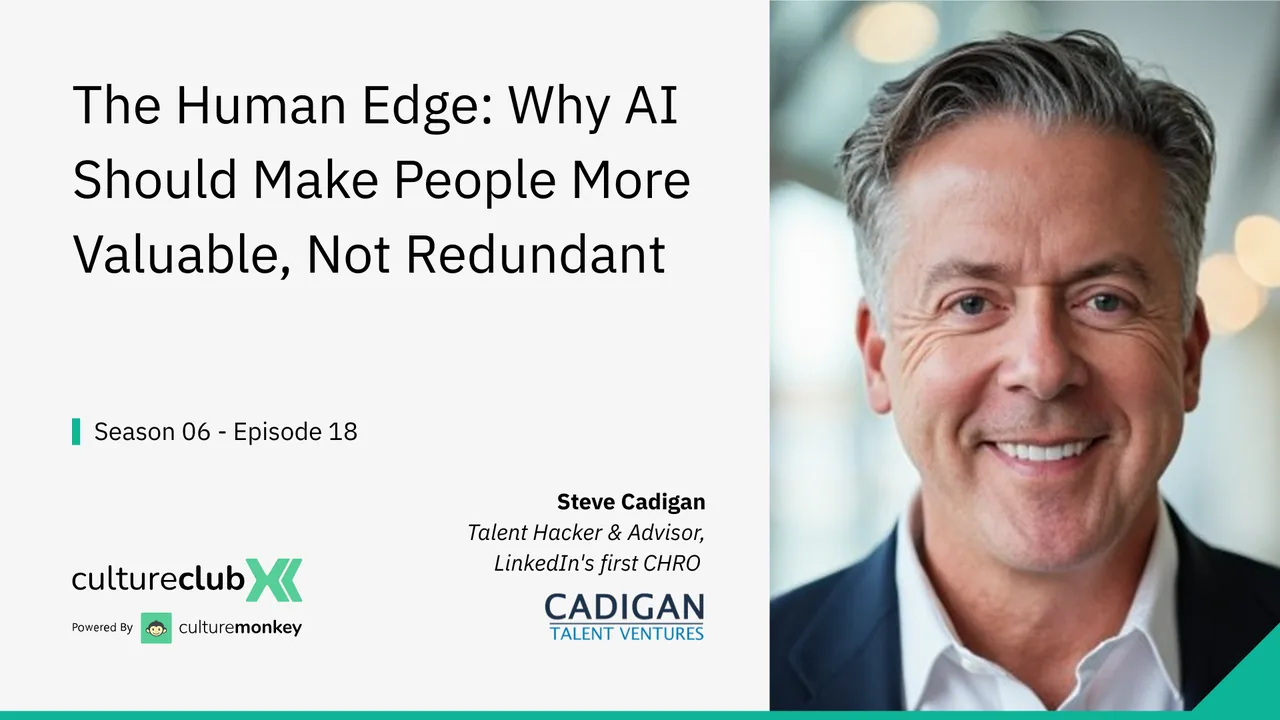
Should HR use AI to cut jobs or make people more valuable? | Steve Cadigan, LinkedIn's first CHRO
Make people more valuable, says Steve Cadigan, LinkedIn's first CHRO. Using AI to cut headcount saves money now but does not explain how the business grows next, and it pushes everyone into career defense. The better use frees capacity and points people at new markets, new skills and better customer experiences.

TL;DR
What you need to know from this episode
- Use AI to add, not subtract. Most organizations are applying AI the way they applied every prior technology: do more, go faster, save money. Freeing capacity and then repurposing people toward new markets and new customers is the version that builds a business rather than shrinking one.
- Answer why anyone would want to work here. LinkedIn could not outpay Google or Facebook, so it found a unique answer instead. Nice, good leadership and competitive pay are what everyone claims, and in a transparent market nobody is persuaded by sameness.
- The skills shortage is self-inflicted. Training and development was cut as a perk rather than run as a core business process, and graduate and internship programs disappeared, at exactly the moment organizations say they need new skills fastest.
- Optimize for shorter tenure, not longer. Tenure has fallen for twenty years and nobody expects it to reverse. College programs winning championships with almost entirely new rosters got better at onboarding fast rather than fighting the churn.
- Talent is loyal to learning. The one non-negotiable is investment in making people better, delivered as learning built into the job itself, not a catalogue of classes. People are not asking for a promised job, they are asking to be made better for an uncertain future.
Steve Cadigan was LinkedIn's first Chief Human Resources Officer, arriving when the company had roughly 400 employees and helping it scale past 4,000 across 17 countries during the most transformative stretch of its history. Before that he had worked across about six industries, from fashion at Esprit in the mid eighties to insurance to high tech, including four years at Cisco where he worked on close to 50 acquisitions around the world. Today he advises organizations including Google, Salesforce and the BBC through Cadigan Talent Ventures, and he wrote Workquake to argue that the world of work has changed faster than our assumptions about it.
The premise of this episode is a direct challenge to how most companies are deploying AI. The default move is to use it the way every previous technology was used: do more, go faster, save money. Steve's argument is that using the most capable technology we have ever had in order to subtract people, rather than add capability, is a strategic error, and one that compounds.
Across the conversation with host Darcy Mehta, he makes the case for repurposing rather than replacing, explains how LinkedIn beat far richer competitors for talent without outbidding them, and lands on a reframing many people leaders will find uncomfortable: stop trying to keep your best people, and start trying to make them better.
Why is using AI to cut jobs a race to the bottom?
Steve is blunt about why organizations behave the way they do. They are using AI like they used every prior technology, because no new playbook exists yet and the old one is sitting right there. Leaders are tired, anxious and worried their competitors are moving faster, so they reach for the shortcut.
His challenge is commercial rather than moral. If AI can absorb a large share of the work your people currently do, the interesting question is what those people could do next: discover new markets, apply different skills, serve customers in ways you could not previously afford. Eliminating them instead saves money now without answering how you intend to make more later.
The greatest technology that we have at our disposal, the opportunity for us to see insights and intelligence we've never been able to see at such massive scale. For us to use that to subtract, not add, seems a real miss.

He also points at an internal contradiction most HR leaders will recognize. The first team cut when times are tough is training and development, at precisely the moment organizations say they need new skills faster than ever. And leading with fear carries a predictable cost: frighten people with AI and everyone starts playing career defense instead of offense, which slows the company down exactly when it needs to move.
How did LinkedIn win talent it could not outspend?
The irony Steve enjoys most is that he ran talent at LinkedIn: a company whose product is a recruiting tool, whose biggest constraint was recruiting, and whose competitors could outpay it many times over. Google, he notes, was making more money in a day than LinkedIn made in a year. Outbidding was never on the table.
So the team asked a question he had never asked in more than 20 years in HR before that point.
I'd been in HR for over 20 years prior to LinkedIn, and I never asked this question. Why would someone want to work here? Why would a great person want to come here when they have lots of other choices with lots of other shinier rewards?
Not why should they, but why would they, given every other option in front of them. The answer that surfaced was the problem itself: helping people find their dream jobs. The second answer was structural. If LinkedIn was going to call itself the network for professionals, it had no business being anything less than the best place a professional had ever worked. That became an explicit commitment from the executive team, and it changed how interviews opened: where do you want this job to take you, and how can I help you get there.
His warning for anyone copying the move is that the answer has to be genuinely unique. Nice, good leadership, interesting work and competitive pay are what everyone claims, and in a transparent market, where people can see every other choice, sameness does not persuade anyone.
Did companies create their own skills shortage?
Steve rejects the framing that the skills shortage is an AI story. Organizations need people with new skills faster than ever, and most have gutted the very infrastructure that would produce them, treating learning and development as a perk rather than a core business process.
The clearest evidence is the disappearance of graduate and internship programs. He visits college campuses around the world and describes the look on students' faces. His objection is strategic rather than sentimental: this is the generation that went through COVID in school, expects things to be broken, and arrives with a hacker mentality that assumes it can fix them. Locking them out while complaining about a skills gap is a contradiction.
Behind it sits a question he thinks leaders should answer honestly. Is your company being built to last a hundred years, or a hundred months? Many of the leaders he talks to are privately planning on a five to ten year horizon, which makes disinvesting in development perfectly rational. His counter is simple: if you are not building the people who will run the company in five years, who is doing it for you?
Why does calling AI a tool stall adoption?
Asked why 88% of employees use AI at work while only a small fraction use it in genuinely transformative ways, Steve points at the language senior executives use. Calling it a tool understates what it is, and if leadership frames it that small, adoption stays that small.
The deeper blocker is self-interest. If people suspect the technology could render them less valuable, they have no reason to accelerate it. That is a rational response to a badly framed rollout, not resistance for its own sake.
His prescription is that every company should write an AI philosophy, a governing principle sitting alongside its stated values, then check that the two actually agree. He pairs it with a memorable test: give every AI project a food label, the way a can of soup carries one. What is in it, what does it add, what does it subtract, does it put people in or take people out, and which privacy or ethical additives has nobody looked at yet.
He is direct about the specific risk in HR. AI tools now make it trivially easy to surface things about candidates that should not be surfaced, and the guardrails do not exist yet. In his view the companies building these products carry more of that responsibility than they have so far accepted, because no government body is close to matching their sophistication.
Why does career security beat job security?
The heart of the episode is Steve's reframing of retention. Tenure has declined steadily for twenty years, and when he asks audiences whether they expect that to reverse, nobody says yes. If short tenure is permanent, then the strategy most organizations still run is defense.
Trying to keep people a long time is playing defense. Trying to expect and believe that they won't stay here a long time is playing offense, and optimizing for a shorter tenure.
His model comes from college sports, where the rules changed and every major program now assumes its best player stays a single year. This past season Michigan won a national championship in basketball with nobody from the previous year's starting five, and Indiana won in football with 60% of the roster new. Those programs did not fight the churn. They got dramatically better at onboarding quickly, building cohesion and chemistry fast, and simplifying their systems so players could contribute without three years of learning.
Translated into HR, the move is to say the quiet part out loud. I know you are probably not going to stay forever, so I am going to make this the best learning experience you have ever had, and when you go, I will celebrate that you got a better job, and you will send your friends here. He offers the counterexample too: Clemson, where almost nobody leaves, which hints that making people better is also the thing most likely to make them stay. Either way, retention strategy stops being about locking people in.
What should a CHRO do in the next 90 days?
Pushed to name a single action every CHRO should take, Steve does not reach for a policy or a platform.
Talent is loyal to learning more than anything today. And if you can feel that hunger and that thirst: just make me better for an uncertain future. Don't promise me a job. Just make me better for an uncertain future.
What people are asking for, he argues, is not a promise of job security. It is: make me better for an uncertain future. And his definition of how to deliver that is deliberately unglamorous. Not a catalogue of classes or tuition reimbursement, but learning built into the job itself, through new challenges and new opportunities that let people grow while the business adapts around them.
What does the benchmark data say about rewards?
Steve's point that rewards is not the lever is borne out by our own data. In CultureMonkey's benchmarks, Rewards is the lowest-scoring named engagement driver globally, and no industry averages above 4.10 on it. Organizations are competing hardest on the ground where they are collectively weakest, which is exactly the trap he is describing. Our benchmark set measures engagement drivers rather than tenure or intent to stay, so it speaks to why rewards is such difficult ground rather than to what replaces it. On that narrower question the data is unambiguous, and it points the same way he does.
| # | Metric | Score | What it shows |
|---|---|---|---|
| 1 | Rewards, global average | 3.565 | The lowest-scoring named engagement driver globally in Q1 2026 |
| 2 | Recognition, global average | 3.775 | Higher than Rewards, but down 0.010 year on year |
| 3 | Highest industry on Rewards | 4.048 | Creative and Media. No industry has averaged above 4.10 |
| 4 | Lowest industry on Rewards | 3.125 | Education, a 0.923-point spread across industries |
Source: CultureMonkey Rewards and Recognition Benchmarks 2026, drawn from 10,000,000+ anonymized employee survey responses collected between January 2024 and March 2026 across Asia Pacific, Europe, North America, Middle East & Africa.
What is continuous listening really for?
On listening, Steve's warning is that the act of asking creates an obligation. Listening is easy and acting on it is hard, and managers who hear "employee survey" and think "more work for me" have usually been trained to think that by surveys that went nowhere.
He also inverts the instinct of perfectionist leaders. The point is not only to find what is broken, but to find what is working so you do not accidentally stop doing it, and to replay that back to the people generous enough to tell you.
His most useful reframe is about ownership. When a leader sees something broken, the instinct is that they have to fix it. He argues the job is to help get it fixed, which turns the loudest voices in the survey into the people helping solve the problem.
He closes with a story from LinkedIn. A vocal group of San Francisco employees wanted a free shuttle because Google, Facebook and Apple all ran one. Rather than refusing, he went and got the data: two buses each way would cost a quarter of a million dollars, and the San Francisco contingent turned out to be a small minority, with more employees living further away in other parts of the Bay Area. He brought that back and asked whether it was a fair use of the money. They said no, and thanked him for looking into it. Months later, when the population shifted, they got the bus. The lesson is that a survey is a trust-building instrument, and that explaining a no can earn more than granting a yes.
That is where pulse surveys and continuous listening earn their place in this argument. If talent really is loyal to learning, the thing worth measuring is whether people believe they are getting better, and that signal shows up long before it appears in your attrition data.
About the guest
Steve Cadigan
Talent Hacker and Advisor, Cadigan Talent Ventures
Steve Cadigan is a talent advisor, leadership strategist and the founder of Cadigan Talent Ventures. He is best known as LinkedIn's first Chief Human Resources Officer, where he helped scale the company from 400 to more than 4,000 employees across 17 countries during its period of fastest growth. Over a career spanning roughly six industries, from fashion at Esprit to insurance to high tech, he spent about four years at Cisco working on close to 50 acquisitions worldwide, work that shaped his focus on change management in fast-moving environments.
He holds a master's in Human Resources and Organization Development from the University of San Francisco. For the last twelve years he has advised global organizations including Google, Salesforce and the BBC, along with investment firms such as Andreessen Horowitz, Sequoia, KKR and McKinsey. He is the author of Workquake, which argues that leaders should rethink talent, leadership and organizational growth for an era shaped by AI and constant change.
Full episode transcript
Season 06, Episode 18 · Steve Cadigan with Darcy Mehta · 47 min
Hello everyone, and welcome to season six of CultureClub X, powered by CultureMonkey. I'm your host, Darcy Mehta. CultureMonkey is an AI-powered employee engagement platform that helps people leaders listen to their employees and build stronger workplace cultures. CultureClub X is our global thought leadership forum where CHROs and people leaders share insights, discuss emerging trends, and exchange practical strategies for building thriving, future-ready organizations.
Today we are delighted to welcome Steve Cadigan, talent advisor, leadership strategist, and talent hacker at Cadigan Talent Ventures. Steve, welcome. It's a pleasure to have you here with us.
Great to be here, Darcy. Looking forward to the conversation.
Yes, so am I. So to give a little background, Steve is widely recognized as LinkedIn's first chief human resources officer, where he helped scale the company from 400 to over 4,000 employees across 17 countries during one of the most transformative periods in its history. Today, he advises global organizations including Google, Salesforce, the BBC, and leading investment firms such as Andreessen Horowitz, Sequoia, KKR, and McKinsey. Through his advisory work and his book, Workquake, Steve helps leaders rethink talent, leadership, and organizational growth in an era shaped by AI and constant change.
Steve, throughout your career, you've challenged conventional thinking about talent by focusing on helping people become more valuable rather than simply making organizations more efficient. And that's why we're so excited to have you join us for today's conversation: why the organizations that make people more valuable in the age of AI will win everything. Before we dive into today's discussion, could you just share a little bit about your own leadership journey and what inspired your perspective on talent and the future of work?
Gosh, that's a big question, and it could probably take the full episode, but let me give just the highlights. I think my draw to the world of talent and culture really comes from my love of sport. You and I were talking off air about this time that we're recording this, the World Cup's happening. For me, I've always been a sports fan, and also an athlete. I love competing, but I really love to see how people handle different situations, how they handle losing, winning, playing from behind, how they handle different coaching styles.
And when I found out pretty early in my career journey, probably about one year into my first job, that there's actually a domain, a profession where you can practice that, called human resources, for me it was just love at first sight. I'm like, you're gonna pay me to do this, to recruit teams and to put people together and try to find the best ingredients for success.
My first job was at a company called Esprit in the fashion industry. Back in the mid eighties, that was a really hot company. It was super fun to be in a place where they truly believed our talent is gonna design the future of fashion. I got to go on these recruiting trips to hire designers, which was really interesting. But over the course of my career I've had a chance to work in about six different industries. I went from fashion to insurance, insurance to high tech in the mid-90s when Silicon Valley was just booming.
I got really addicted to talent strategy in high tech because it's very dynamic. It was and is a place that is constantly facing all sorts of changes and challenges, the competition for talent is fierce, and winning really matters. That's been probably where I spent the last twenty years of my career, capped off by my last regular operator role being the first chief HR officer at LinkedIn.
I've learned a lot about myself during that journey. I think all of us over the course of our career find out, hopefully sooner rather than later, where do I play best? What are my superpowers? What are the areas I'm not super great in? In the world of human resources, for me it was coaching, employee relations, dispute resolution, and acquisition integration was a big part of my career. For about four years at Cisco, I worked on almost 50 deals around the world. That kind of change management in high-paced, crazy environments was where I enjoy working the most. Sitting around looking at benefit and compensation plans, that's not my superpower, nor is it my super interest.
So over the course of my career I gravitated more and more towards roles and organizations that wanted that capacity for me to contribute and were gonna teach me how to be better at that craft. About ten years into my journey, I decided I wanted to do HR for the rest of my life, so I went and got a master's degree at University of San Francisco, a master's in HROD. The best part of that was my colleagues and classmates were amazing. I built a great network, but I also just built confidence in my craft.
I get asked a lot, why did you get an MBA? Why'd you get a master's of HR? And I say, I don't think it really matters. For me, I wanted to be surrounded by the people that loved what I loved. It was the first time I ever went to school with a real purpose. When I went to undergrad, it was sort of like, well, that's what you do. And when you go get a master's, it's like, I want this. It was a really big turning point for me. So I left LinkedIn about a dozen years ago, and for the last twelve years or so I've been helping leaders, countries and companies build compelling talent strategies for the crazy world of work that we live in right now.
Wow. I want to ask you so many questions, but thank you for sharing that. Such a breadth of experience, and I love what you said about how we all, on our career journeys, figure out where our talents lie, where our strengths lie. And like you said, being surrounded by like-minded people who are passionate about the same thing is so amazing. So the fact that you knew that's what you wanted to do.
And of course the sports analogy. I am an athlete too, my whole life, growing up watching sports, playing sports. I always think that sports can teach us everything in life and business, and all the lessons can be applied. Just learning to be part of a team, right? We all have to learn that, and all the different dynamics in a team. I could go on. You're right, the sports topic and how that relates is a whole other one. But it explains why we enjoyed chatting about the World Cup, like you mentioned.
Yeah, 100%. And the irony of my story, if I look back, was that I graduated school and I had no plan. I had no idea what I wanted to do. I was a history major, modern European history. And everyone asked me, well, when does modern European history begin? I was like, well, that's a whole other story.
I majored in that just because I was the son of a minister, and my mom was a daycare center volunteer, pretty much in low income neighborhoods in our community. My parental role models were really people who were doing good in the community and society, and business was not really something my family was excited about. So I'm sort of the one that got, like, what did we go wrong with that guy? My older sister's an ordained minister, my younger sister is a creative writer, and my brother's an artist.
So how I got into the world of business, I don't know, but I will say that there is no greater art form than the art of getting people to do something better together. To me that's like the ultimate joy. And so I do feel that I've been practicing art, and I do feel that the superpowers today are not AI as much as they are really bringing out your deeper human capabilities of communication and empathy and understanding and conflict resolution and reading body language and trying to listen for what's not said, which AI can't do. AI can hear what's said, but it can't see what's not said.
A lot of times, simply in interviews, it's: that's interesting, they never asked about this, or they never talked about that part of their background. That's fascinating to me. And so those powers I find have really served me well, and continue to. I think it's a sign of hope for the future that they've never been more important than they are today.
It's a really great take, and a positive take as well. I studied political science in undergrad and didn't necessarily go on to use much of that either, but I find it interesting, and I love that you did history. So okay, let's dive right in, and I'm sure a lot of this will come up in our questions too.
Most companies use AI to cut costs and replace jobs. You argue its real power is making people more valuable, which you just touched on. Why is that distinction the most important strategic choice of this decade?
Well, let me first address why most organizations are using AI in the same way that software technology has been used in the past. That's really the answer in plain sight. We're using AI like we have prior technologies. Do more, go faster, save money. And that's something that AI can absolutely do.
But I think it's a huge miss when the greatest technology that we have at our disposal, the opportunity for us to see insights and intelligence we've never been able to see at such massive scale, for us to use that to subtract, not add, seems a real miss. That's a big oversimplification, but I'm doing it to be a little bit provocative. Why wouldn't you use AI to build your business? If you can free up your workers and AI can replace a lot of the work they're doing, why would you eliminate them versus repurpose them to discover new markets, to use different skills, to maybe delight more customers in a different way? It seems like a race to the bottom. You're saving money now, but how are you making money? How are you gonna make more money? And isn't that, in very simple terms, what the ultimate promise is for what AI can deliver to us?
If you want to step back even further, what's the whole point of technology if it's not to create a more beautiful world? Because if you just cut and you eliminate people, that doesn't necessarily deliver a beautiful world, unless you're gonna promise a guaranteed income for people and free health care and all kinds of other things, which no one's really getting excited about or is comfortable with.
So to me, most organizations are using the old playbook because there isn't a new one yet. Do I have confidence that I can actually retrain my workers to do more and greater? The answer is probably not, because most companies, sad to say, aren't great at retraining or developing people. They need new skills. Okay, well, let's go hire them. And I know that because in the world of HR, and all the people in the HR community who are listening to this know, what's the first team that's let go when times are tough? The training and development department, at a time when we've never needed new skills faster than we do today. What are we doing?
So I think a lot of leaders are behaving this way because they're afraid. They're worried their competitors are moving faster than they are, and they're panicking, and they're not taking a step back going, okay, rule number one of change management, what do we want to change, and what's the best way to do that? Let's scare our employees by taking all of them out with AI. Yeah, that's gonna deliver the greatest outcomes, if we put a lot of fear into them. Then maybe we should go ask Brene Brown what she thinks about that. Creating a hostile, scary work environment doesn't allow people to do their best work.
So why are we perpetuating all these narratives of gloom and doom, which we're hearing in the news? It's a huge disappointment to me that we don't see more companies saying, okay, we're gonna use AI to make you superhuman so you can do more and have a more fulfilling, more impactful, more amazing life, not just a job. That, I think, is the challenge of our lifetime right now. I'll talk about this until my last breath. We really have got the greatest opportunity of our lifetime right now. Let's take advantage of it.
That's fascinating, and I like the idea of reframing it. Think of it as a challenge, a good challenge. How can we use people better, versus that fear of it? And what you said about replaced: think about repurpose, not replace. That just makes perfect sense, doesn't it?
So at LinkedIn you outcompeted Google, Facebook, and Apple for talent, not by outspending them, but by making people more valuable. How does that philosophy become the playbook for winning talent in the AI era?
Yeah, this is another one of the enormous ironies, Darcy, of being the head of talent at LinkedIn during its period of biggest growth. Imagine I'm the head of recruiting, head of HR at LinkedIn, whose main product is a recruiting tool, whose biggest company challenge is recruiting people, because we're not making as much money as all those companies you just mentioned. Google, Apple, Facebook, Twitter when they were hot, all those companies were making more, and Google was making more money in a day than we made in a year. That's how extreme this was. So they could outbenefit me, outperk me, outcomp me, out-everything me.
So what we had to learn was, what assets do we have here to really compete against these really sexy choices that people have? And that's the one thing when I look at the pandemic, what I love about that scary moment for a lot of businesses is that a lot of companies realized, we're gonna have to really compete for people now. It's no longer you're lucky to have a job. It's like, whoa, we gotta really show up. And if you compete for talent in the technology industry, you become a street fighter. This is not an easy game and you're gonna have to really innovate.
For us as a company, we looked at recruiting like, if our customers knew that we don't know how to recruit, that is not an option. We have to be really great at this. And the fact that we realized the only way we're gonna double every year is if this whole company's mission is to recruit people, not just sell the recruiting product. We've got to get all in. Board of directors, advisors, every employee is gonna have to help us figure this out. One of the things we did with our culture that was really great was we said, the only way we're gonna be able to realize our destiny of becoming a great company is if we hire not just a lot of people, a lot of great people. And that's hard to do when great people have really great choices.
So what it really forced us to do, Darcy, was ask a question I would really urge every listener to think through if you're struggling with recruiting. Start with a very simple question. I'd been in HR for over 20 years prior to LinkedIn, and I never asked this question. Why would someone want to work here? Why would a great person want to come here when they have lots of other choices with lots of other shinier rewards?
And when we asked that question, the answer revealed itself in a really powerful way. They want to come here because the problem we're solving really matters, helping people find their dream jobs. That matters. Do you want to go to Facebook and help kids develop their short attention span and proliferate fake news? Or you can help people find their dream jobs over here. What do you want to do? Do you want to go over to Google and be engineer number 17,000 and buff the trophies of everyone before you? Or do you want to come here and build something incredible for your children, for your grandchildren, for future generations, that's gonna not just change their world, but change the economy and give greater transparency to great companies and bad companies?
That really helped us. And then the second thing we asked was, what assets do we have to attract people here, because we can't outpay people? And we said, well, the asset we have is, and again, this is in retrospect, it's gonna sound duh, that was so simple, Steve. It wasn't that obvious back then. We realized that we're a professional network. If we are not the greatest place anyone's ever worked, we have no business being the network for professionals. Does that make sense? How could we say we're the network for professionals unless we are a phenomenal place to work?
So all of us on the executive team, probably a dozen of us, said, we don't agree on much, but let's agree this will be the greatest job that our employees have ever had. That was the ultimate cultural commitment right there. We would begin every interview by saying, where do you want this job to take you, and how can I shepherd you there? What can I do to frame you getting there? Because I know you're not gonna stay here forever. That's okay.
Just to reiterate, that question I think every organization should have a really good answer to: why would anyone want to work here? And to jump ahead a little bit here, the right answer isn't because we're nice. The right answer isn't because we like people, or because we treat people well, we have good leadership, we're gonna make a lot of money, we're doing really cool stuff, because everyone says that. You've got to find a unique angle, because in the transparent world, thanks to social media and sites like LinkedIn, people can see other choices. So you gotta stand out. What is different and unique about you, and the problems that you're solving? That really helped us not just recruit better, but build our own identity of what's our purpose here. That really was a rallying point for us as a leadership team.
Wow. That's amazing. I like how you said you had to think about how are we gonna realize our destiny. And then, like you said, that question seems so obvious, doesn't it? That everyone would be asking that, why do you want to work here? But like you said, it's not that obvious. So it definitely bears repeating.
So Deloitte's 2026 research finds that competitive advantage is now driven by the human edge, not technology, because AI is replicable but people aren't. Yet most organizations are still leading with technology. What are they getting fundamentally wrong?
I think we're looking for a shortcut. I think we're freaking out. I think we're tired, we're stressed, we're anxious, we're worried our competitors are moving faster, and we're like, there's gotta be a technical advantage. And I understand why people are looking at it like that.
Take a look at the McKinsey State of AI report from the end of 2025. Of every company that's making a significant profit with AI, only six percent of the companies that McKinsey surveyed in 2025, thousands of them, are seeing a significant incremental increase to their profits. 33% of the companies were seeing an increase, but only six percent were seeing a significant increase. And they said, well, what are those companies doing differently? They're using AI to augment talent, not replace it.
If you were at the table in the eighties, Darcy, when there was this whole outsource to India movement, in the eighties and nineties, lower costs of labor, let's move all our development over to India. What happened to most companies is, for us to move all our development to India, we've actually got to tell them how we do what we do. Turns out we don't really know how we do what we do. And so all these companies got stuck for years.
That's the same thing with AI. AI is not going to learn how you do what you do unless you teach it. And a lot of organizations are realizing there's a lot of gray area here. There's a lot of human connection that's not just algorithms. So that, I think, is the biggest challenge right now. People have gotta see this is a very human moment. And if you start with we're using it to replace people, you've now introduced fear into the equation. Now everyone's playing career defense, not offense. And that's going to break your company. That's gonna put toxins into your veins and it's gonna slow things down dramatically.
As we're recording this, all the major AI producing firms, Anthropic, OpenAI, Google with their Gemini, Microsoft, are all coming out saying, whoa, whoa, whoa, what we didn't mean was all those jobs are gonna be replaced by AI. And I say, well, that's really good, because you're the ones that said that. Like, in the last six months you were saying all white-collar jobs are toast, there's gonna be no more internships and new grads, and now they're hiring like crazy.
A friend of mine just took the head of recruiting job at Anthropic, and I was joking with him. I said, what's your pitch when you're hiring at Anthropic? Join our company, but don't get comfortable? Come here and help destroy all the careers? How are you gonna walk that back after Dario Amodei said, yeah, 18 months, it's pretty much over? So it's heartening to see the walk back, but it's disheartening to see how brazen they were with all these predictions that were really harmful to a lot of organizations who thought, we better cut, because AI is gonna replace all these people. And now they're realizing that was a big mistake.
It's so fascinating, isn't it? I know myself personally, I'm not one to jump into something just because everyone's doing it, or because that panic is created. It's that little bit of, let's see if the tide's gonna turn back around, sit back and wait. So I'm happy to see a little bit of that personally too. And I work in the creative field, so of course there is always that fear.
But also what you said about companies realizing there are a lot of gray areas, and it may be hard to explain why they do what they do. I feel like that can actually be an advantage, that it's causing organizations to have a bit of a shakeup: we've got to reevaluate, we need to see why we're doing this, how we're doing this, how can we do it better. Obviously, if you're in the right mindset, that can be an opportunity, right?
So you've said the skills shortage isn't an AI story, it's a development failure we created. What do you mean by that, and how can HR leaders begin fixing a problem they may not even realize they helped create?
Yeah, we're really in a pickle right now when you think about it. When I talk to organizations today, there are two big pain points they've been facing. Aside from AI, it's we need people with new skills faster, we need people to grow faster. But I just don't see the investment in that infrastructure. Most organizations, large to medium enterprises, have gutted training and development. They've looked at it as a perk, not a core business process.
Let's take, for example, what's been in the news a lot the last six months: the disappearance of new grad and internship opportunities. I visit college campuses all over the world, and the look on these kids' faces is like, what have you guys done? Where did all these jobs go? And the question is, if you realize you're lacking the skills you need as fast as possible, why are you cutting access to the generation that went through COVID in school and is probably the most adaptable generation in history? A generation that probably can figure out AI faster than we can, that can run circles around us.
This young generation expects things are broken, and our generation expects things should work. So they're going in with a complete hacker mentality, which is, I can fix this. I don't expect it's gonna work. That we're locking out that generation is a huge miss.
So what I think HR leaders really need to ask themselves is, are you playing for today or are you playing for tomorrow? The best selling all time book on leadership is the book by Jim Collins and Jerry Porras called Built to Last, how to build a hundred year company. And my question for all the listeners is, how many of you really believe your company's being built to last 100 years? Or more like a hundred months? Because a lot of leaders I'm talking to today are thinking like five to ten years, that's it. We can't predict the future. We might not be around. Some new technology is gonna take us out, we're gonna get acquired, we might go under because some other paradigm is gonna take our value out.
So I don't blame leaders for worrying about an uncertain future and disinvesting, but there are consequences if you're not developing your people, the skills and particularly leadership. Who's gonna run your company in five years? You're not worried about it? I would be. And I think it's another one that when you lay it out, it seems pretty obvious. It begs the question, so why are so many companies not investing more in it? Who are you looking to build the next generation of leaders? If it's not you, who's doing it? Your neighbor's doing what you're doing. Some other country doing it? So we've got to wake up and say, we own that. We all own that.
I sat on a board with a few members from Deloitte and a couple of companies, and I was like, how's the new grad program going? And they said, yeah, we stopped it. I'm like, you stopped it? Why? Well, because we're not sure about the future. I'm like, but management consulting is the greatest onboarding for any new grad, because it's like a career buffet table. You've got all these different clients, they go out on projects, they get to see different cultures and leadership styles. And she's like, yeah, you're right. So you don't have a good answer for that. And if they're struggling with it, I'm sure a lot of other really smart companies are too. It's a really challenging moment.
Yeah, absolutely. That's fascinating too, because being concerned about the future, of course, that's one thing, but it doesn't mean you stop. It means you need to keep going, you need to keep hiring, you can learn how to navigate things as you're going too. And then it's also taking that long view and thinking about the future, like you said, like who's gonna keep this running?
So switching gears a little bit, research shows that 88% of employees use AI at work, but only 5% use it in ways that fundamentally transform how they work. What creates this gap between AI adoption and real business value, and who is responsible for closing it?
Boy, that's the million dollar question. I think the answer is everyone's responsible for this. The challenge is most senior executives that I talk to are still calling AI a tool. I'm like, it's a tool? Why do you call it a tool? It's so much more. It's the most transformative dimension that we've had access to. It's massive amounts of data and insight and intelligence. It's not a tool. Now maybe ChatGPT is a tool, but that's just one tiny feature of what AI is capable of doing. Artificial intelligence is basically crunching all kinds of data in ways and at speed that we've never seen possible before, which is phenomenal.
And so the hard part is, if the senior executives are calling it a tool, how are we going to get adoption? Because when you've got so much that's capable here, people are just afraid it's going to render them possibly less valuable. Why would I accelerate something that could diminish my power? Why would I do that? Simple question.
And there's a lot of uncertainty. Look at all the press releases from Sam Altman, Dario Amodei, the CEOs of Microsoft and Google. They've flip flopped, they've gone back and forth, they're not sure even in their own organizations how they're doing it. But I think Microsoft is probably the best example of someone who's sort of saying, okay, we kind of get this. The big money is in helping organizations adopt AI, not selling an AI product. Same way as the gold rush: who made the most money, the gold miners or the hardware stores? The hardware stores, because they're servicing everyone. So who's gonna make the money right now? The Deloittes. Microsoft just built a huge thousand person consulting arm, sort of saying, okay, we've got to go in and help you figure out how to leverage this to your best possible outcomes.
But the biggest problem that's now coming to light is security. If you have all your employees running out using all these AI tools, asking all kinds of questions, it's going to reveal in the open market what your trade secrets are. And that's not something that any corporate lawyer is gonna feel okay about. It's gonna cause a lot of sleepless nights. So we have to build a self-contained AI solution inside our firewall and allow it to go out and retrieve stuff, but not show the rest of the world the kind of stuff we're retrieving. So there's a lot that needs to be worked out right now, and that's why we're kind of stuck.
My starting point is every company should build an AI philosophy, a governing principle. It's just like, here's our culture, here are our values. What's our AI philosophy? And do they align with our culture and our values? That seems to be a good place to start.
And every project should have, and I've talked about this for probably the last year or so, it's kind of humorous, but I think it addresses how simple and how profound we need to start. Every project you have should have a food label, like a can of soup. What are the calories? Protein, carbs, sugar, all the additives. How additive or subtractive to our culture is this project? Are we gonna add people or lose people? What are the features that could break our policy on privacy, or could run us into some ethical conflict that we don't anticipate? Are we really looking at this stuff right now?
Just look in the simple world of recruiting. HR folks who are listening right now, we have the ability with artificial intelligence to find out things on candidates that probably shouldn't be found. Have they been divorced? What's the value of their house? I can find that stuff out now. I can just go to Zillow. You give me your address, I see where you live, I can quickly go and find out who owns that house and how much is it worth.
There's a lot of legislation in the state of California, where I do a lot of work. But who's putting up the guardrails? Nobody yet. Who's supposed to put up the guardrails? Government. What's your confidence level that governments know about AI more than the people building AI? Not very high. So should the companies building these products be responsible for putting in the guardrails? Yeah, I think so, a lot more than they have in the past, because there's no government entity out there that's more AI sophisticated than any of these companies. In HR, we have the tools to cross ethical boundaries in the blink of an eye, and it's pretty scary. So you've got to really wake up and be very careful here, because there are a lot of missteps that you could unintentionally make in the blink of an eye.
Absolutely. You covered so many different things that are so interesting there. As you were saying it, my thought was that creating an AI philosophy, first of all not just thinking of it as a tool, figuring out how are we gonna use this, what are our thoughts about it, that's a great starting point. But of course, everything you said about security, we've seen a lot more about that.
And funny that you mentioned security, because this brings me to my next question, but a different type of security. You often say that career security beats job security, and I really like that phrase. So what does a true career security strategy look like in practice, and how can organizations build it?
Yeah, the reason I say that, Darcy, is because the last twenty years we've seen a steady decline in tenure in organizations. People are not staying as long as they used to. There are a lot of reasons for that, and we can talk about that. But the bigger question is, do you think that will change in the future? I ask this everywhere I go. When someone says, hey, people just aren't as loyal, they're not staying as long, I say, okay, well, we can talk about why, but let me ask you a bigger question. Do you think in the future that's gonna change? Do you think we're just hitting an inflection point and in the next 10 years people are gonna go back to staying in the same company their whole career? Nobody I talk to thinks it's gonna happen.
So short tenure is here to stay. Okay. So trying to keep people a long time is playing defense. Trying to expect and believe that they won't stay here a long time is playing offense and optimizing for a shorter tenure. And that feels really uncomfortable for a lot of our listeners, I know, because a lot of people were brought up in the world I was, where you get a bonus the longer people stay. If turnover's up, people look at you like, hey, something's wrong in your culture, your leadership, people are leaving. And I'm like, nobody thinks people are gonna stay longer today.
So what we need to do is find out how do we create value in a more fluid talent universe? That's a really fun puzzle to solve. Let's see who's done that really well. I don't know, maybe college sports can give us an example. In college basketball and college football today, every major program coach knows their best player is probably staying one year. That's it. And because of the rule change, and because COVID allowed it, there are no penalties, there's no red shirt year if you change schools. A lot of these traditionalists are up in arms, this is just so wrong. I'm like, no, it's not wrong. These kids are bringing tons of money to school. They should have the freedom to choose where they want to go and practice their craft.
But look at some of these schools. This past year we had two programs, Michigan in basketball and Indiana in football, that won national championships with almost entirely new teams. Nobody on the Michigan starting five was there the year before, and 60% of the roster at Indiana was new. They won a national championship. So what are they doing? They're onboarding people fast. They're rapidly building teams. They're dramatically finding ways of building cohesion and chemistry. They're teaching simpler offenses and simpler defenses that don't take three years for players to learn to optimize a system. They're like, we gotta find a way to relate to these kids, to get them to gel and to understand a simpler offense.
So what's the flip in terms of HR? The flip is you flip to say, I know you're not gonna stay here a long time, but I'm gonna make you better for your career, however long you stay. That's why I'm not gonna try to keep you here. I'm gonna try to make you better. My hope is if I make you better, you might want to choose to stay here. Clemson University is one of the few football programs that almost nobody leaves. I don't know what Dabo Swinney's putting in the food over there, but they're doing something right that nobody's leaving.
So that's what I'm talking about. Let's have an honest conversation with people. I know you're probably gonna leave. Let me make this the greatest experience you've ever had. So if and when you do go, you're gonna refer all your friends here, because you're gonna know this was a great learning experience for you. And I'm gonna celebrate that I got you a better job. And if I get you a better job somewhere else, I'm gonna tell the next people that I'm hiring, hey, come here and look at so-and-so. Susie got a much better job when she came here. Do you want to go get a better job? That's cool. Let's have that conversation.
Now, a lot of traditionalists are just terrified by that conversation, because they've been using that old paradigm playbook for years. And I was part of building that playbook. But I think today we have to have a more intelligent, more mature conversation. Recognize we're not going to be able to keep people here as long as we used to, and figure out ways of onboarding people and getting them productive really quickly.
I think college sports is a great place to look because there are a lot of lessons there. Coach K was the last holdout in college basketball. He was like, no one's coming to Duke unless you're loyal and staying here four years. And then he was starting to lose, and he's like, we're going to have to change the program here. We're going to have to do the one and done. And look what he's created. Some of his best players are there one year and they go on to super careers. So one of the things Coach K had to do was, I've got to recruit all the time. And that's not fun. And because they opened up the rules now, he's gotta not just recruit from high school, but recruit from every college in the world. But it can be done. It's very uncomfortable, it's not easy, but I think that's the wave of the future.
I mean, change in its essence is uncomfortable, but that's a good thing, right? That's how we grow as well. And so it's more about accepting it, like you said in HR, that people aren't gonna stay. Not bemoaning it, accepting it, and then it's a fun puzzle to solve. I love your positive outlook on everything and on the future. It's like, well, this is where we're at. How can we adapt? How can we grow?
So I love this next question because it kind of forces you to give me one thing. What is the one non-negotiable action every CHRO should take in the next ninety days to start building the human advantage before their organization falls irreversibly behind?
One non-negotiable. It's a good question. I'm buying myself time here, trying to answer slowly. The one non-negotiable is the investment in making people better. You know, great 401(k) matching, whatever you want. But I think talent is loyal to learning more than anything today. And if you can feel that hunger and that thirst: just make me better for an uncertain future. Don't promise me a job. Just make me better for an uncertain future.
And what that looks like is building learning in the job. It doesn't mean a lot of classes, a lot of tuition reimbursement. Build learning in the job. That's the one non-negotiable I would say today. Yes, you gotta deliver productivity, you gotta do some things, but we also gotta give people new challenges and new opportunities so that they can continue to grow and help us adapt our business as the world adapts around us.
Build learning into the job. I agree with that. I love that. Great answer.
So how can real-time employee listening platforms like CultureMonkey help organizations understand whether their people are genuinely becoming more valuable, or quietly falling behind as AI reshapes the workplace?
I think the most important thing with employee listening is that if you're gonna listen, you better do something with what you're listening to. It's easy to listen, it's hard to take action on that. Most of my career I've done employee listening and employee surveys. And when I tell a manager we have an employee survey, what they hear is more work for me. And that's disappointing.
So the tendency, if you're a perfectionist like a lot of us are, is, well, let's find all the stuff that's jacked up. No. What you want to find out in listening is all the stuff that's working well, so you don't stop doing that. And you replay to the people who were so generous to give you that feedback: this is what we heard is working really well. Is that right? You want us to continue that? Okay. Here's one or two things that are really irritating you that we're gonna take some action on, and we're gonna have a town hall and we're gonna want your help.
And this is the one big thing that I think a lot of companies, and I got it wrong many times over the course of my career, you think as a leader, when you see something broken, I gotta fix it. No, you don't have to fix it. You have to help get it fixed. So that means, okay, the people who are the loudest, squeakiest wheels, guess what? You volunteered yourself to help us figure out how we solve this problem. Let's figure it out together.
And so that's the way you open the door to this not being just a huge action list that I'm gonna run into as a leader, that's gonna be painful, or we're gonna have to say no to a bunch of stuff and everyone's gonna hate me, because we can't do some of the things they want us to do. I've had to say no many times over the course of my career, but when you tell them why, they respect you so much more than if you just say no. Because if you say we can't do that because it's cost prohibitive, and it's not fair for this other party over here, it's inconsistent with our culture, thank you very much for bringing it up, do you understand why we can't do that?
I had one time at LinkedIn, I'll give a quick story here. We had an office in the middle of Silicon Valley that is probably, on a good day, about a forty-five minute commute from San Francisco. And we had a very loud group of San Francisco employees say, we need a free shuttle, because Google's got a free shuttle and Facebook's got a free shuttle and Apple's got a free shuttle, and we need a free shuttle. And so I said, okay, I'm gonna go do some research, and I'm gonna come back to you and we'll have a conversation once I have the research.
So I looked into it: two buses in the morning, two buses in the evening was gonna cost us a quarter of a million dollars. Then I looked into what's the real demographic spread of our employee base? And there were more people living further away than San Francisco, in disparate other parts of the Bay Area, some down Morgan Hill, way down to the south, some in the East Bay, that had longer than a 45-minute commute. And so the group in San Francisco was a pretty small minority.
And so I said, okay, here's the data. This is how much it costs. This is what percentage of the population lives in San Francisco, and this is how many more people are living further away. Do you think this is a good use and a fair use of our money? The answer they all said was no, but thank you for looking into it.
I could have just said no, screw you guys, you know what you're doing. That would have just made the situation worse. Did it take some time? Yeah, it did. But it bought me trust. Six, nine months later, the population of our employees in San Francisco grew to the point where it was like, okay, now we need to have a bus. And so we wound up getting the bus in the end. But that was a seminal moment where these surveys present you opportunities to build trust. And that's really, I think, the game that you want to win in the survey business. Build trust.
Absolutely. It's not just about fixing every problem or saying yes to everything, but explaining it. It builds transparency and trust on both sides. And it shows that you have confidence in your employees that they will also understand. And you're kind of bolstering them that way too, to say, hey, let me read you in, this is the reason, giving them an opportunity to understand that. And like you said, many of them did, so it worked that way.
Well, I could keep chatting with you all day, and you've been so interesting. So thank you so much. Your insights have challenged many of the traditional assumptions about AI, talent, and leadership. One message stood out clearly throughout our conversation: organizations that invest in making their people more capable, adaptable, and confident will create a lasting competitive advantage in the AI era.
At CultureMonkey, we believe continuous listening plays an important role in that journey. By combining pulse surveys with real-time employee feedback, organizations can better understand how employees are adapting to change, identify skill and engagement gaps early, and create environments where both people and businesses can thrive together. And before we wrap up, Steve, how can our listeners connect with you to continue this conversation or learn more about your work?
Yeah, thank you, and thank you for having me. The best way to get a hold of me is on LinkedIn. You can connect with me there, and you can follow up if you have any questions directly. I also have a website, stevecadigan.com, and you can find my book on Amazon if you're curious. You're also welcome to email me directly, steve@cadiganventures.com.
Amazing. Well, I'm definitely gonna connect with you as well. And thank you so much again. And to all our listeners, thank you for joining us. If you enjoyed today's conversation, don't forget to follow, share, and subscribe. And that's a wrap for this episode of CultureClub X, powered by CultureMonkey. I'm your host, Darcy, signing off.
Frequently asked questions
Why does Steve Cadigan say using AI to cut jobs is a race to the bottom?
Because it answers the wrong question. AI can absorb a large share of existing work, which frees capacity that could be pointed at new markets, new skills and better customer experiences. Eliminating people instead saves money now without explaining how the business will make more later, and it introduces fear that pushes everyone into career defense.
How did LinkedIn compete for talent against Google, Facebook and Apple?
Not by outspending them, which was never possible. The team asked why a great person would want to work there given every other option, and found two answers: the problem itself, helping people find their dream jobs, and a structural commitment that the network for professionals had to be the best place a professional had ever worked.
What does career security beats job security mean in practice?
It means accepting that short tenure is permanent and optimizing for it rather than against it. Instead of trying to keep people for a long time, tell them honestly that you will make this the best learning experience they have had, get dramatically better at onboarding quickly, and celebrate it when someone leaves for a better job.
What is the one action a CHRO should take in the next 90 days?
Invest in making people better, and build the learning into the job itself rather than into a catalogue of classes or tuition reimbursement. Steve Cadigan's argument is that talent is loyal to learning more than to anything else, and what people want is not a promised job but to be made better for an uncertain future.
What should companies do before adopting AI tools?
Write an AI philosophy, a governing principle that sits alongside the company values, and check that the two agree. Steve also suggests giving every AI project a food label: what does it add, what does it subtract, does it put people in or take people out, and what privacy or ethical additives has nobody examined yet.
Read the cross-episode roundups
More from CultureClub X
 S07 E04employee engagementWhy don't employees come to work for the company mission? | Jessica Zwaan
 Jessica Zwaan
 S07 E02change leadershipHR as Chief Disruption Officer: Why Supporting the Business Is a Ceiling, with Jennifer McClure
 Jennifer McClure
 S07 E01employee engagementWhy is employee wellbeing spending not paying off? | Gethin Nadin, Benifex
 Gethin Nadin
Never miss an episode
Every new episode, plus the takeaways that matter, posted on the CultureMonkey LinkedIn page as soon as they drop.
Free on LinkedIn. Unfollow anytime.