

S06 E17
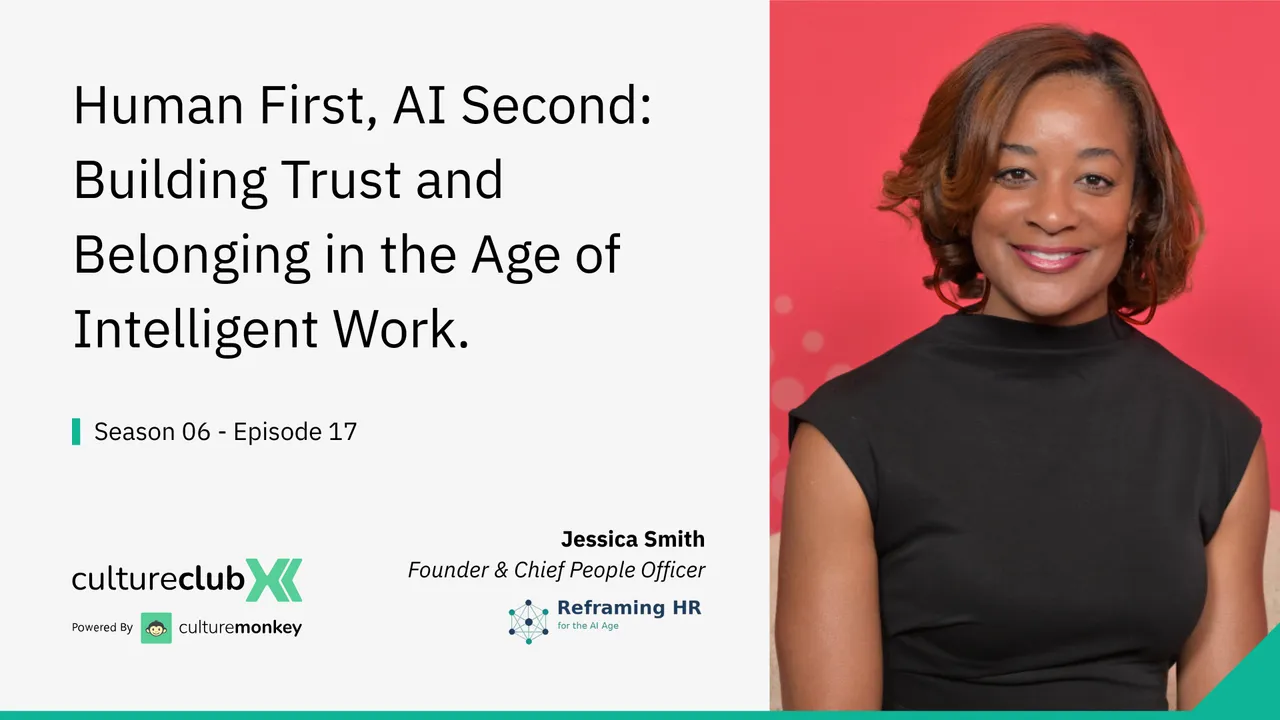
How do you build trust and belonging in the age of AI? | Jessica Smith, Reframing HR
Protect the uniquely human skills first, says Jessica Smith, founder of Reframing HR. Judgment, discernment and emotional intelligence decide whether people trust a decision, and AI cannot replace them. To check whether belonging is real, watch who goes quiet on sensitive survey questions and who turns up to optional events, then put strategy before tools.

TL;DR
What you need to know from this episode
- The human skills are the moat. Judgment, discernment, emotional intelligence, and cultural understanding are the capabilities AI cannot replicate, and they are what make the technology useful in the first place.
- Silence is what erodes belonging. Managers who never discuss reskilling create uncertainty without knowing it. Naming which skills the team will need, and how they will build them, is what keeps psychological safety intact.
- Belonging shows up in the optional moments. Watch who goes quiet on sensitive survey questions and who skips the non-work social events. Engagement at the things nobody is required to attend is the truest signal.
- Strategy before tools, every time. Start from the business problem and bring the right stakeholders in, then let the technology serve it. Buying tools first is where the hard problems resurface later.
- Continuous listening is the safeguard. When the business model itself is transforming, real-time listening keeps a pulse on how change lands, surfacing trust gaps early enough to retain the top talent you cannot afford to lose.
Jessica Smith has spent more than 15 years leading global HR teams inside some of the most demanding technology and staffing organizations in the world, including Amazon, AWS, Meta, and Hays. Today she is the founder and Chief People Officer of Reframing HR, where she helps people leaders prepare their organizations for an AI-native future. That combination of big-tech scale and hands-on transformation work makes her a clear-eyed guide to the question at the heart of this episode.
The framing is deliberately provocative: human first, AI second. As intelligent tools get woven into everyday work, the easy assumption is that technology will carry the culture. Jessica argues the opposite. The more capable the tools become, the more the uniquely human parts of work decide whether trust and belonging survive the transition.
Across the conversation with host Darcy Mehta, she walks through what AI cannot replace, how belonging quietly erodes when managers lean too hard on automation, and the specific moves people leaders can make in the next 90 days to protect their culture while they modernize. The through line is simple: put the human problem first, and let the technology serve it.
Why can't AI replace uniquely human skills?
Asked what AI fundamentally cannot replace, Jessica does not hesitate: the things that make us human. Judgment, discernment, emotional intelligence, and an understanding of culture and cultural impact are the capabilities she keeps returning to. These are not soft extras. They are the skills that decide whether a team trusts a decision and whether change actually lands.
The things that make us unique and human are the ones that AI can never do.
For people leaders, that reframes the anxiety of the moment. The goal is not to compete with the machine on speed or recall. It is to double down on the human judgment that makes the machine useful in the first place. She points to Amazon, Meta, and Hays as the places she watched this play out at scale, through hyper growth and through direct attacks on the business model, and the lesson held every time: the technology changes, the value of human discernment does not.
What happens to belonging and psychological safety when managers lean on AI?
The risk, Jessica warns, is subtle. A manager who never talks about reskilling or how their people fit into the future of work can create uncertainty without realizing it. Silence reads as threat. The fix is not to have every answer, but to open the conversation about which skills the team will need and how everyone gets ready for them.
That is also where psychological safety is won or lost. She is blunt that the framing matters: the message cannot be that AI will replace you. It has to be a shared question about what to automate and how the tools can supplement the team, so that people stop bracing for redundancy and start planning for their next role.
How can you tell whether belonging is real in a tech-first culture?
Belonging is easy to claim and hard to verify, so Jessica points to signals leaders can actually read. The first lives in survey data. When people do not feel safe, they go quiet on the sensitive questions, declining to share demographic details or personal information they would answer freely in a healthier culture.
The second signal is attendance at the optional, social side of work. Do people show up to non-work events? Do they respond to invitations and feel comfortable being themselves? Engagement at the things nobody is required to attend is a truer read on belonging than any headline score.
What makes both signals powerful is that they sit outside anyone's job description. People answer sensitive questions and give up their personal time only when they already feel safe, so the gaps show up long before they surface in performance or resignation data. For a leader, that early warning is the whole point.
How do shared experience and shared hardship build human connection?
When it comes to building connection in a tools-heavy workplace, Jessica goes back to basics. Bring people together, let them spend time together, share stories, and build a shared experience.
The easiest way to build the human connection is to bring people together.
Her more counterintuitive point is that shared difficulty bonds people faster than shared fun. Give a team something genuinely hard to overcome together and the connection forms quickly, because people learn how their colleagues handle challenge and show resilience under pressure.
How do you create honest dialogue when employees quietly fear being replaced?
Honest dialogue, Jessica says, is mimicked from the top. When a manager is willing to share how they actually feel, the team reciprocates. But there is a discipline to it: you cannot drop a fear on the team and walk away. You share the worry alongside a sense that a solution is coming and that you will face it together.
Reassurance matters most in moments when nobody has the answers. Managers carry the same fears as their teams, and naming that shared uncertainty is often what opens the discussion. Her practical corollary is that no tool should run without a human in the loop, because the technology still hallucinates and needs constant challenging.
How do you measure the trust deficit and put strategy before tools?
The trust deficit that AI creates is hard to measure, and Jessica thinks HR is still tracking the wrong things. Engagement metrics should continue, but leaders also need forward-looking questions: do people feel prepared for the next version of their role, do they know what that role is, are they using the tools today, and what excites them about those tools tomorrow.
On the strategy question, her 90-day answer is unambiguous. Too many organizations start by implementing a tool and back into the purpose. She flips it.
Having the strategy first and thinking about really honing into what is the business problem that you're trying to solve.
Start from the business problem, bring the right stakeholders into the room, and let the technology serve the goal. Buy tools without that clarity, she warns, and the hard problems simply resurface later.
How does continuous listening protect trust and belonging?
Every company is heading into some form of digital transformation, and that, Jessica argues, is exactly why continuous listening has never mattered more. When the business model itself is changing, leaders need a way to keep a pulse on how the change is landing for their people, so productivity holds while the organization reinvents itself.
Because at the end of it, the human is still the most important asset. You need smart people working alongside smart technology, which means retaining your top talent through the disruption. That is where pulse surveys and real-time listening earn their keep: they surface trust gaps early, before quiet fear hardens into attrition.
She closes on a warning that reframes the whole discussion. The tools are designed to hype you up, and she is watching people mistake that confidence for competence. The antidote is the same human judgment she started with: stay critical, keep listening, and hold on to what you know to be true as the technology keeps evolving.

About the guest
Jessica Smith
Founder and Chief People Officer, Reframing HR
Jessica Smith is a Chief People Officer with over 15 years of experience leading global HR teams across tech and enterprise, including Amazon, AWS, Meta, and Hays Staffing & Workforce Solutions. Her expertise spans business transformation, change management, finance, talent intelligence, leadership development, workforce planning, inclusion strategy, and HR analytics. Jess holds a BS in Finance from Hampton University, an MBA from IESE Business School in Barcelona, and a certificate in AI Leadership & Digital Transformation from MIT.
Bilingual in Spanish and English, she has lived and worked in three countries and writes and publishes articles on leadership. Currently she serves as the Principal and Founder of Reframing HR, where she helps HR leaders navigate the shift to an AI-native future through thought leadership, reskilling, and strategic advisory grounded in real operating experience.
Full episode transcript
Season 06, Episode 17 · Jessica Smith with Darcy Mehta · 26 min
Hello everyone, and welcome to season six of CultureClub X, powered by CultureMonkey. I'm your host, Darcy Mehta. CultureMonkey is an AI-powered employee engagement platform that helps people leaders listen to their employees and build stronger workplace cultures. CultureClub X is our global thought leadership forum where CHROs and people leaders share insights, discuss emerging trends, and exchange practical strategies for building thriving, future-ready organizations.
Today we're delighted to host Jessica Smith, founder and chief people officer at Reframing HR, a people and transformation leader who has spent her career helping organizations navigate growth, organizational change, and workforce transformation at scale. Jessica, welcome. It's so wonderful to have you here with us.
Thank you, Darcy. Thanks for having me.
Yes, absolutely. So Jessica is a chief people officer with more than 15 years of experience leading global HR teams across Amazon, AWS, Meta, and Hays Staffing and Workforce Solutions. Her expertise spans business transformation, change management, leadership development, workforce planning, HR analytics, inclusion strategy, and AI-enabled workforce transformation.
She holds a bachelor's degree in finance from Hampton University, an MBA from IESE Business School in Barcelona, and a certificate in AI Leadership and Digital Transformation from MIT. Bilingual in English and Spanish, Jessica has lived and worked across three countries and regularly writes on leadership and the future of work. Today, as the founder of Reframing HR, she partners with HR leaders to prepare their organizations for an AI-native future through strategic advisory, thought leadership, and workforce reskilling.
Jessica, your experience leading global HR transformation and helping organizations prepare for an AI-native future makes you the perfect voice for today's conversation. And we're so excited to have you here to discuss our latest topic: human first, AI second, building trust and belonging in the age of intelligent work. Before we dive into our questions, could you just share a little bit about your own leadership journey?
Yeah, absolutely. Well, first of all, thanks so much, Darcy, for having me. I'm super excited to be here. You did a great introduction, so I think you summed it up really well. But like you said, I've been leading global HR teams for over fifteen years now.
I spent most of my executive HR career in big tech, so in Amazon and Meta, and then as Chief People Officer at Hays, which is a global staffing organization. I've been in industries which have seen hyper growth, and industries that have seen attacks on the business plan and the business model, and how to lead through those. So I'm excited to come here today and share some thoughts around that.
I'm so excited too. This topic really interests me, and your breadth of experience is amazing. And studying in Barcelona is so much fun, and that explains why you're bilingual, English and Spanish too. So that is awesome, really impressive. Okay, so let's just dive into our first question.
What is the one thing AI fundamentally cannot replace, and why does it matter most for people leaders right now?
Yeah, so there are many, but essentially the main thing is that we are uniquely human and AI is not. And so it's those things that make us uniquely human, Darcy. So everything from judgment, discernment, being able to have emotional intelligence, understanding cultures and cultural impacts. Those are the types of things. The things that make us unique and human are the ones that AI can never do.
Absolutely. I mean emotional intelligence, right? You hit on that, and just that intuitive intangibles, of course.
So what happens to belonging and psychological safety when managers start believing AI can replace their teams?
Yeah, so it definitely can be impacted. The important thing is that if you're out there now leading teams and you're not talking about reskilling the team or how those colleagues fit into the future of work, you probably are creating, without knowing it, a lot of uncertainty for other people.
And so definitely you want to be thinking, as a leader, as a manager, what are some of the things that might get impacted in our roles? And even if you don't have all the answers, talking about, okay, let's think through as a team what are the future skills that we're gonna need, and then let's talk about how we're gonna get you ready for those and prepared. So not thinking that it can replace you, but what are those skills and how can it just supplement you?
So how do you know when belonging is truly present in a tech-first culture, and what breaks it the fastest?
Yeah. I would say a good way to know if belonging is present is that there are some basic signals within the company survey data. So for example, a lot of times in company surveys it'll ask if you are comfortable sharing details about yourself, such as demographic data or perhaps your sexual orientation, things like this. Where I have seen cultures where people don't feel belonging is strong or they don't feel psychologically safe, a lot of times they are afraid to answer those types of questions. And so that's a really good place to look.
Another really good place to look is your employee events. So are people showing up to those? Are they responding to the invitations? Do they feel comfortable going to a work event that's non-work, that's more focused on the social aspect and being themselves? And so checking in on attendance and engagement on those types of things will also give you some insights into whether your colleagues are feeling like they belong.
Those are great points. Especially seeing that engagement is very clear, right? But it makes sense that it's not just at work, but are you attending the non-work, the more social events, being part of it. That would really be very telling for sure.
Yeah, because there's those parts where it's optional, right? So it's in your personal time a lot of times.
Absolutely.
So how do you build genuine human connections inside organizations where the tools around you are getting smarter every day?
Yeah, so it's really kind of back to basics on this one, Darcy. The easiest way to build the human connection is to bring people together. So the more you can bring people together, they can spend time together, they can share stories, have a shared experience.
A lot of times this probably sounds strange, but shared hardship typically brings people together. So even if you bring people together and then have them do something hard in a team, give them some kind of shared experience that feels difficult, they feel pain and they need to overcome it and show resilience together, that really helps to bring people together and feel that connection rather quickly.
That's such a great idea. It's not rocket science, right? It makes sense, of course. Spending time together brings people together. But I like how you said it's not just doing something fun or sharing your past experiences. I like the idea of traversing something difficult, taking on a challenge together. That's gonna provide so much, you're gonna learn about the other person, how they deal with challenges. That's so interesting and it makes perfect sense, but it bears saying.
So how do you create the conditions for honest dialogue in a workplace where employees quietly fear being replaced?
Yeah. So I think this one's really about mimicking the behavior. So if the manager or the leader is comfortable sharing how they feel with the team, then the team is likely to respond and reciprocate and share feelings as well. So that one is really key. And the more you can share your own thoughts and fears, but also thinking that you can't just drop a fear on the team and walk away, right? You need to share your own thoughts and fears, thinking that there's a solution coming, or here's what you've been thinking about and here's what we're gonna do about it.
That'll help the team feel like they can connect as well and share their thoughts. And just reassuring them, in a moment where nobody has any of the answers, reassuring them that this is something you're all gonna go through together. But at the same time being proactive, which is really gonna be the key.
I love that, being proactive and the mimicking. So it starts from the top down, from the manager, not just sharing their own thoughts and experiences, but then being ready to listen, to listen back, right? I mean, obviously everybody has the same fear. AI has come at us very quickly, at everybody. And you're always being told you're gonna be left behind. But realizing many people, managers included, have those same fears, those same thoughts and questions, starting that opens up the discussion, right?
Yeah, absolutely. And I think too, AI is not gonna replace your entire job, right? There might be tasks in it that it does replace. But if you work in these tools every day, sometimes I call myself an AI babysitter because you constantly need to challenge it and be like, No, I said this, remember that. No, we talked about this the other day, go back and review it. You can't a hundred percent rely and trust what the technology says, right? It still has plenty of hallucinations.
So if you're working every day, you absolutely understand that nobody should be using this completely without a human in the loop, at the minimum, in its current state. And so you should be asking yourself, okay, let me just get real about what can be automated in my role, and then take the agency to figure out for yourself what those things are and then just do them. And then look for what are the next skills. At Reframing HR, we focus a lot on reskilling, thinking about what are the next skills for someone taking their job. So those are some of the things people can think about. If they wanna protect their role, this is the best way.
Absolutely. I mean, we should all be AI babysitters, right? Like you said. I remember one of the first times I used it, just to test it out, to help write a script for a video. And it came up with these quotes and put them in quotation marks, being said by a real person. And I said, where did you get that? I never gave you that information. And then it was, this was just made up. And then I was like, hmm, can't put that in quotation marks then as a direct quote. So things like that. That really turned that light bulb on of like, wow, okay, this is just making things up, putting it together. So of course you need that human element to be an AI babysitter, like you said.
So how do you measure the trust deficit that AI adoption creates, and what should HR leaders be tracking that they currently aren't?
Yeah. So this one's really challenging, right? Some of the things that we used to measure were more focused on engagement, which we should continue to do. But as we look at the AI deficit, we should be thinking about and measuring what our colleagues, the end user, might be thinking, and try to get more information about that.
So for example, I would be asking questions to colleagues more about their role into the future than AI today. So do you feel like you're prepared to do the next version of your role? Do you know what that is? Are you using the tools today? And what makes you excited about those tools in the future? Because we need more information from our colleagues about what they're experiencing as they use the tools.
Many companies have some version of AI tools in house, whether that be Copilot for those people who are using Microsoft, or some version of ChatGPT, etc. And so learning more about the experiences that people are having today, and understanding how they think they fit into the future, helps you understand their trust and their potential anxiety around it.
I mean, it's true, so much has changed. These things weren't being tracked before, right? So it's important to start tracking that now. And I think the trust deficit is such an interesting topic, because trust is the most important thing in doing business, between managers and employees, between customers. And obviously this is creating that deficit. So I feel like that's even a whole interesting topic we could delve into too, for sure.
Yes. Well, and then the tools itself, right? Because like we just talked about, you can't a hundred percent trust it. So you do need to question it, like you did, Darcy, and say, where did you get this from? Where are you getting this information? How are you coming up with this? So even you as an individual, trusting the tools you use, you need to be quite critical.
Absolutely. I mean, it goes back to the whole don't believe everything you read or see on the internet, which we were told before all of this anyway. So it rings even more true now.
So this is always an interesting question because it kind of puts you on the spot, but what is the one action every people leader must take in the next ninety days to ensure their AI strategy doesn't cost them their human culture?
Yeah. Hmm, this is a good one. So I would say it's get the strategy right. Right now, what I see a lot working with clients at Reframing HR is that there's a lot of hype about AI. So everybody's talking about it, all the companies believe they're behind, and there's not a lot of people that are super far ahead. And in many cases, when an organization goes to look at AI, they're looking at implementing a tool. So we're implementing this tool or this technology or this add-on feature to our systems.
When you do it from that direction, it becomes really difficult to ensure you've got all the right stakeholders in the room, that you've thought through all the downstream implications of making that choice, and that you've looked at how that choice impacts other teams and clients and potentially customers. And so having the strategy first and thinking about really honing into what is the business problem that you're trying to solve, and then using the technology and tools to solve for that, are gonna be key, because everything else comes after.
And doing it from that direction, you'll be able to better understand, because it's gonna be asked, what efficiency savings or improvements did you make. That'll help with people's anxiety and help people understand where all this is going. So really being clear in the next ninety days of what is your roadmap, and realizing that it may change, because the technology literally is changing every day. It's improving, it's changing. So you might need to make changes. But if you find yourself especially buying tools without thinking backwards from what is the bigger business problem you're trying to solve, that is probably where you're going to find it difficult to solve for some of the other things in the future.
Definitely. It's easy to get excited or to say, I've got to try this new tool or dive into this, but for what purpose? To what end? What are you trying to solve? So that makes perfect sense. And I love that question and that answer. And 90 days is a long time too, right? So it may change if we're ready to adjust course. But no, that's a great answer, so thank you for that.
Okay, so what role should continuous listening play in helping HR leaders detect trust and belonging gaps in an AI-driven workplace?
Yeah, so this is gonna be key over the next year, year and a half, because just like we talked about, everything's changing quickly. So I think it's really important that you have a strong tool for listening embedded, because every company right now is going through, or about to go through, some kind of digital transformation. The digital transformation in this scenario will transform, in many cases, the business model itself or the way things are done. That means you are transforming the core.
And so you need to transform to keep up with what's happening outside, but at the same time you need to ensure that the productivity you have in the business stays consistent as you work to transform and grow. And so it is absolutely key that you've got some type of enterprise listening solution, such that you're able to keep a pulse as you go through these changes, of what's happening to your colleagues.
Because at the end of all of this, the human is still the most important and you need your top talent. You need them there. I call this the era of the smart person, because you need smart people to work alongside an extremely smart piece of technology. You need a smart person. So you need to retain those people. And so I think it's never been more important to have enterprise listening.
Absolutely. I like that. The smart era makes perfect sense. And you're right, you need to not only maintain and keep those relationships, but really nurture them. And that's where the continuous listening comes into play, to find out what their experiences are, how they can help, how it can get better. So this has been so interesting. I could keep talking to you all day. Is there any topic that we did not cover in our questions, or anything else you'd like to share?
I'll share one other thing, which is more about confidence and competence. So this one really concerns me, Darcy, as we go through this era. What I'm seeing with some clients that I work with is that there are people using the tools, feeling very confident, because as you use them, they will hype you up, right? They'll say, you're great, that was a great idea, even if it may not be the best one. And so what I'm seeing is people mistaking that confidence for competence.
I've even seen people within my clients come up with a business idea, leave their jobs, because they're like, I can put together this new idea, create a business, and it's gonna be the next best thing. And not that it won't. But remember, you were getting your advice from something that is extremely positive and designed really to help you be great, but you need to tell it to challenge you as well.
And so I just want people to be, I think we're in an era where it's really special. It's a great time to think through how do you create different streams of income. You maybe have some new ideas and experiment, but also remember that technology is still evolving. So how we pay for this technology will evolve. And maybe the thing you're getting today is so expensive in the future that the business model you're creating doesn't work. So because it's all still evolving, we need to be very careful, even as individuals, that we don't let our confidence outweigh what we know to be true, and make sure we're holding those truths really close to us, such that we continue to make good choices.
That's amazing. What a great last thing to share, the competence and confidence. And that's where experience comes into play, right? Having worked in business, not being so quick to say yes, that's great, and jump off to the next big thing. But with experience you know, okay, I need to think through this more. And it's kind of like that whole culture of, you know, you participated, you get a ribbon, everyone did great. Like you said, this is designed to give you the confidence, which can be good with some things. My husband and I have a funny thing, we call it the idea notebook. We don't even have a real one, but we come up with ideas all the time and we'll be like, let's stick that in the idea notebook. Not all ideas are gonna work or be great, but it's fun to brainstorm. So I like that, that's really good advice.
So thank you so much. Your insights on trust, belonging, and the human side of AI adoption have been both timely and thought-provoking. And as organizations continue to invest in AI and intelligent technologies, it's becoming increasingly clear that technology alone cannot create high-performing workplaces. Sustainable success will come from leaders who can balance innovation with empathy, and efficiency with human connection. And one of the key takeaways from today's discussion is that trust and belonging are not soft outcomes. They are business-critical foundations that determine whether employees embrace change, contribute their best work, and remain engaged through transformation.
And that's where CultureMonkey excels, with pulse surveys and real-time listening capabilities that help people leaders understand employee sentiment, identify trust gaps early, and build cultures where both people and performance thrive. And before we end, Jessica, how can our listeners connect with you to keep this conversation going or to share their own perspectives?
Yeah, so definitely on LinkedIn, Jess Smith, Reframing HR. Also the Reframing HR website, so reframinghr.com. And then finally on Instagram, I also write a blog on leadership and post a lot of things there, which is leadership_lessons_from_life on Instagram.
Okay, amazing. I can't wait to read your blog and connect with you as well. And to all our listeners, thank you so much for being here as always. And don't forget to follow, share, and subscribe. And that's a wrap for this episode of CultureClub X, powered by CultureMonkey. Until next time, I'm your host, Darcy, signing off.
Frequently asked questions
What is the one thing AI cannot replace in the workplace?
The uniquely human capabilities: judgment, discernment, emotional intelligence, and an understanding of culture and cultural impact. Jessica Smith argues these are the skills that decide whether people trust a decision and whether change actually lands, which is why they matter most for people leaders navigating AI adoption.
How do you know if employees genuinely feel like they belong?
Look at two signals. In survey data, people who do not feel safe tend to go quiet on sensitive questions, declining to share demographic or personal details. And watch attendance at optional, social events: whether people show up when nothing requires them to is a truer read on belonging than a headline engagement score.
How can managers build human connection in a tech-heavy workplace?
Bring people together and give them a shared experience. Jessica notes that shared hardship bonds people especially fast: a genuinely difficult challenge a team has to overcome together builds connection quickly, because people learn how their colleagues handle pressure.
What should HR leaders do in the next 90 days to protect culture during AI adoption?
Get the strategy right before buying tools. Start from the business problem you are trying to solve, bring the right stakeholders into the room, and let the technology serve that goal. Set a clear roadmap for the next 90 days and expect to adjust it, because the technology is changing constantly.
What role should continuous listening play in an AI-driven workplace?
It keeps a pulse on how transformation is landing for employees. With business models themselves changing, an enterprise listening solution helps leaders surface trust and belonging gaps early, hold productivity steady through change, and retain the top talent they need to work alongside the technology.
Read the cross-episode roundups
More from CultureClub X
 S07 E03employee engagementWhy do grievance procedures damage workplace culture? | David Liddle, The TCM Group
 David Liddle
 S07 E02change leadershipHR as Chief Disruption Officer: Why Supporting the Business Is a Ceiling, with Jennifer McClure
 Jennifer McClure
 S06 E20change leadershipWhy does culture change stall? | Jamie Notter, culture scientist
 Jamie Notter
Never miss an episode
Every new episode, plus the takeaways that matter, posted on the CultureMonkey LinkedIn page as soon as they drop.
Free on LinkedIn. Unfollow anytime.