

S06 E19
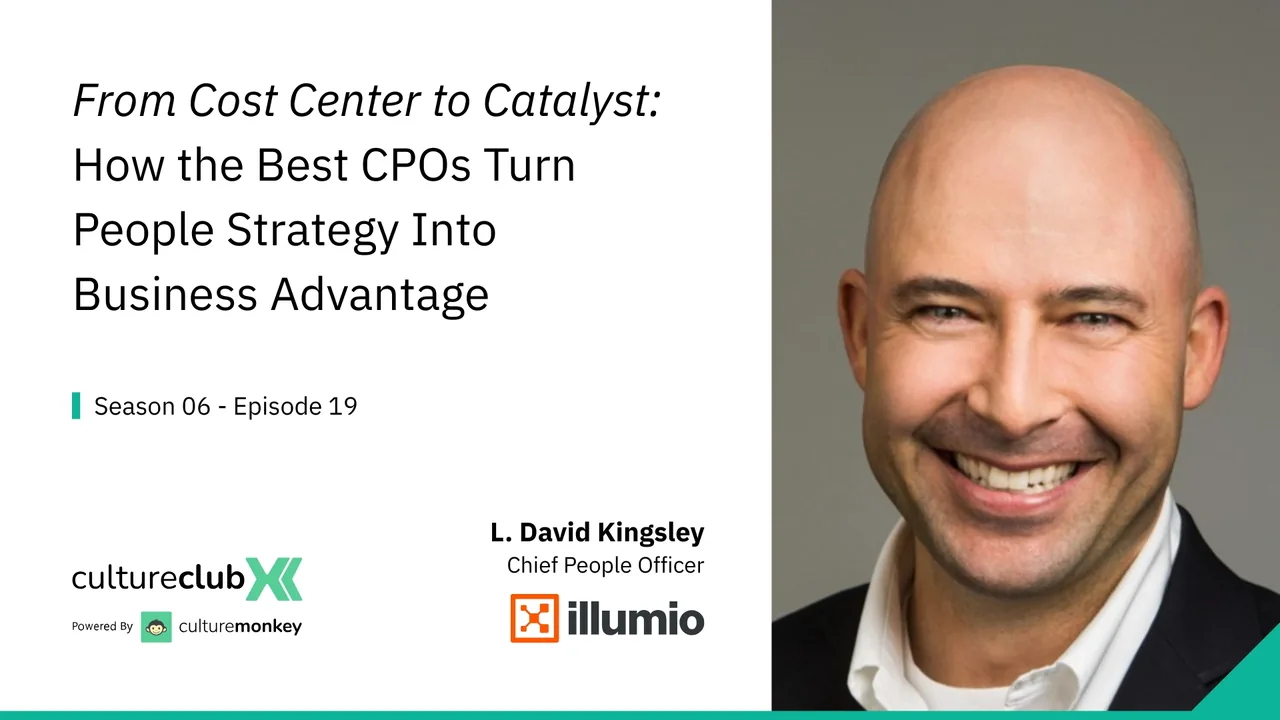
From Cost Center to Catalyst: How CPOs Turn People Strategy Into Business Advantage, with L. David Kingsley
L. David Kingsley has been a Chief People Officer five times over, at MuleSoft, Vlocity, Alteryx, Intercom and now Illumio. He joins CultureClub X to argue that people teams should stop fighting the cost center label and start working like one: three jobs in order, the shortest possible version of everything, and a single question that surfaces the capacity your organization is quietly missing.

TL;DR
What you need to know from this episode
- Accept the cost center label, then act on it. David's three jobs of HR run in order: keep the company out of jail, keep it out of the headlines for the wrong reasons, then everything else that helps the company achieve its mission. Once the first two are handled, the question for every G and A function is how close it can get to delivering customer value with the minimum calories deployed.
- Most organizations are already 75 percent ready to treat HR as a trusted advisor. The gap between necessary evil and trusted advisor is usually permission rather than capability. Ask your internal clients how they perceive the function, what they use it for and where it drives value, and most will answer plainly.
- Simplicity is the expensive version, which is why it earns attention. AI made the long document free to produce and left the short one costing exactly what it always did. A distilled position tells the stakeholder you spent the time so they would not have to.
- HR stays at the kids' table until it speaks the language of the business. An outside observer can usually pick out the HR person in a room, because HR people speak on HR topics and go quiet on everything else. The fix is a score you run on yourself: how often do you contribute on something that is not explicitly HR?
- Watch participation before sentiment. On manager effectiveness surveys, David goes to the response rate first, because participation is energy and energy can be redirected. A quiet survey is the harder problem, not the safer one.
L. David Kingsley has been a Chief People Officer five times over, at MuleSoft, Vlocity, Alteryx, Intercom and now Illumio, where he leads global people strategy across talent acquisition, learning and development, total rewards, engagement and DEIB. He did not start in HR. He began as a systems integrator at Andersen Consulting, which later became Accenture, implementing PeopleSoft systems for organizations in the middle of technology transformations. That route in is the reason his language sounds more like an operator's than a practitioner's.
The premise of this episode is one most people in HR spend their careers arguing against. David says HR is a cost center, not a profit center, and that people teams which keep fighting that description are spending energy in the wrong place. Accepting it, in his telling, is what makes the function useful.
Across the conversation with host Darcy Mehta, he lays out the three jobs of a people function in order, explains why most organizations are far closer to treating HR as a trusted advisor than HR realizes, and gives one question he would have every leader ask their team in the next 90 days.
The three jobs of HR, in order
David's framing is deliberately unglamorous. Job one is to keep the company out of jail. Job two is to keep it out of the headlines, at least for the wrong reasons. Job three through X is everything else that helps the company achieve its mission. The first two are table stakes, and his point is that people teams forget the order rather than the list.
Job number one, keep the company out of jail. Job number two, keep the company out of the headlines in the newspaper, at least for the wrong reasons. And then job number three through X is everything that helps that company achieve the mission.
What follows from accepting cost center status is a discipline about effort. Product, sales, marketing and customer success all have a legible line to a customer. The G and A functions, which he lists as finance, accounting, HR, IT, legal, real estate and workplace services, do not. So their question becomes how close they can get to delivering that same customer value with, in his words, the minimum amount of calories deployed.
The failure mode he names is doing HR for HR's sake. His phrase for it is doing what the dusty binder tab three says you are supposed to do. He includes himself and points out that customers never feel the benefit of work done that way.
Necessary evil, critical enabler, trusted advisor
David describes every people function as sitting somewhere on a three-point continuum. Necessary evil at one end. Critical enabler in the middle. Trusted advisor at the far end, which he defines not by title but by whether the room waits for you before it starts.
When he joins a company, he says the function is usually somewhere between the first two. The more interesting claim is what sits underneath that. Most of the time, he argues, the organization is already about 75 percent of the way to treating the people team as a trusted advisor. It simply has not issued the invitation, or the team has not yet shown up in a way that made the invitation obvious.
His example comes from Illumio, where the chief product officer told him that at a previous company he always felt he was having to chase HR, putting things on the table he wanted them to think about.
I want HR to chase me. I want you to bring me ideas, observations, data, insights, perspectives.
When the demand signal is already there, he says, the job is simply to show up and meet it. His practical advice for finding out where you stand is to ask directly. He mentions using a Gartner assessment of HR function maturity, and adds that you do not need an analyst firm to do it. Ask your internal clients how they perceive you, what they use you for and where you drive value, and most will tell you plainly.
Simplicity is expensive, which is why it wins
Asked why the best organizations simplify while most add process, David reaches for the line usually attributed to either Mark Twain or Blaise Pascal: I wrote you a long letter because I did not have time to write a short one. With AI in the room, he notes, producing the long version costs almost nothing. Producing the short one still costs what it always did.
His argument is that a tight, distilled position earns airtime because of what it signals. It tells the stakeholder that you put in the time to make this simple so they would not have to. The alternative, in his description, is a complex word salad policy that feels impressively HR and wins internal praise while nobody reads it.
He makes the same point twice through design rather than policy. The first is a night in Tokyo, walking a mile to dinner with an empty water bottle he could not throw away because there was no bin anywhere in sight.
If we don't have a place for you to put garbage, you just won't make garbage. Therefore, we won't have garbage on our streets. How brilliantly simple.
The second is getting up from a Southwest Airlines seat and finding himself folding the seatbelt across it the way the cabin crew do, because the culture had a way of doing things and he had absorbed it inside one flight. Both stories point the same direction: design that removes a problem beats process that manages one.
Why HR gets seated at the kids' table
This is the section most likely to sting, and David puts himself inside it. His observation is that an outside observer can usually pick out the HR person in a room, because HR people speak on HR topics and go quiet on everything else. Product development lifecycle, customer maturation, the marketing approach: no view offered.
His self-test is a score he runs on meetings. In any executive or board meeting, how often is he contributing on something that is not explicitly HR? He asks his colleagues to engage on culture, talent and retention, so the same expectation has to run in reverse.
We're gonna stay at the little kids' table until we speak the language of the business.
In publicly traded and venture-backed companies he means that literally. If you cannot discern one financial acronym from another, cannot connect people work to net-new ARR, NACV or GRR, you will not be heard. He extends the point to how HR teams are developed: the first time someone encounters these business concepts should not be when they land their first CPO role, and too often it is. He sees teaching them earlier as the job of whoever currently holds the executive seat.
Mental wellbeing as capacity, not a benefit
David sits on the board of Nivati, a mental health platform, while running people strategy at a high-growth cybersecurity company, so he has had to make this case to business audiences rather than HR ones. He does it with an analogy rather than a statistic.
Tie your dominant hand behind your back for a day and type with the other one. You would get through the day. Your emails would go out slower, your responses would lag, you would accomplish less and finish with a cramp. That, he argues, is what turning up to work without mental wellbeing looks like: not absence, not underperformance you could name in a review, just working with one hand.
He backs it with something he heard from a neuroscientist. Under threat, with cortisol spiking, people drop into fight or flight and functional IQ falls. Someone who normally operates at 130 or 150 might be working at 105 or 110, unable to do their best work because they are not psychologically safe in that moment. If you want people at the height of their game, you have to set them up for it.
The 90-day non-negotiable
Asked for the single action every Chief People Officer should take in the next 90 days, David did not name a project. He named a question, and said it should be asked of every person in the organization.
How are we doing as a company at getting you what you thought you bought here?
His claim is that most organizations run at roughly 80 percent of the capacity they believe they have. Not because people are disengaged in a way an engagement report would flag, but because some are under-engaged, under-equipped, under-informed or under-empowered in ways that never surface unless somebody asks directly. Most people will say they are fine. A few will tell you they came to do one thing and have not been able to, and that is the answer worth having.
His name for the alternative is crockpot management.
You can do crockpot cooking, you can't do crockpot management.
Set it and forget it works on beef stew. It does not work on people, and the fix is a moment in your skip levels, your one-to-ones and your coffee chats rather than a new program. If you want the phrasing that gets useful answers, our guide to engagement survey questions covers how to ask without leading the witness.
What asking actually communicates
Asked how real-time listening platforms help build the business case for people strategy, David put the signal ahead of the data. When an organization stops and asks in a way the employee believes is sincere, the message received is simple.
Your voice matters. You have impact and import here in this organization.
That, he says, is the most important thing engagement efforts do. A very close second is the insight itself: the feedback that tells leadership the thing they believe is working is not working, or not in the way they think. Both require the asking to be genuine, which is the part that cannot be automated.
Participation before sentiment
The most practical idea in the episode is also the least intuitive. When David looks at manager effectiveness surveys, the first number he goes to is not the score. It is the participation rate.
I actually care about that more than I care about what people say in the survey. I care about are they speaking up? Because when they're speaking up, they care.
He borrows the physics to explain it. Vector is direction, valence is energy. If there is no valence, you cannot re-vector things. So on a 360 survey, what he wants to know first is how many people gave feedback about their manager at all, good, bad or indifferent. People who tell you what would make them more effective are people who believe their voice is valued, and a group that has gone quiet is the harder problem, not the safer one.
That is where manager effectiveness surveys and continuous listening earn their place in his argument. If participation is the leading indicator he says it is, the number worth watching is whether people still think it is worth answering, and that moves long before anything shows up in your attrition data.
For a broader look at what this means for the people at the top of the organization, our piece on leadership engagement covers how senior teams stay connected to the work they are accountable for.
About the guest
L. David Kingsley
Chief People Officer, Illumio
L. David Kingsley is Chief People Officer at Illumio, where he leads global people strategy across talent acquisition, learning and development, total rewards, employee engagement and diversity, equity, inclusion and belonging. He has held the Chief People Officer role five times, previously at MuleSoft, Vlocity, Alteryx and Intercom, and has more than 20 years of leadership experience scaling high-growth technology companies through periods of rapid change.
He began his career as a systems integrator at Andersen Consulting, later Accenture, implementing PeopleSoft systems for organizations in the middle of technology transformations, which is where his business-first view of the people function was formed. He also serves on the board of Nivati, a mental health platform, and argues that mental wellbeing belongs in business strategy as a question of capacity rather than benefits.
Full episode transcript
Season 06, Episode 19 · L. David Kingsley with Darcy Mehta · 48 min
Frequently asked questions
Why does L. David Kingsley say HR is a cost center?
Because he thinks arguing otherwise wastes the energy that should go into the work. Product, sales, marketing and customer success all have a legible line to a customer. The G and A functions, finance, accounting, HR, IT, legal and workplace services, do not, so their question is different: how close can we get to delivering that same customer value with the minimum amount of calories deployed. Accepting the label is what makes that question the operating one.
What are the three jobs of HR, according to David Kingsley?
Job one is to keep the company out of jail. Job two is to keep it out of the headlines, at least for the wrong reasons. Job three through X is everything else that helps the company achieve its mission. His point is that the first two are table stakes and that people teams forget the order rather than the list, which is how a function ends up doing HR for HR's sake.
What is the one question he would have every leader ask in the next 90 days?
"How are we doing as a company at getting you what you thought you bought here?" asked of every person on the team. His estimate is that most organizations run at roughly 80 percent of the capacity they believe they have, because some people are under-engaged, under-equipped, under-informed or under-empowered in ways that never surface unless somebody asks directly. He calls the alternative crockpot management: you can do crockpot cooking, you cannot do crockpot management.
Why does he care more about survey participation than survey scores?
Because participation tells him whether people still believe speaking up is worth it. He borrows the physics: vector is direction and valence is energy, and if there is no valence you cannot re-vector things. On a 360 survey he looks first at how many people gave feedback about their manager at all, good, bad or indifferent, on the grounds that a group which has gone quiet is a harder problem than a group with a low score.
Why does he say HR gets seated at the kids' table?
Because, in his view, HR puts itself there. An outside observer can usually pick out the HR person in a room, since HR people speak on HR topics and go quiet on product, customer and marketing questions. In publicly traded and venture-backed companies he means it literally: if you cannot connect people work to net-new ARR, NACV or GRR, you will not be heard. He includes himself and scores his own meeting contributions on it.
Read the cross-episode roundups
More from CultureClub X
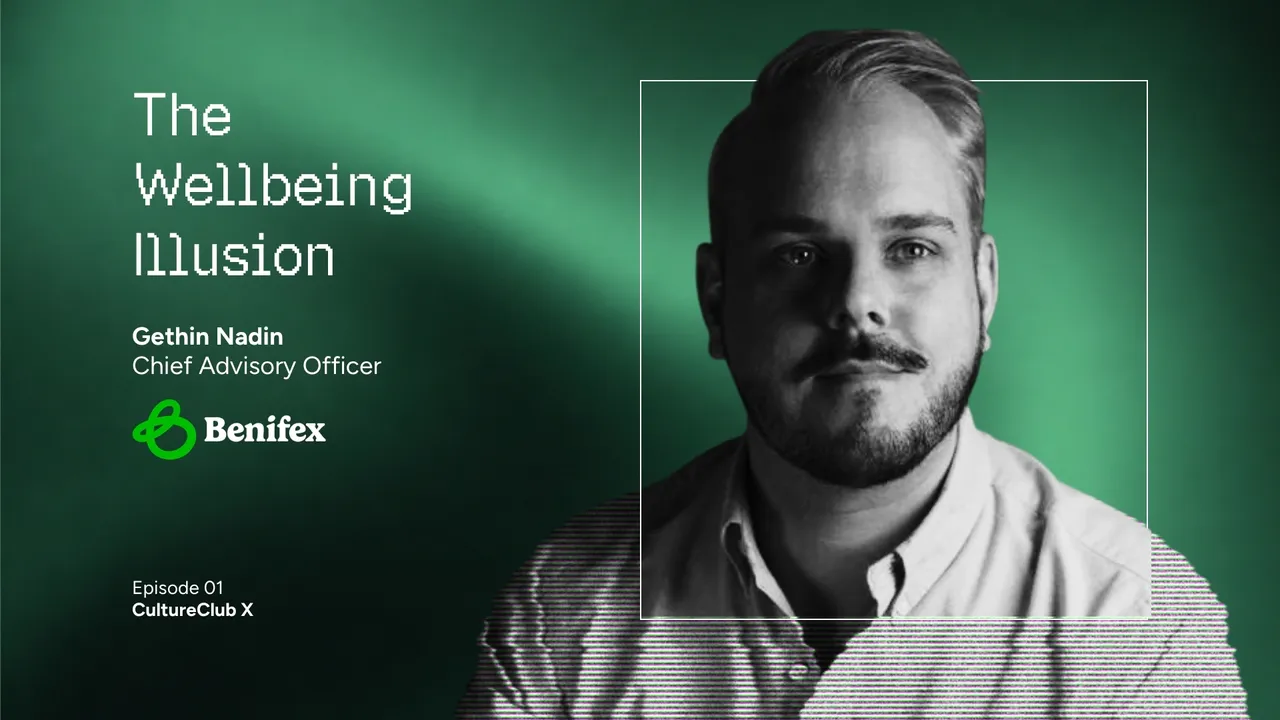 S07 E01employee engagementThe Wellbeing Illusion: Why Most Organizations Are Spending More on Wellbeing and Getting Less in Return, with Gethin Nadin
 Gethin Nadin
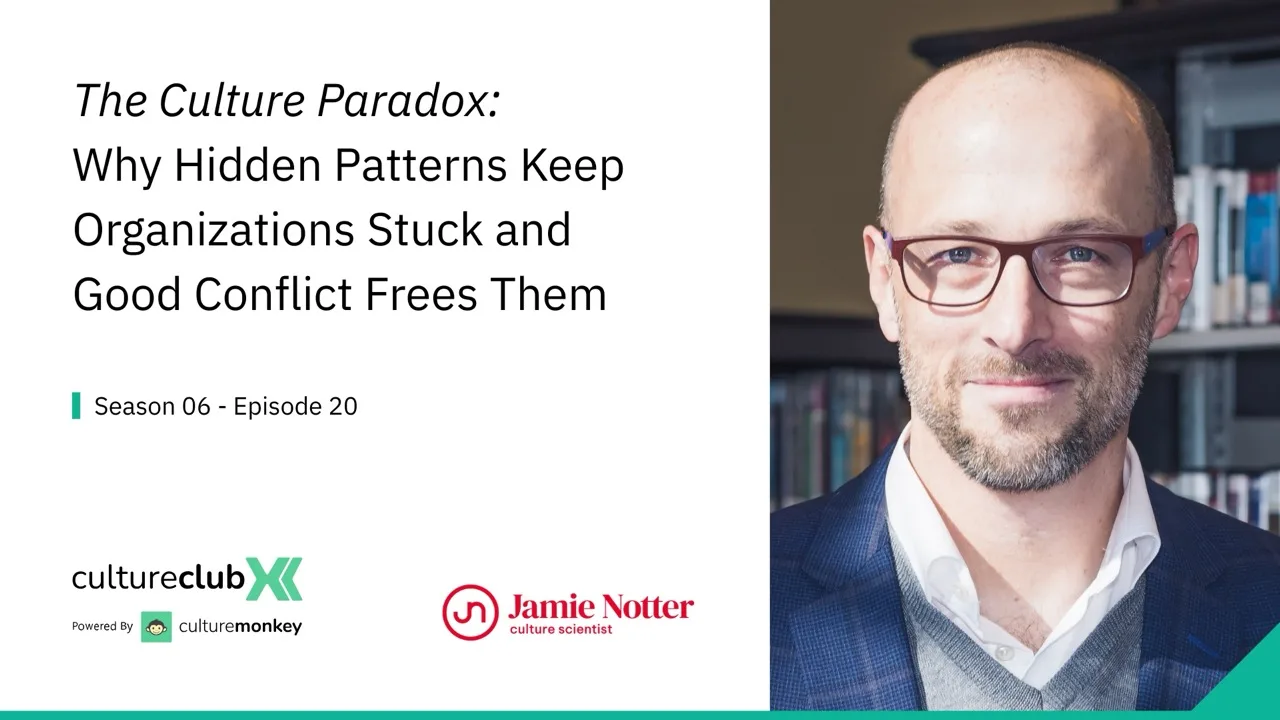 S06 E20change leadershipThe Culture Paradox: Why Hidden Patterns Keep Organizations Stuck and Good Conflict Sets Them Free, with Jamie Notter
 Jamie Notter
 S06 E17ai in hrBuilding Trust and Belonging in the Age of AI, with Jessica Smith
 Jessica Smith
Never miss an episode
Every new episode, plus the takeaways that matter, posted on the CultureMonkey LinkedIn page as soon as they drop.
Free on LinkedIn. Unfollow anytime.