

Culture Litmus
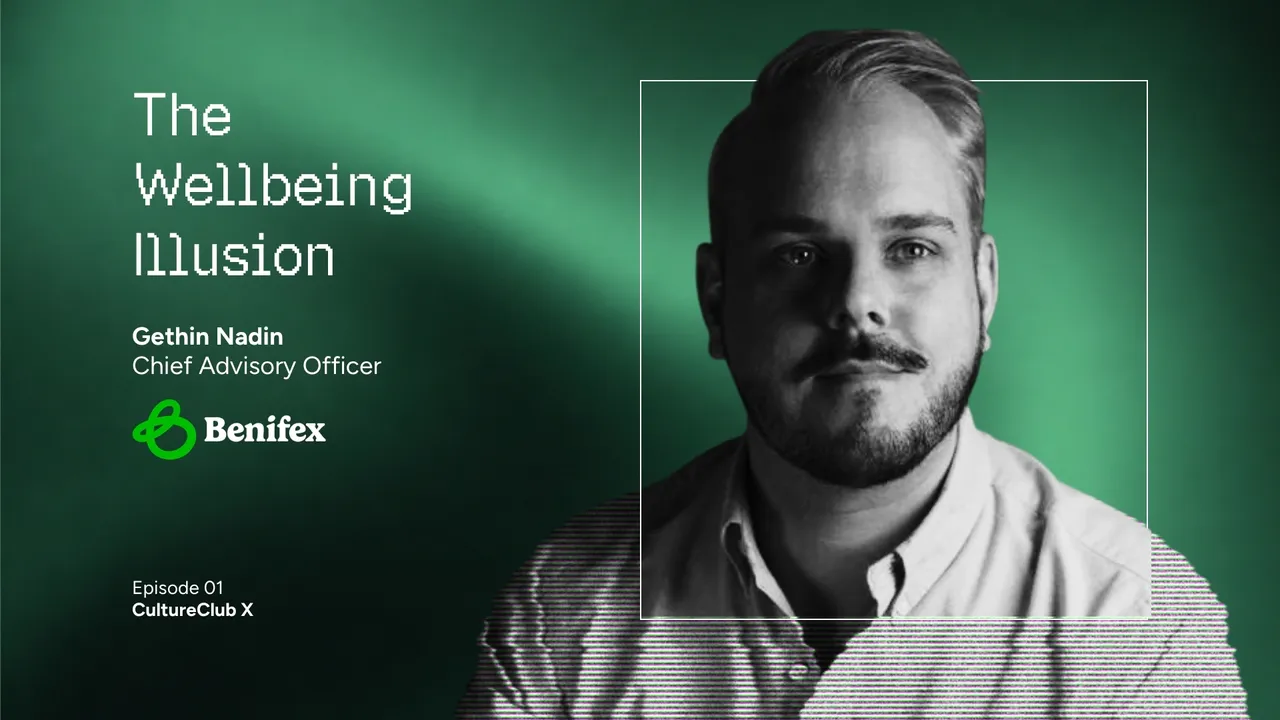
Why is employee wellbeing spending not paying off? | Gethin Nadin, Benifex
Because it treats the symptoms of poor work instead of the causes, says Gethin Nadin, Chief Advisory Officer at Benifex. Support is layered on top of the workloads, managers and job design doing the harm, and scattered platforms mean employees cannot find it. The strongest drivers of wellbeing are job design, workload, autonomy, recognition and leadership.

Five conversations on the gap between what organizations claim about their people and what they can actually evidence.
- 01Gethin Nadin, BenifexThis episode
- 02Jennifer McClure, DisruptHRSeptember 22, 2026
- 03David Liddle, TCM GroupOctober 6, 2026
- 04Jessica Zwaan, LeapsomeOctober 20, 2026
- 05Helene V. Gagnon, CAEComing November 3, 2026
TL;DR
What you need to know from this episode
- It is not a generosity problem. Employers are spending more on wellbeing than ever and the UK still ranks second lowest for employee experience. The failure is in design and delivery: support that people cannot find, do not understand, or cannot connect to their own lives. As Gethin puts it, that investment might as well not exist.
- The real drivers of wellbeing are never labeled wellbeing. Job design, workload, autonomy, recognition, quality of leadership and role clarity carry the evidence. No assistance program or meditation app compensates for an impossible workload or a poor manager.
- Managers under financial stress are the system eating itself. Managers are the single biggest factor in most people's experience of work, and Zellis research found that those under financial pressure are more likely to say it affects their ability to lead. Money worries narrow attention, and the loss cascades straight down to the team.
- Embedded organizations ask a different question. Not what wellbeing products to buy this year, but how to create a working environment that helps people perform and thrive. They prevent as much as they treat, and wellbeing has board-level ownership rather than sitting with HR.
- Stop saying wellbeing. Say performance. The 90-day action is to connect every people investment to the one to three priorities the CEO and CFO actually hold, and to measure success in productivity, customer satisfaction and manager effectiveness rather than wellbeing metrics.
Gethin Nadin is Chief Advisory Officer at Benifex, part of the Zellis executive team, a Fellow at King's Business School and the chair of the Policy Liaison Group on Workplace Wellbeing, the Westminster think tank he founded to put employers in the same room as policymakers. He started as a manager of seventeen people at twenty-three, in financial services, watching good people underperform because of what was happening to them outside work. Two decades and two bestselling books later, that is still the question he is working on.
This is the first episode of Culture Litmus, the Season 07 series on the gap between what organizations claim about their people and what they can evidence. Wellbeing is the natural place to start, because it is the line item that has grown fastest and is measured least. Gethin's argument across the hour is that the money is real, the intent is real, and most of it never reaches anyone.
Is poor wellbeing a generosity problem?
Employers have been investing heavily in wellbeing, benefits and general support, and the UK still ranks second lowest in the world for employee experience. Gethin's first move is to rule out the obvious explanation. This is not a generosity problem. Organizations have become very good at adding things and not very good at designing and delivering them, so large numbers of employees do not know the support exists, do not understand how it works, or cannot see how it applies to them.
“If you can't find something, if you don't understand it, or it's difficult to access when you need it, that investment might as well not exist.”

His definition of the design and delivery failure is an organization spending millions on wellbeing programs while its people still say they are overwhelmed, unsupported or disconnected, and measuring the number of things it does rather than whether any of them change an outcome. Underneath that sits a deeper misallocation: years of investment in managing the symptoms of ill health, and much less in preventing it.
Job design Workload Autonomy Recognition Quality of leadership Role clarity
None of these are labeled wellbeing, and no employee assistance program compensates for an impossible workload.
What happens to wellbeing benefits employees cannot find?
The phrase Gethin coined is the spine of the episode, and he gives three reasons spending fails to reach people.
| # | Why spending fails | What it looks like |
|---|---|---|
| 1 | Treating consequences, not causes | Support is layered on top of the workloads, managers and job designs doing the harm. You cannot be treated badly by your manager and then be handed a meditation app. |
| 2 | Complexity | Years of purchases stacked up. When he asked employers at around 150 workshops what their approach was, they read him a shopping list. Employees become administrators of their own wellbeing, and every extra login lowers the odds anyone gets through. |
| 3 | Relevance | A graduate, a new parent, someone caring for an elderly relative and someone nearing retirement have very different needs. Generic communication reaches none of them. |
A frictionless strategy, in his description, is not a collection of products but a way of working: a clear purpose, executive ownership, a five to ten year commitment rather than a one to three year plan, and above all a habit of running decisions through a wellbeing lens. His example is an expense policy. Ask a twenty-three-year-old living payday to payday to fund a train ticket and wait thirty days, and the workplace is the thing causing the stress.
“You can't compensate for poor workplace design with a collection of wellbeing interventions.”
Why is wellbeing a societal problem that shows up at work?
Gethin set up the Policy Liaison Group because wellbeing is easy to treat as an organizational challenge when it is increasingly a societal one that happens to materialize in the workplace. Across most developed economies the indicators are moving the wrong way: rising economic inactivity, rising sickness absence, growing mental health need, mounting pressure on healthcare. Employers feel the consequences first, in productivity, recruitment and retention, and in the UK they are often trying to solve problems no single organization can address.
The group's aim is a direct line between employers and policymakers in both directions: government understanding what good work looks like in practice, and employers getting the incentives and freedoms to deliver it. He is careful about where responsibility sits. Employers step in because the problems affect their people, but they are not responsible for public health. In September the group publishes the UK's first duty of care guidelines for policymakers, launched in the Houses of Parliament and delivered the same day to Downing Street.
Why is money still a taboo at work?
Financial wellbeing has been in the benefits space for years, and Gethin built one of the first workplace financial education tools with Barclays around fifteen years ago. It stays peripheral for a cultural reason: people will discuss almost any other part of their health before admitting they are struggling financially, and employers worry that raising money is an intrusion. He sees the same arc mental health went through, and expects it to resolve the same way.
The case for moving it to the center is that financial stress does not stay at home. It shows up in concentration, decision-making, sleep and absence, and it consumes cognitive bandwidth. His own framework runs from immediate stress at one end to long-term security at the other.
Debt guidance
For people in immediate financial stress, with unexpected costs and money keeping them up at night.
Emergency savings
A buffer so the next broken-down car is not a crisis.
Flexible pay
Calling down earned salary early for a few hundred dollars when it is needed.
Saving habits
Moving from the immediate need to building security for the future.
Pensions, retirement, later life
Understanding 401k and retirement options, and making benefit choices that pay off in later life.
The organizations making progress treat financial wellbeing as a strategic capability rather than a rescue package for people in crisis, and they measure it against productivity and retention rather than uptake.
How is the wellbeing system eating itself?
The episode's sharpest argument is about managers. Financial stress is assumed to be a low-pay problem, and it is heavily weighted that way, but people earning six figures worry too, about different things, at the same intensity. Psychologists call the effect cognitive scarcity: attention narrows onto the money, and the capacity that would have gone to decisions, creativity and relationships is spent. Layer that on the person responsible for coaching a team, and the picture is obvious.
- A manager is worried about money. Attention narrows onto the immediate concern.
- Cognitive capacity is consumed. Less is left for coaching, empathy and decisions.
- They are less present. One-to-ones thin out, and they miss that someone else is struggling.
- The pressure passes down. Communication and collaboration deteriorate, development conversations disappear.
- The team feels unsupported. Workloads feel heavier, and the organization's main wellbeing mechanism breaks.
Managers are the single most important factor in most people's experience of work. Zellis research found that managers under financial stress are more likely to report that it affects their ability to lead. That manager becomes less present, less able to coach and less able to notice that someone else is struggling, not because they do not care but because they are carrying their own load.
“The very people organizations rely on to create healthy, engaged and productive teams are actually increasingly experiencing the same financial pressures as everyone else.”
Should wellbeing be embedded or bolted on?
The structural difference between organizations that embed wellbeing and those that bolt it on is the question they start from.
| # | Dimension | Bolted on | Embedded |
|---|---|---|---|
| 1 | The question | What wellbeing products should we buy this year? | How do we create a working environment that helps people perform and thrive? |
| 2 | The strategy | A list of purchases: gym membership, a meditation app, an assistance program. | Job design, workload, autonomy, recognition, psychological safety, manager capability. |
| 3 | Timing | Reacts once someone presents with a problem. | Prevents as much as it treats, because the most stressful life events are a repeatable list everyone can see coming. |
| 4 | Ownership | An HR initiative on the side of the business. | A board-level priority with a direct line to the CEO and CFO. |
| 5 | How it reads | A feature of a progressive employer. | Part of a high-performing business, backed by more than 300 studies. |
“We don't just pull people out of the wreckage of a crash. We walk up the road to see why those cars are crashing in the first place.”
What is the one thing to do in the next 90 days?
Asked for one action every CHRO should take in the next ninety days, Gethin would rather stop talking about wellbeing altogether and talk about performance. The label has become so overused that it disconnects the work from business outcomes, and the moment a conversation is filed under wellbeing, leaders hear an HR issue.
Market share Customer experience Innovation Productivity AI adoption Shareholder returns Growth
Wellbeing is not on this list. The CHRO's job is to connect to it anyway.
The action, then, is to identify the one to three business priorities that matter most to the CEO and CFO and connect every people investment to them explicitly. His worked example is AI. Almost every company has doubled its AI investment, half of CEOs say their reputation depends on getting it right, and the most successful adoptions are cultural rather than technical: people who feel cared for, included and psychologically safe are the ones who use the tools. A financial wellbeing program that makes managers more effective is a productivity and AI story, and it should be sold as one.
| # | Six months later | Ask |
|---|---|---|
| 1 | Productivity | Has it improved? |
| 2 | Customer satisfaction | Has it improved? |
| 3 | Manager effectiveness | Is it better because of the investment we made? |
| 4 | Wellbeing metrics | Forget them. Report the three above. |
Only a minority of HR leaders can make that connection today, and he thinks the future belongs to the ones who can.
“Investing in people isn't a cost of doing business, but actually one of the most reliable drivers of organizational success.”
What should listening platforms catch?
Gethin describes employee listening as one of the most underused wellbeing tools available, and gives the episode its most quotable line unprompted.
“There is nothing that will increase employee engagement faster than asking employees what they think, but equally nothing will destroy that trust more quickly than asking for that feedback and then doing nothing with it.”
The problem is rarely the asking. Organizations run surveys, pulses and focus groups. Employees learn quickly whether their feedback is valued or merely collected, and stop participating when it is the latter. What makes listening powerful is that it captures the one thing objective measures miss, which is how people actually feel, and it does so early. Absence and attrition are lagging indicators. By the time someone resigns the decision was made six months ago.
| # | Real-time listening catches | Before it becomes |
|---|---|---|
| 1 | Strain | Sickness |
| 2 | Disengagement | Turnover |
| 3 | Conflict | A formal employee relations case |
It also tells you when the support you have bought is not reaching anyone, which is where the conversation began. Used well, he thinks it moves wellbeing from reactive to predictive, and the organizations that get the most from it will treat employee feedback as a strategic data source rather than an annual HR exercise.
About the guest
Gethin Nadin
Chief Advisory Officer, Benifex
Gethin Nadin is an award-winning psychologist and bestselling HR author who has spent more than two decades working across HR technology, employee wellbeing and employee experience. In 2026 he was named one of the UK's Top 100 Most Influential People, and he has received more than twelve awards since 2024 for his contribution to the global HR industry, including double Gold at the Stevie Awards in New York and a Lifetime Achievement Award from the UK Employee Experience Awards in 2025. He has been recognized as one of the world's Most Influential HR Thinkers from 2023 to 2026 and received PwC's Outstanding Contribution to the Industry recognition.
He is a Fellow at King's College London, King's Business School, chairs the Westminster think tank the Policy Liaison Group on Workplace Wellbeing, and is part of the executive team at Benifex and Zellis, where he serves as Chief Advisory Officer. He is the author of A World of Good and A Work in Progress, with a third book, Heart in the Age of the Mechanical, due late 2026.
Full episode transcript
Season 07, Episode 01 · Gethin Nadin with Darcy Mehta · 51 min
Hello, everyone, and welcome to season seven of CultureClub X, powered by CultureMonkey. I'm your host, Darcy Mehta. CultureMonkey is an AI-powered enterprise employee engagement platform that helps people leaders listen to their employees and build stronger workplace cultures. CultureClub X is our global thought leadership forum where CHROs, people leaders, and workplace experts. Share insights, discuss emerging trends, and exchange practical strategies for building thriving future-ready organizations.
Today we are delighted to welcome Gethin Nadin, Chief Advisory Officer at Benifex and part of the executive team at Zellis. Gethin, welcome. It's so wonderful to have you with us.
Thank you for having me. Really excited to have this conversation with you.
Yes, so am I. So Gethin is an award winning psychologist and best selling HR author who has spent more than two decades working across HR technology, employee wellbeing, and employee experience. In 2026, he was named one of the UK's top 100 most influential people and has received more than 12 awards since 2024 for his contribution to the global HR industry, including double gold. At the Stevie Awards in New York and a Lifetime Achievement Award from the UK Employee Experience Awards in 2025.
He has also been recognized as one of the world's most influential HR thinkers from 2023 to 2026 and received PwC's outstanding contribution to the industry recognition. Gethin is a fellow at King's College London, King's Business School, and chairs the Westminster think tank, the Policy Liaison Group on Workplace Wellbeing. He is also part of the executive team at Benifex and Zellis, where he serves as Chief Advisory Officer.
His work sits at the intersection of psychology, workplace wellbeing, employee experience, and the future of HR, making him a great voice for today's conversation. Gethin, your work sits at the intersection of psychology, employee wellbeing, technology, and workplace design. You've spent years examining not just what organizations offer employees, but whether those investments actually make a meaningful difference to people's lives.
And that's why we're so excited to have you join us for today's conversation: the wellbeing illusion. Why most organizations are spending more on wellbeing and getting less in return. Before we get into the discussion, could you just share a little bit about your own leadership journey and what led you to focus so deeply on workplace wellbeing, employee experience, and the systems that shape how people experience work?
Yeah, well thank you for that introduction. That was really kind. I think for me it began when I started to become a manager of people. When I was about twenty three years old working in financial services, at one point I had a team of seventeen people and and that's quite a lot, right? That's quite a lot to deal with from a management perspective. And I started to see situations where people were underperforming because of stuff that was happening outside of work.
Yeah, life was was pushing hard on some of these people and that was materializing in kind of poor poor performance at work. And even as a twenty-three year old started to think there must be a better way of doing this. You know, if we take better care of people, surely we're going to get better results. We'll get more loyalty. Those people have become better at their jobs. And so that's probably where it really started. I I think anyone working in the workplace in leadership or in HR is is always trying to get somebody to do something.
So I think behavioral psychology always comes into the work where you're trying to get somebody to choose a benefit, choose a wellbeing initiative, lead people in a certain way. We're always trying to persuade people to to do things. and as my career's gone on, it's really I've worked with a lot of very big employees, some the biggest names in the world. And I've really had to work really hard to get them to buy into this stuff.
And so I've had to also become quite commercial. And so building the proposals, the return on investment conversations for all the things that we think businesses should be doing. So I ended up getting quite commercial. And that's now actually led on to I see the workplace as a really strong actor in how societies and countries and nations get better. And so that's the parliamentary work now is actually if you improve the workplace, I think we can improve economic prosperity, we can improve public health. and that's kind of where a lot of my thinking is now.
So it's a a a a weird journey from kind of pr being a leader to c influence and change at the highest level, I guess.
Well, it's amazing. I love hearing, you know, how people got to where they are today and you know, no journey is the same and all your different experiences, you know, obviously assist you of where you are and what you said about the workplace. I mean, how much time do we all spend there, right? So of course, you know, it definitely, you know, is affects every other area of life too. So no, thank you so much for sharing that.
Well, let's dive right into our first question. So two-thirds of employers expanded their benefits offering last year, yet the UK ranks second lowest for employee experience globally. Why is the wellbeing investment gap widening? And what does a design and delivery failure actually look like inside an organization?
Yeah, so it's a really good question. And it's not just the UK that's suffering from this. The UK's ranking particularly poorly, which is interesting because of how much we invest in in the UK and throughout Europe and but also across America in people at work. So I think that the first thing to recognise is that this doesn't appear to be a generosity problem. Employers have actually been investing quite a lot in wellbeing, employee benefits and kind of general employee support. the challenge I think is most of that investment isn't really reaching people in a way that's changing their daily experience of work.
In most companies that I spend time with, we become very good at adding things like benefits, but not very good at actually kind of designing and delivering that kind of support effectively. So we see lots of employers offering things like financial wellbeing support or mental health resources, learning opportunities and flexibility. Yet large numbers of employees aren't aware that those opportunities exist. They don't understand how that support works.
Or sometimes they just don't see it as relevant to their own circumstances. And generally speaking, if you can't find something, if you don't understand it, or it's difficult to access when you need it, that employee's perspective is that investment might as well not exist. and that design and delivery failure, as I call it, it looks like an organization spending millions on wellbeing programs while employees are still saying they're overwhelmed, they're unsupported, or disconnected from their work.
And it kind of looks like companies measuring the number of things that they do rather than whether those things are actually improving outcomes for their people. But there's also an even bigger issue here, I think, when it comes to workplace wellbeing in particular, we've heavily invested in managing the symptoms of people's ill health rather than addressing the causes in the workplace. And so for years organizations are focused on helping people cope with stress, but only after it appears. and it's important to do that, but I think much less attention has been paid to how do we prevent that stress from materialising in the first place.
And when we look at the research, you know, there's a now a vast and compelling body of research to show that the strongest drivers of workplace wellbeing are the kind of structural aspects of work itself. So job design, workload management, autonomy, employee recognition, the quality of leadership, you know, the the clarity we all have about what our job is and what our roles are. And they're not traditionally labelled as wellbeing at dimensions, but they have a really profound impact on how people feel and turn up every day. so if somebody has an impossible workload or has very little control over their work or even any no recognition for their contribution, no amount of wellbeing as we see it in the market, no employee assistance programs, no kind of videos to watch are gonna compensate for that.
And I think finally there's a a wider societal context to this. Across much of the world, people are facing pretty significant kind of financial pressure. There's a lot of uncertainty in the world. There's growing mental health challenges in pretty much every country. We know that housing costs, economic volatility, the care responsibilities that people have got now. You've got groups of people who've got kids, but they're also caring for their elderly parents.
And all this social change affects people's lives in a way that inevitably shows up at work. And I think employees are increasingly bearing the cost of the problems that originate outside of the workplace because those issues influence things like attendance and productivity. and then finally, added to this kind of perfect storm of things that are happening, employee expectations have fundamentally changed, and the pandemic had a big impact on that.
People increasingly want to work for an organization that supports their wellbeing. and many forms of support that most of your listeners would have expected historically came from. governments, public services, local communities, and today the research is shouting that employees are increasingly looking to their employer for help navigating all those things that go on in their lives in a way that previous generations just didn't.
Hmm, that's so interesting. So, like you said, it's kind of a perfect storm, all those things happening kind of at once. And of course, yes, the pandemic changed things in so many aspects too. And I think that was a really interesting distinction about a lot of these wellbeing initiatives are initi set up to address the symptoms, right? And not the root cause. So, you know, you're very, you know, stressed. How can we fix that?
But why are you stressed? Let's fix that, you know, of course. So
and and lots of the questions we ask about that end up being lagging indicators. If you ask somebody in an annual survey, how do you feel about our support and your wellbeing, and they kind of say, Not very good, that's already happened. They're already at the point where they don't feel very good. so we we're we're not particularly good at kind of thinking in advance. We react to stuff that's already happened in the organization.
And sometimes that's because we the way we track things is we don't know something's a problem until it's actually happened.
True. Mm-hmm. We're more reactive than proactive, but no, of course, you you know, it takes time to identify the problems first of all. So okay, leading into our next question, you kind of touched on this already, but you've coined the phrase investment that employees can't find, access, or connect to their own lives may as well not exist. So, what are the three most common reasons wellbeing spending fails to reach employees?
And what does a frictionless wellbeing strategy look like in practice?
Yeah, it's a really important question. I think this is this is really commonplace in lots of employees I deal with around the world at the moment. I think generally the biggest con kind of misconception in employee workplace wellbeing at the moment is that if you buy enough support, wellbeing will improve. And kind of in reality, one of the most common reasons why wellbeing spending fails to reach employees is that organizations, as we just discussed, focused on treating the consequences of of of kind of poor work rather than the causes of it, or poor wellbeing rather than the causes of it. and there will always be a place, I think, for supporting employees through difficult periods of their lives, whether that's kind of illness, financial pressure, bereavement, divorce, kind of whatever complex things go on in people's lives.
But we also have to recognise that work itself is a source of harm. You can't compensate for poor workplace design with a collection of wellbeing interventions. You can't be treated horribly by your manager and overwhelmed by your manager and then just get access to a meditation app and s expect that to kind of solve itself. The evidence tells us that factors like that, like I talked about, the autonomy, the role clarity, workload, managed support, they all have a really profound impact on our wellbeing.
So if those foundations aren't right, whatever benefits or support we layer over the top of that will only do so much. and the second reason I think is complexity. I think many organizations accumulated a lot of wellbeing support over years. the pandemic again accelerated this. from my second book, which I published in 2022. I ran about 100, 150 workplace wellbeing workshops with employees around the world. And when I asked them what their approach to workplace wellbeing was, they just gave me a list of things they went out to buy.
Employee assistance programs, Headspace, Calm, BetterHelp. They just kind of went out and bought lots of stuff. And I think the result of that is a a really fragmented experience where employees expected themselves to navigate multiple platforms, deal with competing messages and kind of unclear processes. And at the moment, the moment that you need that to support the most, it's almost like we're forcing these people to become kind of administrators of their own wellbeing.
And that friction is is an enemy of engagement in any kind of process or piece of tech. You know, every additional click or login or form you have to complete, that reduces the likelihood that somebody will do that thing. And in this context, access that support. and I think that third reason is probably like how relevant this stuff is to me as an employee. Employees ex increasingly expect experiences that reflect their individual circumstances.
You know, a graduate entering the workforce, parent of young children, as I mentioned, somebody caring for an elderly relative or an employee themselves approaching retirement, they all have very different needs. Yet many organizations still communicate wellbeing support in a really generic and impersonal way. And I think if employees can't see how support connects to their own lives, they just won't engage in it. And when I think about a frictionless wellbeing strategy.
I don't think about collection of products. I think almost like a way of working. So a genuine wellbeing strategy will have a very clear purpose. It will have executive ownership within the business and it will actually have a long term commitment. This will be kind of a five to ten year commitment. This isn't a one to three year strategy. But that strategy will also be very visible across all your major stakeholders. It'll be championed by the highest levels in the organization.
And most importantly, it should influence how decisions are made. So, you know, wellbeing stops being something the organization does and starts becoming something that the organization kind of considers in everything it does. And I think one really good example I've used in the past is things like expense policies. So we'll say to an employee, you pay for a train ticket and you know you you submit your receipt and we'll pay that back to you in 30 days.
If I'm a 23 year old person living in New York, working in New York and I'm living payday to payday, Expecting me to fund that ticket is going to put financial stress on me. So when you look at that process, which is really common in lots of organizations, through a wellbeing lens, you start to realise we might actually be causing a problem because of the way the workplace is designed. And so I think when you start to think about wellbeing in that instance and you kind of look at it in that sense, you start to then realize a lot of these micro experiences we have in the workplace are actually kind of holding people back from being kind of flourishing and thriving.
Mm-hmm. Now you touched on so many, you know, interesting things. And I'm glad you used that example. I mean, I was that student in the past, you know, or that young, you know, employer, and I'm sure we all have been, but you're right. It's like things like that. It it seems minor and to the employer who's making enough money that buying train tickets is not a big deal, but it's just that there is that amount of stress. And then yes, it's that admin of I'm not going to get paid for another 30 days or when is I gonna get processed.
And so it's just, you know, you Something like that's such a good example. And there was something else you touched on and now I just lost it. I know what it was when you said about all these processes and having the different admin work and logging in and I I, you know, just thinking wellbeing, if wellbeing feels like work, it's losing its purpose, right? And and we all get that. password login fatigue and if it's just a new tech thing and a new tool and you're like, I'm already having to learn a lot.
Probably with AI, there's new things to learn. So exactly like how you said, it's just, you know, not something that we do, but it's just in everything and it's a way of working. So that makes a lot of sense. So you created the Policy Liaison Group on Workplace Wellbeing to bring employers directly into Westminster. What does the systemic failure of employee wellbeing look like at a national level? And why can't HR programs alone fix what is fundamentally a policy and design problem?
Yeah, another really good question. I think we're I think most countries, not just the UK, are are grappling with this. We're we're starting to understand like what is the relationship between these big institutions like employment and the employers that employ our people and kind of wider society and the responsibility of governments over things like public health. and I think the reason why I I set up the Policy Liaison Group on Workplace Wellbeing and continue to chair that a couple of years later. is I think when we talk about employee wellbeing, it's really easy to view it just as an organizational challenge.
But I think increasingly what we're seeing is a societal challenge that happens to materialize in the workplace. So across kind of most, if not all, developed economies, wellbeing indicators tend to be moving in the wrong direction. We're seeing rising levels of economic inactivity. These are people that just aren't going to work at all. They're kind of withdrawing from the workforce. Almost every country has increasing sickness absence.
We've got growing mental health challenges and mounting pressure on healthcare systems all around the world. And employers tend to actually be often the first to feel the consequences of those issues because they show up in things like productivity, recruitment, retention, absent data. but the causes really originate entirely within the workplace. and as I mentioned, you know, the employers I work with around the world are overwhelming the majority genuinely want to improve people's lives.
I think if you work in HR, you have a natural propensity to want to help people. And so that we invest heavily in employee benefits and wellbeing support and the general employee experience. Yeah, in some countries and particularly in the UK, employers are often trying to solve problems that are actually just much larger than any single organization can address on its own. So the aim of the Policy Liaison Group was really to to create a direct connection between employers and policymakers.
So that government has a better understanding of what does good work look like in practice? Because too often policy, again, in every country, is developed without the sufficient input from the organizations who are going to be responsible for delivering work on a daily basis. And equally, employers are not always given the incentives, the support, or the freedoms they need from governments to make the meaningful improvements that they want to see.
And the reality is in the UK, we cannot sustain our current level of economic inactivity indefinitely. We need to be able to get people to be more willing and able and healthy enough to participate in work. And so that means work itself has to become a bit more accommodating. And employers can't achieve that transformation alone. Good employees need more support to continue investing in their people, whilst poor employers need stronger accountability to ensure that minimum standards of kind of treatment and safety and wellbeing at work are consistently upheld.
And I think what's become increasingly clear over the last decade or so is that workplaces have emerged as as one of the most important determinants, I think, of national wellbeing. You know, the evidence shows this that if you create good work and you provide employees with security and you support their health and wellbeing, that extends far beyond the workplace. Public health improves, labour market participation improves, economic performance improves. now I don't think I'm not suggesting that responsibility for national wellbeing starts to rest just on employers' shoulders.
Many of the challenges that we deal with today are are, as I mentioned before, originating outside of the workplace. But Employers often step in because those challenges are affecting their people and ultimately their operations. But you know, they're not responsible for public health, and I kind of want make that clear. and that's really the thinking behind the Policy Liaison Group. And we've just about to publish in September the UK's first duty of care guidelines for policymakers. and the goal of that document is to ensure that those people who are shaping legislation and influencing the workplace policy. fully understand the impact their decisions on employees, employers and society as a whole has made.
And I'm really pleased that we're actually launching that in the Houses of Parliament with lots of ministers and MPs it present. And that very same day we're actually delivering that to Number 10 Downing Street, directly to the Prime Minister and his team. So you know I hopefully I feel like the governments are kind of on board with this and the role that they have to play that that relationship between governments and employment as well.
Wow, that's that's amazing. Congratulations, first of all, to you for you know. Yes, that's huge. I mean, for the concept of creating that link and you know, obviously offering that support, you know, to employers and you know, helping the government to understand more too. And it's fascinating how of course everything is so interconnected, you know, to workplace wellbeing. So, no, congratulations on that. That's amazing. And so we touched on financial stress a little bit earlier.
So research shows financial stress drives 19% of sick leave, reduces productivity by 23%, and makes employees twice as likely to leave. Why do most organizations still treat financial wellbeing as a peripheral benefit? And what does a financial wellbeing strategy that actually move these numbers look like?
So this I think this is a really timely question. financial wellbeing has existed in the kind of workplace wellbeing and employee benefit space for for quite a while. I actually built one of the first financial education workplace tools with Barclays kind of fifteen years ago, I think. but it seems like it's going through a resurgent, particularly in the US. It's one of the big HR trends for the next couple of years, I think, financial wellbeing in the workplace.
But one of the reasons why, despite that kind of the great stats you just led with, you know, it's driving sick leave and it's reducing productivity at quite a large scale when you think about it. but I think one of the reasons why it remains fairly underdeveloped in many organizations is that culturally I think money is still a difficult subject for many people to talk about. Yeah, I think in most countries discussing their people's finances carries a degree of stigma.
I think people are often more comfortable discussing almost any other part of their health than they are admitting that they're struggling financially or that they're in debt. And I think that discomfort definitely extends into the workplace. I think many employers worry that if they talk to their people about money, that's going to be an intrusion into their personal lives, or that money somehow falls outside their responsibility, which is a really similar characteristic we saw with mental health.
You know, there was a a point where we just didn't talk about this in the workplace. It felt like an intrusion. It felt like it shouldn't be talked about in the workplace. And thankfully we've we've kind of got through that. So hopefully we get past that with financial wellbeing. But like all these different facets of wellbeing. That financial stress doesn't stay at home. It shows up in our concentration at work, how do we make decisions, our sleep quality, our mental health, obviously absence, as you pointed out.
Even managers' performance. We know when managers are worried about money, they are less engaged in the one-to-ones they have with their team, they're less present for their team members. You know, when you're worried about money, the psychology of money becomes very consuming. It consumes a lot of cognitive bandwidth. Loads of studies have shown that if somebody's financially stressed, if they're worried about money, it becomes much, much harder for them to focus on work, to be productive, or even kind of think about their long term career development.
So it's one of the few wellbeing domains that I think directly influences almost every other aspect of health. There's a very cyclical relationship between money and wellbeing. Financial stress creates anxiety and depression and poor sleep. It creates physical health problems. At the same time, those who are in poor health, it reduces somebody's ability to earn, save or plan financially. So you know, they're kind of deeply connected with almost every kind of pillar of wellbeing.
And so financial wellbeing, I think, should sit at the center of a wellbeing strategy rather than kind of on the edges of it. And I think if you can prove somebody's financial confidence and financial security, you'll often see positive effects across the the kind of all the workforce output, depending on kind of how you measure that. and those organizations that have made the greatest strides have moved beyond seeing financial wellbeing again as a collection of things that you've gone out and bought or benefits.
And they adopt kind of what I've what I kind coined years ago as kind of a crisis to comfort approach. So at one end of the spectrum, employees experiencing immediate financial stress, they're probably in debt, they've lots of unexpected costs that arrived, and it's money's really stressing them out. Those people need practical support so they can make a difference really quickly. So they might need access to financial education, they might need debt guidance, they might need emergency savings. they might even need some of these emerging flexible pay options.
So I can just call down my salary because I need a couple of hundred dollars to pay for something that I'm worried about, my car's broken down or whatever that might be. but the strategy doesn't stop there and a lot of our focus is is down that end. Same with the rest of wellbeing, it's on the immediate need that has presented itself. but we should also be helping people build greater security of the future. So helping people develop saving habits, understanding and invest in 401k and retirement options. making more informed benefit choices that will help them in later life. and the most effective employees recognise, I think, that financial wellbeing isn't about increasing pay or freeing up more money.
Obviously fear and I think competitive pay measures and up manages matters enormously in this conversation. But the control and confidence are two words that I bring out quite a lot. Financial control is shaped by sometimes how easy organizations make it for people to understand, manage and maximize kind of their money. So as I mentioned, like share plans, flexible benefits, pensions, retirement, 401k, whatever that might be. and for employers, I think they need to really understand this is a performance issue.
You know, you've shared some data that shows that people aren't really participating in work in the same way. but you just you just I any of your listeners and even yourself, you think about the times, probably especially when you were young, when you were really stressed about money, it becomes really all consumed and it becomes really difficult to do anything, let alone do your job. And so those with the strongest wellbeing strategies focus on business outcomes as a result of that kind of financial stress.
So they aim to reduce stress, improve financial confidence, but also improve employee productivity, support the retention of staff and strengthen overall wellbeing, not just stuff to do with money. So I think it's organizations need to stop viewing financial wellbeing as a niche benefit for those people in crisis and see it almost as strategic capability. it affects the organization and organizational performance so much that if you can help people to feel more just a little bit more financially secure today and a little bit more financially confident about tomorrow, we don't just improve those people's lives.
We actually improve the performance of those individuals and then the entire organization itself. And so I think that's the way that I think the most progressive strategies feel and how you get your business to agree to do more in this space when you directly link it to stuff that the board and the C suite are interested in. performance and productivity.
Absolutely. It's so interesting how, you know, may have been considered, like you said, like a niche you know, thing and aspect of wellbeing, but it's, you know, what are our basic needs? Food, water, roof overhead, first of all. And of course, financial security provides that. So, you know, it is such an epicenter. And, you know, I like how you pointed out mental health obviously used to be a stigma and to talk about that or feel safe bringing that up.
And now luckily, you know, we've crossed many of those hurdles and and it's become much more common to talk about it. It's not, you know, bad to say you, you know, you've got some mental health going on or you need some Things for your wellbeing, but it's interesting that financial is still the more, even more scary thing to talk about. So, yeah, so let's dive into the manager aspect a little bit more of this. You said if managers are worried about money, they can't be good leaders.
Obviously, the system is eating itself. How does financial stress at the manager level create a cascading disengagement crisis? And why is this one of the most underdiagnosed drivers of poor culture in 2026?
Yeah, I'm glad you've asked this question because this is something that I think many people are not they're not having this conversation. I think it's a very overlooked issue in in workplace wellbeing generally. I think because we we tend to think of financial stress as an employee problem rather than leadership problem, and we tend to associate somebody worried about money to be somebody on low pay in a kind of a low pay industry.
So, you know, when you look at where financial stress materializes. It is heavily leaned to people who don't have much money. So if you're paid less, if you're working in a a grocery store or you're cleaning the streets and you're down that end of kind of of not earning kind of huge amounts of pay, you do tend to have more financial stress clearly down that end. But we also see research where people earning kind of a hundred thousand dollars plus are worried about their money at quite large scale.
They're worried about different things, but those money worries they've got are all consuming. So people with high salaries tend to be worried about The future, they're worried about, you know, am I making the right investments? Do I have enough retirement? Is my family protected? And that causes them stress. And down the other end, people are worried, you know, do I have enough money to keep the lights on? Do I have enough money to feed my kids? so very, very different problems, but actually for those people causing the same levels of stress. and the reality is I mentioned before, this is this is all consuming when you're worried about money.
Psychologists often describe this through concepts like cognitive scarcity or attention narrowing. When people are under financial pressure, their attention becomes really dominated by that immediate financial concerns. And again, I'm sure if people listening really thought about the time that they were really stressed when they were younger or they were student, it brings up some kind of really horrible feelings about what life felt like then when you didn't have enough money to pay your bills or you went to an ATM and there's not enough money in your account.
When you're thinking about bills and debt and housing costs and all that kind of stuff. That consumes this mental capacity that would otherwise be really good and available for decision-making, creativity, and input interpersonal relationships. So when you layer that over, the person that's also responsible for leading a team, for coaching them, to mentoring them, for showing empathy, you start to see actually this is this is going to create a terrible situation if our managers are really worried about money.
The research tells us that managers are the single most important factor in most employees' experience of work. We know from decades of research that the quality of line management has a really profound impact on employee engagement, performance, wellbeing, and retention. in fact, you know, some of the research we have shows that your manager has more of an influence over your day-to-day wellbeing than your doctor does, and in many cases, your partner does, simply because of the amount of time, as you mentioned, that you're spending with them, but also the emotional energy that you're investing in kind of the work and relationship between managers. and we found this in our And Benifex's parent company is Zellis, and Zellis did some recent research, and we found this out.
Managers who experience their financial stress admit that they are more likely to report that it's affecting their ability to lead effectively. And that should really concern all of us because as I mentioned, managers sit at the kind of center of the employer experience for most employees. When that capacity is being consumed by something else, as I mentioned earlier, they're being less present in conversations and one-to-one, they're less effective at coaching.
Less able to recognise that someone else is struggling and less able less capable of providing support to those people in need. Not because they don't care, but because they're carrying their own kind of cognitive and emotional burden. And that effect becomes really cumulative. Financial stressed manager will unintentionally pass that pressure down to a team. And we know from the research that things like communication becomes poorer, collaboration becomes poorer, development conversations disappear, team members feel less supported and start to therefore become more overwhelmed with work. and that's why I described it as the system eating itself, you know, the very people organizations rely on to create healthy, engaged and productive teams are actually increasingly experiencing the same financial pressures as everyone else.
And if a manager's struggling, the organization's most important wellbeing mechanism probably starts to break down.
Absolutely. It's so fascinating to see that, you know, taking that broader approach to looking at that and of you know, the way everything does cascade down and is interconnected, right? And then, you know, goes into that for communication and everything. So it's just such a, you know, everything relates to everything else for sure. So switching gears.
Yeah, managers are a linchpin.
Mm-hmm. absolutely. Yes. And and you're right when you said that, you know, most people assume the financial stress is okay, the lower, you know, employee, the newer one, maybe who's not being paid as much. But, you know, w what's the phrase? More money, more problems. I mean, you know, obviously that's that's the funny phrase, but it's so true, you know, managers can and do have that stress as well. So, you know, it's important to identify that.
So switching gears a little bit, McKinsey research shows organizations that integrate wellbeing. into leadership practices and organizational design report up to twenty five percent higher productivity. What is the single biggest structural difference between organizations that embed wellbeing into culture and those that bolt it on as a standalone program?
Yeah, this this is a really good but a big question. I mean I've I've written an an entire bestseller on how to create a an evolve a workplace wellbeing strategy, which I think covers a lot of what a strategy should look like. but I think the biggest difference is the organizations that succeed don't, as I mentioned before, they kind of they don't see something they can't buy themselves out of poor wellbeing. They see it as something that they have to design into the organization.
As I mentioned before, when I ran those kind of hundred plus wellbeing workshops with employers, when I asked them what their approach, they just list off things they purchase. So we give people gym membership, we've got a dead meditation app, we use an employee assistance programme, our health insurance has got some ancillary benefits. All those things are really, really valuable, but they are not a strategy. They're tools to deal with mostly a reactionary approach to somebody already presenting with some kind of illness or or poor wellbeing.
And I think the organizations that really excel at workplace wellbeing start from a different place. They rather than ask what wellbeing products should we buy for our people this year, they ask the question, yeah, how do I or how do we create a working environment that helps people perform and thrive? And I think that's a really different mindset. The strongest organizations balance prevention with intervention. They absolutely provide support for employees who are facing difficult life events.
You if an employee receives a cancer diagnosis, if they experience bereavement, if they struggle with their mental health, or they have that financial hardship we've been talking about, the organisation should be there for them. But they also spend just as much time preventing those avoidable harm from occurring in the first place. And when you look at most people getting ill and the things that happen in people's lives, you tend to have a repeatable list of about seven to ten things that happen to people that really affect their wellbeing or really affect their financial well being.
And it's all the stuff you're about to go out and find. You know, the most stressful things people go through are starting a family, kind of getting married, moving house. You know, these things happen to everyone every day. So we know we can help people through them because we actually know they're coming. Now this stuff doesn't surprise. You we all go through difficult stuff in life, but we know that the most stressful things is a repeatable pattern of stuff that we will probably all go through at some point in our lives.
But those really good organizations focus on things like the st the stuff they can control, knowing that stuff will happen into employee life, stuff will happen in society, but they things they they focus on what they're in control of. And so they'll look at the quality of management, they'll look at workload design, autonomy recognition, the communications, the psychological safety they have in the organization. They will equip managers to have meaningful wellbeing conversations.
They'll train managers to spot signs of somebody who's struggling. They will really kind of do what we said earlier, which is examine the day-to-day experience of people at work and ask whether, you know, as the employer, am I helping this thing or am I harming the people that are kind of going to those experiences? And the the the the the metaphor I used in my book was, you know, we don't just pull people out the wreckage of a crash.
We walk up the road to see why those cars are crashing in the first place, and then we do something about trying to stop those cars from skidding down the road. and then the other really big thing, which I think is really, really important is executive ownership. The high performing organizations that I work with, wellbeing is not a HR initiative. It sits kind of on the side of the business. It's a board level priority. It has board level sight.
There's a direct line of sight between wellbeing and the CEO and the CFO. and managers also understand and champion it. So they don't view wellbeing as a feature of a kind of left wing progressive organization. They see it as part of a really high performing, successful business. and I think that's really, really important. And I think You know, we're actually at a point where we've described wellbeing in in probably too narrow of a sense.
The evidence is now overwhelming that organizations that have healthier and more engaged workforces achieve better outcomes across almost any metric that leaders care about in any industry. You know, you get higher productivity, higher importance, shareholder returns higher, profitability is higher, innovation's higher, you have better retention and lower absence rates. I think we've got more than 300 studies globally that now demonstrate the links between employee wellbeing and organizational performance. so organizations investing in wellbeing are not stepping away from business performance.
They're actually directly investing in it. So that's why I think, you know, the best organizations don't ask what is our strategy. They kind of ask, you know, how is wellbeing showing up in the way that we lead and design work and make the decisions? and so it becomes less a strategy that's kind of in a piece of paper or a little booklet with wellbeing written on it and actually just starts to naturally become part of how we lead people and how we build the business.
Yes, absolutely. And and viewing it, like you said, it has historically been viewed with much narrower focus than just, you know, this kind of side thing. that's a HR thing to deal with wellbeing. Here's here's the tools. But in reality, it's so much bigger than that. And and it requires an overall strategy, like you said. So everyone needs to buy your best seller to learn more for sure.
Yeah, absolutely. Thanks.
So what is, and this next question is always interesting so makes you pick one. What is the one non-negotiable action every CHRO should take in the next 90 days to move from wellbeing theater to wellbeing that delivers measurable ROI? And how would you measure success six months later?
I mean, first of all, I think I would almost love us to just stop talking about wellbeing and just start talking about performance, because I think they're just one of the team thing. Or wellbeing, I think, has become so overused and commercialised, it's actually it feels disconnected from business outcomes. the moment discussion gets labelled as wellbeing, I think there's a risk that leaders view it as a as you mentioned, like a HR issue rather than a business issue.
But I think as we've kind of brought out in this discussion, this isn't a wellbeing conversation, it's a productivity conversation, it's a revenue conversation, it's a profitability and shareholder return conversation. It's a growth conversation. And they're all the things CEOs want to talk about. When I sit with CEOs, they're thinking about market share, customer experience, innovation, productivity, AI adoption, shareholder returns, business growth.
I think the role of the chief HR officer is not separate to the CEO's agenda. You know, we have to demonstrate how we invest in people, enable the outcomes that CEOs want to see. And really good chief HR officers know this, but so many I spend time with don't. They do not connect what they're doing in HR to wider business priorities. so I think the first step is you have to identify the one, two, or three business priorities that matter most to the organization, that matter most to your CFO and CEO.
And then explicitly connect what it is you're doing in HR to those things. So if the organization wants to improve productivity, how does the manager capability or training that you're investing in support that? So if your business wants to, I mean a really good example at the moment is AI, because CEOs are investing so heavily in AI, you've got almost every company says they've doubled AI investment in 2026 versus 2025 or 2024.
Half of CEOs in one study say that they're their reputation and their jobs depend on getting AI right. We've put so much money at corporate level into AI. Businesses have to make it work and for CEOs it's become really personal. So if you're thinking right, I want to put financial wellbeing in place, whatever the initiative is, and your CEO has said AI is really a heavy investment area and that's really important to us, you have to connect those two things. and you can do that because actually if you look at the most successful workplace AI adoptions, they're all cultural, it's nothing to do with technology.
The more you create the conditions for people to feel cared for, included and feel psychologically safe, the more they actually use AI tools. So the better that investment gets and the higher the productivity gains on the back of it. And so with just what we've talked about today, you can make that link. If I roll out this financial wellbeing initiative, I can directly say that this is going to help managers to be better at their jobs.
Managers that are better at their jobs are more likely to hit their targets, have more productive teams, and I can kind of make those links between productivity or whatever it is the AI the CEO is in important in. but I think there's a challenge for HR globally. You know, I I'm lucky enough to speak at events all around the world, increasingly much much more in the US, and I speak to a lot of HR leaders, you know, board level HR leaders.
And I consistently see in the conversations I have, and this also materialises in the research, that only a minority of HR leaders can clearly connect their work to overall business strategy. in many organizations there remains this pretty big gap between what the CHRO wants to achieve and what the CEO wants to achieve. And that shouldn't be happening. The most effective CHROs that I know are highly commercial. They understand that business strategy, they understand that at the top level, and they can explain how every decision they make, every people investment they make contributes to that. and so, you know, forget wellbeing metrics.
Let's start looking at the stuff executive team cares about. Productivity has that improved? Has customer satisfaction improved? Are we selling more things because of this thing we did in the HR? Is manager effectiveness better because of the investments that we made? You know, how are we linking those big board-level conversations, investor and shareholder conversations, with these things? And it doesn't escape the fact that morally helping employees at work and supporting their wellbeing and their health is, I think, morally the right thing to do.
But you're more likely to get the attention and investment you need by linking those two things those two things through. So again, it's probably the thing that comes up most li most of the time. I think the shift with HR needs to take will take a few years. but I do think the future belongs to those HR leaders that can demonstrate that investing in people isn't a cost of doing business, but actually one of the most reliable drivers of organizational success.
Exactly. That's such an important distinction and that's you know very actionable advice and you know something our listeners can get on right away. So thank you for that. And you know, obviously it takes HR leaders first understanding themselves and identifying that that link and and the importance of it and then explicitly making that connection too. So Yes, definitely. So how can real time employee listening platforms like Culture Monkey help organizations detect where their wellbeing investment is failing to reach people and turn those signals into smarter, more targeted wellbeing decisions?
So I will do a little bit of PR for CultureMonkey here. I think what you guys do is one of the most underutilized wellbeing tools available to an organization today. There is in all of my experience, there is nothing that will increase employee engagement faster than asking employees what they think, but equally nothing will destroy that trust more quickly than asking for that feedback and then doing nothing with it. And so organizations have become very good at listening and collecting data.
They will run employee surveys, they'll do pulse checks or focus groups, feedback exercises at the year, those kind of things. The problem isn't really the asking, it's just as you said, it's the listening. Employees will quickly learn whether gen their their feedback is genuinely valued or whether it's just been collected. I think if people repeatedly share concerns and never see any action, they'll just stop participating.
And organizations lose, I think, one of the most valuable sources of insight they have, which is subjectively, what do employees think about this this organization and what we do for them. and I think what makes employee listening really powerful is that it gives organizations access to something objective measures in the workplace often miss, and that's how employees actually feel. For years, as I mentioned at the very start, organizations have relied heavily on lagging indicators like absence rates.
By the time somebody decides to leave you, that decision was made probably six months ago. Those measures are important, but the by the time they move that problem existed and is probably gone. You know, it's the reason why people don't tend to participate in exit interviews. 'Cause they've already kind of well decided this is not the company I want to work for anymore. whereas employee listening and what CultureMonkey does provide leading indicators.
I think tools like yours help organizations identify strain before it becomes sickness, they identify disengagement before it becomes turnover, and it identifies conflict before it becomes a formal employee relations issue. And that's really important because wellbeing, as we talked about today, is is is fundamentally a human experience. You know, two employees can have identical jobs with the same salaries and the same working conditions, yet will probably experience those very differently.
And so we have to understand those differences in perception. And those subjective measures are now being used well beyond the workflow. So we've got some great research to show economists and policymakers are now regularly using people's self reported wellbeing and life life satisfaction data. To understand the health of nations and populations. Because we are starting to understand really now that how people experience their circumstances is probably more important than the circumstances themselves.
And I think that applies at work as well. When employees consistently feel overwhelmed or unsupported or anxious, if they feel disconnected from leadership, you know, those signals matter, but they will also appear long before an employee starts to. To show that in objective data like absence or they resign or all those kind of stuff. So the most sophisticated organizations, I think, will use that real time listening almost as an early warning system.
They won't wait just for kind of annual surveys. They'll create those continuous feedback loops that allow them to understand what's going on and what's changing through different teams, locations, and employee groups. you know, you We've talked about lots of stuff today, which is kind of wellbeing, resources, and investment. You know, if if you do all these great things but employee feedback reveals that employees don't know how to access them, which was kind of the start of this conversation, that listen exercise will tell you that.
And so you don't continue to invest in something that's not working, or you start to realise the way we talk about this thing or the way we communicate it needs to change. You know, without listening, leaders will just continue to invest in the wrong solutions. and what I find Exciting is the potential for employee wellbeing, sorry, employee listening to move wellbeing from reactive to predictive, which is kind of I think where the really good organization be should be looking to head.
Subjective feedback can help organizations identify patterns associated with deteriorating wellbeing long before symptoms become visible. So we've got really interesting research to say that the way somebody asks a question in an employee survey or listening exercise can actually start to detect things like rising stress. or declining psychological safety, even before that starts to materialize in other things like our health and risk claims or more formal employee surveys or conversations with managers.
And that will allow us to target interventions far more intelligently, which will obviously improve costs. So we don't just launch blanket initiatives across the organization. We're looking at specifically what are the things we need to improve and we just use that data point to to focus those resources or that investment on the things that needed the most. And so I think generally employees listening is no longer about kind of surveys with just asking people.
I think it's about understanding the human experience people have at work. And I think the organizations that achieve the best outcomes are gonna be those that treat that employee feedback as a strategic data source rather than just a kind of annual HR exercise. so I think the work you guys are doing is really, really important. I talk about employee listening in both of my books. It's kind of I think one of the top five things you should be doing to create a high s highly successful organization.
Mm-hmm. Well, Gethin, thank you so much. I mean, that seems so obvious, doesn't it? That listening, you know, first of all is so important and it's what you do with that data as well. And I like how you said it's about understanding the human experience. So well, thank you so much. I can keep talking to you all day and it's just so interesting the work that you're doing. And today's conversation has highlighted an important distinction.
Wellbeing isn't simply about how much an organization spends, it's about whether employees can access, understand, and genuinely benefit from that investment. We've also explored how financial wellbeing, leadership, organizational design, and employee experience are interconnected. When these areas are treated separately, organizations can end up investing heavily without addressing the underlying causes of stress and disengagement.
That's where continuous listening becomes particularly valuable. With pulse surveys and real time employee feedback, platforms like CultureMonkey can help people leaders understand how employees are actually experiencing wellbeing initiatives, identify gaps in access and relevance, and spot emerging concerns. before they become larger engagement or retention challenges. And before we wrap up, Gethin how can our listeners connect with you to continue the conversation or learn more about your work?
Yeah, so I've I've got the two books, A World of Good: Lessons From Around the World in Improving the Employee Experience. My second book was A Work in Progress, and my third book, which is going to be out in September, October 2026, is called Heart in the Age of the Mechanical, and it's about the cultural impact of using AI at work and how we decide what work to give AI and what we should keep uniquely human. So you can digest those books, but you can also find me pretty active on LinkedIn and and join the community and I'll share lots of research regularly on there as well.
Amazing. Well, I will definitely check out your books as well and connect with you. And you you do so much and have done so much. So you're very inspirational as well. So, you know, thanks again, Gethin. And to all of our listeners, thank you for being here. Don't forget to follow, share, and subscribe. And that's a wrap for this episode of CultureClub X, powered by CultureMonkey. Until next time, I'm your host, Darcy, signing off.
Frequently asked questions
Why does wellbeing investment fail to reach employees?
Gethin gives three reasons. Organizations treat the consequences of poor work rather than its causes, so support is layered on top of workloads, managers and job designs that are doing the harm. Years of accumulated purchases create a fragmented experience in which employees have to administer their own wellbeing across multiple platforms, and every extra login lowers the odds anyone gets through. And support is communicated generically, so a graduate, a new parent and someone nearing retirement all fail to see how it applies to them.
What actually drives employee wellbeing?
The strongest drivers in the research are structural aspects of work itself: job design, workload management, autonomy, recognition, the quality of leadership and clarity about what the job is. None of these are traditionally labeled as wellbeing, which is why they get less attention than the products, and no amount of purchased support compensates for them being wrong.
How does financial stress in managers affect a team?
Financial worry consumes cognitive bandwidth, an effect psychologists call cognitive scarcity, and it affects people at every salary level. When the person carrying it is also responsible for coaching and supporting a team, they become less present in one-to-ones, less effective at coaching and less able to notice when someone else is struggling. Zellis research found that managers under financial stress are more likely to report it affecting their ability to lead. The pressure passes down through poorer communication, fewer development conversations and teams that feel less supported, which is why Gethin calls it the system eating itself.
What is the difference between embedding wellbeing and bolting it on?
The starting question. Organizations that bolt wellbeing on ask what products to buy this year and can list their purchases but not their strategy. Organizations that embed it ask how to create a working environment that helps people perform and thrive, balance prevention with intervention, run decisions like expense policies through a wellbeing lens, and hold wellbeing at board level with a direct line to the CEO and CFO rather than as an HR initiative.
What should a CHRO do in the next 90 days?
Identify the one to three business priorities that matter most to the CEO and CFO, then explicitly connect every people investment to them. If the priority is productivity or AI adoption, show how manager capability or financial wellbeing supports it, because the most successful AI adoptions are cultural rather than technical. Six months later, measure the business outcomes rather than wellbeing metrics: whether productivity, customer satisfaction and manager effectiveness improved.
Read the cross-episode roundups
More from CultureClub X
 S07 E04employee engagementWhy don't employees come to work for the company mission? | Jessica Zwaan
 Jessica Zwaan
 S07 E03employee engagementWhy do grievance procedures damage workplace culture? | David Liddle, The TCM Group
 David Liddle
 S07 E02change leadershipHR as Chief Disruption Officer: Why Supporting the Business Is a Ceiling, with Jennifer McClure
 Jennifer McClure
Never miss an episode
Every new episode, plus the takeaways that matter, posted on the CultureMonkey LinkedIn page as soon as they drop.
Free on LinkedIn. Unfollow anytime.