

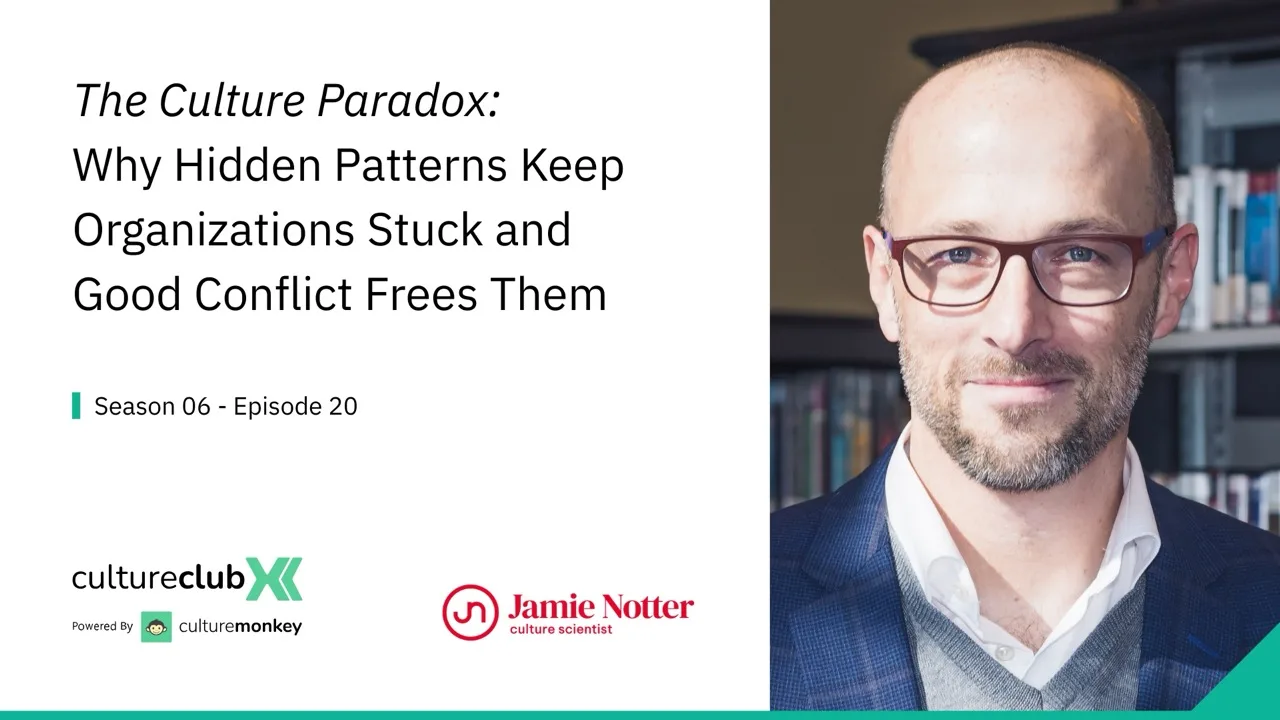
S06 E20
Why does culture change stall? | Jamie Notter, culture scientist
Culture change stalls because every stated value has a competing commitment quietly cancelling it, says culture scientist Jamie Notter. A company commits to collaboration and also to departmental autonomy, and the second creates silos. The way out is better conflict: the right issues handled by the right people at the right time.

TL;DR
What you need to know from this episode
- Culture work stalls on competing commitments, not on effort. Every organisation wants collaboration and also wants departmental autonomy. Push hard enough on the second and it produces the silos nobody says they want. The same shape sits behind almost every value an organisation claims. As Jamie puts it, if you misdiagnose the source, all of your solutions fail.
- Four patterns show up again and again in the data. Collaborative individuals inside uncollaborative groups. Incomplete innovation, where the concept is valued more than the practice. Heavy agility, where nothing is ever stopped. And lagging transparency, where sharing is reactive and information arrives too late.
- The incentives produce the opposite of what leaders ask for. Experimenting in secret feels rational when a failed experiment gets a raised eyebrow and repeating known work gets a well done. Jamie has seen three departments build AI prototypes on the same data in isolation, six months of duplicated work that a single conversation would have prevented.
- Conflict and change are the strongest correlated pair in the dataset. Of sixty-four things measured, managing conflict and embracing change track together more closely than anything else. Bad conflict is not shouting, it is a senior team spending an hour on email wording while the strategic conflict underneath goes unnamed.
- Build the conflict system deliberately, because you already have one. Capacity is the floor, processes and governance rules are where the effort belongs, accountability comes last. The cheapest version is a standing agenda item asking what conflict is not being talked about, or a dissent agenda placed second on the agenda so there is time left to resolve it.
Jamie Notter is a speaker, author, consultant and culture scientist. He started in conflict resolution, took a master's in conflict analysis and resolution from George Mason, worked internationally for six years, then spent twenty-five years running his own consulting firm. He also holds a certificate in organization development from Georgetown, where he served as adjunct faculty.
The turn to culture came from frustration. He kept hearing that culture was vague, squishy, too complex to understand and slow to shift. One CEO told him it takes a minimum of eight years to change a culture. He disagreed, built a definition he could actually manage against, and in 2016 co-created a culture assessment with his partner Maddie that has since gathered more than a million data points.
What that data shows is the premise of this episode. Culture work stalls for a reason most leaders never see, because it is invisible from inside the organisation. And the fix is not more collaboration or better values. It is conflict, done properly.
What are competing commitments, and why do they stall culture work?
Every organisation Jamie visits wants collaboration and believes it is essential. What they also have, and do not name, is a competing commitment to the autonomy of subgroups. Marketing should get to make marketing decisions. That is reasonable, and pushed hard enough it produces exactly the silos everyone says they do not want.
He offers a personal version of the same shape: you are committed to a full life and you are committed to doing well at work. Both are fine. Push too hard on the second and things quietly fall on the first. The organisational version is no different, and the consequence is that leaders misread the symptom as a person. Jamie is bad at collaborating. Those two departments do not like each other. As he puts it, if you misdiagnose the source, all of your solutions fail.
What are the four patterns that keep organizations stuck?
The assessment measures eight things, and there is a pattern for each. Four come up most often, and they are the ones where clients look at the data and say that is us.
Collaboration. Organisations genuinely value collaborative individuals. Helping each other one to one is present and real. Collaborative groups are much less present, and that imbalance is invisible because you can see people collaborating everywhere.
Incomplete innovation. Cultures value the concept of innovation more than the practice. Creativity and thinking about the future are fully there. Running an experiment that might fail is not, because the competing commitment is appearing competent. You cannot have the right answer all the time and also innovate.
Heavy agility. Valuing moving forward and valuing quality, but never stopping to fix or retire what no longer adds value, so everything gets dragged along.
Lagging transparency. Reactive sharing is valued, proactive sharing is not. Ask and you will be told. Nobody puts the information out before you need it, so it arrives too little and too late.
What is gridlock, and which AI experiments does nobody mention?
The gridlock metaphor is a driver edging into a junction on a yellow light. Every individual decision felt logical and in your own interest. Together they produce an outcome nobody can move through.
Jamie's current example is AI. Every department is running its own experiments and telling nobody, because admitting an experiment failed reads as a risk while repeating what you already knew how to do gets a well done. He has watched three departments separately build AI prototypes on the same data, then arrive at IT one by one to have it built properly, at which point IT points out it is one tool, not three, and they should have been talking six months earlier. Six months, as he puts it, is a long time in AI years.
What is the difference between good conflict and bad conflict?
Conflict is not the failure state. There is no relationship on the planet that does not have conflict in it, and conflict is how creativity, new ideas and growth happen. Adults only develop by hitting the gap between how they see the world and how it is, and resolving it.
The data backs the link. Across sixty-four things measured in the culture dataset, the two with the strongest correlation are managing conflict and embracing change. You do not do change if you do not do conflict.
Good conflict is the right issues dealt with by the right people at the right time, resolved well. Bad conflict is not shouting. It is a senior team spending an hour debating email wording, which is an hour spent avoiding the strategic conflict underneath it. It is also a senior team resolving something that will be implemented by a department that was never in the room.
How do you build a conflict system?
Every organisation already has a conflict system, in the same way every organisation already has a culture, whether anyone designed it or not. There is an inherited set of processes and unwritten rules deciding which conflicts get aired, by whom, and when.
Jamie's design has four layers, and he is clear about where the effort belongs.
Capacity is the floor. Skills and training, and the easy answer most people reach for first. Do not raise a conflict you have no capacity to hold.
Processes are where the work is. Build a step into product development that forces a conversation with sales before it is too late to solve. Put a standing item on every team agenda: what is the conflict we are not talking about.
Governance rules decide routing. Write down that a conflict with a ten million dollar impact goes to the management team, or that if ninety percent of implementation sits with another department, that department is in the room. Write down that the senior team handles conflicts with strategic impact, so somebody can flag the hour being spent on email wording.
Accountability comes last, once the system exists, to check that resolutions are fair and no department is quietly favoured.
The clearest example is borrowed from a friend who works with nonprofit boards. Boards use a consent agenda to move the routine items in one block. His friend's response was to add a dissent agenda as the very next item: name the biggest conflict we need to have, second on the agenda, so if it takes the whole meeting there is a whole meeting left.
What is the one action to take in the next 90 days?
Convene the senior team, and do not have a high-level conversation about culture. Facilitate one where they identify the behaviours they are engaging in that are the opposite of what they say they want.
That is where culture dies, in the contradictions. A team commits to a culture where conflict is welcome, and one of them has a star salesperson who steamrolls everyone, who nobody will challenge, and who keeps getting rewarded. Jamie's view is that culture belongs on the senior team's agenda once a quarter, with the people leader facilitating, because the senior team will not do the work of culture change but nothing survives without them behind it.
What should listening platforms be measuring?
Start with what is, not with the ideal. Plenty of organisations define their ideal culture and set off towards it without establishing where they are standing, and you cannot move towards something if you do not know your position.
His advice on the data itself is specific. Satisfaction data asks whether people are happy. What he wants is where people felt thwarted, where they could have done better and did not. The core message of his engagement book is that engagement is not driven by happiness, it is driven by success, so the useful question is where success is breaking down.
He tells one story about a company that got red scores on agility and responded with an agility task force, which produced a slide deck whose last slide read do not just say you are agile, be agile. The score told them where to look. It did not tell them what to do, and nobody went and found out.

About the guest
Jamie Notter
Speaker, Author and Culture Scientist, JamieNotter.com
Jamie Notter is a speaker, author, consultant and culture scientist who has spent his career helping organisations get out of their own way. He holds a master's in conflict analysis and resolution from George Mason and a certificate in organization development from Georgetown, where he served as adjunct faculty.
He worked in international conflict resolution for six years before moving inside organisations, and has run his own consulting firm for twenty-five years. In 2016 he co-created a culture assessment that has since gathered more than a million data points, and he is the co-author of four books, including the award-winning Non-Obvious Guide to Employee Engagement and Culture Change Made Easy.
Full episode transcript
Season 06, Episode 20 · Jamie Notter with Darcy Mehta · 42 min
Hello everyone and welcome to season six of CultureClub X, powered by CultureMonkey. I'm your host, Darcy Mehta. CultureMonkey is an AI-powered employee engagement platform that helps people leaders listen to their employees and build stronger workplace cultures.
CultureClub X is our global thought leadership forum where CHROs, business leaders, and workplace experts share practical insights. Discuss emerging trends and exchange proven strategies for building high-performing organizations. Today we're so delighted to welcome Jamie Notter, speaker, author, consultant, and culture scientist at JamieNotter.
com. Jamie, welcome. It's a pleasure to have you here with us.
Thank you, I'm excited for this. Yes, so am I'm looking forward to our discussion. So Jamie has dedicated his career to helping organizations build healthier workplace cultures by Understanding the systems that shape behavior, collaboration, and change.
He is the co-author of four books, including the award-winning The Non-Obvious Guide to Employee Engagement and Culture Change Made Easy. Through his research and consulting, Jamie helps leaders uncover the hidden patterns that influence organizational performance and equips them with practical strategies to navigate conflict and drive meaningful culture change. Jamie, your work has consistently challenged leaders to look beyond surface level culture initiatives and uncover the hidden systems that truly shape how organizations perform.
And that's why we're so excited to have you join us for today's top conversation: the culture paradox, why hidden patterns keep organizations stuck
and good conflict sets them free.
Before we dive into today's discussion, could you just share a little bit about your own leadership journey and what inspired your focus on workplace, culture, conflict, and organizational change? Yeah, so I actually started my career, and I hate to say this, 30 years ago in the conflict resolution field. I got a master's degree in conflict analysis and resolution, which is not too common.
And did that work internationally for about six years before transitioning into doing work inside organizations. And I quickly learned, again about twenty-five years ago, that Maybe there was a reason I always hated my boss, and maybe I actually wanted to run my own thing. And so I started my own consulting company twenty-five years ago and have been doing it ever since.
The shift to culture happened in the map the last ten years or so, and it was originally inspired I was basically frustrated with the narrative around culture that it's vague and it's squishy and it's too complex to understand and then and changing it takes forever. I heard a CEO say, it takes a minimum of eight years to change a culture. And I'm like, no, it doesn't.
And so I kind of challenged myself to say, all right, I think it's actually pretty clear and tangible. So I came up with a definition of culture and sort of started from there to say, look, this is something that we can manage like we do finance or IT or anything else inside our organization. should be doing that.
And so that led to a culture assessment that my partner Maddie and I created in 2016. And really since then I've been nonstop on showing people what's going on inside their culture because they think they know what it is, but they once they see the data, that changes their mind. and then actually coming up with concrete plans to fix it, to change it, to move it in the right direction.
Wow, it's fascinating to see how your work and career has evolved. I'm always love finding out how people get into things and you know, like you said, becoming your own boss. And, you know, I definitely understand that as well.
And you're right about culture being very, you know, what is it? And it's that word is thrown around so much, isn't it? So, no, thank you so much for sharing.
Well, let's just dive right into our first question. So, what is a hidden culture pattern? And why do most leaders keep investing in culture without ever seeing the real problem?
Yeah, so the culture patterns that emerged in my research are basically rooted inside competing commitments in organizations. We have a commitment to a certain thing we want to have happen, like collaboration, for instance. And then we have a competing commitment that ends up getting in the way.
So these competing commitments make it impossible to have our cultural values lived either fully or as intended. Right. So we every organization I go to wants collaboration.
They think it's super important. They can't survive without it. We need more collaboration in our culture.
And they really do believe and have that as a value. The competing commitment part is they also actually have a strong commitment to the autonomy of subgroups. We want our departments to have autonomy.
That makes sense. If you're the marketing department, you should be able to make marketing decisions. But we push too hard on that autonomy and it generates behaviors that make the collaboration more difficult.
This is why we have silo issues inside work. Organizations. We say we don't want them, but we actually value that autonomy so much that when I told this other department I'd help them, and then my boss comes and says, But we have this priority we need to do right now, I drop the other person and I go with what my boss says.
And it I don't realize that I'm making collaboration across groups much harder by valuing that autonomy, but that's what's going on. And so the second part of the question is like, why do we keep Like not moving the needle on culture, it's because we don't see that we are setting ourselves up for failure, right? We don't see that we I mean, I don't know.
The personal example of this is like work-life balance, right? Like you have a commitment to having a full life and you know, being whole and healthy and all that stuff. You also have a commitment to doing well at work.
And those are both fine. But if you push too hard on the work one, you start letting things fall on the life one, right? So this is something where.
we don't realize that we're engaging in this behavior or valuing something that is gonna push us in an opposite direction. It's actually very common in humans. We do this all the time.
but that's what I started to see in the data is like, there's one of these competing commitments for almost everything that you say you value inside your culture.
Huh, that's so fascinating. I that's really interesting just yeah, analyzing that. And so it's coming up with a balance, right?
I mean, like you said, having, you know, departments be autonomous, letting them focus on their work, that's important. But when it's pushing against collaboration and making collaboration more difficult, that's when it becomes a problem, right? So it's kind of recognizing that first of all that's happening.
No, and then what leaders do is like they see that I dropped the ball and didn't help this other department and that it becomes a personal thing. Like, Jamie's not good at collaborating, or you know, these departments don't like each other. And like that's not it.
and we don't sort of realize what the source of it is. And again, like anything, if you misdiagnose what the source is, all of your solutions fail. Right.
And so that's what's going on. Mm-hmm. No, definitely.
okay, so your research has analyzed more than one million data points from culture assessments. So, you know, talking still about patterns, what are the most common patterns keeping organizations stuck? And why are they so difficult to recognize from the inside?
Yeah, so c the collaboration one is this th I call them the big four. It's collaboration, innovation, transparency, and agility. These are things that most organizations say they want at least some of.
Like some value innovation more than others, that's fine, depends on what you're doing, but almost everybody wants more innovation, more collaboration. And the collaboration pattern in the culture data is that we absolutely value collaborative individuals. Like helping each other out on a one-on-one basis is super important and it's very present inside cultures.
What's not as present is collaborative groups. And that sort of territorialness and boundaries and silos and even hierarchical distinctions. Like it's we have a tough time when the middle layer needs to collaborate with the senior layer.
Right? Like and the data shows that It's not that collaborative groups don't exist at all. It's just not as present as the collaborative individuals.
And that sort of creates the imbalance. And why that's hard to see is because you see a bunch of people collaborating. Right.
And you ask people, we do you value collaboration? Absolutely. And they do.
They just don't know that this pattern's going on that's getting in the way of that group collaboration. The other three have sort of similar dynamics. Innovation was probably the very first one I saw in the research.
Organizational cultures value the concepts of innovation more than the practices. Right? We talk the talk and we don't walk the walk.
I mean, we do some, but like we value creativity and thinking about the future. That's a hundred percent there. But when it comes to running an experiment that might fail, we don't do that as much.
We don't beta test things. We don't take something unfinished and show it to a stakeholder or a customer because we don't want to look bad. Right.
The competing commitment there is about appearing competent and having the right answer all the time. You can't have the right answer all the time and do innovation because you got to try new stuff. That's how it works.
And so w again, we say we value innovation. And if you ask people, they will absolutely say they do. They just don't realize that there's some pressure on them to have the right answer, which means they're not gonna experiment.
Or if they do it in secret, right? So that it doesn't come out. Which actually contributes to the silo problem because everyone's doing their experiments in secret.
and so it these behaviors show up that make innovation harder to achieve. Right. So I call it incomplete innovation.
The agility one is about valuing moving forward and valuing quality, but never stopping to fix things, or stop things that are no longer adding value. So it's I call it heavy agility 'cause you're way dragging all this stuff that you can't get rid of. And transparency is called lagging transparency.
We value reactive information sharing, but not proactive. Right? If you ask me, I'm happy to share.
Of course, we're transparent here, but I'm not actually putting information out there that you can have before you even need to ask. And that means we're usually too little, too late with information. So lagging transparency.
So there's actually eight, because we measure eight things in our assessment and there's a pattern for each one. But those are like the big four, the ones where when I show the pattern to the client, they're like, that's us. Like, wow, we totally do that, don't we?
I'm like, Yes, you do. So and then they realize, well, this is why we're so frustrated with X. This is why we're not achieving this, you know, goal around innovation.
And so that's the whole purpose about culture being a tangible business tool. If you fix those, you don't necessarily fix those patterns, like you said, if you bring them into balance. And shift the behaviors towards the ones that you know are gonna make you successful, then like that's not that hard to do and it can happen fairly quickly, and that's culture change.
That's amazing. I mean, that's why organizations need you, right? Just to point it out.
To, you know, like you said, it's like you're they're valuing those things and the concept. And I completely was thinking about that when you're talking about innovation. You know, it's it is so like, yes, let's create.
But you're right, there is that hidden pressure of, well, we have to be right. We have to show the client, you know, here's the perfect version of something. And then there's not that time if the time is not given or the, you know.
value put on taking that time to innovate and everything. So I thought that's really interesting. And then like you said, that contributes to the silo effect too, because people are doing it in secret.
So yeah, found that very interesting. So you argue that culture actively incentivizes employees to behave in ways that create organizational gridlock. How do these hidden culture patterns contribute to that gridlock and what other factors make it even harder for organizations to move forward?
Yeah, the you know, the gridlock metaphor isn't a hundred percent accurate here, but it's the idea in traffic gridlock of you're at that yellow you're at that light and it turns yellow and you just want to get home. Mm-hmm. And so you sneak ahead and try and get through it and then you block the box and if a bunch of other people are doing that, you've literally created gridlock, no one can go anywhere.
So it's the idea that Your decision seemed logical at the time. It seemed like it was in your best interest to do it. And then it ended up creating a s an outcome that was very bad for you, right?
So that is what happens in cultures and it's related to the competing commitments. Like that innovation example is a good one. It's like When I decide not to share my experiment, it's because it feels like it's in my interest to do that because I want to be the smartest person in the room.
I don't want to go up in front of my peers and say, I tried something and wow, did it not work? Right? That seems against my interests.
So I choose to do it in silent. And I see this one around AI right now all the time. Every department is doing their own AI experiments and they're not telling anybody what they're doing.
So they have these incentives in our culture, which is, and this is where leaders actually have to pay attention. What do leaders say when someone says, I'm not sure this is going to work, but I'm going try it anyway? Or I did it and I it did not go as I planned.
I did learn some things, but it really didn't produce the results I was hoping for. If the leader's like, well, this is a problem and we need to up our game, right? And even if they're not as like visceral about it, Just the words they use to react to that versus reacting to someone that said that I tried I did something that I already knew how to do and it worked perfectly.
Good job, Jamie, right? So we provide these incentives to for me to do this behavior where I'm experimenting with AI in secret. And I've seen this in organizations where di three departments all build AI tools on their own, or at least prototypes of them.
Mm-hmm. And then they all go to IT and say, Well, these are working, so I want you to Build this for me. And IT says, folks, these three things all use the same data.
This is one thing. Uh-huh. Right?
Not three. You should have been coordinating six months ago. but because we're incentivized to keep it secret, we just wasted six months' worth of work.
And six months in AI years is it's like dog year. Like that's that puts you behind 10 years at the speed that things are going. So we don't see that we're incentivizing behaviors that deliver the opposite of what we want from our culture and the results that we want.
Mm-hmm. So I mean, it absolutely comes from leadership, right? And comes from the top down because if you feel valued that you can try something and say that it didn't work.
But I mean, obvious it seems so obvious, doesn't it? That of course you're gonna learn something from everything you try and you know, maybe what you were aiming for doesn't work, but you discovered something new or you discover why. So it just it seems so obvious, right?
But it's talking about it's recognizing it, and it definitely comes from leadership and the traffic, you know, was a good example. As well. It's like taking that shortcut, but when everybody does it, obviously that creates gridlock and everything.
So yeah, very interesting. So most organizations treat conflict as something to eliminate. You argue it's actually the upstream solution to innovation, retention, and meaningful change.
So what's the real difference between good conflict and bad conflict? Yeah, I would probably add too, I think conflict contributes to gridlock in a similar sort of way. We're kind of incentivized to avoid conflict, to downplay it, to not want to elevate it because we feel like it's a problem.
And in the end that's gonna cause lots of problems for us. Like Again, I have a master's degree in conflict resolution. I did it internationally.
I worked on the island of Cyprus where the Greek Cypriots and Turkish Cypriots have not been getting along for the last five hundred years or so. Wow. And I've s and I've studied it from a theory basis.
And when you study conflict, the first conclusion that you draw is that it's a good thing. That we need conflict. There's no relationship on the planet that doesn't have conflict in it.
Mm-hmm. I mean, a psychologist would argue if you've got one person in the room, you've got conflict. but every social system has conflict, every biological system has conflict is actually how you get to things like creativity and new ideas and growth.
Human beings don't grow unless they realize that there's some conflict with how they see the world and how it is. If you don't Absolutely. resolve that conflict, you stay where you are as an adult in terms of development.
But if you're like, wow, this is new data. I think I need to change my view of the world. Here's my new synthesized view of the world.
That's actually conflict resolution, and that's the only way we grow as adults. And so if you think about a workplace where there's no conflict, I ask people to do that when I do training. I'm like, what would it be like if there was no conflict here at all?
And they realize it would be really boring. Like nothing would change. Right?
Like it, I mean, I've known the link between conflict and change a long time because of my studies, but in the data that I have, the culture data, you measure sixty-four different things. The two things with the strongest correlation are managing conflict and embracing change. Right?
You don't do change if you don't do conflict. those two things go together. and so part of my challenge in my thirty year career is this is trying to help people like do conflict better.
And so that's what I mean when I say good conflict is just the right issues being dealt by the right people at the right time and coming up with good resolutions around it. And we all have experience of that. Bad conflict is like the senior team spending an hour debating email language.
Now they can have a conflict about the email language and they can resolve that conflict. It's not good conflict because you just spent an hour where you were avoiding a huge strategic conflict. Right?
You've got conflict where the senior team is making decisions and resolving a conflict that's going to be implemented by some department that's not good conflict because the people who are going to implement it should have been a part of that conversation. Right. So we spend a lot of time like bad conflict is not just yelling and screaming and, you know, divorce, you know, angry people.
Like that exists too, but that's not what I'm talking about like spending our time trying to resolve a conflict than spinning our wheels. Mhm. Right?
Spending our time on the wrong things, and putting energy into the wrong things and s we have a system inside our organizations that often pushes us towards that bad conflict stuff. And we don't even it's again it's kinda like the guy I applied some of the same culture thinking to conflict inside organizations, which is we don't even realize that we have a system that is pushing us in this direction. just like a lot of people didn't realize they had these culture patterns.
And so I think that's part of my current work is really trying to pull that stuff apart and say what's What is the essence of good conflict and how do you create a system that makes it happen?
That's actually really yeah, fascinating. I think I would have enjoyed studying that as well. And it must be so, you know, to have you must have such a unique perspective, like you said, studying, you know, working in this internationally and, you know, with, you know, different cultures and people and you know, and then bringing it into the workplace as well.
And obviously we have conflicts in our, you know, personal relationships too and everything. And it's funny as you were talking, it had me thinking, I always try to adhere to the idea that you know, it's good to be uncomfortable and it's that change is often uncomfortable and that's, you know, because it's change, but do good things always result? You know, is that's how you grow, that's how you create and we have to be uncomfortable.
If you find yourself too comfortable, it's because you're avoiding that change and growing and you know, it's the same thing with conflict as well. You know, you don't avoid it but learn how to do conflict better. So Yeah, there's not a version of like really successful organizations that do amazing things where it's easy all the time.
Right? Like that would be weird to think, well, of course, it's just gonna be easy that this happened. And it's not gonna be easy, but it I will say that organizations that do amazing things tend to be the ones that don't tolerate that conflict lying under the surface for months or years.
And they figure out ways to get to the other side in a productive way.
Mm-hmm. Yeah, it makes perfect sense. So, okay, so it gears a little bit.
Research suggests that burnout continues to be a major workplace challenge, yet many organizations still treat it purely as a well-being issue. How does unresolved conflict quietly fuel disengagement and attrition in ways leaders often overlook?
So I mean the burnout crisis is huge. And I me we have those numbers that like you shared, but it's not just that it's up. I think it's like a generational thing.
Like I think we are shifting to perpetual burnout because the world has moved from complicated to complex. Like it is faster with AI and all the stuff that's going on in the world, everything is changing faster. And in ways that is not linear, you know, it's not like it in the I'm like I joke, like I'm from the nineteen hundreds.
Right? Like I'm an old guy. Like it used to be easier to track causation or here's what's happening and here's how we got to where we are.
It's harder to do that now. And I think Part of our channel, there's two parts to the challenge here, which is in organizations today, individuals need to figure out how to stay coherent in the middle of uncertainty. Like we gotta know, and we're not used to providing that for folks.
I think at the group level, we need to be able to face the our reality together and sort of define it jointly moving forward, which we didn't have to do. It was kind of obvious what our reality was. those two things, sort of maintaining coherence for individuals and having groups being able to come up with a shared picture of what's going on, require conflict.
Right? If you push the conflict under the rug, then I'm sitting here as an individual not knowing that if my job is gonna be replaced by AI or not. And I don't know what I need to do to prevent that from happening or to make that happen and have it be good for me.
I don't have that coherence because I'm not talking, my leaders aren't talking to me about what they're going to do with AI. You know what I mean? Like we have to confront these conflicts and deal with it.
And if we don't, then I get stressed. Right? I get burnt out.
I try too hard or I spin my wheels in the wrong directions. And again, if we're not having that shared picture of what's going on and what are the like we talk about roles and responsibilities in organizations and how that's not clear when roles and responsibilities are not clear, that creates burnout too. That creates what researchers call cognitive load.
Right? I can only handle so much stuff in my brain before I get burned out. I just I don't think we've realized that the roles and responsibilities used to be like, well, what's the role of the marketing department?
Now we're having conversations, what is the role of humans in our organization? Right. This is that's the level that's complicated to complex.
Right. And in that environment, what I'm seeing is that I mean, this is not a surprising conclusion. Most organizations are pretty bad at conflict.
They just don't do it well. I don't blame them. I have a master's degree in conflict resolution.
You can get three PhDs in other fields and never study conflict at all. Never get any skills. So I think we're a little under prepared for this.
but I think those Our inability to have those tough conflict conversations and have them work through to a side the other side where we're like, Okay, we have a plan moving forward is what is really contributing to the burnout right now because it's not addressing the kind of existential crisis that we're in. Mm-hmm. It does also come down to communication, right?
At its essence and transparency too, which creates the trust, which is not sweeping things under the rug, it's addressing it's being more clear, like you said, about roles and responsibilities and you know, all of that contributes to then not feeling overwhelmed and you know, when the employee understands what's going on too and where they
fit in with everything. So okay, so this is kind of still talking about conflict system.
You've said every organization has a conflict system. Even if leaders don't recognize it. So, what does a healthy system look like?
And where should CHROs begin if they want to build one?
Yeah, I think again, I applied some of the culture thinking to this. Every organization has a culture whether you've tried to build it or not. Right.
There's a there's there is a collection of words and thoughts and actions and behaviors that communicate to your people this is what's valued in our culture. And the again, the smart ones are intentional about that and clear about that, but even if you're not, you still have it. Same with the conflict system.
There is a set of processes and rules in your organization that determines which conflicts get aired and who gets to talk about them and when they're addressed and how they are talked about. And no one designed that system on purpose. Right?
Everyone is a has inherited this system that they didn't even know they had. a good system like do generates the opposite of what I said I just said. The right people, the right issues are dealt by the right people at the right time.
in the right way and generate sort of fair resolutions around it. So those are your outcomes that you're shooting for in your conflict system. If you want to design one that produces those outcomes, I'm arguing there's four things you need to look at.
Number one is capacity. Like I said before, we need to be better at dealing with conflict. We need to have skills and you should get training and like that's kind of the easy answer.
That's the go-to, the level one. Where it's more challenging, I think where or leaders need to spend most of their time right now is on processes and governance rules. So processes are specific processes that you can put in place, not just to have a conflict.
Like you can actually create a process that says, hey, if we have a conflict, we're gonna bring in a facilitator and we're gonna have this conversation and it's gonna flow like this, and here are the ground rules. Those are all good process sort of issues to deal with conflict. I mean like If you're building and if you're developing a new product, you have a sort of standard operating procedure for product development and stages that it goes through.
At some point you need to add a process that says check with sales to see if this product is going to cause them problem. Or who do you need to check with and ha and sort of have a conflict before it gets down the road when it's too late to solve? Right.
So you can actually create processes that enable conflicts to happen at the right time. You know, and I mean simple examples of like any team meeting, you should have an agenda item that says, What's the conflict we're not talking about? You know what I mean?
Like it sounds sort of silly, but if you actually built that in, people would say, Well, actually I've been worried about this product and what sales is gonna think about it. You know, let's talk about it and have that conflict out and then realize we need to talk to sales. Like whatever it is, you can add agenda items, you can create simple process changes that kind of force people to have conversations.
That will at least unearth the conflict. And then the governance rules are often about how conflicts get rooted. So when does this conflict get kicked upstairs?
Like you can actually create some guidelines or principles or specific rules that say if this conflict is gonna have a $10 million or more impact on our bottom line, it goes up to the management team. Right? It's above our pregrade, we shouldn't be doing it.
If 90% of the implementation of what we're talking about involves another department, they need to be brought in. You know, or the senior team example I gave. Somebody on the senior team, if they're spending an hour arguing about email language, someone needs to flag their governance rule that says, Hey, we made it clear that at the senior team we want to have conflicts that have strategic impact.
This is not one of them we need to change the topic. Right. And so that's making sure that the right issues are dealt with by the right people.
And you can actually write down governance rules that will guide people in doing it. And it'll be a bit of an experiment. You'll write some rules and then some people won't use them and you'll have to figure out how to fix that.
But better to do try something and get it going than sort of waiting until it's perfect. The last, so those two are the most important ones. The last piece is accountability systems.
That's after you've already built a really clear system, you actually have to build other pieces to it that ensure that the resolutions are fair, that one department's not getting sort of unfair bias in our resolutions that you know, that we're practicing what we preach, that kind of evaluative piece needs to happen, but you gotta have a system in place before you can do that. So I usually leave that one off. It's really the processes and the governance rules that I think can make a big difference.
Mm-hmm.
Absolutely. You'll get to there at the end. But I mean it the most important thing is starting,
right? I mean, it sounds very doable and these are already great actionable items. So thank you for that.
And you broke it down so well. And I love the idea of just adding that to the agenda, just by putting that out there, that bullet point, it makes you think, is there a conflict? What is the conflict?
So right there, right, that's already making progress. So Yeah, I've got a friend who does a lot of work with nonprofit boards of directors. And boards of directors usually use something it's called the consent agenda.
It's like when they have to approve the meeting minutes and the committee reports and all the boring stuff. You just put it in one agenda item, it just saves you time. And it's called the consent agenda.
And my friend immediately said, That's great, we're gonna do the consent agenda. The next agenda item on every board meeting should be the dissent agenda. Which is what is the biggest conflict that we need to have because we only meet once a quarter or whatever it is.
that so that we don't waste our time. And it's just again, it's a simple process change, but it's like we have to name a big conflict every time we meet and work through it. And it's the second item on the agenda so that if we need the whole meeting for it, we've got it.
so that it requires being intentional and again, being able to do that does require the capacity piece. Like Don't raise the conflict if you can't if you know the c the conversation's gonna go south every time. So the capacity piece is kind of like the floor.
You gotta build that foundation and then work on the more advanced stuff.
know that like w we are open to talking about this and we have a way to potentially fix this and to deal with it and everything. So I used to work with a lot of nonprofits, still do too so definitely understand,
you know, the board of directors and things. So okay, so I love this question because it kind of forces you to, you know, give me one thing. So what is the one non-negotiable action?
Every people leader should take in the next 90 days to break free from hidden culture patterns and create the kind of healthy conflict that drives better performance.
Well, I mean, my gut was to go back to something that you said earlier, which is that this comes from the top down. And The top-down thing is a little more complex than that. Because the top doesn't actually drive culture or conflict systems 100%.
Like it's gonna require other people. but I had a friend of mine, a CEO friend of mine, said, Yeah, I can't drive culture from my seat because it's it exists everywhere. She said, But I can kill it in a heartbeat.
And so Yeah. the number one thing to do is the people leader needs to convene the senior team. And I'm hoping that the People leader is on the senior team.
If not, they need to convene the senior team and have a conversation, not high level about culture. I mean it'll include some of that,
but what is but about the what is our culture right now? And how are we living it? And then the big this weaves in some of the conflict.
I want you to facilitate a conversation with the senior team where they can identify the behaviors they are engaging in that are the opposite of what they say they want in the culture. Like those contradictions, that's how the senior team kills culture. Just by saying one thing and doing another, by saying we only, you know We have a culture where we want to have our conflict, where we believe it's important and we're committed to that and we're gonna support that.
And they all believe that's great. And then one of them has their star salesperson who steamrolls everybody and doesn't ever and everyone's afraid to have conflict with them. And that person gets rewarded and rewarded.
That is the opposite of what you said you wanted in your culture. And we gotta start paying attention to how we're supporting that. it's kind of the first layer of getting at the sort of hidden patterns or the contradictions inside your culture.
And the senior team has to be able to have that conversation. and I mean in my view, you the senior team should be should have culture on their agenda once a quarter. And a little bit of what are we, what's going on, what do we need to address?
What are we doing that's getting in the way? Like they need to be having that conversation and the people leaders should be facilitating that. again, you can have a similar conversation around conflict.
but I would start there. I would get them behind it because they're gonna have to reinforce whatever you do later. Right?
Like if you decide, wow, we need training, like the like good news is people leaders get training and they're good at doing that stuff. And so they're probably already doing conflict resolution training, so maybe that's easy. But if they weren't When they roll it out, you gotta have the senior team saying, We're so excited about this rollout because conflict is so important.
And if you haven't had that conversation with them, that's not what they're gonna say. So it's about the communications mostly around it, but the consistency. And so it that's where it starts.
Like they're not gonna do the work of culture change, senior team. they're not gonna do the work of building your conflict system. people leader will probably be more in charge of that.
but you need to have them on your side, otherwise gonna.
To say, you know, look, this is important. You know, what do you feel about it? Where is it?
I'm gonna spearhead this, but and like you said, it's consistency, it's not a one-time conversation, it's at least a quarter checking in. So no, that's a great answer. So thank you so much.
That's very something everyone can go do right now, right? So how can real-time employee listening platforms like CultureMonkey help organizations uncover hidden culture patterns and identify conflict signals before they turn into disengagement?
And attrition. I think I mean I think my big emphasis around culture is starting with what is and starting with the reality and not the ideal. Everyone wants frequently wants to say, let's come up with our ideal culture and then let's move towards that.
And that is well meaning, but ineffective because it's not ex is you're not explaining where you are. You can't move towards something if you don't know where you are. And So there's nothing wrong with thinking about ideals.
That's fine with me. But if you don't have the what is piece, then you're off. And I think listening platforms are great for getting good data on what's going on.
And not, you know, when the boss goes and talks to the team, well, how's our culture here? They're gonna get different answers than what you hear in anonymous surveys or, you know, other ways that you can gather data now from employees, which is I'm excited actually as a culture guy that these Tools are getting better, right? And sort of proliferating, because I think it's really important.
My advice though is to make sure you are gathering data in those systems that focus on where people are successful or unsuccessful. And I feel like we do a lot of satisfaction data collecting. Are you happy?
Do you are you pleased with this result? Is this a good thing? It's all good, bad.
And I mean, success and lack of success is also good, bad. But what I want to look for is when did people feel thwarted by the system? When did they feel like they could have done better and they didn't?
If you can start looking at that and then find the data around that and the sort of sentiment around that and the experiences around that, then you're gonna start to get a little bit clearer that there might be a pattern going on there. Right? Like What is where did we fall short?
Like I wanna be gathering those data because on this is, you know, the non-obvio to employee engagement book, the core message from that book is that engagement is not driven by happiness. It is driven by success. People who are successful in their role, work for successful organizations, and feel like they're being successful as a human being are the most engaged employees on the Mm-hmm.
And so you need to look for where that's breaking down. And again, I feel like it's real easy to say, ooh, we got red scores on this, the whole red, yellow, green thing. people aren't happy about this.
They don't like it. They don't think we're doing agility well. Mm-hmm.
I don't like that's fine. I probably could have told you that. Agility is actually the lowest scoring in our data set.
I wanna know where agility is messing where lack of agility is messing with their success. Mm-hmm. Because that's where you're gonna sort of find the actionable items.
I worked with a big corporation years ago that did an engagement survey and they got red scores on agility. And so they created an agility task force that created an agility task force slide deck. And the last slide was remember, don't just say you're agile, be agile.
And I'm like, what does that even mean? This is not about agility. This is about Hey, you need to learn how to stop your programs that are no longer working.
Right? You need to fix things that are broken so that we're not redoing everything all the time. That's why we can't be agile.
And that's letting the customer down. Right. Like you got to get down to that level.
and I again I think there's a huge opportunity with listening software to get to that stuff, but it's gonna require, I think, some work on the front end, on the administrative end of those platforms. to make sure we're collecting the right data and asking the right questions.
It is exciting, like you said, that we have these, you know, these tools now. And, you know, right, you can't fix something or move towards something if you don't know where you're at right now. So no, I mean, I could keep talking to you all day and I just love I th I find the conflict and change and all that so interesting too.
So, you know, thank you so much, Jamie. And today's conversation was a powerful reminder that culture isn't just defined by values written on a wall. It's shaped by the everyday patterns.
Behaviors and conversations that influence how people work together. And as you've shared today, organizations that learn to recognize those hidden patterns and embrace healthy conflict are far better positioned to innovate, adapt, and grow. And that's where continuous listening becomes so important with real-time employee feedback and pulse surveys.
Platforms like CultureMonkey can help leaders identify emerging culture patterns. detect areas of friction early and create an environment where honest conversations lead to meaningful action rather than disengagement. So before we wrap up, Jamie, how can our listeners connect with you to continue the conversation or learn more about your work?
So my website is quite simply JamieNotter. com. I would also point people to my Substack newsletter, which is jamienotter.
substack. com, because that's where my content is.
Okay, amazing. I'm definitely gonna check it out and connect with you. So thank you again and to all our listeners, thank you so much for joining us.
If you enjoyed today's conversation, don't forget to follow, share, and subscribe. And that's a wrap for this episode of CultureClub X Powered by CultureMonkey. I'm your host, Darcy, signing off.
Frequently asked questions
What is a hidden culture pattern?
A competing commitment that quietly cancels a stated value. An organisation commits to collaboration and also commits to the autonomy of its departments. Both feel reasonable, and the second one generates behaviour that makes the first harder, which is where silos come from. It is hidden because you can see people collaborating everywhere, so nothing looks wrong. Leaders then read the symptom as a personality problem or a departmental feud, and every solution built on that diagnosis fails.
What are the four patterns that keep organizations stuck?
Jamie's assessment measures eight things and finds a pattern in each, but four come up most often. Collaboration, where collaborative individuals are strongly present and collaborative groups are not. Incomplete innovation, where the concept of innovation is valued more than the practice of running an experiment that might fail. Heavy agility, where the organisation moves forward without ever stopping or retiring anything. And lagging transparency, where sharing happens on request rather than in advance, so information is consistently too little and too late.
What is the difference between good conflict and bad conflict?
Good conflict is the right issues being dealt with by the right people at the right time, resolved well. Bad conflict is not shouting or hostility. It is a senior team spending an hour debating email language, which is an hour spent avoiding the strategic conflict underneath it, or a senior team resolving something that will be implemented by a department nobody invited into the room. Both are conflicts that get resolved. Neither is the conflict that mattered.
How do you build a conflict system?
In four layers, in order. Capacity, meaning skills and training, is the floor and the easy answer. Processes come next: a step in product development that forces a conversation with sales before it is too late, or a standing agenda item asking what conflict is not being discussed. Governance rules decide routing, written down, such as a conflict above a certain financial impact going to the management team, or any decision whose implementation sits mostly with another department requiring that department in the room. Accountability comes last, once a system exists to hold it, and checks that resolutions are fair.
What should employee listening platforms measure instead of satisfaction?
Where people felt thwarted. Satisfaction data asks whether people are happy with something. Jamie's argument, and the core message of his book on engagement, is that engagement is not driven by happiness, it is driven by success, so the useful signal is where people felt they could have done better and could not. A red score on agility tells you where to look. It does not tell you what to do, and one company he worked with answered theirs with an agility task force whose deck ended on the line do not just say you are agile, be agile.
Read the cross-episode roundups
More from CultureClub X
 S07 E02change leadershipHR as Chief Disruption Officer: Why Supporting the Business Is a Ceiling, with Jennifer McClure
 Jennifer McClure
 S07 E01employee engagementWhy is employee wellbeing spending not paying off? | Gethin Nadin, Benifex
 Gethin Nadin
 S06 E19change leadershipFrom Cost Center to Catalyst: How CPOs Turn People Strategy Into Business Advantage, with L. David Kingsley
 L. David Kingsley
Never miss an episode
Every new episode, plus the takeaways that matter, posted on the CultureMonkey LinkedIn page as soon as they drop.
Free on LinkedIn. Unfollow anytime.