

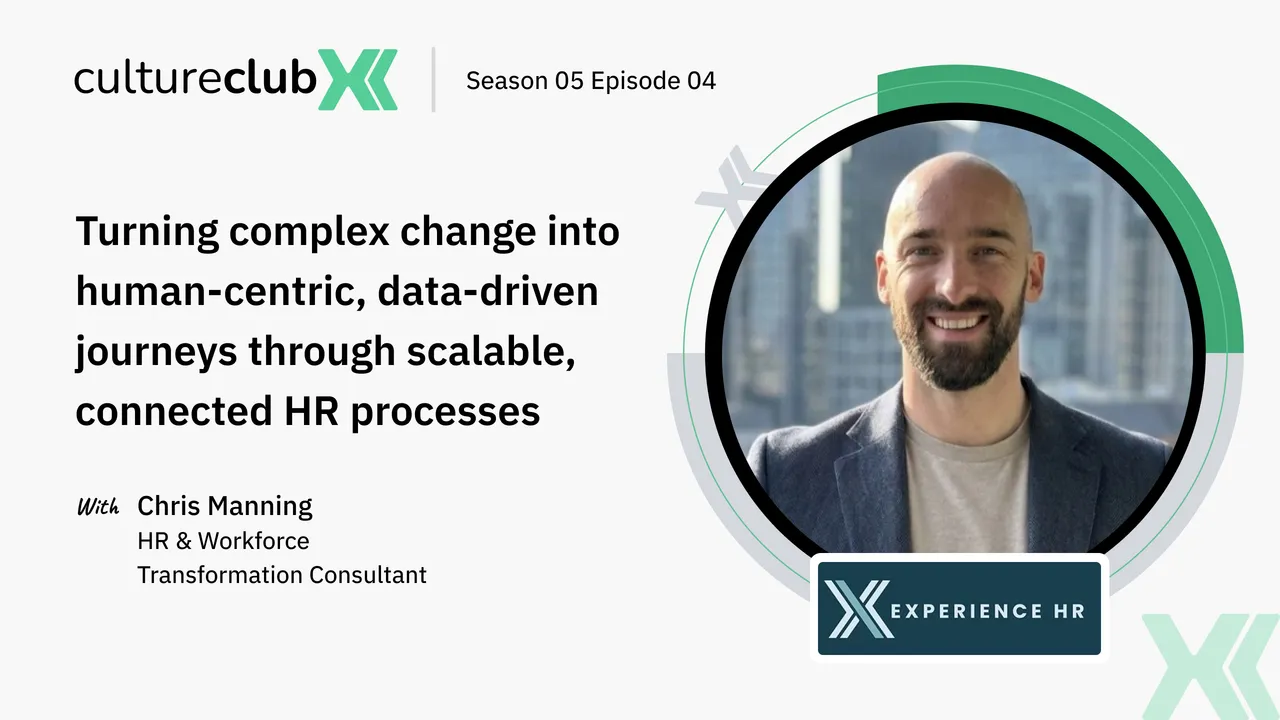
S05 E04
Turning Complex Change Into Human-Centric Journeys
In this episode, Chris Manning explains why transformation fails when organizations prioritize outcomes over lived experience. He shares how empathy, behavior-led design, and pragmatic change drive adoption, and why progress and co-creation matter more than rigid processes.

TL;DR
What you need to know from this episode
- Empathy closes the gap between the boardroom and the day to day. Executives measure milestones and outcomes while employees live the conditions: blockers, duplicated effort and clunky systems. The first stage of design thinking, empathize, is how you bridge the two.
- Choose progress over compliance perfection. The question to answer is whether the experience is workable, not whether it is compliant. Rabbit holes, artifact factories and happy path design are the early signs a program has gone process first.
- Start change before the announcement. Most change management begins at the knowledge stage of ADKAR, which is telling, not adopting. Use COM-B to assess capability, opportunity and motivation, and involve employee forums, pilots and champion networks while the change is still being tabled.
- Retire static personas and aggregate real employee data. Ten rarely validated personas pigeonhole entire workforces while ERP, ITSM and Microsoft Graph signals sit unused. Dynamic, aggregated data unlocks organizational network analysis and hyper personalized experiences.
- Co-design creates emotional ownership. Change done with people, through co-design, champion networks and hopes and fears sessions, gets employees emotionally invested. And emotionally invested people commit to the change and champion it themselves.
What happens to a transformation program when the boardroom measures milestones but nobody measures friction? That is the question at the heart of this episode of CultureClubX, where host Jodie sits down with Chris Manning, an independent HR and workforce transformation consultant, founder of Experience HR, and one of HR's most influential leaders for 2025.
Chris has spent almost 20 years across HR, workforce management, managed services, outsourcing and consulting. His experience runs from transforming recruitment functions and reshaping talent management frameworks to designing lifecycle wide global employee experiences for multinational blue chips and providing HR design assurance for ERP implementations. His stated purpose is disarmingly simple: make the workplace more enjoyable for those who experience it by making performance effortless.
Across the conversation, Chris makes one consistent argument. Transformation fails when organizations obsess over outcomes, artifacts and compliance, and it succeeds when they design around lived experience, real behaviors and honest data. Here is how he breaks that down, framework by framework.
Why do transformation goals drift so far from employee experience
Chris opens with the complaint every transformation leader has heard: you're not in the detail. In his view the gap is real but curable, and the cure is empathy. He points to the five stages of design thinking, where the very first step is empathize, and calls it unbelievably important in any transformation journey.
The disconnect is not really about detail at all. Executives, rightly, are focused on outcomes: driving efficiency, improving user experience, reducing cost. What they are not focused on are the conditions, the workflow blockers, the time lost, the duplicated effort, the clunky systems and the inconsistent knowledge articles that shape everyday work.
Exec are focused on the destination, rightly so, because they don't experience the journey and I think that's the part that empathy can start to bridge because exec teams measure milestones, they don't measure friction per se.
His prescription is to take the macro apart and understand which micros make it up. Break the operating model into its core pillars of people, process, tech and data, then use empathy, use cases and the moments that matter to surface day to day realities and friction points inside each one. That, he says, is what the phrase moments that matter is really for: it drives empathy.
What are the early signs a change program has become too process driven
Big programs breed governance, and governance breeds artifacts: personas, service maps, standard operating procedures, stage gates. Chris's test is blunt. If you cannot get any conversational insight from those products, they are pointless and they do not drive transformation.
He has run global design workshops with participants from the Philippines, the US, Costa Rica, Australia, the UK and Germany, and watched rooms spend days on policies nobody was there to solve. His advice is to hold on to the macro design principles and let some nuances iron themselves out, rather than disappearing down rabbit holes that make no macro difference.
The second warning sign is compliance overtaking progress. Chris describes himself as a perfectionist who has had to relearn pragmatism after setting up his own business and working with a UK government organization, where anchoring yourself in perfection can quietly stall everything.
The question you should be answering is, is the experience workable? Not is it compliant?
Finally, he warns against designing only for happy paths. Real services live or die in the exception cases, the moments a standard operating procedure fails someone on a help desk. Like the news, transformation feedback skews negative, so always study what fails as well as what works, and actually use the RACIs and stakeholder maps you produce.
How do you build adoption journeys that feel easy for employees
Chris is unapologetically framework minded, and for adoption he reaches for ADKAR: awareness, desire, knowledge, ability and reinforcement. The problem, he argues, is that most change management starts at knowledge, halfway through the model, so nobody has built awareness or desire.
More often than not, change management starts with knowledge. So you're starting halfway through that. You are not galvanizing excitement, you are telling people what change they are going to adopt. That is not adoption. That is exec forcing something upon an organization.
His number one rule is to start the change early and make it easier. If a change is being tabled in a boardroom, it should also be tabled with an employee forum, a change champion network, end users or some sort of pilot, so people understand the rationale instead of receiving instructions.
He layers on COM-B, a behavioral science framework covering capability, opportunity, motivation and behavior, splitting the first elements into psychological and physiological questions. His iPhone example makes it concrete: does the person understand iOS, can they physically use the device, will the opportunity to switch arise, and do they even want to leave Android? RAG rate those answers before announcing anything and you have your change runway.
Then comes the provocation. Chris, knowing exactly which podcast he is on, says he does not believe in culture as a thing in itself. Culture is just the result of many, many behaviours experienced, which means changing culture is really a matter of understanding very specific behaviours at the micro level.
What makes handoffs between systems, policies and behaviors feel seamless
Chris's tool of choice here is the service blueprint, which he is using right now in his UK government work. A blueprint maps the journey end to end, but also in depth, through layered swimlanes that expose every dimension of a service.
The key layer is front stage versus backstage. The front stage is everything end users directly interact with: the systems, the people, the service providers. The backstage is the engine they never see: the policies, the application management keeping the case management tool alive, the knowledge articles, and the AI digital assistant surfacing the right article at the right time to enable self service.
Map every interaction point across those layers and you can genuinely understand user experience, then define what the transformation journey and outcomes should be. Chris also stresses ownership. Give global process owners a clear definition of end to end success and they will fly the flag for you, keeping net promoter scores high, sentiment maintained and time to resolution on target.
Why live employee data beats static personas
Asked how data becomes meaningful behavioral insight, Chris returns to his biggest bugbear. Ten static, rarely validated personas pigeonhole thousands or even hundreds of thousands of people into ten types, dehumanizing them, while countless data points sit unused across ERP platforms, ITSM tools, Microsoft Viva, Outlook and SharePoint.
Leverage data over personas, he argues, and you get far richer insight into sentiment, experiences and transformation capability. No organization he knows of is aggregating Workday, Oracle or SuccessFactors, case management systems like ServiceNow, and the Microsoft Graph into one single view of what it means to be a particular employee. He sees that as a huge missed opportunity.
Aggregated, dynamic data unlocks organizational network analysis, reading the tone between colleagues to find the strong bonds worth leveraging for change management and the strained ones to route around. It also unlocks hyper personalization: a new dependent in the HR system should shift benefits nudges from an Adidas discount to a creche or diapers, and longer hours plus a new baby should prompt a manager to check in. The principle underneath it all is to focus on variances, not averages, which is exactly the territory where continuous employee sentiment analysis turns raw signals into something leaders can act on.
On AI, Chris sees the big enterprise HR platforms doing incredible things, and points to learning management systems evolving into learning experience platforms that embed nudges and learning on demand inside Slack, Microsoft Teams and Zoom. The missing piece is bringing those siloed use cases together at macro scale.
What gives employees real emotional ownership of change
Historically, Chris says, organizations have done change to people rather than with them. That single nuance is what drives both adoption and emotional ownership, because the combination of capability, opportunity and motivation is what evokes emotion.
The working mechanisms are co-design and change champion networks, informed by organizational network analysis so you know who needs to influence whom. If people are emotionally invested in something, they are far more likely to commit to it. Co-design makes change fun, a journey people own, and even if only 30 people were in the room, they will shout from the rooftops for everyone else to adopt it.
His favourite ritual is hopes and fears. Open every design session by asking what people hope for and fear, then close by playing back which hopes were achieved and which fears were mitigated. The real value is not the list itself but people recognizing which parts of the design they personally shaped.
How do you protect experience when leaders push for speed and scale
When the pressure is speed or scale, Chris leans on pragmatism and the minimum viable product. As a perfectionist he hates the idea, it feels lazy to him, but an MVP paired with a brilliant continuous improvement roadmap still gets you to the excellence you wanted. The speed, cost and quality triangle forces honesty about the compromise: push one corner and another gives.
He also urges systems thinking. In ERP implementations, one small configuration change can ripple out to something that seems miles away and completely unrelated, the butterfly effect program teams so often misjudge. Blueprint mapping of the complete data flow, tributaries and confluences included, is what lets you see knock-on impacts before employees feel them.
Why continuous listening turns change into a journey people trust
Strip away the frameworks and Chris's argument is a listening argument. Empathize before you design. Study friction, not just milestones. Read live sentiment instead of static personas. Ask for hopes and fears, then play them back. Every one of those moves depends on hearing employees continuously, not surveying them once the change has already shipped.
That is where an always on employee feedback loop earns its place in transformation work: it gives change teams the dynamic, human data Chris keeps asking for, so adoption is designed with employees rather than done to them. As he puts it, enjoyable work means performance, and the organizations that keep listening are the ones that can make change feel clear, simple and human.

About the guest
Chris Manning
HR & Workforce Transformation Consultant, Experience HR
Chris Manning is an independent HR and workforce transformation consultant, the founder of Experience HR, and one of HR's most influential leaders for 2025. He has spent almost 20 years across HR, workforce management, managed services, outsourcing and consulting. His experience spans transforming recruitment functions, designing people change functions, reshaping talent management frameworks, designing lifecycle wide global employee experiences for multinational blue chips, and providing HR design assurance for ERP implementations.
In recent years he has focused on bridging executive strategy to operational transformation, specializing in techno functional, experience led design. His purpose is to make the workplace more enjoyable for those who experience it by making performance effortless.
Full episode transcript
Season 05, Episode 04 · Chris Manning with Jodie O'Brien · 40 min
So where do you see the biggest gap in an organization's transformation goals and what employees are actually experiencing in their everyday work during major change?
It's that classic people not seeing the operation, people not seeing the detail. That's quite often what is thrown about, you're not in the detail. And that can be quite easily cured, and it goes through empathy. I'm a big advocate for design thinking. I'm not a purist by any means, but the first step of the five stages of design thinking is empathize. It is so unbelievably important in any transformation journey that you empathize with the end users. What's really noticeable, it's less about being in the detail and it's more about what people are focused on.
Hello everyone, and welcome to the fifth season of CultureClubX powered by CultureMonkey. I'm your host Jodie. CultureMonkey is an enterprise employee engagement platform that helps people leaders listen to their employees and enhance workplace cultures. CultureClubX is our community initiative where global leaders share best practices from their experiences and discuss all things company culture. We are joined by Chris Manning. He's an independent HR and workforce transformation consultant and one of HR's most influential leaders for 2025. Welcome Chris, it's such a pleasure to host you today.
Thanks Jodie, good to be here.
So you have spent almost 20 years in HR and workforce management, as well as in managed services, outsourcing and consulting. And your experience spans transforming recruitment functions, designing people change functions and reshaping talent management frameworks, to designing lifecycle wide global employee experiences for multinational blue chips and providing HR design assurance for ERP implementations. I love too that in recent years you've really focused your attention on bridging executive strategy to operational transformation, specializing in techno functional experience led design. And your sole purpose really is to make the workplace more enjoyable for those who experience it by making performance effortless. How awesome is that? Chris, it's such a pleasure to have you here. Welcome to CultureClubX.
Thanks for having me.
So before we dive into the discussion, could you tell us a little bit more about yourself and your leadership journey?
Yeah, of course. So I think leadership for me really comes through maturity, and maturity at work is less about age and I think more about scars and experience, and going through times that you wouldn't have imagined. I think most recently my leadership has accelerated exponentially and it's been more reflective actually. It's less about the position I'm in and more about reflecting on what leadership really means in those tough situations.
I've been lucky in that I didn't go to university. I went straight into work from college, went straight into management positions, almost fell into them as most people do, and that was early on. I think I was managing a team of five at the age of 19 in my managed services days. I had no leadership then. It was management, it was very much management, it wasn't leadership. I think really leadership started to come in probably about, gosh, 2024 is when I actually felt like a leader, so it's almost 20 years for me. Maybe that's more reflective of me, I don't know.
But I really felt it was working at Nuffield Health, which is a fitness charity in the UK, and I came in to design their people change transformation capability. So they had multiple millions of pounds of capital expenditure to invest in Workday transformation and all the processes that go around that. They had no transformation capability within HR. So I came in to set that up, and I was given three incredible resources, I say resources, three incredible humans to work with, who had some HR experience but no transformation experience. And I took them on the journey of kind of where I had gone, actually, of falling into transformation. My career ambition was to be a psychologist, not a transformation consultant.
So I took them through all the different methodologies I learned, and the best of all of them through my years of consulting, and it was through there that I got really nice feedback to say how inspirational my story had been, which sounds really cliche for me to say. But it took my team on a journey and it ignited something in them, and everyone around us said what a difference it made to the HR function, to their engagement, to how they view the work, to how they found a bit of a purpose. That's when I felt like I was a leader. I ignited something in someone. I think that that's what leadership is to me, and it goes back to my purpose of just making work enjoyable through performance.
I think that is a very good use case for it. Well, I'm sorry to tell you this, but you actually did go into psychology, because, I mean, right? It's really a lot about that, and so it's interesting to see where you are today.
So where do you see the biggest gap in an organization's transformation goals and what employees are actually experiencing in their everyday work during major change?
It's that classic people not seeing the operation, people not seeing the detail. That's quite often what is thrown about. You're not in the detail. And that can be quite easily cured, and it goes through empathy. I'm a big advocate for design thinking. I'm not a purist by any means, but the first step of the five stages of design thinking is empathize. It is so unbelievably important in any transformation journey that you empathize with the end users.
What's really noticeable is it's less about being in the detail and it's more about what people are focused on. The exec, rightly so, are focused on things like outcomes. You know, they want to drive efficiency, they want to improve user experience, they want to reduce cost, whatever it may be. They're not focused on the conditions, and that is what I think people really mean when they say you're not in the detail. You're not in the conditions, you're not feeling it, you're not experiencing it.
It always reminds me of that saying, it's about the journey, not the destination. And that's kind of the disparity, I think, is exec are focused on the destination, rightly so, because they don't experience the journey and I think that's the part that empathy can start to bridge because exec teams measure milestones, they don't measure friction per se.
When you think about where the exec are and the people that are sponsoring these big programs, they're there to operationalize and optimize operating models. I mean, that's largely what I do for work as well. But it's taking down those pillars of what an operating model is typically, and very simply putting it, people, process, tech, data. There's other bits in there as well, but those are the kind of core four pillars, and it's within those you get some of those conditions. So the workflow blockers, the time lost, the duplicated effort, the clunky systems, the inconsistent knowledge articles and guidance.
So it's about taking that macro, understanding what micros make up the macro, and like I said, you do that through empathy and things like use cases and understanding what those day to day realities are and the friction points and the moments that matter. There's a lot of talk about moments that matter. That's what drives empathy. That's why moments that matter are so important, why that phrase is thrown around, because it drives empathy.
Really well said, and interesting because it really boils down to people. If you don't insert the human factor into it, the empathy into it, then all is lost. So what early signs help you recognize when a change initiative becomes too process driven instead of evolving into that human-centered journey which employees can really connect to?
Yeah, it's really tough to see, especially in some of the bigger transformation programs. Obviously the greater the size, the more complex, and the more complex, the more governance, the more teams, the more products that are created. And it's very easy to get lost in artifact creation, be it personas, creating service maps, creating standard operating procedures, heavy, heavy governance. And that is all typically towards a purpose, towards your design principles, towards your milestones, towards your stage gates. But if you can't actually get any conversational insight from those products, they're pointless. They're absolutely pointless. It's means to an end and it doesn't drive transformation.
I've run global workshops before, global design workshops with a global FMCG, and you've got people from the Philippines, from the US, from Costa Rica, from Australia, from the UK, from Germany, all representing in one point in time. And you can be in those workshops for weeks at a time sometimes, and you can end up talking about policies for days on end. You're not there to solve policies, and this is the piece between that macro and micro principle that I mentioned earlier. You need to understand that macro design principle, but you must focus on it. It's where design principles come in. Don't get lost in some of the nuances. Some of them will iron themselves out. So don't spend all of your time looking at some of the micro things that don't make a macro difference, and that's really important. So that's one key area, is avoiding rabbit holes where you can.
The other, which is a massive bugbear for me, and I write about this a lot, is personas. Personas have been used in design for years and years and years, and they have served a purpose. They can be very, very useful. But they're a real bugbear for me because, no matter the size of the organization, if you're working with an organization of 200,000 people, even a thousand people, and you have 10 personas to work from that are static, they're not dynamic, they're rarely validated, you are pigeonholing thousands, maybe tens of thousands, maybe hundreds of thousands of people into 10 types of people. You're completely dehumanizing them as a result. And yet we have countless data points on employees in today's world. Why are we throwing them onto 10 PowerPoint slides? It drives me mad. I'm trying to keep calm as I talk about it.
We've got data points from ERP platforms, from ITSM platforms, from Microsoft Viva, you know, from Outlook, from SharePoint, whatever it may be, right, I'm talking about Azure based organizations there. We're not looking at organizational network analysis. We're not looking at sentiment. We're losing that human-centered point because personas aren't human. They're a mere representation of a snippet. So spending too much time looking at personas and basing design on personas, you're wasting your time. Use data.
The other one, which is a big one for me actually this week, is compliance. Are you focused too much on governance? You know, are you making sure everything is compliant before actually making progress? The question you should be answering is, is the experience workable? Not is it compliant? This is one of my biggest leadership reflections of the last year. I'm a bit of a perfectionist, and certainly going off on my own as I have, I set up my own business this year and I've been working with a UK government organization, and I wanted to do the best job I possibly could, as anyone would. And you strive for perfection and you anchor yourself in perfection. You can very quickly lose pragmatism through that lens. And this takes us back to compliance. You want everything to be compliant, of course you do, but sometimes not in the face of progress. So again, it's something that you can work through at a later point. So don't focus too much on compliance. Focus on progress, focus on experience.
The other one as well is one that came out from a couple of weeks ago in my work, is happy paths, as they say in design. So typically you design for happy paths. If someone talks to you about a recruitment process, you will typically talk through the happy path end to end. You won't talk about those edge cases, those nuances of design issues, when a standard operating procedure doesn't work for someone on a help desk. How do you work through those exception cases? That is absolutely critical. Because much like when you read the news or you watch the news, typically it's the bad news, not the good news. I can guarantee you there is a lot more good news in the world than there is bad news, but what do we focus on? The bad news. It's the same in transformation. You will hear the bad news over the good. So always focus on what fails as well as what works.
Again, I take this back to governance. I love a good RACI. I love a good stakeholder map. But they're useless if you're not actually managing the stakeholders with them or actually defining the roles of the people that you are working with. Again, progress over compliance. That's a big piece. Often the dominoes will fall on their own into the right places. So yeah, pragmatism is important.
So difficult when you talk about being a perfectionist and then chasing after that pragmatic formula, because we all want things to be just right. And yet there's so many variables in there. And so, great conversation today. How do you create adoption journeys that really feel easy for employees while still keeping that full purpose of the change alive?
I mentioned methodologies earlier, and I sound like a true management consultant now when I talk about methodologies. But consulting is great for following frameworks. I'm very framework and structured minded, so it works for me. Not that I follow them in a purist manner. But the best one for me, when I think about adoption, I think about change management. When I think about change management, I think about ADKAR. ADKAR is, I think, a sub process of a process, which is a certification. And ADKAR stands for awareness, desire, knowledge, ability, and reinforcement.
More often than not, change management starts with knowledge. So you're starting halfway through that. You are not galvanizing excitement, you are telling people what change they are going to adopt. That is not adoption. That is exec forcing something upon an organization. Quite often without co-design, quite often without a change champion network. And it's those two things that work for adoption. That's what makes adoption work.
So start the change early. If it's being tabled somewhere in a boardroom, it should be tabled somewhere with an employee forum, a change champion network, end users, some sort of a pilot. Start it earlier, make it easier. That's the number one rule. And you do that by making it easy for users to understand what the rationale behind that change is. So again, it takes us to that macro and micro. The exec need to understand the macro. They can't be in the micro all the time. And when I talk about that gap, it's not a criticism, but you need someone that can operate and bridge those two things. So the exec need to know the macro, the users or the employees need to know the micro. But make sure you understand what that gap is and what needs to be true for it to be adopted. Are you improving user experience? Are you removing process steps? Do you need more guidance? Often it's all of the above and then some.
But most importantly, I like following another framework, which is COM-B. It's a behavioral change and behavioral science framework, and what it stands for is capability, opportunity, motivation, and behavior. So if you can understand what the capability needed is, if you can define that opportunity, if you can understand the motivation, you will get behavioral change. So get all those things before you've even announced anything, and I can guarantee you adoption is going to work. And you should split those C, O, M into two areas, psychological and physiological.
So for example, if I want you to start using an iPhone, other brands of phone are available, then I can say, okay, do you have the capability to use this iPhone? Do you understand the operating system? Have you used iOS before? If not, maybe a challenge if you're an Android user. And physically, can you use it? Do you have thumbs? Might not have a thumb. Do you have hands? You might not have those things. So very important things to understand, both the psychological and the physiological. And then the opportunity. Is the opportunity going to rise for you to move out of your current contract with Samsung and move into an iPhone? Do you even want that transition? Are you going to like the user interface? And then motivation. Are you upset with Android? Are you flying the Android flag? You're not going to go to iOS. Again, it's just understanding some of these very basic things to go, okay, we can start to do a bit of a RAG rating here, red and green. What are the areas we need to influence before we announce this change? And that gives you your change runway.
And quite controversially, and I say this knowing the podcast I'm on, I don't believe in culture. Culture is not a thing. Many, many micros of behaviours creates culture. Culture in itself is not a thing. So culture is just a result of many, many behaviours experienced. And it's much the same with change. If you understand all the different behaviours that are impacting something that you want to fix, you can understand how to overcome it. And that is culture. What is the culture of the change you're trying to achieve? And you do that by looking at very specific behaviours. Again, it's macro, micro. So culture is at the macro, but behaviour is at the micro.
You know, we talked a little bit about the very practical things that you can do. But what else helps you create that smoother handoff between systems, policies and then those behaviours throughout that employee journey? Because as you said, maybe it's not about the greater culture, it's about these individuals.
Absolutely. I'm very visual, having been in so many design workshops in my time, and for me it's all about visualising those experiences. So there's, again, a typical approach that uses design thinking called service blueprints. And I've used that in managed service transformations before. I'm using it as we speak, actually, in my current work with the UK government. And on a service blueprint, you visualise the entire journey into it. And you do that, yes, end to end, from start to finish. But you also do it in terms of that depth, your breadth and depth. And that depth is typically broken down into multiple dimensions, or swimlanes, typically, they're called. And those in themselves are almost layered.
So one particular area is front stage and backstage. So when you're experiencing a service, for example, the front stage is what the end users directly interact with. So those are typically the systems, the people, the personas, the service providers that are often in there. It's that direct interaction. That's what people experience. What they don't experience, which is quite often the engine behind it, is what we call the backstage. So that could be your policies, that could be the behind the scenes of the service. That's actually typically what makes the entire thing run. It's the application management of the case management tool, for example, that is keeping those lights on. It's understanding what the knowledge articles are, when to point them to it, what the AI digital assistant might be doing to surface those articles at the right time to enable self service. It's all those things that they don't see working that actually make their experience.
So it's understanding the depth, more than just what the end users directly interact with. It's the entire engine in the background. It's the data. You know, it's the suppliers. It's the governance. Quite often it's seeing that bigger picture of every single interaction point in all of those layers. If you can map that, you can really, really understand user experience. And if you can understand user experience, you can define what your transformation journey should be and what your outcome should be.
So again, through that, you can start to understand where your sources of truth are. We quite like to talk about single sources of truth. Very rare, especially in your big enterprise organizations where there are integrations left, right, and center. But you can still understand where your sources are. And then it's looking at who actually owns that end to end journey. Quite often there are roles of global process owners, and they are domain experts. They are data experts, they're product managers, they are scrum masters. They are a jack of all trades and masters of all at the same time. And if you can give them a definition of what success looks like end to end, they will fly the flag for you and make sure that your net promoter score is high, that your sentiment is maintained, that your time to resolution is achieved, that your continuous improvement roadmap is optimized at all times. But there is always strive for progress. And like I said, things like knowledge nudges and all of these sorts of maximizing technology to influence things like policies and those behaviors throughout that journey. So it's all about depth and breadth.
Well, one question I have for you is when that data becomes alive, because that's what's so fulfilling, right? You have now implemented that data, and then on the back end of it, you're seeing such success with people. So how do you translate that data pattern into meaningful behavioral insights that genuinely are reshaping how HR processes and employee experiences are actually designed?
Yeah, this is back to that persona place for me. So if you leverage data over personas, you will get far richer insights into sentiment, into experiences and into transformation capabilities. Not only that, you will make work far more enjoyable for everyone in the organization, and enjoyable work means performance.
So like I said previously, we have so many data points on employees at work today. It could be within Workday or Oracle or SuccessFactors, whatever your ERP may be. You have case management systems like ServiceNow or Workday Help or whatever it may be. You have the Microsoft Graph and everything within that. So SharePoint, Teams, Viva Insights, Outlook. No one is aggregating these platforms together to give one single view of what it means to be Chris Manning, what it means to be Jodie. And it baffles me that we are not doing those things. Very few or no organizations, to my knowledge, are actually aggregating this data to understand how to better employee experiences. It is a huge opportunity for organizations.
And what it will mean is, when you get that data together, number one, you have dynamic data. So you don't need static personas anymore. You have an almost by the second update on how people are experiencing journeys. What tickets are they raising? What's their organizational network analysis? An ONA, organizational network analysis, is how people interact with each other at work. What's the sentiment between people? Myself and Rob at work may call each other pal, friend, mate. And ONA can pick up on that, and they will know I've got a strong bond with Rob in finance. You can leverage that for change management. Whereas actually, we'll know that myself and Tim have a terrible, very transactional, very sharp tone with each other. We know that there's a break there. So don't leverage that for change management. Here's one example.
You can understand pretty much everything that an employee is going through in their personal life. And, you know, you can understand I had a baby last year. And so if I was an employee, I'd have put that I've got a dependent now, Sebastian, my son. So linking that to my benefits, it will know that I'm probably not interested now in an Adidas discount. As much as I like Adidas, my priority now is a discount for a creche or for diapers, because my priorities have changed. So it may nudge me to say, hey, we've noticed something is different. You know, we could offer you better benefits now, better engagement. We know that you're actually working from home more, but you're working longer hours. You can give a nudge to the manager to say, can you check on Chris? He's probably not sleeping and he's working longer hours because he's just had a baby. Probably not a good recipe. So again, maximize engagement.
So focus on variances, not averages. Focus on the micro, the many micros, to understand the macro. Don't just look at the macro. So again, it goes down to that level of depth, but aggregated. There is a huge opportunity for hyper personalization that will inform better transformation of employee experience. Focus on the data and not just the operating model.
You know, we're using AI in so many different areas and facets of our life. And it sounds like obviously when you're analyzing Slack and Slack channels, I mean, that's tech, that's data, that's AI. What are some systems that are your go tos when it comes to the most latest technology with AI?
It's typically your bigger enterprise platforms. So obviously the greater the revenue for that product, the greater investment they're going to put in. So you've got the triopoly of the HR platforms all doing incredible things in and of their own right with AI. But you've also got degrees of personalization through the use of AI and data in some of the more siloed areas. So there's lots about LMS, learning management systems, moving towards LXP, so learning experience platforms. And that is embedding them within the everyday working environment of Slack, of Microsoft Teams, of Zoom, to create nudges, to have learning on demand. So there are many, many use cases of it being done in a siloed manner. Hopefully one day we have a point where we can bring it all together to leverage it on the macro scale as well as the micro.
So what enables employees to build that real emotional ownership of change? Once we analyze the data and we see what's needed, like we talked about. You have a new baby, by the way, congratulations on this baby. Once we analyze Chris and we decide where he's at, what enables employees to build real emotional ownership of that change? And how does that differ from the traditional approaches that organizations are typically using right now?
So stereotyping somewhat, but a lot of organizations, at least historically, have, as I said before, very much done change to organizations. They haven't done it with them. And that's the nuance. And like I said before, that's what drives adoption, but it's also what helps to drive emotional ownership. And I mentioned the COM-B piece again. The combination of those things evokes emotion.
Most importantly, and many organizations are doing this regularly now, which is fantastic to see, but it's co-design. And combining co-design with change champion networks, like I said, understanding organizational network analysis, understanding who needs to influence who to make change happen. If you can bring those things together, you have a very, very strong opportunity for people to support the change emotively. And if you're emotionally invested in something, you are far more likely to commit to it. And co-design becomes fun. That change becomes fun. It becomes a journey, much like my leadership journey that I mentioned before. Very, very emotive. If you can get people owning design, like they are doing it themselves, albeit it may be 30 people in a room co-designing, you will get people shouting from the rooftops for you to adopt the change.
One really important thing that I try to do at the start and finish of every design session is something called hopes and fears. And at the start of every design session, I say, what are your hopes for today? And then what are your fears? And we play that back to say what hopes have been achieved and what fears have been mitigated, hopefully. The most important part of that isn't actually understanding what the hopes and fears are. It's understanding what parts of design people feel like they have done. That is championing change. If people can say, I did that, I made that change, I challenged that decision for a better outcome, their emotions are within that design. And that becomes a game changer.
Chris, I'm taking all kinds of notes here. My piece of paper, I'm running out of. I'm old school, I'm running out of space. I'm going to have to get a new notepad. So when leaders push for speed or scale, how do you ensure that that transformation stays centered on real employee experience rather than top down organizational assumptions?
We spoke a little bit about compromise earlier, so I won't go over that again, but that level of pragmatism again immediately comes to mind. In the technology or techno functional transformation space, we often talk about MVP, minimum viable products. What needs to be true for this to be adopted at its absolute minimum? It's always really painful for me. As I said, I'm a perfectionist. I hate the idea of an MVP. It feels lazy because it's not striving for excellence, but it is pragmatic. And importantly, you can very easily go for an MVP and still make change and have a brilliant continuous improvement roadmap and transformation roadmap, and get to that level of perfection that you wanted to get to. So I'll just caveat that. MVPs are really important. It allows for that degree of speed, cost, and quality, that special little triangle. If one falls, something else will often fall as well. If you want to do something really quickly, it's often not going to be the best quality. Or actually, it might cost more. And you can rinse and repeat that in different ways on that triangle. And being really clear on what that compromise is and what it means for end users and for adoption is absolutely critical.
So scenario model as much as you possibly can. But most importantly, when you're scenario modeling, quite often it may be on one specific design decision. And what program teams and leaders often misjudge is the butterfly effect, or the chaos theory, or using systems thinking. What is the knock-on effect of that? And this is particularly true in ERP implementations. I'm implementing Workday at the moment, which again is why this comes to mind. If you change one small configuration, and it's the same for all ERPs, and quite often the same for general processes, even if offline, it can have a knock-on effect and impact to something that may seem miles away and completely unrelated.
So that mapping that I mentioned before, the blueprint mapping, becomes absolutely critical, because you can map each data point right from the start to the finish. It's like a river of confluence, tributaries going everywhere. Understanding that complete data flow is critical, because you can understand what the knock-on impacts of that are. So use systems thinking, understand the minimum levels of compromise and pragmatism that you're willing to have. And that's what will give you a good degree of speed where required and scalability where required, but hopefully not at the integrity breakdown of the employee experience.
Well, it's absolutely clear from today's conversation that real transformation really isn't about the complexity of it. It's about clarity, and you've really helped us get some clarity today and helped us see how connected HR processes, thoughtful design, service design, and meaningful data can turn change from something that employees are enduring into something that they can actually navigate and trust in.
So with you today, we of course explored why smooth handoffs matter, how behavioral insights shape better journeys, and why transformation succeeds only when people within the organization are designing together, not just the processes, and having those in mind. At the end of the day, the organizations that thrive will of course be the ones who blend systems thinking with that empathy that we talked about. We use the data to inform decisions, but the human connection is also used to guide. And that's exactly what we aim to do here at CultureMonkey. We obviously help enterprises understand how employees experience that work every day at those touch points, enabling leaders to build connected culture, strengthen trust, and make everything and every change initiative feel clearer, simpler, and more human.
Chris, it's been such a privilege to have you on CultureClubX today, even though you don't believe in culture. We're glad to have you here. And before we sign off, could you just share with our viewers how they can connect with you if they'd like to continue that conversation?
Of course, yeah, I'm available on LinkedIn. If you search Chris Manning, my company is Experience HR. So put the two together and you should be able to find me.
That's easy. Very easy. Thank you, Chris. Once again, thank you for your time. And to our listeners, we thank you for tuning in. Don't forget to follow, share, and rate the podcast. Of course, share this episode. And as always, keep listening to your people and leading with purpose. That's all we have for you in this episode of CultureClubX powered by CultureMonkey. Until next time, I'm Jodie signing off.
Frequently asked questions
Why do transformation programs feel disconnected from employees?
According to Chris Manning, executives are focused on the destination: outcomes like efficiency, user experience and cost. Employees live the journey: workflow blockers, time lost, duplicated effort and clunky systems. Exec teams measure milestones, not friction, so the lived conditions of change go unseen.
The fix is empathy, the first stage of design thinking. Break the operating model into people, process, tech and data, then use use cases and moments that matter to understand the day to day friction inside each pillar.
What is the COM-B framework and how does it help change adoption?
COM-B is a behavioral science framework standing for capability, opportunity, motivation and behavior. If you understand the capability needed, define the opportunity and understand the motivation, you get behavioral change. Chris recommends splitting the assessment into psychological and physiological questions.
Run that assessment before announcing anything, RAG rate the gaps, and you get a change runway: a clear picture of which areas to influence before the change lands.
Are personas still useful in employee experience design?
Chris argues they have served a purpose but are now a liability. Ten static, rarely validated personas pigeonhole thousands or hundreds of thousands of employees into ten types, dehumanizing them, when organizations already hold countless live data points across ERP, ITSM, Microsoft Viva, Outlook and SharePoint.
His advice is to leverage data over personas: aggregated, dynamic signals, organizational network analysis and sentiment give far richer insight than a snapshot on ten PowerPoint slides.
What is a service blueprint in HR transformation?
A service blueprint visualises an entire journey end to end and in depth, through layered swimlanes. A key layer is front stage versus backstage: the front stage is what end users directly interact with, while the backstage is the engine behind it, such as policies, case management upkeep, knowledge articles and AI assistants enabling self service.
Mapping every interaction point across those layers reveals the true user experience, exposes knock-on effects of design decisions, and defines what the transformation journey and outcomes should be.
How do you keep transformation human when leaders push for speed and scale?
Chris recommends pragmatism through minimum viable products: an MVP plus a strong continuous improvement roadmap still reaches excellence, as long as you are explicit about the speed, cost and quality trade off. Scenario model design decisions and use systems thinking, because in ERP implementations one small configuration change can impact something seemingly miles away.
The goal is speed and scalability where required, but never at the integrity breakdown of the employee experience.
More from CultureClub X
 S07 E03employee engagementWhy do grievance procedures damage workplace culture? | David Liddle, The TCM Group
 David Liddle
 S07 E02change leadershipHR as Chief Disruption Officer: Why Supporting the Business Is a Ceiling, with Jennifer McClure
 Jennifer McClure
 S06 E20change leadershipWhy does culture change stall? | Jamie Notter, culture scientist
 Jamie Notter
Never miss an episode
Every new episode, plus the takeaways that matter, posted on the CultureMonkey LinkedIn page as soon as they drop.
Free on LinkedIn. Unfollow anytime.