

S05 E05
The Leadership Behaviours That Decide EX During Change
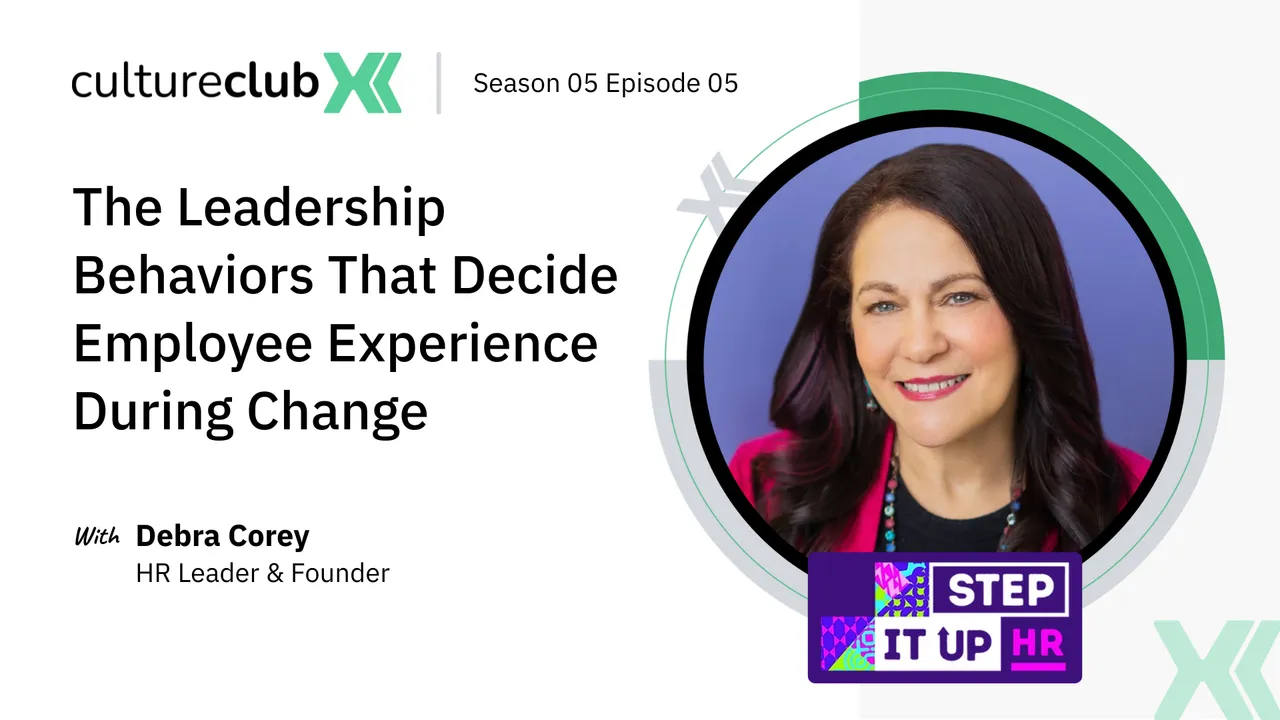
What helps employees feel supported during change? In this episode of CultureClub X, Debra Corey breaks down the leadership behaviors that build stability, trust, awareness, and stronger employee experience during transformation.
TL;DR
What you need to know from this episode
- Stability is the first thing leaders owe people during change. Debra Corey advises anchoring teams to mission, vision, and values so employees stay centered while everything else moves around them.
- No single leadership tool fits every person or moment. Her Great Boss Building Block Model has 14 building blocks precisely because the same approach never works at the same time for the same person.
- Awareness precedes acceptance and action. Leaders need to look in all directions to see the impact they are having, then treat data as a mirror; without awareness and acceptance, development programs never truly land.
- Most bad bosses have no idea they are bad bosses. Debra estimates nine out of 10 of the bosses in the stories she collected did not act on purpose, which is why brave employees and honest feedback channels matter so much.
- Engagement is a partnership, not the boss's job alone. Employees must own their development and feedback, while leaders open the door so people feel safe to speak up; she cites a study saying 45% of people are afraid to do so.
What do leaders actually do that decides whether employees feel supported through change or quietly worn down by it? That is the question at the heart of this episode of CultureClub X, powered by CultureMonkey, as host Jodie O'Brien sits down with Debra Corey, an award-winning HR leader and the founder of Step It Up HR.
Debra has spent her entire career in HR, more than 20 years across the US and Europe, and now works as a consultant, speaker, trainer and author. As Chief Pay It Forward Officer at Step It Up HR, she helps organizations build people strategies and cultures that create real impact. She is a six time bestselling author, named among the top 101 global engagement influencers for eight consecutive years.
The conversation moves from the behaviors that steady people during change to the fear of becoming obsolete, why she gave her latest book such a blunt title, her three A's model, and why engagement is always a partnership between leaders and employees. Here is a full recap of what she shared.
What gives employees stability when everything is changing
Debra frames change leadership around two areas. The first is stability. When everything is going crazy around people, they need to be centered somewhere, and she recalls picturing someone on a tightrope balancing balls during the pandemic. The anchor, she argues, is your mission, vision, and values, which leaders should constantly refer back to so people can hold onto what the organization is all about.
The second area is behavior. Depending on the change itself and the individual, leaders need to bring out the behaviors that support people where they are in the moment. Her most recent book introduces the Great Boss Building Block Model with 14 building blocks, and she is quick to explain why there are so many: not one building block is going to work at the same time for the same person.
She makes the point with a self-deprecating gardening story. A terrible gardener living in the UK, she uses the same comfortable three-pronged tool for everything from planting to weeding, and keeps breaking it. The lesson for leaders is the same one her husband keeps repeating to her: the right tool and the right behavior for the right situation and person.
How did Debra Corey fall into HR in the first place
Debra describes her career in three phases: traditional HR in the US, a rebel phase after moving to Europe where she began questioning everything she had been taught, and her current pay it forward phase of books, blogs, interviews and client work. But the very start was accidental. A competitive gymnast in college, she kept changing majors before landing on communications and psychology.
In her final year she took a part-time job in human resources, loved it, and was hired full time after graduating. Five years in came her first big lesson: her boss fired her, telling her that everyone else had been there forever and that she had a lot more to offer. Debra calls it a gift, her first experience of being pushed outside her comfort zone, and it launched her through academia, financial institutions and consulting.
She credits Garry Ridge with the phrase she now uses for all of those stumbles: learning moments. What matters, she says, is what you do with them.
Can leaders beat the fear of becoming obsolete
Asked about FOBO, the fear of becoming obsolete, Debra is candid that everyone feels insecure at times, no matter how confident they are, and new technology sharpens that fear of being replaced. Her answer is to stay current. She keeps pushing new material out into the world partly because it helps other people, and partly because it forces her to keep learning.
Leaders who continually question, challenge, stay curious and try new things will not get left behind, she argues. Chasing perfection is the real trap: you are never going to be perfect as a leader, and believing you are is exactly what leaves you behind. The final piece is understanding yourself and understanding your people, which keeps you two steps ahead in supporting the business.
Why awareness is the first job of a leader during change
If a leader could change one thing tomorrow to improve engagement and retention, Debra says it comes back to personalization, and she illustrates it with an embarrassing story from her own career.
Newly relocated from the US to the UK, she managed her multicultural team exactly the way her American bosses had managed her. Three months in, a brave employee revealed that the team had formed a Debra Corey support group that met every Friday to share stories of how she had upset them that week.
We need to constantly be looking in all directions, front, back, sideways, everywhere, to see what type of impact we're having on our people so that we can do something about it.
The story stings, but her point is that she never intended any of it. Most bad bosses do not. When she interviewed people for her book, she heard plenty of bad boss stories and estimates nine out of 10 of those bosses did not act on purpose and probably never knew the damage they caused, because they did not have a brave employee willing to say it out loud.
Do bad bosses really ruin lives
Her latest book is titled Bad Bosses Ruin Lives: The Building Blocks for Being a Great Boss, and the bluntness was deliberate and, for a self-described optimist once nicknamed Susie Sunshine by a boss, deeply uncomfortable. The phrase surfaced while writing her second book with her CEO, when she told him about a boss who had ruined her life. A horrible day at work does not rinse away when you get home.
I wanted it to be bold. I wanted it to just hit people between the eyes so that you don't ruin lives.
She chose discomfort on purpose, for herself and her readers, because in her words you need to be uncomfortable in order to change sometimes. Most of us are not ruining lives to that extent, she concedes, but we might be making things difficult, and a bold title forces the question.
How do the three A's turn engagement data into real change
Debra's model for stepping up your greatness has three A's: awareness, acceptance, and action, and she is emphatic that data fits under the first two. HR teams often build brilliant development programs and then send leaders to them without explaining why. Her husband, a former engineering leader, describes sitting in those classes frustrated, thinking only about getting back to his team.
Skip awareness and acceptance and leaders never truly engage or embrace change. That is why she says she absolutely loves data, whether it is the scores or the open comments that come out of an employee pulse survey tool. The numbers open the door to awareness; acceptance is what happens when a leader looks in the mirror.
Anything that can help you open the door to awareness and then acceptance is about looking in the mirror so you can see exactly what you need to change. To me, that is the magic and that is the only way things are gonna change.
What do great bosses and great employees have in common
Asked for a boss worth emulating, Debra names the tech company CEO she later co-wrote a book with. He pushed her to question and challenge everything while genuinely caring about people, so much so that employees who left five or 10 years ago still talk about the culture. His secret sauce was not swagger: he was brave, humble and human, the kind of leader who joked that he put his trousers on one leg at a time.
Great employees mirror that partnership. Debra genuinely believes engagement is never 100% the boss's job: employees have to own their development and their feedback, and organizations can even train people to take responsibility, as one company she interviewed does with its work from anywhere flexibility policy.
That ownership only works when people feel safe to use it. Debra cites a study she had read that day suggesting 45% of people are afraid to speak up in their company, which is why leaders have to open the door and build psychological safety at work before expecting employees to own their side of engagement.
Where employee listening fits into leading through change
Pull the threads together and a pattern emerges: stability gives people something to hold onto, but awareness is what tells a leader whether their good intentions are landing. Debra needed a brave employee to hold up the mirror. Most leaders will not get that lucky, which is exactly why structured listening matters: regular signals from employees that show the impact you are actually having, in every direction.
As Jodie notes in closing, change is constant, but how leaders listen, communicate and act makes all the difference in how employees experience it. That is the work CultureMonkey supports every day, helping leaders turn employee feedback and analytics into faster, more meaningful action on engagement and culture.
To continue the conversation with Debra, connect with her on LinkedIn or visit Step It Up HR, where she shares blogs, newsletters and free assessments. As she puts it, she loves a good challenge and will be honest if she cannot answer it.

About the guest
Debra Corey
Founder of Step It Up HR
Debra Corey is an award-winning HR leader and the founder and Chief Pay It Forward Officer of Step It Up HR, where she works as a consultant, speaker, trainer and author. She has spent her entire career in HR, more than 20 years, starting in traditional HR roles in the US before moving to Europe and working across industries from academia to financial institutions. A six time bestselling author, she has been named among the top 101 global engagement influencers for eight consecutive years and recognized among HR's most influential thinkers.
Her most recent book, Bad Bosses Ruin Lives: The Building Blocks for Being a Great Boss, introduces her Great Boss Building Block Model, and her earlier book The Rebel Playbook coined the term revolutionize that she champions for HR. Through consulting and leadership workshops, she helps organizations create modern HR practices and workplaces where people feel valued and do their best work.
Full episode transcript
Season 05, Episode 05 · Debra Corey with Jodie O'Brien · 22 min
Hello everyone and welcome to the latest episode of CultureClub X, powered by CultureMonkey. I'm your host Jodie. CultureMonkey is an AI powered employee engagement platform that helps organizations listen to their people, understand workplace sentiment and build stronger high performing cultures. CultureClub X is our global thought leadership video cast where HR and business leaders share knowledge, best practices and practical experiences on building stronger workplace cultures.
In the fifth episode of this season of CultureClub X, we're pleased to feature Debra Corey. She's an award-winning HR leader and founder of Step It Up HR. Welcome Debra, it's wonderful to have you here today.
Thank you for inviting me.
Debra brings over 20 years of experience as an award-winning HR leader and now works as a consultant, speaker, leader, trainer and author. As Chief Pay It Forward Officer at Step It Up HR, she helps organizations build people strategies and cultures that truly create impact from leadership to employees, all while equipping leaders to meet the changing needs of their businesses and their people. She's also a six time bestselling author and a recognized global thought leader named among the top 101 global engagement influencers for eight consecutive years and HR's most influential thinkers.
Through her consulting and leadership workshops, she helps organizations create modern HR practices and workplaces where people feel valued and do their best work. Driven by her mission to pay it forward, Debra works closely with leaders to create meaningful and lasting change aligned with each organization's unique culture and strategy, helping them build environments where employees feel empowered. She is also a strong advocate for rethinking how HR supports people and organizations in today's changing workplace, championing more human centered approaches and encouraging leaders to revolutionize traditional HR practices for a better world of work.
Debra, it really truly is a pleasure to have you with us and welcome again to the CultureClub X videocast on leadership moves that make or break employee experience during change. Before we begin, Debra, could you just briefly tell us more about yourself and the work that you're currently focused on?
Sure, so I've been in HR my entire career, which has been over 20 years. So I think it would take the entire episode if I told you everything about me. So I normally break it down into three phases. The first is my traditional HR. Started out in the US in various HR roles. Then my second phase, I call my rebel phase. I moved over to Europe and I started really questioning and challenging some of the things that I had done and other people had done, working in lots of different industries and different types of roles.
And then now you mentioned my job title. Now I'm in my pay it forward phase, which is all about trying to write as many books as possible to get information out there, write blogs, participate in amazing opportunities like this, having interviews and working with clients. I love the word you used before, the revolutionize. That came from my second book, which is called The Rebel Playbook. We came up with that term revolutionize. So yeah, that's what I'm doing. I work with, again, lots of different clients in different situations, scenarios, industries. And I love the whole idea of just supporting and helping and driving change.
That's amazing and wonderful to hear. So with your experience helping organizations navigate people and culture challenges, this is a perfect moment to dive into today's conversation. So let's go ahead and get started. During change, which leadership behaviors help employees feel supported and what mindset shifts turn good intentions into real impact?
You know, I sort of have two areas that I think leaders need to focus on when it's change. First of all, to some extent when people are going through change, you need some sense of stability. So for example, with everything going on crazy around you, you need to be centered somewhere. During the pandemic, I had this picture of somebody on a tightrope balancing all these balls. And it's that idea that you need to have things like your mission, your vision, and your values. So as a leader, you need to constantly refer to those and use them so that your people have a bit of stability. This is what we're all about. This is what we're trying to do. And then depending on the change itself or your individual people, it's trying to bring out the best behaviors, as you said, to support your people where they are in the moment and what's going to work best with them.
My most recent book that I wrote has a leadership model called the Great Boss Building Block Model. And there's 14 building blocks. And the reason I say that is that not one building block is going to work at the same time for the same person. So that's why it's really important to have lots of different tools in your toolkit, whether it's my 14 building blocks, or there's lots of amazing models out there. And then trying to understand which one to use at the right time. I always joke when I talk about tools, 'cause I'm a horrible gardener. And I live in the UK where they love gardening. And I basically use the same tool all the time, which my husband yells at me about, because I break it. It's meant for one purpose, and I use it for everything, from planting to weeding to moving things around. And that is absolutely the wrong thing to do. So again, the right tool, the right behavior for the right situation in person.
Oh, I'm so curious. What is the tool?
It's probably because it's comfortable to me. It's one of those ones with like the three prongs, and it's not a really long...
Yes, the little short one.
Yeah. And I just hack it on the ground all the time. And I can't tell you how many I've broken. And he's bought me more tools, but I still go back to my comfortable tool. So there's a lesson in there somewhere. Maybe hire a gardener.
That is such a good point though. I mean, we do, we rely on that one tool, and there's a whole bunch of them in the basket. It's just a matter of grabbing them when they're needed and for what purpose. I love that analogy. That's amazing. Tell us a little bit about your journey as a young person, breaking into the industry and how you landed specifically in HR.
Well, actually, I think I might've had three jobs before Gap. I did move around quite a bit. First of all, I fell into HR. I had a bunch of different majors. I did competitive gymnastics when I was in college, which is probably why I kept changing my major, 'cause I just kept doing gymnastics, thinking what am I doing and changing it? I finally ended up with communications and psychology 'cause I enjoyed it the most. But my last year of university, I didn't have any eligibility left. I decided to leave gymnastics and I took a part-time job in human resources. That was what they gave me. And I absolutely loved it. I worked there for a year part-time. And then when I graduated, they offered me a job. And I loved it.
I was there for five years when I had my first important lesson. My boss kicked me out the door. And the reason she did that is she said, everyone else here has been here forever. And I know you have a lot more to offer. So I'm giving you the gift of firing you. And once I got it, I wasn't angry with her. And it was the best thing I could do 'cause I had to go out and look for something different. It was my first example of getting outside of my comfort zone. And yeah, as a young professional, I just moved into different jobs, different industries. That was academia. Then I went and worked in financial institutions for a little while. I even did consulting for a little bit, but I left because I felt that I couldn't consult when I didn't know enough myself. I could continue on my journey, but yeah, lots of different industries, lots of learning, lots and lots of mistakes, or as someone I love, Garry Ridge, always calls them learning moments. To me, learning moments, it's what you do with them that absolutely helps you learn and grow.
So we're hearing more and more about FOBO, the fear of becoming obsolete. Man, I think we've all had this in the back of our brain since we were in our 20s. How can leaders address this while still moving transformation forward?
I think when it comes to that, we're all to some extent, we're always gonna feel insecure, no matter how confident we are, and especially with new technology coming out, this fear of it replacing us. Well, it's not gonna replace us if we continue to stay current. I mean, that's why I'm always pushing new material out there, because not only does it help other people, but it helps me stay current as well. So I think that you're never gonna get left behind if you're continually questioning and challenging and being curious about what things are going on, and also not being afraid to try new things. The whole idea of not being perfect as a leader, you're never gonna be perfect. And if you think you are, then you're gonna be again left behind. And then I guess the last bit, and we'll talk more about this later as well, is again, this whole idea of you're not gonna be left behind if you understand yourself and you understand your people. That's really where you're going to always be two steps ahead to be able to support your business and your people.
We know many leaders are listening today, and if there is one that's listening that could change just one thing tomorrow to improve engagement and retention, what would that one thing be?
I think it goes back to that idea of personalization. And I'll give you a perfect example. I share this story in the book. It's very embarrassing, so I should probably just keep it in the book and not share it again. But when I first moved from the US to the UK, I was a leader in the US for maybe two years, so I wasn't that experienced. And I had learned everything through my leaders who were, from a cultural perspective, American. And then I moved over to the UK, and I had people from different countries reporting to me, other aspects of diversity. And I just was doing what I had been taught. And about three months into my job, a brave employee came up to me and said, I just want you to know that we have a Debra Corey support group that meets every Friday and share stories of how you upset and made us cry during the week.
And the reason I share that story is that the first thing as a leader that we need to do is be aware. We need to be aware. We need to constantly be looking in all directions, front, back, sideways, everywhere, to see what type of impact we're having on our people so that we can do something about it. But then also don't make the mistake that I made in the beginning, which was not looking at the individual needs of my people. I just naively thought that how I like to be managed back in the US or how my boss had managed me was the right thing. And the fact that they had to create a support group definitely shows me that I did something wrong, and I've never ever made that mistake again.
Oh my goodness, Debra, you know we've had bosses like you, right?
Yeah, but the thing is I didn't do it intentionally, and I think that's a really important point. I think the majority of people, my husband who co-wrote the book with me, he does this much better when we're on stage, but we don't wake up in the morning and he goes, ha ha ha, today's the day I'm gonna ruin someone's life. I don't do it evil like that, but I definitely did not intend to do that. But many of us get it wrong. And when I interviewed people about the book, a lot of them shared stories about bosses, and I'm pretty confident that probably nine out of 10 of them didn't do it on purpose and probably didn't even know they had done it. 'Cause they might not have had a brave employee like mine.
Wow, wonderful. Well, your book is titled Bad Bosses Ruin Lives. We've known some of those. And the second part of that title is The Building Blocks for Being a Great Boss. So it's a bold statement. Why did you choose that title and what change are you hoping it sparks in leaders?
Well, first of all, it was a really hard title to use because I am one of those half-glass full kind of people. You know, one of my bosses called me Susie Sunshine or something like that. I am definitely an optimist. But it was a phrase that came about when I was writing my second book and I was writing it with my CEO. It was the one I mentioned before about the Rebel Playbook. And we were talking about leadership and I was telling him a story about a boss that I had and how they had ruined my life. Because you can't magically have a horrible day at work and then just rinse it away and come home and everything is fine.
So I wanted it to be bold. I wanted it to just hit people between the eyes so that you don't ruin lives. 'Cause I don't think the majority of us ruin lives to that extent. I think we might make things difficult. But I thought this time I'm not gonna do something that I'm comfortable with 'cause I wanna make everyone else uncomfortable also, 'cause you need to be uncomfortable in order to change sometimes.
Wow, that's amazing. You talk about how awareness precedes acceptance and action. How can leaders use analytics and behavioral feedback tools like CultureMonkey, not just to measure engagement, but to really genuinely strengthen trust and performance?
Do you know, I think that's where the magic happens. And that's why I came up with this model of the three A's to step up your greatness. As you said, awareness, acceptance, and action. And data absolutely fits under awareness and acceptance. And I can say this from experience. With the best intent in HR, often what we do is we create this amazing development strategy. And we create these amazing development programs and then we send our leaders to them. And they're sitting in there. And again, my husband who I wrote with is an engineering leader. He was an engineering leader. And as he explains it, I get sent by HR to these classes. They don't tell me why. I sit in it frustrated. All I do is think about how I need to get back and help my people or come up with some new code or something like that. So if we don't first start with awareness and acceptance, they're not truly gonna engage. They're not truly going to embrace change. And it's not gonna be done effective.
I love data, absolutely love data. Whether it's the data from your surveys or the comments from your surveys. To me, anything that can help you open the door to awareness and then acceptance is about looking in the mirror so you can see exactly what you need to change. To me, that is the magic and that is the only way things are gonna change.
Looking back, who would you say is a boss that you would like to emulate? Someone that you really looked up to?
Oh, do you know, I have been so fortunate to have a few really good bosses. I'll probably, you know, the whole recency effect, I'll go with my most recent great boss and he was the one that I wrote a book with. He was the CEO of a tech company. And the reason he was such a great boss is that he was the one who really had me question and challenge everything I did. He had this lovely balance of driving change but also from a people perspective. Oh my goodness, did he care about his people. People who have left five, 10 years ago still talk about the culture of this company. And as we know in HR, we can't do it alone. It is our leaders who help us drive the culture and he absolutely did that. I would not be the same person I am today without him. I always joke about he's on my shoulder whispering in my ear all the time, questioning me, challenging me, encouraging me. Yeah, wonderful, wonderful man.
What do you think was his secret sauce? You know, what was that example of being an amazing leader?
You know, I used to think it was someone who was just so confident, and I'm not saying he wasn't confident, he was human. He used to say, you know, I put my trousers on one leg at a time. I think he was brave, he was humble. And yeah, I think that combination, and he was just caring. I mean, part of it is just innate. I think it's the person you are and he just genuinely, genuinely cared about people.
And it's interesting, I interviewed someone today for a blog that I'm writing. They do these fantastic things when it comes to flexibility. And I said, who's driving that? You as the chief people officer or your leadership team. And he said, it's all of us. He said, it's not an uphill battle trying to force my leaders. My leaders get it. They embrace it and they push and challenge me and human resources to be better. To me, that's the secret sauce is having that partnership and being aligned and again, not being afraid to be a rebel.
Well, that, I mean, leads us to the next question, which is great because the question would be, what does that employee look like? You know, if you had a team underneath you, what is an example of a great employee?
Do you know, it's interesting 'cause my second book that I've talked about a couple of times, it has a model called the employee engagement model. And it has 10 different elements of what you need to do to engage your employees. And I wanna write a book for employees because I'm so glad you asked me that, because I genuinely believe it's partnership. And any employee who thinks that it's 100% up to your boss, it just is not. You as an employee have to take responsibility. At the end of the day, we're all grownups. And going back to this interview that I did today on flexibility, they actually train their employees on what does it mean to own flexibility. So, 'cause they have something like you can work from anywhere type of policy and they do things with lots of days off. And they said, yeah, we teach them and we have them learn how to take responsibility for it.
And that's why I think that, you know, as leaders, we need to set that expectation with our employees. You know, you need to own your own development. Yes, I'm gonna be here to partner with you, to coach you, but at the end of the day, I can't tell you what is important to you. You need to own your own feedback, for example. You know, if you need something from me, don't be shy. Come to me, that type of thing. I read a study just today that talked about, I think it said 45% of people are afraid to speak up in their company. So, we as leaders need to open the door so that our employees can speak up and then take the responsibility for what they need to do to own engagement.
Well, I mean, I think that's one thing that's been such a beautiful change in the last 20 years is the culture has shifted, right? We're working in different environments with different models, with unique perspectives. And so, it's really exciting to hear you speak about these things. And I know it's really connecting with a lot of people. So, thank you so much for those thoughtful insights. Your perspective, I mean, it really highlights how leadership behavior directly shapes how employees are experiencing these changes at work. Change is constant, but as we discussed today, how leaders listen, communicate, and act, it really makes all the difference in supporting employees through these transitions. As you know, at CultureMonkey, we help leaders use employee feedback and analytics to take faster, meaningful action, to strengthen that engagement and that workplace culture.
And with that, here we are at the end of our episode today of CultureClub X. Debra, thank you once again for joining us and sharing your valuable perspectives. Before we wrap up, could you please let our viewers know how they can connect with you to continue that conversation?
The easiest one is LinkedIn. Connect with me on LinkedIn. I'm very open with accepting invitations. I'm also on my website, Step It Up HR. I've got my title with Chief Pay It Forward Officer. I've got lots of freebies there for people, whether that's blogs or newsletters or free assessments, whatever it can be. So yeah, by all means, just let me know. I love a good challenge and I'll be honest if I can't answer it.
I love that. Debra, thank you for the chat today. Thank you for joining us on this episode of CultureClub X, powered by CultureMonkey. Everybody out there, don't forget to like, subscribe, and share this episode with your friends and your coworkers. Until next time, this is your host, Jodie, signing on.
Frequently asked questions
Which leadership behaviors help employees feel supported during change?
Debra Corey points to two areas. First, give people stability by constantly referring back to the organization's mission, vision, and values so they have something steady to hold onto. Second, adapt your behavior to the specific change and the specific person, supporting people where they are in the moment rather than applying one comfortable approach to everything.
What is FOBO and how should leaders respond to it?
FOBO is the fear of becoming obsolete, a worry sharpened by new technology. Debra's response is that technology will not replace leaders who stay current: keep questioning, challenging, and staying curious, do not be afraid to try new things, and accept that you will never be perfect. Understanding yourself and your people keeps you two steps ahead.
What are the three A's in Debra Corey's leadership model?
Awareness, acceptance, and action, a model she calls the three A's to step up your greatness. Data, such as survey scores and comments, fits under awareness and acceptance: it opens the door to seeing your real impact, and acceptance means looking in the mirror at what you need to change. Only then does action, like development programs, actually work.
Do managers usually know when they are hurting their teams?
Usually not. Debra tells the story of an employee revealing that her team ran a weekly Debra Corey support group to share how she had upset them, damage she never intended. From her interviews for Bad Bosses Ruin Lives, she estimates nine out of 10 bad bosses did not act on purpose and probably never knew, because no one told them.
How much responsibility do employees have for their own engagement?
A lot. Debra genuinely believes engagement is a partnership and that it is never 100% up to the boss: employees need to own their development and their feedback, and ask for what they need. Leaders set that expectation and open the door, which matters because, per a study she cites, 45% of people are afraid to speak up in their company.
Read the cross-episode roundups
More from CultureClub X
 S07 E04employee engagementWhy don't employees come to work for the company mission? | Jessica Zwaan
 Jessica Zwaan
 S07 E03employee engagementWhy do grievance procedures damage workplace culture? | David Liddle, The TCM Group
 David Liddle
 S07 E02change leadershipHR as Chief Disruption Officer: Why Supporting the Business Is a Ceiling, with Jennifer McClure
 Jennifer McClure
Never miss an episode
Every new episode, plus the takeaways that matter, posted on the CultureMonkey LinkedIn page as soon as they drop.
Free on LinkedIn. Unfollow anytime.