

Culture Litmus
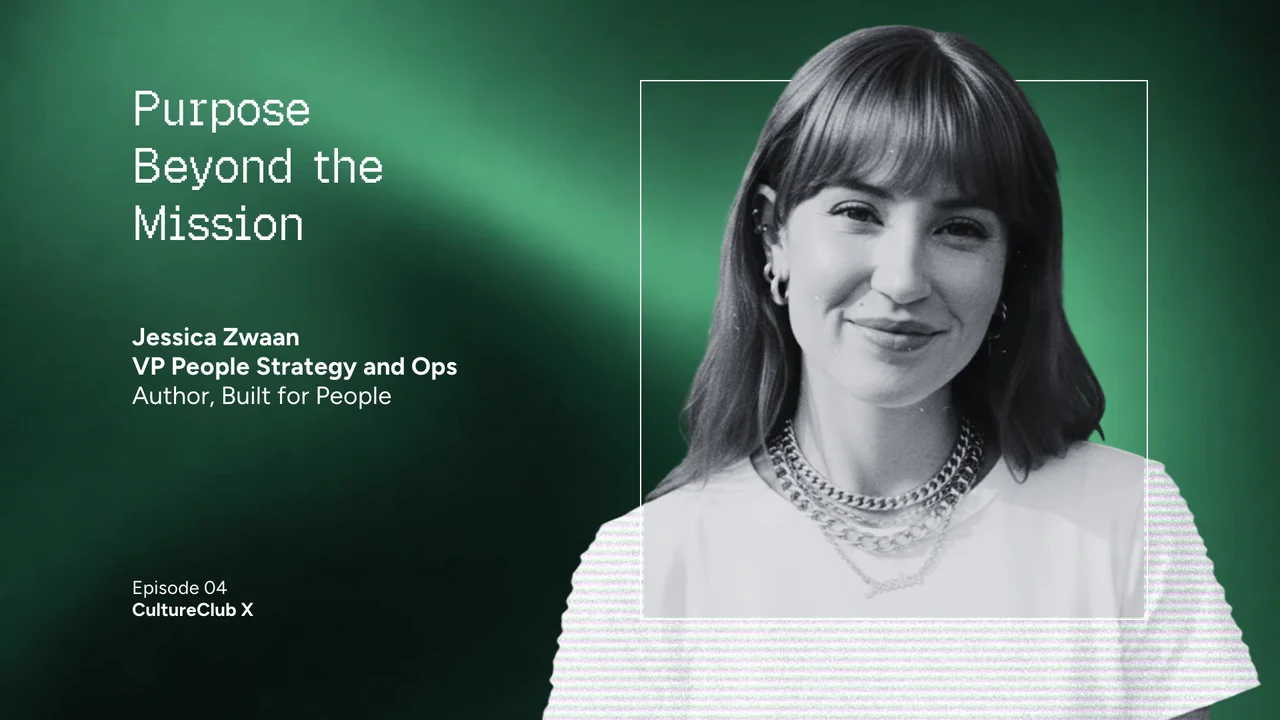
Why don't employees come to work for the company mission? | Jessica Zwaan
Because a job does different jobs for different people, says Jessica Zwaan, author of Purpose and Work. For some it is a vocation, for others a means to an end, and neither makes someone a better performer. In her research connection, autonomy and creativity ranked above the mission, and her first step for leaders is an honest look at engagement gaps.

Five conversations on the gap between what organizations claim about their people and what they can actually evidence.
- 01Gethin Nadin, BenifexSeptember 8, 2026
- 02Jennifer McClure, DisruptHRSeptember 22, 2026
- 03David Liddle, TCM GroupOctober 6, 2026
- 04Jessica Zwaan, LeapsomeThis episode
- 05Helene V. Gagnon, CAEComing November 3, 2026
TL;DR
What you need to know from this episode
- Most people don't come to work for the mission, and that is fine. For some, work is a vocation; for others it is a means to an end. Jessica Zwaan says there is no evidence that either makes someone a better or worse performer.
- Purpose washing has stopped working. Grand missions motivated people for a while, but downturns, the pandemic and an oversaturated tech industry wore the language thin. Selling a mission people do not believe creates a quiet dissonance.
- Know where you sit on the purpose spectrum. After Joseph Pine's experience economy, organizations run from service to transformation. Most are somewhere in between, and HR programs should fit that position rather than pretend.
- Connection, autonomy and creativity outrank the mission. In her research the company mission came last for almost everyone, and rose only when people imagined a mission that was unethical.
- The 90-day action is an honest conversation, then user research. Talk to the executive team about engagement gaps, then ask indirect questions about flow and how people would describe the workplace, instead of presuming the answer.
Jessica Zwaan is VP of People Strategy and Operations at Leapsome and the author of two books on people operations: Built for People, which approaches HR through the lens of product management, and Purpose and Work, a practical guide to how purpose supports motivation, productivity and performance. She has worked across operations, people and talent on three continents, including as Chief Operating Officer at Talentful and Whereby.
This is the fourth episode of Culture Litmus, the Season 07 series on the gap between what organizations claim about their people and what they can evidence. Jessica's subject is one of the most common claims of all: that people come to work for the company mission.
Why don't employees come to work for the company mission?
Because, in Jessica Zwaan's account, a job does different jobs for different people, and the mission is only one of them. For some people work is genuinely a vocation and the mission is the point. For others it is a means to an end: a way to get from one place in their life to another, to pay for a family, to travel or study, or to pursue a purpose outside work entirely. Whatever role work plays in someone's life, she says there is no evidence that it makes them a better or worse performer than anyone else.
The idea that a company has a mission, and that people should find fulfillment through work, is fairly new. For most of history work meant putting food on the table. As work became more abstract, people teams borrowed from marketing, employee value propositions were born, and through the 2000s and 2010s companies told employees that the mission was the reason to come to work. It worked for a while, she says, but economic downturns, the pandemic and an oversaturated tech industry wore the language thin. Trying to make everyone feel that "our cloud accounting software is changing the world" is, in her words, something "we just know is not really the case." That gap between the story and the experience is what she calls purpose washing.
What job is your job doing for you?
It is the question that started Purpose and Work. Jessica's friend Dart Lindsley, another people-as-a-product practitioner, asks every guest on his podcast what job their job is doing for them, and she found she could not answer it. Her first book had argued that a company builds three products: its customer-facing product, its fiscal product for shareholders, and its employee experience, which she describes as a subscription people renew every month until they hand in their resignation and churn. If a job is a product people buy into, she reasoned, they must be buying it for a reason. Purpose and Work is her attempt to find out what those reasons are and where people find fulfillment.
How can HR use product thinking to design for meaning?
By treating work as a marketplace. Different companies attract different people, and in Jessica Zwaan's view each has something like an ideal customer profile, an ideal employee profile that matches what the job is selling. A high-skill role in a lab or an AI company is a different proposition from a role in a not-for-profit, and the people it attracts need to be engaged differently.
Companies also sit on a purpose spectrum, which she draws from Joseph Pine's work on the experience economy. At one end are organizations that work almost like a service: they offer pay and benefits, and nobody expects the job to be what someone wakes up for. At the other is the transformational end, a Patagonia, or an artist working in a famous artist's studio, where the work changes the person doing it. Most workplaces sit in between, and that is fine. What matters is that HR builds programs that fit where the company actually sits. A vocational business may ask for corporate volunteer days and learning opportunities; a service business may need a clear career framework and compensation ladder far more.
Why is it hard for leaders to admit their organization isn't a calling?
Because many of them built their careers on the opposite idea. Jessica says she bought into it too, and that there is an "eating our hat" moment a few people leaders need to have. For years the message was that the way to be a great performer was to care deeply about the company mission, so people feel a sense of shame, even something close to sin, in admitting that their job is not their be-all and end-all.
Her example is a working parent whose real vocation is raising children, and whose job pays for a good school and ballet lessons and the time to be with them. "Who are we to say that motivation is any more valid than somebody that comes to work every day because they love the company mission?" Leadership and HR, she argues, have to go first: be open that work is everything for some people and not for others, and build programs like sabbaticals and generous family leave to match.
What does the PERMA model add that purpose statistics miss?
A fuller picture of what makes work fulfilling. Jessica borrows from positive psychology, in particular Martin Seligman's PERMA model: positive emotions, engagement and flow, relationships, meaning and achievement. Her observation is that HR teams find it easy to focus on meaning-making and achievement, because those are the structures most of them were raised in, while the other three matter just as much. Using the whole model helps a people team think creatively about the parts of work they can actually facilitate.
Why doesn't more mission fix low engagement?
Because it is the wrong tool for the problem. Darcy Mehta set two numbers side by side: Deloitte's 2025 survey, in which 89% of Gen Z say a sense of purpose is important to their job satisfaction and wellbeing, and Gallup's measure of global employee engagement at 20%, its lowest level since 2020. Jessica's reading is that people are saying they lack meaning at work, and organizations are answering with more corporate mission statements and harder pushes on company values. Her alternative is to give people meaning that is not just a top-down mission or an achievement factory: opportunities to learn, creativity, relationships, positive experiences, and for a service business, structure and clarity.
What motivates employees more than the company mission?
Connection, autonomy and creativity. For the book, Jessica asked the people she interviewed, and a larger quantitative survey, to stack rank the elements of work that give them motivation and fulfillment. Consistently at the top were connection and relationships with their community or customers, a sense of autonomy, and a sense of creativity. The company mission came last for almost everyone. It only climbed the ranking when she asked what would happen if the mission were evil, which tells her that people want a mission broadly aligned with who they are, not one that does something they find unethical.
Autonomy, she says, is often mistaken for fully remote working. It is really about ways of working: the room to decide how to deliver the work and which tools to use, rather than a rigid, bureaucratic program management suite. Creativity means being able to make things and solve problems rather than move information from one spreadsheet to another. She sees AI cutting both ways here: it can be detrimental to creativity if people are not trained to use it well, and it can strip out the admin roles that keep people from the problem-solving they actually want to do.
What should people leaders do in the next 90 days?
Two things, in Jessica Zwaan's answer. First, have an honest conversation with the executive team about engagement gaps: if people are not connecting with the mission or the strategy, the methods being used to engage them may simply be the wrong ones. Second, do real user research on where the team sits on the purpose spectrum. You cannot just ask people whether they believe in the company mission, because they will be nervous about answering honestly. Instead she proposes indirect questions, such as when someone last felt a deep sense of flow at work, or what words they would use to describe the workplace to someone about to join. Presuming the answer, she warns, is short-sighted. Leaders need to understand where their team actually sits.
How can continuous listening close the gap between messaging and experience?
By showing leaders what employees actually value rather than what the organization assumes. Closing the conversation, Darcy Mehta drew the line from Jessica's argument to measurement: treating employee experience as something that can be understood, measured, tested and continuously improved. Continuous listening platforms like CultureMonkey help people leaders capture employee sentiment in real time, understand what employees value, identify gaps between organizational messaging and employee experience, and turn those insights into better people decisions.

About the guest
Jessica Zwaan
VP People Strategy and Operations, Leapsome
Jessica Zwaan is VP of People Strategy and Operations at Leapsome and the author of Built for People and Purpose and Work, both published by Kogan Page. A startup and technology executive with experience across operations, people and talent on three continents, she was previously Chief Operating Officer at Talentful and Whereby, Group Head of Talent at McCann Worldgroup and VP People and Talent at Wonderbly. Her work focuses on building better systems rather than adding more processes, and on treating people operations as a product.
Full episode transcript
Season 07, Episode 04 · Jessica Zwaan with Darcy Mehta · 30 min
Hello, everyone, and welcome to season seven of CultureClub X, powered by CultureMonkey. I'm your host, Darcy Mehta. CultureMonkey is an AI-powered enterprise employee engagement platform that helps people leaders listen to their employees and build stronger workplace cultures. CultureClub X is our global thought leadership forum where CHROs, people leaders, and workplace experts come together to share perspectives on emerging workplace trends and the strategies shaping the future of work. Today we are delighted to welcome Jessica Zwaan, VP of People Strategy and Operations at Leapsome. Jessica, welcome.
It's wonderful to have you with us. And just to give a little background, Jessica is a startup and technology executive with experience across operations, people and talent spanning three continents. She is the author of Built for People, which approaches HR through the lens of product discipline, and Purpose and Work. How purpose supports motivation, productivity, and performance at work. A practical guide to building purpose-driven organizations.
Before joining Leapsome, Jessica served as Chief Operating Officer at Talentful and Whereby, Group Head of Talent at McCann Worldgroup and VP People and Talent at Wonderbly. Her work focuses strongly on building better systems rather than simply adding more processes. And she advocates for using connected data and AI to surface people insights before problems escalate. Jessica, your work challenges some of the traditional assumptions HR leaders make about employee experience, purpose, and motivation.
One of the ideas that particularly stands out is your argument that people don't necessarily come to work because they believe in the company's mission and that assuming they do can create a disconnect between what organizations communicate and what employees actually experience. That's what makes today's conversation particularly interesting. We're excited to explore. Purpose at work, how connecting people to meaning drives motivation, productivity, and performance.
Before we dive into the questions, could you share a little bit about your own journey and what led you to think about HR and employee experience through the lens of products, systems, and ultimately purpose?
Mm, absolutely. yeah, so I've been working in this space now my entire career. I came out of university and like a lot of people didn't intend to get into this space, but when I started working on it, I just found it really, really interesting. I think work is obviously such a huge part of people's lives, and I'm kind of endlessly curious about how to make it more fulfilling. I was really inspired by other disciplines quite early in my career.
I was working at Goldman Sachs, and there was a an analyst in our team, a s a strat, who was helping us do a lot of data analysis, and I found that really, really interesting. And then after that, I started thinking like what other things can we kind of take and borrow from other functions that seem to be doing things in interesting ways. And was really inspired by product management and how product management was emerging at that time. And I Then wrote a blog about my kind of ways of working, thinking about HR a little bit more like product management product squads.
and ultimately that turned into Built for People, which was published a couple of years ago. And then Built for People started asking when I was writing Built for People, I started asking myself questions about kind of the meaning of work. So it was more like, well, if our if our job is a product and we're kind of buying into this employee experience, like, has to have some kind of purpose in our lives. It's doing something more than just money. Otherwise everyone would be an investment banker.
So I yeah, really started thinking about the kind of like purpose and what drives people to do the work that they're doing and feel motivated by it. and that was the kind of birth of Purpose and Work.
That's amazing. I love hearing how everybody, you know, the different journeys of how people get to where they are. And this question fascinates me too. I mean, how to make it not be work, right? How to make it be, you know, we spend so much time doing it. So, no, thank you for that.
So let's just dive into our first question, which pulls from your book, your new book, Purpose and Work. It's so exciting. Opens with the question what job is your job doing for you? Why is that one of the most important questions organizations are failing to ask their employees? And what does the answer reveal about why so many purpose strategies fail before they even start?
Yeah, so like I mentioned in Built for People, I kind of operate with the premise that your job is a product that you're buying into effectively. So I argue that your company's building three products. One of them is your consumer facing product, one of them is your fiscal product, which is your shareholder value or your investor capital, whatever it might be. And then the final product is your employee experience, which is a subscription people subscribe to every single month until they ostensibly hand their resignation in and churn that subscription.
And if you think about it with that kind of framing, it becomes much easier, I think, to have like a kind of commercial, business level conversation with the other leaders of your executive team. and also build in a way that is like iterative, evidence-based. so that was Built for People, like I said, published a couple of years ago. And then the kind of question it was begging from me was well, if my job is a product that I'm buying into, then I must be doing it for a reason. And my good friend Dart Lindsley, who is another people as a product practitioner, had me on his podcast.
And one of the questions he asks every guest is, What job is your job doing for you? And I remember having that interview and feeling kind of stumped by not really knowing what my own answer was. and after that I just became really interested in Try to explore that. Like what are the what's the reasons that people pick the paths that they pick and why do they stay there? And where do they find fulfillment? it all comes back ultimately to kind of the job your job is doing for you in your life. And that was the questions I was interested in kind of unpicking.
Ah, I love that. That's so interesting. And you know, it's it's good for everybody even step back, even if you think you know that when you hear that question, it does make you stop and think, you know, what is my job doing for me? So,
So you argue that most people don't come to work for the company mission. And pretending they do creates a dissonance employees feel but rarely voice. So what does purpose washing actually look like inside an organization and how can leaders recognize when they're doing it?
Yeah, so at the beginning of both books I kind of go on like a history of HR to some with like a certain angle. So the first one was very much the h history of like kind of operations in HR. and then the second book I really go quite deep on the history of like work and purpose. And this idea that like the company mission, like companies have a mission. is actually like a fairly new idea. This idea of like getting fulfillment through work is also a fairly new idea.
For a very long time it was, you know, putting food on the table or even just like an immediate connection between I live on a farm, I have to grow food, this is my property, and this is the work that I need to do. And it kind of started getting abstracted at a certain point. and when that started happening, ah people ops Similar to the way that I've this with Built for People, started taking really good ideas from other departments, including marketing, for example, and saying, like, well, how do we motivate people? How do we inspire them to come and work here? Employee value propositions were born.
and companies started, I think really in like kind of early 2010s, early 2000s, starting to say, like, you know, our company is changing the world, our company mission this thing you're coming to work for. and I think it was a very motivating and interesting time. And I think it did work for a period, right? Like people were, I think, really like buying into this idea that like tech was changing the world and these companies had these like kind of grand missions.
But I think just over time, the effectiveness of those programs has just kind of started to reveal itself as not being maybe the best way to motivate your teams. and that comes from things like economic downturn, it comes from things like the pandemic, It comes from things like just an oversaturation of the tech industry and this kind of like language. So people weren't kind of finding it like sparkly and new anymore. They were starting to like have this kind of sense of dissonance between it.
And I think what we're learning now, and what I definitely like propose in Purpose and Work is that people have all different reasons for coming to work. Their jobs does do multiple different jobs for them. For some people, it is genuinely like a vocation, it's the company mission. but for others it's a kind of means to an end. It's taking them from point A to point B in their lives or helping them you know, maybe pursue purposes outside of work or like raising children or studying or traveling or whatever it might be.
And whatever kind of purpose work fits in your life, there's not evidence that it makes you a better or worse performer than anyone else. And indeed it's actually probably very healthy to be motivating people through their genuine motivation, rather than trying to make everyone feel like, you know. our cloud accounting software is changing the world and this is the reason I wake up every morning, which we just know is not really the case.
Mm-hmm. Ah, that's fascinating and so true. And you're right, I feel like there was that change that it was, you know, kind of this new exciting thing. Yes, I work for a company that's really doing something. And, you know, of course there may still be some of that, but it's also like, let's be honest, why is everybody here? And it's for a variety of reasons and acknowledging that is a big part of it.
So in Built for People, you made the case for treating employee experience as a product using evidence-based decision making, continuous feedback loops, and iteration. How does that same product thinking apply to designing for meaning? And what can it help leaders observe and measure that a traditional value statement cannot?
Yeah, so I effectively made the argument that companies kind of fit on this like economic spectrum, which is inspired by the work of Joseph Pine. and my kind of point of view is that okay, so in Built for People, I argue that like work is in a marketplace, right? So like different types of companies exist and they attract different kinds of people. And there's like kind of an ICP, an ideal customer profile or an ideal employee profile that matches well with what you're selling.
If you're selling a highly technical, high leverage, high skill job, maybe working in like a lab or you know, an AI company, that's going to be a very different value proposition than maybe a not for profit. And that means that you're going to be looking for a different type of person that wants to work there and you engaging them in a different way. And I also argue that companies kind of exist on this like kind of purpose spectrum as well, where Some companies lean more towards being almost like a service. So we provide an opportunity to have benefits and pay. And you come, you work with us.
We don't really expect that our job is the thing that you're kind of like waking up for in the morning, but your sense of purpose is fulfilled elsewhere. But that still is a motivating factor, right? Your job is the thing that you need to be able to like raise a family or travel. All the way through to the kind of transformational end, which is maybe companies more like a Patagonia or you know an artist maybe working for a very famous artist in a studio where genuinely the work is changing them.
It's like their vocation in life and they are coming to work every day because the job their job does for them is give them a kind of deep sense of purpose and motivation. And again you kind of need to like do your very best to try and make sure that the ideal profile of the person is a is what you're attracting to these different types of companies. And you're never going to get it perfect and people do change throughout their lives.
But the idea is that you should be building programs of work that kind of associate your ideal profile with the company so that there is a kind of cohesive communication strategy and a program of what you're delivering to your team.
A company that is focused around like a service business is going to have very different expectations of what you're building as a HR team than a kind of vocational business who they may be asking for Things like corporate volunteer days or learning opportunities, whereas your service business might just be requiring like a very clear career framework and compensation ladder, for example. So it's about what you prioritize as a HR team.
Hmm, absolutely.
So, Jessica, you've drawn on Joe Pine's experience economy to place work on a spectrum from service to experience to transformation and argue that most workplaces are experiential and that this is fine. And we've got, you know, already touched on this. What does it take for a leader to be honest about where their organization actually sits and what changes once they stop pretending it sits somewhere else?
Yeah, I think there is a kind of eating our hat moment, I think a few of us need to kind of do. You know, I very much bought into the same thing that we were just talking about with purpose washing, what I call it in the book, but you know, really going very, very deep on making sure that our company mission and purpose is the thing that we're using to motivate people. And now that's kind of revealing itself to maybe not be the most effective method, I think there is a kind of eating our hat, like I said. So kind of accepting that maybe we need to like change tactics.
And I think that sometimes can be difficult for leaders who are kind of raised in the idea that this is how you do it. I know a lot of people feel a deep sense of shame if they say things like, you know, my job isn't my be-all and end all. Like my job is something that, you know, is an a kind of a vessel for me to get career opportunity or a visa or travel or whatever it may be. Something feels like almost a little bit like sinful about admitting that.
And that's because I think for so long we really did perpetuate this idea that the way to be a great performer and the way to really participate in your company was to deeply, deeply care about the company mission. And yeah, like it's just revealing itself to not necessarily be true. So I think there was a kind of honesty that we need to encourage and kind of lead from the front on. and once you can recognize that actually is a safe thing to do and it actually is like an effective thing to do, I think then it will start kind of breaking down those walls a little more.
But we definitely can't, I think, expect our team to lead from the front on that. I think leadership and HR need to be transparent about the fact that for some people work is their everything and their motivation and their vocation and for some people it isn't and that's actually totally fine and that's why we build things like sabbatical programs and very generous family leave and whatever else it may be that you're you're doing aligned with your kind of position on that experiential economy spectrum.
I'm so glad you touched on that word shame too, because I think that's that's very true. And I think there's a good amount of people you feel that kind of embarrassment or shame if you're not that one that's saying, you know, I'm really living my purpose and this, you know, is I really believe in this mission. But it's, you know, it does come from leadership to feel that That's first of all okay because like you said, not everyone is.
And you know, to have that safe place and that trust to be able to express that and then you know, you still feel valued even if you know you're there for like you said, maybe your per you know, to fulfill your purpose or your hobby doing something else. So everyone has their own reason, but to kind of take away that stigma of it being, you know. So I thought that was yeah.
Yeah, I think the stigma thing is interesting. That's like there's this idea kind of that's perpetuated that if your kind of primary motivation is something outside of work, that you like I just mentioned, that somehow it's like kind of a shameful or sinful thing to think. But I think like a good example of how like it just helps you realize how nonsensical that is, you know, if you if you're someone that is like, for example, a working mom and your real motivation and vocation in life is like raising children.
But work provides you the means to be able to, you know, put them into a great school and take them to ballet lessons and spend time with them. Who are we to say that motivation is any more valid than somebody that comes to work every day because they love the company mission? And definitely, who are we to say that person's gonna be less like committed or capable? They their purpose is still being fulfilled by the job that they're doing. It just is a kind of different vessel for them. And I think that helps you kind of, I think, really realize.
Yeah, just how kind of nonsensical some of these like inherent beliefs are when you start breaking them down, you're like, Yeah, of course that doesn't make sense.
Yes. Like you said, they and so many of them are these inherent beliefs and what you know leaders are raised and everyone. So it's takes someone like you to point this out and everything. So I think and it's once you say it out loud, you realize, that makes sense, right? So
So rather than focusing only on mission alignment, you draw on the PERMA model and research distinguishing job, career, and calling orientations. What does that research actually tell us about why people work and why do you find it more useful than the purpose statistics organizations typically quote?
Yeah, I think I've kind of I really enjoy looking at other research maybe outside of the kind of future of workspace and trying to figure out like where can we learn from this? and the positive psychology movement and those studies I think are really interesting because they are really it's the same kind of mindset as what I'm trying to explore, right? Which is like how do we make work fulfilling for people?
and Martin Spiegelman's PERMA model, I think, gives us a really nice framing of how to build like a more kind of fulfilling, robust set of programs in your team, rather than what I think is kind of the general focus, which is just around kind of meaning making. So it's like PERMA is positive emotions. So having people giving you compliments and well, compliments probably not the right way to say it, but It's you know, receiving like warm feelings through a social connection.
There's a sense of like engagement, you're in the kind of a flow state, it's building relationships with people long-term, meaning making, and then achievement. And I think for a lot of HR teams, it's quite easy to focus on meaning making and achievement because they tend to be the kind of structure that a lot of us have been like raised in. But the others are just as important to have a kind of like fulfilled sense of. you know, positive meaning at work or in life.
So I really wanted to draw on them because I think it helps you kind of like creatively think about the other pieces of work that do need to exist that you're able to facilitate.
Absolutely.
So Deloitte's 2025 survey found that 89% of Gen Z say a sense of purpose is important to their job satisfaction and wellbeing, while Gallup puts global engagement at 20%, a five-year low. Your arguments just the answer isn't simply more mission. What are organizations misunderstanding when they look at numbers like these and what would a better response look like?
I think part of the kind of gap between these things is genuinely because we're trying to like almost fix the problem with the wrong tool, right? Like people are saying that they feel like they lack a sense of meaning at work, but I think the solution to that is not just creating more kind of corporate mission statements and kind of driving home the corporate values more. I think it is also about like, you know, giving people opportunity to have meaning outside of work to learn things. Like wherever you are in that economic spectrum, wherever your team may be in their own job orientation.
How do you make those things aligned so that people have a genuine sense of meaning that isn't just this kind of like top down mission statement and or achievement factory? But instead focusing on, you know, things like creativity and relationships and positive experiences. and, you know, in the case of like services business for example, like structure and clarity, which you know, are very, very helpful.
I like how you said fix the problem with the wrong tool. So that's that's a good point for sure.
So you've written that people are motivated by connection, autonomy, and creativity far more than by mission, which makes perfect sense. Can you walk us through what that looks like in practice inside a real organization and what separates the organizations that get it right from those that don't?
Yeah. So I have basically I asked a series of questions to the people that I interviewed for the book, and one of them was to stack rank and I also did like a more quantitative survey as well to stack rank these like elements of work and what gives them a sense of motivation and fulfillment. And consistently the on top was having a connections and relationships with your community or your customers. Having a sense of autonomy and having a sense of creativity.
So having a sense of autonomy is not being kind of dictated how to do the work and a sense of creativity is being able to actually make things, produce something, not just you know, be running admin, for example. So moving things from A to B. and then of course was company mission at the at the end for almost everybody that I interviewed or surveyed. And What is interesting though is company mission does go up if you start asking questions about like what happens if the company mission is evil. All of a sudden people start stacking that much higher.
So what this kind of I think tells you is that what people really are looking for is a company mission that is like broadly aligned with who they are as a person. So it's not doing something that they find diabolical or unethical. And that they're having opportunities to connect with their colleagues in some way so that they are. either some kind of program around social connection or getting to know each other. And I think a lot of teams, you know, focus on this with things like company off sites, for example. And then autonomy, I think is a really interesting one.
A lot of people, I think, presume that is going to be something like, you know, maybe just fully remote working, but in fact, actually, it's more about the kind of ways of working that you have. Do you have a very top down kind of program management suite, or are you allowing people the time and space to work out how they would like to deliver the work, which tools they'd like to use, et cetera. Obviously, like I think an anti-pattern of this would be like a highly bureaucratic organization where people feel quite rigid about the ways that they're doing work and the tools in which they're using to do it.
So giving people some kind of flexibility around those kinds of decisions, I think is really beneficial. And then the final one is yeah about creativity. And I think this kind of like movement towards AI is an interesting one because On one hand, AI has the ability to I think be quite detrimental for creativity. And you really do need to train your team on how to really use it effectively.
But on the other hand, I think it also has been very, very good at helping us reduce these roles that are there just to basically create admin or to you know move things from one spreadsheet to another or you know, click buttons in HubSpot, when in reality what people are really looking for is the opportunity to. solve problems, to create pieces of work, to work on projects. And that is, I think, ultimately one of the things that you can really focus on in this kind of AI transformation is how do we really use AI to help allow people to be more creative in the way that they solve problems at work.
Mm. Absolutely. When you creatively solve a problem, that's the best feeling, right? I mean, so that really g gets you wanting to do more too. And but overall, I like, you know, how you pointed out, it's still aligning with an organization's mission broadly, you know, right? So obviously still agreeing, but it's just that likely is not the only thing and the main thing, the purpose, but it's still important to overall align with the organization's mission. But absolutely the connection, collaboration, and creativity is so important as well.
So I love this last question because it makes you kind of think of one thing.
So finally, what is the one non-negotiable action every people leader should take in the next 90 days to move from selling a purpose that employees may not believe in to building a workplace where meaning is genuinely experienced every day.
Yeah, I think one of the things I advocate for as being like kind of a first step is to really I think two things. One is like have a very honest conversation with your executive team about you know, engagement gaps. Like I just meant like you just mentioned in the stats and I just mentioned in like the kind of follow up there is like, you know, if you're seeing genuinely this like kind of gap between your team like really feeling engaged with your company mission or where your company is heading, basically strategically.
It may be that actually the kind of methods by which you're trying to engage your team are just not the right ones. So I think an honest conversation with your executive team about the tools you're using to try and solve those problems is really helpful. And then doing, I think, critical kind of user research on what this looks like for your team. Like, where do they sit on this purpose spectrum? How do you get honest answers from them? Is it listening groups? Is it surveys? And you can't just go and ask your team, like, do you believe in the company mission?
Because people, of course, like we just mentioned, will feel quite. nervous about answering that question directly if they think that it could be you know retaliated against. So it's I you propose a series of different kinds of questions in the book, ranging from things like, you know, when was the last time you felt like a deep sense of flow at work? To you know, on if you were to describe our workplace to someone that was going to come and work here, what kind of words would you use to describe it?
These are the kinds of questions that you're trying to get at understanding people's motivations and kind of perceptions of the job that they're doing. And I think just spending a lot of time doing that user research is really valuable because then you'll get a I think a decent understanding of whether you've got a team that is feeling like they see their job as a service to themselves, like it's there to pay my bills, in which case there's a program of work we need to do. Or is it something genuinely vocational? And I think presuming the answer is going to be maybe short-sighted.
You really do need to like fully understand where your team sits.
Hmm. That's really actionable advice for our listeners. So thank you so much for that. And just I could keep talking to you all day and I, you know, really appreciate you taking the time. Was there anything we didn't cover today that you would like to share?
No, I think that's great. Thank you so much. I'm yeah, I think it's just one of those things that the more honest we can be now and like kind of move out of the last couple of years of challenge and this big kind of like revolution we're going on techno technologically at the moment. I think we have a real chance to kind of, you know, take this reflection point and turn it into a time where people really genuinely have a better shot at seeing their fulfillment at work increase. And that's something that I'm, you know, really passionate about.
I love that. And I love the positive outlook too. And I agree. I mean, honesty should make a huge difference, of course. And it's obvious, but always bears repeating. So no, Jessica, thank you so much.
Today's conversation has challenged a common assumption about purpose at work that employees need to believe deeply in an organization's mission in order to be motivated and engaged. Instead, we've explored a more nuanced question: what makes work meaningful for the individual employee? Connection, autonomy, creativity, personal growth, and the experience people have every day may matter just as much as the purpose an organization communicates internally.
We've also discussed how HR can move beyond statements and assumptions by treating employee experience as something that can be understood, measured, tested, and continuously improved. That's where continuous listening can play an important role. Platforms like CultureMonkey can help people leaders capture employee sentiment in real time, understand what employees actually value, identify gaps between organizational messaging and employee experience, and turn those insights into more informed people decisions.
Before we wrap up, Jessica, how can our listeners connect with you or learn more about your work and your books?
Yeah, absolutely. So feel free to connect with me on LinkedIn. I think I'm the only Jessica Zwaan, Z-W-A-A-N. and if you're interested, I've got a Substack called MPL Build where I talk a lot about people operations as a product and the work I'm doing in a bit more of an operational way. And also our Leapsome People Over Perks community. So if you Google Leapsome People Over Perks, you'll find our community. I'm there answering questions very often and talking to the folks in there. So I would love to see you.
That's amazing. Thank you so much. And definitely check out Jessica's books. And to all our listeners, just thank you so much for being here. Don't forget to follow, share, and subscribe. And that's a wrap for this episode of CultureClub X, powered by CultureMonkey. Until next time, I'm your host, Darcy, signing off.
Frequently asked questions
Who is Jessica Zwaan?
Jessica Zwaan is VP of People Strategy and Operations at Leapsome and the author of Built for People and Purpose and Work, both published by Kogan Page. A startup and technology executive, she has worked across operations, people and talent on three continents, including as Chief Operating Officer at Talentful and Whereby, Group Head of Talent at McCann Worldgroup and VP People and Talent at Wonderbly. She began her career at Goldman Sachs.
What are the three products a company builds, according to Jessica Zwaan?
Its customer-facing product, its fiscal product (shareholder value or investor capital) and its employee experience. She describes the employee experience as a subscription people renew every month until they hand in their resignation and churn. Framing it that way, she says, makes it easier to have a commercial conversation with the rest of the executive team and to build in an iterative, evidence-based way. The idea comes from her first book, Built for People.
What is the PERMA model?
PERMA is Martin Seligman's model from positive psychology. It stands for positive emotions, engagement (including flow), relationships, meaning and achievement. Jessica Zwaan uses it as a framework for building fulfilling programs at work, and notes that HR teams tend to focus on meaning and achievement while the other three matter just as much.
Can you ask employees directly whether they believe in the company mission?
Jessica Zwaan says no, or at least not usefully. People will be nervous about answering honestly if they think their answer could be held against them. She suggests indirect questions instead: when did you last feel a deep sense of flow at work, and what words would you use to describe this workplace to someone about to join? The answers show where a team sits on the purpose spectrum.
Does caring about the company mission make someone a better employee?
Not according to Jessica Zwaan. Whatever role work plays in someone's life, whether a vocation or a means to an end, she says there is no evidence that it makes them a better or worse performer. She argues it is healthier to motivate people through their genuine motivations than to make everyone pretend the mission is why they get up in the morning.
Read the cross-episode roundups
More from CultureClub X
 S07 E03employee engagementWhy do grievance procedures damage workplace culture? | David Liddle, The TCM Group
 David Liddle
 S07 E02change leadershipHR as Chief Disruption Officer: Why Supporting the Business Is a Ceiling, with Jennifer McClure
 Jennifer McClure
 S07 E01employee engagementWhy is employee wellbeing spending not paying off? | Gethin Nadin, Benifex
 Gethin Nadin
Never miss an episode
Every new episode, plus the takeaways that matter, posted on the CultureMonkey LinkedIn page as soon as they drop.
Free on LinkedIn. Unfollow anytime.