

Set up recurring survey automation rules
How to make a survey repeat on a schedule in CultureMonkey - what recurring automation actually does, how each run is created, how results stay separate or trend over time, and when to use recurring rules, a pulse, or a one-off survey.
On this page
- What "recurring automation" actually does here
- The recurrence options you can set
- How to set up a recurring rule
- How each run is created
- Managing a rule after it's running
- How results are kept: one survey, one dataset
- When to use recurring, a pulse, or a one-off
- Best practices
- Limitations and things to watch
- Frequently asked questions
- Where to go next
"Recurring automation" means one thing to most people: set the schedule once, and the system keeps the survey going without you touching it again. CultureMonkey supports that idea, but it does it in two distinct ways depending on what you actually want to repeat. This guide explains both, so you set up the right one the first time.
The confusion is worth clearing up early. A single survey can be put on a recurring rule that automatically nudges non-responders on the days and channels you choose, for as long as the survey runs. A separate concept, the pulse, is what you use when you want the whole survey to fire again and again on a cadence, with each run scored on its own and trended over time. They solve different problems, and picking the wrong one is the most common setup mistake.
Inside a running CultureMonkey survey, a recurring rule repeats reminders automatically on the weekdays and channels you pick (for example, every Monday by email and every Thursday by Slack) until the survey ends or your end date passes. If you want the entire survey to re-run on a schedule and be trended run over run, that is a pulse, not a recurring rule. Use a recurring rule to keep response rates up on one survey; use a pulse to measure the same thing repeatedly.
What "recurring automation" actually does here
CultureMonkey's recurring automation lives on an individual survey, under its notifications, and it automates reminders, not new survey launches. When you create a recurring rule you are telling the platform: "For this survey, keep sending reminders to people who haven't answered yet, on these weekdays, through these channels, automatically."
That is a real time-saver. Without it you would have to schedule each reminder by hand (see Recurring vs one-time reminders). With a recurring rule, you define the pattern once and the system schedules the next reminder for you every time the previous one goes out.
Two things it does not do, and it is important to be clear about them:
- It does not create a new survey each cycle. The survey, its questions, and its participants stay the same. Only the reminders repeat.
- It does not re-open a closed survey. Recurring reminders run only while the survey is live. Once the survey ends (or the rule's end date passes), the automation stops.
If what you actually want is the survey itself to come back around next week or next month as a fresh measurement, jump to When to use recurring, pulse, or one-off, because a pulse is the tool for that.
The recurrence options you can set
A recurring rule has a small, deliberate set of options. Each one maps directly to a field you fill in.
| Option | What it controls | Notes |
|---|---|---|
| Start date | The day the recurring reminders begin | Must fall on or after the survey's start date. Once the rule is saved and has begun sending, the start date is locked. |
| End date | The day recurring reminders stop | Optional. Leave it blank and the reminders run until the survey itself ends. If set, it must be after the start date and cannot exceed the survey's own end date. |
| Day | Which weekday a reminder goes out | Chosen per rule row, from Sunday through Saturday. Each weekday can be used only once per survey. |
| Channel | How that reminder is delivered | Email, SMS, Slack, WhatsApp, or Teams, depending on which channels your account has enabled. |
The day + channel pairing is the heart of the feature. Each row you add is one "rule set": one weekday tied to one channel. You can stack several rows to build a weekly rhythm. For example:
- Monday - Email and Thursday - Slack gives non-responders two nudges a week through two channels.
- A single Wednesday - Email row gives one steady weekly reminder.
Because a weekday can only appear once, you can't schedule two reminders on the same day within one recurring rule. If you try, the form flags the day as already taken and asks you to pick another. This keeps people from being double-messaged on the same day.
The channels you can choose reflect what your account has switched on. If Slack or Teams isn't in the list, it hasn't been enabled or connected yet. Reminders sent through a channel employees already check tend to lift response rates more than another email in a crowded inbox.
How to set up a recurring rule
You configure recurring reminders from inside the survey, on its notifications area. The survey needs a start date (and, if it has one, an end date) before the automation has a window to run in.
- 1Open the survey - go to Listen > Surveys, open the survey you want to automate, and move to its notifications. You'll see three tabs: Reminder Schedule, One Time Reminder, and Recurring Reminders.
- 2Open Recurring Reminders - this is where the recurring rule lives. Everything below is set here.
- 3Set the start date - pick the day the recurring reminders should begin. It must be on or after the survey's start date.
- 4Set an end date (optional) - if you want the reminders to stop before the survey closes, choose a date. Leave it empty to let them run for the survey's whole life.
- 5Add a day and channel - use Add Recurring Reminder to add a row, then choose a weekday and a delivery channel. Repeat to build your weekly pattern (each weekday once).
- 6Save changes - confirm the prompt. The platform schedules the first reminder for the next matching weekday and will keep scheduling the following ones automatically.
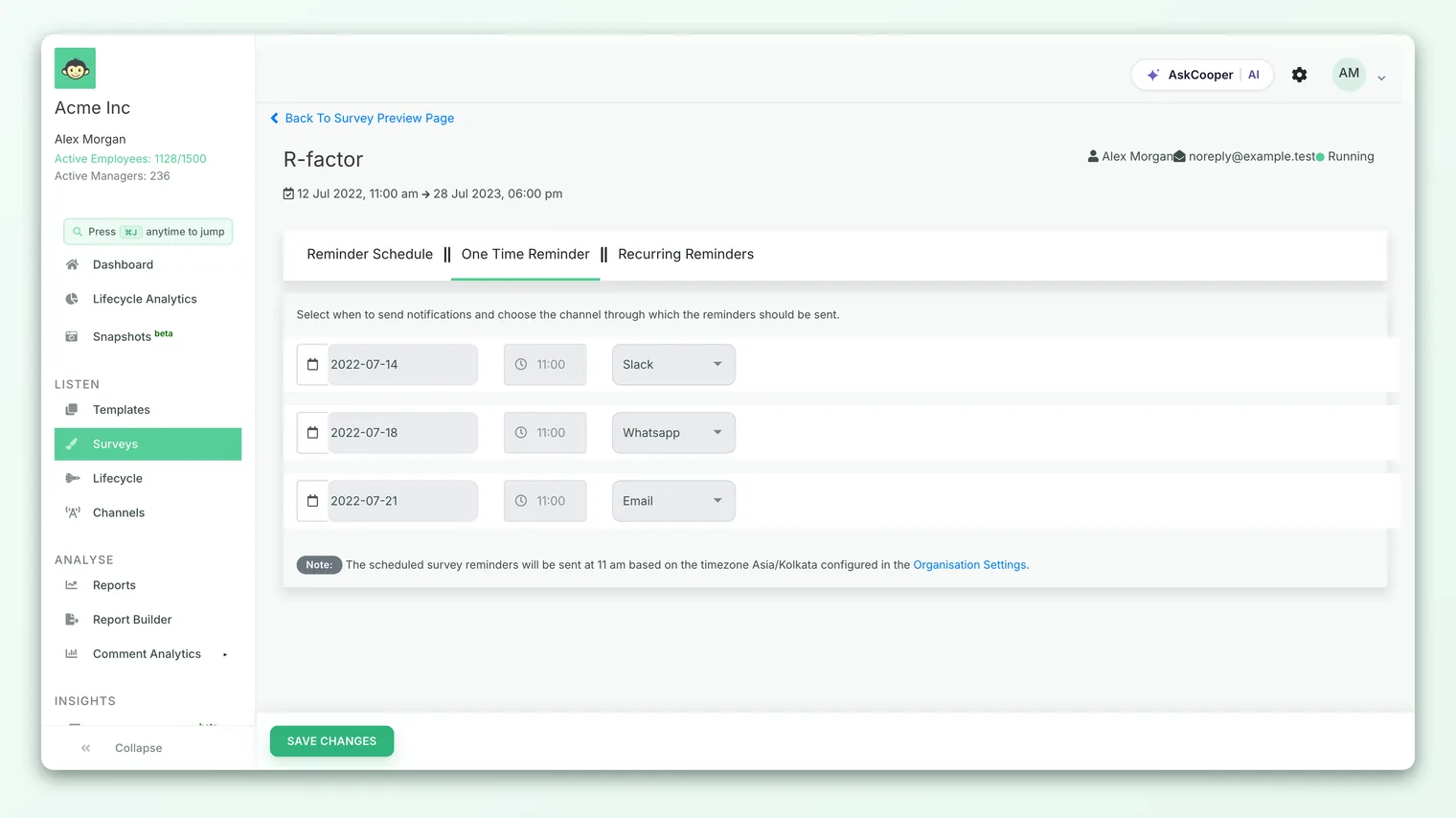
Once saved, the rule is live and the rows are locked to keep the schedule stable. From here you manage it row by row rather than editing days in place.
How each run is created
This is the part that trips people up, so it's worth being precise. A recurring rule doesn't queue up every future reminder at once. It works one step ahead:
- When you save the rule, CultureMonkey looks at your active day rows and schedules a reminder for the next matching weekday.
- When that reminder finishes sending, the same job immediately calculates the next matching weekday from your active rows and schedules that one.
- That cycle repeats. Each completed reminder triggers the scheduling of the one after it, always looking forward to the next active day.
The system checks two guards before it schedules each next reminder: your rule's end date and the survey's own end date. If the next reminder would fall after either, it isn't scheduled, and the automation quietly stops. That's why a recurring rule can never outlive the survey it belongs to.
There's also sensible de-duplication. If you happen to have a one-time reminder set for the same day a recurring reminder would land, the recurring one steps aside so people aren't messaged twice on the same day. And within a single day, a participant who has already been reminded won't be reminded again.
Every recurring reminder targets non-responders only. Once someone submits, they drop out of the reminder list automatically. The automation is about chasing completion, not re-surveying people who are already done.
Managing a rule after it's running
You don't have to tear a rule down to change its behaviour. Each day row can be turned on or off independently, and the whole rule can be stopped.
- Deactivate a day - switch a single weekday off (say you decide Thursday reminders are too much). Its scheduled reminder is cancelled and future reminders skip that day, while your other days keep running.
- Reactivate a day - turn a paused weekday back on. It rejoins the rotation and the next matching occurrence gets scheduled again.
- Stop all recurring reminders - this cancels every scheduled recurring reminder and moves all the day rows to an inactive state. Use it when you want the automation to end but leave the survey itself running.
Whenever you deactivate, reactivate, or stop rows, CultureMonkey re-computes what should come next: it clears any not-yet-sent recurring reminders and re-schedules from your currently active days. Reminders that have already gone out are left untouched, so your history stays intact.
How results are kept: one survey, one dataset
Because a recurring rule repeats reminders and not the survey, all responses land in the same survey. There is one result set, and it fills up as more people respond across the reminder cycles. A reminder sent on week three simply pulls in a few more late responses to the same report you were already looking at.
That is exactly what you want when the goal is a single, well-completed measurement: you launch once, the reminders chase stragglers automatically, and your one report gets more complete and more representative over time. It is not the tool for comparing "this week versus last week," because there is only ever one run to look at.
If you need results that are kept separate per cycle and trended (this run scored on its own, next run scored on its own, and a line showing movement between them), that is the pulse model, covered next.
When to use recurring, a pulse, or a one-off
Here is the decision in one table. The question to ask yourself is: what do I want to repeat, the reminders or the whole survey?
| You want to... | Use | Why |
|---|---|---|
| Run one survey once and keep response rates high without scheduling every nudge | A one-off survey with a recurring reminder rule | The survey fires once; reminders repeat automatically on your chosen days and channels until it ends. |
| Ask the same questions again and again on a cadence and trend the score over time | A pulse survey | Each cycle is its own run, scored separately and charted so you can see the trend. See What is a pulse survey?. |
| Send a single survey with no automation at all | A one-off survey | Full manual control; schedule reminders by hand if and when you want them. |
A few sharper distinctions:
- Recurring rule vs pulse. A recurring rule keeps one survey healthy by repeating reminders. A pulse keeps measuring by repeating the survey. If your stakeholders will ask "is the number going up or down?", you need a pulse, because that question only makes sense across separate runs.
- Recurring rule vs one-off. They're the same survey; the recurring rule just automates the reminder cadence instead of you setting each reminder manually. If you'd otherwise be scheduling the same weekly nudge by hand, the recurring rule saves that effort. For the manual side, see Recurring vs one-time reminders.
- Pulse cadence. A pulse has its own frequency (for example weekly, fortnightly, or monthly) and manages its own schedule and trend line. You don't build a "recurring survey" by chaining reminder rules; you use a pulse.
The single most common mistake is setting up a recurring reminder rule expecting the survey to relaunch each week. It won't. The survey runs once; only the reminders repeat. If you need the survey itself to come back on a schedule, set up a pulse instead.
Best practices
- Decide the goal before the mechanism. "Complete one survey well" points to a recurring reminder rule. "Track a number over time" points to a pulse. Name the goal first and the right tool is obvious.
- Don't over-nudge. Two reminder days a week is usually plenty. More than that risks fatigue and can actually lower quality responses. Start light and add a day only if completion is genuinely lagging.
- Spread across channels. Pairing different days with different channels (an email early in the week, a Slack or Teams ping later) reaches people who tune one channel out, without hammering a single inbox.
- Set an end date when you have a deadline. If the survey must close on a fixed day, an explicit rule end date keeps reminders from bumping right up against it. Otherwise let the rule run to the survey's own end.
- Deactivate rather than delete when experimenting. Turning a day off and back on is reversible and keeps your sent history clean, which is better than tearing down and rebuilding the whole rule.
Limitations and things to watch
- It's weekday-based, not date-based. Recurrence is defined by day of the week, so you can't say "remind on the 1st and 15th." Think in terms of "every Monday," not calendar dates.
- One reminder per weekday per survey. You can't stack two channels on the same day inside one rule; each weekday is used once.
- Bounded by the survey's life. Reminders never run past the survey's end date, whatever your rule says. The survey always wins.
- Only non-responders are contacted. By design. This is a completion tool, not a way to re-poll people who already answered.
- Not available for every survey type. QR-only surveys don't support reminders at all, so recurring rules don't apply to them.
Frequently asked questions
Does a recurring rule create a new survey each cycle?
No. It repeats reminders within a single survey. The survey, its questions, and its participants stay the same, and all responses go into one result set. To repeat the whole survey and trend it, use a pulse.
What happens when the survey ends?
All recurring reminders stop. The automation is bounded by the survey's end date (and by your rule's own end date, if you set one), whichever comes first. Nothing is scheduled beyond that point.
Can I change the schedule after it's live?
Yes. You can deactivate or reactivate individual weekdays, or stop the whole rule. After each change, CultureMonkey re-computes the next reminder from your active days. Already-sent reminders are left as they are.
Will someone get reminded twice on the same day?
No. A weekday can only appear once in a recurring rule, CultureMonkey skips a participant who has already been reminded that day, and if a one-time reminder overlaps a recurring one on the same day, the recurring reminder steps aside.
How is this different from a pulse?
A recurring rule automates reminders on one survey to lift its response rate. A pulse re-runs the survey on a cadence, scoring each run separately and trending it over time. Different jobs: keeping one survey complete versus measuring the same thing repeatedly.
Where to go next
- Repeat the whole survey and trend it: What is a pulse survey?
- Understand manual vs automated reminders: Recurring vs one-time reminders
- Start a fresh survey: Create a survey from scratch
Your feedback helps us improve the Help Center.