

S03 E01
What DEI Really Means in the Modern Workplace
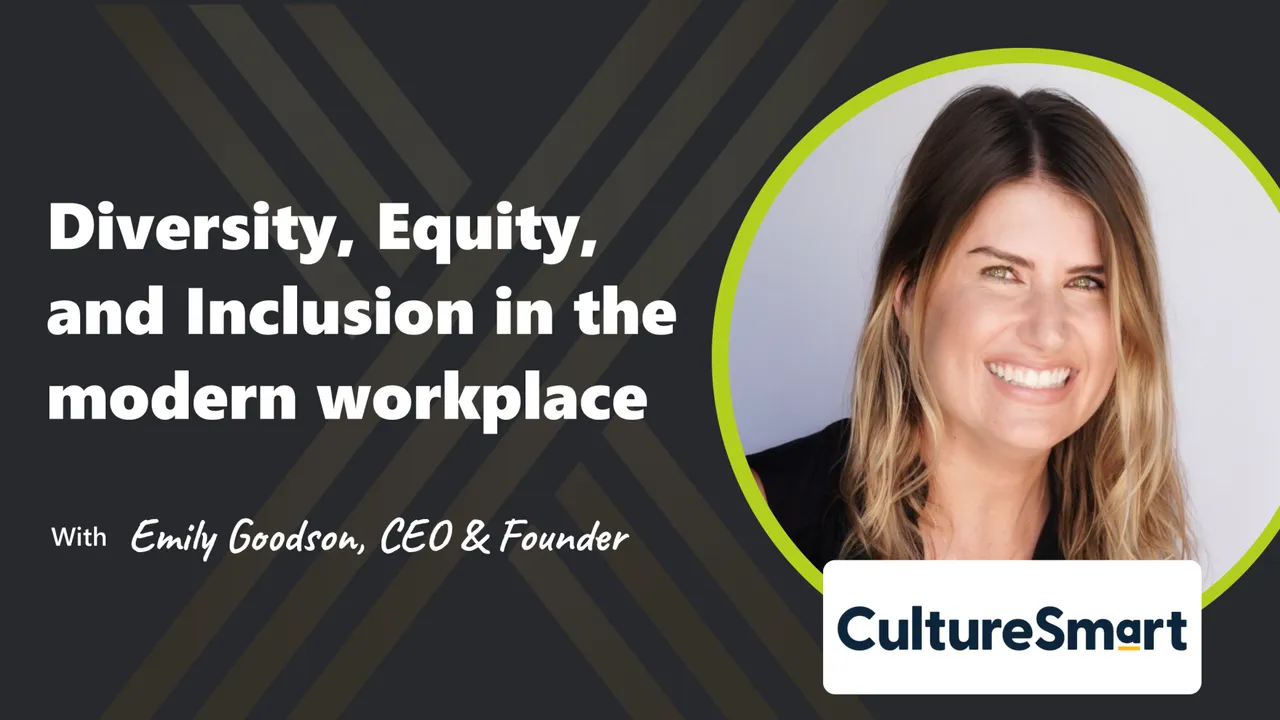
Kicking off Season 3, Emily Goodson, CEO of Culture Smart, unpacks the real meaning of DEI in today’s workplace, shedding light on equity vs. equality, tackling biases in hiring, and the role of belonging in building inclusive, high-performing cultures.
TL;DR
What you need to know from this episode
- Equity is not the same as equality. Equality hands everyone the same apple, while equity accounts for different starting points and gives people what they actually need to succeed, from closed captioning to an interpreter in an interview.
- Statements without action backfire. Employer brand and company culture are now basically synonymous, so a public DEI stance that is not backed by internal action gets exposed by employees who speak openly about what the culture is really like.
- Managers are the early warning system for culture. Belonging starts with whether a manager sees the person before the task, and because they sit closest to the team, managers can sense when culture starts to slip before anyone else does.
- You cannot improve what you do not measure. Running a regular engagement or pulse survey and setting concrete recruiting goals turns DEI from good intentions into progress you can track and course correct when a score dips.
- Culture gets built either way, so start small. Lean startups can use a free survey form, a spreadsheet of goals, and a proactive accommodations email to begin building belonging without a big budget or a lot of time.
Season 3 of Culture Club opens with a conversation about diversity, equity, and inclusion, and the guest is Emily Goodson, CEO and founder of Culture Smart. Based in Los Angeles, she left corporate people leadership about two years ago to build a consultancy that helps organizations become more supportive and inclusive places to work.
Her perspective is shaped by lived experience. She advises startups, draws on years leading talent and people functions for high-growth companies, and speaks openly about disability and what it teaches about how people should treat each other. The episode asks a deceptively simple question: what does DEI really mean once you move past the statements and the headlines?
Host Soumya Saval frames DEI as a broad and deep concept, spanning race, gender, faith, age, and educational background. Goodson uses the hour to separate the terms that often get blurred, to locate where bias hides, and to show why belonging lives or dies with the everyday manager.
What separates equity from equality
Goodson starts by pulling apart three words that often get used interchangeably. Diversity, she says, is the wide array of differences people bring, from race and ethnicity to gender, ability, religion, political beliefs, and military service. Inclusion is the feeling of belonging: being seen, heard, and supported.
Equity is the newest and most misunderstood term. Equality treats everyone identically, while equity accounts for different starting points. Her example: everyone getting an apple is equality, but a candidate who needs closed captioning or an interpreter to interview well needs something different to get a fair shot.
Equity is actually taking into account what people need to be supported and the idea that not everyone starts out on the same foot.
Why DEI is a performance issue, not a branding exercise
Asked for reasons beyond brand image and compliance, Goodson points straight at business performance. Research shows that employees who feel safe and supported perform better, innovate, and do their best work, and that requires feeling included. She wants companies to focus on both people and profit, but argues that even a profit-only lens still leads back to inclusion.
She is blunt about the gap between statements and action. Companies are eager to publish a diversity statement, she notes, but do not always have the internal action to back it up. In today's workplaces, employer brand and company culture are basically synonymous, and employees will be vocal externally about what the culture is really like.
That is why she treats an unbacked public stance as a genuine liability. A statement about values reads as hollow the moment employees describe a different reality from the inside, and Goodson insists the work with your people has to come first.
How bias slips into hiring, and how to contain it
Bias, Goodson says, is always going to creep in, and it shows up in hiring when we favor people with similar backgrounds or certain schools and degrees. Those are assumptions, not truths, and they crowd out equally capable candidates from different backgrounds.
Her fixes are concrete. Get specific about the three or four skills a role actually needs, so conversations focus on qualities like influencing or communication rather than pedigree. Keep the same people across an interview process so every candidate gets a consistent experience with consistent questions.
She also pushes teams to open the funnel. Recruiters naturally post where they would look for jobs themselves, so deliberately adding non-traditional sources brings in candidates who might not survive a first glance but who can do the job just as well.
What belonging actually asks of managers
Belonging, in Goodson's telling, starts with the manager. A manager who is too busy to talk, or who jumps straight to tasks without asking how someone is, leaves people feeling defeated and isolated, and remote settings make that worse. Accommodations send signals too: an interview site with no accessible entrance tells a wheelchair user they were not thought about.
She defines psychological safety plainly, as the sense that it is okay to make mistakes and to own up to them when you do. Because managers sit closest to the team, she treats them as the early warning system for culture, the people who should sense trouble first. This is where psychological safety is won or lost, long before it shows up in any survey.
when the culture is going awry your manager should be able to tell you because they should be able to sense it
Why you cannot improve DEI without data
Goodson's number one piece of advice is to put a collection process in place. Without quantitative data, tracking progress on belonging is guesswork, and she encourages clients to run a regular engagement or pulse survey so they can watch how people feel over time and course correct when a score dips.
The value shows up in the details. If a motivation question drops sharply after a big internal meeting, the data points you toward what happened and why. A steady pulse survey gives leaders that comparison over time rather than a single snapshot.
She pairs listening data with goals on the recruiting side: a diverse interviewer on every panel, a non-traditional source for each posting, more women in the sales interview process. Targets you measure against are what turn good intentions into progress you can actually see.
if you don't set goals and actually measure yourself against them it's hard to know what progress you're making
How startups can start small on culture
Culture Smart focuses on Series A and Series B startups, and Goodson founded it because early-stage companies so often postpone culture while chasing the bottom line and an MVP. Skip it, she warns, and you do not scale: employees leave, turnover climbs, and hiring gets harder. The answer is not a big budget but a decision about how intentional to be.
Start small is her refrain. A lean team can run a Google Form instead of software, track goals in a spreadsheet, or send candidates a proactive note explaining who to email for a visual, auditory, or physical accommodation. None of that costs much money or time, yet it moves belonging forward.
Her closing image is a plant in a garden. Certain vegetables, like the snap pea, have to be trained on a trellis to grow in the right direction, and culture is the same: left untrained it goes wild, so you monitor it, grow it, and stay intentional about it.
Where employee listening turns intent into action
The thread running through the conversation is that DEI is everyone's job, from the CEO and C-suite to every manager, not a task to hand off to HR. Words alone are meaningless without action behind them, and the only way to know whether that action is landing is to keep listening.
That is where continuous employee listening earns its place. A steady employee feedback loop lets leaders see when belonging slips, understand why a sentiment score moved, and respond before people quit. Goodson's metaphor holds to the end: culture will get built either way, so the real choice is whether to build it consciously.
About the guest
Emily Goodson
CEO & founder, Culture Smart
Emily Goodson is the CEO and founder of Culture Smart, a consultancy based in Los Angeles that partners with organizations internationally through training, speaking, and advising, with a particular focus on Series A and Series B startups. Before founding Culture Smart about two years ago, she built and led talent and people functions for various high-growth organizations and worked in campus recruiting for Deloitte Consulting. She holds multiple coaching certifications and is an advocate for individuals with disabilities, drawing on a debilitating brain injury she experienced at age eight that paralyzed the left side of her body.
She recovered and relearned to walk, and regularly writes and speaks about disability and overcoming challenges. In 2020 she was recognized by the San Diego chapter of the National Association of Women Business Owners.
Full episode transcript
Season 03, Episode 01 · Emily Goodson with Soumya Saval · 38 min
Hello, everyone. This is Soumya Saval and you're watching Season 3 of Culture Club powered by CultureMonkey. Culture Club is a community for sharing and learning about all things workplace culture and engagement, and CultureMonkey is a full suite employee engagement analytics platform, helping HR professionals and people leaders build data-driven strategies to attract, retain, and engage employees better.
This is the very first episode of Season 3, and we'll be talking about diversity, equity, and inclusion at the workplace. Leading us in this conversation is Emily Goodson, a very special guest we have today. She's an inspirational speaker, writer, and a positive workplace culture advocate. Emily runs her own consultancy, Culture Smart, and she partners with organizations internationally through training, speaking, and advising engagements.
Prior to founding Culture Smart, she built and led the talent and people function for various high-growth organizations. She also worked in campus recruiting for Deloitte Consulting and achieved multiple coaching certifications. Emily is an advocate for individuals with disabilities. She experienced a debilitating brain injury at age eight and was paralyzed on the left side of her body. She recovered from her injury, relearning to walk with two legs of different lengths, and becoming fully functional with the use of one arm and hand.
She regularly writes and speaks about her experience with disability and overcoming challenges. Emily was also recognized as a rising star female business owner by the San Diego chapter of the National Association of Women Business Owners in 2020. Emily, a very warm welcome to you. What an honor it is to have you on our show.
Thank you so much. It's an honor to be here, and it's just lovely to be with you and chatting all things culture.
I know I've given a bit of introduction there, but I still believe that just touches the tip of the iceberg. Could you go ahead, fill in the gaps for us, tell us all about yourself.
Sure, absolutely. Again, Emily Goodson, I am the CEO of my company, Culture Smart. I live in Los Angeles, California, and I went out on this journey about two years ago to start my own business and to help influence workplaces and make them more supportive and inclusive places for people. I do that through advising and also through speaking about my lived experiences with disability and what that teaches me about how we should treat each other.
Thank you for agreeing to talk to us about diversity, equity, and inclusion. There's been lots going on in the media about DEI, and I've been following all of that and been reading up myself, but I think this is the first ever time that I will be speaking about it or discussing it on a public forum. So that kind of does make me nervous and vulnerable, because I worry, what if I'm going to make a mistake? But I'm also guessing that's the only way to get out there and progress. So feel free to call me out in case I can do better in any of the discussions that we have.
Well, and I appreciate you saying that, because I think being vulnerable and being willing to make mistakes is sort of the foundation of a lot of inclusion work. All of us have biases and all of us come with different upbringings and different styles. And so it's not uncommon for us to make mistakes in how we're talking about other people or how we're talking about ourselves. And so I think having the grace to recognize that you make mistakes is foundational to being successful in this work.
Okay then, so jumping right into our first question. I understand that diversity is multiple dimensions, right? On one hand, we have the more widely discussed representations of women, people of color, and various sexual orientations. On the other hand, every employee themselves also brings in some dimension of diversity into the workplace. So it could be their faith, their age, their educational background. DEI in itself is a broad and deep concept. So can we start right there? Could you break down diversity and inclusion for us?
Happy to do that. So when you think about diversity, I think about a wide array of differences. And you highlighted them right there with differences in race, ethnicity, gender, ability, religion. It could even be a difference in political beliefs. It could be, I love that you had education, it could be having served in armed forces here in the United States, having been a veteran. Diversity is these many wonderful components that we all bring to the table and that are different.
Now, when I think about inclusion, inclusion is to me really this idea of belonging. So it's this idea of everyone feels like they belong in this environment. Everyone feels included, and that means they're seen, they're heard, they're supported. And then equity is an interesting term, and it's one of the newer terms in this work. But equity and equality are not the same thing.
So when you think about equality, it's treating everybody equally. It's Emily gets an apple and Joe gets an apple and David gets an apple. Everyone gets an apple, right? That's equality. Equity is actually taking into account what people need to be supported and the idea that not everyone starts out on the same foot. And so that is thinking about something like an accommodation. So if I'm interviewing for a job, I may be able to do that over Zoom just fine. But somebody else may need closed captioning to be as equally successful over Zoom, or they may need an interpreter. And so that's this concept of equity: instead of treating everyone as they would want to be treated, treating them taking into account where they're coming from.
That entire part where you spoke about equity and equality is something new that I'm capturing. And you're very right. Equality does not equate to equity, and everyone starts at different footings, and being aware of it and making space for that becomes very important. So a lot of discussions around racial and gender-based discrimination took center stage in 2020, and a lot of organizations felt the pressure to make public their commitment towards identifying some of these institutional biases. But beyond brand image and compliance, what are some of the more powerful reasons, according to you, Emily, as to why organizations should focus on DEI?
It's making your employees feel supported, but it's also just business performance. There are so many research studies out there that show that employees who are supported and who feel safe in their workplace are going to perform better. And so I would like for all companies to focus on both people and profit. But I know that's not everyone. So even if you're just focused on profit, it behooves you to have a workforce that feels safe, feels like they can innovate, feels like they can do their best work. And in order for that to happen, they need to feel like they belong and they need to feel included.
So to me, that's the primary reason: if you're in business to benefit people and profit, you need to make sure people feel included. And going back to your question around employer brand, I find that a lot of times companies are eager to put out a statement about diversity and inclusion, but they don't always have the internal action to back it up. And that's a real detriment, and that's something that you may think is sort of not going to come to the forefront, but it always does.
One of the things we're seeing in today's workplaces is that employer brand and company culture are basically synonymous, and employees are going to be vocal externally about culture a lot of times. And so I think it's really important for employers, if you are going to make that sort of external statement about DEI or about your beliefs or how you're treating employees, make sure you're taking actions to back it up because the words are meaningless if you're not actually doing the work with your employees.
With access to social media and peer-based communication, there was a time when I believe I could go on the internet or talk to an HR about how the organization is, but today I have access to people working in that organization to really know. So that kind of erases the earlier divide that we had, which is both a good thing and maybe a thing that we need to consider. So workplace culture now is all about working inside out: truly what's inside will actually reflect how you are on the outside.
I love that. Well said.
Catching on your earlier statement as well, you said that we all come with our inherent biases, and I also believe that there's no one who can absolutely be non-judgmental. Somewhere it comes down to being aware of our judgments. So when it comes to the recruitment and hiring process, maybe bias tends to creep in into the practices of even the best of recruiters. So how can people be aware of this, and how can organizations work around it?
Bias is always going to creep in. It's not something that we can completely separate ourselves from, and it creeps into the recruiting process in the sense that sometimes we have a tendency to hire people who have similar backgrounds to us. Sometimes we have a tendency to believe that people who've gone to certain schools or have certain degrees are going to be better fits. And those are all assumptions that we've made based on our past upbringing and past experience, but it doesn't mean they're necessarily true, and it doesn't mean that somebody with a different background can't be just as successful.
So one of the first things that I always encourage recruiting teams to do is to get very specific with what you're looking for. So if we're hiring a sales professional, what are the three to four skills that we're looking for this person to have? Getting very objective with, we're looking for someone who is good at influencing, is good at communication, is diligent about entering data into Salesforce. Getting very specific with that helps to eliminate some of the bias, because then when you get into a conversation about the candidates you can focus on those qualities and those skills versus, oh, this person went to my school or this person has a similar background to me.
So getting very clear with interview teams about what we're looking for and how we're going to make hiring decisions, and then I always include the same people in an interview process, because then it can be a standard. All of the same people have interviewed all of the candidates, and it's going to be a consistent experience, consistent questions, consistent consideration. So those are two important internal processes. There's another piece of this too about external sourcing. Any recruiter, any hiring manager is going to post jobs where they likely would look for jobs, and there's nothing wrong with that, but opening up your funnel a little bit to include some non-traditional sources that you wouldn't necessarily always consider is going to help bring more candidates into the mix who upon first glance you may not have thought of.
Especially going out and reaching through non-traditional mediums, probably places that we don't usually go out looking for candidates. I think that's a lovely insight for people to take back. I'm also wondering, because now talking about hiring for diversity is only one part of this entire equation. Once people come in it's also important that everyone feels included, represented, seen, heard. So how do you actually bring in that element of really belongingness and psychological safety in the workplace?
Love the term psychological safety too, and for those who aren't familiar, psychological safety is this idea that employees feel it's okay for them to make mistakes and for them to own up when they do make mistakes, which is huge. I feel like we could probably talk about this for an hour. Belonging in the workplace, to me, a lot of this starts with the person's manager. Does an employee's manager make it clear that they understand the person, that they see the person, that they respect the person?
Because I see this a lot of times: the first area where things start to slip is, if I'm working at a company and my manager is too busy to have a conversation with me, or my manager starts a conversation with me by immediately jumping into the tasks at hand versus asking how I am as a person, as an employee that's going to make me feel a little defeated and that's going to make me feel a little isolated. And particularly in organizations where people are working remotely, 100 percent, that's where things can start to crumble a little bit. So managers are really important in fostering belonging both at the individual level and at the team level.
Things like we talked about at the beginning of this, the idea of interviewing and what accommodations does someone need if they need any. That too is a signal to people. If I'm in a wheelchair and I'm going to an interview in a physical workplace and I get there and there's no elevator or there's no way for me to get in the building safely, that's a huge indicator and red flag for me that I might not belong here, because somebody hasn't thought ahead. And that's not to say, I know certain buildings have historical codes and different things here in the United States where they aren't renovated, but even just thinking ahead to telling candidates ahead of time, we are not wheelchair accessible, here's what we can do, here's what we can't do, it lets people know that you're thinking of their needs.
And the same thing is true in workplaces as companies are going back to physical workplaces after the pandemic. There are a lot of needs to take into account here, and expecting that everyone can come back in right away or on the same schedule is probably not realistic, and you're probably not taking into account caregivers and parents and some other forms of diversity. So when we think about belonging, it's really having a team of people who can champion around who our employees are, what their needs are, how do we make sure they're supported, and how can we think ahead about supporting them as much as possible, and then it's proactively communicating that and setting up systems to do that.
So what I hear you immediately say is, let employees bring their whole selves to work. How do you have a person-to-person conversation, not just look at me as a resource but also look at me for who I am as a person? And at that level you are also saying that managers play the most crucial role, because from an organization perspective they are the ones closest to their team. So from knowing what their team would require, managers are in the best position to be able to engage and help employees through this process, especially returning to work. There's a lot of anxiety around it.
There's a lot of anxiety around it, and I think there will probably continue to be anxiety as the world continues to evolve and as this pandemic continues to evolve and change. Working from home has its benefits, it also has its detriment that a lot of people are on the clock 24/7 in a way that they weren't before in physical workplaces. It's so tempting to hop on a Zoom at all hours, it's so tempting to check your email. And so I think there's a lot of anxiety here, and managers, to your point, should have a good pulse on that because they should be checking in regularly with their teams, and if they're not, they should start. It always comes back to the manager: is a manager checking in on the person, are they aware of what's going on with them? Managers can give the first warning sign, is what I'm trying to say. When the culture is going awry your manager should be able to tell you because they should be able to sense it.
That makes a lot of sense. You're also probably talking about a shift. For the longest time when it comes to things like workplace culture we would talk about HRs owning it, or senior management owning it, but now we're also talking about managers really taking charge of this because they are the closest to people, and they're the ones who can really ensure everyone feels included, seen, heard, and has the opportunity that they need to progress in their organization. Another interesting thing that I came across when I was looking at return to work is this entire paradox of people wanting connection but also wanting the flexibility that came with working from home. So, Emily, for someone who's been working in this field helping organizations build their culture, what advice would you give to organizations that are focused on hiring for diversity, ensuring everyone feels included and gets equal opportunities?
My number one piece of advice would be to get some sort of software or collection process for data, because when you're thinking about creating a workplace where people belong, and you're thinking about tracking progress on diversity initiatives, a lot of times you don't have the quantitative data to do that, and you really need the data to understand where you are and what story you're making. So I always encourage my clients to have some sort of employee engagement or pulse survey in place that they're doing regularly to track belonging, and that way you can track how people are feeling, you can course correct when needed. Obviously you can do focus groups and dive into the data a bit more, but having the data to be able to compare how people are feeling over time is important.
For instance, let's say you have a big internal meeting and there's a huge dip in the question, I feel motivated to come to work every day. That's going to help you know maybe why that question dipped. Did something happen at that meeting where somebody made a comment, and maybe they didn't intend to come off a certain way but it did? Having that data is important. And then on the recruiting side, the flip side, setting goals and setting metrics for how you want to improve diversity in the recruiting funnel is important, because you can talk about it and that's wonderful, but if you don't set goals and actually measure yourself against them it's hard to know what progress you're making.
So is it, we want to have a diverse interviewer on each panel, every candidate meets with a diverse interviewer? Okay, great, and that's something you can track. Is it, we want to have a non-traditional source for each job posting? Okay, great, let's track that. Is it, we want to bring more women into our sales interviewing process? Okay, great. Setting some goals and then sticking to them is really what's going to help you track progress and make sure you're moving it in the right direction.
So you're talking about having a continuous improvement mechanism in place which is supported by data. And thankfully we are in an age where, for what was once considered the softer aspect of business, we have technology to actually quantify and measure these areas and be able to improve them. So I hear you say, have various ways, whether it be through software or any other medium, to measure your initiatives around DEI, ensuring that people belong, and that also gives you insights into what should be your course of action next.
Amazing. I think my last question then to you would be, like I said earlier, DEI continues to be a broad, deep concept, so for organizations I'm sure there are some common challenges that people face when it comes to trying to be more diverse, more inclusive, and more equitable. So what are some of those challenges that maybe you have heard and seen in organizations, and how can they be overcome?
One of them you said earlier: historically we've thought of culture as the job of the HR team, and I think the same is true from a diversity and inclusion perspective. It's really everyone's job. And yes, absolutely have a head of people, have a chief diversity officer if you can, those are all great initiatives, but the CEO, the C-suite, the managers, all of these people have to be championing this cause, and they all have to be behind creating an environment where people feel supported and can do their best work. So that's a challenge I continue to see: people say, no, that's not my job, that's HR's job. And certainly HR can help and implement some different initiatives around this, but everyone philosophically should be behind it.
Another challenge we mentioned briefly earlier too is this idea of action versus words. Words are wonderful and statements are wonderful, but you need to have action to back it up. And in particular, when I talk to companies, in my opinion, before you're concerned and acting externally by saying something externally, you want to make sure that your people internally are taken care of. When something happens in the world that's traumatic and triggering to people, an external statement about your values is wonderful, but you also want to make sure you're checking in on your employees and you're taking action internally to match what you're saying externally.
I think while organizations do spend a lot of time and effort talking and communicating about their values and culture, more importantly they should also be demonstrating these in their behaviors and actions. I think that's something that is very important, and like you said, employer brand is something that's built inside out. What your workplace culture is ultimately is what your employer brand becomes.
Yep, yep.
I know I've run to the end of the session, but one question, because I know you work with a lot of early stage companies just starting up. Conversations around workplace culture, or DEI, how does that happen in an organization that's just starting up?
Great question. My advising business with Culture Smart is particularly focused on Series A and Series B startups, which I love, and one of the reasons that I started my company was because I felt that workplace culture wasn't paid attention to early on in startups. A lot of startups are understandably very concerned with the bottom line and very concerned with getting a product to market, an MVP in place, but without your workplace culture you're not going to scale. Your employees are going to leave, you're going to have turnover, you're going to have problems hiring, and workplace culture is everything, we know. So startups have to make a decision of how intentional they're going to be about workplace culture and DEI with the resources they have.
And sometimes that looks like hiring a full-time person, sometimes it looks like hiring part-time consulting help like me or some of my peers, sometimes it means having internal champions. But the thing with startups is I always tell my clients, start small. There are some very small things you can do to increase belonging and to start to place focus on inclusion that aren't going to take you a lot of effort. Sometimes we get scared thinking about the amount of effort involved when in reality you can just take some small steps.
So for instance, if you're a very lean startup and you can't afford software but you want to get a pulse on your workplace culture, put together a Google survey, put together a survey in Google Forms or Typeform or any of those platforms and send it out, because that's going to allow you to track your metrics. Same thing with goals: if you can't afford software, put it in a spreadsheet. There are simple things that you could do. On the recruiting side, put together a proactive email to candidates about, this is what our office looks like, and if you need a visual, auditory, or physical accommodation, here's who you email. Things like that don't cost a lot of money and don't take a lot of time but can make a big difference. So with startups, that's where I tend to focus: how can we start small and then build over time?
I think starting small, especially from the context of a startup, becomes very important. Culture is not built once you're maybe over a hundred employees; culture is built from the very beginning. So it does not have to be an exercise that you pick up later, but you start small, and there are a lot of things, like you said, that can be done even at that smaller scale for startups. I also remember, I think I was listening to some talk of yours, and there was this example that you gave about workplace culture about, I believe, a plant. Do you recall?
Yes, I'm so touched that you listen to my videos or watch my videos. I do. This was, yes, it's coming back to me now, it was the snap pea. I've talked about this in an article I wrote, but also in a video article that I co-wrote, where we talked about how, if you think of your workplace culture like a plant in a garden, certain plants and vegetables have to be trained on a trellis to grow in the right direction. If you don't train them on a trellis they kind of go wild. And the same is true with culture. You have to monitor it and grow it and be intentional about it.
That's exactly what I remembered. In fact, that example clearly says that your workplace culture is anyway going to be built, so do you choose to consciously build it and have what you want in place, or do you let something build on its own? So I think that metaphor that you give beautifully describes that.
Well, thank you for reading my articles.
Oh, I love them. Emily, I think that's all that I had for you today. Thank you so much for joining us today, Emily. It means a lot to us, and for me personally, to have been able to host you, listen to all the insights that you had to share, and to just get to know you a lot better. I read your articles, I watched some of your videos, but actually having this interaction with you has been great, and I truly leave this session a little more informed, a little more aware, so very grateful for that. Thank you so much for joining us. And Emily, before we leave, if you could let everyone know how they can find you.
Yeah, I would love to help if anyone has questions about workplace culture and scaling it. If anyone is looking for speakers to talk about diversity and inclusion in the workplace, I do that quite a bit as well. My email address is emily@workculturesmart.com, and Culture Smart's website is also www.workculturesmart.com, so you can find us there, also on LinkedIn and Instagram, so please don't hesitate to reach out.
Thank you so much, Emily, and thank you all for watching. Keep watching Culture Club for more such talks from thought leaders.
Thank you for having me.
Frequently asked questions
What is the difference between equity and equality in the workplace?
Equality means treating everyone identically, giving each person the same thing regardless of their situation. Equity means taking into account what people actually need to be supported, recognizing that not everyone starts out on the same foot.
Emily Goodson's example is a job interview over Zoom: one candidate may be fine as is, while another may need closed captioning or an interpreter to be equally successful. Equity provides that support rather than assuming everyone can succeed under identical conditions.
How can companies reduce bias in hiring?
Goodson says bias always creeps in because recruiters tend to favor people with similar backgrounds or certain schools and degrees. To contain it, get very specific about the three or four skills a role truly requires, so interview conversations focus on those qualities instead of pedigree.
She also recommends including the same people across the interview process for a consistent experience, and opening the funnel to non-traditional sourcing so strong candidates who might not survive a first glance still enter the mix.
Why are managers so important to employee belonging?
Belonging starts with the manager. When a manager is too busy to talk or jumps straight to tasks without asking how someone is as a person, employees feel defeated and isolated, and remote work makes that worse.
Managers also sit closest to the team, so they can check in regularly, notice needs and accommodations, and act as the first warning sign when culture starts to go awry.
How can early-stage startups build culture with limited resources?
Goodson tells startups to start small and be intentional. You do not need expensive software: a Google Form or similar survey can capture a pulse on culture, and goals can live in a simple spreadsheet.
On the recruiting side, a proactive email telling candidates what the office is like and who to contact for accommodations costs little but signals that you are thinking about people's needs. Culture gets built from the beginning, so small steps early beat waiting until you have a hundred employees.
Why does DEI need data and measurement?
Without quantitative data, tracking progress on belonging and diversity is guesswork. Goodson advises running a regular employee engagement or pulse survey so you can compare how people feel over time and course correct when a score dips.
She pairs that with concrete recruiting goals, such as a diverse interviewer on every panel or a non-traditional source for each posting. If you do not set goals and measure yourself against them, it is hard to know what progress you are making.
Never miss an episode
Every new episode, plus the takeaways that matter, posted on the CultureMonkey LinkedIn page as soon as they drop.
Free on LinkedIn. Unfollow anytime.