

S03 E11
DEI as the Bridge to Sustainable Culture
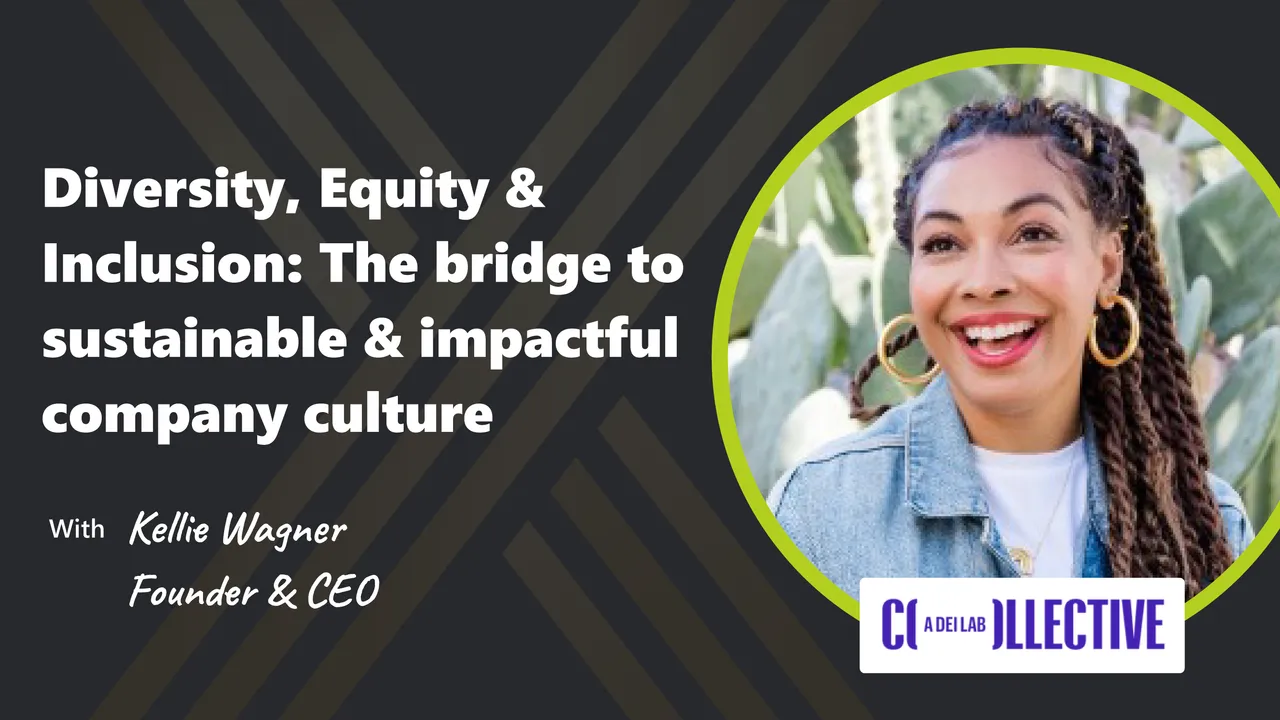
Kellie Wagner discusses how DEI bridges to a sustainable culture, highlighting leadership ownership, manager accountability, employee advocacy, and continuous listening through pulse surveys to embed equity and inclusion in everyday workplace practices.
TL;DR
What you need to know from this episode
- Trust, working relationships, and empowerment are where leaders should start. Kellie Wagner's research across thousands of employees points to three buckets that drive belonging and retention, and each one has to be worked at both the behavior level and the structure level.
- Name the behaviors, not just the values. A value like respect means different things to different people, so leaders have to spell out the specific behaviors that support or undermine it and keep resurfacing them until it feels like a broken record.
- Accountability is the hardest and most revealing step. When a high-performing rainmaker is allowed to erode the culture without consequence, employees quickly learn how little the stated values actually count.
- Culture is shared ownership, with HR as custodian rather than sole owner. Kellie frames employee contribution as civic engagement: give people real options to participate, then hold everyone accountable to some form of it.
- Listening only builds trust when feedback visibly leads to action. People can weather adversity far better than uncertainty, so pulse surveys and feedback loops matter most when leaders show that what employees say changes what leaders do.
Diversity, equity, and inclusion work is easy to announce and hard to sustain. In the 11th episode of Season 3 of CultureClub X, host Nicole Patrick sits down with Kellie Wagner, founder and CEO of Collective, a DEI lab, to unpack what actually makes inclusion stick inside a company culture. Kellie launched Collective to change the way the workplace engages with its most marginalized team members, and her consultancy has since worked with companies like Spotify, Glossier, Food52, and Taco Bell.
Her approach did not start in a classroom. Kellie spent almost a decade in tech, thinking about how products create a sense of belonging and access for customers, before she noticed the exact same barriers playing out for employees inside the workplace. That realization pulled her into grassroots, employee-led efforts like DEI councils and employee resource groups, where she saw how much power sits with the people closest to the problems.
The core question of the conversation is a practical one: how do leaders move DEI from a set of pretty words in a document to something absorbed into the everyday culture? Kellie frames DEI less as a siloed program and more as a lens laid on top of how an organization already works, and she is candid about the moments where good intentions quietly fall apart.
Where senior leaders should actually start
Kellie says the question she hears most often is simply where to begin. Culture and DEI work can tempt leaders to boil the ocean or stay permanently reactive to whatever problem pops up next. After surveying thousands of employees, Collective's research surfaced three buckets where senior leaders can drive the most impact on belonging and retention.
The first is trust, across peers, the leadership team, and the broader organization. The second is effective working relationships, especially the ability to communicate and to give and receive feedback with people who are different from you. The third is empowerment and advocacy, because a paycheck alone no longer keeps people who now have far more options. Get those three right, Kellie argues, and you create a strong sense of belonging that helps retain your best talent.
The first one is trust. So how is trust created, upheld, and sort of repaired when it's broken?
Why culture has to live in both behaviors and structures
For any of these pillars to embed, Kellie argues, leaders have to work them at two levels at once. There are the individual skills and behaviors that strengthen trust and relationships, and there are the organizational structures and people processes that either reinforce or undermine them.
Transparency in decision making ties directly to trust. The way manager and director relationships are structured shapes growth and development. Behaviors matter, but so do the systems those behaviors live inside, which is why she pushes leaders to look past posters and slogans. Solutions will look different in every company, she notes, but the discipline of working both levels at once is what carries a value from an intention into a lived reality.
How do you operationalize values so they stick
Plenty of organizations commit to culture or DEI work, Kellie notes, without asking how to operationalize it. Her recommended path has three steps. First, set clear expectations and resurface them often, even at the risk of sounding like a broken record, and name the specific behaviors that support or work against each value rather than leaving a word like respect open to interpretation.
Second, give people the resources and training to actually meet those expectations, because it is unfair to hold someone accountable for a skill they were never taught. Third, build structures of accountability, which she calls the hardest step of all.
Sometimes you have folks who are what we call rainmakers. They're really good at their job. They're really effective in things that contribute to the bottom line, but they're not showing up in a way that's strengthening the culture.
When a rainmaker is allowed to undercut the culture with no consequence, employees quickly learn how much the stated values really matter. That, Kellie says, is the moment trust is either reinforced or eroded in front of everyone watching.
What a DEI lens adds as an organization scales
Many companies build a genuinely good organic culture early, almost always a testament to strong leadership. The trouble starts as they grow and senior leaders lose direct contact with employees, letting microcultures form that drift from the original norms.
A more formalized DEI structure, which Kellie describes as a lens or a layer on top of the work, keeps culture scalable and present across every layer of the organization. It also guards against a common blind spot: a culture designed around a few types of people can feel great to them and alienating to everyone else as the team diversifies. A one-off seminar cannot fix that, because workshops only address the behavioral side while the systemic side goes untouched.
Is HR the owner or the custodian of culture
Nicole asks whether HR should be seen as custodians of engagement rather than owners, and Kellie strongly agrees. Culture is not a siloed practice HR can carry alone; it is shared ownership with leaders and managers, with HR acting as a strong resource and an innovative partner rather than only a risk mitigator.
To make shared ownership real, Kellie borrows the idea of civic engagement. Just as citizens are expected to contribute, employees who benefit from a good culture have a duty to help shape it. The practical move is to give people options rather than mandates.
Giving people options of ways that they can participate, but then holding them, again, accountable to some form of participation.
Can technology make DEI measurable
Technology earns its place in two areas, Kellie says. The first is listening. HR tech has exploded, and tools now gather feedback anonymously, annually, and through the constant read on sentiment that a pulse survey is built for, which matters even more in remote settings where no one can simply walk into the HR office.
The second is tracking data. DEI has too often felt intangible because, unlike other parts of the business, its initiatives are launched without a clear goal or any measurement of impact. Kellie's example is the team that starts employee resource groups without knowing what those groups are meant to achieve. Tracking representation and spotting where people drop out of the funnel turns DEI into something you can manage like any other function.
What keeps people from leaving when things get hard
The final thread ties everything back to listening. Many organizations now survey employees, Kellie observes, but plenty collect feedback and then do nothing with it, which is corrosive to trust. Strong feedback loops, paired with clear processes for how that feedback is used, are what keep people through hard stretches.
People, she argues, can weather adversity far more easily than they can weather uncertainty. When leaders paint a clear path forward and prove their word matters, employees will ride out a storm. When feedback vanishes into a void, hope and trust go with it, and that is when people leave. For an employee-listening platform like CultureMonkey, that is the whole point: real-time sentiment only builds culture when leaders visibly act on what they hear.

About the guest
Kellie Wagner
Founder & CEO, Collective, A DEI Lab
Kellie is a HR influencer, leader and a “Forbes Next 1000” nominee, who launched the Collective, a DEI lab, to change the way the workplace engages with its most marginalized team members. She believes in driving grassroots change through employee-led DEI initiatives that are human centered and backed by design thinking and data. Kellie’s consultancy has worked with companies like Spotify, Glossier, Food52, and Taco Bell.
Her thought-leading work on equity, intersectionality, and mental health has been featured in Forbes, GQ, and New York Magazine. She is also a seasoned DEI practitioner and renowned speaker at various HR conferences. Kellie is a graduate of NYU’s Managing Workplace Diversity & Inclusion program and holds an MFA from The New School.
Full episode transcript
Season 03, Episode 11 · Kellie Wagner with Nicole Patrick · 34 min
Hello, everyone, and welcome to the latest episode of CultureClub X, powered by CultureMonkey. I'm your host, Nicole Patrick. CultureMonkey is a complete employee engagement platform that helps people leaders to measure and improve their workplace culture.
In the 11th episode of this season of CultureClub X, we have with us Kellie Wagner, founder and CEO at Collective, a DEI lab, a leading diversity, equity, and inclusion consultancy. Motivated by her personal experiences, Kellie launched Collective to change the way the workplace engages with its most marginalized team members. She believes in driving grassroots change through employee-led DEI initiatives that are human-centered and backed by design thinking and data.
Kellie's consultancy has worked with companies like Spotify, Glossier, Food52, and Taco Bell. Her thought-leading work on equity, intersectionality, and mental health has been featured in Forbes, GQ, and New York Magazine. She is also a seasoned DEI practitioner and renowned speaker at various HR conferences. Kellie is a graduate of NYU's Managing Workplace Diversity and Inclusion Program and holds an MFA from The New School. Kellie, it's great to have you here with us today. Welcome again to CultureClub X's videocast on diversity, equity, and inclusion in the modern workplace.
Thanks so much for having me.
Before we begin, please tell us more about yourself and your organization.
Well, you did such an amazing job. Thank you for introing me. I started Collective about four and a half years ago after working in the tech space for almost a decade. I really was interested, when I was working in tech, in how we created experiences that make customers and users feel a sense of belonging, a sense of happiness, and also created access to people to better be able to use products. And what I realized while I was doing this work was that I was seeing the exact same issues and barriers play out for employees within the workplace.
And so that really motivated me to get involved in grassroots employee-led efforts at the organizations that I was at, participating in DEI councils, employee resource groups. And I saw a lot of power and impact that employees could create, because they knew firsthand the issues, because they were experiencing them directly, and often knew what they needed even more than maybe the leadership team in the organization. And so a lot of the work that Collective does is rooted in bringing leaders together with the employees who are most vulnerable, most likely to be experiencing a lot of challenges within the culture, to really design solutions that are meaningful, impactful, as well as feasible and sustainable, so that this work doesn't fall off the radar but is something that is integrated into the company culture and organizational priorities over the long term.
That's great. Well, it sounds like you're the perfect person to have for this today, for this interview. So we're very excited and lucky to have you here with us today. And let's get started.
Great.
Members often overlook what's essential while formulating policies around culture. It could be because of hurdles, or because this is low on their list of priorities. What, according to you, are the key focus areas for senior leadership to build a better culture for their organization? And how can they ensure that this is embedded in the company culture in a meaningful way?
That's a great question. I often hear, where do we start? What's actually most important? And with this work, with culture, with diversity, equity, and inclusion, you can really start to boil the ocean, or always be in this place where you're being reactive to problems that are popping up. But as Collective has done research through surveying thousands of employees over the past few years, three bucket areas have really emerged for us around where senior leaders can have the most impact to drive a culture that creates a strong sense of belonging and retains great top talent.
The first one is trust. So how is trust created, upheld, and sort of repaired when it's broken? And that can look like trust amongst peers, trust in the leadership team, and trust in the broader organization. The second one is effective working relationships. So how do your employees engage with one another? When you're working alongside other people, especially other people that are different than you, being able to be effective communicators, to know how to give and receive feedback, all of these things can create a better day-to-day experience in a way that's going to serve the business and the culture, because it's going to bring out the best in people, the most creativity, the best problem solving, and ultimately allow people to feel like they are a supportive member in the community.
And then the third bucket that I always encourage senior leaders to look at is empowerment and advocacy. In past generations, we saw employees staying at companies their entire career for 20, 30, 40 years. And now, as we just have so many more companies, employees have so many more options, I think we've realized a paycheck isn't enough. People want to feel invested in, they want to feel empowered, they want to feel like the organization that they work for really believes in them and has their back. And so that's another area that we really recommend focusing on.
Now, these three pillars are probably going to look different in different organizations in terms of what solutions look like and what that looks like in practice. But the really important thing to remember is that if you want to embed it in the company culture in a meaningful way, you have to look at these pillars both at the individual skills and behavior level. So what are the skills and behaviors that people exhibit that strengthen trust, that strengthen working relationships, and lead to people feeling empowered and advocated for, as well as the organizational structures? What does transparency look like, and how does that tie to trust around decision making? When you look at working relationships, how do you structure manager, director relationships and growth and development? So these things exist certainly through individual behaviors, but a lot of times it's really also important to be looking at the organizational structures and people processes that you put into place.
I love that you're bringing trust into it. I think that's so cool. I've spoken about this to many people and interviewed them about it. And it really is so important that, as an employee, you have trust with your employers that they're looking out for you for the long run, especially because now employees really do have so many places that they can go to. So you want to know, okay, I'm going to come here and I'm going to work really hard for you and give you a big piece of my life. And I need to know that there's going to be support for me all the way around, and that empowerment like you said. But trust that we're really going to be in this together, and not just me slaving away for you just for a paycheck. So I think that's a very cool way to put it.
I think that's the biggest difference too, right, is that our parents and our grandparents, when they came home at 5 PM, they were done. And now we're still connected to our computers, and so we work longer hours, to your point. You give such a big portion of your life to work. And so feeling like you can trust the organization is going to make decisions that not just benefit the bottom line, but benefit their people, is really important to employees.
There's no set company culture framework that can be replicated as a copy paste mechanism. Once formulated, how can people leaders ensure organizational wide scalability and permeability of good culture practices? What role can managers play in the process of change management?
It's a great question. A lot of people put a strategy into place, or say that they're committed to culture work or DEI work, but they don't really think about, how do you operationalize it? How do you make sure that it's not something that is just some pretty words in the document, but is really absorbed within the culture? So I really recommend a three-step process. The first one is setting really clear expectations and resurfacing them often. A lot of organizations, when they want to signal change, and let's say they release new values, they have a big presentation and they share it with the team, but what they don't often remember is that you start to feel like a broken record, but it is about continually repeating and going back to those values, and also moving beyond just values or cultural tenets, but naming the behaviors, the specific behaviors that support or work against those values.
I think that's a part in operationalizing that a lot of organizations miss, is they name things like respect as a value, but what respect looks like to one person may look very different to another. And so people may be showing up in ways that feels disrespectful to one person, but that person that's engaging in the behavior, because it hasn't been named that that is a behavior that is going against the value of respect, doesn't even realize the harm that they might be creating to the culture. So being really specific and giving people very clear behavioral expectations is super important. And one way that managers specifically can support in that part of it is really referencing values and cultural norms whenever they're giving feedback. Feedback, when it's ongoing, is actually a really great tool for reinforcing culture, because it's not necessarily just about skills or work performance issues. It's also about how are you doing the work. So that's a really great, easy touch point for managers to continue to reinforce those expectations.
The second is giving people access to the resources and trainings that they need to upskill around those behaviors. So once you say, hey, these are the expectations of this culture, and this is how we want you to show up, it's really important to be able to identify where in our teams, or across different levels for our managers, might they be missing the skills to really be able to meet those expectations, or awareness to be able to meet those expectations, and then to invest in them. Because it's not enough to say, hey, I want you to do this. If the person genuinely doesn't know how, they need practice, and they need frameworks. It's really hard to hold someone accountable when they're saying, hey, I don't know how to do that. And so managers certainly can advocate for that, be aware where they're seeing skills gaps in their team, and even invest in themselves to continue to develop themselves.
The third one is creating structures of accountability. So once you've named the expectations, once you've given people access to the skills and resources to be able to follow through on those behavioral expectations, it's really important then to hold them to those things. That really goes back to trust in your organization. When a value is stated and behaviors are clarified, and then people see that, hey, there are folks who aren't engaging in those behaviors, or maybe are even engaging in behaviors that go explicitly against our values, and they're allowed to stay at the organization, or the issue isn't addressed, that can really erode trust. And it sort of makes the values or the cultural norms that you're trying to say are important seem like actually they're not that important at all.
And I found that organizations, actually, this is probably the hardest part, because sometimes you have folks who are what we call rainmakers. They're really good at their job. They're really effective in things that contribute to the bottom line, but they're not showing up in a way that's strengthening the culture. That's that moment when you can tell, and when employees see, how important are these cultural norms and these values that you're saying you want to drive if you're not addressing it in the hard moments when it's really important to do so.
Totally. And it's really when a company then can kind of put their money where their mouth is and show, okay, we really are here for you. And even though maybe the bottom line isn't being helped, if you've got a rainmaker and they're really helping with the bottom line but they're not helping with the company culture, that's when you can show, no, this has to change. Or employees aren't going to be having that trust with them if you just look away. So I think that's a very interesting way that you put it. I like the rainmaker analogy with it.
Recently, many big companies known to have a good company culture have reported a lack of proper DEI initiatives. How do you think the lack of proper DEI initiatives in an organization can affect the company culture? And why is just conducting a seminar or workshop on DEI not enough?
There are a lot of companies that get to a certain place in their development, in their growth, and have a really great organic culture. And that's almost always a testament to great leadership. That being said, as an organization grows, and leaders, especially senior leaders who may have shaped the culture initially, aren't having as much direct access with employees, I think that's when things start to slip through the cracks. When, again, the cultural norms become less scalable, you start to see teams start to have different microcosms and microcultures that go against what the culture has historically been. And so having that more formalized DEI structure, and I always call it a lens or a layer on top of the work, allows you to, again, operationalize, make sure that what you are trying to create is able to be sustained and is able to be present throughout all layers of the organization.
I also think that we go into companies that might have a great culture, but when they start to grow and they look around, they realize, hey, we're also pretty homogenous. And so a great culture can be really great for one type of person or a few different types of people. But as you get bigger, and especially if you're growing with a lens for increasing the representation of different identities and lived experiences on your team, what often happens is that the culture no longer is great for everyone. It was designed with certain types of people at the center of it. And so having those DEI initiatives just allows you to continue to make sure that you're bringing people into the fold, and making sure that you don't look five years down the line and there are certain people who are saying, hey, I actually don't feel a part of this culture. I don't feel like it serves me. My trust in the organization looks very different than those folks.
And then, why doesn't just conducting a seminar or a workshop on DEI solve for the issue? Again, it's just a single touch point. And also, it's really important to think about what workshops are designed to do, which is they're designed to address behavioral issues. And like we said, it's so important that with DEI work, with culture work, that you're looking at it both at the systemic and organizational level, as well as at the behavioral, interpersonal, individual level. And so workshops are really only designed to tackle one part of that equation. So having a more formal program and strategy in place allows you to make sure you're hitting the challenges from all directions.
Absolutely.
Do you agree that HR are the custodians of employee engagement and the subsequent culture practices, not just the owners? If so, what are your thoughts on this?
That's such a good question. And it's interesting, over the past four and a half years that I've been running Collective, this question of HR and the people function, and how it's shifting, has been so front and center. In a lot of companies, HR are put in charge of being the ones to lead and own, whether it's company culture, whether it's diversity, equity, and inclusion more specifically. It sort of falls on their plate. And I think that we're starting to see that shift, in the sense that we're recognizing that HR can't be the sole owners, because this work, again, it's not a siloed practice. It's something that you layer on top of all the ways in which you work. It's how you work. And it's not just specific to some of the functions that HR has historically been in charge of.
In terms of being custodians, in many ways I think that that's actually more of an apt way to look at what HR can do than simply the owners. Because I think it's shared ownership. I think especially it's shared ownership of leaders and with managers. But I would look at HR as being a really strong resource, especially if they are, again, evolving with the ways in which the people function is needing to evolve, and educating themselves on DEI functions, on placing themselves not just as a risk mitigator but as an innovative partner, to think proactively about how to engage, grow, retain employees. And so in that sense, they play a really impactful role, or can play a really impactful role, in being a resource and a partner to the broader senior leadership team, to the broader team as a whole. And I think with the lens of not just being asked to solve these problems, but being able to help upskill employees and managers to be able to better navigate conflict that arises, and to encourage other people to also be custodians of this work.
Exactly. I think that sometimes if you just lay everything onto HR, and, oh, that's their problem, they'll deal with it, then no one really takes the responsibility for the company culture, when, in reality, that's something that everyone needs to take responsibility in. So when they're the custodian, then maybe they're the people that you go to if you need a little bit of guidance, or to make sure everything's kind of going in the right way and oversee everything. But it really is important that everyone is responsible for the company culture, and it's not just kind of brushed under the rug for HR to deal with. So totally agree.
One of the ideas I like to use with my clients, I talk a lot about this idea of civic engagement. So as a citizen of a country, you have things that are expected of you. You're expected to pay taxes. You're encouraged to vote. Things like that. And I think of it similarly in a company, which is, at a company, you are benefiting in certain ways, whether it's financially through a paycheck, but even especially if there's a good culture, you're benefiting from the culture and the resources that are invested in you. And in return, what is your duty to continue to drive and shape that culture in a positive way? And so when we're building strategies with our clients, one of the things we often talk about is creating very clear expectations with all employees of how they can contribute to the culture, and not necessarily mandating specific things like you have to be on a DEI committee, but rather giving them options. Here are ways that you can support the culture. Here are ways that you can drive. You can take a training to build more awareness so that you can better engage with your colleagues around a particular background. You can be a part of a DEI task force and put on an event, or participate in sitting on a recruiting panel. So giving people options of ways that they can participate, but then holding them, again, accountable to some form of participation.
I think also in this day and age, that's so important, because like we said, you take your work home with you. And that really is a huge part of your life. And people want to be a part of a good company culture generally. So I'm sure that you find that people really do want to go and say, hey, you know what, maybe I will do this little program of learning how I might be doing something wrong, or I might be able to learn how to engage in a better way, or be on a committee. I'm sure that people really are positive around that and want to be a part of that, which is a cool thing to have.
How do you think people leaders can leverage technology to implement DEIB initiatives in their organizations? And what part does listening to employees frequently play in that?
It's a great question. And especially for organizations that are growing, or that are larger, technology can play a really big part. The area that I found it to be most helpful is certainly surveying. There are lots of tools now to gather feedback from your employees. And, again, Collective, at the root of how we build strategies with our clients, is through listening to employees, to first understand what is your experience, but also to listen to their ideas for how things could be better, could better serve them. And there are just such a plethora now. HR tech has sort of exploded in the past several years. And there are so many tools and platforms out there to gather feedback, both anonymously, as well as ways that are attributed, in more of an annual frequency, as well as using pulse surveying to be constantly keeping the pulse on how your employees are feeling, so that you're not waiting for a whole year to go by to hear from them. And so I think that's a really wonderful use of technology, especially in a remote environment where people aren't just walking through the offices. You can't hop into the HR office to share feedback.
The other piece that I'm hoping and seeing more technology evolve in, and I think is super important, is using technology to track data. One of the things that has made DEI and culture sometimes feel like this intangible thing, and something that a lot of folks in organizations have to work really hard to advocate to get budget for, is that, unlike a lot of other areas of a business, we don't always track data to show if the strategies that we're putting into place, the initiatives that we're investing in, are actually having the impact that we want them to have. And I see a lot of folks even put initiatives into place without even having any clear idea of what it is that they want the initiative to accomplish. So let's say we launched employee resource groups. Great. What are you hoping that the employee resource groups are going to do? I don't know. I just thought that we were supposed to have employee resource groups. Well, that's great. I think they're a great tool, but knowing what the tool is meant to do, and then seeing if it's actually doing that, is really important. And it's akin to how you would run any other department or function within the business.
So I think there's some great technology out there to gather data, whether it's representation and seeing, if you're saying we want more diversity in these particular parts of the business, being able to see and track if that is happening, and also being able to see where you might be losing folks in the funnel, and being able to then use that to make better decisions and improve your processes for the results that you want.
Absolutely. And that's where we at CultureMonkey jump into things, and we make sure that by allowing people leaders to constantly check the pulse of their employees, that they're able to use that feedback and actually take actions on it. And like you said, not just wait once a year to speak with people, but check in with them every few days, every few weeks, and make sure that they're actually, A, keeping people happy, but taking that feedback and using it for the future, and to make sure that everyone feels included and heard. So it's a very exciting time for tackling it that way.
What, according to you, should top business leaders focus on with respect to DEIB policies to avoid attrition due to DEI-related issues within an organization?
I think having really strong feedback loops, like you just mentioned, and setting really clear expectations and processes around how that feedback is utilized. I do think that I see a lot more organizations these days surveying their employees. I think it's a pretty common practice now, and gathering feedback, but I also see a lot of companies that then don't do anything with the feedback. And when you go back to trust, and you think about what keeps people at an organization, even through the hard times, it is that trust that we may not be where we want to be, but we believe that the organization is going to address these issues. And so I think one of the biggest things that I've seen that keeps people in an organization, even when things aren't maybe where they want them to be, they don't necessarily see leaders that look like them, or they're having interpersonal issues, is when they see their feedback taken and used to influence decisions forward for how to fix those and address those challenges.
People, I heard this at a conference recently, and I now think about it in so many different contexts, which is that people can tolerate adversity much better than they can tolerate uncertainty. And so I think when you can paint a clear path forward, and you have shown that your word matters, that what you say you're going to do, you're doing, people are willing to kind of weather that storm a lot longer than when they feel like they're not sure where their feedback goes, if it matters, or even worse, if they feel like, oh, my feedback actually does not matter. I've seen evidence to say that this feedback goes nowhere. I think that's when you start to see people leave, because they don't have hope at that point. They don't have hope, and they don't have trust in the organization that things are going to improve.
I completely agree, and that's very interesting, what they said in that conference. I like that.
I love your views on all the things we discussed, Kellie. Your answers were truly reflective of the human-focused approach you take in your consultancy as well. Your unique perspective definitely adds a lot of value to this space and is a major learning for all of us. In my opinion, to make any policy human-centered, people leaders need to pay a lot of attention to their employee sentiment. Only when they put people first can they achieve the result they expect. CultureMonkey actually solves this for people leaders so effectively. Its employee feedback platform enables leaders to constantly listen to their employee sentiments in real time, provides them with real-time analytics, and lets them take decisive action. So if you want a super swift tool to improve your company culture, visit www.culturemonkey.io today. With that said, thank you so much for your time, Kellie. This was a very interesting and engaging discussion. I'm sure our audience will agree too. Please let our viewers know how they can connect with you and share their thoughts on this topic.
We always love meeting new people at Collective. You can check out more about us at www.hello-collective.com, and you can also follow us on Instagram, LinkedIn, @collectivedei.
Well, that's all we have for you in this episode of CultureClub X powered by CultureMonkey. Until next time, this is your host, Nicole, signing off.
Frequently asked questions
Where should senior leaders start when building a better company culture?
Kellie Wagner recommends focusing on three areas her firm identified after surveying thousands of employees: trust, effective working relationships, and empowerment and advocacy. Trust spans peers, the leadership team, and the broader organization; working relationships hinge on communication and giving and receiving feedback; empowerment reflects that a paycheck alone no longer holds people who have many more options.
Crucially, each pillar has to be addressed at both the individual behavior level and the organizational structure level, so that transparency, decision making, and growth processes reinforce the behaviors leaders want to see.
How do you operationalize company values so they actually stick?
Kellie describes a three-step process. First, set clear expectations and resurface them often, and name the specific behaviors that support or work against each value instead of leaving a word like respect open to interpretation. Second, give people the training and resources to meet those expectations, since it is unfair to hold someone accountable for a skill they were never taught.
Third, build structures of accountability and apply them even to high performers, because employees judge how much a value matters by whether it is enforced in the hard moments.
Is HR the owner of company culture or the custodian?
Kellie sees HR as a custodian rather than the sole owner. Culture and DEI are not siloed practices HR can carry alone; they are shared ownership with leaders and managers, with HR acting as a strong resource and an innovative partner rather than only a risk mitigator.
She uses a civic engagement analogy: employees who benefit from a good culture have a duty to help shape it, so leaders should give people clear options to participate and then hold them accountable to some form of participation.
Why isn't a one-off DEI seminar or workshop enough?
A workshop is a single touch point designed mainly to address behavioral and interpersonal issues. Kellie stresses that DEI and culture work has to be tackled at both the systemic, organizational level and the behavioral, individual level, so a workshop only ever covers one part of the equation.
A more formal program and strategy lets an organization hit the challenges from all directions and keep culture scalable as leaders lose direct contact with employees and microcultures start to form.
What role do pulse surveys and feedback loops play in retention?
Kellie points to strong feedback loops, plus clear processes for how feedback is used, as central to keeping people. Pulse surveys let leaders keep a constant read on how employees feel instead of waiting a full year, which matters especially in remote settings.
The catch is action: many companies gather feedback and then do nothing with it. Because people tolerate adversity better than uncertainty, employees stay when they see their feedback influence decisions, and they leave when it appears to go nowhere.
Read the cross-episode roundups
More from CultureClub X
 S07 E03employee engagementWhy do grievance procedures damage workplace culture? | David Liddle, The TCM Group
 David Liddle
 S06 E19change leadershipFrom Cost Center to Catalyst: How CPOs Turn People Strategy Into Business Advantage, with L. David Kingsley
 L. David Kingsley
 S06 E17ai in hrHow do you build trust and belonging in the age of AI? | Jessica Smith, Reframing HR
 Jessica Smith
Never miss an episode
Every new episode, plus the takeaways that matter, posted on the CultureMonkey LinkedIn page as soon as they drop.
Free on LinkedIn. Unfollow anytime.