

S03 E04
Why Collaboration Retains Talent Better Than Pay
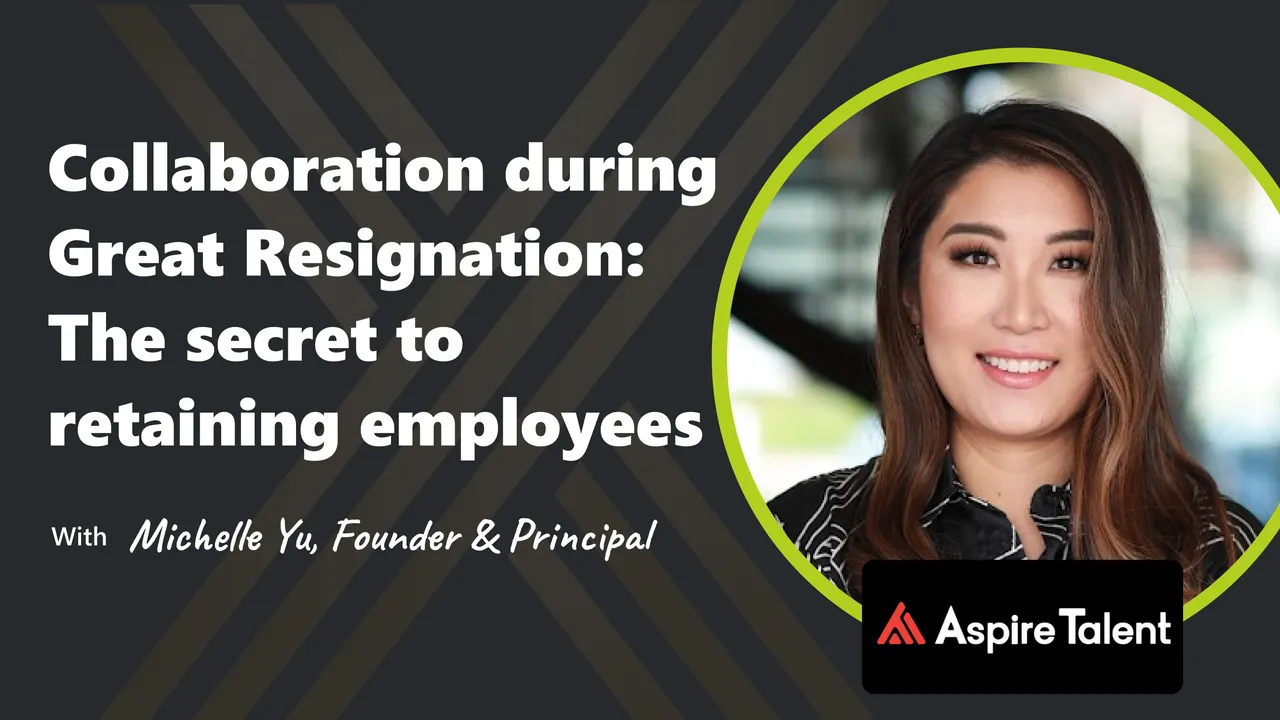
In this episode, Michelle Yu reveals why collaboration and culture, not just pay, are the real keys to retaining talent during the Great Resignation, urging leaders to embrace employee needs, invest in growth, and foster genuine connection.
TL;DR
What you need to know from this episode
- The Great Resignation surfaced problems that were already there. Michelle Yu frames the pandemic as a catalyst, not a cause, that exposed long-standing strains around employee healthcare, mental health, and fair pay.
- Retention is won across the whole employee life cycle, not just at hiring. Companies over-invest in recruiting and onboarding, then neglect the development, leadership growth, and career pathing where people actually decide to stay.
- Culture change fails when it is performative. Blanket DEI or wellbeing statements do not stick without genuine appetite from senior leaders and the small day-to-day actions that show the shift.
- Technology works best as an early-warning system. Pulse surveys and quick check-ins let leaders spot discontent and respond proactively instead of reacting after someone has already resigned.
- Coaching and one-to-one support retain people that pay alone cannot. Customized support in a space separate from the employer builds individual skills while benefiting the company.
The Great Resignation left a lot of leaders scrambling, but Michelle Yu had watched the pressure build for years. As founder and principal at Aspire Talent, a boutique agency that pairs HR consulting with one-to-one coaching, she is brought in when organizations hit a moment of transition, whether their people team is stretched thin or a gap has opened between the values they preach and the way they actually operate. She is a career and leadership coach and HR consultant with more than a decade of experience across people operations roles in tech, including a stint as head of HR Operations at SoftBank.
In this episode of Culture Club, hosted by Nicole Patrick, Yu digs into the question every people leader was asking at the time: what really drove employees to leave in such numbers, and what does it take to make them stay? Her answer keeps returning to two things money alone cannot buy, collaboration and culture.
Rather than treat the exodus as a single event, Yu frames it as the surfacing of problems that had been swept under the rug for a long time. The pandemic, in her telling, was less a cause than a catalyst that gave workers both the reasons and the options to rethink where they wanted to be. That reframing runs through everything she says: the fixes are less about firefighting departures and more about the everyday practices that make people want to stay.
What actually triggered the great resignation
Yu is careful not to pin everything on the pandemic. The underlying core issues, she says, had been brewing for a while, especially in the US, and the crisis simply brought them to light. Employee healthcare, mental health, and fair pay were long-standing strains that suddenly became impossible to ignore once a worker shortage set in.
She reads the moment as a melting pot of elements: the mental health toll on workers, the need for flexible environments for parents, and a wave of social reckoning around DEI. Together these pushed employees to question whether they were in the right place and how their employer was responding when it mattered most.
Crucially, Yu sees a catalyst as an opportunity rather than a threat. Once problems are visible at the surface, she argues, organizations can finally take proactive steps to resolve them instead of letting them fester. The leaders who treat the moment that way are the ones who come out of it with stronger, more resilient cultures.
Why retaining people matters as much as hiring them
For Yu, the fix starts with seeing the whole employee life cycle rather than obsessing over the front door. Companies pour energy into recruiting and onboarding, then lose interest once someone is in the seat, even though leadership growth, support, and career trajectory are where retention is won or lost.
it's so expensive to hire and it's painful when you lose people.
The economics reinforce the point. When a recruiter takes 10 to 25 percent of a hire's compensation as a placement fee, a revolving door gets expensive fast. Yu argues it is smarter to find the pillars of why people leave than to keep reacting with a fresh candidate pipeline, so the later stages of the life cycle get the same care as the first day.
Her warning is against a common trap: treating new hires beautifully while forgetting everyone already in the building. Sustainability, she says, comes from looking at the experience entirely, from the first interview through every promotion and role change, rather than churning people in and out.
How remote and hybrid work strained collaboration
The shift to remote and hybrid work is where communication fell apart, or at least had the potential to. Yu recalls coaching people who started new roles entirely online, unable to meet teammates or read the culture of a company from a distance. She points to deliberate design, Slack channels, networking events, anything that ropes new joiners into the fold, as the antidote.
She also flags a generational split. Some employees are so accustomed to in-person work that letting go of it is hard, while early-career clients are starting their first jobs having never known an office. Bridging that spectrum, she says, comes down to identifying the best way to communicate for each person.
Why lasting culture change beats performative gestures
Yu is blunt about change theater. Saying DEI or wellbeing matters as a blanket statement, because everyone else is doing it, does not stick. Real change needs genuine appetite at the top, because culture trickles down from the most senior leaders who either embody the values or quietly let them fall apart.
the small day-to-day actions that show the shifts versus the big push and the big initiative.
What makes culture durable, she argues, is the accumulation of small details: a manager offering acknowledgement, opening space for uncomfortable conversations, or checking in on someone's sense of belonging. She pairs that with measurement, urging companies to embed KPIs and keep pulse checking against the objectives they set at the outset rather than declaring victory in month one.
Can technology help leaders retain and scale
The past decade's boom in HR tech gives leaders more tools than ever, though Yu admits the sheer volume can be numbing. Beyond performance management and pulse surveys, she points to modern learning and development, new perk vendors, and platforms like Oyster, Deel, and Remote that handle the administration of international workers when mobility becomes a retention lever.
Her practical advice is to start where the signal is clearest. Quick check-ins and a pulse survey tool let organizations see where people are at, surface why someone is disgruntled, and respond proactively instead of reacting after a resignation lands. Normalizing that technology, she notes, has also transformed coaching and training, letting practitioners work across cities and time zones without the old boundaries of location.
Why coaching and one-to-one support build resilience
Yu is open about her bias as a coach, but her case is straightforward. Organizations can take a better stance by giving struggling employees customized, one-to-one support in a space that sits outside the reporting line.
organizations can take a better stance with providing customized or one-to-one support for their employees who might be struggling.
That kind of support, she argues, builds skills the individual keeps while also benefiting the company, and it belongs alongside mental health services rather than in place of them. It is a reminder that retention is ultimately personal, earned one relationship at a time.
Yu is upfront that this is her bias as a coach, but the underlying logic holds beyond coaching itself. Whether the vehicle is coaching, training, or learning and development, the aim is the same: give people a safe space to grow so they build commitment to the organization instead of quietly planning their exit.
Listening as the foundation of retention
The thread running through Yu's answers is that people stay when they feel heard and see their value reflected back. Pay alone will not hold them, but a culture that notices discontent early, acts on it, and keeps the conversation going through the whole life cycle will.
That is where an employee listening platform earns its keep. Continuously capturing employee sentiment and closing the loop on it turns Yu's advice into a repeatable practice, so leaders can give people enough reasons to stay long before they start looking for the door.

About the guest
Michelle Yu
Founder & Principal, Aspire Talent
Michelle is a Career & Leadership Coach and HR Consultant and a keynote speaker with more than a decade of experience working in various people operations roles within the Tech industry. In the past, Michelle has spoken at companies like Google and NBC Universal, and has been featured in outlets like CNBC. Prior to her current stint as the founder and principal of Aspire talent, she was the former Head of HR Operations at SoftBank, and has worked at companies like Google and Groupon.
Her work majorly focuses on helping both individuals and organizations bring further alignment to their values. She specializes in coaching leaders in bridging the gap for underrepresented populations, in particular women and people of colour. She received her MBA from Duke, and is also an ICF certified coach.
Full episode transcript
Season 03, Episode 04 · Michelle Yu with Nicole Patrick · 26 min
Hello, everyone, and welcome to the latest episode of Culture Club powered by Culture Monkey. I'm your host, Nicole Patrick. Culture Monkey is a complete employee engagement platform that helps you to measure and improve your workplace culture and listen to your employees better.
In this latest episode of this season of Culture Club, we have with us Michelle Yu, founder and principal at Aspire Talent. Michelle is a career and leadership coach and HR consultant with more than a decade of experience working in various people operations roles within the tech industry. Her work focuses on helping both individuals and organizations bring further alignment to their values.
In the past, Michelle has spoken at companies like Google and NBC Universal and has been featured in outlets like CNBC. Michelle was the former head of HR Operations at SoftBank and has worked at companies like Google and Groupon. Coaching-wise, she's especially focused on bridging the gap for underrepresented populations, in particular women and people of color. She received her MBA from Duke and is an ICF certified coach.
Michelle, welcome again to Culture Club's video cast on the great resignation and retention challenge and its impact on organizations across the globe. Before we start, please tell us a little more about yourself and your organization.
Thank you so much for having me here. I run a boutique agency called Aspire Talent, and we're both focused on HR consulting and also coaching individuals. So really we get brought in to help organizations while they're at a time of transition, whether it be being really lean on their HR team or realizing that there's a people tax or there's a gap in how they're currently running things. So we like to come in and help organizations just improve their existing processes and live up to the values that they preach.
That's great, and we can't wait to hear more about what you have to say on this topic. So let's get right into it.
Organizations were caught off guard by the great resignation. Were there signs of this drive, and did people ignore it before the pandemic struck? What could be the factors that drove the paradigm shift in employee expectations?
I would say that the whole pandemic was a big catalyst for all of this. And it's hard to say that the pandemic caused it, but I would say that these underlying core issues have been brewing for a while, especially in countries like the US where there have just been things that have not been working for a while, and the pandemic really brought a lot of these things to light. For example, just like employee healthcare, mental health, all of these things that have been sort of swept away underneath the rug for some time.
And then when the pandemic came and we realized that there was going to be a shortage of workers, and they're not getting paid fairly, it just brought a lot of these issues to the forefront. And sometimes the catalysts are a great movement for change, and recognizing that now that we see all these things to the surface, we can now take steps to proactively resolve them. So there's just been a series of incidents over the last two, three years now that have really shown that change is needed.
Of course, the pandemic and its effect on mental health and workers, the need for more flexible working environments for parents, DEI, especially with George Floyd and the rise of the Asian hate crimes. So I think a lot of these social issues have put a spotlight on organizations of how are they going to be supporting their individuals, especially during these crucial times.
So I will say it's a combination of all of that, and bringing it to light and helping employees know that they have options, and to really question if they're in the right spot and how their organizations are responding to these things. That I would say has been like a mix and a melting pot of elements that are causing people to rethink, to question whether they should leave and look for better opportunities. So that's my view on this.
It's almost like it was the perfect storm and everything was brewing beforehand. And then the pandemic was just the rain clouds going down.
Absolutely, yeah.
Hopefully there are brighter days ahead for everyone, because now they're more concerned with actually having a healthier work-life balance and having all these important things in their work life. So it'll be interesting to see what's to come.
Do you think the great resignation is the linchpin that will lead companies to adopt a more employee-centric model?
So I will say that in the past, at least from my personal experience, when we think about employees, we have to think about their entire life cycle within an organization. There's so much emphasis on the earlier stages, like let's get them in, let's recruit them, let's onboard them. But when we think about once an individual has been placed in an organization, there's so much to continue developing. How do they become better leaders? How do they get the right support that they need? What's their career trajectory going to look like? Performance, all of that.
So there's this shift of recognizing, it's not just now, of course we're having challenges like bringing them in and getting people through the door given all that's going on, but there's also challenges with retaining people. And if anything, it just shows that it's the entire life cycle that we should really be focusing on, not just getting fresh people in and new perspectives, but how do you actually continue to develop that?
And the other comment to that too, is it's so expensive to hire and it's painful when you lose people. So if you think about an average recruiter, and they're taking maybe 10 to 20%, 25% of the person's compensation for a placement, if you're doing that, you're placing people and then they're leaving, it's going to be expensive for the company. And why not then just try to solve and find the pillars of what's having them leave versus constantly reacting to getting a new candidate pipeline in?
So I think if we just take a step back and recognize there's a whole array of support that employees do need, and it's not just at the beginning, we don't want to just treat our new things really well and then forget about the old. It's like, let's look at everything entirely, because that's really what's going to allow more sustainability for organizations. Instead of just in and out, in and out, let's take a step back and see what's not working at the later stages of the employee's life cycle.
Yeah, that's actually where technologies like Culture Monkey can really help employers. When you onboard an employee, especially if you onboard employees early on in the game and then are scaling, it's important to make sure that they're continuously happy so that you don't have to spend that money to rehire, and so that you can really retain the top talent for your company and be able to check in all the time and make sure things are working for them. And if it's not working, see why that is.
Because when you grow and expand as a company, things are going to change, and employees are going to have to change with them and grow with them. And it's an amazing opportunity for employers to learn and to see really how to create the best company culture for everybody around. So that's interesting. You kind of tied that in with what we do.
Yeah, absolutely. And it's so needed too, right? If you're able to use technology to pulse check where people are at and how they're feeling and identify that, and maybe they're disgruntled because they're not able to voice open feedback to their manager, or they're disgruntled about compensation or whatever it is, the more touch points that you have in the safe space that employees are able to share this, then it allows organizations to respond in a more proactive measure versus, oh no, now they left, and now they're going to be reacting to finding a new person in their spot. So absolutely a big fan of technology and leveraging it as a way to proactively assess how employees are feeling.
What role do you think the lack of collaboration plays in people leaving the organization? How can companies combat the great resignation by creating the culture of connection?
Right now is an interesting time because we've moved into remote working arrangements and hybrid working arrangements. And I think with that, that's where the communication fell apart, or has potential to fall apart, I should say. Because if we think about March, 2020 when the pandemic first started, it was like everybody had to be forced into this new way of working and there was a lot of change there. But now as people start to settle in, they're getting more into rhythm.
And I remember coaching a lot of individuals who would start new roles and they're starting in a remote environment. They're not able to meet their team members or having a hard time finding ways to connect, to communicate, to find out what's the culture of a company, especially remotely. So there's ways organizations can help to design and embed people into that cycle and really help to rope them in, or create things in place, Slack channels, networking events, whatever it is to really help bridge that communication.
But I would say that because we've had to move into and adopt different working styles, that's where people had to start to adjust of how do you work with someone that's in a completely different time zone that you'll never see? How do you build rapport with them? And at the core of it, it really is identifying what's the best way to communicate.
That makes sense. It's interesting because it's almost like right now everyone has a fresh slate, and we can start to create these new ways of connecting in an environment that's for most people very new and still touch and go. So if we can collectively now start making sure to pay attention to these things that employers weren't really paying attention to before, there's a possibility for everyone to really have a better future.
Right. And I think part of it is also potentially generational, because there's going to be people who have been in the workforce and they are so accustomed to doing business a certain way. They're really keen on in-person, and that might be hard to let go of, and to recognize you can still do that, but in a different setting. And that comes down to communicating and figuring out those channels, but it could be a generational thing.
And now I have some early career clients who've had to start their first role ever in a remote environment, and that's also different than someone that's been on the other spectrum only accustomed to in-person communication. So now there's a whole spectrum and a whole blend of how do you do this? How do you socialize folks to it? So it'll be interesting to see in a couple of years where things land and what the general sentiment is, because we can see the benefits of both, but it's now just figuring out what is the right balance.
How can companies craft changes that aren't just quick fixes, but long-term strategy shifts that will help them thrive during and after the great resignation period?
My response would be that there has to be a big desire to drive change, right? Change for the sake of driving change isn't going to be sticky enough. For example, you can't say, oh, DEI is important, and then just use that as a blanket statement because everyone else is doing it and because it's performative. And you can say that for DEI, you can say that for mental health and employee wellbeing. You can say that for a bunch of different things, but I think at the core of it is, is there that appetite and is there a true desire to drive change? And are the people at the top committed to doing that? Because that's really where the culture trickles down to the rest of the organization. And you need to have your senior most leaders really embodying those values and really being a champion and an advocate for it and living up to it. Otherwise, it's just going to fall apart.
So, going back to your point, it really has to be an initiative that a company is really wanting to commit to, and upholding people and training people on small little ways that they could drive the change. Not just a big one and done, but continuously. It's almost like it's the small day-to-day actions that show the shifts versus the big push and the big initiative. Culture is hard to describe because it can be a very intangible thing, and it's oftentimes in the smallest details of, oh, the manager giving acknowledgement, or creating the open channel for bringing up uncomfortable conversations, or really asking and checking in on someone's mental health or how they're feeling about belonging and inclusivity. So it's really those small things that have to be pushed forward day in and day out versus just, hey, we're going to be doing this. It's like, how do you actually continue to follow through with it to actually drive long-term sustainable change and ultimately to change the culture?
I was just speaking in one of our past video casts with somebody about this, and what we were talking about is empowering managers to really feel like they are able to then create a culture with their employees, and having it from a top down level of making sure that everyone is empowered to create this company culture and not just have blanket statements of the top people saying, oh, this is what we're going to do now, and this is our new mission statement for DEI.
And so it's interesting, you would almost hope that, because of course not every company does have these people leaders, especially at the top, that are caring about these subjects and really caring about their company culture, but you would hope that at least they would take a cue from other companies that they're seeing that it's successfully working for. And maybe even if it's not the best reason to start with that they're doing it, at least they're beginning to do it hopefully in the future.
Right, and with everything, it's like how then do you start to embed KPIs? If you're going to say this is a big crucial initiative, how do you start to measure the effectiveness of that over time, not just the month of, because they had to get it out, but in a quarter's time, in six months time, in a year's time, how are they still holding up to the objectives that they set at the onset of that project, and where's the mismatch? And that's what companies need to be doing over the long term, not just out of reactivity to what other people are doing or responsiveness to the employee sentiment, but let's measure it and see how things are going. And even the next stage is pulse checking with the employees, like how do you feel the company is doing with these initiatives that they sought out to do, and taking that data and feedback really to heart, because that's what's going to drive the change.
How can people leaders leverage technology to help them with the retention process, and how do you think it can help in scaling your organization?
It has been a big rise of HR tech over the last, I would say, decade, and HR tech is definitely booming. There's a lot more startups in this space and a lot more services there. And there's a couple of things outside of just, of course, the performance management, retention, pulse surveys, all of that, that is great. But HR tech also could look like online trainings and learning and development that is available and accessible through a modern means, not just a very clunky interface.
You could even think about what are some of the additional perks. There's a lot of new perk vendors like Fringe, and you can break it down into family planning, fertility, all of these things that are also built on an internet and tech-based platform. So we're seeing perks available there. We're even seeing a rise of HR tech for international expansion, office expansions, which can be great if you're trying to retain people and you want to give them mobility and a different work environment experience. There's now HR tech like Oyster and Deel and Remote that helps with the administration of international workers. So there's just a lot out there, and I think it's kind of numbing actually, because it's like, where do you even start?
But definitely thinking about pulse surveys, utilizing quick check-ins, performance management tools, new online perks that are available, and then even going broad to HR tools that can help with international support.
It's really exciting. It's an exciting time to be in this field, and at Culture Monkey, it's really exciting for us to be able to offer that support to employers, to be able to constantly check the pulse of their employees and ride it out for the long term with them and make sure that they're able to retain these employees for a long time. And I think all of those companies that you've just mentioned, it's such an amazing opportunity now to be able to use the power of tech to keep employees on and to make sure that we can make a better culture for all of them.
And like you said, not just clunky websites that are just saying, oh, fill out this survey, what do you think about this? But actually enticing employers and employees to use the services to their advantage. And I think it'll be really cool to see in the coming years how that expands and develops now that so many people are working from home and they are remote.
Totally, and there's definitely an adjustment of realizing that it's normalizing HR technology in coaching and training spaces. Before, I remember even before the pandemic, I had a coach and I had online sessions, and I was like, well, I'd rather meet you in person and do the sessions in person. But then honestly, since the pandemic came, it's like you can do a lot of this remotely, and you can be working with people in different cities and time zones and countries, and getting training from people in all sorts of locations. So we can really thank the technology for allowing this interconnectedness that takes away any boundaries of location. So it's definitely a unique time that we're in, and I'm sure it's going to continue to evolve in the future.
Absolutely. That just made me realize and think about, I can't imagine what life would be like had this happened 10 to 15 years ago, and where we would be right now, not being able to do video calls and just kind of the world having really stopped still. It's crazy to me.
Right, it would be like, oh, let's go and meet in person and hire someone to record us while we're having a conversation in person, versus, okay, let's hop on a Zoom call and make this accessible to whoever wants to watch it, right? So it's definitely a changing sentiment that technology is playing.
Yeah, exactly. Very lucky that we had it around during the pandemic.
So the great resignation has forced organizations to take a hard look at their employee relationships. What can organizations do to truly improve the employee experience and retain top talent?
So I'm a bit biased because I'm a coach. So I'm a huge fan of coaching and training and learning and development. And I do think that organizations can take a better stance with providing customized or one-to-one support for their employees who might be struggling. The safe and open space that is separate from their employer so that they can not only build the tools and the skills that they need for themselves, but also it ends up benefiting the company as well. So coaching is one of my big things that I'm advocating for that companies should be doing, in addition to mental health services as well. But there's just a lot. I'm biased, so I'm going to press for coaching.
That is such a great take on a topic that is being talked upon by many organizations today, Michelle. I was going through your profile earlier. One of your recommendations talked about you being a master of navigating ambiguity and getting things done with forward thinking strategy. And your answers today were truly reflective of those traits.
Thank you so much for your time, Michelle. This has been such an enriching experience for all of us. I'm sure our viewers will gain immensely from your thoughts. Before we finish, please let our viewers know how to connect or reach out to you in case they want to have a quick chat or share their thoughts with you.
Yeah, absolutely. The best way to connect is on LinkedIn. So it's LinkedIn.com/in/michellekyu, or you can go on my website, michellekyu.com. If you're interested in consulting services for your organization, it's aspiretalent.io. So you'll be able to find me through social media.
Great, thank you, Michelle, for helping us understand the needs of such a dynamically changing topic. It was a great pleasure to have spoken with you today.
Awesome, thank you so much for having me.
Of course. I'm sure topics like the great resignation have affected our viewers or someone around them. To listen to your employees better and use real actionable insights to increase retention rates, visit www.CultureMonkey.io today. That's all we have for you in this episode of Culture Club powered by Culture Monkey. Until next time, this is your host, Nicole, signing off.
Frequently asked questions
Was the Great Resignation caused by the pandemic?
Not directly, according to Michelle Yu. She describes the pandemic as a catalyst rather than the cause, arguing that underlying issues around employee healthcare, mental health, and fair pay had been building for years, especially in the US. The crisis brought those strains to the surface and gave employees both the options and the reasons to rethink where they worked.
Why is retaining employees cheaper than hiring new ones?
Yu points to placement economics: a recruiter often takes 10 to 25 percent of a new hire's compensation as a fee, so a revolving door of departures gets costly quickly. She recommends finding the underlying reasons people leave rather than constantly reacting with a new candidate pipeline.
How can companies build connection in remote and hybrid teams?
She suggests deliberately designing ways to embed new joiners, such as Slack channels and networking events, so they can meet teammates and absorb the culture from a distance. Yu also notes a generational split between employees accustomed to in-person work and early-career hires who have never worked in an office, so leaders should identify the best way to communicate for each person.
What makes culture change actually stick?
Genuine appetite at the top, says Yu, because culture trickles down from the senior most leaders who embody the values. She emphasizes small, repeated day-to-day actions over one-off initiatives, and urges companies to embed KPIs and keep pulse checking against the objectives they set at the outset.
Which HR technologies help with employee retention?
Yu highlights pulse surveys, quick check-ins, and performance management tools, along with modern learning and development and new perk platforms. For distributed teams she mentions services like Oyster, Deel, and Remote that handle the administration of international workers.
More from CultureClub X

Never miss an episode
Every new episode, plus the takeaways that matter, posted on the CultureMonkey LinkedIn page as soon as they drop.
Free on LinkedIn. Unfollow anytime.