

S04 E02
Designing Employee Experience That Boosts Retention
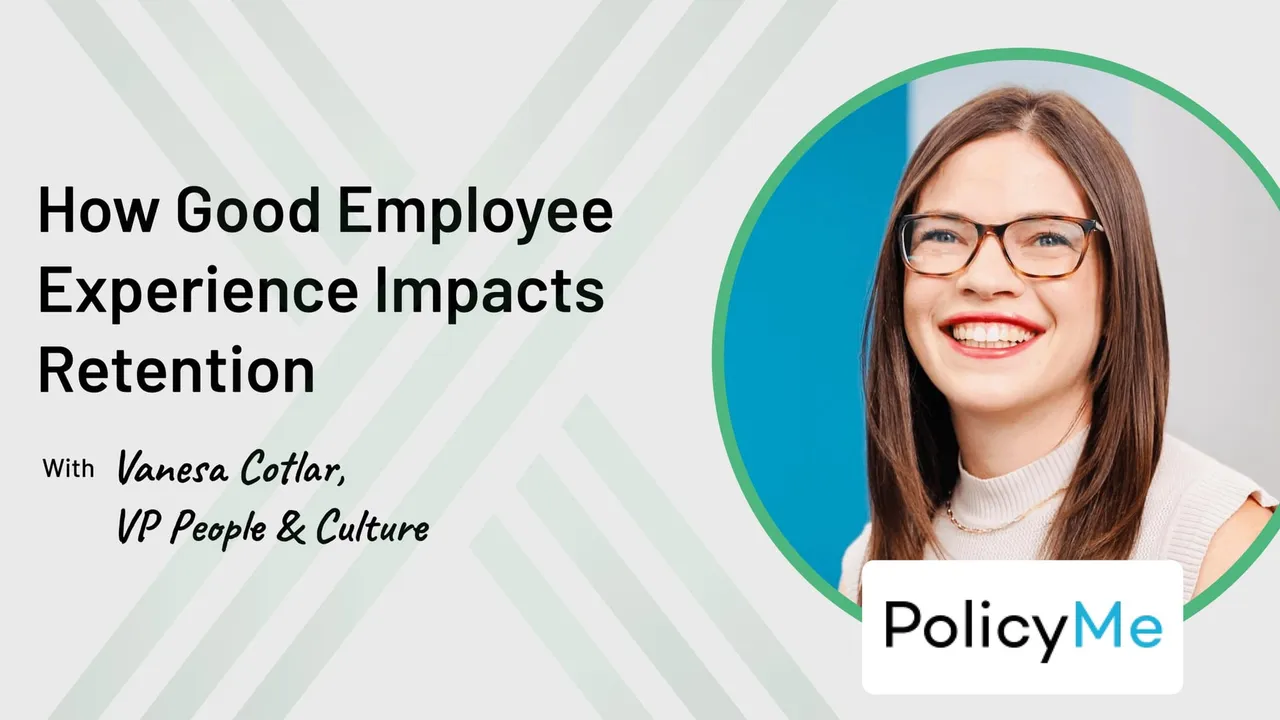
In this episode of CultureClub X, Vanesa Cotlar, VP of People & Culture at PolicyMe, explores the crucial link between employee experience and retention. From engagement strategies to real-life insights, she reveals how culture directly impacts business outcomes.
TL;DR
What you need to know from this episode
- Ownership is the fastest route to trust. Leaders build trust by giving direct reports real ownership instead of micromanaging, and by creating space where experimentation and even failure feel safe.
- Attrition usually traces back to three gaps. Lack of trust, lack of flexibility, and lack of continuous feedback or recognition drive people out, while compensation remains the biggest single stated reason for leaving.
- Diagnose before you fix, then pick one thing. PolicyMe surfaces themes through quarterly engagement surveys, anonymous town hall questions, and one-on-ones, then centers change on a single memorable issue so employees can see real progress.
- The gap between offer and day one is its own journey. An Offer to First Day checklist, notes from the VP and the manager, and a PM Pals buddy program keep new hires engaged and reduce offer drop-off.
- Advocacy is an outcome, not a campaign. When PolicyMe mailed identical holiday swag boxes, employees spontaneously posted photos on Slack; design experiences people love and brand advocacy follows organically.
What actually keeps people at a company? Pay explains part of it, but the daily experience of being trusted, heard, and welcomed explains far more. In this episode of CultureClub X, powered by CultureMonkey, host Diana Blass sits down with Vanesa Cotlar, VP of People and Culture at PolicyMe, to uncover the link between an intentionally crafted employee experience and retention.
Vanesa brings a wide lens to the topic. Before PolicyMe she was Director of People Operations at iQmetrix, a management consultant at Monitor Deloitte Canada, and co-founder and CEO of Octagon Careers, a German-based HR tech startup. She has worked in over 15 countries, holds an MBA from Queen's University, and made the shortlist for Business Leader of the Year at the Women in IT Awards Berlin 2019.
Her current company makes a useful test case. PolicyMe, a digital first life insurance company, has more than tripled its headcount since 2020 to 48 people, with more hiring ahead. Vanesa oversees everything from talent attraction to onboarding, engagement, and career pathing, and her message across the episode is simple: retention is built through intentional choices at every stage of the employee journey.
How can leaders build trust with their direct reports
Vanesa's starting point is ownership. Leaders build trust by giving direct reports real work to run with, not a list of tightly specified tasks to hit. That kind of micromanagement is demotivating, she argues, because it never lets someone take a piece of work from beginning to end and truly make it theirs.
And when leaders give that ownership, they're essentially saying to their direct reports, I trust you, you can take this, you can run with it, you're going to do a good job.
The second ingredient is a climate where experimenting feels safe. Innovation needs comfort with failure, a space where people can ask questions and be wrong without fear, which is the essence of psychological safety at work. When employees feel it is okay to try, and okay if it does not work, trust grows.
The third ingredient reaches beyond work. Vanesa urges leaders to look at the entire person: what they care about, their interests outside the job, and what they want from their careers. Investing in those conversations builds the relationship from both sides, the work and the person.
Career pathing makes growth transparent and equitable
Diana picks up on transparency, and Vanesa describes how PolicyMe turned it into structure. The team built out journeys showing how someone moves from junior designer to head of design, and how the requirements of the role, the autonomy in the work, and the leadership expectations change at every stage.
The payoff comes at self-reflection time. Employees look at their goals to see how far they have come, then look at the career path and objectively assess what they are hitting and what they are still working on. It gives everyone a more equitable framework, even in a startup where only the next 12 to 24 months are truly clear.
What employee experience gaps are quietly driving attrition
Vanesa names three gaps. Lack of trust means every task comes wrapped in second guessing. Lack of flexibility clashes with what research consistently says employees want most. And lack of continuous feedback or recognition strips the fulfillment out of work that occupies such a large share of our lives.
She adds an honest caveat: compensation is still usually the biggest single reason people leave, tied closely to performance reviews and the sense of progression. Experience matters enormously, but pay cannot be waved away.
The remedy starts with diagnosis, because themes are generic and your organization's problems are specific. PolicyMe runs quarterly engagement surveys, holds town halls where anyone can ask questions anonymously or by name, gathers feedback through one-on-ones, and Vanesa herself meets with almost everyone in the company periodically.
I always say that the best way to ensure that your employees feel like you're actually addressing the issue is by picking that one thing.
Picking one focus makes change memorable and visible. People can see that something has actually been done about the issue the company promised to address.
Is the Gen Z candidate journey really that different
Some things have clearly shifted at the top of the funnel. Younger candidates research employers on TikTok and listen to influencers on what makes a good first job, so the way companies used to market roles is not the way to start those conversations now.
But Vanesa resists the generational stereotype. It is not really a generation thing, she says, it is a listening thing: understanding where the differences are, what candidates are looking for, and how to communicate in a way that makes sense to them and still feels authentic.
For offer drop-off, the moment after signing matters most. Send short videos, mail something to the candidate's home, and take the extra step so they feel welcomed, especially for Gen Zs starting remote first careers without the office relationships earlier generations relied on.
Diana adds a wider point: New York now requires employers to post pay ranges, and salaries are discussed openly on social platforms. Whether the driver is generational or cultural, transparency has become the default expectation.
Where does technology help the employee experience and where does it hurt
Having tried to co-found an HR tech startup herself, Vanesa is blunt about the market: there is so much HR tech out there. Organizations need to be intentional about the where and the why of technology, because five disconnected systems for recognition, reviews, surveys, chat, and video calls make the day to day worse, not better.
Small, well-chosen tools can punch above their weight. PolicyMe has used Donut, a Slack integration that randomly pairs people for coffee chats, and Hypercontext, which builds dynamic meeting agendas in Google Calendar and sends out the notes automatically afterwards.
The line she draws is the human element. An automated Slack prompt asking you to rate your week from one to four is not the same as your manager genuinely asking how your week is going.
Technology also has limits that PolicyMe answers in person. The remote first company gathers everyone three times a year for a lunch, an experiential afternoon like an amazing race through downtown Toronto or treetop trekking, and an optional evening, deliberately modular so nobody with home commitments feels pressure to stay late.
What should happen between the offer and the first day
Companies invest heavily in interviews, then go quiet the moment a candidate signs. That radio silence between signing and starting is where drop-off happens, so PolicyMe treats those weeks as a designed experience, with a checklist called Offer to First Day that assigns clear roles and responsibilities internally.
The touchpoints are simple. Vanesa sends a congratulations email as VP of People, the manager shares excitement and optional reading, and every new hire gets a PM Pal, a buddy from outside their team who is available for a virtual coffee and questions before day one.
So you're looking at the recruitment process, you're looking at onboarding when someone starts, but the chunk in the middle is its own piece of the journey, and creating for that intentionally I think can really have a huge impact in reducing those drop off rates.
Onboarding then keeps the momentum. New hires answer three fun questions from a list and are introduced at town hall, where everyone cheers, a simple and slightly quirky way to spark first conversations and shared experiences.
Culture creates brand advocates when the experience comes first
Vanesa agrees that employees are a company's biggest advocates, but warns against forcing it. The goal is a culture that is authentic and ideally codified, which is why PolicyMe recently recodified its values with clear examples, so incoming hires can quickly understand how the company operates and what it values.
Transparency extends into hiring itself. Near the end of the process, Vanesa runs a back and forth Q&A with candidates to sense check that they truly understand what working at PolicyMe will be like, because not everyone thrives in the same environment.
Her favorite proof point was unplanned. Holiday swag boxes sent to employees' homes, each with identical contents, sparked a weekend of spontaneous thank you photos on Slack. Build experiences people genuinely love, she concludes, and advocacy follows on its own; chase advocacy directly and it rings hollow.
Why continuous listening ties the whole experience together
Strip the episode back and one discipline underpins everything: listening. Career paths answer what employees keep asking about growth. The three attrition gaps only surface if surveys, town halls, and one-on-ones give people a way to name them. Even the Gen Z discussion lands on listening rather than generational labels.
That is the practical takeaway for people leaders. Build a continuous employee feedback loop, act visibly on one thing at a time, and let employees see that speaking up changes something. As Vanesa's work at PolicyMe shows, retention follows the experience, and the experience starts with hearing your people.

About the guest
Vanesa Cotlar
VP of People and Culture, PolicyMe
Vanesa Coltar is an ambitious, people-first leader who is the VP of People & Culture at PolicyMe. She believes and is very passionate about building flexible workplaces and advocates for work-from-anywhere practices as well as transparency and ongoing feedback from employees to increase attraction, retention, and satisfaction. Previously, Vanesa worked as the Director of People Operations at iQmetrix and Management Consultant at Monitor Deloitte Canada, and she also helped build Winnipeg’s talent ecosystem while at Economic Development Winnipeg.
She has worked in over 15 countries and has a unique understanding of how markets operate around the globe and how people have found success in them. Vanesa is a graduate of Smith School of Business at Queen’s University’s Master of Business Administration.
Full episode transcript
Season 04, Episode 02 · Vanesa Cotlar with Diana Blass · 39 min
Hello everyone, and welcome to the latest episode of CultureClub X, powered by CultureMonkey. I'm your host, Diana Blass. CultureMonkey is a complete employee engagement platform that helps people leaders listen to their employees and enhance workplace cultures. In the second episode of our latest season of CultureClub X, I'm joined by Vanesa Cotlar, VP of People and Culture at PolicyMe. Welcome Vanesa, it's a pleasure to host you today.
Thank you so much for having me.
Well, I'm so excited to have you on today. And I'm just gonna share a little bit more about your background with our viewers before we get started, because it's pretty impressive. Vanesa Cotlar is an ambitious people first leader who spends her days as VP of People and Culture at PolicyMe. She's passionate about building flexible workplaces and advocates for work from anywhere practices, as well as transparency and ongoing feedback from employees to increase attraction, retention and satisfaction.
Previously, she worked as a Director of People Operations at iQmetrix, where she spearheaded people initiatives, including innovative skill mapping, retention and recruitment strategies. Vanesa has worked as a management consultant at Monitor Deloitte Canada, where she provided strategic guidance to some of the world's largest companies, and helped build Winnipeg's talent ecosystem while at Economic Development Winnipeg. Vanesa has worked in over 15 countries and has a unique understanding of how different markets operate and how people have found success in them.
Prior to returning to Canada in 2019, Vanesa was a co-founder and CEO of Octagon Careers, a German-based HR tech startup focused on understanding the skills and aptitudes of success in certain roles, and assessing and hiring based on those attributes without the need for a resume. She made the shortlist for the Business Leader of the Year, Women in IT Awards Berlin 2019, for her work with her startup, and won several pitch competitions.
In her spare time, Vanesa can be found exploring a new part of the world, contributing to people and culture conversations, and offering her time to startups that need help structuring their people practices. Vanesa is also an ambassador and speaker for Manitoba Women in Technology and holds an MBA from Queen's University.
Vanesa, it's great to have you with us today. Welcome again to CultureClub X's video cast on Uncovering the Link: how employee experience impacts retention. Before we begin, please tell us more about yourself and your organization.
Yes, Diana, happy to share. So at PolicyMe, we are a digital first life insurance company. And what that means is we're looking to provide simple and affordable insurance for Canadian families. So basically the traditional process for getting insurance tends to be a little bit complex. You have to go in person, you have to go to a broker. There's a lot of components that go from the moment you're trying to get that insurance to the moment you actually have a fully enforced policy. So we save a lot of time in that experience. And we have some of the most competitive pricing in Canada, with our rates at approximately 10 to 20% lower than our competitors.
And what's really interesting is that on the people side of things, since 2020 we've more than tripled our headcount to 48 now, and we'll be growing into next year. So there'll be lots of hiring going on as well. And in my role as VP of People and Culture, what I do is I oversee everything on the people side of things. So that includes both the talent attraction, so the recruitment component, and the more traditional people and culture side of things. So everything from onboarding, employee engagement, career pathing that essentially helps manage the day-to-day so that we can have a great place to work.
Great, well, that makes you really the perfect person to chat with us today about our latest video cast.
So the first idea to kickstart our questions today. Building trust and being valued is the bedrock of a good culture. How can leaders build trust with their direct reports?
Diana, I love that question. I think it's a great opener. So when we think about trust, I think there's a few different things that leaders can do. So first of all, the most important thing, in my opinion, as leaders are starting out with that trust-building exercise, is giving real ownership to their direct reports and ensuring that they're not really micromanaging. And we've all had that experience where you're told very specific things and you're just hitting those tasks, but that's not really motivating. That doesn't give someone the ownership to take something from beginning to end, to really be able to work with it. And when leaders give that ownership, they're essentially saying to their direct reports, I trust you, you can take this, you can run with it, you're going to do a good job.
And I think beyond the work component itself, there's so much that leaders can do to essentially create a space where employees feel comfortable experimenting. And I think experimentation is huge for innovation, but for that to happen, there needs to be comfort with failure. There needs to be a space where people feel comfortable just asking the questions and where they feel comfortable being wrong, honestly. I think that when those safe spaces are there and when employees feel that it's okay to try, it's okay if it doesn't work, and when they're given that ownership anyways, that's one of the best ways that leaders can build trust.
And maybe one more thing that I would add is going beyond just the work component. So if we're thinking about how you build that trust, it's about looking at the entire person. So what does this human really care about? What are their interests beyond work? What are they looking to get out of their job? I think when leaders take that time to really sit down with their direct reports and invest in those critical conversations around their careers and around their entire life journey, so that work can really become a fulfilling part of it, it's essentially such a strong building block when it comes to that trust component. Because you're really coming at it from both of those sides, right? It's the work and it's the person, so that you're able to really come together to build that relationship.
Yeah, definitely. And I was reading about some of the things that you've helped to implement at PolicyMe. And I love the idea of really creating a path for that employee once they enter into the organization, to be very transparent about the steps you need to get to your goals, and to know that it's achievable and that your company trusts in you to achieve those goals. Tell us a little bit about that. I think that's so fascinating as a tip that others could take home with them.
Yeah, of course. And Diana, when you say that transparency component, I think that is so important. So when we're thinking about transparency, essentially that's where career pathing can have such a positive impact. And what it is, it's essentially creating paths that help people have the clarity of, if I'm joining an organization, say as a junior designer, but I aspire to be here for years or I want my career to grow, what does that look like? And of course, not every organization can have clarity for what every journey is gonna look like, but you normally can have a sense of what you see the next 12 to 24 months looking like, especially in a startup, or potentially for those roles.
So what we did is we built out the journeys from how do you get from junior designer to head of design. And how does that change in terms of the actual requirements of the role versus the autonomy in your work, the leadership that you need to be showcasing, and all of these skills and competencies that are required at each stage. And one of the things that we find super beneficial about that is when it comes time to do a self-reflection and to think about how you've progressed, I say there's two really good things to do. One is look at your goals and see how far you've come, see what you've achieved. But two is take a look at those career paths and be objective and think about, where am I at? What am I hitting? What am I still working on? And it gives everyone a much more equitable framework and place to look at, to really understand their place in the journey and where they're looking to go.
What potential employee experience weaknesses are leaders failing to address that are leading to attrition? How can these be remedied?
I think it's a really good follow-up, because when we think about building trust, if that trust is not there, the employee experience just isn't going to be as good. But there's a lot of research out there around why people leave their jobs. And when it comes to the experience component, I really think it comes down to three main things. And I do really believe trust is that first one. I think that if you're not trusted in your day-to-day, your experience is just going to be poor, because every time that you're doing something, you're gonna be second guessing yourself and you're gonna be questioning, is this what they want me to do? Is this correct? Is someone gonna tell me that what I did is wrong? And that's not really a positive mindset in which to live your day-to-day, or experiment as we were talking about before.
The other two that I would add, though, are lack of flexibility and lack of continuous feedback or recognition for good work. Those are also two really big components that could lead to that attrition if they're not present. And it's really because flexibility is just one of the top things that keeps coming up in the research of what employees are looking for in their roles, but also growth. And I think when we think about our jobs, they take up so much of our days, right? And it's a big investment and it's a big part of our lives. So feeling like someone tells us when we've done something really well, or someone is supporting us in ways we can improve to be better, becomes really fulfilling as part of that employee experience.
I will say maybe one small thing to add, this isn't quite the experience component, but there is something to be said as well around just their pay and compensation, which kind of ties to that performance review component and how you feel you're progressing within the organization. I do see the biggest reason people still leave their jobs today usually is compensation. So it's just worth keeping in mind.
But you also asked, how can this be remedied? And one of the things that I always say is figure out what's going on in your organization. The things that you and I are talking about today are themes, right? But it's super important to figure out what are the specifics that are going on for you. And there's a couple of ways to do that. At PolicyMe, we do quarterly engagement surveys so that we can get a good sense of where people are at across a number of issues. We have town halls where there's opportunities to ask anything, anonymously or with your name, depending on what you feel more comfortable with. And we ask for a lot of feedback during one-on-one conversations between managers and direct reports. And I also meet with almost everyone across the company every once in a while. So that creates space so that people can share what's going on.
And then when you see what those bigger themes are that bubble up, pick one thing you're going to focus on first. I always say that the best way to ensure that your employees feel like you're actually addressing the issue is by picking that one thing. And that's because that makes it memorable, to understand what are we centering around? What are we looking to address? And it's meaningful change that you can see when something has actually been done to address that bigger issue.
Definitely. That's interesting to think about how the pandemic really put a spotlight on these issues, because I think your managers had to go an extra mile. Your leaders had to go that extra mile to make sure that they were hearing their employees' concerns. And it really put a spotlight on micromanagement for sure, when it comes to Teams or Slack constantly buzzing on your phone.
Yes, 100%.
Yeah, so it's interesting to think how you can connect with your employees in a remote way, but not in a way that's overwhelming at the same time. So those are all really great tips there.
How is the candidate journey for Gen Z different from other generations? How can organizations rethink their processes to reduce offer drop-off within Gen Z applicants?
I think it's an excellent question to move us in a direction to essentially talk about how journeys can differ, not only across generations, but just individuals from different backgrounds or that search for information in different ways. And I don't know about you, but one of the things that was funny to me was when the kids that I used to babysit started venturing into work, and hearing from them about how they search for jobs, where they look for information around what is a reliable company, what is a place that I wanna be starting out my career in. And there definitely are some shifts that are happening there in terms of what's considered a good job, or where essentially Gen Zs are looking to get those first experiences.
I think when we think though about the top of the funnel, and how they're listening or getting access to that information about companies, there are some nuances that are a little different. So for example, looking for that information on TikTok and hearing from influencers about what is a good organization to work at, or what should I be looking for in my first job? And I think something to think about is that potentially the way we used to market is not the same way we market to get those conversations started. But beyond that, it really isn't just a generation thing, but it's about listening. And it's about taking that time to understand where are those differences? What are they looking for? How can we communicate in a way that makes sense to them, but that also feels authentic? Because you wanna ensure that you're getting that information to candidates in a way that they feel is a reliable source, but also just helping build that trust that we were talking about at the beginning, from the onset.
So I think that when we split too much into what is this generation thing versus that generation, sometimes we create some generalizations that may not always be applicable. But I do think what's really interesting in terms of the offer drop-off rates, or reducing some of those friction components, is just being really mindful of essentially, once someone gets that offer, what does that look like to keep them engaged in that journey? So there's so much more that can be done to leverage resources, send the little videos, send something to someone's home, take that extra step to ensure that the person feels essentially really welcomed from the beginning. And I think especially for Gen Zs, they're entering the workforce and going into their first jobs knowing that so many more roles are now remote, and they're not necessarily gonna be building relationships from the beginning in office as many of us did when we started our careers. It's everything that you can do to help them feel like they're going to be a part of something.
Yeah, it's interesting. I love what you said there about how it's maybe not necessarily the generations that are that different from one another. I mean, maybe it's the arrival of new technology like TikTok that you mentioned. I remember scrolling on TikTok and seeing different people talking about their salaries very openly on there, encouraging others to share, the quiet quitting that was taking over, and talking about different ways they were leaving their jobs. But I mean, especially on the compensation side of it, New York just passed a law that now requires those hiring here to post a pay range. And so is that because the current generations are demanding it, or just because it's become easier to share that information anyway? And you should be more transparent as a result of that, which goes back to what we were talking about with transparency earlier. So yeah, it's interesting to think about that shift. Is it generational, or is it just a result of our larger culture today in our society?
How can modern people leaders rely on technology to provide an optimum employee experience from onboarding onwards, to ensure higher retention rates?
I think, Diana, what you were getting at just before the question as well is super interesting. I think there is so much happening just around the dissemination of information, right? And that is largely due to technology, largely due to the fact that we can go on LinkedIn, that we can Google, that we can do all these things now much more effectively. And that there are all these tools that further support that research. Like you can go on salary.com or you can go on Levels.fyi, and you can get so much of that information of individuals just self-reporting as well, of how much are they making in this job? What was their offer like? Because people are just starting to essentially be more open about some of those data points so that others can look at them too.
I think when we think about technology though, and how people leaders can rely on it, one of the things that I've noticed, especially in the last five or 10 years, is there is so much HR tech out there. And I say that as someone that tried to co-found a startup in the HR tech space. There is so much HR tech out there in the space. And what this means is that, as an organization, you need to be really intentional around the where and the why of technology, and how it's gonna add to that experience as opposed to just complicate it. And what I mean by that is, if you have five different systems that your people are going into, one for recognition, another for their performance reviews, another for engagement surveys, another for how they communicate day to day, another for their video conferencing. When there's so many things that are not integrated, it's just not a really great way for employees to be living their day to day.
However, there are so many small things that you can do that are technology enabled that I think can have a really big impact. So a couple that we've tried, or I've tried in previous roles as well: in a remote setting, if you find that you have a larger company or an organization where people don't know each other as well, I don't know if you've heard of the Donut app, but it's an integration in Slack. Basically, it matches people up randomly for a coffee chat. And it's a really great way, especially when you have a new group of people or you want people to meet for those first few meetings. It definitely can get tiring if you're doing it every week, but initially, to have conversations, it's such a helpful way for people to be paired up.
And another thing that is more in the day to day, one of the greatest things about being remote as well is thinking through how you can work better async. We're not gonna be in the same space. We're not gonna be able to walk to each other's desks and ask a question. And one of the things that we've found to be super helpful is another tool called Hypercontext, which integrates into your Google Calendar, and you can use it to create dynamic meeting agendas. So ahead of the meeting, I can set my items. You can set your items. We can look, ahead of showing up, as to what we each wanna talk about, and we can be prepared for that conversation. And what's great is it's pretty automated. So after the meeting, it sends out the meeting notes on its own, and you know what we discussed. You can write out next steps. You can write out descriptions.
So I think when we think about that employee experience, once someone has been onboarded into the business, how to keep employees engaged, it's thinking about those places where technology can have a really positive impact, but also remembering where it's important to just use the human elements, right? I don't think just a Slack automated 'how's your week going? Answer between one to four' is as good as your manager asking you, 'Hey Diana, how's your week going? How are things on your end?' And just being able to have that conversation. So being able to really understand where those right components are to incorporate that.
Yeah, it's super interesting. I can't tell you how many people I met during the pandemic now who have switched jobs during this time and never met their colleagues. So it's interesting to think about how technology can humanize somebody. Obviously video chats help, but any additional services really help you to just create that relationship that you hopefully could have gained in person. One solution I know, if you work with people internationally, it'll automatically put subtitles as they speak. And I think that's so comforting too, especially even if you both speak the same language, people are concerned about accents and things like that. So it's definitely interesting to think about the advancements that have been made. And I agree, hopefully they become more interoperable and they can all work together, because it can be overwhelming if you're not a techie, that's for sure.
Yeah, and maybe, Diana, one more thing that I wanted to add there, just on what you were getting at. I think one of the things that's amazing about technology is it has enabled us to work remotely, right? If we had gone through the pandemic maybe 20 years ago, we didn't already have laptops at home. It wasn't as easy as, okay, we're just gonna try this. We have the ability, right? So I think what's important to remember is we're in a point in time in where technology is at where we can work in the way that we're working. But to your point, there's some things that being in person, I do still think, can't replace.
So one of the things that we do is we are remote first, but we bring everyone together in our company for in-person get-togethers three times a year. And those really are the only times that we're like, now we do really want you, we're highly, highly encouraging you to show up to the office, for the three Fridays a year where we do these things. But what that creates is a way for people to actually meet each other, build those relationships, have those connections, have a shared experience in person that they can then take to their day-to-day afterwards, and just have that memory of what it was actually like to be together. Because to your point, I also was one of those people that started and hadn't met my colleagues. And I think when you do meet, it helps that relationship building, but you don't need to see each other every day for that relationship to continue afterwards. I think it's just hard if you never ever meet, but as long as you meet a few times, I think it helps create that base that you can build off of.
Definitely. And real quick, what are some of the things you do during those meetups? I think sometimes companies, they try and do all these team bonding exercises, and I'm wondering what ones you found to actually be beneficial compared to just playing games and things.
Yeah, really good question. So we've done them a couple of ways, but what we've found, I'll kind of walk you through it, is we do a lunch at our office in downtown Toronto and then some type of afternoon experiential activity. And what I mean by that is something that is outside of the norm, that you wouldn't get a chance to do if you were just thinking about doing it yourself. So the last two that we did, for the one in June and then the one in September: in June we did an amazing race through downtown Toronto. So someone on our team helped organize, we were split up into teams, and it was like a scavenger hunt. We needed to go to all these different places and do all these different tasks, and we gave each team a budget so that they could actually go have all these experiences together. So it was a really different way to spend an afternoon.
And then the one we did in September was treetop trekking. So we went a little bit outside of the city, and then we were climbing through the trees, doing zip lines. For those that were a little bit more afraid of heights, they could also do a nice walk throughout the park as well. And it was just a totally different experience, right? To be in the harnesses together, to be cheering each other on, to have some people work through some fears of heights. So it's just thinking through what can you create that it's gonna be an exciting and different way for the team to bond.
And after that afternoon activity, we always do an evening portion that is more like a dinner. Either we've done it at our founder's house in the past, or we've done it at a big restaurant where we book out a space, and then we do different things. Like at the summer one we had a signature PolicyMe blue cocktail for the evening event, which was really fun. And what we try to do is create events in a modular capacity. So one of the things to remember is people have different home lives as well. So sometimes a person cannot stay with a group from their work until 9 p.m. on a Friday, right? Which is totally fair. So that's why we chunk it out, so that during the workday is the lunch and the afternoon activity that wraps up around four or five. And if that's your moment where you need to go home, go home, that's totally okay. We don't want you to feel like there's any pressure to stay for that evening component. But for those individuals that love an evening component, there is an evening component with the dinner. And then sometimes we will do karaoke. So I think it's just about listening to your employees and what they need, and structuring in a way that makes it accessible for everyone.
Yeah, that sounds really fun. And I would bet people would want that more than three times a year.
Yeah, I mean, I think what's interesting is I think we talked about potentially more frequency, but then it becomes like, oh, I have to go in again, versus, I can't wait for the next one. So we try to keep that excitement of three or four months between events to get that momentum.
A good candidate experience would help organizations with better employer branding, reduce offer drop-off and attracting top talent. How can organizations optimize candidate experience in the pre-joining and the onboarding stages to reduce drop-off rates?
I think also another really great question. What happens a lot is you really invest in that interview process and you get someone to sign, and then there's this radio silence between the moment when they sign and when they're actually starting at an organization. So from that, I've signed, I know I'm joining you, that pre-joining phase, to the actual day that you start. One of the things that we found was it's super important to think through the roles and responsibilities of each person internally for the experience of that candidate that is about to start.
So what we do at PolicyMe is we actually have a checklist called Offer to First Day. And it's specific to those couple of weeks. And for some people it's two weeks that they get at their job, for some people it's longer, maybe they're going on vacation or they need to give more time, of how we're going to create that experience for that person, so they really feel like they're already part of the team and that they're excited to join. So basically it's really about that clarity and that transparency, so that they understand what's going to happen at the touch points. And what we do is we include everyone in that process. So it's me as the VP of People just reaching out, saying congrats again, sending an email in the timeframe. It's their managers saying how excited they are for them to join, and giving them a couple resources if they want to read anything in advance. We don't make anyone do anything in advance of starting, of course, but we have a lot of people that ask, is there any information I can start reading? So we've put something together just because that's a pretty common question.
And then one of the things that we do that I think has made a really big impact, and it's super simple to implement, is we have PolicyMe pals. So we call them PM Pals. And basically once you sign, we assign someone outside of your team to be your pal at PolicyMe. And it's kind of like a buddy program. So that person is there for you as a resource, for you to grab potentially a virtual coffee chat ahead of starting and ask any questions, or even just sending you that email of how excited we are to have you on the team. And I think it's just thinking about that experience as its own experience. So you're looking at the recruitment process, you're looking at onboarding when someone starts, but the chunk in the middle is its own piece of the journey, and creating for that intentionally I think can really have a huge impact in reducing those drop off rates.
Yeah, definitely. I mean, you think that the employee, that new employee, is starting on the set hire date, but in reality, as you mentioned, there are so many weeks in between where so many questions arise. I mean, there's nothing worse than not knowing, what time should I get there? Where's my desk going to be? Where's lunch? So many things where you feel like you're back in high school in a way. And so anything that can alleviate that is definitely nice. I remember my job when I moved into the corporate world, I have a background in news, and on my first day I remember the HR had my favorite type of candy. And I love that, because I'm not a huge candy eater, but it just made me think that they were taking time to learn what I like and trying to make my first day special. And it encouraged everybody then in the office to come stop by my desk to get candy.
That's so nice. You know what, I think it's really interesting that you say that. So for the onboarding component, one of the things that we do is we do have a fun survey for new hires as well, where we ask them to answer three questions from a list. And I always introduce new hires at town hall, either virtually or in person. And everyone cheers, everyone gets really excited about them and says hello. And it's just a way for people to learn some fun things about them and to see shared experiences. So some people answer about, where do you want to go next in terms of travel destinations, favorite movies, random skills that you have that people don't know about, or TV shows or movies. And it's a fun way for people to connect with one another. So certainly I think, to your point, when people are onboarding already and they're starting to join the company, doing things that are simple but maybe a little bit quirkier can help with those initial conversations and relationship building.
Yeah, definitely. Do you agree that company culture has a direct impact on a good candidate experience? How does this impact retention rates and employer branding, and help in building brand advocates?
I think it's a really good question as well. And I think that culture really is at the center of it all. And when we think about culture and the candidate experience component, one of the things I always say is, some companies say your employees are your biggest advocate. And I definitely agree with that, but I think what doesn't work as well is when companies are trying to force their employees to be their biggest advocate. And it's one of those things where what you want is to create a culture that's authentic, but ideally also codified if possible, so that when new people join, it's easy to understand: how do you operate? What's valued? What is this place really gonna be like? And one of the exercises that we did recently was recodify our values and present them in a way that is visually appealing, easy to understand, with examples, so that we feel that as we're now moving into hiring more people next year, it'll be clear to them, what is our culture? What do we value? What does this organization look like in its day to day?
So when you're thinking about the candidate experience, one of the best things you can do is be really transparent as to what it's actually like to work at that organization. So at the end, for anyone that interviews with us that we're almost all good to go with, I do one final, it's not really an interview, but it's more like a back and forth Q&A, where I set out to answer any questions the person has, but I also sense check that they've gotten a good understanding of what it's actually gonna be like to work with us, what our culture is like, what our environment is like. And if I sense that they're not clear, I'm able to share more with them to ensure that they're actually really excited about the culture they're getting themselves into. Because it makes a huge difference, right? Not everyone likes to work in the same way, not everyone likes to work in the same type of environment, and of course we have people with different preferences, but all in all there's a really strong alignment around our values and what those mean and what those look like. So I think that just creating that space to be intentional, and ensuring that candidates know what you're looking for and know what they're getting into, makes a really, really huge difference.
And I think that secondary part where you were talking about employer branding and building those brand advocates, I have a funny example from the other day actually. We sent to all of our employees little swag boxes to their homes for the holiday season, just to say thank you for the year. And we had a PolicyMe shirt, we had a mug, we had a notebook, we had a couple of things in there. And a funny thing happened which was totally unplanned, and it started happening over the weekend, which is everyone started taking pictures of what they got in their box and posting it on Slack and just saying thank you. And it was interesting, because if you think about it, the contents of all the boxes were the same. So it's not like people were taking pictures of all these different things, everyone got a similar box. But there was just so much excitement, because it had been a while since we'd done something like this, and people just really liked getting things in the home, that everyone just started to share. And I love that, because I think that's such a great example of the brand building component, but in a way that happened organically.
And we didn't do it so people would take pictures and talk about it, that was just the outcome, because everyone just enjoyed what they got and because they were genuinely excited about this thing that arrived in their home. But it was never like, take a picture and post it once you get it, you know what I mean? So I think it's just important to build good strategies, do things that are gonna make your employees love where they work, and then those brand advocate components will come as a result of creating that good experience. But I think it's important to focus on the experience, not to just try to get people to advocate for the organization.
Right, yeah, I mean, everybody today has a personal brand, right? And I think it's important to think about how that personal brand fits into your corporate brand, and are you naturally going to wanna share these updates on your social media? Is it a natural fit? And it's maybe things we didn't have to think about before. I love that example that you shared about the gifts, and I bet it was fascinating to see the different things that stuck out to people, what they were sharing. Because you think about it, everybody enjoyed that gift, but you look at how they each enjoyed a different element of it. And then it makes sense that you have such an interesting team, that as a result, everybody thinks about things differently, but you're united by similar likes and interests. It's just probably an interesting thing to look out for.
Yeah, it definitely was.
Well, that was really a fascinating take on a topic that's gaining limelight in the HR space. Undoubtedly, the employer brand is at stake with negative employee experiences. As a consequence, leaders need to showcase culture and strong employee experiences to stay afloat. CultureMonkey offers a data-driven platform to listen to talent and solve workplace problems around culture and employee experience. It helps people leaders holistically build and showcase better cultures while enhancing their acquisition and retention scores. So visit culturemonkey.io to see how you can improve your workplace culture today.
With that, we conclude this episode of CultureClub X. Thank you, Vanesa. It was truly a delightful conversation, and we learned so much from you today. Please let our viewers know how they can connect with you if they want to have a quick chat or share their thoughts.
Thank you so much for having me. It's been so nice getting to know you and having this conversation. And I'm pretty active on LinkedIn. I believe I'm the only person with my name, so Vanesa with one s tends to be pretty easy to find. But I'm always posting more on there about different things that I'm seeing within our organization, within the broader space. So feel free to connect on LinkedIn. Always happy to share more insights there, and feel free to ask a question if there's anything else you'd like to know more about.
Well, that's all we have for you in this episode of CultureClub X, powered by CultureMonkey. Until next time, this is your host, Diana Blass, signing off.
Frequently asked questions
How can leaders build trust with their direct reports?
Vanesa Cotlar suggests three moves. Give direct reports real ownership instead of micromanaging, create a space where experimentation and even failure are safe, and invest in conversations about the whole person, their interests and career hopes beyond the immediate work.
When leaders hand over ownership, she says, they are effectively telling their people that they trust them to run with the work and do a good job.
What employee experience gaps cause attrition?
Vanesa points to three: lack of trust, lack of flexibility, and lack of continuous feedback or recognition for good work. She also notes that compensation remains the single biggest stated reason people leave their jobs, so pay and progression cannot be ignored.
How can companies reduce offer drop-off among Gen Z candidates?
Meet them where they research jobs, which increasingly includes TikTok and influencer content, and communicate in a way that feels authentic. Then treat the period after the offer as its own journey: send videos, mail something to their home, and take extra steps so they feel welcomed before day one, especially in remote roles.
What should happen between offer acceptance and an employee's first day?
PolicyMe uses a checklist called Offer to First Day that assigns internal roles and responsibilities for the new hire's experience. The VP of People sends a congratulations email, the manager shares optional reading, and a PM Pal from outside the team is assigned as a buddy for questions and a virtual coffee ahead of starting.
How often should a remote-first company meet in person?
PolicyMe brings everyone together three times a year for a lunch, an experiential afternoon activity, and an optional evening. Vanesa says the three to four month gap keeps the events exciting, so people think they cannot wait for the next one rather than dreading another office day.
Read the cross-episode roundups
More from CultureClub X
 S07 E03employee engagementWhy do grievance procedures damage workplace culture? | David Liddle, The TCM Group
 David Liddle
 S07 E01employee engagementWhy is employee wellbeing spending not paying off? | Gethin Nadin, Benifex
 Gethin Nadin
 S06 E20change leadershipWhy does culture change stall? | Jamie Notter, culture scientist
 Jamie Notter
Never miss an episode
Every new episode, plus the takeaways that matter, posted on the CultureMonkey LinkedIn page as soon as they drop.
Free on LinkedIn. Unfollow anytime.