

S04 E04
Mental Well-Being as an Engagement Strategy
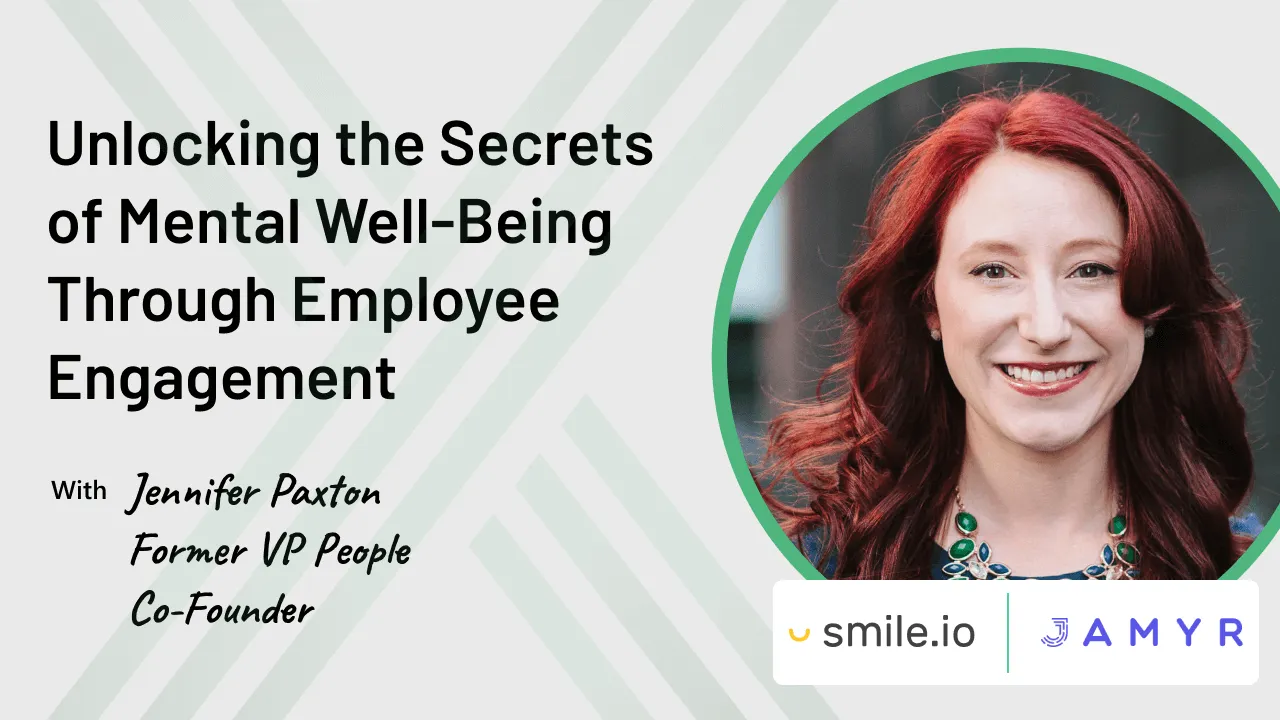
Jennifer Paxton joins S04 E04 of CultureClub X to reveal how focusing on employee mental health drives engagement, productivity, and belonging, while offering actionable guidance for HRs and leaders to manage stress, prevent burnout, and build inclusive, supportive workplace cultures.
TL;DR
What you need to know from this episode
- Mental wellbeing touches every part of the business. Jennifer ties it to productivity, engagement, collaboration, innovation and company culture, and WHO research cited in the episode found 68% of millennials and 81% of Gen Zers have left roles for mental health reasons.
- Stop making HR carry mental health alone. Organizations should buffer in grace, build policies collaboratively across the leadership team, and back the work with real budget instead of repeated nos that leave HR burnt out and disincentivized.
- Leaders have to model disconnecting. A leader who checks email and Slack on vacation signals the team must too; real disconnection, clear boundaries around asynchronous hours, and delayed send habits set the healthier tone.
- Managers are the first responders. Watch for changed body language, slipping productivity and quieter Slack activity, ask the second 'no, really, how are you doing?', and lay a psychological safety foundation so people bring struggles to you early.
- Pulse survey data reveals more when you respect the lag. Employees take about a week to digest big events before scores move, so read spikes and dips against the prior week or two, and use segment breakdowns to target resources.
What does it cost a business when its people are quietly running on empty? In this episode of CultureClub X, powered by CultureMonkey, host Diana Blass sits down with Jennifer Paxton, co-founder of Jamyr and former VP of People at Smile.io, to unpack how mental wellbeing shapes engagement, productivity and culture, and what HR teams, leaders and managers can actually do about it.
Jennifer brings a decade of experience building and scaling high growth tech startups, including Privy (acquired by Attentive), TrueMotion and Logentries (acquired by Rapid7). She has been part of three successful acquisitions, and almost all of her companies have won best place to work awards at least once while she was there.
Her heart, she says, sits with smaller startups that do not have structure yet and are primed for someone to come in, shape the culture, and build a place employees want to work at and thrive at.
Across the conversation, she and Diana cover the risks of neglecting emotional health, why HR professionals themselves are burning out, the signals managers should watch for, the link between belonging and mental health, and how survey data can surface what employees will not say out loud.
What do organizations risk when they ignore employee mental health?
Jennifer's answer is that everything is connected. Mental health and wellbeing affect every aspect of the business, from an employee's level of productivity to their engagement and collaboration, and even their capacity to think about innovation for the future of the product or the organization.
Culture takes the hit too. When people feel stressed out and unable to take a break, that starts to shape how they communicate with each other and, over time, the overall culture of the organization. In her view, the success of the business ties directly to employees feeling comfortable from a mental health and wellbeing perspective.
The retention stakes are stark. Diana cites World Health Organization research showing that 68% of millennials and 81% of Gen Zers have left roles for mental health reasons. Jennifer adds a data point of her own: she has recently spoken with many HR professionals who are leaving the field, or taking extended breaks, because of their own mental health.
Why are HR professionals burning out, and what do organizations owe them?
Through the pandemic, everyone looked to HR for all of the answers. Jennifer admits she put enormous pressure on herself to have those answers and be perfect all the time, and found it very stressful. Her first fix is structural: organizations should buffer in grace, accept that HR does not have every answer, and develop policies collaboratively so the weight is carried by the entire leadership team.
Her second fix is budget. Asking for resources and being told no again and again leaves HR professionals dissatisfied and almost disincentivized. Real investment means putting money in, and it means the mental health conversation coming from many leaders across the organization, not just from HR.
You have to number one, acknowledge that it's not supposed to just all fall on HR shoulders. Number two, HR is not perfect and no one should be held to that standard.
Where should that budget go? Jennifer points to mental health coverage in the benefits plan, which was an afterthought for years but has risen to the top of what employees ask for. She also flags employee resource groups, going deeper than a one-off yoga session or meditation class, and apps like Spill, which integrates with Slack so employees can connect directly with a therapist.
Her most underrated line item is wellness days, kept separate from PTO rather than lumped in. Tracked on their own, they generate data you can share with teams about how many people take them and what the average is, which normalizes the practice and helps de-stigmatize it.
Leaders who never switch off teach their teams to do the same
Diana raises a theme from earlier episodes this season: employees do not take their PTO, even when it is unlimited. Jennifer's response puts the responsibility on leaders. If you are on vacation but checking email, Slacking people and taking calls, your team sees that behavior and concludes they have to do it too.
The same discipline applies to boundaries on global, asynchronous teams. Sending emails at 10 PM, when a colleague is just waking up, sets expectations nobody agreed to. Delayed send tools can protect the team, though your own wellbeing still needs attention.
Jennifer recalls her own 10 hour days that left her with nothing for her two kids by the evening, a disservice, she says, to the company, to herself and to her wellbeing. Occasional crunches happen, but when they become the norm it is time to model better behavior.
Beyond modeling, she urges leaders to run genuine check-ins from afar: grab 15 minutes on a Slack huddle or Zoom just to see how someone is doing, and have an actual conversation rather than a drive-by greeting. It means a lot, and it carries a lot of weight, when leadership does that.
What signs show a team member is struggling?
Jennifer's first responders are managers who pay attention. On video or in person, watch whether body language has changed from one check-in to the next. When someone answers 'I'm good, it's fine' and shrugs it off, treat it as an opening to ask again: no, really, how are you doing?
Digital signals matter too, because happiness and engagement correlate directly with productivity. Slipping output, going quiet in public channels, or an employee who used to react with emojis on every single post suddenly stopping: these subtle shifts are worth noticing early.
I want to build a space and a relationship with you where you feel comfortable coming to me with anything.
That openness only happens on a deliberate foundation of psychological safety at work, and it comes with accountability: checking in more frequently on someone who is struggling, pointing them to resource groups, apps and benefits, and advocating upward for team-level fixes such as a company-wide mental health day.
At her own company, a manager group and organically formed peer buddies give managers a place to compare notes on what they are seeing and feeling. And Jennifer's famous loose leaf tea ritual sets the stage for one-on-ones: pouring tea keeps her listening instead of talking, and makes her a trusted advisor who controls nobody's salary or progression.
Belonging and mental health are two sides of the same coin
Asked whether a lack of belonging is linked to poor mental health, Jennifer definitely thinks so. When employees feel they have to be performative and cannot bring their whole selves to work, inclusion and belonging suffer. Stigmas persist, access to care is not equal, and cultural norms vary widely: some cultures talk openly about feelings while others are walled off and buttoned up.
Silence shows up at both ends of a career. Newer employees stay quiet because they want to be seen as leaders; senior people feel trapped in a stoic, cookie cutter image and fear being seen differently if they show vulnerability. Providing mental health resources, championing flexibility and modeling vulnerability all help build an inclusive space that is built for all.
The level of vulnerability that you bring to a conversation is hopefully the level of vulnerability you're gonna get back.
The data backs the urgency. Diana points to the same World Health Organization research showing that respondents who say DEI is a mental health issue rose from 41% in 2019 to 54% just a couple of years later.
Can technology really tell you how your people are feeling?
Jennifer distinguishes between two kinds of workplace technology. Resource tools like Spill widen access to therapists. Listening tools factor in how employees are actually feeling and how that changes over time.
A well-designed pulse survey tool shows whether sentiment is up or down through the year and breaks results into segments like relationship with manager, overall happiness and recognition, so you can see which area needs more resources, time and attention.
Her favorite lesson from her own data is the lagging indicator. When something big happened at the company, the survey did not spike that week; it took people about a week to digest it and write in how they really felt. So when you see a spike or a dip, look back a week or two for the cause.
She draws a firm line at employee monitoring tools: not a fan. People crave flexibility and choice, and binary tracking software cannot honor that. Used with good intentions, though, listening tools inform budget allocation and resourcing decisions, even if a tool is never going to solve everything on its own.
Mental wellbeing starts with genuinely listening to employees
Strip away the specifics and one thread runs through this episode: listening. The leader who books 15 minutes just to ask how someone is doing, the manager who notices the missing emojis, the HR team reading pulse survey trends with lagging indicators in mind. Each is a form of paying attention before a struggle becomes a resignation.
Jennifer's parting challenge turns the lens inward: HR people should plot their own survey answers across the year and reflect on how they were feeling, because the profession that listens to everyone else routinely forgets itself.
For organizations, the mandate is the same at scale. Continuous employee listening is what turns mental wellbeing from a poster on the wall into a strategy, and it is the reason platforms like CultureMonkey exist: so people leaders can hear what their employees need and act on it before burnout does the talking.

About the guest
Jennifer Paxton
Co-founder of Jamyr and former VP of people at Smile.io
Jennifer is a highly passionate, energetic and experienced HR professional with expertise in high-growth tech startups. She has independently designed a rewards program and a manager career development program to provide equitable opportunities across her organization. Over the past 10 years, she has developed a passion for building and scaling startups; giving employees the structure and support they need to flourish and grow.
She loves coaching managers, fostering a culture of feedback, and creating programs that help build a sense of belonging. Jennifer has worked with leading organizations like Privy (acquired by Attentive), TrueMotion, Rapid7 to name a few. She has been a part of three successful acquisitions and almost all of her companies have won “Best Place to Work” awards at least once while she was there.
An alumna of Boston Conservatory, Berklee, she holds a professional license in HR from HRCI and sits on the Cultural Alliance of Medfield’s board.
Full episode transcript
Season 04, Episode 04 · Jennifer Paxton with Diana Blass · 33 min
Hi everyone and welcome to the latest episode of CultureClub X, powered by CultureMonkey. I'm your host, Diana Blass. CultureMonkey is a complete employee engagement platform that helps people leaders listen to their employees and enhance workplace cultures. In the fourth episode of CultureClub X, I have with us Jennifer Paxton, VP of People at Smile.io. Welcome Jennifer, it's great to have you with us today.
Thank you so much. I'm so excited to chat with you today.
Well, thanks again. And I know it's gonna be a great conversation, but first let's talk a little bit about your background. Jennifer is a highly passionate and energetic and experienced HR executive with expertise in high growth tech startups. She has independently designed a rewards program and a manager career development program to provide equitable opportunities across her organization.
Over the past 10 years, she has developed a passion for building and scaling startups, giving employees the structure and support they need to flourish and grow. She loves coaching managers, fostering a culture of feedback and creating programs that help build a sense of belonging. Jennifer has worked with leading organizations like Privy, which was acquired by Attentive, TrueMotion and Logentries, acquired by Rapid7, just to name a few. She's been part of three successful acquisitions and almost all of her companies have won best place to work at least once while she was there.
An alumna of the Boston Conservatory, Berklee, she holds a professional license in HR from HRCI and sits on the Cultural Alliance of Medfield's board. She's a mom of two girls, loves being outdoors, eating tacos and drinking her weight in loose teas. Jennifer, it's a pleasure to host you today. Welcome again to CultureClub X's videocast on unlocking the secrets of mental wellbeing through employee engagement. Before we begin, tell us more about you and what you're doing today.
So there's been a few beautiful acquisitions that I've been a part of, but I have helped those smaller startups to scale to acquisition level, which has been wonderful and a wild ride for sure. And I feel like what's nearest and dearest to my heart is in those smaller startups that do not have structure yet and actually are really primed to have someone come in and help to guide and shape that culture, and just build a place that employees really wanna work at, but also really wanna thrive at too.
Definitely, well, all really impressive stuff there, and I'm so excited to dive into today's topic. So without further ado, let's get started.
What is the risk that organizations carry when they don't give adequate attention to the emotional health of their employees?
I feel like there's been a lot written on this, especially since the pandemic, but employees' mental health and mental wellbeing, and just wellness in all, really affects every aspect of the business, from the employee's level of productivity to their engagement, level of collaboration, or even being able to think about things for the future, thinking about innovation for the future of the product or for the future of the organization.
And then also, it actually has a really direct correlation to just the overall culture of the company. If people are feeling really stressed out, if they're feeling like they can't take a break, that is going to start to really shape how people are gonna communicate with each other, and just shape the overall culture of the organization too. So there's a lot of things, I think, that tie directly into the success of the business, to the success of employees feeling comfortable from a mental health perspective and from a wellbeing perspective too.
Yeah, I am so excited to talk about this topic with you today. I mean, just the research I did before our interview, I was shocked by some of these numbers. I mean, the fact that 68% of millennials, 81% of Gen Zers have left roles for mental health reasons. I mean, it's hard enough to keep engaged employees today in the market. And so the idea that mental health can have that much of an impact as to why someone would leave, that's according to the World Health Organization. It's just crazy, it really is.
And you think about the employees in general leaving for mental health, but with my own data points recently, I've talked to a lot of just HR professionals that are leaving the field, or are just taking a break for a while, because of their own mental health and needing to re-center and reset themselves too.
In the post-pandemic world, HRs are expected to help employees with mental health and burnout issues, but as a result, HRs are getting burnt out themselves. The first question, how can organizations better train and support HRs to ensure their mental wellbeing?
Yeah, well, I mean, you said kind of that one of the problems and the challenges I think that we face is that we're so busy on the HR side taking care of everyone else's needs, or thinking about everyone else, that we really do sometimes forget about ourselves. And I think, especially with the pandemic, people were just looking to HR for all of the answers, and I know even myself, I put a lot of pressure on myself to have all those answers and be able to be perfect all the time. And it was very, very stressful for that.
So I think about it on the flip side of that, of organizations need to buffer in grace, so that, hey, HR doesn't have all the answers here, or let's think about a collaborative approach when we're developing policies. It doesn't have to just fall all on HR shoulders for that. It really needs to be a collective agreement from the entire leadership team. I think that's really important.
And then the other thing that I think companies should do, which I think would help HR to not be as burnt out, is to give us budget. There are so many times when you could ask for something and ask for something and ask for something. And if you get told no so many times, eventually you're gonna feel burnt out as well, and honestly feel, disappointed is not the right word, but dissatisfied or almost disincentivized to do other things, because you feel like you just don't have the budget to do it as well.
So I think it's one of those things where you have to number one, acknowledge that it's not supposed to just all fall on HR shoulders. Number two, HR is not perfect and no one should be held to that standard. And then the number three is you really have to invest in this, which means putting money into it, means keeping the conversation going, meaning it's not just coming from HR, it's coming from lots of different leaders at the organization as well.
It's really, it's interesting. You're right, HR always has to be that cheerleader, right? To maintain the culture across the organization, or the persona, but what about them? And when you say investments, I'm sure we'll dig further into this, but what are some top things that sometimes don't get budgeted for that you think are critical?
Yeah, oh, so many different ones. I think one of them is just investing in mental health in your benefits plan. It was definitely more of an afterthought for a lot of years, and I think with the pandemic, it has risen to the top of one of the needs that employees are asking for at this point. And I think companies are realizing they need to have that be in their benefits plan. And also having an employee resource group for it as well is really, really important. Those sometimes can fly under the radar.
And then I think table stakes sometimes is like, hey, can you have a mental resiliency workshop, or can you have yoga or meditation? And I think companies had some of those previous to the pandemic, where they'd have a yoga teacher come in and teach a yoga session, or have a meditation. But you didn't go deeper than that and have a conversation really around mental health. And there's also been a lot of mental health apps as well. I feel like I'm answering the next question now, but I'm gonna go for it.
Yeah.
But there's been a lot of great mental health apps like Spill that has come out, that integrates in with Slack, where you can actually connect directly with a therapist in the app and then also schedule a live session if you needed to. We've used it in one of my previous companies. I speak very highly of it.
And then the last thing I think that still kind of flies under the radar, and when you think about budget, it's not one of those things that is directly budget, but it's wellness days. So people are still, even companies that have unlimited PTO, it's so broad. And then employees are like, what's normal? What's average? What do people really take? And you can do the same thing with wellness days, as wellness days can be separate from PTO days. You don't have to lump them all in.
And then from a data perspective, it's great, 'cause you can tell how many people are actually taking the wellness days and what's the average people are taking. And you can tell your teams about that to normalize it a little bit more and hopefully de-stigmatize it. That is a lot. I'm going to stop talking for a minute, sorry.
No, everything you say, it's very interesting to think about how it's playing out in various corporations, businesses, and just sticking back to interviews we've already conducted in this season. It seems to be a common theme that employees don't take their PTO days, even if it's unlimited. And there's such an effort now to ensure that people take off when they are taking off, even not sending emails or checking your Slack messages when you are off. So it's interesting to think about those themes. So I'm glad you dug into that a little bit, and I'm sure we'll dig further into that as we go through our questions.
How should leaders effectively manage their employees' mental health and their workload in order to avoid a decrease in productivity and potential employee attrition?
You actually brought up a really great point of actually being off when you're off. And I think that leaders really have to model that behavior. If you're a leader and you are on vacation, but you're checking email, you're Slacking people, you're taking calls, then your team is going to see you're doing that behavior. Oh, I have to do that too. And so if you want to actually really have people disconnect, you have to disconnect as well, which I know is hard. Believe me, I know it's hard, but it has to be done.
And you have to think about it from, not your perspective, but your team's perspective. How is this going to be perceived if I am on Slack? How is this going to be perceived if I am checking email and sending emails while I'm on vacation? What pressure am I going to be putting on my team to do the same because I'm doing it? I'm modeling bad behavior here.
And the other part of that is just setting clear boundaries, just in general. So I've worked for global teams where we have very asynchronous communication that goes on, and that can be very challenging if you're not setting your own boundaries. So depending on when you're working during the day, that might overlap with when another person's working, but also you don't want to be sending emails, or maybe you do, I don't know, but you probably don't want to be sending emails at like 10 PM at night, when that other person is just waking up. You really want to set those expectations, but also have your own boundaries, because that can also lead to burnout.
I've definitely worked a few 10 hour days where it's just, at the end of the day, I'm like, I don't want to do anything. And I have two kids, so it's like, I didn't want to talk to my kids at that point. And then I know I've done a disservice to the company, and to myself and my wellbeing as well. Obviously, there are going to be instances where this is not avoidable whatsoever, but when it becomes the norm, that can be when you're like, ooh, I need to be better at modeling this behavior, and hopefully my team doesn't see me doing this and do it themselves too. So that's one, modeling behavior.
And then definitely as a leader as well, working from home, it's really become harder to see when people are struggling. And so I think that leadership should even have those check-ins with people, and have those messages that go out, or like, hey, let's just grab 15 minutes. We can be in a Slack huddle, we could be on Zoom, whatever you want to do here, but I just want to see how you're doing. And I think it means a lot, and it carries a lot of weight, when leadership does that and really checks in. Not just one of those, hey, how you doing? Oh, I'm fine, thanks. And then gets off. You really want to have an actual conversation with the person too. So yeah, I'd probably say that's what I would want to make sure that leadership is doing, and I'm modeling as a leader myself.
Definitely, yeah. I can tell you how much I resonate with what you just said, and even just when I speak to friends of mine, the common theme is the fear of taking off, and wanting to, you want to progress in your career. And so naturally you look at those ahead of you in line, and if they're saying, oh, I'm taking off, but still available, reach out to me whenever, it sets a tone, it really does. And I think you want to send that email when it's the weekend, it's top of your mind, but there needs to be that thought of how that then translates to those you work with. And it's hard. It really brings in so many personalities. And I suppose that's where culture really comes into play, you know?
Yeah. Well, the other thing I'll say is there's so many great technologies out there now with delayed send. So if for some reason, hey, you just need to get that idea out there, you could still do a delayed send and they will never know that you did it on the weekends. But again, you have to think about your own wellbeing after that still.
That's a great point. I think that a lot of that's becoming more common even. I mean, I guess you can even take back an email now. There's so many ways to manage your virtual communication. It's interesting.
What signs can managers look for to gauge the emotional and mental health of their team members? How can they become first responders to employees dealing with such issues?
Well, in those check-ins, hopefully you're doing these via video or even live in person, but you can start to see, has their body language changed? And then start to really pay attention to what that is, because there's a very big difference between someone like this and someone like this in a meeting, right? And so I think that it's worth managers being very in tune to that.
And then also, I mentioned this earlier, but when you're doing those check-ins, asking those real questions. I've found, and I don't have data on it, I wish I did, but when people are like, hey, how you doing? And people are like, I'm good, it's fine, and then shrug it off, that could be an opportunity to ask, no, really, how are you doing? I just want to check in, making sure you're doing okay. Or maybe, hey, I've noticed your X, Y, and Z is happening, just want to talk to you a little bit about that.
Usually as well, we'll see a direct correlation between employees' happiness and engagement to productivity. And so if you're noticing, oh, productivity is slipping, or they're just not contributing to the public spaces like they used to, they're not contributing on Slack as much. We have employees that will do emojis on every single post, and then if they're not doing emojis on those posts, ooh, maybe they're not as engaged anymore. What do you do? And it's subtle things like that that you can start to pay attention to.
And then I think managers can just set the foundation for, I want to build a space and a relationship with you where you feel comfortable coming to me with anything. You feel comfortable bringing me, hey, I feel like I'm not doing well in this, can you check on me on this? Or, hey, I'm going through a lot right now, I need to take a break. And I want to build that space for you. And so having that conversation with your direct report, and just laying that psychological safety foundation, I think is really important.
And then being accountable to them with that as well, because if they are going through something, that means you're definitely checking on them hopefully more frequently as well, to see how are they doing? What else can you do? Here's these resources over here, here's this resource group, we have this app, we have additional HSA for you, whatever your company provides. And then potentially also managers could advocate for members of their team as well, 'cause they probably have a bigger ear to the leadership team. And so, hey, my team's been experiencing burnout a lot more. Could we do this at the company level to normalize X, Y, and Z? Could we do a company-wide mental health day? Is that possible? So yeah, I'd say those are the things I would encourage managers to do.
Yeah, it's definitely interesting. You think about technology, and there's been so many articles today about how companies are investing in ways to track their employees. But you're bringing up a really positive way and different ways that it's being done. And so I think that gets lost in the message out there, of how to use the technology to your advantage to spot signs like you're just describing. How do you encourage that at your companies now? I mean, do you have training sessions to help? Like you mentioned the body language, for example, things that managers may not just be that in tune to?
Yeah, well, I don't have a specific training for this, but we did have manager training last year, which talked a little bit more about body language in meetings and how to build that trust level with employees. We haven't decided to do it again this next year yet, hopefully. But then we also have just a manager group that people feel very comfortable bringing up and raising things that they might be seeing, might be hearing from direct reports in there. And then the other thing I think is really special is that we have managers that now have almost like a buddy. It happened more organically, but people that they could turn to, peers that they could turn to and really have a conversation of, what are you seeing? I'm seeing this. I'm feeling like this. Are you feeling like this? And so I think that that's been helpful as well for them.
Definitely. And I think this is a good point in our conversation to bring in the loose teas that you have. I mean, talk about creating a really calm space, right? I love what you described, how you purposely bring it into meetings, but it comes across and it makes you much more approachable. And perhaps those you work with want to then communicate with you more often, or open up to you.
Yeah, well, and I think the level of vulnerability that you bring to a conversation is hopefully the level of vulnerability you're gonna get back. And making it more of a casual conversation is what I like to do, especially in those one-on-ones with managers. I want them to see me as this trusted friend, trusted advisor that they can come to and ask questions. They can be like, ooh, I feel like I'm failing here, can you help me with this? Like, yeah, sure. And the great thing about my position is none of them report into me, and so I don't have any control over their performance management, or their salaries, or their progression. I am just here as a resource to help them and to be a sounding board for them.
So yeah, setting the stage, I have this big teapot that I bring in, and it has this great little loose leaf tea. And then I just pour some tea and we talk. And I also think for me as an HR professional, it helps me to just listen. I feel like I'm talking a lot, but if I'm just sipping tea and they're talking, then I'm not talking back. I'm just listening and enjoying this beautiful tea too.
No, I mean, it's so authentic. It's something you really enjoy. And when that comes across in a conversation where someone's just relaxed and being themselves, you naturally, I would think, want to open up more and create that relationship, which is great.
Do you think a lack of belonging is linked to the poor mental health of employees? How can organizations support and promote DEI centric cultures that emphasize mental health?
I mean, I definitely do. When an employee feels like they have to be performative, and they're not being able to bring their whole selves to work, and what their culture is, or who they are as a human, it is very, very challenging, I think, from an inclusion and a belonging standpoint. There's so many stigmas out there about mental health, and of course, access is not equal, and so that can be very challenging.
And also from a cultural standpoint, again, I've supported global cultures where in some cultures it's very standard, it's something that people will do, where they will just talk about how they're feeling, and other cultures are very walled off and buttoned up, and that is not something they would ever talk about. And so you really have to think about, where are people coming from, and how can you build an inclusive space that is built for all at that point too.
And I think that mental health is definitely a big piece of it, because it affects so much of a person's being, right? It affects who they are as a human, how they relate to others, how they communicate. Everything can get tied back to it. So I think being able to provide that resource for mental health, and also championing flexibility and just being vulnerable, is gonna help build that inclusive space.
Yeah, there's a lot of people that still feel like they can't say when they're struggling. And it could be because they feel concerned of how they're gonna get perceived. Maybe they're someone who is new in their career, and they're trying to be seen as this leader. Or maybe they're a person later on in their career that is just like, well, I've been seen as this stoic person that's a leader, and I have to be stern, I have to be this cookie cutter way, and I can't be vulnerable because people might see me differently. I think all of those things tie into inclusion and belonging.
Definitely. Yeah, it's interesting to think about the impact that DEI initiatives do have on an organization's overall culture and success. We just talked about your vulnerability, and how the tea is something that's so authentic to you and personal to you. And so the idea that others may have that from different cultures and wanna bring that to the table, but the nerves to do so, is alarming. And I mean, the research even backs this up. That World Health Organization study I mentioned earlier, it shows that there's been an increase of respondents who say that DEI is a mental health issue. And this is just within a couple of years. In 2019, 41% said it was an issue, and now that number is up to 54%. And so again, just within a two, three year period, you see that increase on the rise. So certainly interesting to look at that.
How do you think technology can help HRs and managers to effectively monitor and improve their workforce's mental wellness?
Well, I do think that there are some really great technologies. Like I mentioned one of the apps for getting access to mental health resources, Spill, and I think that's wonderful from a resources perspective. But then there are the other technologies that are actually factoring in employees' wellbeing and how they're feeling. So those pulse surveys as well, I think, are really great, because honestly, during the year, you can see, how are people feeling? Is it up, is it down? Why is it one way or another?
There's also some pulse surveys that actually will even break those down into relationship with manager, overall happiness, recognition. They'll break it into even smaller things, so that you can see what segment needs potentially a little bit more resources, more time and attention, you name it there.
And then at the end of the year, you can actually go back through the data, which I think is also really helpful from tools. As you can see, okay, our pulse survey was really high during this time. Why was it high during that time? What made employees potentially even more bought in? Or, our participation rate was really low during this time. I'm wondering why people didn't participate. Was it that they were too busy? Did they not want to participate? What was it about that time? And you can take the data that you see and then start to understand what might affect that data. And that helps you, I think, in the future, of course, thinking about where you're gonna allocate your budget, what are the resources you need to get. Or maybe even, hey, my tool's not good enough for reporting, you name it. I think tools can be really great for that, and tools can be a resource. A tool's not gonna solve everything obviously too, but that can really help.
To your point though, with the monitoring tools, not a fan, just because I think there's a flexibility and a level of choice that employees crave and need. And sometimes tools just are very binary, and it's not gonna help for that kind of situation. But I would say for the most part, if you're using the tool the way it's supposed to be used, or using it with good intentions, then that's gonna be the positive part of the tools.
Definitely, yeah. I mean, we've been hearing for years now that data's the new oil, so it's fascinating to see how it's playing out across industries like HR. Are there specific ways you could speak to where, 'cause people have their head in the sand, the whole getting so involved in their work that you don't really see the big picture sometimes, or sometimes even things right in front of you get lost. So I'm wondering, is there anything that came across in your research that you then spotted, were able to acknowledge, change? What value have you gotten from the research?
Yeah, well, the one thing I found fascinating actually was the lagging indicators, because it wasn't one of those things where something really big at the company happened, and then that week the pulse surveys spiked, right? It was actually, oh, it took people about a week to digest it and then write in on how they are really feeling at that point. And I think that was something that as a human I should know, right? But immediately I'm like, oh, what happened in the data? Where was it? And when I'd see, oh, these spikes happened, or these dips happened, I'd be like, what happened that week? And then I was like, no, no, no, let's go back a week or two, because sometimes people have to go through different stages to get to answering a survey in different ways. So that was interesting.
And then the other part was just the level of participation. I have been championing getting these pulse surveys out and trying to educate employees on, hey, why do I wanna get this from you? Why should you fill this in? And seeing, hey, if you fill this in, I'm gonna understand you X, Y, and Z, and I'm gonna be able to do this with our budget next year, hopefully. And I think that's been helpful from getting the data and interpreting the data perspective.
I haven't done it on mine personally, and I think that's something that maybe HR people should actually do, is pull out their own survey data that they did on themselves and plot it out for the year, and see, how was I feeling during this time? Given hopefully they're answering the pulse surveys honestly, and not just answering them positively or whatever to skew the numbers, 'cause you wanna answer them realistically here. But it might be interesting to see, how are you feeling during this time too, and take a little bit of reflecting time.
Yeah, yep. That brings us back to that first question we talked about with the HR burnout. You know, it's always so attentive towards others, you forget about yourself. So it's nice to end on that note. So that wraps up our questions today. Well, it was wonderful to hear you talk today, Jen, in depth about mental health. I'm truly blown away by your knowledge on it.
Mental health in the workplace is the upcoming revolution, and employees expect more sensitivity and coverage around it. With CultureMonkey, people leaders can listen and understand the needs of their employees, effectively create mental health initiatives in accordance, and enhance employee productivity. So visit CultureMonkey.io to see how you can improve your workplace culture today. With that, we conclude this episode of CultureClub X. Thank you, Jennifer. It was delightful to have you on, and we learned so much from you today. Please let our viewers know how they can connect with you if they wanna have a quick chat or share their thoughts.
Please reach out to me on LinkedIn. I love a LinkedIn message, so connect with me on LinkedIn. All my connections are open, so I love getting to meet new people and networking.
Well, that's all we have for you in this episode of CultureClub X, powered by CultureMonkey. Until next time, this is your host, Diana Blass, signing off.
Frequently asked questions
Why should organizations pay attention to employee mental health?
Because it affects every aspect of the business. Jennifer Paxton explains that mental wellbeing drives productivity, engagement, collaboration and even innovation, and it directly shapes company culture: stressed people who cannot take a break change how the whole organization communicates. Research cited in the episode found 68% of millennials and 81% of Gen Zers have left roles for mental health reasons.
How can companies prevent HR burnout?
Three ways, per Jennifer: acknowledge that mental health is not supposed to fall entirely on HR's shoulders, stop holding HR to a standard of perfection, and invest real budget. Policies should be built collaboratively by the entire leadership team, and the mental health conversation should come from many leaders, not just HR.
She also encourages HR professionals to review their own survey responses across the year and take time to reflect on their own wellbeing, not just everyone else's.
What signs suggest an employee is struggling with their mental health?
Changed body language in meetings, brushed-off answers like 'I'm good, it's fine', slipping productivity, and reduced activity in public channels, such as an employee who used to react to every post going quiet. Jennifer advises managers to ask real follow-up questions in check-ins and to build a relationship where people feel comfortable raising anything.
How do pulse surveys help improve employee wellbeing?
Pulse surveys show how people are feeling throughout the year and can break results into segments like relationship with manager, overall happiness and recognition, pointing to where resources and attention are needed. Jennifer's key insight is that sentiment is a lagging indicator: employees take about a week to digest big events, so interpret spikes and dips against the week or two before.
Is a lack of belonging linked to poor mental health at work?
Jennifer definitely thinks so. When employees have to be performative and cannot bring their whole selves to work, inclusion and belonging suffer, and stigma plus unequal access to care compounds the problem. She recommends providing mental health resources, championing flexibility and modeling vulnerability, since the vulnerability you bring to a conversation is hopefully the vulnerability you get back.
Read the cross-episode roundups
More from CultureClub X
 S07 E03employee engagementWhy do grievance procedures damage workplace culture? | David Liddle, The TCM Group
 David Liddle
 S07 E01employee engagementWhy is employee wellbeing spending not paying off? | Gethin Nadin, Benifex
 Gethin Nadin
 S06 E20change leadershipWhy does culture change stall? | Jamie Notter, culture scientist
 Jamie Notter
Never miss an episode
Every new episode, plus the takeaways that matter, posted on the CultureMonkey LinkedIn page as soon as they drop.
Free on LinkedIn. Unfollow anytime.