

S04 E05
The Case for Manager-Driven Company Culture
In S04 E05 of CultureClub X, Michele Lau-Torres discusses a manager-driven company culture. A 20-year talent development veteran, she stresses that managers must lead team culture, address employee wellness, and prevent burnout by actively listening and supporting their teams.
 GuestMichele Lau-Torres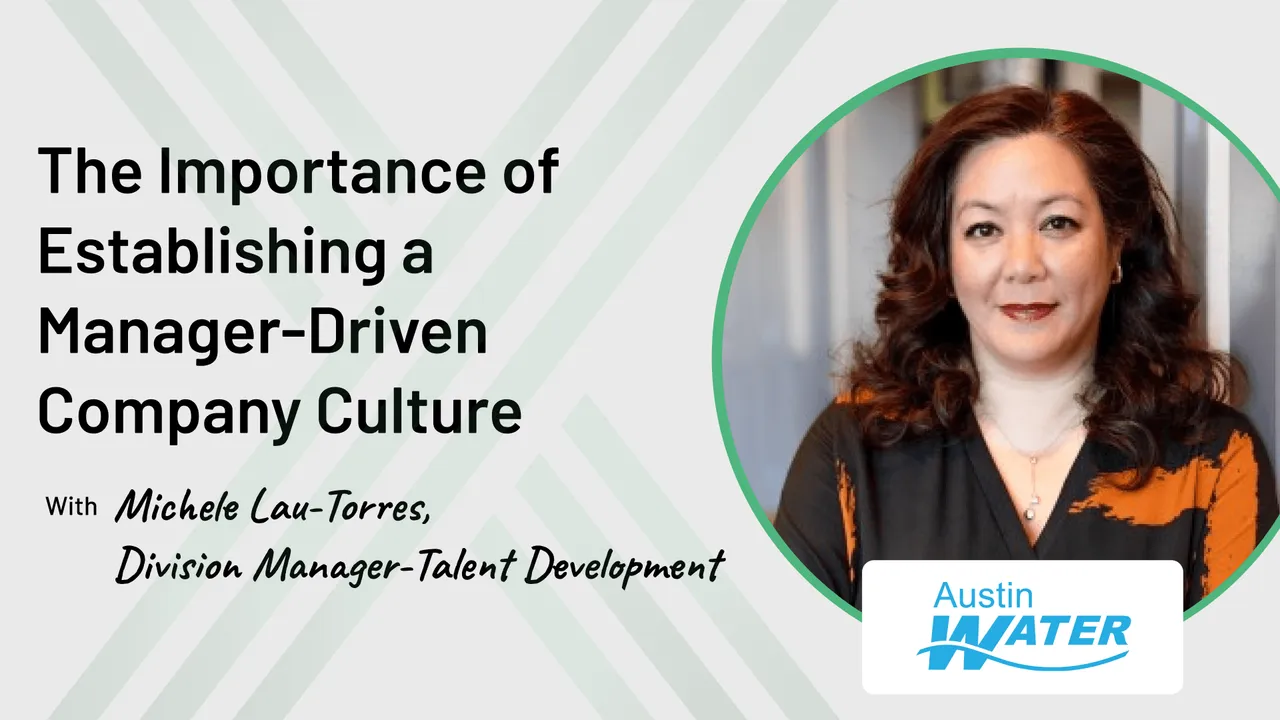
TL;DR
What you need to know from this episode
- Give trust to build trust. Michele argues you cannot mandate trust into a team. Managers earn it by trusting employees' expertise, giving them freedom and space to do their best work, and staying consistent.
- Managers are first responders to employee mental health. Absenteeism, opting out, unusual behavior, and forgetfulness are visible signs. A simple, non prying check-in like are you okay, I see you, can open the door before burnout becomes attrition.
- Much manager burnout is self inflicted. Managers who keep acting as individual contributors become micromanagers and take on responsibility for work their teams should own. The skill of doing work through people is getting lost.
- Your real values are the worst behavior you tolerate. Espoused values that leadership does not live out breed toxic cultures and legal problems. Culture is a garden: cultivate it purposefully or it grows overgrown and weedy on its own.
- Design engagement for the hardest person to reach. Start your strategy with the employee who has no computer, no desk, and no survey link, then close the loop on what you heard. Technology is the rice; managers and executives are the rice cooker.
Most companies say culture is a priority. Far fewer can say who actually owns it. In this episode of CultureClub X, powered by CultureMonkey, host Diana Blass sits down with Michele Lau-Torres, Division Manager of Talent Development for Austin Water Utility at the City of Austin, to make the case that company culture lives or dies with managers.
Michele brings a rare vantage point to that argument. She is a performance and organizational development professional with over 20 years of expertise in talent management, organizational improvement, and employee development. She designed onboarding and new hire programs for Austin 311, led culture and talent strategies in divisions including the Austin Police Department and Austin-Bergstrom International Airport, and consults for organizations such as the US Air Force Federal Executive Board and the Washington State Criminal Justice Training Commission.
That background grounds the conversation in some of the hardest places to build culture: hierarchical, rank based, 24/7 essential services where you cannot simply send everyone home. Across the hour, one theme keeps returning. Managers set the subculture of their teams, and those subcultures, far more than any values poster, decide whether people feel trusted, valued, and heard.
How can managers make employees feel more valued and build trust
Michele's starting point is deliberately small. Every manager has a group of people reporting up through them, so the real question is what the culture and subculture look like inside that one team. Trust is not built by announcing an initiative; it is built by the manager letting go of their own ego and accepting that the job is not about them, it is about their people.
Her practical formula is simple: give employees the freedom and space to do the work they do best, because that is when you get their best thinking and their best work product. Being valued, she says, starts with having a voice on a team rather than being dictated to. And crucially, you have to give trust to build trust. Show employees you trust their decisions and expertise, be consistent, and put listening first.
Does hierarchy make trust harder to build
Diana pushes on whether team oriented, rule bound sectors make this harder, and Michele does not pretend otherwise. Government is hierarchical by nature, wrapped in regulations around hiring and performance management, and it carries the extra weight of public trust. Police departments add rank and a paramilitary structure, where inviting creative ideas from the rank and file does not come naturally.
Her workaround runs through decision making. Leaders can decide autonomously, but the moment a decision needs the team to execute it, excluding them shrinks the likelihood of their support. If you need buy-in from the people doing the work, include them in the decision, listen to their pros and cons, and give them room to push back. Even the most hierarchical chains of command she has worked in see the value of that trust, because it raises psychological safety and lets teams take risks.
Why managers are first responders to employee mental health
Few managers see themselves as first responders to their employees' mental health, and Michele calls that a terrible shame. Her advice is to pay attention to the signals: absenteeism, opting out, unusual behavior, forgetfulness. She tells the story of a colleague who was always engaged and then quietly started missing meetings. She simply asked, are you okay, I see you. It turned out his father had dementia and was dying, and he had been burning the candle at both ends.
That small act of inquiry opened the door to real support, and it illustrates her wider point about what care does to performance.
When you let an employee know that their worth is more than their outcome or their product at work, they will give you their discretionary effort, because they know that you mean it and they know that you care.
Running somebody into the ground, she adds, is not the way to produce a positive culture. Encourage self care, reprioritize the work, and let family come first.
Are managers overburdened, or are they overburdening themselves
Asked whether managers are overburdened with expectations beyond their scope, Michele offers a contrarian answer: she is not sure they are. Too many managers choose to keep being individual contributors when their job is to manage, which makes them micromanagers. Managing means staffing, controls, support, and resources; it does not mean doing your team's job or owning the outcome of their work.
The skill of doing work through people is getting lost, she argues, with decisions drifting upward and no autonomy pushed down to frontline workers. That absolutely produces burnout, but much of it is self inflicted through a lack of delegation skill. She also points at executives: a colleague who moved from government to the private sector found an unspoken culture of coming to work sick, where espoused values about caring for employees collapsed the moment deadlines hit. When leaders force managers to run people that way, the managers burn out too.
Two way trust is built in small interactions, not big projects
On two way trust, Michele's rule is blunt: if you say you are going to do something, do it, whether you are the manager or the employee. Trust does not come from the big project that went your way. Every day can be death by a thousand paper cuts, or you can be trusted by a thousand small interactions that went well.
She borrows a line from a colleague: when you want to show up, think about how you are making the other person feel. Being honest, clear, and even blunt develops trust, as does admitting your mistakes and what you do not know. And she warns against in groups and out groups, because it only takes one person who feels unfairly treated or unheard to derail a team. Psychological safety, in her definition, is knowing you are in a safe space to hold a different opinion, speak your truth, and still be appreciated.
What happens when a team microculture meets a strong company culture
Do manager driven microcultures guide the larger company culture, or the other way around? It depends on scope, Michele says. Her talent teams touch the whole organization, so they have to walk their talk: a team teaching conflict facilitation must be able to facilitate its own conflict. She has seen a healthy microculture catch fire and lift an entire organization, and she has also seen the opposite, where the wider culture is too strong and the team retreats into defense mode.
When that angst appears, the answer is influence, and it starts with leadership accountability. Everybody talks about accountability until it knocks on their own door. Culture, she says, is like a garden: either it grows overgrown and weedy by default, or you cultivate it into something purposeful.
Your culture is going to be driven by what is the worst behavior that you're going to tolerate in an organization.
If an organization espouses integrity but covers up bad behavior, its value is not integrity, and the gap between stated and lived values is exactly where toxic cultures and legal problems begin.
Should blue collar and white collar employees get different engagement strategies
Michele resists the premise that culture initiatives should differ for white and blue collar workforces. Having worked in critical infrastructure for 15 years, across public safety, transportation, and utilities, she reframes the question as one of equity. It is easy to engage an office worker with an email and a survey. It is much harder to reach the technician testing water samples on a night shift, who may not have equitable access to technology or the same fluency with it.
Her strategy starts with the hardest person to reach: the employee grooming horses in a stable from five thirty in the morning with no computer and no cell phone. Design engagement for that person and everyone else follows. In practice that means in person forums, sticky notes, and awareness of literacy limits, and above all closing the feedback loop: telling people what will happen with their input, when they will see it, and what their own role in the solutions will be. There is no point in asking if you are not going to do something with the ask.
Technology is the rice, managers are the rice cooker
On technology's role, Michele is enthusiastic but precise. Platforms like CultureMonkey, with nudges and crowdsourced coaching insights, have a strong place in the market, and data absolutely drives informed decisions and strategy. But rice does not boil itself. The technology is the rice; managers and executives are the rice cooker, the ones who actually have to make something happen. Her own struggle has been mixed workforces where a technology only approach meant hearing from just 25 percent of the organization, all office workers.
Culture keeps evolving, with hybrid work, Gen Z's demands, internal mobility, and DEI reshaping expectations, so listening cannot be a one time exercise. This is where continuous employee listening earns its place: not as a substitute for management, but as the input that tells managers where to act before people walk out the door with knowledge and money behind them.
When you take care of your people, your people are going to take care of your business. That's why culture is important.
That, in the end, is Michele's case for a manager driven culture. Tools can surface the truth, but only managers who listen, act, and keep their word can turn it into a workplace people choose to stay in.
About the guest
Michele Lau-Torres
Michele Lau-Torres is a performance and organizational development professional with over 20 years of expertise in talent management, organizational improvement, and employee development. She is the Division Manager of Talent Development for Austin Water Utility at the City of Austin, a role she moved into after leading culture and talent strategies in divisions including the Austin Police Department and Austin-Bergstrom International Airport, and designing onboarding and new hire programs for Austin 311. She also works as an independent consultant for the US Air Force Federal Executive Board, the Washington State Criminal Justice Training Commission, Capital Metro, and the Austin Radiological Association, where she champions organizational culture, leadership development, and employee value proposition.
An alumna of Liverpool John Moores University, Michele is a certified instructor for the Texas Commission on Law Enforcement as well as a DISC instructor. In her free time, she enjoys walks on the beach, poetry, and theater.
Full episode transcript
Season 04, Episode 05 · Michele Lau-Torres with Diana Blass · 58 min
Hi, everyone, and welcome to the latest episode of CultureClub X, powered by CultureMonkey. I'm your host, Diana Blass. CultureMonkey is a complete employee engagement platform that helps people leaders listen to their employees and enhance workplace cultures. In the fifth episode of our latest season, I'm joined by Michele Lau-Torres, the Division Manager of Talent Development for Austin Water Utility at the City of Austin. Welcome, Michele, it's great to have you today.
Thank you very much, it's lovely to be here.
Great, well, I'm excited to dig further into our topic today. But first, just a little bit about your background for our viewers. Michele is a performance and organizational development professional with over 20 years of expertise in talent management, organizational improvement, and employee development. She designed onboarding and new hire programs for Austin 311, and led and implemented culture and talent strategies in divisions that have included the Austin Police Department and Austin-Bergstrom International Airport.
She's also an independent consultant for the US Air Force Federal Executive Board, Washington State Criminal Justice Training Commission, Capital Metro, and the Austin Radiological Association, where she works to redefine and champion organizational culture, leadership development, and employee value proposition. An alumna of Liverpool John Moores University, Michele is a certified instructor for the Texas Commission on Law Enforcement, as well as a DISC instructor. In her free time, Michele enjoys walks on the beach, poetry, and theater. Michele, we're so pleased to have you today. And just share a little bit more about your background with our viewers.
Sure, yeah, so you pretty much gave a great description there. I currently work for the Austin Water Department. So yes, it is a utility. And there, pretty much, I'm bringing the same expertise into that organization. I literally just started within the last three months. So I just moved from the international airport into the Water Department. So I am being blessed in fire or water, I'm not too sure which one it is. But over there I have purview over employee engagement, employee and leadership development, as well as learning and development strategies. And employee recognition and culture, of course, right? So all of those things drive culture.
Definitely, and I think it's fascinating, our conversation today from your perspective. Because you do so much work with the government or federal organizations. We haven't really had that perspective, so I'm interested to dig in there. Again, this videocast will focus on the importance of establishing a manager-driven company culture. So thanks again for your time today. And without further ado, let's get started.
So the first set of questions center around this idea of building trust and being valued, which are the bedrock of a good culture. What steps can managers then take to make employees feel more valued and improve trust with their teams?
Yeah, this is a great question. Because I don't think that people ordinarily walk into an organization and think to themselves, how can I improve trust right now? Teams, every manager should have a team, right? They're gonna have a group of people that are gonna report up through them. And the question there is, how is your culture and your subculture just in your team? You have to start small.
And so developing that trust and making sure that employees feel valued and know what they bring to the organization. Everybody wants to add value to an organization. Everybody wants to know that the work that they do actually matters. And it has to start at an executive level and then travel down to a manager level, which travels to a supervisor level into the individual contributor. And so some of those things are letting go, right? So letting go of your own ego as a manager and realizing that it's not about you. It's about them.
So how do you build trust? You give your employees the freedom and space to do the work that they do best. Because when you give them the freedom and space to give you their best thinking, you get their best work product. And the first thing, being valued, is actually having a voice on a team versus being dictated to all of the time, right? And that's a big issue with supervision and leadership, I think, is that people don't know once they get to a certain point. Once you go from an individual contributor and you reach that level of, right now I have purview over people, I have to now manage people and get them to do their best work. How do you go about doing that? How do you be a trusted person?
I think you start off by being trustworthy yourself, right? And you have to give trust to build trust. You can't just come in and say, let's improve the trust in here, we all need to trust one another. You have to be able to show that you're trusting your employees to make good decisions, that you're trusting their expertise. That's why you hired them. And be consistent. And it all kind of starts with listening as well, right? Listening and putting them first. That to me is when you know that your employees, that your smaller organization that you have control over, is being valued.
It's certainly interesting to think about that dynamic. And especially with the organizations you work for, they are so team oriented. I mean, you think about the police department, or from your work as being an instructor for law enforcement agencies. Would you say it's harder in certain sectors to, I guess, accomplish that end result of having that individual voice and also the team environment, versus maybe a startup, for example, where everybody's individual creativity is embraced and encouraged? I mean, I'm sure they're encouraged in both spaces, but maybe one isn't as welcoming as the other.
It can be, so government is very hierarchical in nature. It's not automatically matrixed. And there's a lot of rules and regulations to things like hiring process and performance management systems, for example. So to be able to have any kind of internal mobility can be a little bit of a challenge. And those are some of the things that impacts culture, freedoms, decision making, and where does the buck stop, right? And so it can be a challenge for supervisors and managers and executives in the government forum to be able to let go a little bit of the insurmountable sometimes amount of pressure that they feel to get things right all of the time.
Remember, you're dealing with public trust when you're in government. And that is a huge thing, right? So when you're talking about trust, it comes from the public. It's from your customer. It's from the community. And then it's also from your workers and co-workers and interdepartmentally as well. Not all government organizations necessarily work together and have all of the same processes and protocols. So it can be a challenge. And then, of course, talking about the police department, that also is very hierarchical, right? It's rank based. And so that in itself has its own challenges as well. I mean, it's a paramilitary organization. So it's hard to necessarily say, hey, what creative ideas do you have, when you're in the rank and file, so to speak. So yes, I never said that I didn't like a challenge though.
Definitely. No, of course. Are there certain exercises you do to encourage that work style, or any tips you can provide?
To encourage the work style of?
Of just embracing that, I guess enabling that open dialogue, the trust among all team members, rather than that hierarchical approach that you were describing, which sometimes can be limiting.
So a lot of the time, I will look at this from a decision making process, right, which means there's multiple ways in which a leader can make a decision. And depending upon what you need from your organization and your employees, that is what is gonna impact how you make a decision. So you can make a decision autonomously yourself. You can make it kind of like directorial, I know the answer, I'm the expert, and you can move forward with that. But then you get to the point where when you make a decision, you have to make sure that your team is on board. And if you go ahead and make a decision yourself without asking for any input, without getting the expertise of the team, the likelihood of their support is gonna decrease.
And at the end of the day, a lot of organizations, what they're looking for is the outcome, a successful outcome. So that is a good way to talk about it. If you need to have buy-in and support from the people who are gonna do the work based upon your decision, you're gonna need to include them in that decision. And if you're gonna include them, they need to trust that you're gonna listen to what they're actually saying and give them the space to give you the pros and cons of what you might be doing. And even in the most rank and file, or even in the most hierarchical chains of command that I've been involved in, they do see the value of building that trust for the increase of psychological safety within the team, right? So that they can take risks.
Well, moving on to a second question now. What signs can managers look for to gauge the emotional and mental health of their team members? How can they become better first responders to employees dealing with those issues?
Another great question, because I don't think a lot of managers see themselves as first responders to mental health issues that their employees might be going through, which is a terrible shame, because health and wellness is really important. And you're not gonna get the best out of your team if they're going through some stuff, yeah? So how can you gauge the emotional health? Take a look around, right? Pay attention, look out for it, that's the first thing.
Recently I had an example. I had a coworker of mine who was somebody who was always involved, engaged, opted in, always had something to say, was always present. And then he started to kind of opt out a little bit. He would miss meetings, he would kind of give a little wave. Just small, small things that made me inquire and ask, is everything okay with this person? And everybody would be like, yeah, I think so. So I got the opportunity to just ask him myself, right? And I said, hey, are you okay? I just want you to know that I see you. And I see that there's been some changes, and I hope you're okay, right? That's all I said. And this wasn't my employee, this was a peer. But the answer was that his father was really sick. He'd been burning the candle at both ends. He'd been trying to take care of his family. His father had dementia. He was probably gonna die soon. In fact, he did, he ended up passing away in the last month or so.
Those small things of inquiry make a huge difference. Because what that did then was, that opened up, he got a little bit emotional, right? And he said, well, thank you for seeing this, and thank you for asking. Thank you for caring. And what that ended up was text messages and just saying, like, how are you, I'm just checking in on you to make sure you're okay. Because I can see you're burnt out.
So how do you gauge it? You gauge it because you're gonna see people often out. You're gonna see absenteeism. You're gonna see unusual behavior, forgetfulness. You're gonna see the signs. The question is, are you gonna do anything about it? Are you just gonna keep flying on like it doesn't exist? So for me, that's the most important piece. How do you become a first responder? It's, you're there, you lay a hand to support and you encourage that self care. Figure out what can be reprioritized. I mean, family has to come first in every organization. When you let somebody know that, when you let an employee know that their worth is more than their outcome or their product at work, they will give you their discretionary effort, because they know that you mean it and they know that you care. Running somebody into the ground is not the way to produce a good positive culture in an organization.
Definitely, I love the way that you positioned your concern there. You didn't really pry and want to know exactly what was going on. You just voiced the concern that you've seen maybe an emotional change in the person. And it's a sensitive topic, right? Because you don't want to overstep. You don't want to make someone feel like they're in trouble. But you want to be able to show that concern.
We'll move on to question number three.
Yeah.
So, do you agree that managers are overburdened with expectations beyond scope of work? What can organizations do to reduce manager burnout and its potential fallouts, like attrition?
I'm not sure, and here's why. I'm not sure that managers are overburdened with expectations beyond the scope of work. So hear me out on this. I feel a lot of the time that managers choose to be individual contributors when their job should be to manage. Which makes them, in some respects, micromanagers. So there's a difference, right? There is a difference between guiding and supporting your employees because that's what they need, because maybe they're new, or you're doing a stretch assignment, or there's a task that they're maybe not familiar with, or a relationship that they need to build. There's a difference between that mentorship versus, when you're there to manage, you're there for staffing, you're there for controls, you're there for support, you're there for resources. You're not there to do their job.
And what I find is a lot of managers are taking over and taking responsibility for the outcome of people's work. And it's your employees, it's your supervisors, it's the people below you that are responsible for that. You're responsible for creating a safe space, a safe culture, for putting in the different models and modems of, how do you as a work group or a department, whatever size of influence that you have, how do you make sure that people feel safe and have what they need to do their best work. And you plan that out. So you plan the goals and you say, okay, everybody, execute on those goals.
I think what we end up doing as managers is we take it all on board, that it's all on us, that the failure is all on us, and to a certain extent, it is. But I think that the skill of doing work through people is starting to get lost. And so we're not pushing down, it's like all the decision making is just heading all the way up and nobody is pushing it down. Where is the autonomy for our frontline workers, for our individual contributors? And that in itself is a cultural thing. It's huge to be able to have that freedom to make autonomous decisions at whatever level that you're at. And know what processes you have to go through to get an answer or to get an approval or to get the guidance that you need. That's part of a choice.
So I'm not sure a lot of managers think to themselves, oh, you know, I think what I want is a culture of decision making, right? Because most people, when they get promoted and their careers advance, they think, well, as I advance, I have more and more responsibility. You have more oversight. Your responsibility doesn't necessarily have to be more and more. It's just a different kind of responsibility. The further up you go, the more responsible for the actual people you are, versus the work that the people do. So I say that because, are they overburdened with expectations? I think some of it is they're overburdening themselves, because there's possibly a lack of skill in understanding what delegation looks like and understanding what the true role in an organization should be. And does this produce manager burnout? Absolutely, it does.
And what can organizations do? I mean, I think organizations need to hire the right people. That's the first step, and have a really clear expectation for work, right? So we talked a little bit earlier about the difference between working with government and corporate. And I recently had a work colleague that jumped out of government and into corporate. And one of the first things that she said to me was, this is really different, because it is an unspoken culture in this organization, in the private industry, that you go to work sick, right? Because you don't let anybody down, and what's ended up happening is everybody is then coming into work and everybody's sick. And because you have a certain amount of time and deadlines, it's like there's no promotion at all of self-care. Now, there is the declared, right, the espoused value of, we're all about caring for our employees, work hard, play hard, get everything done. But when the rubber hits the road, what's really happening is, you're sick? Oh, well, you have work to do. And that culture is something that, now that she's really experienced it outside of government, she's like, I don't want to work like this. This isn't okay. This is like a hard line in the sand for me, where I know that I don't want to work for an organization like this.
But that's where some of the manager burnout comes from. Because when you're at an executive level and you are forcing managers to treat people without that respect or the value of self-care that we talked about earlier, or employee well-being, that burns you out too, because you feel like you have to comply as a manager to what you're being told to do. So I'm not sure I have an answer for, you know, how do you reduce manager burnout. I think it starts with knowing what organizational values are and truly living those values. And managers can then get to choose if that's the organization they want to be in.
I find everything you said to be so fascinating there, because there's so much talk today about personal brand and what that brings to a company culture. And what about personal responsibility, which it seems like you're discussing there, where it comes to the choice that you have as to how you kind of set the tone for how your department works, or what you need from your organization to succeed. It makes me think, because I've definitely had times of burnout in my experiences. And I don't always have the resources or the team to rely on. And so it seems like there's also this idea of promotion that comes with just then consolidating positions. You know, you get a new job title, but there's no one really taking over you from below.
What ways do you work with companies to ensure that this burnout, and I don't want to use burnout because it seems like that's not the best term to use, but maybe it's just, their workflow isn't really the best for long term growth and retention. What ways do you work with organizations to ensure that these situations don't happen? What kind of check-ins can you do, check-ins for if people are doing okay? Or just to see that managers, the burnout from taking on too much, right, not delegating their duties, or at least training their staff to properly then take on the role, so that they can then step into more of a management role. Where does that come from then, to ensure that managers are living up to that expectation rather than just taking on more work and micromanaging?
That's a really great question. And I have a really simple answer, in a word, according to Michele. And it's listening. It's actually properly listening. Not only setting up the opportunity for people to speak and tell you what's going on, but actually listen to what's happening. If you go and you talk to your individual contributor, your supervisor, even your managers in the workforce, what is it that's forcing burnout? The repetitive issues that keep coming up over and over again in organizations. Either personnel issues, whether it's a workflow issue, whatever it is, there's something that's always there. And there's something that they know that can be done better. And it doesn't often get heard.
So as a manager, I don't know what can be done better, because I'm here thinking about these things. You're here doing these things. If I make a decision and it trickles down to you, why would I not ask you what's the best way to go? Right? And a lot of folks who have burnout, it's emotional too. It's emotional because they're tired of saying the same thing over again. We need this. Our tools are old. Our infrastructure is cracking. Right? There's only so much we can do to hold on. This process needs changed. The way we behave, our group norms, it's toxic. And number one, are you creating a safe space for which folks can actually say what they need to say? Do you care enough to listen to make those changes? Because you're burning yourself out as well if you're not listening to the advice of the people who are actually doing the work.
And I talk about this too, when we talk about performance management, and what is it that we are actually measuring on. Well, why are we not asking the people who are doing the job what they think that they should be measured on, and come to an agreement, versus me pushing it down? I'm two layers away from you. I have no idea what you do day to day. I know what I need the outcomes to be, and I can help plan for that and give you resources. But the actual challenges that you face day to day, I don't know about. And I'm not going to know unless I choose as a manager to listen and drive that culture of, you're safe taking interpersonal risk. Tell me what's wrong so that it stops at your level. And that means it doesn't come to my level over and over again, where we're just dealing with the same issues.
So those kinds of things are categorically organization wide for me. Right? So it can start very small, but that stuff catches. So you might have siloed teams of people, but they're all operating in the same way. And that impacts the culture of the entire organization. So it can be pretty tough. I think managers leave less frequently than the folks below them. And I think sometimes managers forget that when people leave, they're leaving them. They're breaking up with you.
That's a very blunt, but truthful statement right there. I mean, because those are the people you work with every day. They're the ones who are really defining your working environment. So it makes complete sense.
And actually, it takes us to our next question now, about the idea of enabling that two way trust with your team. What can managers do to ensure that trust is there? How important is psychological safety in this, especially in today's remote work world? Which maybe isn't too applicable to the water utility, I'm sure you have a lot of people on site, but we haven't really touched too much about how the post pandemic work world has impacted this development of two way trust.
If you as a manager say you're going to do something, you need to do it. And if you as an employee say you're going to do something, you need to do it. Right? So this goes back to, it's the very small day to day things that help develop trust. It's not the big project that went your way. It's the small interactions. Every day you can be, you know, death by a thousand paper cuts, or you can be trusted by a thousand small interactions that went well, because you had in your heart the spirit of, I want to help this person get to where they need to be. I want to help them do the best that they can do today. Right? With every small interaction, I want to help them negotiate or navigate a conflict that they have with their supervisor or another employee or whoever it might be, instead of leaving things dead to the ground.
I had a conversation today with a friend of mine and a colleague, and we were talking about brand and how you show up. And one of the things that she had said to me was, well, when you want to show up, don't think about how you're showing up. Think about how you're making the other person feel. Right? And that was like, yay, oh my God, you just put into words one of the things that I feel like I want to do. For me to want you to trust me means that I have to make you feel at ease. I have to be honest with you. I have to find a way to tell you what I need to tell you in a way that is going to be meaningful and clear, and also not upsetting. Because I have a clear goal in my mind, and that clear goal in my mind is to fix something, or give you the truth so that you can fix something. Brené Brown says, you know, being unclear is unkind. And there's so much truth to that. It's like, let's just be really clear, and let's call forward the things that we're either doing well or we're not doing well.
And admitting that you can make mistakes and you do make mistakes as well, and admitting that you don't know everything, that also develops trust. So think of any friendship that you have. How do you develop a two way trust with friendships? It's the small interactions that work and that work well. You don't let somebody down, and you're honest and you're open about stuff. Managers need to do that too. That's how you develop two way trust for me with teams. And of course, a team is made up of each person. So being sure that you don't have your in group and your out group, because that dissipates trust. And it only takes one person that can derail a team. One person who believes that they're not being treated fairly, one person that feels that they don't have psychological safety, or they're not being listened to. And for me, what is psychological safety? It's the ability to know that you're in a safe space to have a different opinion, to speak your truth, right, that you're going to be heard and appreciated for what you bring to the table.
Definitely, it's refreshing to hear about just your natural interaction with people, the being transparent and honest, and even blunt to some extent. It seems like sometimes we get overwhelmed by doing specific networking events or having specific ways, you know, happy hours or things like that, just to create that bond. When really, as you put it, it's those day to day interactions that are really going to set that tone. You can just kind of get boggled down by the ways that we're supposed to bond, rather than just being natural with one another. I think that's an important thing to mention.
Now, on the next question, I mean, speaking of the ways we interact with one another, how important are frequent pulse checks and manager driven microcultures within teams? Do you think they guide a larger company culture, or vice versa?
It depends. It depends on the scope of the team. So, for example, the teams that I work in generally have scope over the entire organization in some shape or form. So it's normally a small and mighty team of dedicated, passionate people who work within the talent development, talent management space. But the work that they do impacts the entire organization. So for somebody who lives and works in the talent space, it's really, really tough for me to lead and for my team to go forth and be like, oh, so we're going to do leadership programs, and we're going to talk about value propositions, and we're going to talk about career progression, and we're going to talk about, you know, Brené Brown or Simon Sinek or all of these great philosophies for workforce development, if we ourselves are a team that is in a state of disrepute. Right?
So the microculture of the teams that I lead are very, very important to me. Right? So when I go in and lead teams, my first port of call is not the organization. I move organizational culture, I begin with my team. Because they need to be a team that can walk their talk. If we're going out there and saying, this is how you facilitate conflict, we need to be able to facilitate our own conflict. If we're saying, this is how you be a good leader, and this is how you lead with empathy, or this is how you lead with authenticity, then that's what we need to do as well. And so for me, the microculture within a talent team specifically is going to be really, really important, because they're pushing out the work.
Now, can that microculture expand and grow and catch fire? Yes, it can. I've seen it happen. My team has done that multiple times. The teams that I've been a part of in multiple organizations have definitely impacted culture in a positive way for an entire organization. I've also had the experience where the culture of the organization is just too strong, and one little pebble isn't going to make the headway or the changes that you want to. So you can get into defense mode, where your microculture is exactly that. It's going to stay, we're a happy team and everything around us sucks. You see what I mean? So that's kind of what I look at there.
I mean, I think that most CEOs and executives don't come from the people space. Even HR executives don't necessarily come from a people and talent and culture space. They come from what is mostly compensation, employee relations, that kind of thing, because human resources also has rules and laws, right, that have to be followed, stipulations that need to be followed. Certainly in government, they do too. So to have that extra piece of an organization that is about talent development, that is about driving culture, that is about employee engagement and equity and inclusion and all of the things that matter to people, I think is desperately needed in organizations to drive a culture change. I'm not sure I answered your question there.
You did. I think it's fascinating to think about how, depending upon the size of the company, different cultures could arise in some sense. I mean, you think of these massive companies, and I guess each division should have its own brand to a certain extent. But when you were talking earlier about the idea that a microculture can almost come off defensive towards the rest of the company culture, what do you do then to tend to that? Because in a way, I would think you'd want that microculture there, which has so much excitement and a breath of fresh air, to remain true to itself. But yeah, what do you do when you have that kind of angst within the company?
Well, you try to influence is what you do. Because ordinarily, if you have that kind of angst, it's because the larger company isn't ready for the real change. Because culture is a top down and bottom up approach. Everybody has their own individual responsibility for how they behave and what they bring to an organization in a work group. It starts, though, from the top, and it translates down. And this is one of the things that is easier as a consultant than an employee, is to come into an organization and say to the leaders, you are the problem. Let's take a look at this. Right? Most people, and it happens everywhere, you come in and you have a discussion and you have a consultation, and everybody's miserable. They're taking advantage, or, you know, the rumors are afield. It's toxic. All of the above. Employees are entitled. They're not working hard enough. They're not meeting their goals. I mean, it can go on and on and on. And I'm like, okay, so what's your part in this? Right? So everybody talks about accountability until accountability knocks their door. And so my question to managers and executives is, where is your accountability in this? Because this is your organization. They don't run it. You run it.
So it's like a garden. Culture is like a garden. It's either going to be overgrown and weedy, because the people on the front line are going to decide what everything is going to look like and how they're going to interact. Or you can cultivate it into something pretty and beautiful and purposeful. Right? And culture should be purposeful, and not just run away with it because this is how we ordinarily do things. If this is how we ordinarily do things and everybody is happy and it's productive and it's positive, okay. But if this is how we ordinarily do things and it's not working out well, people are getting in trouble. If we are punitive because we can be, versus punitive because you're doing something that is strongly against our values. I mean, I've seen organizations, I think every organization has integrity as a value. And I'm like, oh my God, stop. Right? Because what does that actually mean? Your culture is going to be driven by what is the worst behavior that you're going to tolerate in an organization. So if you have somebody, or a group of people, or whatever, who break a law, do something bad, and you cover it up, your value isn't integrity. So don't espouse it. Because then what you're trying to say is, we want a culture of this, and this is what we're telling everybody that we're all about. But the reality is something entirely different. And when those two things don't align, that's when you get folks making bad decisions, getting away with it, toxic cultures, and legal problems as well. I mean, this is how this all comes out to fruition.
I think executives are afraid to actually stand up these days and say, this is what I stand for. They're either afraid or they don't know how to go about it. Which is, these are values, this is what I want our organization to stand for and look like and do. And it transfers down. Here's the thing. It's more than words. It's action as well. It's action on your executives' part, and it's action on your managers' part. And it has to travel down. So I think that I lost track of what I was saying.
I mean, I absolutely love that framework that you pointed out, and something that everybody can keep in mind, just about the lowest values or actions you'll tolerate as a company. I mean, that's the easiest thing to think about when it comes to defining what you stand for and what you're working towards. It's just a great exercise, I think, for anybody to have.
Digging further into defining culture, organizations often use a blanket culture policy for white and blue collar employees. How should culture and engagement initiatives be different for these respective workforces?
I'm not sure they should be. I'm not sure they should be different. This is a really tough one. It's a tough one for me, because I have been working in organizations that have a large skills craft workforce as well as, you know, your support office staff. There's definitely better ways to give this imagery out. But I have been working for critical infrastructures for 15 years. Right? Whether it's public safety, transportation, or utility, because I used to work with Austin Energy as well, that was the 311 thing, and now the water department. So you're looking at infrastructure, you're looking at 24/7 and shift work, consistent shift work. And you're also dealing with heavy equipment operators, plumbers, technicians, folks who are out and about testing water. They're out and about, you know, painting things, changing light bulbs on the runway, doing all of those different things. Or they're on shift, you know, with the police department, or what have you.
Covid was a really huge defining moment, certainly in my experience, working with essential infrastructures where operations is vital. You can't close down. You can't tell everybody, let's all go home. The airport shut. There's not going to be any water this week. Right? Or electricity is done for the day. So you have to find a way to navigate that. This is where leading with empathy is really, really important, and having some kind of an empathetic approach to your employees. They're normally the least paid in an organization, and they're the ones that are holding your organization up. And I think that is lost on a lot of folks. So that's me on my soapbox a little bit about that, by the way.
I think that when you're talking about engaging your employees, it's really easy to engage an employee who sits in an office and works in finance, for example, or who's an engineer. You send an email and you say, what do you think about this? Well, here's a Microsoft form, fill it in. Here's a survey, answer the survey. Right? Well, I'm going to see you at this meeting. Wonderful. But when I'm talking to somebody who is, you know, testing water at a water plant, taking samples, things like that, somebody who's working in SCADA night and day, checking all the lab work and all of that stuff, how am I going to reach out to that employee? Because number one, there's not necessarily equitable access to technology. And number two, there's not necessarily the same fluency in using technology that there is for somebody who works in spreadsheets all day.
So when I talk about engagement initiatives, what I honestly think about is equity. And it's regardless as to whether you're skills craft or you're on the field. If English is your second language, if you don't have either access or fluency in technology, what does employee engagement really look like? It's engagement in some shape or form where I can bring you a message and information, and that's a two way street. You can bring it back to me or my team or this organization in some shape or form as well. So I honestly don't think that culture engagement initiatives should be different, because what I like to do is put in place in my mind, what employees are the most difficult to engage with? And that's your strategy, because everybody else is going to have other capacities and other capabilities. The ones who are the most difficult, the ones that you don't see, the ones that you don't hear from, the ones whose voice is missing from the table when you set that table, that's where your strategy starts. It's, okay, forget all these office workers. We have a person in here and he grooms horses, right, Monday through Thursday, and he starts at five thirty in the morning. How do we talk to the guy who grooms the horses? How do we, in a stable where he doesn't have a computer, he doesn't have a cell phone, how do we get messages to this guy? And that's where your engagement strategy starts.
And so I sort of led with the challenge of covid, and what I saw certainly in government and in my consultant role as well, like you said, I had a lot of federal agencies as well that I work with. What I saw was a very huge distinction between those that were capable of working from home and those who were operational and essential workforce and not able to work from home. Point is, we're not unique. You know, we have doctors and nurses out there who had that same thing. I think organizations find it really difficult to bridge any kind of a culture that would embrace both. And it became them and us to a certain extent. There's them that can work here, and then there's us that are doing this stuff. And I think that most organizations struggled with, how do we merge this and bring this into, this is who we are, we all have different roles and capabilities. And instead sometimes arbitrarily just brought people back into the workforce and didn't give them the opportunity for a hybrid work schedule or an alternate work schedule. My personal belief, working for the water department, and when I was working for the airport as well, was that if you're in the land of engagement, you need to engage, and that means you need to be there. So I spent a lot of my time there, even though I do have an option to work from home. It's lead by example. You want your team to come in, you need to come in.
Yeah, it reminds me of what we spoke about earlier, right, that outcome approach. What outcomes are you trying to achieve? And I think if you keep those goals in mind, then you naturally unite all types of employees within a workforce, if everyone's super engaged on that mission. I'm so curious to know, when it comes to those more difficult, I don't know if difficult is the right word, but, you know, just challenging employees to engage with, who do work shift work or work alone and maybe aren't used to working in a team, when you're trying to build a culture that starts with that person and then naturally extends outward, what are the ways you engage with those employees?
And so for me, I create forums in which they can show up, and they're usually very specific and pointed. And sometimes they're successful, and sometimes they're okay. Because again, it depends on developing that trust. So repetitive is something that's big for me. So I like to engage the workforce in person and have lots of sticky notes, all old school. I love that. I love to get their handwriting done. I love to get them talking. I have dealt with folks who, you know, they have literacy issues, they don't read well, they don't write well. And so when they come in and I'm asking them, hey, put this on a sticky note, you can see, it's like, well, right. So it's being really cognizant of who your audience is as well, and what their limitations might be. And that's a facilitator thing.
Again, there's no point in asking if you're not going to do something with the ask. So bringing the loop back around. Right? So let's say we go out and we ask the question, how can we make X, Y and Z better? And they have all of these wonderful, bright ideas. It's like, okay, great. So here's what I'm going to do with this information. Here's when you're going to see it. And then I'm going to come back around again. We're going to talk about it again and see how we can make it different, and engage them in a way where it's not like, I'm going to take all of these problems and solve them. It's, taking all of these problems, we've talked about it with others, how are we going to maximize some of the solutions that you also came up with? And what's your role going to be in the solutions? Employee engagement isn't all just about listening. It's also about having employees, having your workforce, actively participate in solutions. And that goes to the individual contributor level and teams.
And so there's also only so much you can do. Not everybody wants to engage. Some people have had enough. Trust is low. They've been told over and over again something's going to change, and they don't want to be let down again. Right? Like I talked about earlier, why do people burn out? They burn out because they're tired of asking for the same thing over and over again and not getting it. And just because somebody like me walks in and says, oh, hooray, I'm here and I'm going to listen, I also can't promise that anything's going to necessarily change. But what I can do is show you that I've tried.
Well, from the sticky notes that you mentioned to now tech. How do you think technology can enable managers and people leaders to deliver on culture initiatives and improve retention?
Well, I mean, the organization that we're represented in right now, I mean, CultureMonkey has a magnificent platform. And there's other platforms that are similar where you're able to reach out. What I like about CultureMonkey in particular, though, is that they're developing nudges and trying to crowdsource information globally to be able to almost have like a coach, which I think is very clever and really has a strong place in the market. Technology absolutely has a place for information and data and to help strategy. There's no doubt about it. It's the action. Right? Rice doesn't boil itself. Right? So for me, the technology is the rice. The managers and the executives, they're the rice cooker. They're the ones who actually have to make something happen, because all the technology in the world isn't going to fix culture, but it will certainly drive your informed decisions if you're asking the right questions in there, and it can help reach a lot of people.
For me, my struggle has always been that I have always worked for a mixed workforce, where at least two thirds have been skills craft, and there's been some challenges with technology, and using that as a sole way in which to engage and gather information, because then I'm really only hearing from 25 percent of my organization, and that 25 percent are all office workers. Right? And so that has been a challenge that I've been trying to overcome, and trying to find ways in which to engage the populations that I really need to talk to and really need to figure out, how can we fix some of the things that's going on culturally, and with your tools and with your work and with your processes, that all impact how we engage with our organization. So I think technology is an incredibly powerful thing, and it certainly is something that can drive decisions and strategy and planning. And that will in itself, once managers and supervisors are on board and executives are on board, deliver on culture initiatives.
The thing is, is that culture is really complicated. So it's not just one thing. It's all of the things. And sometimes it's hard to wrap your mind around how a simple singular procedure can actually impact culture at a team level, which can then impact the organization and ripple throughout. Nothing is ever going to just be perfect all of the time for everybody. Right? Because culture evolves. It evolves as your organization matures, and it evolves as your client base changes, and it evolves as technology changes. It's evolved for everybody with covid and hybrid work from home and policies and all of those things that have changed. It's evolving as Gen Z comes into the workforce and has different demands on their employer and a much more global perspective of the world. It evolves when the gig economy kind of crashed a little bit, and now people are expecting internal mobility and a gig economy within the organization that they actually work for. It evolves in so many ways that you have to meet it where it is.
Culture changed as well massively with various things that were happening in the world, with Black Lives Matter and with DEI initiatives. Very few people were talking about diversity, equity and inclusion. There were very few jobs out there, you know, even five years ago. Now it's huge. Everybody is looking for, we need this consultant. We need to see, are we being equitable? We need to see, you know, are we diversifying our workforce? Are we listening? Are we being inclusive? Do we have an ERG? Do we have an employee resource group? All of those things impact culture. Because here's why we have culture, by the way. Why is culture important? Because when you take care of your people, your people are going to take care of your business. That's why culture is important.
And if you want to sustain a healthy organization and a healthy business and stay competitive in the market, if you're private industry, of course. Public industry, it's about essential infrastructure. It's about meeting the demands of your community, and the demands of your community are going to change. You need to keep a really close eye on culture, because every time you lose somebody, because you can't get it right, because you have a toxic work environment, because whatever the reason is, every time you lose somebody, it's money out the door, it's knowledge out the door, and it's stuff that has to be replaced. And that is a cost, no matter what organization or where you're at. If you want people to come and give a great employee experience or customer experience and a great customer service, you're not going to do that if you're miserable. That's not who you're going to be. That's not how you're going to show up. And so this is why culture is so important. People will come in and they'll spend a short amount of time, and then they'll decide what they want, what they can live with and what they can't live with. And when we talk about values, I mean, Gen Z is very high on values. They want social justice. They want environmental justice. Right? They want to know that organizations are doing what's right. And that also starts at the top with your values.
Yeah, I mean, I'm so glad that you mentioned how complex culture can be, because in this conversation, I keep looking for, you know, the answer. A lot of my follow up questions being like, well, what can we do? What have you done? And as this conversation has gone on, it's clear that there is no one answer, as you just said. So it's fascinating to think about it that way, and all the layers, and how it can ultimately become a beast of its own if you don't continuously stay on top of it. And I suppose that's why technology is so important as an element to the conversation, because it at least helps you to better organize it and manage those different layers that ultimately create the full pie. It's definitely a fascinating conversation.
Well, that being said, let's close it out now. Really, again, an amazing conversation. Your insights and expertise on manager driven cultures were thought provoking. Managers are an important pillar of culture at workplaces and help impact employee engagement and retention levels drastically. With CultureMonkey, managers can listen to the needs of their employees and drive change with action based insights to create culture driven organizations. So visit CultureMonkey.io to see how you can improve your workplace today. And with that, we conclude this episode of CultureClub X. Thank you, Michele. Honestly, really great conversation. I had so many light bulbs go off throughout it. But please let our viewers know how they too can reach out to you if they want to have a quick chat or just share their perspectives.
Absolutely. I am on LinkedIn. You can find me under Michele Lau-Torres. I will be happy to engage. I love talking about this stuff. Can you tell?
I mean, it really is great. It's just crazy how many new questions arise. And I think it's interesting, too, that we don't have the answer to it. So that being said, we'll definitely have more to come. And that's all we have for you in this episode of CultureClub X, powered by CultureMonkey. Until next time, I'm your host, Diana Blass, signing off.
Frequently asked questions
What can managers do to make employees feel valued and build trust?
Start small, with your own team's subculture. Michele Lau-Torres advises managers to let go of their ego, give employees the freedom and space to do the work they do best, and show that they trust their people's decisions and expertise. Being valued starts with having a voice on the team rather than being dictated to, and it all begins with listening and putting employees first.
What are the warning signs that an employee is struggling with burnout or mental health issues?
Watch for people opting out: missed meetings, absenteeism, unusual behavior, and forgetfulness, especially from someone who used to be engaged and present. Michele says the signs are usually visible; the question is whether the manager does anything about them.
Her approach is a low pressure check-in that does not pry: saying are you okay, I see you, and I hope you are okay. That signal of care opens the door for the employee to share what is really going on.
Why do managers burn out?
Partly because they overburden themselves. Michele argues many managers choose to stay individual contributors, micromanage, and take responsibility for outcomes their teams should own, often because they lack delegation skills. Burnout also comes from above, when executives force managers to run people without respect for self care or well-being.
Her remedy is proper listening: repetitive, unheard complaints about old tools, broken processes, and toxic norms are emotionally exhausting, so create a safe space where issues get raised and actually addressed.
Should employee engagement initiatives be different for blue collar and white collar employees?
Michele does not think they should be. Instead, she treats engagement as an equity problem: office workers are easy to reach with email and surveys, while shift workers and skills craft employees may lack access to or fluency with technology. Build your strategy around the hardest to reach employee first, use in person forums and formats that fit your audience, and always come back to show people what happened with their input.
Can technology alone fix workplace culture?
No. Michele's metaphor is that technology is the rice and managers and executives are the rice cooker: platforms like CultureMonkey surface data, nudges, and insights that drive informed decisions, but people have to act on them. She also cautions that relying on technology as the only listening channel can mean hearing from just a quarter of a mixed workforce, so pair digital tools with in person engagement.
Read the cross-episode roundups
More from CultureClub X
 S07 E03employee engagementWhy do grievance procedures damage workplace culture? | David Liddle, The TCM Group
 David Liddle
 S07 E01employee engagementWhy is employee wellbeing spending not paying off? | Gethin Nadin, Benifex
 Gethin Nadin
 S06 E20change leadershipWhy does culture change stall? | Jamie Notter, culture scientist
 Jamie Notter
Never miss an episode
Every new episode, plus the takeaways that matter, posted on the CultureMonkey LinkedIn page as soon as they drop.
Free on LinkedIn. Unfollow anytime.