

S04 E07
Trust and Safety in a Manager-Centered Culture
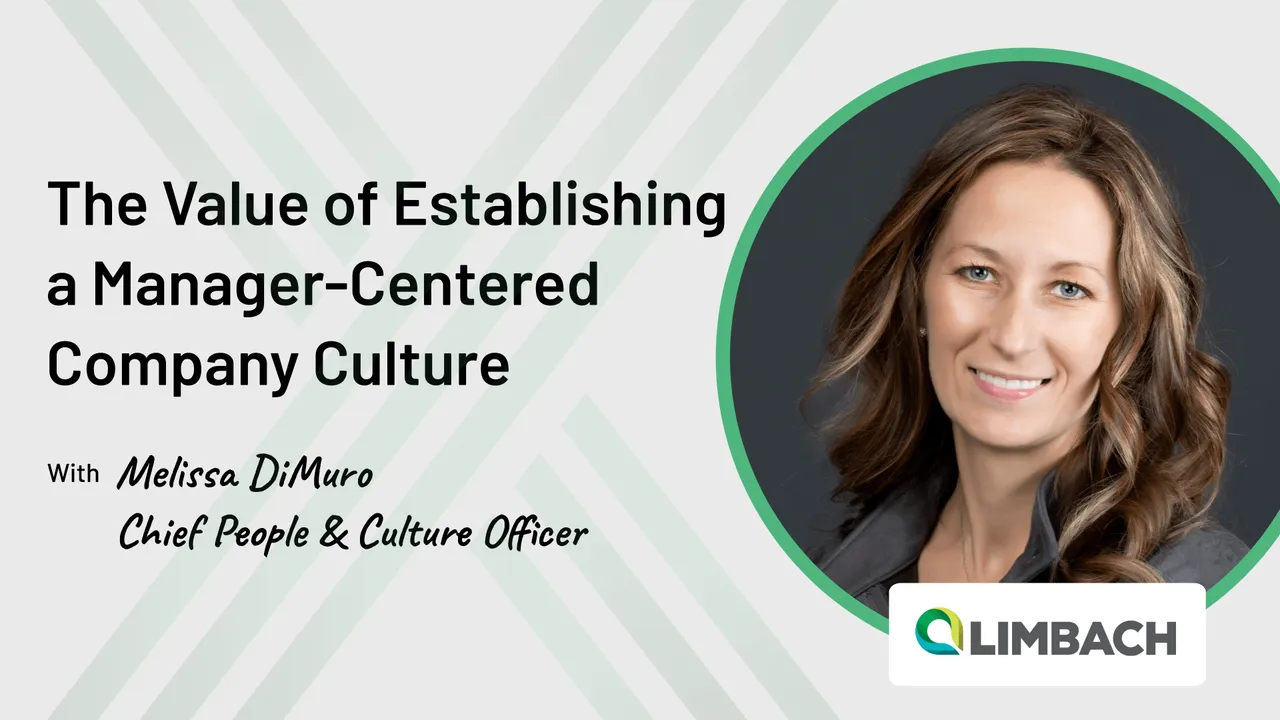
Melissa DiMuro, Chief People and Culture Officer at Limbach, discusses managers' role in building trust and psychological safety. In S04 E07 of CultureClub X, she also highlights the importance of leader mental health and frequent pulse checks.
TL;DR
What you need to know from this episode
- Trust is the currency of relationships. Melissa DiMuro builds it on three ingredients: fundamental respect that includes walking a day in employees' shoes, real time and authentic communication, and genuine care for the human outside the work relationship.
- Culture happens in micro bits, not big programs. The manager drives the day-to-day experience, so DiMuro recommends weekly touch points at a minimum with every direct report, and keeps almost daily micro touches with her own team by text, email and quick calls.
- Managers can be mental health first responders without being therapists. Normalize the conversation, be vulnerable about your own hard days, watch for changes in behavior, and know the resources so you can connect people to an expert.
- Psychological safety is a prerequisite, not a perk. Without it, politics beats great work and people stop raising issues, and micromanagement quietly signals distrust because actions are bigger than words.
- Technology is a supplement, never a replacement, for great leadership. Use surveys and predictive analytics to surface themes and leading indicators, then close the loop in person and keep telling the story of what changed because of employee feedback.
What actually creates a company's culture: the strategy deck at the top, or the conversation an employee has with their manager on an ordinary Tuesday? In this episode of Culture Club X, host Diana Blass puts that question to Melissa DiMuro, Chief People and Culture Officer at Limbach Holdings, where she leads the human capital strategy for over 1600 employees across the US.
Melissa brings 20 years of progressive HR leadership to the conversation, 15 of them at GE Aviation and three in the printing industry at Quebecor World. She joined Limbach about two years ago, her first CHRO role and her third industry, with a mandate to transform a 121 year old construction company into an ever evolving contemporary business.
The backdrop is stark. Construction faces over 1 million unfilled jobs over the next couple of years as retirements accelerate and the industry grows. Melissa's answer is a manager-centered culture: one where trust, psychological safety and frequent pulse checks live in the day-to-day behavior of frontline leaders rather than in policy documents.
What can managers do to make employees feel valued and trusted
For Melissa, trust is the underlying fundamental of everything, the currency of relationships. The first ingredient is respect: managers have to show that the work their people do matters, and they need to know what it is like to walk a day in their shoes. Early in her career, a leader made her actually do the manufacturing roles she was about to recruit for, and the lesson stuck.
The second ingredient is communication. People have to believe they are getting real time, transparent and authentic communication from their leader; the moment they sense a hidden agenda, trust starts to break down. The third is genuine care for the human outside the work relationship, knowing someone's family and ambitions, not just their output.
I think culture really happens in micro bits and small chunks and the manager is the one that drives the majority of that day-to-day.
That conviction shapes her practical advice. She recommends weekly touch points at a minimum with every single direct report, and with her own team the rhythm is almost daily: little micro bits by text, email or a quick phone call, plus milestone conversations about career and development across the year. The micro engagement is where people see whether a manager is walking the talk on company values.
How can managers become first responders for employee mental health
Limbach is a safety-committed construction business, and Melissa argues that mental safety deserves the same seriousness as physical safety. The company weaves wellbeing into its Hearts and Minds safety program, which looks beyond compliance to care for the entire individual, so raising a mental health concern is not taboo.
She also asks leaders to be a bit vulnerable. Having been through her own struggles, she believes managers should admit that not every day is a great day and that it is okay to need help, leading by example. Because a manager sees people day in and day out, they are often the first, aside from family, to notice changes in behavior.
Crucially, managers do not need to be trained therapists. Their job is to know the resources and make the connection to an expert while showing care. Remote and hybrid work has made cues harder to read and has exacerbated underlying struggles, but Melissa sees more of it surfacing precisely because workplaces are becoming safer places to talk. In construction, one of the leading industries for suicides, that shift matters enormously.
Why the frontline manager is the toughest role in the organization
Melissa is blunt about the load managers carry: pressure coming down from the hierarchy, employee challenges coming up, and customer commitments to deliver on. She calls the frontline leader by far the toughest role that exists, a huge responsibility and a huge privilege, and acknowledges that great leaders try to do it all when the reality is they cannot.
Her prescription starts with investing in leaders' own mental health: real time off with coverage plans in place, workload conversations that are safe to have, and executives who are willing to stop, push out or simplify work. Leadership teams also owe managers clearer priorities, because everything funnels through the frontline leader and everything can feel essential.
The last piece is skills. Organizations promote great individual contributors and then fail to teach them how to manage. Limbach's response is a three-stage leadership development series, cohort-based monthly onboarding with a curated first week, 30, 60, 90 day plans, buddies and C-suite meetings, an approach that recently earned external recognition for training and development. The same discipline is now being applied to manager readiness.
Why psychological safety is a prerequisite for two-way trust
When Melissa entered the field, psychological safety was dismissed as a warm and fuzzy nice-to-have. She is glad the concept has come back, because in her view real trust cannot exist without it. Safety, she stresses, is not just freedom from harm but the ability to be your whole self at work.
Psychological safety to me is a prerequisite. I don't think you can have real trust without that.
Without that foundation, ineffectiveness creeps in everywhere: politics takes precedent over great work, people stop raising issues because they are afraid, and posturing replaces problem solving. The antidote sits with the manager, who has to create an open environment where their way is not the only way and people are engaged in decisions. It is the same ground CultureMonkey explores in its guide to psychological safety at work.
Two-way trust also dies by micromanagement. Saying "I trust you" while reviewing work three more times before it goes out sends the opposite signal, and those small things add up. In a fully dispersed company like Limbach, the currency of trust changes by setting: boots on the ground and walking job sites in the field, intentional one-on-ones, surveys and roundtables for virtual teams. Different tools, same human desire to matter to your leader.
Do manager-driven microcultures set the real company culture
Melissa applies a dinner table test. When employees go home, they are not typically talking about the CEO; they are talking about their manager and their colleagues. That manager and team experience is the company and is the culture, while the executive team's job is to minimize any disconnect and build systems that reinforce the right behaviors.
Frequent pulse checks fit that reality. Newer generations entering the workforce want real-time signals about whether they are doing the right thing, not one big annual review. And managers set the tone by behavior, not announcements: as a leader you are on stage whether you wanted to be or not, watched every single day, even when you think nobody is looking.
As companies grow and acquire, microcultures inevitably creep in, and Melissa does not fight them all. Limbach holds its core values as non-negotiables, to the point of refusing to acquire a company that does not share them. Within that range, teams get the freedom to feel unique and to be who they need to be to perform.
Can technology deliver on culture without replacing the human touch
Melissa is no technology skeptic; she is implementing a whole new human capital management system this year to take retention to the next level. Predictive analytics help at the macro level, where a leader cannot hold one-on-one relationships with an entire population, by surfacing themes, trends and leading indicators in retention data.
Her caveat is firm: for the average leader, technology is supplementation, not a replacement for what great leaders need to be doing. No manager should wait for a system to announce a retention problem. Tools must also earn adoption by engaging end users, measuring the right things frequently enough to see whether an action actually worked.
That philosophy shows in how Limbach runs surveys. After digesting the data, the team goes back out to branches with the themes it heard and asks whether the proposed actions really solve the challenge, an iterative dialogue where employees build the culture with the company rather than just exchanging information. It is a working example of a healthy employee feedback loop.
You have to continue to tell the story about here's what you said, here's what we chose to do, here was the impact it had.
Acting on feedback is not enough, because people join and leave constantly and may never have seen the original survey. Leaders have to keep narrating: here is what you said, here is what we chose to do, here is the impact, and here is your next opportunity to speak. Otherwise, as Melissa puts it, you did what they asked, but nobody knows about it, and the impact of the action is lost.
What a manager-centered culture means for employee listening
Across every topic in this conversation, one thread holds: culture happens in micro bits, and the manager drives the majority of it. Trust, mental health support, psychological safety and even technology adoption all come down to what frontline leaders do daily, which means listening to employees has to be continuous, not an annual event.
That is exactly the premise behind Culture Club X's home, CultureMonkey, an employee listening platform built to help people leaders run frequent pulse checks, read sentiment across dispersed teams and close the loop visibly. As Melissa's survey process shows, the technology only matters when it helps managers have better human conversations, and that is the standard any listening program should hold itself to.

About the guest
Melissa DiMuro
Chief People and Culture Officer at Limbach Holdings, Inc
Melissa DiMuro is the Chief People and Culture Officer at Limbach Holdings, Inc, where she leads the human capital strategy for over 1600 employees across the US, spanning talent management, recruitment, succession, leadership development, workforce planning, total rewards and culture. She has 20 years of progressive leadership experience in HR, 15 of which were spent at GE Aviation, a leading global provider of aircraft engines and aviation systems, plus three years in the printing industry at Quebecor World.
She is a graduate of the Human Resources Leadership Program at GE and an alumna of the University of Cincinnati, and she sits on the board of the Spring of Tampa Bay. DiMuro joined Limbach about two years ago in her first CHRO role, and is a business leader with a passion for organizational transformation, culture evolution and talent strategies.
Full episode transcript
Season 04, Episode 07 · Melissa DiMuro with Diana Blass · 39 min
Hello everyone and welcome to the latest episode of Culture Club X, powered by CultureMonkey. I'm your host, Diana Blass. CultureMonkey is a complete employee engagement platform that helps people leaders listen to their employees and enhance workplace cultures. In the seventh episode of the latest season of Culture Club X, we have with us Melissa DiMuro, Chief People and Culture Officer at Limbach. Welcome, Melissa, it's great to have you.
Thank you for having me.
Well, first we'll just discuss a little bit about your background with our viewers. As Chief People and Culture Officer at Limbach Holdings, Melissa is responsible for leading the human capital strategy for over 1600 employees across the US. This includes talent management, recruitment, succession, leadership development, workforce planning, total rewards and culture. Melissa has 20 years of progressive leadership experience in HR, 15 of which were spent at GE Aviation, a leading global provider of aircraft engines and aviation systems. She also spent three years in the printing industry at Quebecor World. She sits on the board of the Spring of Tampa Bay and is a graduate of the Human Resources Leadership Program at GE. An alumna of the University of Cincinnati, she is a business leader with a passion for organizational transformation, culture evolution and talent strategies.
Melissa, what an honor to have you with us today. Welcome again to Culture Club X's video cast on the value of establishing a manager-centered company culture. Before we begin, please tell us more about your current organization and what you're doing today.
Absolutely. So I joined Limbach about two years ago, and this is my first foray into a CHRO role and my third industry. We are a leading construction provider. So within Limbach Holdings, I joined about two years ago, new to the industry and really trying to transform what is a 121 year old company into an ever evolving contemporary company today. And from a talent management perspective, in construction there are over 1 million jobs that go unfilled right now over the next couple of years due to changes in talent dynamics, retirements that are coming up and frankly the growth in the industry. And so a lot of what I'm focused on is how do we really pivot the company's strategy and our talent strategies to really be an employer of choice for that type of environment?
Great, well, I can't wait to have this discussion with you today. So without further ado, let's get started.
The first idea centers around building trust and being valued as a bedrock of a good culture. What steps can managers take to make employees feel more valued and improve trust within their teams?
I think it's a great question, and absolutely trust is the underlying fundamental of everything. It's the currency of relationships, and that is especially important as a manager in your employee population. I think the first thing comes down to respect. You've got to demonstrate a fundamental level of respect to your team members, and you've got to show that the work they do matters to you personally, to the company, and everything big and small. You need to know what it's like to walk a day in their shoes.
And I remember being brand new in my first HR role, and I had a leader that I worked for that actually recommended, this is back in the printing company, that before I started recruiting for these roles and really surfacing these roles that were in the manufacturing shop, I needed to go out and spend time and actually do the role and see what it was like to actually live a day in their shoes. And I think that message has stuck with me. So you can't skip over that, and any new leader in a role has to reestablish that level of respect with their team.
Secondly, I think it's really about communication. People have to believe that they're getting real time, transparent and authentic communication from their leader in order to really have trust with them. If they feel like their leader is holding back or has some other agenda, again, that begins to break down.
And then the third piece that I would highlight is the genuine care for the human outside of the work relationship. The best leaders that I've worked with and worked for have really cared about me, what I want to do outside of my day job, my family. They know me as a human being. And I think we have to make sure, especially coming out of this post COVID pandemic time, that we're taking time to relate to the human aspect. And I think that really goes a long way for trust.
Yeah, interesting. I think trust when it comes to communication, authenticity, as you mentioned, those are things I suppose you can look for in the hiring process. But when it comes down to how you can have that better management with your team, and the ongoing feedback sessions where you're seeing how they're doing, those mental health checks, are there things that you do to encourage that kind of environment, that you train your managers to carry out, to ensure that that part of the company culture is present?
I think it's a good question, because sometimes we think of culture and we think of the big things that we're doing, the big strategies, the new ways that we're establishing to listen to our employees or the policies that we're making. But I think culture really happens in micro bits and small chunks and the manager is the one that drives the majority of that day-to-day.
So again, to build on what we spoke about on the trust side, I think it's really staying close to your people and looking for what are any changes in behavior that might be occurring. What are the things that they're focusing on? And really making sure that you're supporting them on a day-to-day basis. I think also having regular touch points. We recommend, at a minimum, weekly touch points with every single person that works for you. But in reality, when I think of my team, I'm having almost daily touch points with them. Little micro bits, it might be texts, it might be emails, it might be a quick phone call, but staying in more real-time connection I think is what more and more people are looking for these days.
And then of course, making sure that you have the milestone conversations throughout the year, conversations about career and development and things of those natures become important. But the micro engagement is really where people see are you walking the talk as it relates to the core values of that company.
Yeah, definitely. Well, we'll get further into the idea of microcultures later, so we can dig further into that topic.
What signs can managers look for to gauge the emotional and mental health of their team members? How can they become first responders to employees dealing with these issues?
I think this has always been a role for leaders, but it is more and more pronounced today. I think, luckily for society, we're bringing mental health more into a safe space. As a company that's very committed to safety and the health and welfare of our people, we can't overlook the fact that physical safety is just as important as our mental safety, and we need to have those conversations.
So one, I think it's normalizing the discussions and making it something that we talk about. Within my current company, we do something called Hearts and Minds, which is really our safety program, trying to capture not just the compliance aspect of things, but really caring for the entire individual. So I think weaving some of those conversations in to make it not so taboo to bring up an issue related to that.
Additionally, I know a lot of people who have struggled with mental health, and frankly, I've been through situations where it's been a struggle for me. And so I think it's incumbent on the leader to be a bit vulnerable and say that not every day is a great day, and it's okay to have certain types of feelings. It's okay to need help, and lead that by example.
As I mentioned before, I think watching for changes in behavior is key. As a leader, you're the one that sees them every day, day in and day out. So you, aside from their family, are probably the one that's going to be able to pick up on changes. And I would just encourage, if there's changes, know your resources. You don't have to be the expert. It is okay to connect them to an expert. And I think sometimes leaders get a little worried in this space because they're not trained therapists or mental health providers. You don't have to be. You can just make the connection and show demonstration of care for that individual.
Definitely. Do you think these are issues that have become more prevalent in light of the new working style we have today in the post-pandemic world? Or do you think they've always just been there, and we just don't talk about it or we don't realize the signs?
I think they've always been there. I think a lot of people have suffered in silence for a long time, but I do think our new reality exacerbates some of the issues that were underlying. So as an example, in a remote work environment, or even in a hybrid work environment, creating relationships where you can have a little bit of a buffer to these challenges, insulate yourself from them, have healthy habits that help ward off some of these challenges, I think it's made it a little more challenging. And as a leader, if you're leading a team that you don't see physically all of the time, it can be maybe a little harder to pick up on those cues.
So I think it's gotten a little more challenging, but frankly, I think it's all coming out because we're making it a safer environment to talk about these things. In my current industry in construction, we're one of the leading industries, unfortunately, for things like suicides. And we're trying to do a lot as an industry to have conversations about how it's okay to need help. It's just as important as your physical safety.
Yeah, interesting. You think about the effects the pandemic had on the workplace, and while we can certainly talk about the negatives of remote work, at least I think it brought a lot of stuff to the surface where you have to deal with it. I've heard about large companies bringing therapists in and having that monthly touch point. And so those are all good changes that I think maybe wouldn't have happened otherwise. So interesting to dig in there.
Do you agree that managers are overburdened with expectations beyond scope of work? What can organizations do to reduce manager burnout and potential fallouts like attrition?
It's difficult to be a manager. I think a frontline leader in an organization is by far the toughest role that exists. You have to deal with the pressures that maybe are coming down on you from higher in the hierarchy. You also are dealing with the employee challenges. You're dealing with what you're trying to deliver on as a customer. So I want to first acknowledge that I think it's probably the most challenging. I see the leadership role, when you take it on, it's a huge responsibility, but also a huge privilege. So I think that leaders put a lot on their shoulders, the great leaders put a lot on their shoulders, for trying to do it all. The reality is, as a leader, you can't do it all.
And so I think one thing is making sure that we really invest in our leaders' mental health. So making sure that they're getting time off to truly disconnect. Leaders of leaders need to create opportunities for them to truly have that opportunity and have coverage plans in place. Sometimes we'll say, oh, take time off, but nothing ever comes in to help alleviate some of those concerns. So I do think we have to be more intentional about that, checking in, adjusting workload, making it an okay conversation to talk about the fact that workload might be too much. And what can we stop or push out or make simpler in order to alleviate it? So that's the leader of leader requirements.
I also think we need to be more clear on priorities. Because everything funnels through that frontline leader, it can be a little confusing as to what the true priorities are. Because in reality, you need to do everything and convey every message and make sure everybody's feeling connected. So I think the executives of the company need to continue to do a better job at really saying this is what's most essential. These other things are important, but if we drop this piece, then that's a bigger impact on the business.
And then I guess my final thought is, we have to make sure that managers are skilled to achieve what we're asking them to do. I've observed so many times managers getting put into roles that they're promoted because they did a great job in the prior role, especially first-time managers. So you're a great individual contributor, so we promote you, and then maybe don't provide you with the actual training and resources and understanding of how to do that job. And I think that continues to occur even as you get promoted. So one of the things we're thinking really hard on is, how do we make sure that every manager has the skills and resources needed to make this huge responsibility more reasonable? Because I think a lot of time can be lost in efficiency, leading to the feeling of being overwhelmed, by just not having the skills and capabilities. And that's the organization's responsibility to provide that to their team members.
Yeah, right. No, I can totally see that. I think there's been a real idea of just learning on a job, or perhaps if you've been in a company for so long, you think that you don't need to train anymore. And I actually saw on LinkedIn that your company recently won an award when it came to its training and development. What do you think stuck out about what you're doing that caught the attention of this award?
Yeah, thanks. So I'm so proud of the team. They've been working really hard, and in February we'll see where we fall on the list. But really we've tried to look at holistic learning. So we have a very structured leadership development series in three stages, one for emerging leaders, one for leaders that are in frontline leadership roles, and then one for more experienced leaders that hope to be executives one day, or already are executives. So one, I think, is the structured approach.
Second is we take a really structured process now to onboarding, where literally we start people once a month. You come in as a cohort. You have a curated experience with your peers for that first week. You receive a 30, 60, 90 day plan for the new hires, customized to your role and your leader. You get a buddy, we have you meet with the C-suite. We really focus on trying to get people up to speed. And that's a newer process for us. We didn't used to do that, and we've seen such great benefits.
And now we're starting to really focus on manager readiness in that same way. Because the longer a manager is trying to figure their way through this, which is the traditional way, well, they've done it so well before, we can put them in this new role. It's part of how we all learn, and we have a sense of that's how it has to be done, but it's not. And so what we're learning through effective onboarding is really that can be applied to leaders, new people going into new roles. And it's really about how do you accelerate their learning in order to be most effective. So I think those are probably some of the things that stuck out, but we'll see. We'll get the full report in February.
Well, either way, just being in the ranking is an amazing achievement. And it's true, people want to see that there's that trajectory there, that there's this path towards success, not being set up to fail, and constantly also provided with challenges to work towards. So it's all very great, interesting tips there.
Next question, actually we're digging further into the theme of trust, and now dealing further with mental health issues. What can managers do to develop two-way trust within teams, and how important is psychological safety in this?
Psychological safety to me is a prerequisite. I don't think you can have real trust without that. And when this was discussed, I guess I've been in the field about 20 years, but on the earlier side, people reacted to the concept of psychological safety as this warm and fuzzy topic and nice to have. It was sort of dismissed. And I'm really happy that it's coming back and being more widely accepted. Because at the end of the day, if you don't feel safe where you are, and I will expand safe to not just the fear of being harmed, but the ability to be yourself and your whole self, then you're going to hold back part, because we're humans, that's just how it works.
So I think it has to be there. And if it's not, you start to get all sorts of ineffectiveness in the organization. You start to see things like politics taking precedent over actual great work. You start getting people who aren't going to raise issues to you because they're afraid. Maybe team dynamics aren't as healthy, and people are more worried about posturing versus solving the issues. And so all sorts of things happen, and those are symptomatic, but I think the root of that is do people feel like it's a fair place to work, where recognition will occur if you deliver it, and some of those foundational items. And really those come down to the manager to create. Again, all things lead to the manager.
But I think, number one, those leaders have to make sure to create an open environment where their way is not the only way, where people can be engaged in part of decisions, that it can be what the team needs it to be, and not just the manager's preference. And then I think also two-way trust. You can't micromanage. Managers who try to control too much signal to their team that they don't trust them, whether they mean to or not. Actions are bigger than words. And so you can say, oh, I trust you, but can I review that three more times before it goes out? Those small things add up to big things. And so I think all of those micro actions are what creates an opening for there to be two-way trust.
Definitely, yeah. That has been one of the biggest pain points for me as I've worked at different companies. It's just the idea that you have a leadership role, but at the end of the day, you're still having so much oversight of your work and tips on how to do it that it doesn't feel like you're actually in that role. And then you end up looking for other jobs or positions to feel like you've gotten to that point in your career.
Now, it's interesting with your company, right? Because you have people who work traditional corporate jobs within, or out in the field in construction positions, right? So would you say one's harder to cultivate or grow that two-way trust in than others? I guess they're both remote in a sense, but just an interesting thing about that dynamic as you look to create that great culture.
Yeah, so it is interesting, because we are fully dispersed. So even when we were fully in the office pre-COVID, we're out on job sites everywhere. So people are dispersed. So I do think there are certain challenges of creating trust when you are not next to people every day. So I think that challenge is probably shared across. I would say sometimes the currency of trust might be a little bit different. People want the same fundamental things. They want you to care about what they do, take time out of your day to make sure that you're recognizing them for the value that they bring. But the way you show it might be different.
When you're on a job site, that's going to occur by walking around, asking about people's weekends, asking them about ways that we can make the job easier for them, coming to them and asking them for ideas and insights to make the company better. Oftentimes you're going to have to be boots on the ground and walking around and engaging with people that way. Likewise, that could occur in an office setting, but we're all kind of virtual. So I think other platforms, and there's some great technology out there, of surveys and roundtables, and making it intentional that you're doing one-on-ones with people and things of that nature. It's just different tools, but it's the same desire that people have to frankly be important to their leader in the company.
Yeah, yeah. And it brings us back to the idea of authenticity and communication and creating that open environment.
How important are frequent pulse checks and manager-driven microcultures within teams? Do you think they guide a larger company culture, or vice versa?
Yes and yes. So I think they're really, really important. As I said in the beginning, or rather at the end of the day, when your employees go home and they have dinner with their family, they're not typically talking about the CEO. Yes, it's an important role, and yes, it's important for business strategy and things like that. But you're talking about your manager and you're talking about your colleagues. So that manager and team experience is the company. It is the culture. Now, sometimes there's a disconnect, and the goal of the executive team is to try to minimize that disconnect as much as possible and create an alignment in the culture. And the executives have to make sure that they're setting the expectation for culture and creating systems and structures that reinforce the behaviors we want to be there, hiring the right people, promoting them, developing them in the right way, all of those types of things. But I think, at the end of the day, the manager is setting that day-to-day culture and experience for the person.
So I do think the touch points are essential. I mentioned how we operate today, and I don't think there's a way around small touches throughout the week. And especially as we start to see changes in the demographics of our workforce, the current newer generation coming into the workforce want more and more real-time touches, rather than a big event, a big annual review or something like that. They want to know more real-time, is what I'm doing the right thing. So I think it's really critical.
I guess the only other point I would make is managers have to set the tone by their leadership behavior. So touch points are important, but they're watching you all the time. So as a leader, you're on stage, whether you wanted to be or not. Now that you took the role, you are. And you have to understand that they're watching every single day. Are you living the behaviors? And are you living to the highest standard of the behaviors? Because it's not fair to expect your team to live to a higher standard than you're willing to put yourself to. And so it's not just what you're saying in the meetings that you're holding, but how you conduct yourself. And even when you think nobody's watching, they still are.
Definitely. It's funny, I never thought about all that goes into the title of manager. As many times as you get promoted, it's just the next step, but there's so much that goes into that role. It's fascinating. And I think it's interesting with your company, 1600 employees you oversee and guide the culture for. Do you ever feel like these microcultures almost fight against the larger company culture? And how do you keep both on track?
Yeah, it's tough. And the bigger you get, the more microcultures do creep in. It's just part of it. And especially when you're doing things like acquiring companies. You're essentially acquiring new cultures and then trying to integrate that. And there's a certain aspect of wanting them to maintain their identity. Because if you're buying a company, or frankly, you have a great operating business unit, there's a reason they're operating well. And it's not because they don't have things figured out from a culture perspective, typically.
So I think there's got to be the unifying principles and the non-negotiables that go across the company. And for us, we have our core values that we hold very close. Those are non-negotiables. We won't acquire a company that doesn't hold them. We make it very clear coming in, any person joining, anyone getting promoted, these are the non-negotiables. And then sometimes it's okay to have a little freedom in the culture for people to feel unique and teams to feel unique. And as long as they're within a certain range and it's not against any of those non-negotiables, then I think we need to let teams be who they need to be to get the best out of their team.
Yeah, interesting.
Well, the next question, and our last one, digs further into some of the technology solutions you're investing in and your thoughts on them. So how do you think technology can enable managers and people leaders to deliver on culture initiatives and improve retention?
Yes. So I think it absolutely can help. I am seeing more and more great technology options coming out, and actually this year I'm going through an implementation of a whole new human capital management system here at the company. So we are going to be leveraging a lot of new technology in order to take our retention to the next level. So I do think there is a time and place for that. And it's very helpful at the macro level, at the high level, when you're leading a company, to have a lot of the predictive analytics and things like that that are available, because you can't have one-on-one relationships with your entire population. So it can help you see themes and trends and insights that maybe you witness.
The only caveat I would say is, for the average leader, look at that as supplementation to all this stuff we already talked about today. I always want to make sure that managers don't think, well, the new system will tell me if I have a retention challenge. You don't want to defer any of that responsibility. I look at it as a way to see things that I couldn't see as a human already. It's a supplementation, not a replacement for what we need to be doing as great leaders. But there's some amazing technology out there, and it's getting better and better at being able to connect the dots in places we typically live.
Interesting. Yeah, a completely different industry and different reasons, but we saw with Southwest recently, right? That whole debacle with all the canceled flights, and it really came down to outdated technology and not being able to predict in the way they needed to for the scale. So I can imagine a company like yours, as large as it is, you do need technology. But how do you go about properly implementing it as you test different solutions and try to get them to work together, at the same time balancing those physical interactions as well? There are some examples you could use, as your day-to-day monthly process when it comes to surveys, but at the same time having those in-person conversations and then recording all that data. How do you properly manage it?
Yeah, and I think it's a challenge, I will say, for anyone, because the world's changing so quickly, right? So I look at technology as a way to handle all of the complexity that's coming at us. And I think Southwest is a really great example of, you can't let the business evolve to a certain level of complexity that you don't have the ability to manage. You have to make sure those things are evolving at the same time. Much like you can't lose focus of your capabilities from a people side and let the business outpace them. So they have to be done at the same time.
I think, for me, it's about engaging the end users in the technology solution, so that it's not technology for technology's sake. It is going to help answer the questions that the leaders need answered. And so when I think about great surveys and things of that nature, are we measuring the right things that will drive the behaviors and the insights that the leaders need? Are we doing that frequently enough to see the changes and reactions to an action we took? Are we sure that the outcome is actually being effective? Are we able to give leading indicators of things, that, hey, something's going on in the retention data here, you may want to pay attention to this subset of employees to go have follow-up conversations. So I really think of it as providing the leader with even more resources and tools to go get what they need to get done. But you have to make sure that the end users see it as value, or else they won't engage, or you won't get the return on it. So whether that end user is a manager or employee or whomever in the organization.
I see. Yeah, it's interesting. So would you not necessarily put a survey out and then take immediate action on that? You instead kind of have that as the initial step, followed by the in-person interaction.
Yeah, I think that's sort of the thing, because you'll have the survey come out, and we're actually right now in the process of just wrapping up ours in the next week or two. We have one out now. We'll take that, and then we'll digest the data, but then we'll go back out to the organization, in our branches and our different populations, and say, here are the things that we heard that were themes. We want to take some action in this. Here's some of the things we're thinking about, but does this really solve the challenge? So entering into more of an iterative dialogue, so that employees feel like they're building the culture with you, versus this exchange of information. So just keeping the human aspect to it and utilizing the technology to help you unlock things that maybe you wouldn't typically have seen. And then that way it feels more authentic, like a partnership between that leader and their teams.
Definitely, yeah. There's one recurring theme I've heard so far in these interviews, is having that, taking action on those surveys.
Absolutely.
So that people feel like their voices matter. But interesting to dive into that process there, of when you take that action and how.
Yeah, and then I think what people sometimes lose sight of is they'll go take the action, and then that's it. They won't talk about it. And the reality is, especially when you're leading a large organization, people are always coming and going, and they might not have been the ones that gave you that feedback. Somebody else might have. So you have to continue to tell the story about here's what you said, here's what we chose to do, here was the impact it had. Now I'm going to offer you another opportunity to tell us something else, and kind of keeping that flow. But it's not enough just to take the action. You have to explain to people that it was based on their feedback, that you're trying to make it a different place based on what they've said, and that you're committed to continuing that iterative learning and action process. And I think sometimes leaders think, well, I did what they asked, but nobody knows about it. And if they don't know about it, then you lose the impact of that action.
Definitely, definitely. Well, great, I'm so happy that we were able to chat today and to gain some tips on how to improve these culture issues that we're all facing today. So with that, this concludes our conversation. Really fabulous conversation, Melissa. Your insights on manager-centered cultures were extremely compelling. In today's day and age, creating manager-centered cultures is the key to organizational success. And with CultureMonkey, leaders can effectively analyze employee sentiments with data and enable managers to take action. So visit culturemonkey.io to see how you can improve your workplace culture today.
And with that, we finish off this episode of Culture Club X. Thank you again for your time today, Melissa. And if you can, let our viewers know how they can get in touch with you if they want to share some thoughts on the episode or just have a quick chat.
Yes, absolutely. I'm on LinkedIn, or you can reach out to me at the company, melissa.dimuro@limbachinc.com.
Great, I love that. We haven't got an email yet, it's always LinkedIn. And I love email as well.
Yeah, direct email is just fine. You can find me.
Yeah, great. Okay, well, that's all we have for you in this episode of Culture Club X, powered by CultureMonkey. Until next time, this is your host, Diana Blass, signing off.
Frequently asked questions
What can managers do to build trust with their employees?
Melissa DiMuro points to three foundations. First, respect: show that the work people do matters and understand what it is like to walk a day in their shoes. Second, communication that is real time, transparent and authentic, because trust breaks down the moment employees sense a leader is holding back or has another agenda.
Third, genuine care for the person outside the work relationship. The best leaders know their people as human beings, including their families and what they want beyond the day job.
How often should managers check in with their team members?
DiMuro recommends weekly touch points at a minimum with every single person who works for you. With her own team she is closer to daily: small micro touches by text, email or a quick phone call, supplemented by milestone conversations about career and development through the year.
She notes that newer generations entering the workforce want more real-time feedback on whether they are doing the right thing, rather than one big annual review.
How can managers support employee mental health without being therapists?
Normalize the conversation so mental health is not taboo; Limbach weaves it into its Hearts and Minds safety program, treating mental safety as seriously as physical safety. Leaders should also be a bit vulnerable and admit that not every day is a great day and that it is okay to need help.
From there, watch for changes in behavior, since a manager sees people every day, and know your resources. You do not have to be the expert; you just have to make the connection to one and show that you care.
What causes manager burnout and how can organizations reduce it?
DiMuro calls the frontline leader by far the toughest role that exists: pressure from above, employee challenges below, and customer delivery all funnel through it. Organizations should invest in leaders' mental health with real time off backed by coverage plans, adjust workloads openly, and have executives clarify what is truly essential.
They also need to skill managers properly. Promoting great individual contributors without training them to manage leaves them overwhelmed, which is why Limbach runs a three-stage leadership development series and structured manager readiness onboarding.
Should companies act on employee survey results immediately?
Not in one silent step. Limbach digests the survey data, then goes back out to its branches with the themes it heard and asks whether the proposed actions really solve the challenge, turning the survey into an iterative dialogue where employees build the culture with the company.
Taking action alone is not enough either. Because people are always coming and going, leaders must keep telling the story: here is what you said, here is what we did, here is the impact, and here is your next chance to be heard.
Read the cross-episode roundups
More from CultureClub X
 S07 E03employee engagementWhy do grievance procedures damage workplace culture? | David Liddle, The TCM Group
 David Liddle
 S06 E19change leadershipFrom Cost Center to Catalyst: How CPOs Turn People Strategy Into Business Advantage, with L. David Kingsley
 L. David Kingsley
 S06 E17ai in hrHow do you build trust and belonging in the age of AI? | Jessica Smith, Reframing HR
 Jessica Smith
Never miss an episode
Every new episode, plus the takeaways that matter, posted on the CultureMonkey LinkedIn page as soon as they drop.
Free on LinkedIn. Unfollow anytime.