

S04 E08
Culture at the Core: What Managers Actually Drive
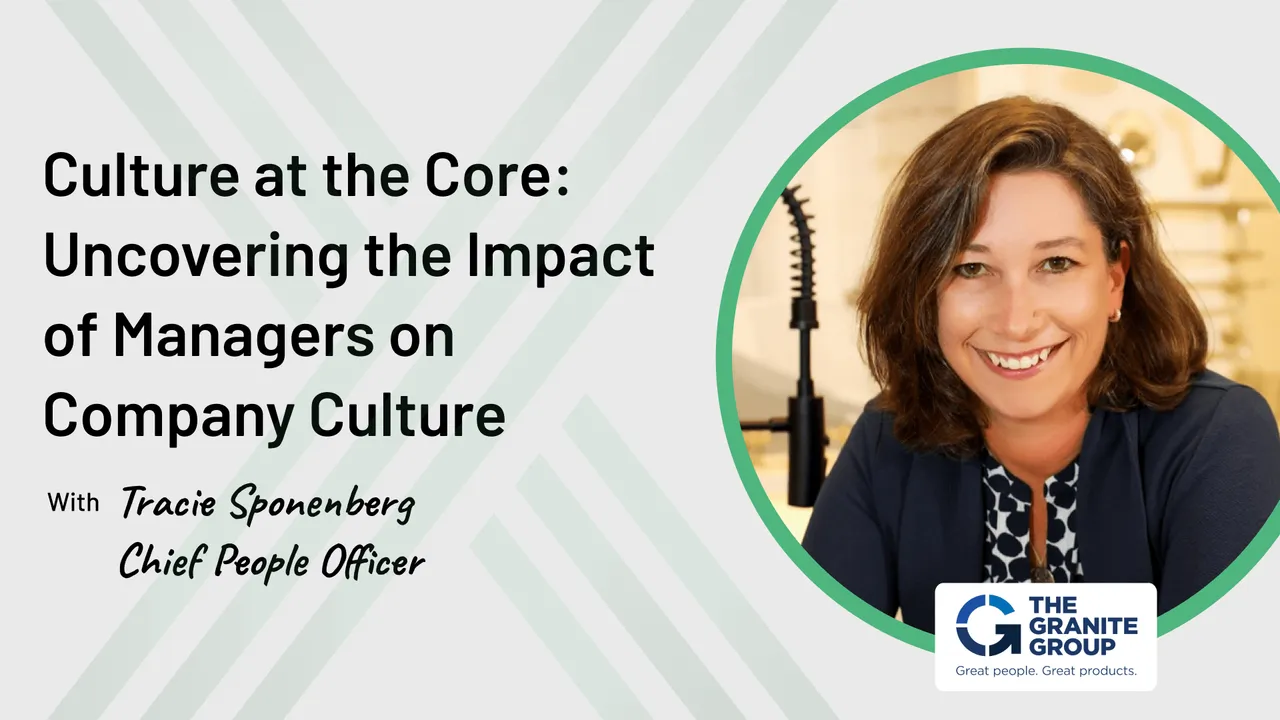
Tracie Sponenberg, Chief People Officer at The Granite Group, joins S04 E08 of CultureClub X to unpack what managers actually drive in company culture, why trust should be given freely, and how people teams can build an individual employee experience while technology deepens rather than replaces human connection.
TL;DR
What you need to know from this episode
- Give trust freely instead of waiting for people to earn it. Tracie learned this from her CEO: extend trust from the start and treat violations as the exception. Her shorthand is the eight C's of trust, from clarity and compassion through consistency.
- Behavior change is the biggest mental health red flag. A dressed-up person arriving disheveled, a punctual person running late, a social person going quiet. The check-in can be as simple as, I noticed X, is everything okay?
- Careers are journeys, not ladders. Sideways, backwards, part-time, or a break from the company can all be the right move. The Granite Group builds learning paths for each role and teaches emerging leaders to lead, not just manage.
- Microcultures drive the overall culture. The Granite Group has one company culture and over 60 team cultures, because every manager sets the tone. HR is not the holder of the culture, and neither is the CEO. It is everybody.
- Automate the routine so humans can connect. Frequent pulse checks beat long point-in-time surveys, and team-led implementations beat resistance to new tools. Technology does not replace human connection; used well, it creates more room for it.
What do managers actually drive when it comes to company culture? In this episode of CultureClub X, powered by CultureMonkey, host Diana Blass sits down with Tracie Sponenberg, Chief People Officer at The Granite Group, to unpack that question from every angle: trust, mental health, burnout, psychological safety, career development, and the technology that holds it all together.
Tracie leads all people functions at The Granite Group, a wholesale distributor of plumbing, heating, cooling, water, and energy supplies with more than 730 people across roughly 56 locations in New England. Her career spans HR leadership at a Pulitzer Prize winning newspaper, a multi-state professional services firm, and a national wellness distribution and technology company.
What makes the conversation stand out is Tracie's own arc. She started out super compliance focused and, in recent years, transitioned into a people first leader. That shift colors every answer she gives, from why trust should be given freely to why you cannot wrap a career development policy around everyone.
Why does trust come before everything else in workplace culture?
Diana opens with the bedrock question: what steps can managers take to make employees feel more valued and improve trust within their teams? Tracie's answer starts from a simple premise: "if you don't have trust, you don't have a relationship." That holds in the workplace just as it does in any other relationship.
Her go-to framework comes from a blog she still cites more than 10 years later, The Eight Pillars of Trust by David Horsiger. She calls them the eight C's of trust: clarity, compassion, character, competency, commitment, connection, contribution and consistency. Hit all eight, she says, and you are building trust with your team.
I used to expect trust to be earned by me. I used to expect people to gain my trust. But I learned from my CEO, Bill Condren, that he gives it freely. If you violate it, that's a problem. But he gives trust freely.
Notably, she does not lean on formal trust exercises. Her leadership team does them occasionally, but what works best with her own team is being authentic, being a straight shooter, and "saying what you mean and meaning what you say."
How can managers become first responders for mental health?
Tracie is careful to say she is not a mental health expert, but she believes everybody can do really simple things to know if there is an issue. The biggest trigger is any kind of behavior change. Someone who normally comes in dressed up suddenly is not. Someone who was always on time starts running late. Someone who was happy turns sad, angry, or anxious, or stops joining conversations.
The response can be as simple as "I noticed X, is everything okay?" That question only lands if trust is already there, which is why she keeps coming back to frontline managers. They are the person an employee will most likely go to, so they need to know where to turn for help even if they cannot know everything.
She recommends Melissa Doman's book on mental health at work and suggests looking into mental health first aid certification, which someone on her own team holds. And while reading people is harder in virtual settings, she insists it is not impossible: you can still notice body language and patterns like someone repeatedly coming late to a meeting.
The pandemic, she says, was terrible for our collective mental health as a society. The Granite Group responded by assigning each member of the people team a set of states to check in on managers and employees, and by building communities for different segments of the population, like women and managers, to share ideas and support one another.
Manager burnout is real, but everybody is overloaded
Asked whether managers are overburdened with expectations beyond their scope of work, Tracie widens the lens. Managers are overburdened, yes, but as a society everybody is. She points to a statistic from an article Jack Kelly wrote, that 98% of HR professionals are burned out, which is how she recognized her own: "I read that and went, wow, that's what it is."
There is no magic wand that makes things better. Her prescription is to lean on technology to automate some things and even to check in on people, but to remember that tools never remove the human obligation. Recognize people as people, not numbers or line items on a spreadsheet.
Employees are not asking for flexibility anymore, they are demanding it
Diana raises the lists circulating on LinkedIn: no dress codes for people who are not client facing, no answering after hours, micromanagement is out. People have found their voice. So how does a people leader honor what employees demand while maintaining the company's own culture and standards?
Tracie's first move is to understand what your culture is. The Granite Group runs in-person businesses that have to operate certain hours, but the company got much better at flexibility within those constraints: part-timers, 4/10 schedules, opening up possibilities beyond what it always did.
People are not asking, they're demanding these types of things for their workplaces, and I love it.
The test she applies to any rule: do I have that policy in place just because it has always been there, or is it something that can really be changed? People perform better if you meet them where they are at, and she believes meeting the needs of the workforce while still meeting the needs of the business is very possible.
How does psychological safety turn trust into belonging?
You cannot have trust without psychological safety at work, which Tracie defines as people being comfortable speaking out without fear of repercussions. But she pushes one step further: the real destination is a sense of belonging, something she thinks workplaces should have been talking about all along.
Her advice for managers is strikingly personal: think before you react. Take a step back, look at yourself in the mirror, and consider what you are going to say and what its impact could be on the individual, the team, and the company. Be tolerant of mistakes and use them as learning tools instead of berating somebody for failure.
Timing matters too. Tough conversations, comfortable or uncomfortable, should happen as in the moment as possible. Addressing an issue a month later does not do anyone any good.
Why promoting your best salesperson is not a leadership strategy
Like a lot of organizations, The Granite Group used to hand its best inside sales person the branch manager job when it opened up, and wish them good luck. Tracie has spent years fixing that through a partnership with a leadership consultant and a series of training that started with the executive team, moved through directors and branch managers, and now includes a program for emerging leaders.
The goal is for people to learn how to lead, not just manage. Where the company once barely factored in people skills when promoting, it certainly does now.
One of her team's biggest projects is career journeys, learning paths for each role, built on the recognition that a career may not be an upward ladder. It may be sideways, backwards, or down. Some people need to leave the organization for a period of time or step back into a part-time role, and the more flexible the company is about that, the better it does.
It all comes back to individual conversations. Her people team's purpose is building an incredible individual people experience, hyper-focused on each person, precisely because a single career development policy cannot fit everyone.
Do microcultures drive company culture or the other way around?
Asked whether manager driven microcultures guide the larger culture or vice versa, Tracie is unequivocal: the microcultures are really what drives the overall culture. The Granite Group has its company culture, but it also has over 60 individual cultures across teams, departments, and locations, because each manager sets the tone for their team.
That reframes who owns culture. HR is not the holder of the culture, and neither is the CEO. It is everybody.
On measurement, she favors frequency over length. Really long surveys measure a point in time, while a pulse survey tool that checks in on the same question over a period of time gives a much better measurement. Without data you are relying on your own instinct, which is helpful in some cases but is not everything.
Cohesion across 56 locations still takes deliberate rituals. Once a year the company brings everybody together for a voluntary annual meeting that draws about 75% of its people, plus monthly town halls in different places and quarterly meetings at every single location with a member of the executive team.
What does this mean for employee listening?
Tracie's team automates everything it can so the humans can focus on the things that really matter: strategic initiatives, coaching, guiding people, and getting physically out to locations to talk to them. The company is even looking at how AI can sit over the whole tech stack and parts of the people experience.
Her adoption playbook is ownership. When The Granite Group replaced a 51 page paper new hire packet, she had her tiny team run the implementations themselves, so each person could say, I did that. Nearly everyone on the team has since led an implementation, which she credits with melting resistance. And when a system fails to stick, the team admits the mistake and moves on.
I think technology is a wonderful tool, it doesn't replace human connection. It actually helps us, though, be more connected to other people if we're using technology in the right way.
That is ultimately where employee listening lands in this conversation. Pulse checks, check-in tools, and data-informed decisions give managers the signal, but it is the human follow-up, the noticing and the individual conversation, that turns listening into trust. Technology earns its place by making managers more connected to their people, not less.

About the guest
Tracie Sponenberg
Chief People Officer-The granite group
Tracie Sponenberg is the Chief People Officer at The Granite Group, a New England wholesale distributor of plumbing, heating, cooling, water, and energy supplies, where she leads all people functions across the company. Over a career of more than 20 years, she has led HR at an award-winning multi-state professional services firm, a Pulitzer Prize winning newspaper and publishing company, and a national wellness distribution and technology company. She co-founded projects like HR Rebooted and DisruptHR, is a keynote speaker on HR, technology, and business issues, and is a past president of her local SHRM chapter.
Her writing has been featured on NPR and in publications including USA Today, US News and World Report, Employee Benefits News, and The Wall Street Journal. She is SPHR and SHRM SCP certified, a graduate of Framingham State University, and sits on the boards of the Harvard Pilgrim Foundation, Red River Theaters, and Families in Transition.
Full episode transcript
Season 04, Episode 08 · Tracie Sponenberg with Diana Blass · 42 min
Hello everyone, and welcome to the latest episode of CultureClub X, powered by CultureMonkey. I'm your host, Diana Blass. CultureMonkey is a complete employee engagement platform that helps people leaders listen to their employees and enhance workplace cultures. In the eighth episode of this season of CultureClub X, we have with us Tracie Sponenberg, Chief People Officer at The Granite Group. Hi Tracie, it's great to have you with us today.
Hey Diana, thanks for having me.
Well, I'm excited to chat with you, but first let's share a little bit more about your background with our viewers.
Tracie is an executive leader focused on aligning people strategy with business strategy. At The Granite Group, Tracie is responsible for leading all people functions throughout the company, which has 45 locations and nearly 600 employees. Throughout the 20 years of her career, she's used her expertise for strategic business planning, employee engagement and wellness, employment branding, culture development and team development, just to name a few.
She's led the HR function at an award-winning multi-state professional services firm, a Pulitzer Prize winning newspaper and publishing company, and a national wellness distribution and technology company. She has also co-founded projects like HR Rebooted and DisruptHR. Tracie is a keynote speaker on HR, technology and business issues, and is a member and past president of her local SHRM chapter. Her writings have been featured on NPR and in publications like USA Today, US News and World Report, Employee Benefits News, the Chicago Sun-Times, and The Wall Street Journal. She is SPHR and SHRM SCP certified.
She was named to the 2017 Supply House Times Women in Industry 20, and was a recipient of the 2019 GSHRC Wright Perry HR Hero Award. A graduate of Framingham State University, Tracie sits on the board of the Harvard Pilgrim Foundation, Red River Theaters, and Families in Transition. Tracie is an avid reader and bookworm. Beyond work, she can be found road tripping, heading to Disney World, or running 5Ks with her husband.
Tracie, we're delighted to have you with us today. Welcome again to the CultureClub X videocast on culture at the core, uncovering the impact of managers on company culture. Before we begin, please tell us more about yourself and your organization.
Sure, and thank you. And I think I need to update my bio. We have about north of 730. We're on our way to 800 people in about 56 locations all over New England. So The Granite Group is a wholesale distributor of plumbing, heating, cooling, water, and energy supplies. We're based in the Northeast, and we're all over New England. But we're really in the service business. We recently changed our tagline to great people, great products, always putting people first, even in our tagline. Because our people are everything, our customers are everything, our vendors are everything. And without them, we literally wouldn't have a business.
And as you said, I've been doing this for a million years. I describe myself as a business leader specializing in people. But I'm that rare person, I think, who started a career out very early on. While I was in high school, I knew what I wanted to do and have stuck with it. Where I worked changed, and what I did changed, and how I grew and learned changed. And I started as super compliance focused and really, in recent years, transitioned to be a people first leader, which has been a really fun and rewarding and challenging change.
You are truly a master of all things HR, Tracie. And I'm really excited to have this discussion with you today. So without further ado, let's get started. The first idea here is centered around building trust and being valued as the bedrock of good culture. So the first question I have for you, what steps can managers take to make employees feel more valued and improve trust within their teams?
I think if you don't have trust, you don't have a relationship. And so I talk about this a lot in the context of really any relationship. But in the workplace, you need to have that foundation of trust. And I used to expect trust to be earned by me. I used to expect people to gain my trust. But I learned from my CEO, Bill Condren, that he gives it freely. If you violate it, that's a problem. But he gives trust freely. So I started to do that. And it's really been rewarding for me.
And whenever I talk about trust, there was actually a blog from more than 10 years ago called The Eight Pillars of Trust, and it's by David Horsiger. And I've read a lot on trust. I've read a lot on building trust. But I'm just going to talk about the eight C's. I call them the eight C's of trust: clarity, compassion, character, competency, commitment, connection, contribution and consistency. And you can dive deep into each of those or not. But if you're hitting on all of those eight things, you're building trust with your team.
So are there specific exercises that you suggest at your own organization to encourage you hit those focus points?
No, I think authenticity and directness and having those tough conversations goes a long way. Now, as a leadership team, occasionally we do trust exercises. As an executive team, occasionally we do that too. But I think with our particular team, what works best is just being authentic and being a straight shooter, so to speak, and saying what you mean and meaning what you say.
Yeah, I completely agree with that. There's nothing worse than trying to read between the lines or to not know how you're faring in the workplace. So I think directness, I've always appreciated it as well. What can managers look for to gauge the emotional and mental health of their team members? How can they become first responders to employees dealing with these issues?
I think we didn't talk about mental health much unless there was a problem. As an organization, as a discipline in HR, we should be talking about it. We should have been talking about it, but we weren't talking about it much. And I'm so thankful that over the past few years it's really come to the forefront. And I have a friend who I met actually through her writing. Her name is Melissa Doman, who literally wrote the book on mental health at work. And that's been really helpful to me. I would suggest first of all that everybody reads that. I would suggest looking into mental health first aid certification. We have somebody on my team that does that.
And I want to preface this by saying I'm not a mental health expert. But I think that everybody can do really simple things to know if there's an issue. And I think one of the biggest triggers is any kind of behavior change. If somebody normally comes in all dressed up and all of a sudden they're not. If they were always on time and they're late, if they were always kind of happy and they're really sad or getting angry or super anxious, if they were normally joining in on conversations and joining the team and they aren't now, any kind of behavior change like that is really a trigger for a conversation. And it can be as simple as, I noticed X, is everything okay? Is there anything I can do to help?
We talked about trust a minute ago. When you're building that trust with that team, and this is why I talk about this a lot, the managers, we have a lot of them, our frontline managers are so critical. That's where your person's going to go most likely if that trust is there. So making sure those managers are equipped with, if not knowing everything, which is impossible, knowing where to go to turn to reach out for help is really important in any organization. And it's harder. We're mostly in person. It's harder, I think, when you're virtual, but it's not impossible. You can still read body language. Somebody's still coming late to a meeting. You can tell sometimes, not always. Sometimes you can never tell. That's the hardest thing.
Right. How would you notice that these issues, or the prevalence of maybe deeper mental health issues, emotional challenges, has evolved since the pandemic? It is obviously a consistent thing that perhaps we haven't paid attention to before, but now that we have a greater understanding, would you notice that employees at a large scale are still generally struggling with the way of work today, with outside external factors? Or was the pandemic really just a specific trigger that made it a particularly challenging time, but perhaps overall it's gotten better?
I think in general, as a society, the pandemic was terrible for mental health. And I think when you take people who are used to being out and about, and there were some wonderful things that happened, like the remote work exploding was wonderful, but terrible things, not seeing family, not seeing friends, not gathering at all for coworkers, for some people for a period of years, definitely had an impact. And then there were other things. People were diving deep into social media and not having healthy practices. And so I think in general, as a society, things were always there, but I think that for sure, our collective mental health has gotten worse.
Are there any practices that you put forward for your organization during that time that you've continued?
So at the very beginning, because we're an essential business, we never stopped working even for a day. And so at the very beginning, what we did was connect our people team to different states. So everybody would have a certain state and they would reach out to the managers every few days and reach out to people randomly throughout that region, just checking in. How are you doing? Anything I can do to help. And we try to keep that to a lesser extent, but we tried to crack our availability wide open, but not to take the place of managers, just to sort of augment that. Because if you're seeing an increase in challenges, you're going to see an increase in FMLA potentially.
And we also tried to spend a lot of time with managers and we're continuing to. So what came out of that was the development of working on building communities. So we're working on building communities for different segments of our population: our women within our organization, our managers, different groups that can get together and share ideas and support one another. And I've done that within the HR community as well, and that community support, whatever that looks like, whether it's virtual or in person, can really help. I'm not going to do something as leading HR to help with somebody's mental health. I can connect people to resources, but somebody finding a friend, and finding somebody who's walked through that, that can really help.
Yeah, definitely. So the next question here, do you agree that managers are overburdened with expectations beyond scope of work? What can organizations do to reduce manager burnout and its potential fallouts like attrition?
I think that everybody's overloaded. We were very fortunate as a business to do very well. We didn't know that at the beginning of the pandemic, but we were fortunate. Everybody stayed home. Everybody worked in their homes. Everybody needed our products. So we were fortunate to do well, which brought its own challenges when that's unexpected. So are managers overburdened? Yes, but I think as a society, everybody is. I think HR professionals are. There's a statistic that I remember, an article Jack Kelly wrote: 98% of HR professionals are burned out. And that's how I realized my own burnout. I read that and went, wow, that's what it is. And that burnout is really tricky to recognize, and we've certainly seen that at work. I've certainly seen that on my team, and it's really difficult to get over.
But I think there's no magic wand that can make things better. You can lean on technology to automate some things. You can lean on technology to check in on people. That's super helpful. You can lean on technology for a lot of things, but you also have to be there as a human for people, whether that's as an individual or as an organization, and recognizing that people are human and people have thoughts and feelings and may not act the same from one day to the other and something may affect them. So just recognizing people as people and not numbers or line items on a spreadsheet.
Yeah, it's interesting how it's entered into the conversation. Similar to the way we're talking about mental health, emotional health, I've been seeing on LinkedIn this year, just this past month, that's 2023, we're going to encourage that people don't have to dress a certain way if you're not client facing. You don't answer after hours, micromanagement is out. People are writing these lists saying this is the kind of workplace I'm demanding today. So it seems that people have definitely found their voice. I guess a question of what the line is. Every organization is going to have its own rules and standards, but how do you manage that in your role to understand what people want today out of a workplace, but also maintain your own culture and standards?
Yeah, I think you have to understand what your culture is, first of all. So we have in-person businesses that have to operate certain hours, so people have to be there at certain hours. And what I think we got better at in our in-person locations was flexibility, in that, okay, maybe somebody doesn't have to be there for the whole time. Let's consider part-timers, let's consider 4/10s, let's just open up the possibility from what we always did. And so I think we got much better at that over the past few years, and I think we'll continue to evolve.
And I don't like to generalize generations, but I have three kids who are considered Gen Z, and I see it with them, and I think it's wonderful. What we're seeing is exactly what you said. People are not asking, they're demanding these types of things for their workplaces, and I love it. And people are coming in, and I added somebody on my team, and she's a great example. She's like, I don't want to work weekends, I don't want to work nights. And we can do that. As a manager, it's up to me and her direct manager too, but it's up to us to set boundaries for the team and respect them. People perform better if you meet them where they're at.
And if somebody came in and said, it's really a full-time job and I can only work every other day, if something was unreasonable, I think that we'd have to address that. But you really meet people where they're at, and you have to take a step back and go, do I have that policy or rule in place just because it's always been there, or is that something that can really be changed? And we have to really meet the needs of the workforce while still meeting the needs of the business, and I think that's very, very possible.
Yeah. I love having that open conversation too, because that's really how you know if somebody's a fit. It's funny, I don't know if you're familiar with Bethany Frankl, the Real Housewife, who also now has a ton of other businesses, and she's very open about the way she's grown her business and her professional life. And she says that she finds today many assistants she's interviewing are almost interviewing her rather than she feels she's interviewing them, and they're saying, I don't want to do this, similar to what you were just saying, these events are off limits. But I think without that conversation, how would you know somebody's a true fit for what you're looking for?
Right. That's really important, I feel. So I think that resistance is still there, but if we can encourage one thing, it should be to have that open dialogue at the very least. And you can't just say yes to everything, because Bethany Frankl may need somebody to work on weekends, and obviously that wouldn't work. But that conversation, and that individual conversation, and that breaking down of rigid rules that are in place for no apparent reason is a great place to start.
Yeah, definitely. So the next question here, what can managers do to develop two-way trust with teams? How important is psychological safety in this?
Yeah, I think we talked quite a bit about trust, and trust is really everything, but you really can't have trust without creating that psychological safety. And so where you really want to get to with that psychological safety, essentially psychological safety being people are comfortable speaking out without fear of repercussions, is you really want to get to a sense of belonging. And I think we're talking a lot about belonging over the past few years. We should have been talking about it all along, but you really want to get to that sense of belonging.
So as a manager, the best thing that you can do, and I do this all the time, is think before you react and take a step back and look at yourself in the mirror and look at how you're going to respond to a situation, what you're going to say, and what that impact could be, not only on the individual, but the team and the company. And being tolerant of mistakes and using mistakes as learning tools instead of berating somebody for failure. Certainly having conversations, whether they're comfortable or uncomfortable, as in the moment as you can possibly have. If you have an issue with somebody and you address it a month later, that doesn't do anyone any good. Nobody's perfect. You have to have tough conversations, but you do that in the moment. And build that trust and be someone who somebody can rely on, and that can go a long way.
Yeah, definitely. What I love about these conversations is to dig into different ways that organizations encourage that kind of manager development, and the thought process there when you're promoting somebody, about not just taking on the additional task or that you earn that position, but that you actually can manage. So I'm wondering, what's your organization like? Is there just this ladder where people automatically get promoted when they've been there a certain amount of time? Or do you really think about, can this person lead a team, and how are we treating that person to develop into this position?
You know what? Like a lot of organizations, we used to go, okay, you're the best inside sales person, and the branch manager either got promoted or left, and so here you go, and good luck. We've really tried hard to fix that. And for us, that came in the form of a series of partnerships with a leadership consultant and a series of training, starting with our executive team, through our directors, and then rolling through our branch managers, and our branch managers are the individual location managers, and then most recently creating in the past few years a learning and development program for emerging leaders. So basically, for people to learn how to lead, not just manage. And so while we used to not so much factor in those people skills, we certainly do now.
And this is one of our biggest projects. We're working on career journeys, so learning paths for each of our roles. And I think it's really important that we recognize and respect that a career may not be a ladder, right? So it may not be an upward ladder. It may be sideways, it may be backwards, it may be down. We may have people who need to leave the organization for a period of time. We may have people who need to step back into a part-time role. And the more flexible we are and the more that we recognize and respect that somebody's career journey can look different at different points in their life, and the more we tie ourselves to those people and give them what they need, the better we are as a company, really. And I think we need to start talking more about careers as not only upward but sideways, and a lot of people do. I talked about this the other day on LinkedIn. A lot of people do do that, but I think in general, we need to have those conversations. I keep saying this over and over. It comes back to these individual conversations. Our purpose as a people team is building an incredible individual people experience, so we're really hyper-focused on each individual, which is really hard, but you can't wrap a career development policy around everyone. You just can't.
Yeah. Fascinating. Especially in today's market across all professions, individual brand is so important, and it then attracts more people to your company, and your background is actually a great example of this. From what I learned in hearing other podcasts, you stayed within HR but sort of bounced around to different types of roles within HR, different types of companies. I loved what you said at one point in an interview. You said, I didn't want a job, I wanted a career. And it makes you think, well, how do you define both? That's my biggest fear, that I'll just have a job, not a career. I think a lot of people feel that way. But going on this idea that your career is not just a ladder, just talk about your own journey. We don't have to go in depth with this, but I think you have great lessons to share about your own personal journey and how that ends up adding more to the company you're with.
Yeah, I started out coming out of college really fired up about making a difference in the workplace, and ended up going to work for a large global public company. I went to work for UPS. It was great. I loved it. I did extraordinarily well. I grew in the few years that I was there. I learned different things, I did different things, I bounced around to different places. And then I realized I wanted to have a family, and this was in my mid-20s, and I couldn't get what I needed, which was a transfer out of the company. I left, which was scary, and led HR, which was just me, at a newspaper. It was scary. I really didn't know anything. I had a master's degree and a few years of experience, but with everybody looking to me as the expert, I felt like a complete imposter. But I learned. I figured it out. And I had learned HR as compliance focused, so that's kind of how I operated.
As a young mom, I ended up having a baby a year after being there, and I stayed there for another 11 years, because it was good. It was good for me as a mom. And I ended up being forced to leave when my position was eliminated during the downturn, which was the end of 2009, and I would have probably stayed there forever. I was really happy. Yes, I was leading HR, but I wasn't making the kind of money that I should have been, but it was good for my lifestyle. I just thought, that's cool, that's it. And I didn't really do much externally. I was involved in my local HR chapter, but that was kind of it. Never traveled, never did.
One of the big catalysts for my evolution was getting forced out of my comfort zone. Being forced to look for a job in the middle of a downturn of an economy, it was terrible, but it gave me perspective. It really gave me perspective, and it gave me a lot of empathy for everyone going through a similar situation. It was not easy. I got extraordinarily lucky and landed somewhere really quickly at a job that I hated. I was very good at it, but I hated it. That taught me that you can be good at something and not enjoy it, that those things don't always go hand in hand. You can also enjoy something that you're not very good at. It gave me experience in leading a team. I had 40 direct reports. I had never led a team before, so I had 40 direct reports. Everything that I did, whether it was enjoyable or not, led to the next thing, which led to the next thing.
And over time, about 10 years ago, I took a good hard look at myself in the mirror and didn't like what I saw, and changed my life and lost some weight and started getting healthy and changed my attitude about things, and went from looking externally like, why don't I get to do this, to flipping that to, I can do that. That's within my own control. I studied psychology as an undergraduate, so I love the sort of psychology behind that, but I just kind of turned that in on myself. And I still sort of dip backwards into, well, why did I get to do that? But what I really was doing was adopting a growth mindset. I was moving from a fixed mindset to a growth mindset, and I didn't realize that at the time, but that cracked open the possibilities of what I was capable of. I became much better at my job, I became much braver, I became much bolder, and I'm still learning every day. I'm still learning.
Yeah. No, I completely agree with all of that. And is that how you would say overall HR has evolved also, as the people first strategy takes hold? Is that really the crux of it compared to what it was before, you said a lot of compliance driven initiatives? Is people first thinking, shifting that mindset, thinking about how you can grow that individual to believe that he or she can succeed to that next level, how can you get them there? Is that the difference?
You know, I think there's a lot of differences, and there's a lot of people who explain this better than I, Lars Schmidt being one, who wrote a book on modern people leadership and redefining HR. But the way I look at it, and I was very much that traditional HR leader, here's the way I describe it. Traditional HR, and there's still a lot of it out there, there's still too much of it out there, is firmly for the company, enforcing rules and enacting policies. And modern people leadership is firmly for the individual employee. And while compliance and policies may play a part, it's not a world that's super wrapped around a policy. For example, how I would handle something now, with, here's an individual who is doing something bad: in my old life and in traditional HR, you might write a policy to avoid talking to that individual. In modern HR, you're going to talk to that individual, and you're not going to enact a policy because one person did one thing. And that's just one example. There are literally thousands. But it's a change that I think is so necessary.
And it's a couple different factors. It's certainly HR. We certainly have to adopt that growth mindset. We certainly have to look differently. But we also have to have companies that recognize the incredible value of strong HR leadership. And we have to have CEOs who have HR reporting into them instead of to finance, instead of to legal or somewhere else, and CEOs who are really supportive. And if you don't have that, it's not going to work. Maybe some places, but mostly it won't.
Right. Yeah, it's interesting. It sounds obvious, people first, but when you actually wrap your head around, well, what exactly does that mean? How does that play out, especially in corporate culture where you need rules and standards? It's interesting. How important are frequent pulse checks and manager driven microcultures within teams? Do you think they guide a larger company culture or vice versa?
You know, I think with a larger company, I think pulse checks are really important. I think really long surveys are measuring a point in time. And if you have frequent pulse checks, particularly if you're checking in on the same question over a period of time, you get a much better measurement. We didn't talk about data yet, but data informs so many of the decisions we make as a company and now many decisions that we make as a team. And if you don't have data, you're relying on your own instinct, which is helpful in some cases, but it's not everything. And so that data that you can get from things like pulse checks is really important.
And we talk about the Granite Group. We have our culture as the Granite Group, but we also have over 60 individual cultures in every team, every different department or location, because that manager is really setting that tone for the team. And so to your point, the microcultures are really what drives the overall culture. HR isn't the holder of the culture. The CEO isn't the holder of the culture. It's everybody.
So, I'm thinking back to the holiday parties we just saw, and a lot of my friends were saying, oh, well, look at what the larger teams have, these better get-togethers than mine, and it's almost like a competition. It's fascinating for me because I don't work in a large office, but I'm wondering how you then unite it at the same time. It's important to have individual branding, as we talked about, and I would think that the individual brands kind of unite together and they naturally gravitate towards a certain area within a company. But anyway, do you hold regular events or anything like that to unite a culture group?
Yeah. So we are so geographically spread out, from Northern Maine through Southern Connecticut. But once a year, we bring everybody together. It's voluntary, but we do get like 75% of our people, which is increasingly harder year after year, to find a location that will hold everybody. Except for 2020 and 2021, we brought people physically together for a kind of combination networking event, dinner, and sort of state of the company, sharing how we're doing. And that's called our annual meeting. It's the best time of the year. I couldn't go last year because I got COVID. So it's kind of the best day of the year. I know it's our CEO's favorite. It's one of my favorites, and it's just a collective coming together of everybody from across the organization, and people rent buses and do different things. And so that's one way we tie people together.
We try to tie people to our executive team and our leadership team. We do town halls, one every month in a different place in the company. We split up all of our locations and do meetings every quarter in every single location with a member of the executive team. We have virtual gatherings that we do. We really try hard to do that. We haven't cracked that code exactly, and we're still working on that. It's very difficult, but I think by and large, we do a pretty good job.
How do you think technology can enable managers and people leaders to deliver on culture initiatives and improve retention?
We talk a lot in our team, because we have a mix of people who are new to the organization, people who are new to the working world, really, with a few years of experience, and people who've been in our company for many decades and people who've been in the working world for many decades. And so we talk a lot about the importance of data-informed decisions, and we talk a lot about all of our different processes and things that we do and what can be automated, so that we can do the things that really matter, which are focusing on strategic initiatives, coaching, guiding our people, getting physically out there into one of our locations and talking to our people, and focusing on the things that matter.
So I think when you're talking about adopting an HR tech stack, you're looking at certainly the core things that you do, but you're looking at bolting on anything else that can help automate processes. We all use AI every day in various ways, but we're looking at it differently, and how we can use it to sit over our whole tech stack and even look at some things along the people experience. And I think giving managers those tools, which our managers have to a degree, and it's tough to adopt them, but then we have to look at, okay, how can we approach it differently, and how can we be better at what we do and better influencers in convincing managers how important these things are? Because I think technology is a wonderful tool, it doesn't replace human connection. It actually helps us, though, be more connected to other people if we're using technology in the right way.
Definitely. It's funny, we use AI, as you said, every day with our smartphones, even now when we're typing into Google, especially with Microsoft just pumping millions into that chat AI tool.
GPT. I love that. It's so fun. I used it to find hotel reservations for a trip we have coming up. It's so fun. And I have my team playing around with it. And it's just an example of what else is out there, right?
Definitely. Yeah. And so that's interesting, right? That you're having your team experiment with it. I don't know if this is something you're requiring, but it's an interesting way that you're going about introducing the technology, because there is fear out there. And actually, I was fascinated to hear about the resistance that you've experienced in the greater HR world when it comes to adopting technology. So I would love to hear more about how you are implementing these tools, getting your team up to date with it, and also just the tools that you've experimented with, because exploring these benefits is really what changed the conversation.
Yeah. So when I first started at the Granite Group, which is like seven and a half years ago, we were really paper driven. We strangely had the system to electronically store employee records, but other than that, and a payroll system, that's pretty much it. We were really paper driven, and the HR leader who wanted to implement all of these things had just come out of a recession and really couldn't do that. She knew what she was doing and she knew what needed to be done. But the rest of the team, which was a person and a half who were brand new to HR, just had no idea what was out there.
So one of the first things that we did was automate everything we could. This is a long time ago, but bring in an HRIS and self service and performance. They actually had a new performance and new LMS system, so some things were automated, but the new hire packet was 51 physical pages. So we automated all of that. And how I really got that through, because I had a tiny team, was I had them be responsible. I had them actually be the ones who did the implementation. I was there to help, but they learned everything as they went through. And so at the end, when everything was implemented, they could say, I did that. I was the one who carried this whole process through. And as we've continued to add new technology, we've continued to do that. And I'm extraordinarily proud of the team members. Except for the newest team member, everybody's led some type of implementation, and I'm so proud of them. And I think they're really proud of themselves. And that really helps with resistance, and also getting people involved in the process, and not just on your team, but outside the team really helps.
And I think recognizing failure. We have a performance system that is failing to stick, and that's okay. So we have to step back and look at, do we have too many systems, or do we have too much that people aren't going to use, and what do we do about that? And recognizing we made a mistake and probably moving on. We've done that before. We did that when I first got there. We moved systems. So just continuing to iterate and continuing to take lessons from agile leadership and bring that to a team. I have somebody on my team who's been at the company for almost 40 years. She's awesome. And she's learning new skills every single day. And I just had to know her well enough to get her comfortable with introducing those things.
Yeah. Well, I'm sure they'll be forever grateful to you for experimenting with these solutions, and just a company as a whole, it's really a requirement today. We look at the airline industry, right? And what's happened recently. From what I understand, the Southwest issue is because they didn't really implement the new tools.
Right. And I understand that resistance. Are you going to stop flying?
Sure. Right. So it's a careful balance, and it's interesting to see how you deploy it and take a step back and see what's working. So all critical steps there. All right. Well, thanks, Tracie, it was wonderful to hear your perspective on a topic that's so critical in today's HR workplace, and employee expectations are evolving rapidly. Technologies like CultureMonkey can enable managers to create better culture and deliver exceptional employee experiences. So visit CultureMonkey.io to learn how you can improve your workplace culture today. And with that, we conclude this episode of CultureClub X. Thank you, Tracie. Truly a great conversation today, and we learned so much from you. Please let our viewers know how they can get in touch with you, to share some thoughts on this episode or for a quick chat.
Sure. And thank you so much for having me, Diana. It was a lot of fun. I enjoyed chatting with you. So probably the easiest way is to find me on LinkedIn. I'm the only Tracie Sponenberg, as far as I know. If there's another one, I think that's sort of a problem. And you can find me at traciespon, T-R-A-C-I-E-S-P-O-N, on Instagram and Twitter and Peloton and all kinds of other places. That's my handle across everything else. I don't know what I'm forgetting, but TikTok, I think I'm there but not doing anything. So I'm very boring. I'm more of a lurker there.
I am too. TikTok is hard. And I'll have to look you up on Peloton.
Yes, that's fun. That's why it's easy to find me. It was a pandemic purchase that I haven't regretted for a second. I love it.
That's awesome. Okay. Well, this is all we have for you in this episode of CultureClub X, powered by CultureMonkey. Till next time, this is your host Diana Blass signing off.
Frequently asked questions
What are the eight C's of trust for managers?
Tracie Sponenberg draws on The Eight Pillars of Trust, a blog by David Horsiger, and calls them the eight C's: clarity, compassion, character, competency, commitment, connection, contribution and consistency. If a manager is hitting on all eight, they are building trust with their team.
She adds that trust does not always need formal exercises. Authenticity, directness, and having tough conversations go a long way, as does giving trust freely rather than expecting people to earn it.
How can managers spot mental health struggles on their team?
Watch for any kind of behavior change: someone who normally dresses up and suddenly does not, someone always on time who is now late, someone happy who becomes sad, angry, or anxious, or someone who stops joining team conversations. Any change like that is a trigger for a conversation, which can be as simple as, I noticed X, is everything okay? Is there anything I can do to help?
Tracie also suggests mental health first aid certification and equipping frontline managers to know where to turn for help, since they are the person an employee is most likely to approach when trust exists.
What can organizations do to reduce manager burnout?
Tracie's starting point is honesty about scale: everybody is overloaded, not just managers, and she cites an article by Jack Kelly reporting that 98% of HR professionals are burned out. Burnout is tricky to recognize and difficult to get over, so there is no magic wand.
What helps is leaning on technology to automate routine work and to check in on people, while still being there as a human. Organizations should recognize people as people, not numbers or line items on a spreadsheet.
Are frequent pulse surveys better than long annual surveys?
In Tracie's view, really long surveys measure a point in time, while frequent pulse checks, particularly ones that revisit the same question over a period of time, give a much better measurement. That data informs decisions at both company and team level; without it, you are relying on instinct alone.
How do you overcome resistance to new HR technology?
Tracie's approach at The Granite Group was to have her team members own the implementations themselves, with her there to help. When everything went live, each person could say, I did that, and nearly everyone on her team has now led some type of implementation. Involving people outside the team also helps.
She also recommends recognizing failure: if a system is failing to stick, step back, admit the mistake, and move on rather than forcing it.
Read the cross-episode roundups
More from CultureClub X
 S07 E03employee engagementWhy do grievance procedures damage workplace culture? | David Liddle, The TCM Group
 David Liddle
 S06 E19change leadershipFrom Cost Center to Catalyst: How CPOs Turn People Strategy Into Business Advantage, with L. David Kingsley
 L. David Kingsley
 S06 E17ai in hrHow do you build trust and belonging in the age of AI? | Jessica Smith, Reframing HR
 Jessica Smith
Never miss an episode
Every new episode, plus the takeaways that matter, posted on the CultureMonkey LinkedIn page as soon as they drop.
Free on LinkedIn. Unfollow anytime.