

S05 E01
Building One Culture Across Global and Local Teams
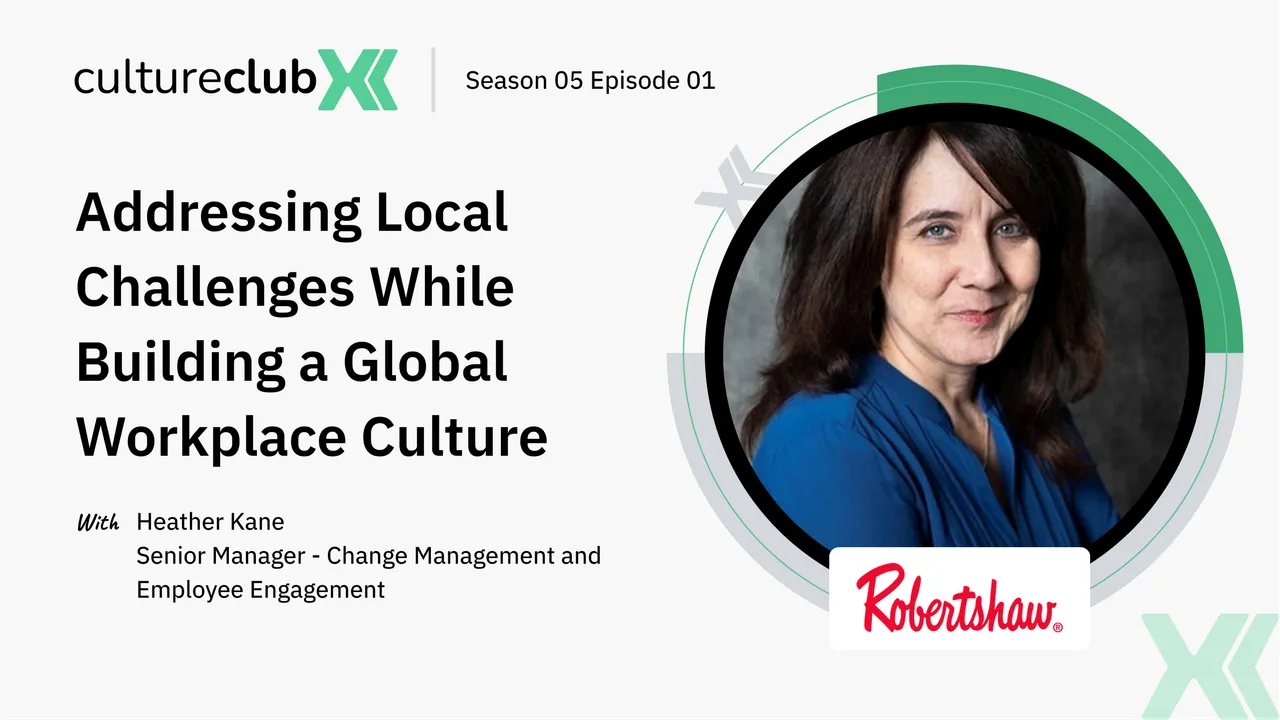
Heather Kane of Robertshaw shares how organizations can bridge global and local workplace cultures, leveraging technology, inclusive communication, and manager-driven initiatives to engage employees meaningfully, making every voice count and fostering connection across diverse teams.
TL;DR
What you need to know from this episode
- Engagement has no single global definition. Language and time zones are only the surface. Daily work experience differs across teams and functions, so a manufacturing floor and a headquarters office will never read engagement the same way.
- Translation is not the same as being understood. Robertshaw found the word accountability did not translate in two of its countries, and dictionary-correct substitutes did not resonate. Employees want to feel the company understands them and their culture.
- Direct access and relevance keep frontline workers connected. Messages that cascade through corporate, VP, manager and supervisor arrive late or diluted. Give employees a direct channel and content that relates to their actual work, or they stop coming back.
- Change happens one person at a time. Break audiences down beyond country or function and equip managers to focus the message, because each employee has to choose the new behavior and have it reinforced through a constant feedback loop.
- Technology levels the playing field, but people need time to catch up. QR codes, mobile access and AI translation made global listening possible at Robertshaw, yet tools now move faster than individuals can learn to use the outputs to drive decisions.
Season five of CultureClub X powered by CultureMonkey opens with a challenge most engagement playbooks quietly skip past. How do you build one unified workplace culture when your people sit in nine countries, speak 10 languages, and mostly work on factory floors rather than at desks? Host Natalie Thomas kicks off the season with Heather Kane, senior manager of change management and employee engagement at Robertshaw.
Robertshaw Controls builds gas and water flow technology, and most homes in the United States and Mexico contain something the company made. It is a global business in the middle of a complete cultural transformation, with about 4,600 employees. Around 80 percent of them are in Mexico, and 80 percent are frontline workers.
Heather is a transformational change leader whose career spans Fortune 500 companies and startups across consumer goods, retail and manufacturing, including digital transformations, SAP rollouts and organizational redesigns that touched thousands of employees. In this conversation she lays out what it actually takes to address local challenges while building a unified global culture.
Why does engagement mean different things to different teams?
Heather's first point sounds obvious but rarely gets acted on. The visible differences, language and time zones, are only the surface of the problem. The daily work experience differs not just across countries but across teams, and a manufacturing floor feels nothing like an office.
That variation makes it genuinely hard to land on a common definition of any part of engagement. Robertshaw also works with languages that are less commonly used, which multiplies the difficulty. Before you can improve engagement, you have to accept that each audience experiences work, and therefore engagement, differently.
What happens when a core value does not translate?
Robertshaw ran into this while establishing its core values. One of them was going to be accountability, and the team discovered that in two of its countries the word did not even translate.
Would a translation service give us some words to put in there? Absolutely, but they didn't really resonate with people on the ground.
The lesson goes beyond vocabulary. A technically correct translation that nobody connects with is still a failure, so the team had to find a word that would actually work on the ground. Heather frames the deeper issue as one of respect: employees want to feel that the company understands them and their culture, not just their language.
The scale of the shift at Robertshaw is striking. Heather notes it is amazing to think how many years the company had communicated in English only, despite having just 200 employees in the United States. For a workforce that is 80 percent Mexico-based, changing that default was foundational.
What keeps frontline employees disconnected from company values?
Heather boils the barriers down to two pieces: direct access and relevance. Without direct access, a message has to cascade from corporate to the VP, to the manager, to the supervisor, and only then, hopefully translated along the way, does it reach the frontline worker.
Direct access gives employees a choice. They will not want to see everything, but they can look things up independently, and the company can push information straight to them. Relevance is the second filter. People may show up for the big global meeting or the new initiative once, but they only keep coming back if what they find relates to their actual work.
What makes a communication system feel fair and inclusive?
Robertshaw has been rebuilding its communications around a set of must-haves, starting with an intranet that works without an email address. Mobile access matters most in a workforce where 80 percent are frontline: anyone, anywhere in the world, should be able to reach company information from a phone.
Multilingual translation is the next layer, and Heather is pragmatic about leveraging AI for it. Less commonly used languages will not have strong coverage in large language models, but she treats that as a starting point rather than a blocker. Locally focused content then ensures people see and hear what is relevant to where they are and what they do.
The final piece is showing that feedback goes somewhere. Heather describes a deliberate habit of reminding employees that the engagement surveys happened, the feedback was heard, and specific actions are the response. That visible follow-through is the heart of a working employee feedback loop, because it earns the next round of honest input.
Why does employee input so rarely become real change?
This is the episode's cold open and its sharpest insight. Change happens one person at a time, and at Robertshaw's scale that means thousands of individual decisions spread across cultural, linguistic and role differences.
Heather argues most organizations fail here because they treat audiences too broadly. What matters to a headquarters office worker in Chicago is totally different from what a frontline worker in Mexico cares about, and translation alone does not close that gap. Plant workers want to know what is happening in their local plant that week, not the corporate message.
Each person then has to move through a change process: understand why the new behavior matters, learn how to do it, and have it reinforced until they fold it into their daily routine. Treating everybody as Mexico or the United States, or as operations versus finance, is not enough. Breaking audiences down and equipping managers to focus the message is what actually drives change.
How does technology level the playing field for global listening?
Asked how managers can understand what culture feels like on the ground when teams operate so differently, Heather is direct about what made it workable at Robertshaw.
Honestly, using CultureMonkey has been huge, because that allows us to collect all that information, and it really does level the playing field, if you will, because QR codes and easy access, and it's just made it possible.
QR codes and easy access mean a survey can reach a frontline worker as readily as an office employee, and Heather says the team has been really excited by the response. Translation works in both directions: questions reach employees in their own language, and open comments come back translated so managers can act with their global teams.
For a distributed, largely deskless workforce, that is exactly the job a mobile-first pulse survey tool exists to do. It removes the email and desktop assumptions that quietly filter out frontline voices.
Better communication vehicles also feed the other direction. Heather's team can now have more direct conversations with employees, sharing what is changing and relaying the message with a local twist. Without those pieces, she says plainly, the transformation just would not be possible.
Will people keep up with the pace of workplace technology?
Heather's one caution is not about the tools but about the humans using them. Change is individual, and so is technology adoption. Phone access is no longer the worry, but even simple analytics can be complex for people who are not used to working with them.
So the speed at which technology can enable us to do things is probably faster than employees or individuals can learn how to use the outputs effectively, and then use it to make forward-looking type of decisions or analytics that will drive the business forward.
For leaders investing in engagement analytics, that gap is the real constraint. The platforms can already collect, translate and report faster than teams can absorb, so helping people learn to use the outputs is part of the rollout, not an afterthought.
What this conversation means for employee listening
Every thread in this episode comes back to listening. Direct access is listening infrastructure, multilingual translation is listening across cultures, and closing the loop on survey feedback is proof that listening leads somewhere.
Heather's experience also shows that listening at global scale is an equity question. When 80 percent of a workforce is frontline, a listening program that assumes email addresses and desks quietly excludes most employees. Meeting people on their phones, in their language, with content about their own plant is what makes every voice count.
Natalie closes the season opener by reminding listeners that engagement is not a one-size-fits-all strategy: it is layered and evolving, reflecting both local realities and the broader culture a company aims to build.
For teams starting that journey, Heather's advice reads like a practical map. Understand your audiences, give them direct and relevant access, respond visibly to what they tell you, and let managers carry change forward one person at a time.

About the guest
Heather Kane
Sr Manager for Employee Engagement, Robertshaw
Heather Kane is a transformational change leader known for turning complexity into progress across global organizations. She serves as senior manager of change management and employee engagement at Robertshaw, where she leads strategic initiatives that drive alignment between business transformation and cultural growth. Her expertise blends business transformation, change management, talent development and global marketing.
Her career spans Fortune 500 companies and startups across consumer goods, retail and manufacturing, and she has led change efforts for digital transformations, SAP rollouts and organizational redesigns, often impacting thousands of employees across geographies. A Loyola University Chicago alum, she is also a recognized speaker and an active leader in the community.
Full episode transcript
Season 05, Episode 01 · Heather Kane with Natalie Thomas · 15 min
What really gets in the way of turning employee input into this meaningful change? And why do some organizations struggle to follow through with this?
So the thing with change is that it happens one person at a time. So it's important to a headquarters office worker in Chicago is totally different than what someone cares about if you're a frontline worker in Mexico.
Hello everybody and welcome to the fifth season of CultureClub X powered by CultureMonkey. I am your host Natalie Thomas, and CultureMonkey is an enterprise employee engagement platform that helps people leaders listen to their employees and enhance workplace cultures. CultureClub X is our community initiative where global leaders share their best practices from their experiences and discuss all things company culture.
After the resounding success of our last season, we are back with our latest episode. And we are very excited to kickstart our fifth season of CultureClub X with Heather Kane, senior manager, change management and employee engagement at Robertshaw. Welcome Heather, it is a pleasure to have you here today.
Hi Natalie, nice to talk to you.
Nice to talk to you as well, and a little introduction before we dive into it. Heather Kane is a transformational change leader known for turning complexity into progress across global organizations. With a unique blend of expertise in business transformation, change management, talent development and global marketing, she brings a strategic lens to solving tough challenges that span people, process and performance.
At Robertshaw she leads strategic initiatives as senior manager of change management and employee engagement, using a cross functional approach to drive alignment between business transformation and cultural growth. Her career spans Fortune 500 companies and startups across industries including consumer goods, retail and manufacturing. She has led change efforts for digital transformations, SAP rollouts and organizational redesigns, often impacting thousands of employees across geographies. A Loyola University Chicago alum, which is a tongue twister I must say. She's also a recognized speaker and active leader in the community.
Heather, it is so great to have you with us today, and welcome again to CultureClub X's videocast on addressing local challenges while building a unified global workplace culture. Welcome to the show.
Thank you.
And before we go into some deeper questions today, just please begin by telling us more about yourself and your organization.
Okay, I joined Robertshaw almost two years ago now, and Robertshaw Controls does a lot of things in gas and water flow technology. So most people in the United States and Mexico will have something in their home that's been made by Robertshaw. So we're a global company and we are doing a complete cultural transformation. We're in nine countries, we have 10 languages and we have about 4,600 employees. 80% are in Mexico and 80% are frontline workers. So we've got some unique challenges to focus on.
Absolutely, and that's very impressive. And I'm just so excited to have this discussion with you today. So without further ado, let's kick it off. Let's get started. And why do you think engagement can mean different things to different teams, especially across regions and functions?
Yeah, cultural change is very different. And so there's some basic changes we think about, or differences we think about, like language, right? Language, time zones. And of course, those are challenges, especially like in our company, we have languages that are less commonly used. But also even in teams and functions, they work differently, their daily work experience, not even across country, but even across teams, like a manufacturing experience versus the office experience. And that can all make it really challenging to get a common definition on any part of engagement.
Wow, and why is it so important for companies to really respect the local ways of working while still nurturing a shared culture? And what also makes that balance between the two so challenging?
Yeah, it's hard to address large populations in many different cultures. And so there's everything from things literally don't translate. We were installing, establishing core values, and one of them is going to be accountability. And we found that two of our countries, the word didn't even translate.
Got it.
Would a translation service give us some words to put in there? Absolutely, but they didn't really resonate with people on the ground. And so if we wanted that, we needed to come up with a word that was gonna work.
And then again, even beyond the classics of what word means this or what translation looks like, people just wanna be understood. So it's not just about doing a translation or putting a concept out there. They wanna feel that you understand them and also their culture. And again, when you're in many different cultures, it's really challenging to find people who can manage that at a high level, but also execute at a local relevant level.
Yeah, that's really interesting, because you say, like the first thing is, as being a part of a team, we do wanna feel connected, right? We wanna feel connected and we wanna be heard, but then there's that extra layer of the language too, and finding the words that really everybody can understand. And then on top of that, the culture just in general. But I'm sure it's been such a learning experience for everybody going through this and working with so many people on an international level as well.
It really is. So it's just amazing to think how for how many years the company had communicated in English only.
Wow.
With only 200 US employees.
Wow. No, that's fascinating.
So even to just dive into everything further, what are some common barriers that prevent frontline or blue collar employees from feeling truly connected to maybe a company's values, their vision, so to say?
Yeah, we found it really gets into two pieces. Direct access, so you don't have to wait for your manager or supervisor, or worse, for it to cascade from corporate to the VP, to the manager, to the supervisor, and then hopefully the message gets to you, and hopefully someone translated it before you get there. So if people have direct access, then they have a choice. I realize they're not gonna wanna see everything, but at least they have a choice to go independently, or for us to push things out independently to them.
And then relevance again. Everyone's always excited about the global meeting or the new initiative, but most people, if you want them to keep coming back and choose to get that, to use their direct access, it has to be relevant for what they're doing.
Right, and going into our next question, kind of weaving into that. From your experience, what does it really take to create these communication systems that do feel fair and inclusive, regardless of role, location, or access within the company?
Yeah, we've been doing a lot more of that to improve our communications, and installing an intranet and things like that. And some of the things that were absolutely must-haves: mobile access, so you don't need an email, you can access it anywhere in the world on your phone. Multilingual translations, we really have to leverage AI these days, right? And it's about making it work for you and your people. So multilingual is good, even though we know some of our languages are less commonly used, and so they won't have as strong translations in those large learning models, for example, but it's still, it's a starting point.
And then locally focused content, like we just spoke about, so that way we can choose what people are going to see and hear based on where they are and what they're doing, so it becomes something that's relevant to them. And then this whole concept of, we're responding to your feedback, so that people don't forget that, you know, we did do our engagement surveys and we have gotten feedback from you, and this is what we're doing to respond to it, to really kind of validate that we hear you, and now we're doing something about it, and then we can get more feedback and build from there.
Yeah, exactly. It's like the listening aspect to it, but then also, like, just in general, with technology now bringing so many people together, especially just the last few years alone, I would say, and the changes that we're seeing just with, like, rapid fire in the technology space.
Exactly.
I mean, we see it, right, with, like, even social media, of how, like, the world is becoming so much stronger, or smaller, I should say, and how so many more people are just so connected now on a deeper level, where I think as before, we felt a little bit maybe more separate from each other, but now we're coming together, which is interesting.
Yeah, where it doesn't exist at work, people will make it exist offline, and it's fascinating how they've done that. And so now we just wanna bring more of that work-related group and discussions back into the workplace a little more, to build that connection with that audience.
And what really gets in the way of turning employee input into this meaningful change? Why do some organizations struggle to follow through with this?
So the thing with change is that it happens one person at a time. And so we have a lot of people and a lot of differences, cultural, linguistic, type of role, how you spend your day. It just makes it so hard to be able to focus on that. So companies are starting to invest more, but you have to break down those audiences. So it's important to a headquarters office worker in Chicago is totally different than what someone cares about if you're a frontline worker in Mexico. Not just if I translate it, even then, they probably still don't wanna hear the corporate messages so much as what's going on in their local plant that week.
And so being able to break down our audiences and then take 'em through a change process, because that's the other piece, is that the change takes time, because each person has to choose to say, this is what I did before, I understand why I'm gonna go do this new behavior. And then they have to know how to do it and have it reinforced in that constant feedback loop of what's going on, until they choose to say, yeah, this makes sense for me, I'm gonna fold it into my daily process. That could be fast or it could be long.
But treating everybody as Mexico or the United States, or maybe just all the operations versus finance, it's not enough. Breaking it down and using our managers, helping, equipping our managers to be able to kinda get that information and really focus things, that's what's gonna drive change. And that's why it gets so difficult at large organizations.
And even going back to that technology piece with everything, how do you think technology can help enable managers to understand what culture feels like on the ground, especially when teams operate in just very different ways around the world? And I know we touched a bit about technology, but wanted to ask this as well.
Honestly, using CultureMonkey has been huge, because that allows us to collect all that information, and it really does level the playing field, if you will, because QR codes and easy access, and it's just made it possible. And we've been really excited by the response we've had. So technology helps us there. The translations, right? Both of questions and also open comments, like just being able for managers to get that other layer down of open feedback from employees. And then being able to have it translated into your own language, you can understand it and work with your global team. So we use the technology a lot that way.
And then this idea that by improving our communication vehicles globally, we're then gonna be able to help have more direct conversation and share with employees things that are changing, and relaying that messaging with a local twist. And so really, that technology has just been huge for us, and we would never have been able to do this without those pieces. It just wouldn't be possible.
Wow, no, that's really interesting. And do you feel that there's any big changes even coming up more with technology that's gonna even bridge people together more? Is that something like a trend that you've also seen?
Definitely, because, again, change is individual, but also technology use and adoption is individual, so people have different experiences. So no one's really worried about, you know, having everyone have access using a cell phone. But then some of those other pieces, even some simple analytics, can be complex for people if they're not used to using it. So the speed at which technology can enable us to do things is probably faster than employees or individuals can learn how to use the outputs effectively, and then use it to make forward-looking type of decisions or analytics that will drive the business forward. So I think there's gonna be a gap for human beings to catch up to really take advantage of some of these tools effectively.
No, definitely. And thank you just so much for your insight and for our conversation today. And I really feel that today's session reminded us that employee engagement just isn't this one-size-fits-all strategy, that it's layered, it's an evolving process that needs to really reflect both the local realities of the team and the broader culture that we aim to build. And really from recognizing the unique challenges faced by the frontline and blue-collar workers, to even understanding how communication, technology, and trust all play a role in shaping the connected workplace.
So thank you so much, 'cause this episode I really feel gave us a deeper look at what it truly takes to make every single employee feel heard, valued, and just a part of a bigger picture. And at CultureMonkey, that's what we aim to support. Thank you so much, Heather. We learned a lot from you today. And please let our viewers know how they can connect with you to share their thoughts, ask some questions about this topic.
Sure, Natalie, thank you. I'm available on LinkedIn. Please reach out and connect or ask questions. I'm always happy to share my general experience and also my CultureMonkey experience with other colleagues, and learn more from them about engagement and employee change. So thank you.
Awesome. So again, thank you, Heather, for sharing your wisdom, lived experience and practical advice with us today. Because conversations like this really help us move the needle on what modern engagement can and should look like. And for everybody tuning in, don't forget to follow, share, and rate the podcast. As always, keep listening to your people and leading with purpose. And that is all we have for you in this episode of CultureClub X powered by CultureMonkey today. Until next time, we hope to see you all again soon. Thank you.
Frequently asked questions
Why do frontline employees feel disconnected from company values?
Heather Kane points to two barriers: direct access and relevance. When messages must cascade from corporate to the VP, to the manager, to the supervisor, frontline workers receive them late, if at all, and often untranslated. Direct access gives employees the choice to see information independently.
The second barrier is relevance. Employees keep using a channel only if the content relates to their daily work, such as what is happening in their local plant that week, rather than generic corporate messaging.
How should companies handle core values that do not translate across languages?
Robertshaw found that accountability, one of its planned core values, did not translate in two of its countries. A translation service could supply words, but they did not resonate with people on the ground, so the team worked to find a word that actually carried the meaning locally.
Heather's broader point is that people just want to be understood. A value has to reflect an understanding of employees and their culture, not just pass through a translation step.
What should an inclusive communication system for deskless workers include?
Heather lists the must-haves from Robertshaw's intranet rollout: mobile access that requires no email address so anyone can connect from a phone anywhere in the world, multilingual translations supported by AI, and locally focused content chosen for where people are and what they do.
The system should also show employees that their feedback is being acted on, reinforcing that surveys were heard and specific responses are underway, which builds trust for the next round of feedback.
Why do employee engagement surveys often fail to produce change?
Because change happens one person at a time. Organizations often treat audiences too broadly, as whole countries or whole functions, when a headquarters office worker and a frontline plant worker care about completely different things. Translation alone does not fix that mismatch.
Each employee has to understand why a new behavior matters, learn how to do it, and have it reinforced in a constant feedback loop until it becomes part of their daily process. Breaking audiences down and equipping managers to focus the message is what drives real change.
How does technology help managers understand culture on the ground in global teams?
At Robertshaw, survey technology with QR codes and easy access levels the playing field, letting frontline workers respond as easily as office staff. Questions and open comments are translated both ways, so managers can read employee feedback in their own language and act with their global teams.
Heather adds one caution: technology now enables things faster than people can learn to use the outputs, so organizations should expect a human catch-up gap around analytics and decision-making.
Read the cross-episode roundups
More from CultureClub X
 S07 E03employee engagementWhy do grievance procedures damage workplace culture? | David Liddle, The TCM Group
 David Liddle
 S07 E02change leadershipHR as Chief Disruption Officer: Why Supporting the Business Is a Ceiling, with Jennifer McClure
 Jennifer McClure
 S06 E20change leadershipWhy does culture change stall? | Jamie Notter, culture scientist
 Jamie Notter
Never miss an episode
Every new episode, plus the takeaways that matter, posted on the CultureMonkey LinkedIn page as soon as they drop.
Free on LinkedIn. Unfollow anytime.