

S05 E02
Shared Accountability and the Culture It Builds
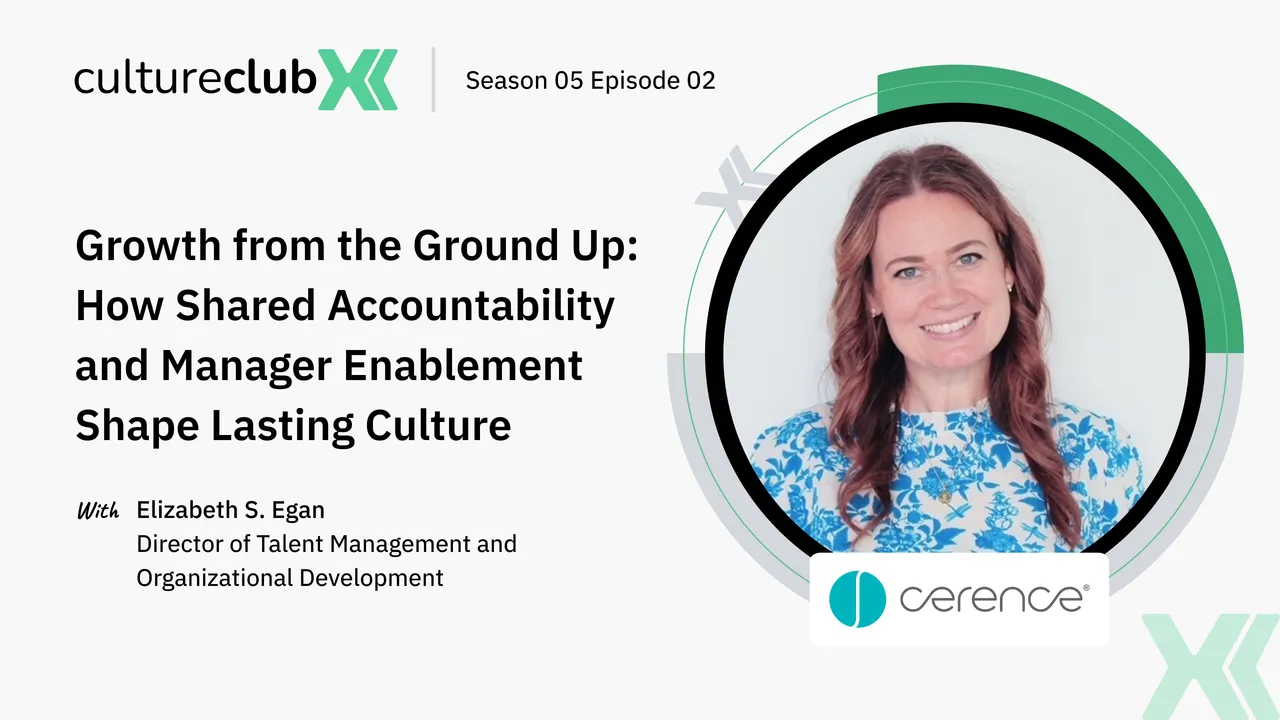
In CultureClub X S05 E02, Elizabeth S. Egan discusses shaping lasting culture through shared accountability and manager enablement. Hear practical strategies to empower employees, embed learning into daily work, and scale development across roles for real organizational impact.

TL;DR
What you need to know from this episode
- Culture is a shared build, not an HR program. Elizabeth compares an organization to a game of Jenga: employees, managers, and leaders each hold pieces, and HR gluing blocks back on cannot save a tower nobody else reinforces. The job is to catch the wobble before it falls.
- Only you can define what success means to you. Growth starts with looking internally at what makes you tick, whether that is technical mastery, people leadership, stability, or rising through the ranks. That definition can shift over time, and that is fine.
- Development is not only about moving up. Skills picked up outside the ladder, from shadowing projects to sitting in other teams' meetings, make you a better employee, manager, and leader regardless of your current level.
- Learning sticks when it is woven into real work. Having someone memorize content in a sit-down session is not the same as learning. Exposure, communication, and real time problem solving beat forced training every time.
- Managers need systems, and employees need networks. Recognition programs help managers spot silent leaders, while skip level meetings, mentorship programs, ERGs, and peers give employees a path forward when a direct manager falls short.
What makes workplace culture actually last? That is the question at the heart of the second episode of CultureClub X season five, where host Jodie O'Brien sits down with Elizabeth S. Egan, Director of Talent Management and Organizational Development at Cerence AI. Her answer is refreshingly practical: culture endures when growth becomes everyone's job, shared by employees, managers, and leaders alike, not just HR.
Elizabeth's route into people work gives her argument unusual weight. She began her career on the business side, working in operations and finance, before an international assignment reshaped her path. Tasked with building a team from the ground up, she saw firsthand how leadership, team dynamics, and workplace culture directly shape both business success and employee well-being.
That experience sent her back to the US for an MBA in organizational development from Boston University, and on to a cross-industry career spanning e-commerce, technology, construction, and the non-profit space, including scaling leadership programs at Wayfair and PTC. In this recap, we unpack her playbook for growth from the ground up: who owns development, how learning embeds into daily work, and what managers need to lead culture rather than just tasks.
Why talent development can't belong to HR alone
Elizabeth opens with a framing that changes everything: she treats employees as her clients. Every strategy she implements starts with the question of what will benefit her end consumer, whether that is a seasoned manager or the graduate who started yesterday. For too long, she argues, talent development was driven by HR and treated as secondary. Companies that now see it as a building block change the whole game.
A company is only as good as its people. If you have the right people in place, you're more likely to accomplish what company goals are.
The logic is structural. Innovation, creativity, and collaboration only show up when each individual feels connected to a shared vision and to other people. That requires employees who feel confident and have autonomy, managers who know how to grow and engage their people, and leaders who set the overarching goals and strategies. None of it works without the others.
Her favorite visual is a game of Jenga. A solid base lets you keep building, but gaps left in critical places create wobble, and the key is to catch the wobble before it turns into a collapse. HR gluing pieces back on only helps if the culture reinforces it, with people believing in it, managers standing by it, and leaders practicing what they preach.
What stops employees from owning their own growth
The biggest barrier, Elizabeth says, is simply not knowing. A fresh graduate has spent years being handed assignments, completing them, and waiting for the next one. A new manager may not know how to build a development plan, a new CEO may not have designed career pipelines yet, and a large company may offer so many paths that people feel lost.
The first real step belongs to the individual: look internally and work out what makes you tick. For some that is deep technical expertise, for others people management. Some want the stability of leaving the office at five to care for an elderly parent, while others want to be top performers rising into senior leadership. Whatever it is, you have to find it and define it, and the definition can shift over time.
How managers turn career ownership into daily opportunity
Individual drive only works when the company meets it halfway. Elizabeth wants the power to create opportunity placed firmly in managers' hands: tapping someone in for a project they have expressed interest in, pairing them with a partner to gain exposure, or simply inviting them to sit in a meeting and hear from people outside their group. That kind of managerial effectiveness is what converts a career framework on paper into growth people can feel.
The company's half of the bargain is to say clearly: we support this, and here is how you tell us what you are looking for. Not everyone's journey will look the same, and Elizabeth is quick to note that the payoff runs both ways. More innovation, more creativity, and more collaboration benefit the company just as much as the individual.
Does development only count if it moves you up the ladder
One myth Elizabeth wants to retire is the idea that you are only learning if it gets you higher up. There are skills that make you a better employee, a better manager, and a better leader regardless of whether they move you up a hierarchy. Sitting in meetings you would not normally access, hearing how different groups interact, or understanding how sales works so the financials make sense all count.
Company size changes the shape of the challenge, not the principle. Small organizations may lack room for title changes and promotions, but they offer out-of-scope tasks you would never touch at a bigger firm. Large companies usually have standard paths built out, which helps, right up until your path veers off the mold. Then it falls to you to find the managers and leaders who can expose you to something new.
How learning sticks when it lives inside everyday work
Asked how leaders can embed learning so it actually sticks, Elizabeth pushes back on the assumption that learning must be a sit-down event. She points to how babies learn: watching what happens around them, mimicking it, trying the square block against the round hole until something finally fits. Nothing is forced. It is gradual understanding built through watching and experiencing.
The workplace equivalent is an open invitation: come on over, take a look at this project, here is how I am going about it. The observer eventually ties it all together, and the veteran gains a fresh vantage point from someone who has not stared at the same problem for five weeks. A newcomer asking why do we do it this way can even improve the process itself.
Anytime you sit somebody down and you're trying to have them memorize something, that is not the same as learning. Those are very different things.
Her advice for anyone designing programmatic approaches follows directly. Exposure, understanding, communication, and collaboration are your best friends, so bring people into real time problem solving where newcomers learn and veterans teach. The company's bottom line benefits right alongside the people.
What managers need to lead culture, not just tasks
Managers sit at the very heart of engagement, and Elizabeth starts from an honest premise: managers are people too. You will connect with some people immediately, while others will challenge or frustrate you. All of that is natural, and you learn something on both ends of the spectrum.
Company systems can carry part of the load. A recognition program gives managers exposure to feedback they would otherwise miss, including the silent leaders a whole team quietly relies on. Spotting those people, supporting them, and making sure they feel rewarded is a cultural act, not an administrative one.
And when your own manager is not opening doors, Elizabeth's advice is direct: use the network around you. Set up a skip level conversation with a clear agenda, thirty minutes tops, and know what you want to learn before you walk in. Tap mentorship programs, ERGs, networking events, and the experienced peers who are often silent leaders themselves.
I am the one at the end of the day who is owning my own career. I am going to be living it day to day. So I want to find somebody who is able to support me in that.
Where employee listening fits into shared accountability
The through line of the whole conversation is attention. Catching the Jenga wobble before it falls, spotting silent leaders, knowing which employees want stretch assignments and which want stability: all of it depends on actually hearing your people. That is the discipline of employee listening, and it is what turns shared accountability from a slogan into a working system.
It is also where structure helps. A consistent employee feedback loop surfaces the recognition signals and growth conversations Elizabeth describes at a cadence that catches wobbles early, so managers act on what their teams are telling them instead of guessing.
Jodie closes the episode with the point that sums it all up: real growth does not come from formal programs or top down initiatives, but from shared ownership. Culture is built in the small everyday moments, and it is the people closest to the work who can make the biggest impact. Or, in the host's own sign-off, keep listening to your people and leading with purpose.

About the guest
Elizabeth S. Egan
Director of Talent Management, Cerence AI
Elizabeth S. Egan is Director of Talent Management and Organizational Development at Cerence AI. She began her career on the business side in operations and finance, until an international assignment, where she was tasked with building a team from the ground up, showed her firsthand how leadership, team dynamics, and workplace culture shape both business success and employee well-being.
She returned to the U.S. to earn an MBA in organizational development from Boston University and has since built a cross-industry career spanning e-commerce, technology, construction, and the non-profit space, including scaling leadership programs at Wayfair and PTC. Based in Boston, Elizabeth is as passionate about community as she is about organizational growth, and when she is not leading change at work she coaches pickleball and competes on the court herself.
Full episode transcript
Season 05, Episode 02 · Elizabeth S. Egan with Jodie O'Brien · 30 min
How can you as a leader encourage people at your organization, managers, leaders, embed that learning into everyday work in a way that it actually sticks?
I think there's sometimes a kind of miss thought that learning has to be sit down and look at this and here's this new thing. And I think if we look at it the same type of way where you have a team member who is, come on over, take a look at this project. I'm going to be going about it this way. Anytime you sit somebody down and you're trying to have them memorize something, that is not the same as learning.
Hello everyone and welcome to the fifth season of CultureClub X powered by CultureMonkey. I'm your host Jodie O'Brien. CultureMonkey is an enterprise employee engagement platform that helps people leaders listen to their employees and enhance workplace cultures. CultureClub X powered by CultureMonkey is our community initiative where global leaders share best practices from their experiences and discuss all things company culture. After the resounding success of our last season, we are back with our latest episode. We are very excited to have Elizabeth S. Egan, Director of Talent Management and Organizational Development at Cerence AI, for the second episode of CultureClub X. Welcome Elizabeth. It's a pleasure to host you today.
Thank you for having me. Excited to be here.
I'm so excited to have you. So Elizabeth is an organizational development leader who brings a rare blend of business and people insight to culture transformation. She began her career on the business side working in operations and finance before an international assignment reshaped her path. Tasked with building a team from the ground up, she saw firsthand how leadership, team dynamics, and workplace culture directly shape both business success and employee well-being. That pivotal moment led her to pursue her passion for people and the people side of business. She returned to the U.S. to earn her MBA in organizational development from Boston University and she's since built a cross-industry career spanning e-commerce, technology, construction, and the non-profit space.
From scaling leadership programs at Wayfair and PTC to strengthening team dynamics in mission-driven organizations, Elizabeth here has always focused on being a help to companies who want to grow from the inside out through culture, leadership, and intentional people practices. She's now based in Boston where she's passionate about community as she is about organizational growth and when she's not leading change at work, you'll likely find her coaching pickleball or competing on the court herself. Elizabeth, it is so great to have you with us today. I'm so interested to learn about this pickleball situation and everything else.
I love it.
Well, today we're going to talk about your business side but we also need to edge in on that and find out all about this pickleball obsession you have.
I love that. So many people love it today.
Well, welcome again to CultureClub X's video cast on growth from the ground up, how shared accountability and manager enablement shape lasting culture. So before we begin, tell us a little bit more about yourself and the organization that you currently work for.
Sure. Yeah. So you did a great job, appreciated, of putting me into one picture there. So I did start out my career on the business side. And while I was doing that, a lot of the work that I ended up doing was really built on how the people leadership, people development, team building aspects was. And that became clearer and clearer to me that I not only enjoyed that part of the business, but also really understood that a building block like that can make or break a company, right? And that was something that not only came natural to me, but also just invigorated me. And that's where I just started to shift the work that I was doing and went into positions that gave me a little bit more taste into that type of work while I was still dabbling in some of that financial operational piece before I decided to go back and get my MBA to specialize in that. And it's been such an exciting journey.
And part of it is because I'm able to take that experience that I had and think through my decisions as what does my end consumer, my end client, who is our employees, what are the benefits that are going to happen when we implement X strategy? What is it that's going to work best for team members, for managers? And what about the person who started, they graduated college, they started yesterday, how can I help them develop? And I think it's changed, it's adapted, we have more technology now, we have different generations in the workforce. There's so many pieces that continue to make this puzzle more and more challenging, which I love. And I think that's where I just really started to excite myself in getting to know what some of those strategies are, what some of the goals are. And for different companies, they're at different stages, they're at different development pieces, they're at different sizes. So there are so many pieces that go into that. And I think that's what makes this both exciting and challenging. And at the end of the day, for me, particularly rewarding, because I can see all of that played out day to day with my colleagues, my peers, my own leadership. And that's really exciting for me.
You know, the best thing that you said, which was really interesting, was you calling your people clients. Because if you look at it like that, it changes everything. We're used to looking at people outside of our company as the clients, and the stakeholders, the people that we're interested in impressing. And instead, you're looking at the people within as your clients, and who you really want to make sure are happy, satisfied. I love that. That is so great. Well, your impressive career path is beyond. But I'm really excited to have this further discussion with you. So without further ado, I have to ask you my first question, which is we know that growth shouldn't be HR's job alone. And in that context, why should talent development be a shared responsibility across the organization, not just something that HR owns?
I love this question. And I'm very excited that companies are starting to really ask this. And I think for so long, HR has driven this. And it's sort of something that people see as secondary. And now that companies are looking at this as a building block, I think that changes everything. A company is only as good as its people. If you have the right people in place, you're more likely to accomplish what company goals are. You're asking them to be innovative, creative, collaborative driven. Those things only come about when each individual feels connected to that shared vision and other people. So you need an employee who is feeling confident in their abilities, has the autonomy to complete their work. They need a manager who's supporting them throughout their day to day lives so that they continue that production. You need direct managers who understand how to grow, develop, engage employees. You also need leaders who are going to be able to create those overarching goals, strategies, visions. And none of that works without each other.
So I like to think of it as a game of Jenga, right? So you have this solid base and you can build on top of it. But sometimes if you were to remove or leave gaps in critical places, you create some of that wobbling. And the key is to catch it before the wobble turns into something that falls. And that's sort of the visual that I keep in my head as I'm going. Where are the places that somebody is going to feel reinforced and then you can add a building block on top of that? Where is it that if you pull from this place, it will stand strong. It's okay. That piece has been built on already and there's more to be done there and we can switch it up and put something else onto somebody's plate. But where is it that if you poke through there, it all comes tumbling down. And I think that's the kind of visual, I'm a visual person, that's the visual that I have in place when thinking through why is it that it's not just one person or one manager or one leader. It can't be just one of those things. It's everything woven into a structure together. You are all building the company together.
A company doesn't exist with just a CEO because there's nobody to do the other work. Company doesn't exist with just a management level because there's nobody to complete the work, nobody to set the vision. So then you just have the middle. And there's no company if it's just an employee without having that understanding, strategy, vision, goal setting. You need all of those things and it doesn't matter if your company is large or small, medium, all of those things are still pieces that exist at that company. And so without all of them working together and creating that vision, supporting, having autonomy, that tower will crumble. And HR going in trying to glue pieces as you go is only as helpful as having it reinvigorated back into the culture, having people believe in it, having managers stand by it, having other leaders practice what they preach. All of those things have to happen in conjunction to keep that tower strong. And you keep building that block and that Jenga puzzle as you're going.
You know, when you create that image there for us, I imagine that yard Jenga, so the one that they have at weddings, right? Where everybody is around it and we're all like, oh, don't let it fall. But we can't forget our responsibility within that game. So in your experience, what makes it hard for us as employees to take ownership of our own growth and how can companies start to shift our mindset?
That's such a great question. And I think it's probably the crux of a lot of where this comes from, because there's a few factors. The first is just not knowing. If you're a fresh graduate, you come out of school, you are used to having people hand you an assignment, you complete it, and then you wait for the next one. So what happens now that you don't necessarily have that structure and you might be a manager who's new and you don't know how to create that plan. Maybe you are a new business and you're a new CEO and you haven't created the fully designed pipeline journey for careers. You might be a large company and there's so many paths that somebody feels lost. So again, it's that combination effort. It starts with the individual. No one can design what success looks like to you or happiness or tell you what makes you feel accomplished. So that's the first real step for each person is taking a look internally, thinking about it and thinking what makes me tick. For some, that might be technical expertise in one subject. For some, it might be a people manager. For some, it might be the simple stability and knowing that they're in the position and they leave the office at five and they go care for their elderly parent. And then for some, it's that constant challenge and trying to be a top performer and wanting to rise up the ranks into high levels of leadership. So whatever that is, the individual needs to find it and define it. That can also shift and change over time.
But to then build that path from there, we need companies that are supporting their teams and their employees to have that natural shift and support. This is where that day-to-day empowerment from managers to give opportunities so that leaders know, here's this path that we built, but we need managers who are able to say, hey, let me tap you in for this. You've expressed some interest in this. Here's an opportunity that we have where you can partner with someone, gain exposure to this, challenge yourself a little bit. It also could be somewhere that you're maybe shadowing and here's an opportunity for you. You're maybe not putting in some of the actual work, but it's just to sit in this meeting, understand how this is going, hearing from people who are outside of your group. But putting that power into managers' hands to allow employees to have that opportunity is the first foremost part from the company side and pairing that with that drive from individuals to say, where am I at in my career? What am I looking for? Giving that person that opportunity.
And I think it's really putting that power back into individuals' hands while saying we are a company that supports this. And if we can make a path fantastic, but here's a way that we are allowing you to tell us what you're looking for and best support it in that manner. Not everyone's journey is going to look exactly the same. I know that firsthand, but where are the opportunities where I can have exposure to some of those other pieces that allow me that new journey, that different piece of thinking, that new partnership. And I will say with that companies benefit hugely. You have more innovation, more creativity, more collaboration, all of those things benefit the company as well as the individual. And I think that's going to be the important thing as we look forward to companies as they grow, that they're putting that ability autonomy back into employee and manager's hands.
Okay. So in talking about all of that, why is it so important to scale development across different roles and levels and what challenges tend to get in the way? Cause you know, there's a lot of personalities in a company.
Definitely. It's a tough question because there will be constant shifting regardless of organization. So you have small, medium, large organizations that will shift and change as they continue in time, regardless of growth. You have small organizations that will face difficulty of maybe not having a ton of people move or space to move, right? Levels to go into. It might be harder to have those title changes or promotions, but there are other opportunities for upskilling in ways like taking on tasks that you wouldn't have a chance to at a larger company. So those are ways that you would say that's outside of scope or working with different teams. And those are the development levels that will happen at a smaller company that wouldn't be existing perhaps at a larger company. So that's an advantage there. For larger companies, they are likely to have a path built out for all of their groups, which is great. And it's a standard way of doing it, which is very helpful. So that's a great way to look into it. The piece there that could be challenging is if your path may veer off or not look exactly like the mold. So that's where you want to as an individual own that career. So finding those managers, leaders, or whomever else who can expose you to something new, give you that new challenge. Understand what you are looking to have exposure to, new tasks. I mentioned earlier, even just shadowing somebody for some time or on a specific project is super helpful.
There's oftentimes an understanding that you are only learning something if it's getting you higher up. And I want to negate that. I think that there are skills regardless of whether or not it moves you up into a hierarchy that you aren't learning. And that's not true. There are so many skills that you will pick up outside of that ladder look and make you a better employee, make you a better manager, make you a better leader. And those are important regardless of what path you're on or what level that you're at currently. So I also always want to encourage people if they can sit in some meetings that maybe you don't have any access to otherwise, or they may not even be part of your group, but hearing how people are thinking, hearing how different groups are interacting, understanding it could be a regional change. It could be understanding how sales are done over here that can help you understand how financials work on this part. And that understanding, that work with other groups, that collaboration is going to help you yourself. And again, we'll help companies. And companies, I think, who buy into this and understand this and assist with any of this learning are going to benefit the most. They will gain the knowledge, exposure, and innovation that the person is going to have. And I think that that is where any company, regardless of size or roles, levels, there are challenges there, but there are benefits to when it goes well for both parties, individual and the company.
That's so true. And so wonderful. We know that, like you said, growth doesn't just happen in workshops. It happens on the daily. So how can you as a leader encourage people at your organization, managers, leaders, embed that learning into everyday work in a way that it actually sticks?
I think that is one of the best questions, also one of the hardest. And I think there's sometimes a kind of miss thought that learning has to be sit down and look at this and here's this new thing. And I think if we go back to even, if you look at children, when they're learning, quote unquote, when they're babies, they are just looking at things that are happening around them. They see something happening and they mimic it. They understand something's happening over here. Maybe I don't know, but I'm going to try this thing and see if it works. Does this square block fit into this round hole? And they may try it a few times and it's going to come back at them and it's going to be a little frustrating, but eventually they find the one that it works on and how exciting. And that's a new skill learned like that in the sense that when you look at it, you think, oh, they've just learned it, but it took a period of time and it was opportunity that they had. It was looking at something that was happening. It was exposure to something happening and it wasn't forced on them. It was part of an everyday gradual understanding, learning, watching, experiencing.
And I think if we look at it the same type of way where you have a team member who is, come on over, take a look at this project. I'm going to be going about it this way. And if you're learning something great, maybe you see something that I don't, because I've looked at this every day for the past five weeks and I am just seeing what I'm seeing, but maybe you have a new vantage point that helps me be able to create the square peg for the square hole, whatever that widget might be. And similarly, the person who's looking on can say, wait a minute, I get it now. I've seen this a few times. I didn't understand it at first, but now I have the exposure to this and I've seen this in meetings and I'm able to tie it back now. And I think without having the pressure of you must learn this in this way, and this is how we're going to do it, a manager is able to be more natural. They can talk about it in a way that's productive and also applicable to the actual work being done. And then sometimes there's again, new opportunity for people as they come in and they say, oh, I have a question about this. Why do we do this? Well, that's a great question. We've been doing it this way, but let's talk about that. Maybe that's not how we have to do it. I think that benefits both.
So to answer the question, I don't know that there's necessarily a stripped manner in how you have to teach or how you have to learn, but I think exposure, understanding, communication and collaboration are going to be your best friends. Anytime you sit somebody down and you're trying to have them memorize something, that is not the same as learning. Those are very different things. So trying to encourage the discussion, the collaboration, the understanding is going to benefit both parties. And again, for companies, that is your bottom line that will benefit as well. So something to consider as you're thinking through programmatic approaches, how can you get more people, more understanding, more exposure, bringing in real time problem solving so that you can have that opportunity for other people to look at it as well as learn for people who have done it before.
You know, we've all had good managers and we've all had not so good managers, but the one similarity is they are often at the very heart of engagement. So how can we continue to support them? Not just in those tasks that we've talked about and bringing the employee alongside in those tasks, but to lead culture.
That is I think a top tier difficulty and question as we go. Managers are people too, right? So you are going to have people that you connect with immediately. You are going to have people that challenge you. You are going to have people that frustrate you. And all of those things are natural and part of life. And no matter what, you will learn something, whether you are the manager or the employee, that you will be on both ends of that spectrum. And you will learn something both ways. So I think one of the benefits, if you have something in place as a company, like a recognition program or something there that can really assist you, from a manager side, to give you some exposure to what's the feedback here, what's happening from other people, where are their leaders within my group that maybe I wasn't aware of. Where is there somebody that might be more of the silent type leader, but I can see they are the go-to for the rest of my team. I want to tap into that. I want to support that. I want to see what they're doing and making sure that they feel rewarded as well. So recognizing them, but keeping track of that too and understanding that.
Also from an employee standpoint, if I have, as you mentioned, maybe a manager who isn't somebody who is going out of their way to give me some of those opportunities or understand what some of my path might be, there are definitely ways that I can utilize the other people, the other network around me. It might be a skip level conversation. So those are natural. That seems to be something people have a little bit of hesitancy on. But setting up a skip level meeting is pretty normal. And you just call it that, this is a skip level meeting so I can understand what's happening at the higher level leadership. I just want to have exposure here. That's a great way to make connection with somebody at a higher level if you have the opportunity. And that's somewhere where you as the individual would set an agenda. Don't go in expecting them to just talk to you or at you. Set an agenda. What are you going in to learn? What are you going in to understand? This is not going to be a two hour meeting. 30 minutes tops. But just giving you that exposure, understanding and connection.
The other piece, if you have a mentorship program at work, that's a great way to tap into other places, other groups, other leaders who might be available for you to have those conversations with. And then the other piece might be a colleague or a peer. They may have been there longer. They may be that silent leader that you happen to be going to. Utilizing people around you is going to be just as important as your direct manager. We all hope that we have direct managers who are supportive and understanding and are somebody who is giving us opportunity. If that's not the case, I am the one at the end of the day who is owning my own career. I am going to be living it day to day. So I want to find somebody who is able to support me in that. That is still a task I should be undertaking. If it's not my manager, who else might it be? Who else is able to assist me with that? That's also going to be a very important part of your journey. And there's a plethora of people, I promise you, at every company who want to help, who want to have that conversation, who want to help you on your journey. It's the process of finding them. So join one of your company groups. They have ERGs, most companies, there's probably a networking conference. There's happy hours at the office, different opportunities for you to connect. Tap into those opportunities if you can.
I love that. So it sounds like the simple habits that managers can pick up like recognition and transparency will really help managers build that stronger day-to-day cultural impact at the company, which is great. Well, it's clear from today's chat, obviously clear from today's chat, that real growth doesn't just come from formal programs or top down initiatives. It comes from shared ownership when employees and everyone at the company, including managers, take responsibility for development. That's when culture really seems to shift. We talked about what it takes to embed learning into everyday work, how to make development feel inclusive and scalable, and the kind of support that managers need to become true culture leaders, not just task owners. At the end of the day, culture is built in the small everyday moments and it's the people closest to the work who can make the biggest impact. It was such a delightful conversation today, Elizabeth, and we learned so much today. Let our viewers know how they can connect with you to share their thoughts or ask additional questions on this topic.
Thank you so much for having me, Jodie. And yes, I am on LinkedIn. Please feel free to look me up. I am under Elizabeth S. Egan, and I'm happy to connect and chat anytime.
Wonderful. She's on the LinkedIn. If everybody heard that, that's what I call it, too. The LinkedIn. Thank you again for tuning in, everybody. Don't forget to follow us, share, and rate this podcast. And as always, keep listening to your people and leading with purpose. Again, a huge thank you to Elizabeth for sharing your wisdom, lived experience, and practical advice with us today. Conversations like this help move the needle on what modern engagement can and should look like. So that's all we have for you in this episode of CultureClub X, powered by CultureMonkey. Until next time, I'm your host, Jodie O'Brien, signing off.
Frequently asked questions
Why should talent development be a shared responsibility instead of just HR's job?
Because a company is only as good as its people, and the conditions for innovation, creativity, and collaboration cannot be produced by one function. Employees need confidence and autonomy, managers need to know how to grow and engage their teams, and leaders need to set the overarching vision. None of it works without the others.
Elizabeth Egan compares it to Jenga: HR gluing pieces back onto a wobbling tower only helps if the wider culture reinforces it, with managers standing by it and leaders practicing what they preach.
How can employees take ownership of their own career growth?
Start internally. No one else can define what success, happiness, or accomplishment looks like for you, so work out what makes you tick, whether that is technical depth, people management, stability, or climbing into leadership. That definition can change over time.
Then build the path deliberately: ask managers for exposure to projects, shadow colleagues, sit in meetings outside your group, and use mentors, skip level conversations, and company groups when your direct manager is not opening doors.
How do leaders embed learning into everyday work rather than formal training?
Elizabeth's rule is that memorizing something in a sit-down session is not the same as learning. People learn the way children do, by watching, mimicking, and trying things without pressure, so the most effective move is inviting team members into live work: come look at this project, here is how I am going about it.
That exchange benefits both sides. The observer gradually ties concepts together, and the veteran gains a fresh vantage point and fresh questions about why things are done the way they are.
What should you do if your manager does not support your development?
Own it yourself and use the network around you. Set up a skip level meeting, which is more normal than people assume, and bring an agenda: know what you want to learn, and keep it to 30 minutes tops. Mentorship programs, ERGs, networking events, and longer-tenured peers are all legitimate routes to the exposure your manager is not providing.
As Elizabeth puts it, you are the one owning your own career and living it day to day, so finding someone who can support you is still your task even when it is not your manager.
Can employees still grow at small companies without promotion paths?
Yes. Small organizations may not have many levels or title changes to offer, but they provide upskilling opportunities larger companies cannot, like taking on tasks that would be out of scope elsewhere and working directly with different teams.
Larger companies usually have standard paths built out, which helps until an individual's path veers off the mold. In both cases the skills that matter are often the ones that do not map to a ladder at all.
More from CultureClub X
 S07 E03employee engagementWhy do grievance procedures damage workplace culture? | David Liddle, The TCM Group
 David Liddle
 S06 E19change leadershipFrom Cost Center to Catalyst: How CPOs Turn People Strategy Into Business Advantage, with L. David Kingsley
 L. David Kingsley
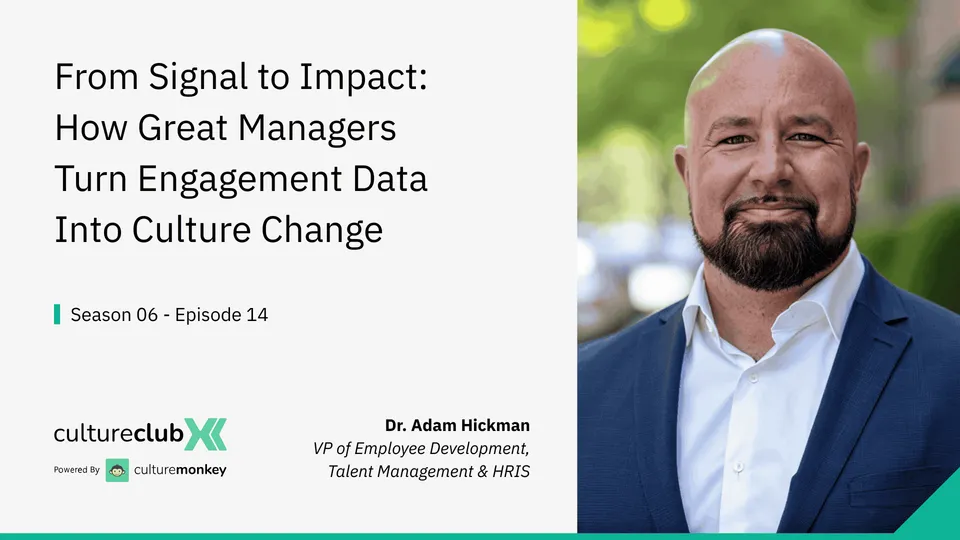 S06 E14manager effectivenessTurning Engagement Data Into Culture Change
 Dr. Adam Hickman
Never miss an episode
Every new episode, plus the takeaways that matter, posted on the CultureMonkey LinkedIn page as soon as they drop.
Free on LinkedIn. Unfollow anytime.