

Culture Litmus
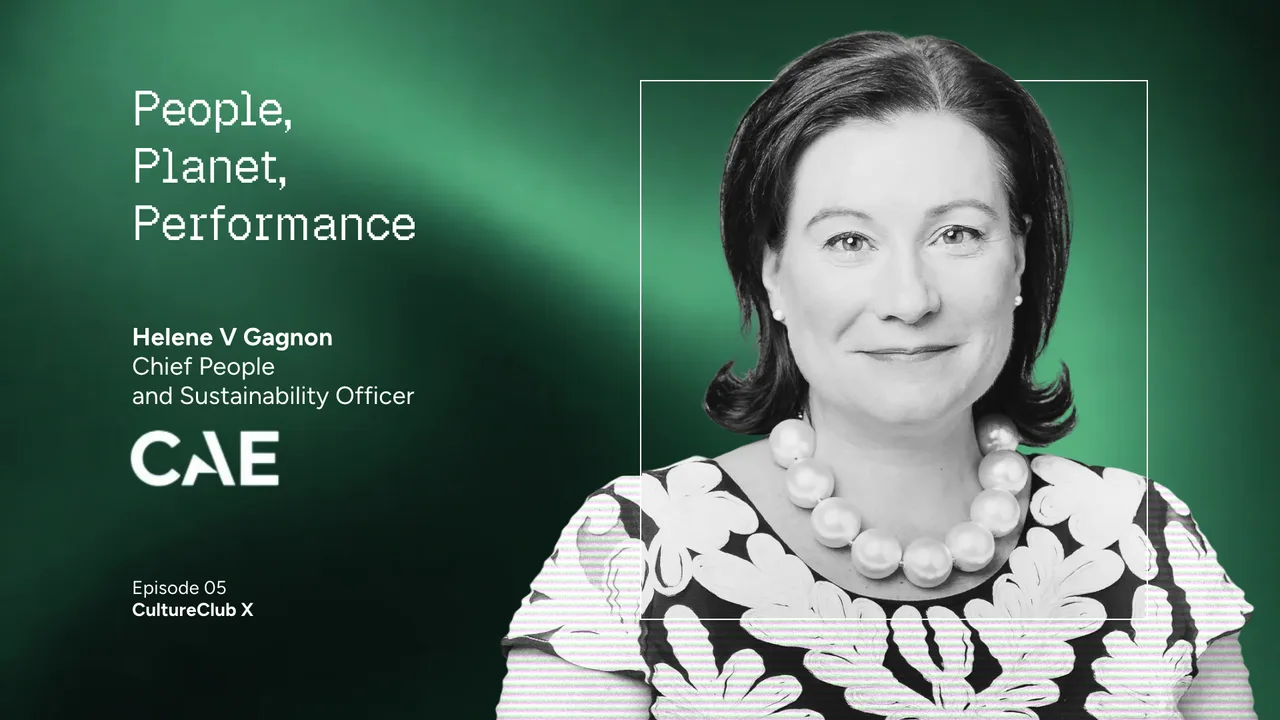
Why do people and sustainability belong together? | Helene V Gagnon
Because sustainability is about purpose, purpose drives engagement, and engagement drives performance, says Helene V Gagnon of CAE. She calls the two mandates one way to build a business that will last, backs it with her company's engagement data, and gives every people leader one thing to do in the next 90 days: connect each person's work to why it matters.
Five conversations on the gap between what organizations claim about their people and what they can actually evidence.
- 01Gethin Nadin, BenifexSeptember 8, 2026
- 02Jennifer McClure, DisruptHRSeptember 22, 2026
- 03David Liddle, TCM GroupOctober 6, 2026
- 04Jessica Zwaan, LeapsomeOctober 20, 2026
- 05Helene V Gagnon, CAEThis episode
TL;DR
What you need to know from this episode
- People and sustainability are one long-term agenda. Helene V Gagnon's chain runs from sustainability to purpose, from purpose to engagement, and from engagement to performance.
- Measure purpose and it stops being soft. At CAE, the engagement score sits at almost 80%, with meaningful work as the standout driver and growth right behind it.
- Redefine retention as a relationship. Purpose earns people's best work, not necessarily their whole career. Someone who contributes, grows and becomes an advocate after leaving is a success.
- AI raises the bar for leadership. Train for power skills such as judgment and empathy, not only technical skills, and evaluate performance on them as well as on output.
- The 90-day action is a conversation about purpose. In one-on-ones, ask each employee how their work connects to why you're here, and help them close the gap.
Helene V Gagnon is Chief People and Sustainability Officer at CAE, the company that trains pilots on its flight simulators and prepares men and women in uniform for their missions. A lawyer by background, she began her career in environmental law, then moved through public affairs, communications, government relations and sustainability in the mining and manufacturing industries, and has served on the boards of five corporate and more than 25 nonprofit organizations.
This is the fifth and final episode of Culture Litmus, the Season 07 series on the gap between what organizations claim about their people and what they can evidence. Helene's subject is the claim that purpose is soft. Her answer sets the tone for the conversation: "When something is measured, I certainly don't call that soft."
Why do people and sustainability belong together?
Because, in Helene V Gagnon's account, they are the same long-term work. She defines sustainability broadly, as the intersection of economic, social and environmental impact, and as doing things that will last after we're gone. People are the social pillar of that definition. From there she draws a chain: sustainability is about purpose, purpose is a driver of engagement, and engagement is the engine of performance. So for her they are not two mandates but "two sides of one coin, really one way to build a business that will last."
She gives CAE as the example. Making the skies safer and enabling readiness is a strong purpose, and when she asks employees around the world why they joined and why they stay, the meaning of the work is right up there with the colleagues they love.
What did CAE's sustainability and employer recognition teach her about culture?
That "recognition on the outside is simply a reflection of the culture on the inside." Darcy Mehta put it to her that CAE became Canada's first carbon-neutral aerospace company while also being recognized as one of the country's best employers. Helene's reading is that both came from the same place: people who care, doing work that means something to them. That is why the first pillar of CAE's employee value proposition is drive and purpose, the idea that every role at the company contributes to a safer world. It sits at the heart of how CAE hires, grows and develops people, which she says is what turns a value into a lived culture.
Does purpose still drive retention when careers are more fluid?
Yes, but the goal changes. The desire for purpose is not unique to one generation, she says, though younger talent demands it faster and is more willing to make career decisions around it. The better question is not how to keep everyone forever but how to make the time together matter for both sides. In her words, "purpose, I think, earns you the best work, not necessarily the whole career."
That leads her to redefine retention "as a relationship, not a lock-in." Someone who stays for a few years, contributes a lot and becomes an advocate afterward counts as success for her, and CAE has many boomerang employees. When she and her team built a retention toolkit for leaders, they told them the best lever they have is the one-on-one conversation, starting with how each person's day-to-day work connects to why it matters.
What is human sustainability?
It is sustainability applied to human beings: giving people real learning and growth opportunities, knowing that some will leave, so that they leave more capable and more employable than they arrived. Helene sees a paradox in it. The companies most willing to develop people, knowing that some will go, are often the ones people don't want to leave.
How can leaders make sure AI strengthens human connection?
By treating AI as something that augments people. As AI advances, she argues, human skills become more important, and she prefers to call them power skills rather than soft skills: judgment, critical thinking, empathy, creativity, ethical decision-making, relationship building, collaboration and leadership. CAE's heritage is her proof: for almost 80 years its flight simulators have augmented human performance in high-consequence environments without replacing the human. There is, she says, "a world of difference between replacing capability and augmenting it."
Her conviction is that "AI does not replace leadership, it actually raises the bar for it." She expects that to force two shifts. Training and reskilling have to strengthen power skills, not only technical ones. And performance management cannot look only at output: it has to evaluate those power skills too.
How do organizations build power skills at scale?
Not through a course or a certification. Helene says they are built through experience, coaching, mentorship and solving real problems alongside each other, and that the responsibility begins earlier than most people think, with students and interns. At CAE, participants in the recent graduate program rotate through four assignments over two years, mentored by senior leaders, and she says the vast majority are now in leadership roles across the company. She also expects AI to push young people to present to executives, make recommendations and engage stakeholders earlier in their careers, so the coaching has to start earlier too.
What is the evidence that purpose is not soft?
She starts with CAE's own data. Its engagement score sits at almost 80%, and meaningful work is the standout driver, with growth right behind it. Employee comments describe the same thing in their own words: pride in training future aviators, in making aviation safer and in contributing to readiness. Beyond CAE she points to Gallup, whose research with Stand Together found that US employees with a strong sense of work purpose are 5.6 times as likely to be engaged as those with a low sense of purpose, and less likely to be looking for a new job. CAE also holds its leaders accountable for acting on the results, because that, she says, is where the value and the innovation come from.
What will define purpose-driven workplaces in 2030?
Something more human than technology. By 2030, Helene expects the technology question to be largely settled. What will set organizations apart is how they help people connect their work to purpose, keep learning and feel supported through change. Good companies, she says, "will have workforces fluent in AI and deeply human", with continuous learning as the default and wellbeing treated as a business fundamental.
Leadership will need to be more participative and agile, with a posture of "permanent agility" that may not come naturally. People thrive through change, in her view, when they feel safe enough to adapt, and when leaders give them clarity, trust and a sense of purpose to hold on to. She hopes the future of work will be "our chance to actually build work around what only people can do best."
What should people leaders do in the next 90 days?
Help people connect what they do to why it matters, in the simplest way possible. In your one-on-ones, ask each employee how their work is connected to why you're here, and help them close that gap. The real shift, she says, is to "win people's hearts, not just their minds, because the minds get you a certain level of performance, but the heart gets you their best." If every people leader had that conversation about purpose in the next 90 days, she is sure it would make a difference.
How can people leaders bring engagement data to the board?
By treating culture as a business indicator rather than a sentiment. CAE listens through its own pulse survey every two weeks, which Helene says moves the conversation "from anecdote to evidence", showing where engagement is strong, where the friction is, and how the drivers connect to retention, growth and performance. The executive team reviews engagement data and its drivers every month during the financial review, and the conversation reaches the board of directors quarterly. Culture, she says, should read as "a business indicator, sitting right alongside the financials."
The other half is closing the loop. It is not about collecting more data: if people feel their voice does not matter, at some point they stop filling in the surveys. CAE keeps leaders accountable for reviewing their results and producing action items, and she sees AI helping to point leaders toward what they could do next.
Where does continuous listening fit?
It brings employee perspectives into conversations about culture, sustainability and business performance. Closing the episode, Darcy Mehta noted that people strategy, sustainability, purpose, technology and business performance can no longer be viewed as separate conversations. Platforms like CultureMonkey, employee engagement survey software for continuous listening, can help people leaders understand employee sentiment in real time and identify engagement and purpose gaps.

About the guest
Helene V Gagnon
Chief People and Sustainability Officer, CAE
Helene V Gagnon is Chief People and Sustainability Officer at CAE, a multinational company headquartered in Canada. A lawyer by background, she started her career at a large law firm in environmental law, then moved into public affairs, communications, government relations, stakeholder management and sustainability for multinational companies in the mining and manufacturing industries. She has been a board member of five corporate companies and more than 25 nonprofit organizations, supporting them on stakeholder management, sustainability, talent and HR.
Full episode transcript
Season 07, Episode 05 · Helene V Gagnon with Darcy Mehta · 29 min
Hello, everyone, and welcome to season seven of CultureClub X, powered by CultureMonkey. I'm your host, Darcy Mehta. CultureMonkey is an AI powered enterprise employee engagement platform that helps people leaders listen to their employees and build stronger workplace cultures. CultureClub X is our global thought leadership forum where CHROs, people leaders, and workplace experts come together to share perspectives on emerging workplace. Place trends and the strategies shaping the future of work. Today we are delighted to welcome Helene Gagnon, Chief People and Sustainability Officer at CAE. Helene, welcome.
It's wonderful to have you with us.
Thank you. I'm it's really a pleasure to be here, Darcy. Thank you.
Yes, absolutely. And you know, to give a little background, she brings a particularly broad perspective to the people function. She is a lawyer by background and began her career in environmental law before moving into public affairs, communications, government relations, stakeholder management, and sustainability across multinational organizations in the mining and manufacturing industries. She has also served on the boards of five. Corporate organizations and more than 25 nonprofit organizations, supporting them across areas, including stakeholder management, sustainability, talent, and HR.
After three decades of experience across these areas, Helene was appointed Chief Human Resources Officer at CAE two years ago, where she now serves as Chief People and Sustainability Officer, bringing people and sustainability together under one leadership mandate. Helene, your career brings together several areas that are increasingly becoming interconnected for organizations today. People, sustainability, stakeholder relationships, and business performance. And that makes your perspective particularly relevant as organizations think about what the workplace needs to look like over the next decade.
We are so excited to explore today's topic: People, Planet, Performance. How chief people and sustainability officers are building the engaged purpose-driven workplaces of 2030. So welcome. We will just dive right into our first question.
So your role at CAE combines two mandates that many organizations manage separately, people and sustainability. Why do you believe that they belong together?
Well, thank you, Darcy, and thanks for having me today. Well, for me honestly, the connection is really obvious because as you said, I started my career more than thirty years ago as a lawyer in environmental law. And so I had that sustainability lens really early on. And when you think of the meaning of sustainability, it's really the intersection of economic impact, social impact, environmental impact. And sustainability defined broadly is all about the long term.
About doing things that will last after we're gone so people they're the social pillar so putting people and sustainability together for me is not a stretch it's the logical whole and people and sustainability they're at the core of business the people agenda is all about you know driving results to our people it's about being the ultimate business partner and sustainability is about doing things for the long term by having a purpose by having an impact on society on the environment on people so They belong together because for me, sustainability is really about purpose, and purpose is really a driver for engagement.
And engagement is the engine for performance. So we know that when somebody sees that their work really matters, that they give their best. And maybe I can give a parallel to my company. I work for CAE, and what we do is that we train pilots for the moments that matter, mostly with our flight simulators, and we also train. The men and women in uniform to be ready for their mission. So making the sky safer, enabling readiness is really a strong purpose.
And when I ask my employees around the world why they joined our company, why they're staying, the meaning of the work, the what we do, the why we do it is right up there. They love the people, the colleagues, but they love that what we do really matter now and for the future. So for me, people and sustainability, they're not two mandates. They're really kind of two sides of one coin, really one way to build a business that will last.
Absolutely. No, it makes perfect sense when you break it down like that for sure.
So CAE became Canada's first carbon neutral aerospace company while also being recognized as one of Canada's best employers. What has that experience taught you about the relationship between purpose, culture, and performance?
Well, I think what it taught me is that purpose becomes powerful when it really is part of how people work every day and their recognition on the outside is simply a reflection of the culture on the inside because when people are proud of what the company stands for and that they can see that their own contribution in it really has some meaning, they bring the most of themselves to work. And so the progress on our sustainability journey or the employer recognition. Came from the same place, you know, people who care doing work that really means something to them.
And that's that's exactly why when we built our employee value proposition or promise for all, the first pillar is all about drive and purpose, the idea that every role at our company contributes to a safer world. And so that purpose is really at the heart of how we hire, how we grow, how we develop people. And so that's really what turns a value into a lived culture. And it shows up in performance because we know that when we have an engaged workforce that is really proud, they just deliver so much more for the company. And that's where the performance angle really kicks in.
Absolutely. I mean it's not rocket science. If you, you know, care about the company, if you really feel that the work you're doing is important and you have that purpose, it makes it exciting to go to work and you want to do better. And it's just it's it's so obvious, isn't it? So
Many employees, particularly younger generations, are approaching careers differently than previous generations. Does the connection between purpose, engagement, and retention still hold in a world of more fluid career paths?
Well, Darcy, I think, you know, that desire for purpose is not unique to one generation. But what changed is perhaps that the younger talent demands it faster. And the younger people they're more willing to make to make career decisions around that. But people leaders consistently report the same thing. People stay where they have real impact, where they where there's meaningful work and when there's an ecosystem genuinely that cares about them. So The question is not so much how do I keep everyone forever, but is how do I make our time together matter for them and for us.
So purpose, I think, earns you the best work, not necessarily the whole career. And so retention is not necessarily about tenure. It's about an engagement, engagement while they're there. And so someone who stays at the company for a few years really engaged and contributes a lot. And becomes an advocate afterwards, for me that's success. So a few months ago I, you know, I'm we're headquartered in Montreal and I attended a conference there where companies from the AI ecosystem, you know, were talking about talent.
They employ almost only young people and they confirm exactly what I'm what I'm saying is that, you know, the people stay in those companies because of the mission, because of the sense of contribution, the culture, the quality of life. So I think we can redefine retention as a relationship, not a lock-in. The goal is to become a place where people are proud to have worked, that you know, they would love to return to. So alumni, advocates, boomerang employees, we have a lot of those and really I love them. But if someone leaves better than you know how they arrived, for me, we've succeeded.
And I think we all have a responsibility to give people real learning and growth opportunities, even knowing that some will leave. If we make them more capable, more employable, that sustainability applied to human beings. It's the concept of human sustainability. And here's I think the paradox is that the companies most willing to develop people, knowing that some will leave, are often the ones that people don't want to leave.
And recently, you know, I was having a conversation with our leaders and we've built a little kind of retention toolkit for the leaders and we told them, you know, the best lever you have for retention is those one-on-one conversations and making sure that the first driver and the first aspect of that conversation is to connect each employee's day-to-day work to why it matters, connected to the customer impact, to the mission, to the purpose, because retention is about consistent leadership behavior. So I believe that the connection between purpose and engagement and retention still holds even in today's world.
Absolutely. It just may look a little bit different. It just is that differentiation of thinking what is retention and what does that mean with the younger generation? And like you said, it's not necessarily about tenure and just about the length of time you are somewhere, but it's about maximizing the time that you are there. Right. And then like you said, that creates, you know, when they leave, you're still, you know, having a positive impact and you've got the alumni, you've got people advocating for you even once they leave. So Yeah, absolutely. No, that's a really interesting point.
So switching gears a little, we always have to touch on AI, and every organization is being told to move fast on AI. As someone leading both people strategy and sustainability, what must leaders do right now to ensure AI strengthens rather than erodes human connection and culture?
Well, I really believe that as AI advances, human skills don't become less important. They really become more important. And some people call them the soft skills. I prefer to call them the power skills because when you think about it, you know, judgment, critical thinking, empathy, creativity, ethical decision making, relationship building, collaboration, leaderships, they remain distinctly human strengths. And the organizations that will succeed won't simply adopt the technology faster, but they'll help their people adapt, grow, use it responsibly.
So the real advantage won't come from AI alone, but it will come from helping people build both the AI fluency and the human capabilities that drive this innovation, the trust, the collaboration. So I think that AI can strengthen human connections and You know, my company CAE, our whole heritage is a proof of that, because for almost 80 years with our flight simulators, we've augmented human performance in the highest consequence environments they are. We're not replacing the human. So there's a world of difference between replacing capability and augmenting it.
And that's exactly the mindset that we need to have with AI. So my conviction is that AI does not replace leadership, it actually raises the bar for it. So all those power skills, strategic thinking, critical judgment, the people leadership, listening, empathy, courage, they'll be the true differentiator. And so it may force two shifts. First, that when you think you think of training and reskilling, you really have to make sure that you train your people, not just on the technical aspect, but on strengthening that leadership muscles and those power skills. And the second aspect is we'll need to adapt.
How we evaluate people, the performance management cannot be just on the output, but we'll need to be able to evaluate the performance on those power skills because they'll be the true differentiators.
That's so true. And I really I love that terminology, calling it power skills instead of soft skills.
I think. Well, it shows how important it is, you know.
Absolutely. Authenticity and the human connection is that's that's what's needed. And like you said, CAE is you know, with the flight simulator has already been using that, you know, exactly. So it just yeah, I think in this day and age with AI it's you know so important to, you know, even hit that home more than once that it's not replacing, it's augmenting and to, you know, reassure reassure people for sure.
So if human and power skills are the real differentiators in an AI world, how do organizations build them at scale so that AI strengthens human connection rather than eroding it? And where does the responsibility for developing talent truly begin?
Hm. Well, I think you're probably gonna agree that, you know, when it's time to think of power skills, they're not built through a course or a certification. They're built through experience to coaching, you know, mentorship, solving real life problems alongside each other. So that's how you develop, you know, the judgment, the communication, the adaptability at scale. And so I think the responsibility begins earlier than most people think. And one of of the most important investments we can make in the future workforce is creating meaningful opportunities for students, for interns.
And over the past you know years, we've welcomed thousands of students and interns at CAE worldwide. And we help them give the experience and build those skills and gain that experience to understand the importance of the power skills. And we also have like a recent graduate program where they rotate through four different assignments over two years. They're mentored by senior leaders and they're really learning how to collaborate, how to influence, lead through complexity and all these things are very human, curiosity and problem solving and ability to build relationships.
So as they go through the rotation, we make sure that we help them develop that those power skills early on. And the results speak for themselves because the vast majority of those who participated in that, you know, recent graduate program, for example, are now in leadership roles across the company. And we've hired, you know, hundreds of students and interns. So I think it's important to think that we cannot empty the talent pipeline as AI is gonna require some critical judgment.
We need to actually invest in those and build the capabilities earlier and Recently I was listening to McKinsey podcast and I liked, you know, what I heard. They said you should hire for judgment and coach for context. Don't ask people what they studied, but ask them how they think and look, you know, for that adaptability, problem solving, learning agility. I agree that AI will push young people to do things earlier in their career, like present to executives, make, you know, some recommendation, engage stakeholders.
So we need to coach them and give them the experience to actually develop and strengthen the power skills earlier because of AI. So it's something that, you know, it's kind of a shift in mindset because sometimes you do those things later in your career, but now you'll be exposed to those things earlier. So we need to start that coaching much earlier in the career as a result of AI.
Yes, absolutely. And I mean that must be so rewarding from your side as well to see something like that graduate program and how well it's working. And like you said, now many of those students are in leadership roles. So it's, you know, you're obviously doing something right there. And you know, what you said about teaching, asking how they think. And, you know, it's funny, I studied political science and you know, I've always said that was a great education because it just it taught you how to think.
How to write, how to think critically, you know, and yes, I did maybe should have taken an accounting course or something as well and learned those skills, but it's just, you know, you realize how important that still is, is just how to analyze, how to think critically. So, you know, just made me think of that.
Law school taught me that as well, the strategic thinking and getting the facts and data and how to position that to like influence people and put yourself in other people's shoes. So just like you, you know, the way we think is becoming more and more important in the education.
Yes, absolutely.
So some leaders still hear purpose and wellbeing as soft. And I know you've already, you know, said you like to call those power skills. And so what is your evidence from CAE and beyond that this actually drives measurable performance, engagement, and retention?
Well, when something is measured, I certainly don't call that soft and there's certainly a lot of data out there available on engagement and retention. And I watch it in our own data because our engagement score sits at almost 80%. And what I when I look at actually what drives it, well, meaningful work is actually our standout. So our people are rating the significance of their work higher than almost anything else, and growth is right behind it. So these are like core to purpose and it's straight from our employees.
And in addition to the numbers, we have all the verbatim comments from employees and they describe, you know, the purpose in their own word, pride in training the future aviators and making aviation safer, in contributing to readiness, in turning ideas into reality through people and technology. And it's not just my company's data. I mean, there's a lot of data out there from a lot of companies. And I think Gallup had a survey and they found that employees that have a strong sense of purpose are more than five times more likely to be engaged and far less likely to be job hunting.
So when it's measured, it's important and it's really linking this to performance. And we of course hold our leaders accountable also to acting on it because When people thrive and they're engaged because of that purpose, then that's where the value comes from. That's where the innovation comes from and it shows up in the performance for sure.
Yes, definitely. I mean, what would inspire someone to want to innovate or create if they don't feel that they have a purpose and they're not engaged? And I like what you said about, you know, if something is being measured, you won't call that soft. And I think that's a good, you know, indicator as well.
So let me ask you, what will define the great engaged purpose-driven workplaces of 2030? And what kind of leadership will be required to help people thrive through consistent change?
Hmm. Well, I wish I knew for sure, you know, what's gonna happen by 2030, but I can share perhaps my thinking as of today. I think that by 2030, the technology question will likely be largely settled, but what will set organizations apart is something more human, you know, how they you know, the companies help how people connect their work to purpose and keep learning and feel supported through change because Good companies will have workforces fluent in AI and deeply human.
And the companies that will consider that continuous learning is the default, rather, the kind of an annual event, and the ones that will treat wellbeing as a business fundamental. So, from a leadership standpoint, I think it will require a more participative, a more agile kind of leadership, because we all know AI is so fast paced, it's exponential. And so organizations and leaders will have to evolve rapidly and on a continuous basis. So that posture of kind of permanent agility might be not natural, but I think it will become non-negotiable.
And I think, you know, we know that people don't really thrive through change because or you know, you ask them to go faster so they go faster. I think they really thrive when they feel safe. Enough to adapt when leaders give them a sense of clarity, trust, and a sense of purpose to hold on to while everything else actually is shifting around them. So that sense of safety is what turns change, you know, from a threat into an opportunity. So you know, I've watched it at CAE for, you know, now 80 years. People that were made more capable by the machines, not replaced by them.
That's what we do with our flight simulators. We enhance human performance. So I think, you know, and it's just my opinion, but you know, in 2030 I think technology will be everywhere. But I'm hoping that the future of work won't be a battle between people and machines, but it will be our chance to actually build work around what only people can do best.
That's a great answer and I'm gonna contact you in 2030 and see if that's that's the case and find out. No, I believe you and I think that's a very good vision of the future as well. And I mean change at its core is scary, you know, it can definitely be. And so like you said, feeling safe is the way and having that trust and that clarity is the way to navigate that and like you said, to That change can be not a threat, but opportunity, which is what it really is. And we all need change to grow and to get better, right? So no, thank you for that.
And then I like this next question because it forces you to come up with one thing.
So what is the one non-negotiable action every people leader should take in the next 90 days to connect purpose and sustainability to business performance?
Hmm. Well, it comes down, I think, really to one thing is you need to help your people connect what they do to why it matters. The mission, the purpose, the impact you know, we have on people, society, the environment, why it matters for the long term. And you do it in the simplest way possible. In your one-on-ones, you ask each employee how their work is connected to why we're here and help them close that gap because I think the real shift is win people's hearts, not just their minds, because the minds get you a certain level of performance, but the heart gets you their best.
It gets you their energy, their creativity, and the it gets you the a level of engagement that is only triggered by a sense of purpose and meaningful work. So That's what truly accelerates performance. And I think we all want to accelerate performance because we're all living through a you know permanent transformation and everything is being accelerated. So in the next 90 days, I think if every people leader had a conversation with their employees about purpose, I'm sure it would make a difference and that would trigger engagement that would accelerate performance.
That's amazing, actionable advice right there, and such an easy first step to take. And from there, so much will be discovered for sure. So thank you for that. Yes, that's a very good tip for our listeners.
And so real-time listening platforms like CultureMonkey help organizations surface engagement signals, purpose gaps, and sustainability sentiment. How can people leaders use that data to build the evidence base that connects purpose, sustainability, and performance at the board level?
Mm. Well, at CAE, we continuously listen through our own pulse survey. We do it every two weeks. And so thanks to that data, it moves, you know, the conversation from anecdote to evidence. And it's really showing us where engagement is strong, where the friction is, what the drivers, you know, are and how they connect to retention, growth, and performance. So from a board perspective, culture should not, you know, be treated as a sentiment. It should really read as a business indicator, sitting right alongside the financials.
And once you can show that your top engagement drivers are meaningful work and growth, you know, that's our case at our company and that's connected to purpose and you tie those to retention and performance, that's a true business impact. So we certainly have those conversations on a quarterly basis with our board of directors. And as an executive team, we review our engagement data and the various drivers every month during our financial review. So it shows that engagement and performance are linked, and that's the real power.
And it's not about collecting more data, like you need to have that core data, but it's also about closing the loop. So it's important to listen. But if people feel that what you know they're saying things and and their voice does not matter, then at some point they'll stop filling the surveys. And so it's very important and we keep our leaders accountable to make sure that they review the employee survey results and we get some action items coming out of that.
And AI can actually help direct, you know, our leaders in the right directions of things that they could do to actually bridge the gap and make sure that they listen and they take action based on what the employees are telling us.
Yes, I mean real time listening is amazing to have, but what's being done with that is key, right? So no, thank you so much so much for that. Yes. I mean, I could keep talking to you all day. This has been so interesting, Helene. And truly, thank you so much.
Is there anything we didn't cover that you would like to share with our listeners today?
Well, I think, you know, if people come out of this conversation thinking about sustainability in the broader term, thinking that sustainability is about how we look for the long term. There's many aspects, you know, in sustainability. It's not just something, you know, that is tiny. And so having the conversation about sustainability as a whole and how this is linked to you know, our people and that this is a driver, just like talent is a driver of business results, that these two are tied to purpose.
And, you know, the more we care about purpose, the more we'll unlock some engagement and we'll win the hearts of our employees and accelerate our performance.
Yes, win the win the hearts of your employees. I really like that point you made earlier too. Not go after the mind, but the heart, right? So yes. Well, thank you so much.
And today's conversation has highlighted how the role of the people leader is continuing to evolve. People strategy, sustainability, purpose, technology, and business performance can no longer be viewed as completely separate conversations. When they are connected thoughtfully, they can shape not only how an organization performs, but also how employees experience their work and their sense of purpose within it.
We've also explored what this could mean for the workplace of 2030, particularly as organizations navigate AI, changing employee expectations, and the need to build more sustainable and resilient businesses. This is where continuous listening can become an important part of the conversation. Platforms like CultureMonkey can help people leaders understand employee sentiment in real time, identify engagement and purpose gaps, and bring employee perspectives into broader conversations around culture, sustainability, and business performance.
Before we wrap up, Helene, how can our listeners connect with you or learn more about your work?
Well, definitely on LinkedIn and if they tell me, you know, how they thought this episode made a difference for them, I would love that.
Yes, absolutely. I will connect with you as well and to all of our listeners. Thank you for being here. Don't forget to follow, share, and subscribe. And that's a wrap for this episode of CultureClub X, powered by CultureMonkey. Until next time, I'm your host, Darcy, signing off.
Frequently asked questions
Who is Helene V Gagnon?
Helene V Gagnon is Chief People and Sustainability Officer at CAE. A lawyer by background, she started in environmental law and has spent 30 years across public affairs, communications, government relations, stakeholder management and sustainability for multinational companies in mining and manufacturing. She has served on the boards of five corporate and more than 25 nonprofit organizations.
What are power skills?
It is Helene V Gagnon's preferred name for what others call soft skills: judgment, critical thinking, empathy, creativity, ethical decision-making, relationship building, collaboration and leadership. She uses the term because, as AI advances, she expects these distinctly human strengths to become the true differentiators.
Is the desire for purpose at work unique to younger employees?
No, according to Helene V Gagnon. What has changed, she says, is that younger talent demands it faster and is more willing to make career decisions around it. People leaders consistently report that people stay where they have real impact, meaningful work and an ecosystem that genuinely cares about them.
What is the best retention lever a manager has?
The one-on-one conversation. In the retention toolkit CAE built for its leaders, the first aspect of that conversation is connecting each employee's day-to-day work to why it matters: the customer impact, the mission and the purpose. Her point is that retention comes down to consistent leadership behavior.
Why do employees stop filling in engagement surveys?
Because they feel their voice does not matter. Helene V Gagnon says listening is not about collecting more data but about closing the loop, which is why CAE holds its leaders accountable for reviewing survey results and producing action items.
Read the cross-episode roundups
More from CultureClub X
 S07 E04employee engagementWhy don't employees come to work for the company mission? | Jessica Zwaan
 Jessica Zwaan
 S07 E03employee engagementWhy do grievance procedures damage workplace culture? | David Liddle, The TCM Group
 David Liddle
 S07 E02change leadershipHR as Chief Disruption Officer: Why Supporting the Business Is a Ceiling, with Jennifer McClure
 Jennifer McClure
Never miss an episode
Every new episode, plus the takeaways that matter, posted on the CultureMonkey LinkedIn page as soon as they drop.
Free on LinkedIn. Unfollow anytime.