

Set SLA targets for CultureMonkey Speak Up cases
How Speak Up uses acknowledgment and resolution SLA targets to set due dates on every case, what counts as overdue, and where those timelines show up for your case team and reporters.
On this page
When someone raises a concern through CultureMonkey Speak Up, the clock starts. A person who has just reported harassment, fraud, or a safety issue wants to know two things: that a real human has seen their report, and that it will actually be dealt with. SLA targets (service-level agreements) are how you turn those expectations into concrete, trackable timelines.
Speak Up works with two SLA targets: one for acknowledgment (how quickly your team confirms it has received a report) and one for resolution (how long a case may stay open before it should be concluded). This article explains what each target does, how Speak Up turns them into due dates on every case, what makes a case count as overdue, and where those timelines appear.
CultureMonkey Speak Up has two SLA targets: an acknowledgment SLA measured in days (default 7) and a resolution SLA measured in months (default 3). Both defaults follow the EU Whistleblowing Directive; you can change them, but to stay compliant keep them within 7 days and 3 months. When a report is submitted, Speak Up stamps two due dates onto the case from those targets. A case is acknowledgment overdue if no one on the case team has moved it forward before its acknowledgment due date, and resolution overdue if it is still open past its resolution due date. Overdue cases are flagged in the case header, the case list and Speak Up analytics.
The two SLA targets
Speak Up tracks two separate promises, because "we saw it" and "we resolved it" are very different commitments.
| Target | What it measures | Unit | Default |
|---|---|---|---|
| Acknowledgment SLA | How quickly your case team confirms a report has been received and picked up | Days | 7 days |
| Resolution SLA | The outer window for a case to be worked and concluded | Months | 3 months |
The acknowledgment target is deliberately short. A quick, human acknowledgment is often the single most reassuring thing a reporter experiences, especially an anonymous one who cannot see who is on the other side. The resolution target is longer, because genuine investigations, especially into serious matters, take time to do properly.
A single "resolve within X" deadline hides the most important early signal: whether anyone has even looked at the report yet. Splitting acknowledgment from resolution lets you hold a tight promise on the first response while giving investigations the room they realistically need.
How targets become due dates
SLA targets are settings that live on your Speak Up configuration. They don't do anything on their own. The work happens the moment a report is submitted.
When a reporter submits a case, CultureMonkey Speak Up reads your two targets and stamps two due dates directly onto that case:
- Acknowledgment due date = time of submission + your acknowledgment SLA (in days)
- Resolution due date = time of submission + your resolution SLA (in months)
So with the defaults, a case submitted on July 1 gets an acknowledgment due date of July 8 (seven days later) and a resolution due date of October 1 (three months later).
Each case stores its own two due dates, calculated from the targets that were in effect when it was submitted. Changing your SLA targets later affects new cases going forward; it does not retroactively rewrite the due dates already stamped on cases that are open.
This "stamp it at submission" design matters for fairness and auditability. Every case carries the promise that was live when it came in, so you can always answer "what were we committed to on this report?" without guessing.
What counts as overdue
Speak Up evaluates the two due dates independently, and each has a precise rule for when it is breached.
Acknowledgment overdue. A case is acknowledgment overdue when all of these are true:
- No one on the case team has acknowledged it yet, and
- Its acknowledgment due date has passed.
A case is considered acknowledged as soon as someone on the case team (an Admin or Member) first moves it out of its opening stage. That first transition records an acknowledgment timestamp on the case. Once that timestamp exists, the acknowledgment clock stops for good, even if the case then stays open for weeks of investigation.
Resolution overdue. A case is resolution overdue when:
- The case is not closed, and
- Its resolution due date has passed.
In other words, the resolution SLA only holds while a case is still open. Closing a case (reaching the closed stage) stops its resolution clock. If you close a case before its resolution due date, it never becomes resolution overdue; if it is still open after that date, it is flagged.
| SLA | Clock stops when | Overdue when |
|---|---|---|
| Acknowledgment | An Admin or Member first moves the case forward (acknowledgment timestamp is set) | Not yet acknowledged and past the acknowledgment due date |
| Resolution | The case reaches the closed stage | Still open and past the resolution due date |
For more on the stages a case moves through (new, triage, investigation, concluding, closed), see Speak Up case stages.
The acknowledgment clock is stopped by an Admin or Member acting on the case (moving it forward), not merely by someone opening it to read it. If your team reads reports but leaves them sitting in the opening stage, those cases will still tip into acknowledgment overdue. Triage promptly.
Where SLA timelines show up
SLA targets influence what both your reporters and your case team see.
What the reporter sees
The acknowledgment target is not just internal. When a reporter finishes submitting a report, the confirmation screen tells them how soon to expect acknowledgment, phrased from your acknowledgment SLA (for example, "We aim to confirm receipt within 7 days"). This sets an honest expectation at exactly the moment the reporter is most anxious about whether anything will happen.
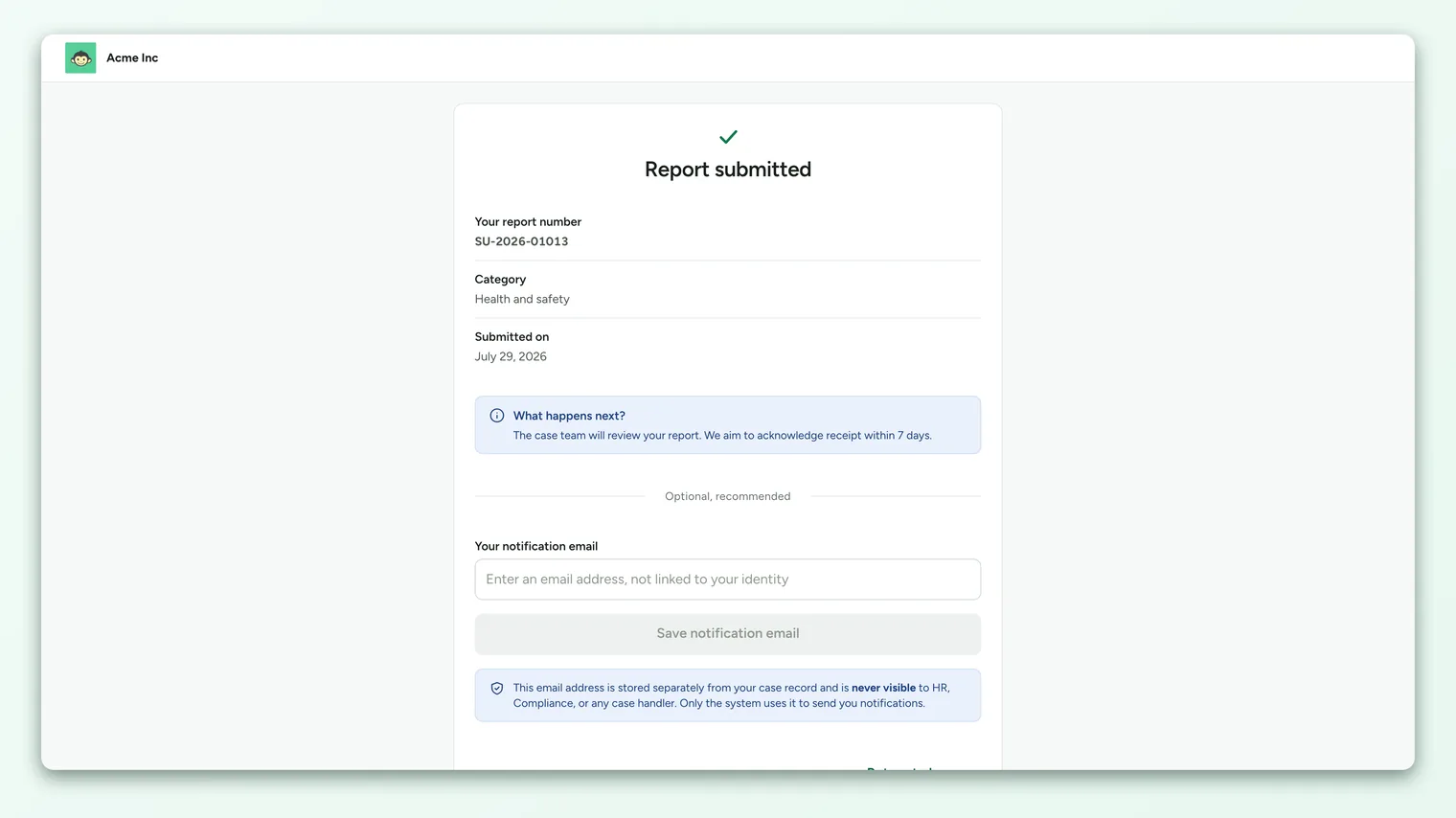
Because this text is generated from the target, keeping the acknowledgment SLA realistic is important: promising acknowledgment in a window your team cannot consistently meet damages trust faster than a slightly longer, honest one.
What the case team sees
Inside the case team's view, every case carries both due dates. Once either one passes, the case is flagged as overdue in three places: the case header, the case list, and Speak Up analytics, which counts overdue and due-soon cases. So a case that has slipped is visible to whoever opens it, to anyone scanning the queue, and to whoever reviews the programme.
A case flagged acknowledgment overdue is one nobody has moved out of New within 7 days. Start triage there: the reporter is still waiting to hear that anyone has seen their report.
For how to filter, sort, and work through the full queue of cases, see Track all cases.
SLA breach notifications
Speak Up's Speak Up notification settings include a template for a team SLA breach notification, alongside the other case-team notifications (new case submitted, new reporter message, case assigned). This is the mechanism intended to alert your case team when a case crosses an SLA line, so an overdue case does not simply sit unnoticed.
The SLA breach notification template is configured in the Speak Up Notifications settings. Exactly which breach (acknowledgment, resolution, or both) triggers it, and on what cadence, should be confirmed against your configuration.
Choosing good targets
The defaults of 7 days and 3 months are set to follow the EU Whistleblowing Directive. You can change either one manually, and the right numbers depend on your team's capacity and the reports you receive, but to stay compliant set them at or inside those limits.
- Acknowledgment: keep it tight and achievable. A shorter acknowledgment SLA (say 2 to 5 days) signals responsiveness, but only set what your team can actually hit on its busiest week. A missed short promise is worse than a met longer one.
- Resolution: give investigations room. Serious cases need real investigation time. A resolution window that is too short pressures teams to close cases prematurely, which undermines the trust Speak Up exists to build. If the EU Whistleblowing Directive applies to you, though, stay within its 3 months.
- Match your obligations. The EU Whistleblowing Directive expects you to acknowledge a report within 7 days and give the reporter feedback within 3 months, which is why CultureMonkey Speak Up uses those as its defaults. If you change a target, keep it at or inside those limits wherever the Directive or a similar rule applies to you.
- Review the trend, not just single misses. One overdue case may be a hard investigation. A pattern of acknowledgment overdue cases usually means triage is under-resourced, not that the target is wrong.
A useful test: would you be happy telling reporters exactly what your acknowledgment and resolution promises are? If a target only works because no one is watching it, it is the wrong target.
How SLA targets fit the bigger picture
SLA targets are one piece of your Speak Up configuration. To have working SLAs, you first need Speak Up switched on and your intake live, which is covered in Enable Speak Up. From there, targets shape the promise on every case, case stages track the work, and notifications keep breaches visible.
The point of all of this is not to hit numbers for their own sake. It is to make sure that the courage it took someone to speak up is met with a response that is prompt, visible, and dependable. Good SLA targets are how you make that promise concrete and how you hold yourself to it.
Frequently asked questions
What are the default SLA targets?
The acknowledgment SLA defaults to 7 days and the resolution SLA defaults to 3 months. These are the timelines the EU Whistleblowing Directive sets. Both can be changed manually in your CultureMonkey Speak Up configuration; to stay compliant, keep them within 7 days and 3 months.
Do the two SLAs use different units?
Yes. The acknowledgment SLA is expressed in days and the resolution SLA in months. Each case's acknowledgment due date is its submission time plus the acknowledgment days, and its resolution due date is its submission time plus the resolution months.
When exactly is a case considered acknowledged?
As soon as an Admin or Member first moves the case forward from its opening stage. That first action records an acknowledgment timestamp, which permanently stops the acknowledgment clock, even if the case then stays open for a long investigation.
Can a case be resolution overdue after it is closed?
No. The resolution SLA only applies while a case is still open. Reaching the closed stage stops the resolution clock, so a closed case is never flagged as resolution overdue.
If I change my SLA targets, do open cases get new due dates?
Changing your targets applies to cases submitted afterward. Cases already open keep the due dates that were stamped on them at submission.
Does the reporter see our resolution SLA?
The confirmation screen CultureMonkey shows to reporters is built from the acknowledgment target (when to expect their report to be acknowledged). The resolution target is used internally to track how long a case may stay open.
Where to go next
- Work your case queue: Track all cases
- Understand how cases move: Speak Up case stages
- Turn Speak Up on first: Enable Speak Up
Your feedback helps us improve the Help Center.