

S03 E10
Managers as Amplifiers of Culture for Gen Z
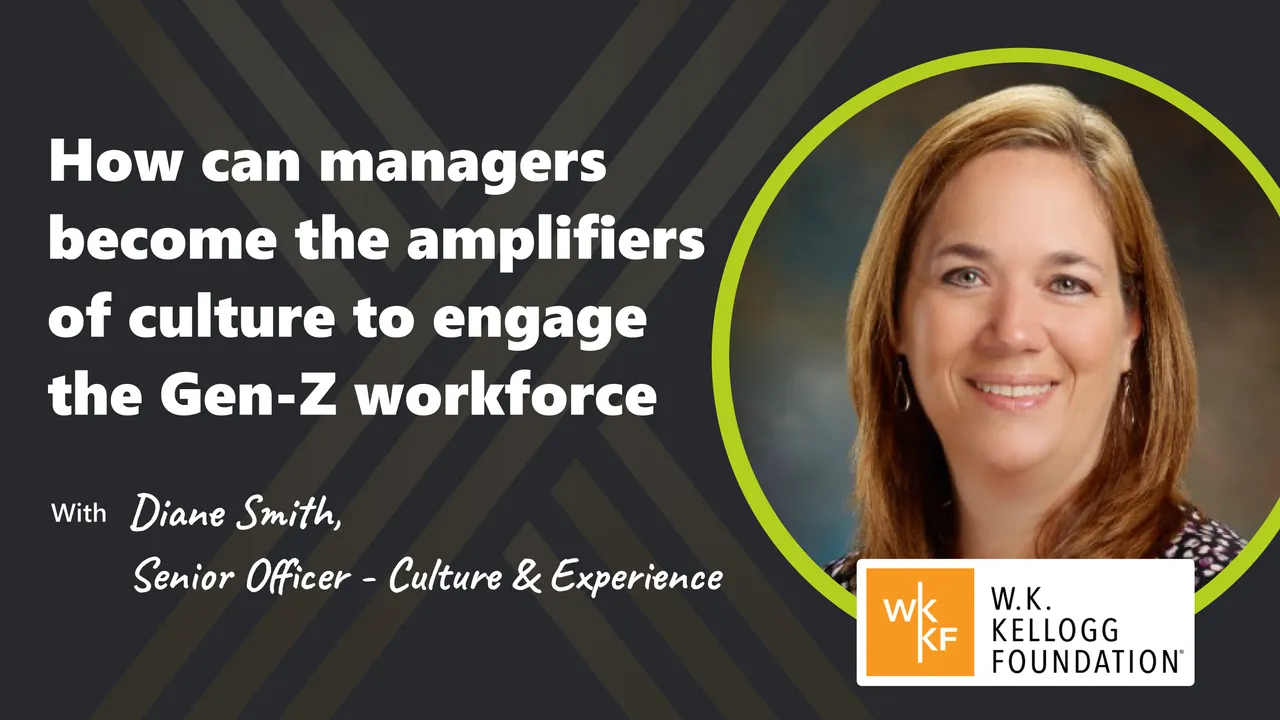
Diane Smith shares how Gen-Z thrives when managers drive culture, through diversity, on-demand learning, coaching, and balance, positioning leaders as key amplifiers of engagement and long-term talent retention.
TL;DR
What you need to know from this episode
- Speed is the first culture signal Gen Z reads. Diane argues that a clunky, slow hiring and onboarding process can make it hard to even attract this generation, so the candidate experience is where policy work should start.
- Run an equity audit, not a DEI slogan. She urges leaders to ask who each policy benefits and who is disproportionately impacted, then partner with managers so every policy is applied fairly and equitably.
- Grow people with a 70/20/10 model. Seventy percent of development comes from on-the-job experience, 20% from coaching and peers, and 10% from outside training, so leaders should delegate for growth instead of waiting for someone to already have every skill.
- Managers, not HR alone, now own culture. Because managers sit closest to employees, they role model and reinforce aligned behaviors and act as a real-time liaison to HR when problems surface within their teams.
- Asking for feedback creates an obligation to act. Diane's rule is direct: if you are going to ask for feedback, you have to show you are listening and adjust where you can, or you drive conflict and turnover.
Generation Z now makes up roughly a quarter of the global workforce, and that single statistic is reshaping how people leaders think about hiring, development, and retention. In the tenth episode of this season of CultureClub X, powered by CultureMonkey, host Nicole Patrick sits down with Diane Smith, Senior Officer of Culture and Experience at the W.K. Kellogg Foundation in Battle Creek, Michigan, to work through what this generation actually expects from work and from the managers who lead them.
Diane brings more than 25 years of people management experience to the table. She has been with the foundation for 28 years, and moved into her culture and experience role only in the last few years, when the organization put greater intentionality around workplace culture and employee experience. Her stated goal is a simple but demanding one: to make the organization the best one to work for and the best one to work with.
The conversation circles a single question. As ownership of culture shifts from HR alone to the managers closest to the work, how do those managers become amplifiers of culture rather than gatekeepers of it? Diane's answer travels across policy, learning and development, benefits, hybrid work, and psychological safety, and it keeps returning to one theme: Gen Z is vocal about what it wants, and the leaders who genuinely listen are the ones who will keep this talent.
Why do Gen Z hiring and onboarding policies need to move faster
Diane starts at the very first touchpoint any employee has with an organization, the candidate, new hire, and onboarding experience. This generation wants to see things move quickly, she says, and a hiring process that feels clunky and slow can make it hard to even attract the next generation of talent.
From there she argues for a total review of policies through a DEI lens. What organizations once treated as optional has become foundational, and younger workers are actively holding employers to that standard rather than taking it on faith.
So what was once considered a nice to have has now become a fundamental part of people and culture practices. And Gen Zers are really pushing employers to ensure DEI.
What does an equity audit of your policies actually ask
Instead of treating diversity and inclusion as a slogan, Diane pushes leaders toward a concrete equity audit of their policies and practices. She frames it as a set of pointed questions: who does this policy benefit, who is being disproportionately impacted by it, and are our policies fair and equitable across gender, race, ethnicity, identity, and sexual orientation.
She is just as firm that writing the policy is only half the work. The organization has to partner with people leaders so they understand each policy and apply it fairly and equitably, because inconsistent enforcement quietly undoes even well written rules.
She then widens the lens to the policies Gen Z cares about most, from training, development, and career pathways to flexible work and benefits. This generation wants advancement, coaching, and mentoring, and it will not wait as patiently as earlier generations did for movement within a company. The benefits list has changed too, stretching to tuition reimbursement, student loan repayment, mental health services, and paid time off for volunteering.
How does the 70/20/10 model modernize learning for Gen Z
On learning and development, Diane makes the case for on-demand training and smaller, bite-size, just-in-time learning nuggets. This generation grew up looking up videos to figure out how to do something in real time, so learning that mirrors that habit lands better than long, scheduled courses.
She also urges leaders to delegate for growth rather than wait for someone to already hold every skill a role requires. Development, in her framing, should follow the opportunity, not precede it. She points to a 70/20/10 model, where 70% of growth comes from on-the-job experiences, 20% from coaching and peers, and 10% from outside skill development like conferences and formal training.
Underpinning all of it is a coaching culture built on regular check-ins and what Diane calls a talent development profile, co-created so the leader understands an employee's career goals and can actively look for opportunities to help them get there.
Why pay and health insurance no longer keep people in their seats
Diane is blunt that the old retention levers have lost their grip. Compensation and benefits alone will not hold Gen Z in place, and she argues leaders have to be open to real career development even when it means an employee eventually outgrows the organization.
That openness runs in both directions. Gen Z is not afraid to give feedback, which Diane treats as a gift rather than a threat, and she notes that more seasoned generations have to be willing to receive it. The job of the leader is to create trusting spaces where that exchange can happen without fear of judgment.
How do managers become amplifiers of culture instead of sole HR custodians
This is the heart of the episode. Diane welcomes the shift away from culture being owned by a single department, because managers sit closest to employees, understand their unique needs, and can role model, reinforce, and recognize the behaviors a company says it values, while coaching against the ones that fall out of alignment.
Decentralizing culture to managers also creates a feedback channel upward. Leaders who sense a problem early can flag it to HR and upper management in real time, giving the organization a truer pulse than a central team could ever gather on its own. Much of this depends on managers helping their teams read the written and unwritten rules of the place.
culture doesn't just live within the logo of our company, right? It lives in how each of us treat one another on a daily basis.
What does productive hybrid work look like for Gen Z
Asked about hybrid work, Diane offers five levers for productivity. The first is genuine work-life balance, supported by more asynchronous ways of working so people can contribute on their own time whether they are in the office or not. The second is regular check-ins that make room for self-care, including the occasional mental health day, and the psychological safety to ask for what they need without being judged.
The remaining three round out the picture: building a positive team culture that trusts people to work independently and embrace new tools, quickly recognizing and managing tensions between generations so they do not stall productivity, and leading with an equity lens for what she calls the most racially and ethnically diverse generation yet. That last point means responding fast to microaggressions, separating intent from impact, and showing vulnerability as a leader.
Why listening has to come before action
By the close, the practical advice collapses into one discipline: engage the generation, listen to what it is asking for, and then actually adjust. Diane is candid that no company can grant every request, but the act of asking creates an obligation to respond.
if we're gonna ask for the feedback, we need to show that we're listening.
That is precisely where continuous employee listening earns its place. When feedback flows into a visible employee feedback loop and leaders act on employee sentiment in something close to real time, the trust Diane describes becomes tangible rather than aspirational. For managers stepping into their role as amplifiers of culture, listening is not the soft part of the job. It is the foundation that makes everything else, from flexibility to belonging, real.

About the guest
Diane Smith
Senior officer of Culture, W.K. Kellogg Foundation
Diane is a people leader with a proven track record of 25+ years of experience in people management. At her current organization, she is responsible for cultivating a strong organizational culture focused on both employees and external partners. She leads, innovates and influences to ensure a people-centered approach to deliver positive internal and external experiences.
She is an exceptional people leader who believes in giving back to the community with her various volunteering efforts and has gained tremendous recognition for her work. Diane is an alumni of Argubright Business College, Kellogg Community College and Davenport University. She is a LUMA Institute Certified Practitioner of Human-Centered Design.
And is also certified in Remote Work by Gitlab and in Change Management for Leaders through Prosci, Inc.
Full episode transcript
Season 03, Episode 10 · Diane Smith with Nicole Patrick · 26 min
Hello everyone and welcome to the latest episode of CultureClub X, powered by CultureMonkey. I'm your host, Nicole Patrick. CultureMonkey is a complete employee engagement platform that helps people leaders to measure and improve their workplace culture. In the 10th episode of this season of CultureClub X, we have with us Diane Smith, Senior Officer of Culture and Experience at W.K. Kellogg Foundation, Michigan.
Diane is a people leader with a proven track record of 25 plus years of experience in people management. At her current organization, she is responsible for cultivating a strong organizational culture focused on both employees and external partners. She leads, innovates and influences to ensure a people centered approach to deliver positive internal and external experiences. She's an exceptional people leader who believes in giving back to the community with her various volunteering efforts and has gained tremendous recognition for her work.
Diane is an alumni of Argubright Business College, Kellogg Community College and Davenport University. She is a LUMA Institute Certified Practitioner of Human Centered Design and is also certified in remote work by GitLab and in change management for leaders through Prosci, Inc. Diane, it's great to have you with us today. Welcome again to CultureClub X's videocast on Gen Z and the evolving workplace culture. Before we begin, please tell us more about yourself and your organization.
Thanks for having me, Nicole. It's definitely an honor to be here and to have an opportunity to share some of what I'm learning and know about workplace culture. So a little more about me. Again, I'm Diane Smith. I was born and raised in Battle Creek, Michigan. I've been married to my wonderful husband, Craig, for almost 36 years. We've got an amazing son, daughter-in-law, granddaughter, and another little one on the way. And we love spending time together as a family.
Professionally, as you mentioned, I'm the Culture and Experience Officer at the W.K. Kellogg Foundation in Battle Creek, Michigan. And while I've been with the foundation for 28 years, I've really only been in this role for the last few years, which is when our organization put some greater intentionality around our workplace culture, employee experience, and really just thinking about how we make our organization the best one to work for and the best one to work with. So that's a little more about me and my work.
Great, well, we're very excited to have you here today.
Generation Z makes up 24% of the global workforce. What do you think are the necessary policy shifts that people leaders should make to their company culture to accommodate the Gen Z employee's style of working?
That's a great question. I'll talk more at the organizational level first. And what I think is that one of the first sets of policies and practices any individual will experience with the organization is really related to the candidate, new hire, and onboarding practices and policies. And this generation wants to see things move quickly. So if the hiring process is clunky and slow, this could make it difficult to even attract this next generation.
I think beyond those policies, a total review of policies using a DEI lens is critical. DEI has become a central concern for companies wishing to create a positive employee experience and for individuals seeking to develop their careers and bear more diverse and inclusive workspaces. So what was once considered a nice to have has now become a fundamental part of people and culture practices. And Gen Zers are really pushing employers to ensure DEI.
So companies need to do an equity audit of their policies and practices and really ask themselves, who does this policy benefit? Who is being disproportionately impacted by this policy? Are our policies fair and equitable across all categories? Gender, race, ethnicity, identity, and sexual orientation? And who has access to what types of benefits and opportunities? And then the organization needs to work with people leaders to make sure they understand the policies and that they're applying all those policies fairly and equitably.
I think a few more policies just to really focus in on for this next generation are really any policies and practices related to training, development, and career pathways. That's another place employers need to examine. So we know that Gen Zers are looking for career advancement opportunities. They want ongoing training, development, coaching, and mentoring. And they aren't going to be as patient as previous generations were in terms of movement within a company. And I think also we know that they're looking for flexibility in their workplaces. So flexible work policies. They want that work-life balance and they're demanding flexibility from their leaders and employers.
And then finally, benefits. So looking at benefits. Gen Zers want different types of benefits than previous generations. They want some of the same things like good health insurance and retirement time off policies, but they also want education or tuition reimbursement or student loan repayment policies. They want benefits that cover mental health services. They want generous parental leave policies and even paid time off for volunteering. So I think just looking at all the policies and making sure they reflect your company culture is wise for companies to do. And then again, ensuring leaders understand the policies and are implementing them with fidelity and equity is critical.
That makes complete sense. And I totally agree with you.
Great.
With Boomers retiring, millennials are becoming managers and Gen Z is comprising the major workforce. From your perspective, what is the modernization required in the areas of learning and development that would help organizations cater to the growing needs of the Gen Z workforce?
In terms of modernization, if I'm thinking of technology, of course, none of us really know where this is going, but we know it's constantly changing and Gen Zers want to work for companies that are keeping up with the times. This generation wants to work for companies that have cutting edge technology and ones that aren't dealing with buffering video and unavailable Wi-Fi or non-intuitive interfaces.
I think for learning and development, offering more on-demand training and smaller bite-size, just-in-time learning nuggets is good. We have to remember that this generation is very comfortable with technology and looking up YouTube videos and all sorts of videos to figure out how to do something real time. I think also leaders need to delegate for growth and development, not just for Gen Z, but really for all generations, but we need to get away from thinking that a person has to have all the skills and abilities needed to perform in their role or to be promoted to that next role. Development should follow.
We like to think about it in a 70/20/10 model with 70% being on-the-job experiences, 20% coming in the form of coaching and peers and interacting with others, and then 10% is more that outside skill development, conferences, trainings, education. I think another area for modernization is, again, back to this overall benefit structure. It's no longer okay for organizations to think pay and health insurance will keep a person at their jobs. We need to really be open to this career development, even if that means someone outgrows the organization.
So I think modernization in the workforce is thinking about development opportunities that expose this generation to new skills and to new people, maybe even thinking about lateral moves that position someone for upward movement, and then really thinking about those opportunities for growth, exposure, and learning. And when you do this as people leaders, that shows that you have their best interest at heart, and it makes them more loyal to you as an organization.
I think they're really looking for this coaching culture, so they want regular check-ins. We have talent development profiles, so co-creating a talent development profile so that as the leader, you understand their career goals, and you can be looking for opportunities to help them achieve those goals. I think also just being open to the feedback that they're gonna offer. This is a generation that's not afraid to give us feedback, and that's great. But those more seasoned generations, I'll call myself, need to be open to feedback, and we just have to create those trusting spaces.
I think that's great, the talent development profile. It's such a wonderful way to make sure that everyone understands where their employees want to end up, and to foster that future for them. That's great.
Thank you.
As a people leader, what have been your major learnings in your experience in handling the Gen Z workforce in a hybrid workplace setup? And what, according to you, are the best ways to bring out maximum productivity from the Gen Z employees?
So my company only has a handful of Gen Zers right now. We've got several millennials, and those two generations are pretty similar, but I think a difference is that millennials were asking for and want some of the same things, but Gen Z is much more bold and demanding these things. So we have to keep in mind that this next generation of workers also has never really experienced that traditional office environment. Most have been working remotely their entire professional career.
So I love this question because I'm so happy with the things that this generation is forcing us to look at in the workplace. Things like how we communicate, the way we do our meetings, ensuring that we promote a positive company culture, that we're embracing new technologies, promoting diversity and inclusion, prioritizing mental health and work-life balance more than I've ever seen. We're encouraging personal and professional development and growth, and we're trusting workers to work independently. And I think for many of these things, they've been a long time coming, and I appreciate this generation for standing up and being vocal about what they want. It's gonna benefit all of us.
In terms of hybrid workplace and things that help bring about that maximum productivity, I think of five things. I'm sure there's others. So we know this generation really wants work-life balance, and they care about personal wellbeing. So as a people leader, if I want these workers to be productive, I need to support my people in looking for those opportunities to balance the work, to give them the flexibility they need, to find ways to work in more asynchronous ways so that everyone can contribute and engage at their own time, regardless of if they're in the office or somewhere else.
Second, I think that these regular check-ins with the workforce and how they're doing, what are they doing to take care of themselves, what do they need from me as their leader to support them in their self-care, including being okay with their need for a mental health day here and there, and creating the psychological safety they need to feel that they can ask for what they need and not be judged for that. They really don't wanna think of their manager as a supervisor, and they wanna see them as a mentee and someone who's gonna help them grow and learn.
Third, I think leaders need to create that positive team culture. We need to be encouraging development and growth. We need to be allowing this generation to work independently and embrace those new technologies. I said this earlier, but we have to remember this generation was raised with the internet. So they're reliant and totally comfortable with different devices, technology platforms, finding information on the internet, and really having that instant access to information. And they're gonna really push some of us in this digital space.
And fourth, I think, in terms of ensuring maximum productivity, leaders need to be able to quickly recognize and manage some of the tensions and conflicts that could arise among the different generations so that those things don't get in the way of productivity. And finally, the other big thing for leaders is really leading with the equity lens. This is the most racially and ethnically diverse generation thus far. And they wanna be seen, heard, valued, respected, included, and engaged, no matter their work location.
So leaders need to do the work to ensure their own biases aren't coming out in a way they lead and manage their people and teams. They need to pay attention to, and quickly respond to microaggressions happening in the workplace, whether they're verbal, behavioral, intentional, unintentional. And this means separating intent from impact, acknowledging the feelings of your team members, challenging stereotypes, promoting empathy, creating that psychological safety I mentioned earlier to have those difficult conversations, showing vulnerability as a leader, and appealing to the values and principles that we all have.
Absolutely, I completely agree. And I think that it really is interesting to think about the fact that Gen Z, they were totally raised with the internet and this is all that they know. So you have to look at it from such a different lens. I mean, even I was raised with cell phones and the internet when I was like 13, 14, but these kids had iPads in their hands since they were babies. So it's a very different style of learning and working and comprehending.
Absolutely, yes. And we have to pay attention. And there's so much to learn from that too.
Exactly.
We've heard a lot about the decentralization of company culture practices from HR only to manager-centric. In your opinion, how can managers become amplifiers of culture for Gen Z employees as opposed to the sole HR custodians?
I love this shift because culture can not be owned and managed by one department or a small set of people within an organization. It really needs to be owned by everyone. And we know that managers can play such a huge role in driving and reinforcing culture within their teams. We know that managers are really closest to their employees. They have those close relationships. They understand the unique desires of their team members. They have the most direct access to and ability to help ensure each team member's needs are met and that they're met in alignment with the desired org culture.
So leaders can role model, reinforce, recognize and celebrate behaviors that are all aligned with the expectations of the company. And they can also coach and give constructive feedback when they see behaviors that are out of alignment. I think that by decentralizing company culture to leaders, leaders can also play a key role in being a liaison to upper management and HR when they begin to sense challenges or problems so that they can be addressed real time or so that the company can make adjustments based on what's going on within the organization. And HR might not have been able to do this if they didn't have leaders in these critical positions where they have the better pulse on how things are going within their teams.
And then I think managers can also help team members understand those written and unwritten rules that apply within an organization. Of course, the mission, vision and values that are explicitly stated for most organizations should be a great indicator of what we stand for, but we also know that culture doesn't just live within the logo of our company, right? It lives in how each of us treat one another on a daily basis. And it lives in how our teams interact and behave and team to team. So this is where the manager becomes a critical partner in managing company culture because it does require so much intentionality.
Absolutely.
Gen Z in particular is a vocal workforce who are open to tech adoption and highly opinionated. How can people leaders pay attention to Gen Z's pulse and constantly keep them engaged? How can managers who are from a very different generation use tech to gain actionable insights for the same?
Good question. I'm not gonna pretend to know the answer on this one, but what I do know is that Gen Z wants to be engaged. So this might be a great place to start. We know this generation isn't afraid to share their thoughts with us and they're bold in their asks of employers. So let's engage with them to see what they want and need. Minimally, we know they wanna work for a company that's technology savvy. So making sure we're staying up on the latest and greatest technologies, of course, will be important.
We definitely need to find ways to use technology to continually appeal to this generation, to seek their feedback, to keep them engaged, to provide ways to collaborate and also have fun. And Gen Z can be great brand ambassadors. They are awesome at sharing information on social media platforms, adding hashtags that attract others to a brand. So we should build on their digital fluency. Gen Z's also going to be looking for companies that have strong internal social platforms, similar to the external social networks they're accustomed to.
So they're gonna look for internal platforms that allow them to quickly get in touch with others, that allow them to easily share personal or professional information with others, that allows them to celebrate and recognize one another. And they're looking for fun features too, like emojis and badges and gamification, other things like that, that make learning, chatting, and engaging with others easy and fun. So I think companies that are adapting to these different ways of doing business will have a better success record in keeping this generation more engaged in the work.
And finally on this one, I think it's important to add that organizations and managers are going to need to become comfortable working in new ways and become more sophisticated in how we use this next gen technology to manage our people and to keep this generation and the ones to follow more engaged. If we resist the changes, this generation will move on to another company more savvy in this space.
Absolutely, and this is where tools like CultureMonkey come in where they're able to use tech to gain actionable insights and check in every single day or however frequently managers or upper management might want, and then actually take the insights from them and take actions based upon that and make sure that they're really keeping all of their employees happy and making the changes that need to happen in areas that they might not have realized otherwise.
Yeah, and I think you mentioned an important point, and if we're gonna ask for the feedback, we need to show that we're listening. Of course, we can't always do everything that everybody wants, but if we're gonna ask for feedback, we need to take a look at it and see where we can adjust accordingly based on that feedback.
Exactly.
How can people leaders design effective HR policies that cater to Gen Z's need for flexibility, transparent work culture, and learning on the job?
I think this kind of wraps up everything I've already mentioned together. First and foremost, we have to engage with and listen to what this generation is saying and asking for from an employer. And we need people leaders to create an environment that fuels creativity and productivity. And while every company may not be able to meet every aspect of what this generation is looking for, leaders do need to take a serious and authentic look at their policies and see where they can make adjustments and consider where they need to be more open-minded to help drive business results.
It's the right and necessary thing to do if you want to attract and retain this new generation of workers. I think failure to recognize these requirements and expectations is really gonna result in workplace conflict, high levels of turnover. And we know that this all comes at a cost for our companies and it impacts productivity and results. I mentioned earlier, the types of policies that the organization needs to really take a look at and managers need to enforce and apply equitably, from flexible workplace policies to DEI policies, different types of benefits these workers want, to policies related to development and career opportunities.
And I also talked earlier about the important role that people leaders play in creating that strong company culture, from role modeling to reinforcing through rewards and recognition, to recommending workers for special projects or promotions, building those strong relationships with your workers so that you really understand the unique needs of each individual and can work to the extent possible to accommodate the different needs. For Gen Zers, again, we know they want that flexibility. They want that sense of belonging. They want to feel seen, heard, valued and respected. And all of this can really begin with the leader creating the environment for these things to happen.
I completely agree. Those were some really great answers, Diane. Since there's no set playbook on how to effectively manage Gen Z workers, your unique perspective definitely adds a lot of value to the space. The one solution for people leaders that I feel is important here is constantly listening to employees to understand the needs of the Gen Z workforce. This has only gained more importance in the post-pandemic world.
This is the gap that CultureMonkey looks to fill for people leaders so effectively. It enables them to constantly listen to their employee's sentiments in real time and take decisive actions based on real-time analytics. So if you want a super swift tool and to improve your company culture, visit www.culturemonkey.io today. With that being said, thank you so much for your time, Diane. This was a wonderful and insightful conversation. I'm sure our audience will agree too. Please let our viewers know how they can contact you in case they want to share their thoughts on this topic.
If anyone has any questions about what I've shared today or wants to share some things you're learning about this next generation of workers and the impact they're having on the workplace, please feel free to reach out to me at diane.smith@wkkf.org or you can find me on LinkedIn.
Well, that's all we have for you in this episode of CultureClub X, powered by CultureMonkey. Until next time, this is your host, Nicole, signing off.
Frequently asked questions
What policy changes help attract and retain Gen Z employees?
Diane recommends starting with the candidate, new hire, and onboarding experience, since Gen Z expects things to move quickly and a slow, clunky process deters them. She then calls for reviewing all policies through a DEI lens and examining training, career pathways, and flexible work.
Benefits matter too, and she notes this generation wants more than good health insurance and time off. They look for tuition reimbursement or student loan repayment, mental health coverage, generous parental leave, and even paid time off for volunteering.
What is the 70/20/10 learning and development model?
It is a development framework where roughly 70% of growth comes from on-the-job experiences, 20% from coaching, peers, and interacting with others, and 10% from outside skill development such as conferences, trainings, and education.
Diane pairs it with delegating for growth, meaning leaders should let people develop into a role rather than expecting them to already hold every skill needed to perform in it or to be promoted.
How can managers become amplifiers of culture rather than sole HR custodians?
Diane says culture cannot be owned by one department, because managers sit closest to employees and understand their unique needs. Managers role model, reinforce, recognize, and celebrate aligned behaviors, and coach or give constructive feedback when behaviors fall out of alignment.
They also act as a liaison to upper management and HR, flagging challenges early so the organization can adjust in real time and keep a truer pulse on how teams are doing.
How should leaders support Gen Z productivity in a hybrid workplace?
She offers five levers: support work-life balance with more asynchronous ways of working, hold regular check-ins that respect self-care and mental health, and build a positive team culture that trusts people to work independently and embrace new technologies.
The final two are quickly recognizing and managing tensions between generations so they do not stall productivity, and leading with an equity lens that responds fast to microaggressions and separates intent from impact.
Why does continuous employee listening matter for engaging Gen Z?
Diane stresses that Gen Z wants to be engaged and is not afraid to share feedback, so leaders should engage them directly to learn what they want and need. She frames asking as a starting point rather than the finish line.
Crucially, asking creates a duty to respond. Leaders should review the feedback and adjust where they can, because failing to recognize these expectations drives workplace conflict and high turnover that carry a real cost.
Read the cross-episode roundups
More from CultureClub X
 S07 E03employee engagementWhy do grievance procedures damage workplace culture? | David Liddle, The TCM Group
 David Liddle
 S07 E02change leadershipHR as Chief Disruption Officer: Why Supporting the Business Is a Ceiling, with Jennifer McClure
 Jennifer McClure
 S07 E01employee engagementWhy is employee wellbeing spending not paying off? | Gethin Nadin, Benifex
 Gethin Nadin
Never miss an episode
Every new episode, plus the takeaways that matter, posted on the CultureMonkey LinkedIn page as soon as they drop.
Free on LinkedIn. Unfollow anytime.