Writes about how companies actually listen to employees: survey design, feedback loops, and where most engagement programs break down with people science research. 250+ articles deep on the topic.
Pulse surveys, AI analytics, Teams integration, action planning
1,000+
Contact sales
★ 4.6
StudyIn · Case Study
"Achieving over 90% participation comes down to trust, transparency, and action — employees engage when they know their feedback will be taken seriously."
What does good look like? Engagement benchmarks by industry
Scores on a 5-point scale. Use these to calibrate your survey results against peer organizations in your sector.
HospitalityHighest
4.6/5
+0.5 vs avg
Financial ServicesOn track
4.1/5
At average
TechnologyOn track
4.0/5
At average
HealthcareWatch
3.95/5
−0.15 vs avg
RetailWatch
3.87/5
−0.23 vs avg
ManufacturingAt risk
3.72/5
−0.38 vs avg
Source: CultureMonkey People Science team analysis of 10M+ employee survey responses across industries. Scores reflect average engagement ratings on a 5-point scale. View full benchmark report →
12 Tools · Full Reviews
The 12 best employee feedback tools in 2026, reviewed
Full reviews of each platform — features, strengths, limitations, and who each tool is actually built for.
All 12 employee feedback tools compared: what each one is best for, its G2 rating, and pricing. Full reviews follow below.
15Five is a performance management and employee feedback platform designed to support continuous communication between employees and managers. It combines pulse surveys, check-ins, and goal tracking to help teams monitor engagement and alignment.
15Fiveclick to expand
Feature
Advantages
High-performance check-ins
Enables regular employee-manager check-ins to build trust, align goals, and uncover challenges, fostering stronger relationships and continuous improvement.
Objectives & key results (OKRs)
Helps set and track measurable goals, aligning individual and team efforts with organizational objectives for better goal achievement.
Pulse feedback surveys
Offers regular sentiment checks, helping identify emerging issues and enabling proactive interventions to enhance engagement and satisfaction.
Performance reviews
Facilitates data-driven reviews to set development goals, provide actionable feedback, and track progress, driving improved performance.
Best-self review
Provides 360-degree feedback, allowing employees to receive input from peers, managers, and reports to better understand their strengths and growth areas.
Best for
Teams that want to combine regular manager–employee check-ins with employee engagement tracking.
Limitations
The pricing structure may be less suitable for smaller teams that only need basic survey functionality.via G2
Standout features
Weekly check-ins combined with pulse survey feedback
OKR tracking for monitoring goals and performance alignment
Employee recognition features that support team appreciation and visibility
Nº 02 / 12
Workleap Officevibe
★ 4.3 G2
G2 Rating
4.3 / 5
Pricing
Contact sales
Best For
Lightweight pulse surveys for SMEs
Standout
Anonymous feedback channels
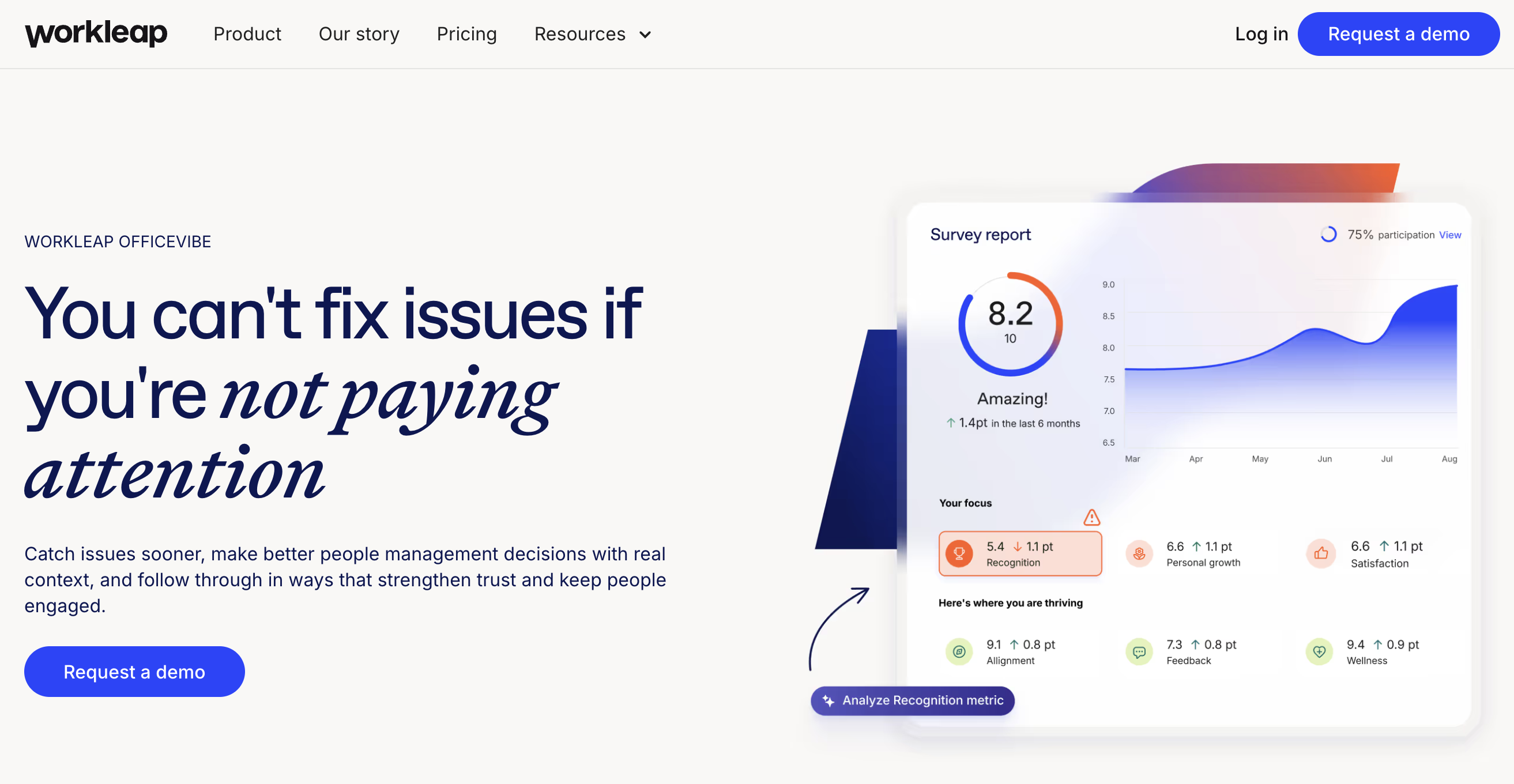
Workleap Officevibe is an employee feedback tool focused on lightweight pulse surveys and anonymous feedback. It allows teams to collect regular sentiment data and identify workplace concerns early.
Workleap Officevibeclick to expand
Feature
Advantages
Pulse surveys
Customizable, quick surveys that gather insights on engagement, culture, and leadership, enabling informed decisions to enhance workplace dynamics.
Anonymous feedback
Encourages honest communication by allowing anonymous feedback, helping to address sensitive issues and build trust.
Manager tools
Equips managers with coaching resources, feedback tips, and training programs to improve leadership and team relationships.
Recognition
Boosts morale and engagement by enabling employees to publicly recognize and celebrate each other's achievements with badges and awards.
Actionable insights
Provides real-time, data-driven insights into engagement and satisfaction, empowering organizations to implement meaningful change.
Best for
Small to mid-sized teams looking for straightforward pulse surveys and anonymous employee feedback.
Limitations
Analytics capabilities may be limited for organizations requiring deeper enterprise-level reporting.via G2
Standout features
Short, recurring pulse surveys designed for continuous feedback
Anonymous feedback channels that encourage honest responses
Manager guidance and action recommendations based on survey results
Nº 03 / 12
CultureMonkey
★ 4.7 G2
G2 Rating
4.7 / 5
Pricing
Best For
Multilingual, omnichannel feedback
Standout
WhatsApp · Text · Slack · QR · Teams
CultureMonkey is an employee feedback and engagement platform that covers the full employee lifecycle — from onboarding to exit — with pulse surveys, engagement programs, AI sentiment analysis, heatmap analytics, and structured action planning. Used by enterprise organizations that need anonymous listening, manager dashboards, and HRIS-integrated distribution across distributed or multilingual teams.
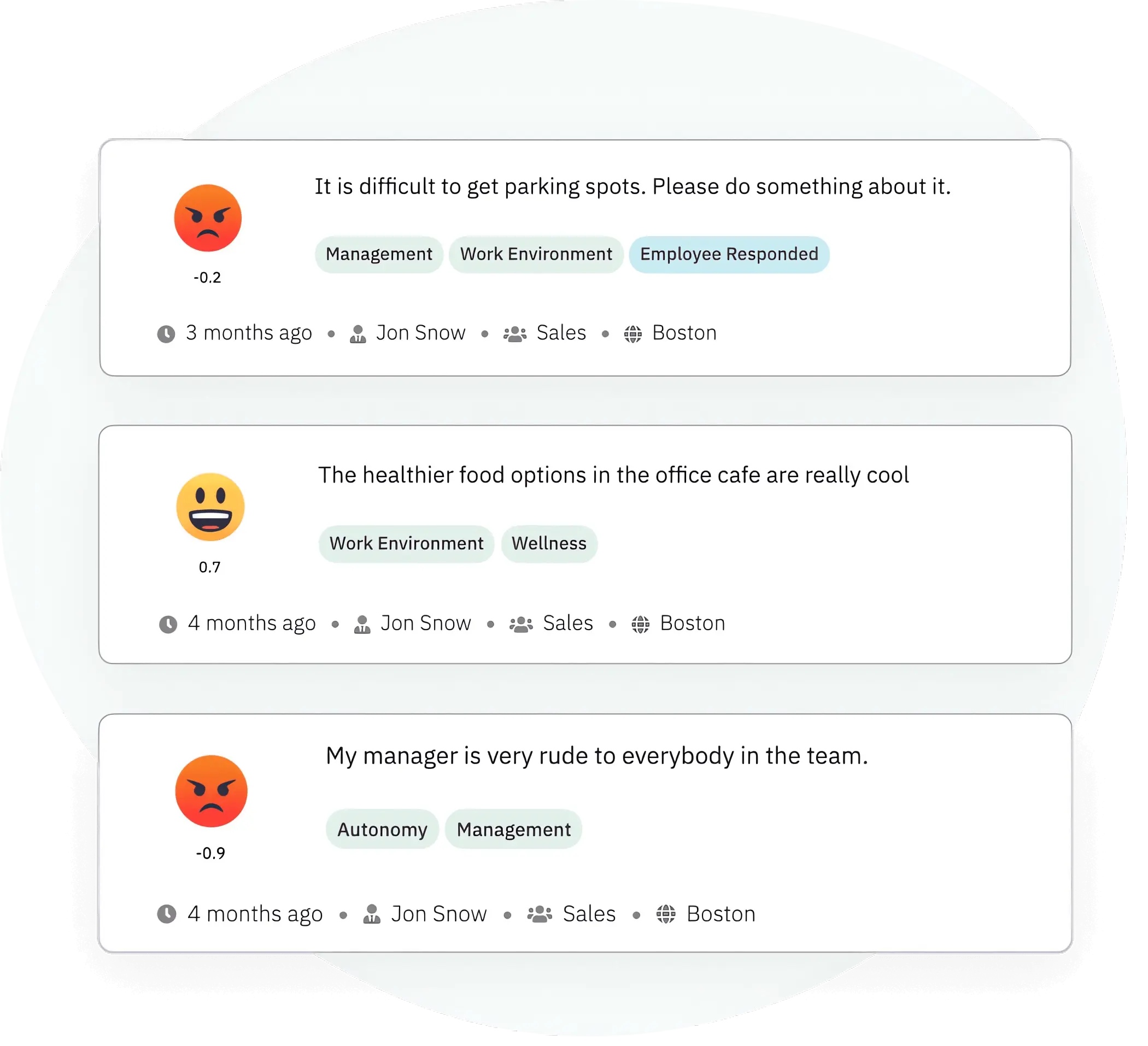
Survey Dashboard
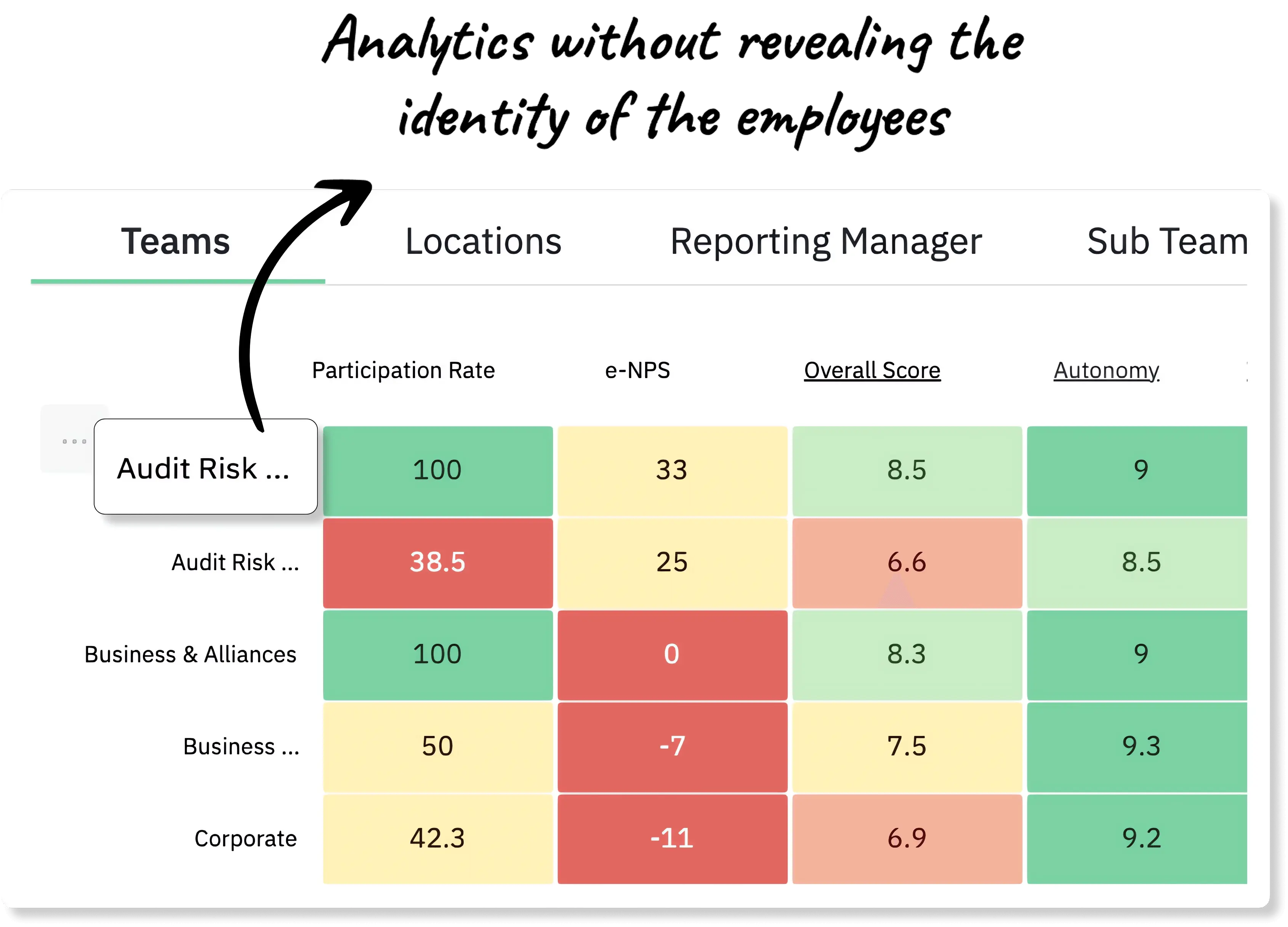
Analytics & Insights
Feature
Advantages
Pulse and employee engagement surveys
Enables organizations to run recurring pulse surveys and engagement surveys to measure employee sentiment and workplace culture trends.
Lifecycle surveys (onboarding, engagement, exit)
Collects employee feedback across key stages of the employee journey to identify experience gaps and engagement risks.
Multi-channel distribution (Slack, Teams, WhatsApp, email, QR codes)
Allows organizations to reach both desk and frontline employees through multiple communication channels, improving survey participation.
AI-based sentiment analysis and text analytics
Analyzes open-ended feedback to identify common themes, sentiment patterns, and emerging workplace issues.
Engagement dashboards and heatmap analytics
Visualizes engagement scores across teams and departments to help HR leaders identify areas that require attention.
Best for
Organizations collecting feedback across languages and channels: CultureMonkey runs anonymous surveys in 100+ languages delivered through Slack, Teams, WhatsApp, SMS, QR codes, and kiosks, with AI sentiment and theme analysis running across every language in one dashboard.
Limitations
Exporting automated, presentation-ready visual reports directly from dashboards could be smoother.via G2
Standout features
Lifecycle listening across onboarding, engagement, and exit stages
AI sentiment analysis and heatmap analytics across teams and departments
Manager dashboards that convert feedback into team-level action points
Multi-channel distribution: WhatsApp, Teams, Slack, email, and QR codes
"In just seven days, CultureMonkey designed and launched our survey to 2,000 employees across multiple geographies and in five languages. A feat that would normally take 45 days. When at Aujan Group, we asked CultureMonkey to support us with our annual employment engagement survey. We gave them an impossible task and they delivered."
Qualtrics XM is an experience management platform used to collect and analyze feedback from employees, customers, and stakeholders. Its employee experience module supports engagement surveys, text analytics, and reporting tools.
Qualtrics XMclick to expand
Feature
Advantages
Real-time feedback
Delivers immediate alerts on critical issues, allowing leaders to take swift, effective action.
Pulse surveys
Offers pre-built templates for quick feedback collection, enabling organizations to measure employee sentiment frequently.
Text analytics
Analyzes open-ended responses to identify themes and trends, providing deeper insights into employee feedback.
Action planning
Enables creation, tracking, and management of action plans to address feedback, fostering accountability and continuous improvement.
Employee engagement measurement
Offers comprehensive tools to measure engagement levels and identify areas for improvement, driving targeted engagement strategies.
Best for
Enterprise organizations that need advanced survey customization and deeper analytics capabilities.
Limitations
The platform's extensive feature set may require additional time for new users to learn and configure.via G2
Standout features
Advanced survey creation with conditional logic and branching
AI-driven sentiment analysis for open-text responses
Infrastructure designed to support large-scale survey deployment
Nº 05 / 12
TINYpulse (WebMD Health Services)
★ 4.4 G2
G2 Rating
4.4 / 5
Pricing
Contact sales
Best For
Pulse surveys + peer recognition
Standout
Anonymous weekly pulse cadence
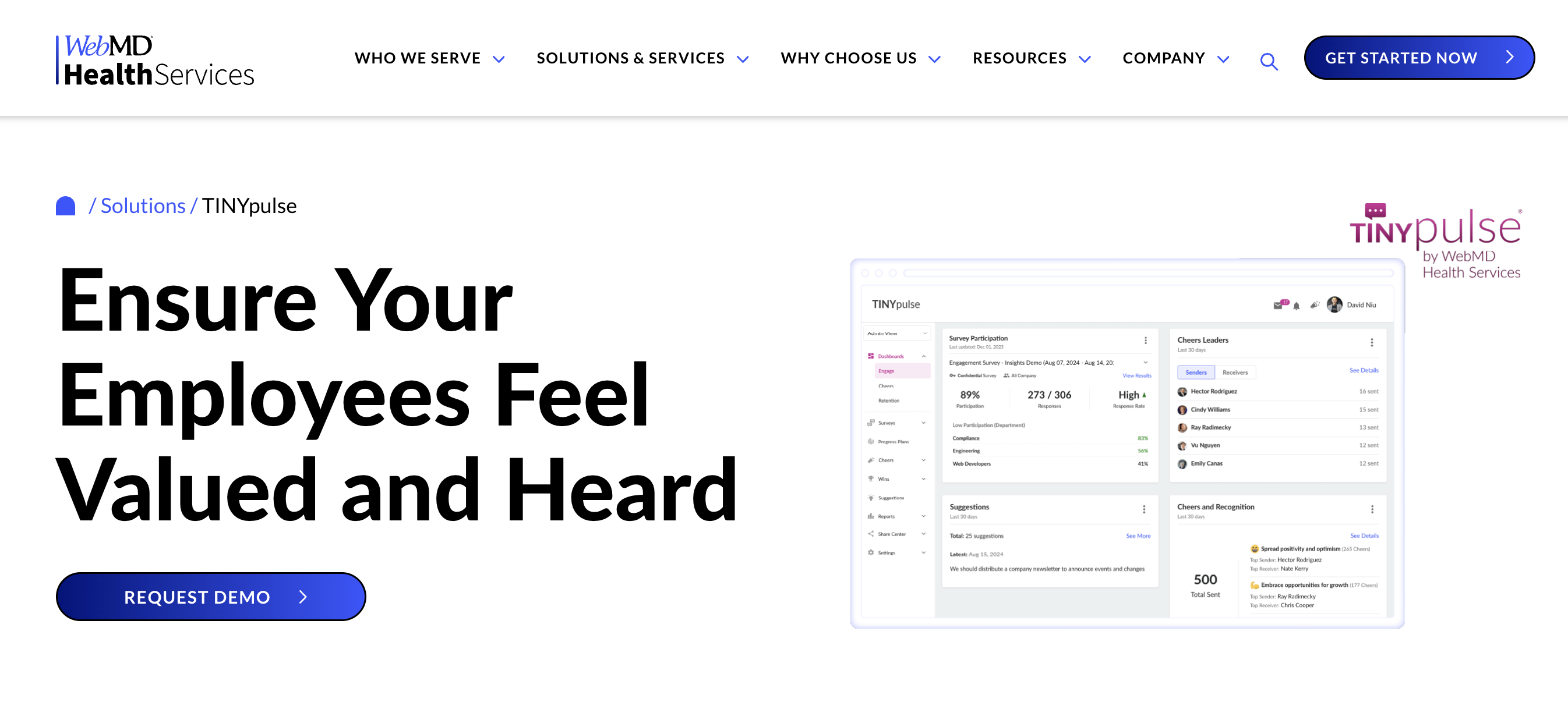
TINYpulse is an employee listening platform designed to gather quick feedback through pulse surveys and anonymous comments. It enables organizations to track sentiment and encourage open communication across teams.
TINYpulseclick to expand
Feature
Advantages
Pulse surveys
Quick, easy surveys for measuring engagement and satisfaction, enabling organizations to gather actionable feedback efficiently.
Real-time feedback
Allows managers to receive and respond to feedback promptly, fostering a responsive and adaptive work culture.
Anonymous feedback
Promotes honest and open communication without fear of retaliation, leading to transparent discussions and actionable insights.
Customizable surveys
Tailor surveys to specific needs, ensuring targeted feedback on the most relevant issues.
Employee recognition
Enhances morale and motivation through public recognition and rewards, creating a culture of appreciation.
Best for
Teams that want simple pulse surveys along with employee recognition and morale tracking features.
Limitations
Performance review functionality may be limited for organizations requiring more structured annual review workflows.via G2
Standout features
Anonymous weekly pulse surveys that encourage honest and frequent feedback
Peer recognition tools designed to highlight contributions and support team morale
Nº 06 / 12
Quantum Workplace
★ 4.4 G2
G2 Rating
4.4 / 5
Pricing
Contact sales
Best For
Structured engagement + benchmarking
Standout
Proprietary engagement framework
Quantum Workplace is an employee engagement platform that helps organizations measure and improve workplace culture. The platform supports engagement surveys, feedback analytics, and benchmarking tools.
Quantum Workplaceclick to expand
Feature
Advantages
Employee feedback surveys
Provides a comprehensive view of organizational culture and employee happiness, with customizable surveys for tailored insights.
Pulse surveys
Tracks employee sentiment over time with shorter, frequent surveys to gauge and respond to changing dynamics.
Performance reviews
Sets goals, tracks progress, and facilitates feedback for ongoing performance development and alignment.
Action planning
Supports the creation and execution of plans to address feedback, driving accountability and improvement.
Analytics
Offers robust reporting capabilities to analyze feedback data and track engagement progress, guiding data-driven strategies.
Best for
Organizations that want structured engagement measurement supported by benchmarking insights.
Limitations
Administrative customization options may be limited for teams requiring more flexible configuration.via G2
Standout features
Proprietary engagement framework designed to measure key engagement drivers
Benchmarking database for comparing results across industries and organizations
AI-supported action planning tools that help translate feedback insights into improvements
"The problem CultureMonkey solves is getting to a mostly frontline workforce in nine different languages — half a dozen of which aren't common. It makes it really easy, so we can spend more of our time on the output that actually matters."
Heather Kane
Change Management & Employee Engagement Lead · Robertshaw
Culture Amp is an employee experience platform focused on engagement surveys, performance feedback, and analytics. It provides tools to collect feedback across the employee lifecycle and measure workplace sentiment.
Culture Ampclick to expand
Feature
Advantages
Employee feedback surveys
Customizable surveys tailored to specific groups for in-depth insights into job satisfaction, manager effectiveness, and workplace culture.
Actionable insights
Uses advanced analytics tools to identify key engagement drivers and provide targeted recommendations for improving employee experience.
Performance reviews
Offers tools for ongoing feedback, coaching, and goal tracking, helping managers and employees drive continuous performance improvement.
Provides metrics and resources to measure representation, inclusion, and equity across teams, supporting more inclusive workplace practices.
Employee lifecycle
Supports feedback collection across onboarding, engagement, development, and exit stages to enhance the overall employee experience.
Best for
Mid-sized to enterprise organizations that want research-based engagement surveys with benchmarking insights.
Limitations
Some advanced analytics and benchmarking capabilities may require dedicated HR or people analytics resources to fully utilize.via G2
Standout features
Psychology-informed survey templates designed to measure engagement drivers
Built-in benchmarking for comparing results across industries
Driver-based engagement insights that guide action planning
Nº 08 / 12
Lattice
★ 4.7 G2
G2 Rating
4.7 / 5
Pricing
$11 / person / month
Best For
Feedback linked to performance + OKRs
Standout
Integrated performance + engagement
Lattice is a people management platform that combines performance reviews, goal tracking, and employee feedback tools. It supports engagement surveys and continuous feedback to help organizations understand employee experience.
Latticeclick to expand
Feature
Advantages
Continuous feedback
Enables real-time feedback between employees and managers, promoting frequent, actionable conversations for growth and improvement.
Goal setting and tracking
Helps align individual goals with organizational objectives, providing clarity and purpose while tracking progress.
Performance reviews
Customizable reviews that track employee performance, incorporate peer feedback, and align with organizational evaluation frameworks.
360-degree feedback
Collects feedback from multiple sources including peers, managers, and reports to provide a holistic view of performance and development opportunities.
Employee engagement surveys
Conducts engagement surveys to measure employee sentiment and workplace satisfaction, helping organizations improve culture and productivity.
Best for
Organizations that want to link employee engagement feedback with performance reviews and goal management.
Limitations
Some advanced customization options may require additional configuration or support during setup.via G2
Standout features
Integrated engagement surveys within the performance management framework
Goal tracking and OKR alignment to connect feedback with team objectives
Recognition and continuous feedback tools for ongoing employee development
Nº 09 / 12
Eletive
★ 4.5 G2
G2 Rating
4.5 / 5
Pricing
Contact sales
Best For
Continuous engagement tracking
Standout
Predictive attrition analytics
Eletive is an employee engagement platform designed to monitor workplace sentiment through continuous pulse surveys. It provides analytics dashboards and predictive insights that help organizations identify potential engagement risks.
Eletiveclick to expand
Feature
Advantages
Real-Time Pulse Surveys
Continuously monitor employee engagement levels, enabling organizations to quickly identify and respond to emerging workplace issues.
Survey Intelligence
Uses advanced analytics to extract meaningful insights from survey responses, helping HR teams make data-driven decisions to improve culture.
Intuitive Heatmaps and Dashboards
Visualizes engagement metrics through easy-to-understand heatmaps and dashboards, helping leaders identify trends and areas requiring attention.
Attrition Prediction
Analyzes engagement data to predict potential employee turnover risks, enabling organizations to take proactive retention actions.
AI-Enhanced Analytics
Applies artificial intelligence to analyze employee feedback, uncover hidden patterns, and deliver deeper insights for engagement strategies.
Best for
Organizations that want continuous employee engagement tracking supported by analytics and sentiment monitoring.
Limitations
Comparing survey results across segments or against historical data for the same group may require additional configuration.via G2
Standout features
Continuous pulse surveys designed to monitor engagement trends
Engagement dashboards and heatmaps for analyzing team sentiment
Predictive analytics that help identify potential engagement or attrition risks
Nº 10 / 12
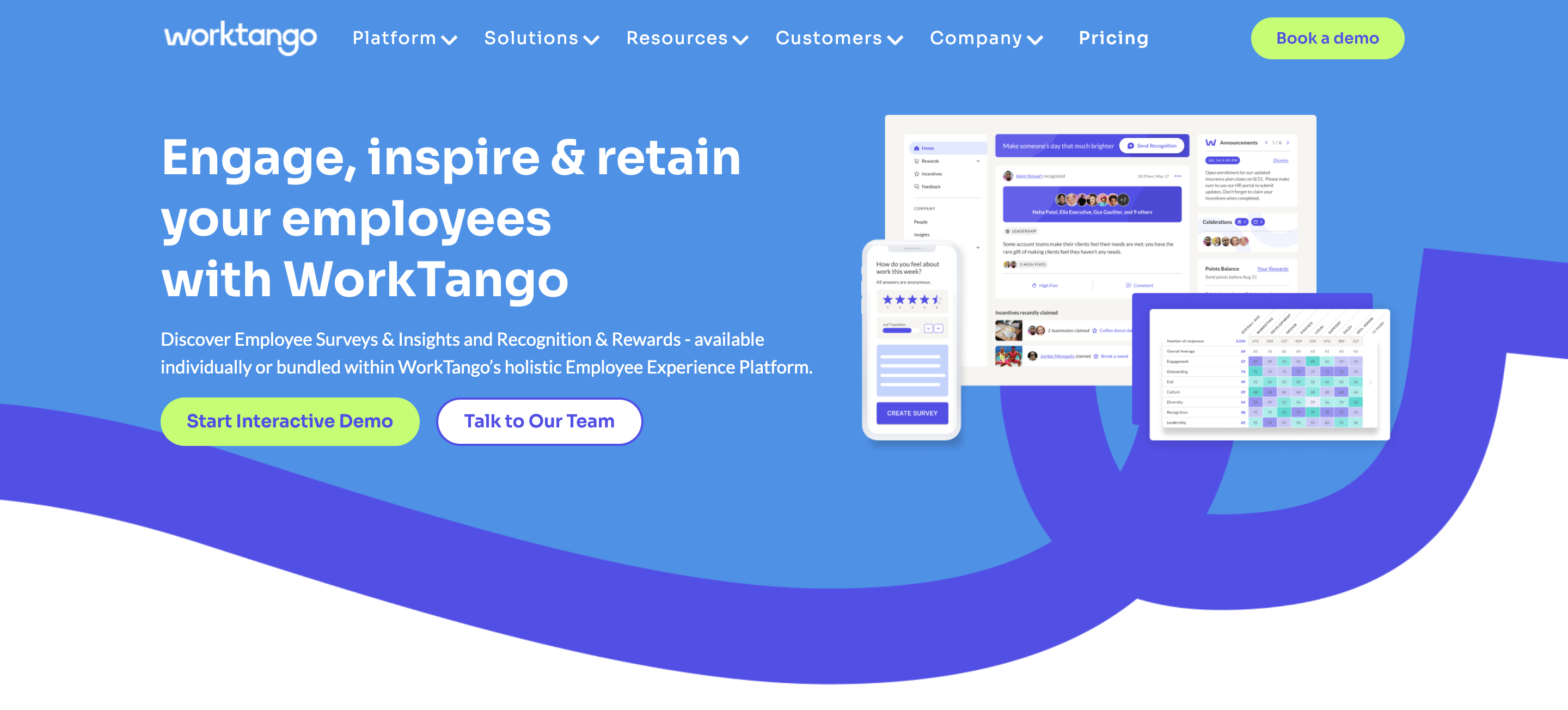
WorkTango
★ 4.7 G2
G2 Rating
4.7 / 5
Pricing
Contact sales
Best For
Feedback + recognition programs
Standout
Confidential feedback + recognition
WorkTango is an employee feedback and recognition platform that collects insights through surveys and engagement analytics. It combines employee listening with recognition programs and action planning tools.
WorkTangoclick to expand
Feature
Advantages
Employee Surveys & Insights
Collects comprehensive feedback across the employee lifecycle, providing leaders with actionable insights to drive meaningful organizational change.
Recognition & Rewards
Automates and scales employee recognition programs to celebrate achievements, boost morale, and reinforce positive workplace behaviors.
Anonymous Conversations
Facilitates open dialogue by enabling employees to provide candid feedback anonymously, helping organizations build transparency and trust.
Action Planning
Equips managers with tools to create, track, and manage action plans based on feedback, ensuring accountability and continuous improvement.
Leader Tools
Provides leaders with insights and guidance to respond effectively to employee feedback and improve team engagement.
Best for
Organizations that want to combine employee engagement surveys with recognition and rewards programs.
Limitations
Reporting capabilities may vary depending on the selected subscription tier.via G2
Standout features
Confidential employee feedback tools designed for engagement surveys
Recognition and rewards features that support employee appreciation
Continuous listening capabilities to track sentiment and engagement trends over time
Nº 11 / 12
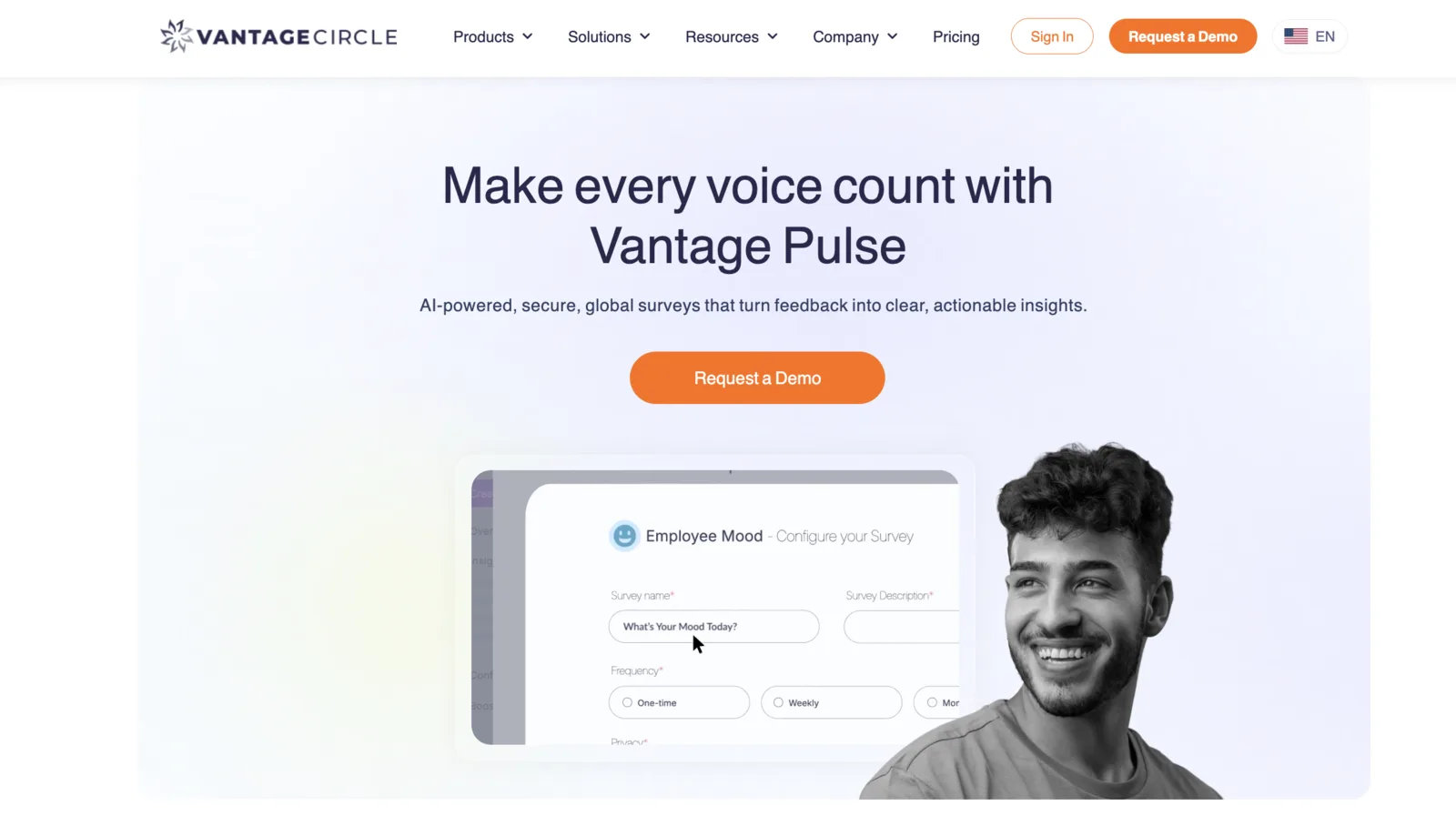
Vantage Pulse
★ 4.7 G2
G2 Rating
4.7 / 5
Pricing
Contact sales
Best For
Pulse surveys + engagement tracking
Standout
Benchmarking and trend analysis
Vantage Pulse is an employee engagement survey tool designed to collect feedback through pulse surveys and analytics dashboards. It helps organizations monitor engagement levels and identify areas that require attention.
Vantage Pulseclick to expand
Feature
Advantages
Real-Time Employee Engagement Tracking
Continuously monitors employee engagement levels, enabling organizations to identify emerging concerns and take timely action.
Anonymous Feedback Mechanism
Ensures confidentiality so employees can share honest feedback without fear of retaliation, fostering open communication.
Customizable Survey Templates
Provides pre-built survey templates that can be tailored to specific organizational needs, simplifying feedback collection.
Actionable Insights and Recommendations
Delivers clear, data-driven insights along with recommended actions to help organizations address engagement challenges.
Benchmarking and Trend Analysis
Compares engagement results with industry benchmarks and tracks trends over time to support informed decision-making.
Best for
Organizations looking for pulse surveys and engagement tracking tools to monitor employee sentiment.
Limitations
Website performance could be improved, as page loading speed may occasionally feel slow.via G2
Standout features
Pulse surveys designed for regular employee sentiment tracking
Engagement analytics dashboards for monitoring feedback trends
Survey templates that support customizable feedback collection
Nº 12 / 12
Microsoft Viva Glint
★ 4.6 G2
G2 Rating
4.6 / 5
Pricing
Contact sales
Best For
Microsoft 365 ecosystem organizations
Standout
Native Teams + Viva integration
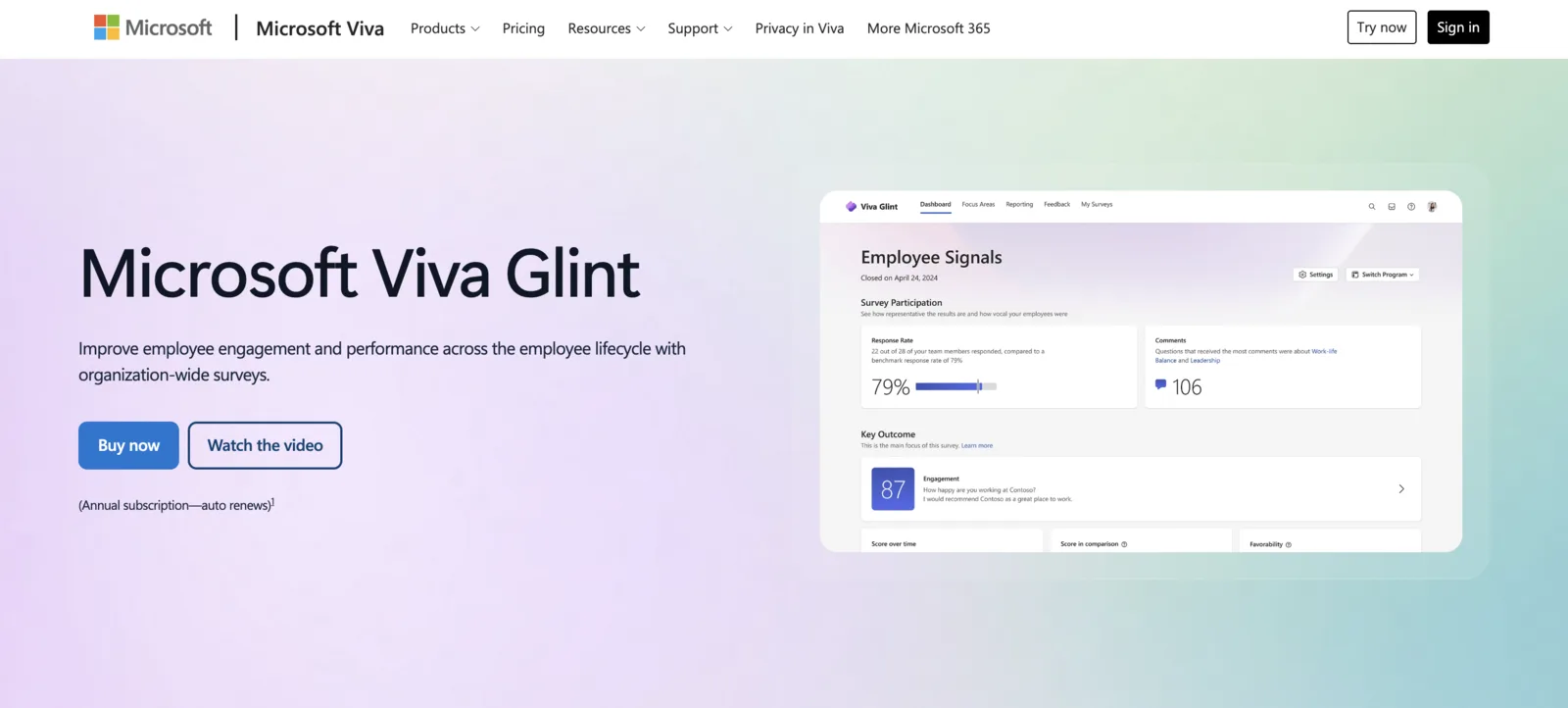
Microsoft Viva Glint is an employee feedback platform within the Microsoft Viva suite. It supports engagement surveys, action planning, and analytics to help organizations understand employee sentiment.
Microsoft Viva Glintclick to expand
Feature
Advantages
Real-Time Pulse Surveys
Continuously monitor employee engagement levels, enabling organizations to quickly identify and respond to emerging workplace issues.
AI-Driven Analytics
Uses artificial intelligence to analyze employee feedback, uncover hidden patterns, and provide deeper insights into engagement trends.
Integrated Action Planning
Provides managers with tools to create, track, and manage action plans based on feedback, ensuring accountability and continuous improvement.
Employee Lifecycle Surveys
Offers surveys designed for key stages of the employee journey such as onboarding, development, and exit to capture meaningful experience insights.
Manager Effectiveness Reports
Delivers insights into managerial performance based on employee feedback, supporting leadership development and stronger team dynamics.
Best for
Enterprise organizations operating within the Microsoft ecosystem that want engagement insights integrated into everyday workplace tools.
Limitations
Some organizations may depend on vendor support to fully utilize advanced features and analytics capabilities.via G2
Standout features
Engagement insights delivered directly within Microsoft Teams and Viva environments
Manager action planning tools that translate feedback results into focused improvement initiatives
Selection Guide
Key features to consider in employee feedback tools
When evaluating an employee feedback tool, it is essential to consider several factors to ensure the tool meets your organization's needs.
01
Customization options
Every organization has unique requirements for collecting feedback from employees. Consider whether the tool allows customization, such as creating custom surveys tailored to your organization's needs.
02
User-friendliness
A feedback tool should be easy to use for both managers and employees. Consider the user interface and whether it is intuitive and straightforward. Look for tools that offer clear instructions and support.
03
Integration
The feedback tool should integrate with your existing HR software or management systems to ensure feedback is easily accessible and tracked. Look for tools that offer APIs or integration options with popular HR systems.
04
Reporting and analytics
The tool should provide reporting and analytics features that help you analyze and interpret the feedback data effectively. Look for customizable reporting options and dashboards.
05
Security and data privacy
Employee feedback data is sensitive and confidential. Ensure the tool adheres to strict security and data privacy standards, including encryption, password protection, and data backup options.
06
Mobile access
Employees should be able to provide feedback from any device, including smartphones and tablets. Look for tools that offer mobile access and are optimized for mobile use.
07
Support and training
A feedback tool should offer training and support to help managers and employees use the tool effectively, including customer support and training resources such as tutorials, webinars, and documentation.
"CultureMonkey made it easy to automate our employee engagement surveys while still giving us the flexibility to customize them. Their real-time data analysis, combined with insights from the People Science team, helped us uncover key focus areas, align our strategy with industry benchmarks, and strengthen our leadership development efforts."
Mollie Mock Kaufman
Director of Talent Development & Training · United Bank
How employee feedback tools support anonymous feedback
Employee feedback tools often include anonymous response options that allow employees to share opinions without revealing their identity. Anonymous feedback helps increase honesty and participation in surveys, enabling organizations to uncover workplace concerns and gather more reliable insights into employee sentiment.
01
Anonymous survey responses
Employees can submit survey answers without their identity being visible to managers or HR teams, encouraging open and honest feedback.
02
Minimum response thresholds
Many platforms only display results when a minimum number of responses are collected, helping protect employee anonymity.
03
Anonymous comment collection
Employees can share written feedback or suggestions without attaching their names, helping surface concerns that might otherwise remain unreported.
04
Secure data handling
Feedback tools use privacy controls and role-based access to ensure employee responses remain confidential.
05
Aggregated reporting
Survey results are typically presented in group-level dashboards, allowing organizations to analyze trends without identifying individual respondents.
Feedback Types
Types of employee feedback modern tools can collect
Modern feedback platforms support structured survey methods, open channels, and continuous listening — across multiple touchpoints in the employee journey, not just annual surveys.
01
Pulse surveys
WeeklyMonthlyQuarterly
Short, recurring surveys that measure employee sentiment on a regular cadence. They focus on key engagement drivers — workload, manager support, collaboration, and job satisfaction — and give HR teams a continuous signal rather than a once-a-year snapshot.
02
Lifecycle surveys
OnboardingEngagementExit
Collect feedback at critical stages of the employee journey: onboarding, mid-year check-in, engagement, and exit. Each touchpoint surfaces experience gaps unique to that stage — from role clarity at 30 days to departure reasons that unlock retention insights.
03
Employee Net Promoter Score (eNPS)
Loyalty metricQuarterly
Measures employee loyalty with a single question: how likely are you to recommend this organization as a place to work? Responses are grouped into promoters, passives, and detractors. Tracking eNPS over time reveals whether culture is improving or eroding.
04
Open-ended feedback
Text analyticsThemes
Written comments alongside survey questions capture what rating scales miss — nuance, specifics, and context. Modern tools apply text analytics to identify recurring themes, flag sentiment shifts, and surface emerging concerns before they become attrition risks.
05
Anonymous feedback channels
ConfidentialAlways-on
Allow employees to share concerns without revealing their identity, increasing honesty and encouraging employees to raise sensitive workplace issues — leadership behavior, team dynamics, safety concerns — that structured surveys rarely surface.
"What stood out about CultureMonkey was their willingness to truly partner with us. We had our own engagement model with seven key drivers, and they helped align it with their research-backed methodology. Together, we created a customized, data-driven experience that reflected who we are as an organization."
"CultureMonkey's support during our first engagement survey was phenomenal. With omni-channel reminders through WhatsApp and Text, we reached 75%+ participation across 1,700+ frontline employees."
Calculated from responses on motivation, recognition, leadership, and job satisfaction. Displayed as dashboards or heatmaps comparing scores across departments and locations at a glance.
02
Employee NPS (eNPS)
A single question groups employees into promoters, passives, and detractors. Tracked quarterly, eNPS reveals whether loyalty is improving or eroding before it shows up in turnover data.
03
Sentiment analysis
AI applied to open-ended responses to flag recurring concerns, emotional tone, and emerging themes that rating scales don't surface. Turns qualitative data into quantifiable insight.
04
Participation rates
High response rates signal trust in the feedback process. Low rates often point to survey fatigue or anonymity concerns — both correctable with the right platform design.
05
Action completion tracking
Are managers acting on survey results? Platforms that track action plan creation and completion show HR whether feedback actually drives change — closing the loop on the entire listening cycle.
06
Heatmap analytics
Shows engagement scores across teams, departments, and locations at a glance. Quickly surfaces outliers — a team that scores well overall but low on a specific driver like recognition or workload.
Air General · Case Study
"With CultureMonkey, managers are using the data to engage their staff, re-engage their staff, and find opportunities to bring the team together and recognise them as well."
Employee feedback tools are employee engagement software platforms that help organizations collect and analyze employee opinions through surveys, pulse checks, and continuous listening programs. They help HR teams understand workforce sentiment, identify workplace issues, and take actions that boost engagement and employee experience.
2. Why are employee feedback tools important for organizations?
Employee feedback tools allow organizations to gather insights directly from employees and identify areas that affect engagement, productivity, and company values. By analyzing feedback trends, leaders can make informed decisions, address concerns earlier, and improve employee experience across teams and departments.
3. What is the difference between an employee feedback tool and an employee engagement platform?
Employee feedback tools focus on collecting and analyzing employee opinions through surveys, pulse checks, and continuous listening. Employee engagement platforms are broader — they include feedback collection but also add action planning workflows, manager enablement tools, recognition programs, and integration with performance management. Most enterprise buyers start with a feedback tool and expand to a full engagement platform as their listening program matures.
4. What is eNPS and how is it different from an employee engagement survey?
eNPS, or employee Net Promoter Score, measures employee loyalty with a single question: how likely are you to recommend this organization as a place to work? Responses segment employees into promoters, passives, and detractors. Unlike full engagement surveys that measure multiple drivers across dozens of questions, eNPS gives a fast, trackable loyalty signal typically run quarterly. Both are complementary — eNPS flags directional shifts while engagement surveys diagnose the underlying causes.
5. What is the difference between pulse surveys and annual employee engagement surveys?
Pulse surveys are short, frequent check-ins — typically 5 to 15 questions — run weekly, monthly, or quarterly to track real-time sentiment on a small set of engagement drivers. Annual engagement surveys are comprehensive, covering 50 to 80 questions across all engagement dimensions, benchmarked against industry data and run once or twice a year. Best practice combines both: annual surveys provide baseline depth, while pulse surveys track the impact of changes made between cycles.
6. Are employee feedback tools anonymous?
Many employee feedback tools allow anonymous responses so employees can share opinions without revealing their identity. Platforms enforce anonymity through minimum response thresholds, aggregated reporting, and role-based access controls that prevent managers from drilling into individual responses. Anonymity helps increase honesty and participation, especially when employees provide feedback about leadership, company culture, or sensitive workplace issues.
7. What delivery channels do employee feedback tools support?
Modern employee feedback tools distribute surveys across multiple channels to maximize participation: email, Slack, Microsoft Teams, WhatsApp, SMS text, QR codes, and web kiosks. Email-only distribution systematically under-represents frontline, manufacturing, and field workers. The best tools for high-reach programs offer omnichannel delivery with automated reminders that respect each channel's frequency norms.
8. How do employee feedback tools support frontline and deskless workers?
Employee feedback tools designed for frontline workers offer delivery channels beyond email — including SMS, WhatsApp, QR codes, and kiosk-based surveys — so employees without corporate email or desktop access can still participate. Platforms like CultureMonkey are built for high-participation environments where reaching non-desk staff in their language and on their device is a core requirement, not an afterthought.
9. Which employee feedback tools integrate with Workday, SAP, or BambooHR?
Enterprise employee feedback platforms like CultureMonkey, Qualtrics XM, and Culture Amp offer native integrations with major HRIS systems including Workday, SAP SuccessFactors, BambooHR, ADP, and Oracle HCM. These integrations automate employee roster syncing, trigger lifecycle surveys at key milestones like onboarding and exit, and ensure feedback data stays aligned with HR records without manual uploads.
10. How do employee feedback tools handle multilingual surveys for global teams?
Enterprise employee feedback platforms support multilingual survey delivery by automatically translating survey content into the respondent's preferred language and collecting responses in that language before aggregating results in a single dashboard. CultureMonkey supports 100+ languages including less common ones, making it viable for organizations with frontline workers across diverse regions. Multilingual support directly improves participation rates and data quality in globally distributed teams.
11. How do employee feedback tools use AI for sentiment analysis?
AI-powered employee feedback tools apply natural language processing to open-ended survey responses to detect emotional tone, cluster recurring themes, and flag high-risk language patterns. Instead of manually reading thousands of comments, HR teams get automated summaries identifying the top concerns by department, manager, or location — turning qualitative feedback into structured, actionable insight at scale.
12. What are average employee engagement scores by industry?
Based on CultureMonkey's analysis of 10M+ survey responses, average engagement scores on a 5-point scale vary significantly by sector. Hospitality scores 4.6, Financial Services 4.1, Technology 4.0, Healthcare 3.95, Retail 3.87, and Manufacturing 3.72. Organizations scoring below their industry average should investigate specific engagement drivers — workload, recognition, and manager quality are the most common gaps.
13. What features should you look for in employee feedback tools?
When evaluating employee feedback tools, organizations should look for pulse surveys, lifecycle surveys, anonymous feedback architecture, AI sentiment analysis, HRIS integrations, multilingual support, multi-channel delivery, and manager action planning dashboards. The right combination depends on your workforce size, distribution, and whether your priority is broad listening or deep diagnostics.
14. How often should companies collect employee feedback?
Many organizations collect employee feedback through pulse surveys every month or quarter, while engagement surveys are typically conducted once or twice a year. Regular feedback helps leaders track sentiment trends, identify workplace concerns early, and monitor the impact of culture and engagement initiatives. Avoid over-surveying — frequency should match your organization's capacity to act on results.
15. What types of surveys do employee feedback tools support?
Employee feedback tools support pulse surveys, annual engagement surveys, onboarding surveys, exit surveys, manager effectiveness surveys, 360-degree feedback, and employee Net Promoter Score (eNPS) surveys. Each survey type captures a different signal in the employee journey — the best platforms let HR teams run all of them from a single listening platform.
16. How do employee feedback tools improve manager effectiveness?
Employee feedback tools give managers visibility into team sentiment, engagement drivers, and workplace concerns. Through anonymous feedback, participation data, and engagement dashboards, managers can identify issues earlier, adjust communication, recognize contributors, and support teams using structured insights. Platforms that include manager-specific dashboards and recommended actions create the most consistent behavior change.
17. How do employee feedback tools support manager action planning after surveys?
Leading employee feedback platforms provide managers with team-level dashboards that highlight their lowest-scoring engagement drivers alongside AI-suggested action plans. Managers can assign actions, set deadlines, and track completion within the platform. This closes the feedback loop — employees see that their input drives change, which increases participation in future surveys and builds a culture of continuous listening.
18. How can employee feedback tools link engagement data to business outcomes?
Modern employee feedback tools connect engagement data with metrics such as retention, productivity, and employee turnover. By analyzing engagement trends, sentiment data, and participation patterns, HR teams can identify factors affecting performance and use people insights to guide workplace improvements. A 1-point improvement in engagement score correlates with measurable gains in retention and productivity.
19. How do you measure the ROI of an employee feedback tool?
ROI from employee feedback tools is measured through improvements in engagement scores, reductions in voluntary turnover, increases in survey participation rates, and manager action plan completion rates. Organizations also track leading indicators: time-to-action from survey close to initiative launch, and adoption of manager dashboards. Platforms that connect listening to action consistently show higher ROI than those used purely for data collection.
20. Can small businesses use employee feedback tools?
Yes, many employee feedback tools offer flexible pricing and simple survey features that work well for small and growing businesses. Tools like Workleap Officevibe and TINYpulse are designed for teams under 500 with lightweight setup and straightforward pulse survey capabilities. As organizations scale, they typically migrate to platforms with more advanced analytics, HRIS integrations, and lifecycle survey support.