

Increase your survey response rate
A practical playbook for lifting participation - the timing, channel choices, leadership messaging, reminder cadence, survey length, anonymity reassurance, and loop-closing that get more of your people to answer honestly.
On this page
- What counts as a good response rate
- Timing: ask at the right moment
- Channel: reach people where they already are
- Leadership communication: have someone people trust introduce it
- Keep the survey short
- Reminders: nudge without nagging
- Reassure people it's anonymous
- Close the loop: the biggest lever of all
- Watch the numbers and adjust
- Frequently asked questions
- Where to go next
A survey is only as good as the number of people who answer it. A brilliant question set with a 25% response rate tells you far less than a simple one that 80% of your team completes - and worse, low participation quietly skews the story, because the people who don't respond are rarely a random sample. Lifting your response rate is one of the highest-leverage things you can do for the quality of your engagement data.
The good news is that participation is not luck. It comes down to a handful of deliberate choices about when you ask, how you reach people, who asks, how long the survey is, whether people trust it, and what happens after they hit submit. This guide walks through each lever, grounded in what CultureMonkey actually lets you do.
Response rate is driven by trust and friction, not by nagging. Ask at a good moment, reach people on the channel they actually use (CultureMonkey can reach them on Email, Slack, Teams, WhatsApp, or SMS), have a leader introduce the survey, keep it short, remind non-responders a few times without over-doing it, reassure people it's anonymous, and - most powerfully of all - visibly act on the last round's feedback. Each lever adds a few points; together they change the picture.
What counts as a good response rate
Before you try to raise a number, it helps to know what a healthy one looks like. There's no universal benchmark, but these bands are a reasonable orientation for an internal employee survey:
| Response rate | General reading |
|---|---|
| Below 50% | Weak signal - results may not represent the whole team, and you should treat findings with caution |
| 50% to 65% | A workable baseline, but there's clear room to improve |
| 65% to 80% | Good - a solid, representative response you can act on with confidence |
| Above 80% | Excellent - strong buy-in and a trustworthy picture of sentiment |
Two caveats matter more than the band you land in. First, the trend beats the number: a team climbing from 55% to 70% over three cycles is doing better than one flat at 75%. Second, look beneath the average: a healthy company-wide rate can hide a team where almost no one responded - and that team is exactly the one you most need to hear from. You can watch both the headline and the segments in Track participation in real time.
Timing: ask at the right moment
When you send matters more than most people expect. A survey that lands in a bad moment gets buried, and a buried survey gets forgotten.
A few timing principles that reliably help:
- Mid-week, mid-morning is the sweet spot. Tuesday to Thursday tends to beat Monday (inbox overload) and Friday (checked-out). CultureMonkey sends scheduled invitations and reminders at 11:00 in your account's time zone by default, chosen to land after the morning rush but before the day gets away from people.
- Avoid dead zones. Don't launch during a major holiday week, a company-wide crunch, or right after a disruptive announcement. Responses will be low and, worse, unrepresentative.
- Give the survey room to breathe. Too short (a single day) forces people to answer on your schedule; too long lets urgency evaporate. Roughly one to two weeks open, with reminders spaced across it, is a common sweet spot.
- Be consistent. If your survey always arrives at a predictable time, people learn to expect it and set aside a few minutes. Predictability itself lifts participation.
If your team is frontline, deskless, or spread across time zones, an 11:00 head-office send may miss them entirely. Consider the channel and time your specific people are actually reachable - a shift worker checks a phone, not a work inbox at 11am. Channel choice, below, is how you solve this.
Channel: reach people where they already are
The biggest, most avoidable cause of low participation is sending an email to someone who doesn't live in email. CultureMonkey can distribute a survey through five channels, and picking the right one for each group is often worth more than any number of reminders.
| Channel | Best for | Why it lifts response |
|---|---|---|
| Desk-based staff with a work inbox | Familiar, detailed, easy to schedule | |
| Slack | Teams that live in Slack all day | The nudge appears where work already happens |
| Microsoft Teams | Microsoft-first organizations | Same benefit as Slack, in the Teams surface |
| Frontline, deskless, or field staff | Reaches people with no regular work inbox | |
| SMS | Workers with no app access at all | Lowest common denominator - almost everyone has it |
The lesson is simple: a deskless workforce reached over WhatsApp or SMS will out-respond the same workforce emailed. Where your account has multiple channels enabled, lean on the ones your people actually check. For the full comparison and how to set each up, see Distribution channels overview.
You don't have to pick just one. Reminders in particular can go out on a different channel from the original invitation - one of the most effective tricks for catching people who tuned out the first message, covered in the reminder section below.
Leadership communication: have someone people trust introduce it
A survey that arrives cold, from a system, gets treated as noise. A survey that a respected leader has personally asked people to complete gets treated as important. This is one of the most underrated response-rate levers, and it costs nothing but a little coordination.
Before the survey goes out, arrange for a visible leader (a department head, a people-team lead, or the CEO for an org-wide survey) to send a short human message covering three things: why you're running the survey, that it's genuinely anonymous, and what will happen with the results. A couple of sentences in an all-hands, a team channel, or a pre-survey note is enough.
Response rates climb noticeably when people hear "this is coming and here's why" before the invitation lands, rather than being surprised by it. A survey framed as "we want to hear you, and we'll act" is one people make time for; one that shows up unexplained is one they skip.
Managers matter here too. When you tell your own team, in your own words, that you care about the results and will talk through them together, participation rises. People answer for someone they trust, not for a platform.
Keep the survey short
Every extra question costs you responses. People start a long survey, hit fatigue, and abandon it - or see the length and never start. Respecting people's time is both courteous and effective.
Practical ways to keep length in check:
- Ask only what you'll act on. If you won't do anything with a question's answer, cut it. Questions that lead nowhere train people that answering is pointless.
- Favor pulse surveys for frequent check-ins. A short, focused pulse of a handful of questions gets far higher completion than a long questionnaire and is designed to answer in a couple of minutes. See What is a pulse survey?.
- Tell people how long it takes. "Takes about three minutes" in the invitation sets an honest expectation and lowers the barrier to starting.
- Use skip logic wisely. Where your survey uses conditional questions, people only see what's relevant to them, keeping their personal path short even in a larger question set. See Show questions conditionally.
A bloated survey doesn't just lower your response rate - it lowers the quality of the answers you do get, because tired respondents rush the back half. A shorter survey that people finish thoughtfully beats a long one they speed through.
Reminders: nudge without nagging
Very few people answer the first invitation. The follow-up reminder does most of the heavy lifting on your final response rate, so reminders aren't optional - they're where participation is won. The art is nudging enough to catch people who genuinely meant to respond, without tipping into annoyance.
CultureMonkey reminders come with two guardrails that make this easier:
- Reminders only ever go to non-responders. The moment someone submits, they drop off every reminder list for that survey. Nobody who has already answered will be nudged.
- A person receives at most one reminder per day. No matter how your reminder rules overlap, an employee will never get two reminders in the same day.
So you can schedule a sensible cadence without worrying about spamming the people who already helped you. For a one-to-two-week window, a reliable cadence looks like this:
- 1Launch with a leader's introduction - the invitation lands with context, not cold.
- 2First reminder mid-window - a few days in, nudge everyone who hasn't answered yet.
- 3Second reminder before the close - a day or two before the survey ends, remind the remaining non-responders that the window is closing.
- 4Switch channels for the final push - if earlier nudges went by email, send the last one over Slack, Teams, WhatsApp, or SMS to catch the people who tune out their inbox.
That channel-switch on the final reminder is one of the highest-yield moves available to you, because it reaches exactly the people the first channel missed. CultureMonkey lets each reminder go out on its own channel, so this takes only a moment. For the full picture of how reminders work across channels, see Understand multi-channel reminders.
Past two or three well-timed nudges, extra reminders lift participation very little while steadily eroding goodwill. The one-per-day cap protects people from the worst of it, but restraint on your side matters just as much. Let the participation numbers, not habit, tell you when another reminder is worth sending.
Reassure people it's anonymous
The quiet reason many people don't respond isn't laziness - it's worry. If someone suspects a candid answer might be traced back to them, they'll either soften it or skip the survey entirely. Removing that fear is one of the biggest levers on both participation and honesty.
CultureMonkey enforces anonymity in the product itself, not just as a promise. Results for any group stay hidden until a minimum number of people have responded, so no single answer can be inferred, and on an anonymous survey no one - not even an admin - can reveal who wrote a specific comment or gave a specific rating. But people are only reassured by protection they know about, so say it clearly:
- State the mode up front. Tell people, in one plain sentence before they answer, whether the survey is anonymous or identified. Ambiguity reads as risk.
- Explain the threshold in human terms. "We never see results for any group smaller than a handful of people" is more reassuring than technical detail, and it's true.
- Promise no individual call-outs, and keep it. Commit that feedback will be discussed as themes, never traced to a person, and hold to it publicly.
For a full plain-language explanation you can share with your team, point them to How anonymity keeps your feedback safe. Being able to link people to a clear, honest explanation is itself reassuring.
"Your answers are pooled with your teammates' and we can't see which are yours - that's the whole point." It directly answers the fear people actually have, and it's the difference between a hesitant maybe and a completed survey.
Close the loop: the biggest lever of all
The single most powerful thing you can do to raise your next survey's response rate is to visibly act on this survey's results. Nothing else comes close.
When people give feedback and see nothing change, they learn that answering is pointless, and participation decays cycle after cycle. When they see a concrete change - "you told us meetings were out of control, so we cut recurring meetings by a third" - they learn their voice moves things, and they show up next time. This is the response-rate flywheel:
- 1People answer honestly because they believe it matters and it's safe.
- 2You act on the themes - not on individuals, on patterns - and make real changes.
- 3You tell everyone what you heard and did - "you said, we did," in plain language.
- 4Trust and participation rise together, so the next survey gets an even better response.
Closing the loop costs nothing but follow-through, and it compounds. A team that has seen its feedback lead to change will out-respond one that hasn't, every time. If you do only one thing from this guide, do this one.
When you share what you heard, talk about groups and patterns, never "whoever said X." Acting in a way that even looks like you identified someone breaks the anonymity trust that participation depends on. Protecting anonymity in how you respond matters as much as the thresholds in the product.
Watch the numbers and adjust
You don't have to guess whether your levers are working. CultureMonkey shows participation live as responses come in, broken down by segment, so you can act while the survey is open.
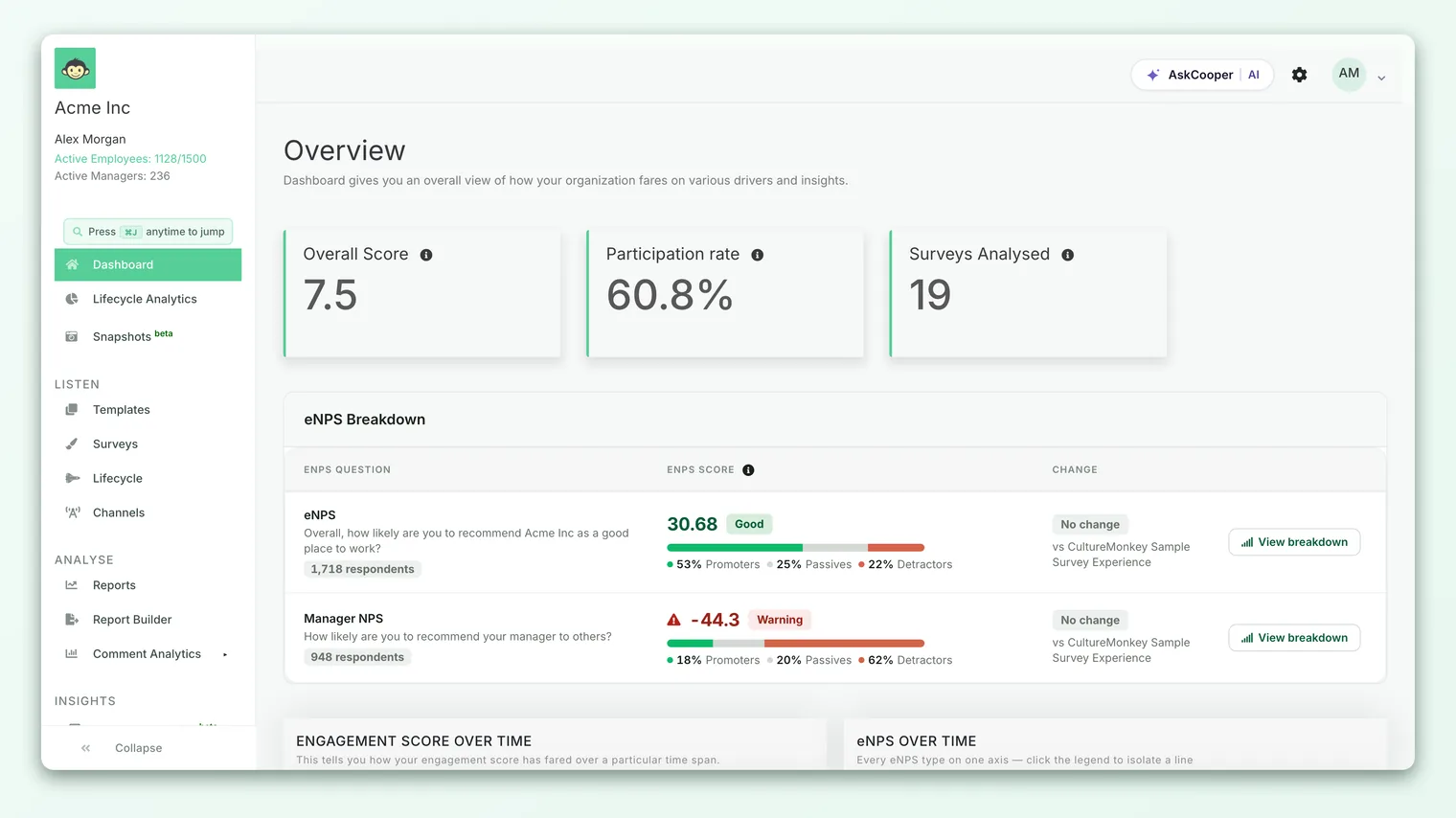
Use that visibility to steer, not just to observe:
- Spot lagging teams early. If one team is well below the rest mid-window, that's your cue to have its manager give a personal nudge, or to send a targeted reminder on a different channel.
- Time your reminders to the data. Send the next nudge when the response curve flattens, not on a fixed schedule out of habit.
- Learn for next time. Note which channels, send times, and messages produced the best response, and repeat what worked. Response rate improves fastest when each survey is a lesson for the next.
For detail on reading these numbers as they update, see Track participation in real time.
Frequently asked questions
What's the fastest way to lift a low response rate right now?
If a survey is already open and lagging, send a manual reminder to non-responders on a channel different from the original invitation, and ask the relevant managers to give their teams a personal nudge. Those two moves catch the people the first message missed. The durable fix, for next time, is closing the loop on the previous survey's feedback.
How many reminders is too many?
Two to three well-spaced reminders across a one-to-two-week window is the sweet spot. Beyond that, extra reminders lift participation very little while wearing down goodwill. CultureMonkey caps reminders at one per person per day, but still exercise restraint on top of that.
Does making a survey anonymous actually increase responses?
Yes, when people believe it. Anonymity removes the fear that stops candid people from answering, but it only helps participation if you tell people about it clearly and act in a way that honors it. Pair the anonymous setting with plain reassurance. See How anonymity keeps your feedback safe.
Which channel gets the best response rate?
There's no universal winner - the best channel is the one your specific people actually use. Desk workers respond well to email and Slack or Teams; frontline and deskless staff respond far better to WhatsApp or SMS. Matching the channel to the audience matters more than the channel itself. See Distribution channels overview.
My response rate is fine overall but one team is very low. What do I do?
Look beneath the average - a low team is often exactly the one you most need to hear from. Ask that team's manager to introduce the survey personally, check whether they're being reached on the right channel, and consider a targeted reminder. You can spot these teams in Track participation in real time.
Where to go next
- Pick the right channel for each group: Distribution channels overview
- Set up reminders that catch non-responders: Understand multi-channel reminders
- Watch participation as it comes in: Track participation in real time
- Reassure your people it's safe to answer: How anonymity keeps your feedback safe
Your feedback helps us improve the Help Center.