

How CultureMonkey keeps your feedback anonymous
A friendly overview of how CultureMonkey protects employee anonymity - response thresholds, anonymous vs identified surveys, what admins and managers can and can't see, and how to reassure your people so they answer honestly.
On this page
Honest feedback only happens when people feel safe giving it. If an employee worries that a candid answer might be traced back to them - and held against them - they'll soften what they say, or say nothing at all. Anonymity is what removes that worry, and it's the quiet foundation everything else in CultureMonkey is built on.
This guide is the friendly, plain-language overview of how that protection works: why it matters, how response thresholds hide small groups until enough people have answered, the difference between anonymous and identified surveys, exactly what admins and managers can and can't see, and how to reassure your team so they answer truthfully. If you want the deeper, more technical version - exact settings, database logic, edge cases - see How anonymity works (technical).
CultureMonkey hides a group's results until a minimum number of people have responded, so no single answer can be traced to a person. Most surveys are anonymous (identities masked); some are identified by design. Managers only ever see their own team's pooled results, never who said what - and when a group is too small, even those results stay hidden. This isn't a limitation to work around; it's the reason your feedback is honest.
Why anonymity matters
The whole point of an engagement survey is to hear what people actually think - not the polished version they'd give in a one-on-one with their boss. That candor is fragile. It depends entirely on trust that answers can't be linked back to a name.
When anonymity is real and visible, three good things happen:
- People tell the truth. Difficult feedback - about a manager, a policy, workload, or culture - only surfaces when it's safe to share. Anonymity is what makes it safe.
- You get a representative picture. If only the confident and the content respond, your data is skewed. Protecting everyone equally means quieter voices count too.
- Trust compounds. Each survey where nothing bad happens to a candid respondent makes the next survey more honest. Anonymity is an investment that pays off over cycles.
The reverse is just as true. One rumor that "leadership can see who wrote that" can poison participation for years. That's why CultureMonkey enforces anonymity in the product itself, rather than relying on a promise.
How response thresholds work
The core mechanism is simple: results for any group stay hidden until enough people in that group have responded. This minimum is called the anonymity threshold (or minimum responses).
The logic is intuitive. If a team of 30 has a score, no individual is exposed - their answer is one voice among many. But if a "team" filters down to two people, showing that group's score would come dangerously close to revealing what each person said. So CultureMonkey simply doesn't show it.
This threshold applies everywhere results are displayed: dashboards, survey reports, eNPS breakdowns, driver scores, comments, and demographic filters. If any slice of data - a team, a location, a custom attribute, or a combination of them - falls below the threshold, that slice is hidden rather than shown.
A few things worth knowing:
- The minimum sits at a small floor (commonly 3 responses for anonymous surveys, and account admins can set it higher). Dashboard heatmaps often use a slightly higher default. The exact numbers are configurable per account.
- A blank or greyed-out report right after launch usually just means responses are still coming in - not that anything is broken. See Why can't I see results yet?.
- Broadening a filter (rolling a small team up into its parent, or a location into a region) pools more responses together and often crosses the threshold.
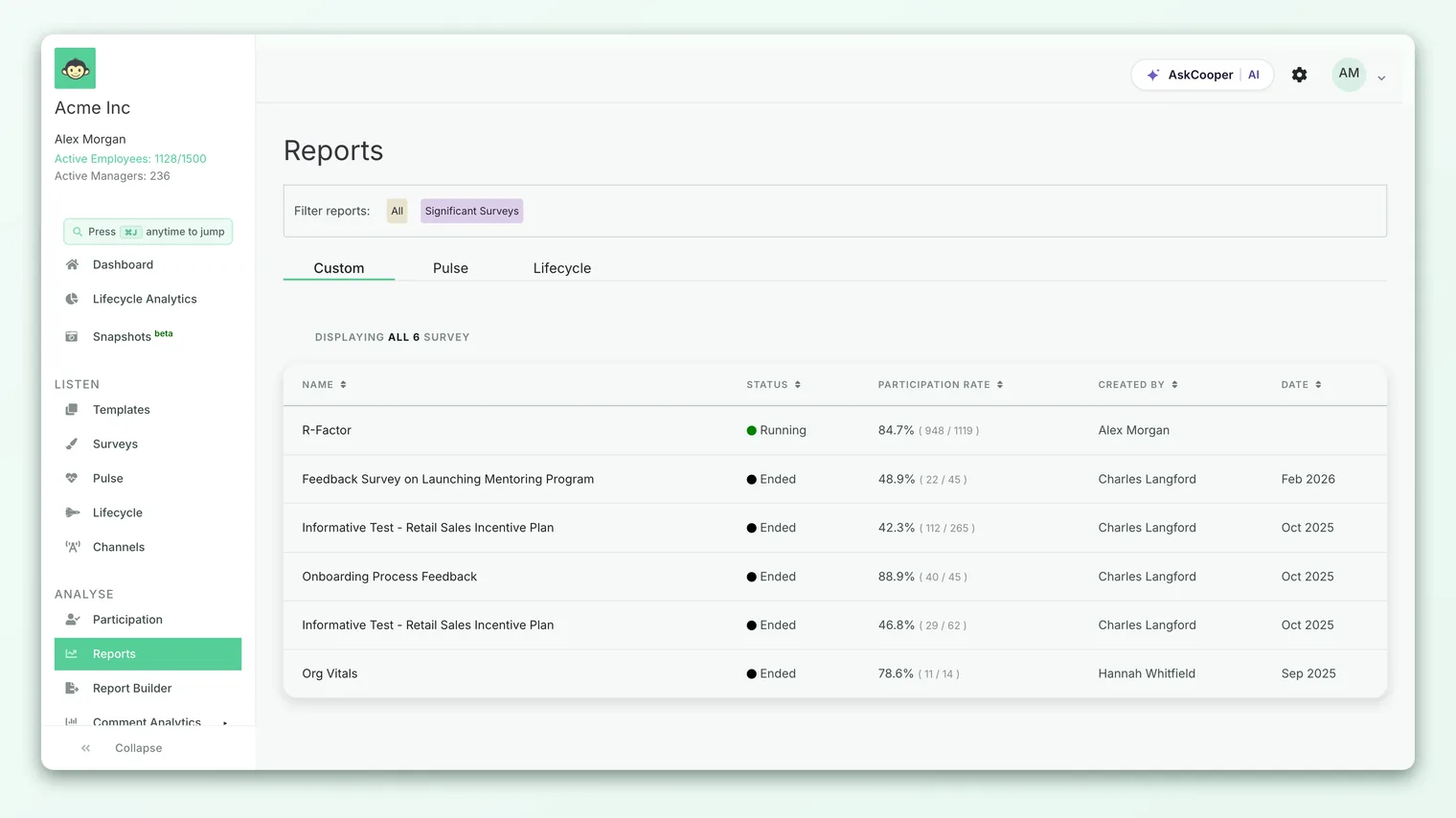
Anonymous vs identified surveys
Not every survey is anonymous, and that's by design. CultureMonkey supports two modes, and it's important to know which one you're running so you can set expectations honestly.
| Anonymous survey | Identified survey | |
|---|---|---|
| Identity in reports | Masked - no names attached to answers | Visible - answers are linked to the respondent |
| Best for | Engagement, eNPS, sensitive topics, honest sentiment | Onboarding check-ins, exit interviews, 1:1 follow-ups where a name is needed to act |
| Minimum responses | Higher floor (commonly 3+) to protect small groups | Lower floor is possible, since identity isn't the concern |
| What employees should be told | "Your individual answers can't be traced to you." | "Your responses are tied to your profile so we can follow up." |
The distinction is a deliberate setting on each survey, and switching a survey to anonymous automatically raises its minimum-response floor so small groups stay protected. The golden rule: tell employees which mode they're in, in plain language, before they answer. Nothing erodes trust faster than someone believing a survey was anonymous when it wasn't. For how to choose and configure this, see Set survey anonymity.
Identified surveys aren't "less safe" - they're for moments where acting on an individual's response is the point, like a new-hire check-in where a manager needs to reach out personally. The trust comes from being upfront about it, not from hiding it.
Anonymity by submission
Here's a subtle but reassuring detail. When CultureMonkey counts whether a group has "enough" responses to clear the threshold, some accounts count the number of people invited, while others count the number of actual submissions - the completed responses that came in.
This is the anonymity-by-submission setting, and it's an account-level choice. Counting by submission is the more conservative option: a group only becomes visible once enough people have genuinely answered, not merely once enough were invited. That closes a subtle gap - a team of five where only two people responded won't be treated as a "group of five." Under submission-based counting, it's a group of two, and stays hidden.
For most people this happens invisibly. It's worth knowing simply because it's another layer working in employees' favor: the system errs toward hiding, not revealing.
What admins and managers can and can't see
This is the question employees ask most, so it deserves a clear answer. Access is scoped deliberately, and anonymity thresholds apply on top of it.
| Role | Can see | Cannot see |
|---|---|---|
| Account admin | Organization-wide scores, trends, and demographic breakdowns that meet the threshold; results for identified surveys as designed | Individual answers on an anonymous survey; any group below the threshold |
| Manager | Pooled results for their own team only, and only once the team meets the threshold | Other teams' data; who said what; any breakdown of their team that falls below the minimum |
| Employee | Their own submitted responses; whatever results are shared with them | Anyone else's individual answers |
A few important clarifications:
- Managers never see individual anonymous answers. They see aggregated scores and comments for their team as a whole, and only when the team is large enough. If a manager has a very small team, they may see nothing at all - that's the protection doing its job.
- When a manager's team is below the threshold, sensitive views like free-text comments are withheld entirely, not just blurred.
- Admins are powerful but not unlimited. On an anonymous survey, no role - admin included - can reveal who wrote a specific comment or gave a specific rating. Anonymity is enforced in the data layer, not by politely hiding a column.
It can be tempting to stack narrow filters - one team, one location, one tenure band - to guess who said something. Don't. CultureMonkey deliberately hides any combination that gets too small, and attempting to unmask a respondent breaks the trust that makes your whole feedback program work. If people suspect it's happening, honest answers dry up. Treat anonymity as a promise you keep, not a lock to pick.
Combination-based anonymity for exports
Thresholds on a single group are the easy case. The clever part is protecting against combinations.
Imagine each filter on its own is safely large - plenty of people in "Engineering," plenty in "London," plenty with "3-5 years tenure." But someone who is all three at once might be a group of one. Looked at individually the filters seem safe; combined, they point straight at a person.
CultureMonkey guards against this, especially in exports (comments and free-text downloads). Before an export is produced, responses are grouped by the full combination of every demographic attribute included - standard fields and custom ones together. Any combination that doesn't have enough responses to clear the survey's minimum is dropped from the export entirely. Only the safe combinations come through.
This is what protects the export at the door, so a spreadsheet of comments can't become a de-anonymizing tool. Account admins can enable this combination-based protection specifically for comment and free-text exports. The deeper mechanics live in How anonymity works (technical).
If a comments export looks "shorter" than what you saw in the report, combination-based anonymity is usually why: rows tied to a demographic combination too small to be safe are removed before the file is generated. That's expected, and it's protecting your people.
How anonymity builds employee trust
Anonymity isn't just a feature - it's a message. Every time the product refuses to reveal a small group, or masks a name, it's telling employees: your honesty won't cost you. Over time that message becomes a reputation, and a good reputation is what lifts participation and candor together.
The trust loop looks like this:
- 1Employees answer honestly because they believe the protection is real.
- 2You get truthful data, including the hard feedback that actually matters.
- 3You act on it visibly - and, crucially, without ever singling anyone out.
- 4Trust grows, so the next survey is even more honest.
The fastest way to break this loop is to act in a way that looks like you identified someone - even if you didn't. So when you close the loop on feedback, speak to themes and groups, never to "whoever said X." Protecting anonymity in how you respond matters as much as the thresholds in the product.
How to reassure employees
You can't just have anonymity - you have to help people believe in it. A little communication goes a long way.
- 1Say it plainly, up front. Before a survey launches, tell people whether it's anonymous or identified, in one clear sentence. Ambiguity reads as risk.
- 2Explain the threshold in human terms. "We never see results for any group smaller than a handful of people" is more reassuring than technical detail - and it's true.
- 3Promise no individual call-outs - and keep it. Commit that feedback will be discussed as themes, never traced to a person, and hold yourself to it publicly.
- 4Point to the safeguards. Let people know the protection is built into the system, not just a policy someone could ignore. You can link them to this article or to How anonymity works (technical).
- 5Prove it over time. The strongest reassurance is a track record: cycle after cycle where candor was safe. Reference past surveys where you listened and acted, without anyone being exposed.
"Your answers are pooled with your teammates' and we can't see which are yours - that's the whole point." Simple, honest, and it directly answers the fear people actually have.
Frequently asked questions
Can my manager see how I personally answered an anonymous survey?
No. On an anonymous survey, managers only see their team's results pooled together, and only once the team is large enough to meet the anonymity threshold. Individual answers are never attached to a name, for any manager.
Why is my team's report empty when other teams can see theirs?
Your team is probably below the minimum-response threshold - either too few people were invited, or too few have responded so far. Once enough responses come in, or if you roll up into a larger group, the results appear. See Why can't I see results yet?.
If a survey is identified, is my feedback still protected?
Your feedback is tied to your profile so the organization can follow up with you personally - that's the purpose of an identified survey. It should be clearly labeled as identified before you answer. If you're unsure which mode a survey uses, ask your admin; and see Set survey anonymity.
Could someone unmask me by combining lots of filters?
CultureMonkey is specifically designed to prevent this. Any combination of filters that would produce a group too small to be safe is hidden on screen and dropped from exports. Trying to work around this is against the spirit of the platform and is actively blocked by combination-based anonymity.
Who sets the anonymity threshold?
Account admins configure the minimums for your organization. There's a small floor built in that can't be lowered past a safe point (commonly 3 for anonymous surveys), and admins can raise it further if they want extra caution.
Does anonymity mean we can't act on feedback?
Not at all. You act on themes and group-level insights - the low driver score, the recurring comment topic, the trend in a department. What you don't do is trace a specific comment to a specific person. Acting on patterns is exactly how anonymity and action coexist.
Where to go next
- Go deeper on the mechanics: How anonymity works (technical)
- Choose a survey's mode: Set survey anonymity
- Report looks empty? Why can't I see results yet?
Anonymity touches almost every part of CultureMonkey, so the rest of the detail sits in several other sections of this Help Center:
- The mechanics: How anonymity works in CultureMonkey
- The minimum group size: CultureMonkey anonymity thresholds explained
- Per-submission protection: Anonymity by submission in CultureMonkey
- Set a survey's mode: Set survey anonymity in CultureMonkey
- The threshold on one survey: The response threshold for a CultureMonkey survey
- Who sees responses: Who can see survey responses in CultureMonkey
- Limit a manager's view: Control what managers can see in CultureMonkey
- The answer for employees: Is my feedback anonymous in CultureMonkey?
- An empty report: Why can't I see results yet?
- Anonymity in Speak Up: How CultureMonkey Speak Up protects reporter anonymity
- Raising a case anonymously: Raise an anonymous or identified case in CultureMonkey Speak Up
- How a survey link identifies someone: The CultureMonkey OTP survey form and its fields
Your feedback helps us improve the Help Center.