

TL;DR
What you need to know from this episode
- In hybrid work, culture stops happening by default. Karin Hurt argues the pandemic forced an emotional and strategic pivot, so leaders now have to take a deliberate step back and decide what they are building rather than assuming the old norms still hold.
- Design every meeting for the person on the screen. After facilitating with half a room remote, Karin says leaders should put themselves on the receiving end and keep asking how the meeting felt, so remote employees never quietly lose voice, influence or career momentum.
- An open door will not surface the ideas you need most. In her Courageous Cultures research, 49 percent of people were not regularly asked for ideas and 50 percent believed nothing would happen anyway, so she pushes for deliberate systems and a real feedback loop instead.
- Be deliberate about bringing people together. One client calls it office occasional: reserve in-person time for ideation, planning and kickoffs, because a 15 minute human moment can build a relationship that no video call reliably replicates.
- Give clarity first, then flexibility. Karin says define what success looks like and name the real parameters, budget, timelines and regulation, before loosening the rules, because flexibility without clear expectations is not sustainable.
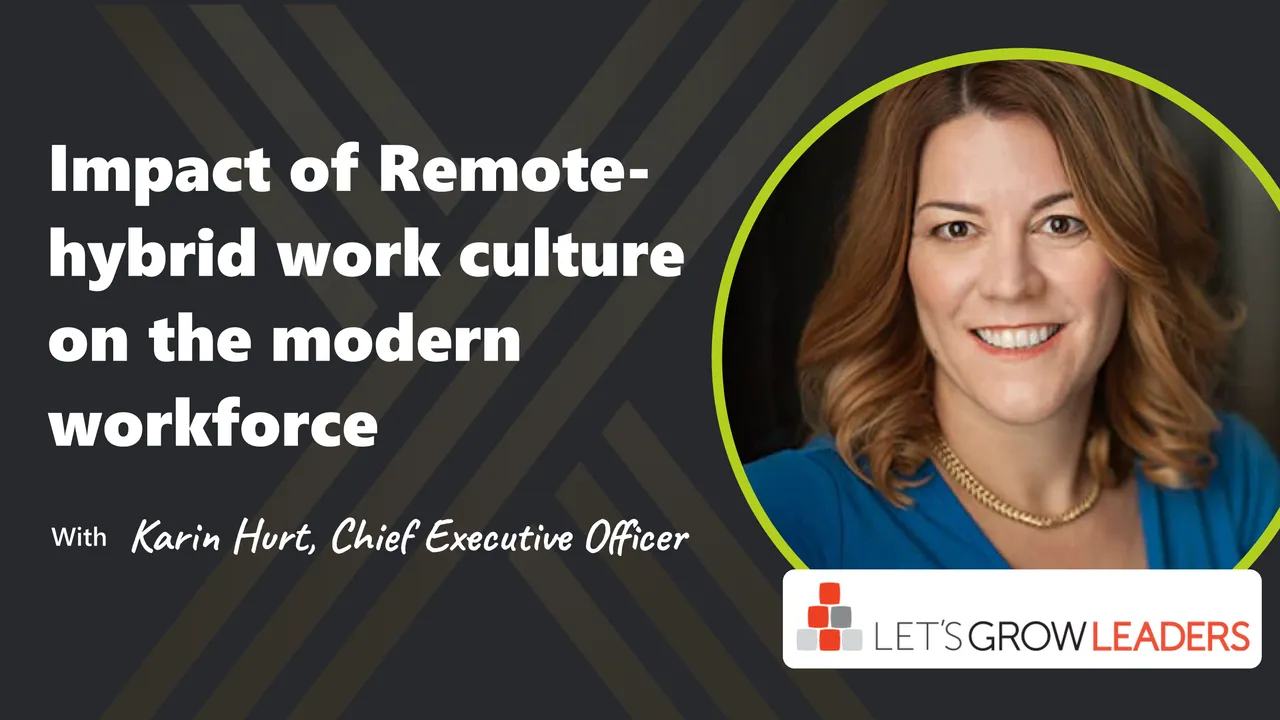
Karin Hurt spent more than 25 years in HR at Verizon Wireless before building Let's Grow Leaders, a training firm focused on human centered leadership development that has helped over 10,000 leaders across more than 14 countries. She is a bestselling author, culture coach and keynote speaker, and Inc Magazine recently named her to its list of the top 100 great leadership speakers.
In this episode of CultureClub X, host Nicole Patrick sits down with Karin to unpack what remote and hybrid work has actually done to company culture. The core question runs through the whole conversation: when the old default ways of working disappear, how do leaders rebuild culture on purpose so that everyone, whether they are in the room or on a screen, still gets a fair shot and an equal voice?
Karin keeps returning to one idea: deliberateness. From the definition of culture she borrows from marketing thinker Seth Godin to the systems that make feedback feel safe, she argues that almost nothing good in a hybrid workplace happens by accident anymore. Leaders have to choose it.
Why hybrid work forced every leader to redefine culture
Karin describes the pandemic as an emotional and strategic pivot that pushed almost every organization into reinventing itself. People started doing things in radically different ways, liking some of it and disliking other parts, and now they are collectively asking what they actually want work to be.
Her favorite definition of culture comes from Seth Godin: people like us do things like this. In a hybrid or virtual environment, that question becomes harder to answer, because people want genuinely different things while the company still carries its own objectives.
What used to happen by default, the hallway chat and the shared assumptions, can no longer be assumed. Karin's point is that leaders now have to take a deliberate step back and ask what they are building, rather than letting culture drift.
How do you keep remote employees from being left behind
A big share of Karin's client work is making sure nobody gets left behind, and she warns that leaders often cause harm without realizing the impact. She shares a leadership program where half the group was in the room and half was online, an accident caused by travel issues, which put her on the hybrid receiving end and forced constant adjustments.
Another session had a global executive on the big screen from London because he had COVID but was only contagious, not very sick. As a professional facilitator, Karin says it took every ounce of energy to keep remembering he was there while the room carried the conversation.
Her guidance is to keep asking how the meeting felt for the people on the other end, and to name the risk out loud instead of pretending it does not exist.
if the advantage is always to be in the room, but you're encouraging some people to work from home. And if that is going to damage careers, damage influence, then you can't pretend it's not.
Why an open door is not enough for honest feedback
The research behind Karin's book Courageous Cultures started from a pattern she kept seeing: senior leaders asking why people would not speak up, while frontline employees told her nobody wanted their ideas. To settle it, her team ran an extensive study with the University of North Colorado.
The ideas people held back were not trivial. They were not asking for kombucha in the break room or virtual Taco Tuesdays. They were sitting on ideas that would improve the customer experience, the employee experience or a process, exactly the ideas a business needs.
The reasons were sobering. 49 percent said they were not regularly asked for their ideas, 50 percent said nothing would ever happen anyway, 67 percent said their manager operated around this is the way we have always done it, and 40 percent said they were simply scared, something Karin calls FOSU, fear of speaking up.
That is why she treats an open door as a start rather than a solution, and why she pushes leaders toward deliberate systems and a real employee feedback loop that tells people what happened with their ideas.
for many people, it still takes courage to walk through an open door and it's even harder if there's no door and there's a zoom
What actually makes people speak up on a video call
To draw out honest input, Karin's team ends leadership programs by staying in the Zoom room until everyone has gone, just as they would linger in a conference room. That is when the juicy questions arrive, often from the three people who hang back once the recording stops.
She also mixes up the medium on purpose. Breakout rooms make it hard for someone to hide the way they can in a room of 25 with the camera off, and priming people to type their best idea into the chat pulls quieter voices into the conversation.
Crucially, she reminds leaders that facilitation is a skill. An IT director has a day job and was never trained to run an engaging virtual meeting, so giving managers real resources and techniques makes a measurable difference.
Deliberate togetherness still beats a free for all
Karin warns leaders not to let the pendulum swing too far toward all remote just because it is cheaper than real estate and travel. One client calls the answer office occasional: be deliberate about the occasions, so people come in for an ideation session, strategic planning or a kickoff, not simply because they can.
She illustrates the point with a conference in Phoenix where an early morning swim with three strangers, all there for the same association, turned into dinners and real relationships. A quiet aside walking to the restroom at an offsite produced a candid ask she doubts would have come over the phone.
A real estate leader told her about a once loved shared room that now sits vacant, because people got used to working their own way and nobody wants to be the only one there. It is a downward spiral, and Karin's fix is to give the space a genuine reason to exist again.
Clarity comes before flexibility
Flexibility without clarity, Karin argues, is a trap. After two years of what one leader called stroking employees' hair and saying whatever you want, please do not resign, she says the real work is defining what success looks like at every level before loosening the rules.
Some roles simply cannot flex the same way. A call center has to plan coverage so customers are not left waiting, so the honest move is to name the parameters, the goal, the budget and the regulatory limits, rather than pretend everything is negotiable.
Her favorite example is her daughter-in-law, a call center employee and foster parent whose company had no foster care policy and invited her to help build one. That respect, Karin says, produced radical loyalty even on hard days.
it's not about lowering expectations unless your expectations are unrealistic, but what success looks like. And then from there, provide some flexibility.
Protecting people from burnout takes real parameters
Karin points to research showing people work more, not less, from home, and admits that even she and her husband and business partner David had to agree to keep business talk out of the living room. Boundaries, she says, are just another form of parameters.
Small deliberate policies help. One client starts every meeting five minutes after the hour so people can exhale, note action items and get water. Amazon protected each person's lunch hour across global teams, which she says also teaches compassion and empathy for a colleague in another time zone.
Another client made emails after 7 p.m. optional to answer, so a message marked urgent still waits until morning. The catch, Karin notes, is that leaders have to live by the rule and not get fussy when someone honors it.
Continuous listening is the closest thing to a hybrid playbook
With no established playbook for hybrid work, Karin's throughline is to keep listening and keep responding. In Courageous Cultures terms she calls it responding with regard: thank people for an idea, tell them what is or is not happening with it, and invite them to keep contributing.
That is where continuous listening earns its place. Checking in with employees regularly, turning what they say into actionable insight from a pulse survey, and actually acting when two or three people raise the same thing is how trust compounds in a distributed team.
The takeaway from Karin's conversation with Nicole is steady and human: hybrid culture is not something you inherit, it is something you build on purpose, one deliberate decision, and one heard voice, at a time.

About the guest
Karin Hurt
CEO, Let's Grow Leaders
Karin is a best selling author, culture coach, Keynote speaker and an HR influencer who helps human-centered leaders resolve workplace ambiguity and drive revenue without burning out their employees. She brings with her over 25 years of HR experience from Verizon wireless. Her current consultancy practice is a training firm focused on human-centered leadership development which has helped over 10,000 leaders across over 14 countries.
She is an alumnus of Wake forest university, University of Maryland and Towson University. Karin was also recently named as Inc magazine’s, Top 100 Great Leadership Speakers.
Full episode transcript
Season 03, Episode 08 · Karin Hurt with Nicole Patrick · 37 min
Hello everyone and welcome to the latest episode of CultureClub X powered by CultureMonkey. I'm your host, Nicole Patrick. CultureMonkey is a complete employee engagement platform that helps people leaders measure and improve their workplace culture.
In the eighth episode of this season of CultureClub X, we have with us Karin Hurt, CEO at Let's Grow Leaders. Karin is a bestselling author, culture coach, keynote speaker and an HR influencer who helps human centered leaders resolve workplace ambiguity and drive revenue without burning out their employees. She brings with her over 25 years of HR experience from Verizon Wireless. Her current consultancy practice is a training firm focused on human centered leadership development, which has helped over 10,000 leaders across over 14 countries. She's an alumnus of Wake Forest University, University of Maryland and Towson University. Karin also was recently named as Inc Magazine's top 100 great leadership speakers. Karin, so good to have you with us here, and welcome to CultureClub X's videocast on the impact of remote hybrid work culture on the modern workforce.
Oh, thank you so much for having me. It's absolutely my pleasure to be here.
Well, before we get started, please tell us a little bit more about yourself and your organization.
So we run a company called Let's Grow Leaders, and we work across a variety of industries, really helping people with very practical skills and tools and techniques to get the results and influence they need and stay a decent human being along the way. We have written a couple of books. Our latest is called Courageous Cultures, How to Build Teams of Micro Innovators, Problem Solvers and Customer Advocates.
Great, well, we have a very interesting and fun videocast ahead of us. So let's get started.
Sounds great.
In the view of the pandemic, what do you think are the challenges faced by people leaders when it comes to company culture with organizations switching to a hybrid work culture?
Everybody has been on some sort of emotional pivot and strategic pivot. There's been a whole lot of reinventing going on and people redefining what culture is, what culture means. And in that, there has been a challenge, because people have done things in a radically different way in many cases than they've done before. People are liking some of that and disliking some of that. I think we're all in this discovery of, okay, what do we want it to be now?
Our favorite definition of culture comes from the marketing guru, Seth Godin. And he says, people like us do things like this. And I think we're all in this mode right now of what is it that people like us do in a hybrid or virtual work environment? One of the biggest challenges we're seeing is that people want different things. You still have your company objectives. So what was happening by default can't be assumed anymore. We now need to take a deliberate step back and say, what are we building here?
Totally.
How do you think HR leaders can solve the misalignment between in-office and remote employees in a hybrid work setup?
One of the things I think you really need to be paying attention to, and we're doing a huge amount of work around this with our clients, is to make sure that nobody gets left behind. Sometimes you think you're doing the right thing, but you don't even know what the impact is. So I'll give you an example. We were facilitating a leadership development program and half the people were online and half the people were in the room. It was somewhat by accident, because there was some travel. Everybody was supposed to be in the room, but there were some travel issues. The meeting planner called me and said, don't get on the plane. You go back to your office. You deal with the remote people and then send David to do the in-person. So we're making this one up. This is not how we had planned it to go. But it gave me such an impression of what it's like to be on that hybrid end. Because I'm watching the room, and if he's too far away, we had to make all these adjustments. Or if they shared a document to the breakout rooms, the document was so big and it was hard to see the people. So I think you need to put yourself on the receiving end of whatever it is you're creating.
The other day I was also facilitating, and they had flown the entire global executive team in, but one guy had COVID. So he didn't come, thank goodness. But he was on the big screen from London, because he was not that sick, he was just contagious. And I am a professional facilitator, and it took every ounce of energy to remember that he was there. Because the whole conversation in the room is going, and here he is on the screen, and how do you have your face to these folks and be cognizant of pulling him in? So I think we need to be having more conversations about what are we doing here, and what does it feel like to be on the other end. Stopping and asking those questions, getting to the end of that meeting and saying, how did that feel for you? What could we do differently? What's one thing we could do differently to make this more engaging for you?
Because that's the real risk of this. If the advantage is always to be in the room, but you're encouraging some people to work from home, and if that is going to damage careers, damage influence, then you can't pretend it's not. So I think we need to be upfront. If we're really creating a hybrid and virtual work environment, and both of those places are okay, then we have to really make sure that everybody gets an equal voice in that process.
That's such an interesting take on it, especially from the view of maybe higher up leaders who really do need to all be in the room together and have their own say. So far, who we've spoken to has more been from the standpoint of a manager and managing their employees under them. But when you're talking about a group of people who really are all on the same level and need to contribute at the same time, it's a very interesting take to have some of the people in the room and then someone else on the screen, and how that can in a way damage their careers if we don't navigate a way of really making sure that everyone gets a piece of the pie and is able to contribute. It's not something I've discussed before, so it's very cool to hear.
And I totally agree with you that communication is so important. What worked for you, what didn't work for you, how can we go forward? With the hybrid workforce now, communication is one of the most important things you can do, because it's important to still have that community sense with your coworkers, what you would do at the water cooler and just have that little chat. But more importantly to see, how is this working for you? How can we make this better for everybody, not just you and me, but for the entire company culture?
What do you think is the importance of bottom-up feedback in a hybrid work environment? And how do you think it can improve any team's employee engagement?
We have been spending a lot of time thinking about this. The research that grounded our latest book, Courageous Cultures, was all about this, because we were noticing a consistent pattern. We would work with very senior leaders across a variety of industries, and we would hear things like, why don't people speak up and share out their ideas? If there's a problem, why don't people just tell us? Why are people not sharing best practices? That bottom-up feedback, why aren't we getting it? And then we would go in and do training at the front line of these very same organizations, and we would hear, nobody wants my ideas. The last time I spoke up, I got in trouble. Nothing's gonna happen anyway, so why bother?
So we went and did an extensive research study with the University of North Colorado to answer that question. When people were holding back ideas, what kinds of ideas were they holding back? And they weren't trivial. It wasn't, oh, I wish we had kombucha in the break room or virtual Taco Tuesdays. They said they were holding back ideas, get this, that would improve the customer experience, the employee experience or productivity in a process. Ideas you really need.
And then we asked, why were you holding back these ideas? 49 percent said, I'm not regularly asked for my ideas. Bottom-up feedback. 50 percent said nothing will ever happen anyway. There's not a feedback loop that goes back to let people know what's happening with their ideas. 67 percent said my manager operates around the notion of this is the way we've always done it. And 40 percent said, I don't have the confidence to share my ideas, I'm scared. We call that FOSU, fear of speaking up. So that's real, because that was an extensive study all around the world across industries. And that's not just in a virtual environment. That study was done before the virtual environment, and now it's even more important.
So we've got to be proactive and we've got to ask. Saying I have an open door is good, I'm a big believer in an open door, but it's not enough. Because for many people, it still takes courage to walk through an open door, and it's even harder if there's no door and there's a Zoom. Or I go into a one-on-one and the one-on-one is one way, and they're just telling me what I need to do and they're not asking me. So this bottom-up feedback is so vital, and really putting in systems and processes to make it be deliberate.
When we do our leadership programs, we always end and say this. We will stay in this Zoom room until everybody is gone, just as if we were in a conference room with you, because that's when the really juicy questions come. You have to be deliberate about that, because a lot of times people are afraid to raise their hand and ask the question in front of 25 of their peers. But if three people hang back, they're like, you know what, the thing is, my boss is really not courageous, so please turn off the recording, and now I'm gonna ask you the real questions. That's where a lot of my, I run a show called Asking for a Friend, and that's where all of these asking for a friend questions come from. So I think putting an infrastructure in place is so critical. And then checking in with how is that infrastructure working? Are people using it? And if they're not, then not being afraid to say, what's going on here and what else might we need to do?
It's so cool to see the way that, because this really is your job, you go in there and you're able to get into the nitty gritty with people from all different organizations. It's so cool to see the way that you're almost changing the way that these Zoom meetings work and these hybrid meetings work, and just saying, just like if we're in a meeting, you stay back to the end, we'll stay back to the end. Because people really do need to start feeling comfortable with something new like being on FaceTime meetings where they might not have been comfortable a year ago. It's gonna take a little bit of time for people to grow that courage and say, okay, it's not that big of a deal if I'm in a meeting with 20 people and it's a FaceTime or Zoom, to just have my voice heard and say what I need to say.
Just like in a regular workplace, you have to foster that environment of saying, it's okay. Let's ask you questions, let's talk to you, and make this an open space and a culture where everyone feels like their voices are heard, and when they say something, it's not a burden on other people. So if a company doesn't have that culture already in place, then it's really not gonna be in place when you're on a Zoom or in a hybrid workplace. So it's something you have to target from both standpoints.
Yeah, I would add two things to that. One is, be very deliberate in mixing up your medium. Breakout rooms are so valuable. If we're facilitating a meeting and people are reluctant, let's do breakout rooms, now come back and report. Because it's hard to sit in a breakout room with three other people and not say anything, but you can sit in a room with 25 people and try to hide, especially if you turn off your camera.
And then the other is using the chat. We say, put your fingers on the keyboard. In a minute, we're gonna ask you for your very best practice about this. And then people see the chat, and then you're calling in the ideas. And you can say, oh wow, thank you so much, John, that was a great point, can you tell us more about that? Now you're calling more people in. So helping your leaders be trained on how to facilitate these meetings, and not assume, because they've got day jobs. If you've got an IT director, they've not necessarily been trained on how to do that. So giving them some resources and some skills of how to do that well can really make a difference.
Totally. I recently was in a meeting and, just like everyone, for me Zoom is newer, and I'm not used to always using it for meeting settings. And I was in a meeting recently where they had everyone do little exercises in the chat. In the beginning, they were asking questions no one really wanted to answer, and everyone was kind of shy and we were all new to Zoom. And then once we did one or two exercises, suddenly there were too many to even pick, because everyone was in the flow and everyone felt like, okay, we're all doing this, this is comfortable, this isn't so scary. I'm not the only one contributing to the chat now. So I definitely agree that having little exercises like that, mixing it up, is so important. Just like when you're coming to a new workplace and you're doing fun little exercises to break the ice. Even for every different meeting that you're having, to have a little ice breaker like that is so important to get the juices flowing and get people going.
The hybrid work culture has forced organizations to take a hard look at their employee relationships and cultural practices. What can organizations do to truly improve the employee experience and retain top talent?
So one thing I would say is, let's not let the pendulum swing too far. There is value in being together in person. If you make these decisions from a purely financial perspective, wow, it's way cheaper to not have all this real estate, true. Our virtual kickoff, bringing all of our people together, will cost us 100,000 dollars if we fly everybody in and give everybody a hotel room. We could do it on Zoom for free. All these things are true. And I will tell you that we do tons and tons of virtual. And we're starting to see some of our clients bring people back together. To be deliberate, we have one client, they call it office occasional. Be deliberate about your occasions. Not just say you can come in whenever you want. Why would you want to come in? You're gonna come in for an ideation session, for a strategic planning session, for a kickoff, because it is hard pressed to replicate what happens when people are in the room.
I'll give you an example. I just went to a conference. It was a conference of people like me, CEOs and presidents who run training companies. I joined this association a couple of years ago, right before the pandemic. I'd only been in a virtual room with all of these people, but I have built some real relationships. First morning I get up, it was in Phoenix, so there was an outdoor pool. I'm training for a triathlon, so I went and swam in this outdoor pool at six o'clock in the morning. Well, there were three other people from the conference who were swimming in that outdoor pool. At the end, we're sitting there with our goggles on, and I'm like, are you here for ISA? Oh gosh, you wrote that book? That 15 minutes we had standing there, for the rest of that conference I ate dinner with one of those guys. And I don't think we would have had that level of relationship if we hadn't had that human moment.
Or the other day I was facilitating a strategic offsite, just a small group, and walking to the ladies room, one of the senior female executives, mostly men in the rest of the thing, said, can I just pick your brain about something? Would she have picked up the phone and called me afterwards? I'm not sure. So be deliberate, keep some money in your budget to bring people together, especially as it gets safer and safer. As it becomes genuinely safe for people and people feel comfortable, make the effort to bring people together and do it well.
I was talking to a real estate company last night, and he said, we have this room in our office and it used to be great, because the real estate agents are all dispersed. There are printers there, there's stuff, people come in and do the stuff. Well, since the pandemic, everybody got used to doing it their own way, and now people don't come together to do the stuff anymore. And this beautiful room that used to be a source of inspiration and best practice training sits vacant. He says, I don't understand it, because people love the room, but nobody's coming into the room. And they're like, I don't want to go to the room because nobody's gonna be in the room. So it's a downward spiral. So he's like, how do I make that room attractive again?
Totally, and it's just like you said. If you're telling your employees, oh well, you can come in, see what you want to do, employees are gonna go into the office, and when they go in they're not gonna see other people there, they're not gonna be connecting with them, and they're not gonna want to come back, just like the real estate office room. If you're there in an empty space, it's totally different. If you deliberately have reasons to come in, reasons to be excited and to connect with people, then you're gonna still be able to foster that environment that we had pre pandemic, and hopefully still have those conversations that 15 minutes after swimming will now give you potentially a lifetime of a working relationship with somebody. Those are things that unfortunately we really can't replicate on the computer.
I do hope that it is like a pendulum. Before, we were in the office 24/7 and we couldn't get away from it, and now it's sort of becoming, okay, we're only ever at home. Hopefully people will really start to miss that human connection and want to come back into the workplace. If not the way it was before, maybe not living in the office, but some sort of happy medium between the two to keep those connections alive.
Yeah. And I think it's also going to, I don't know if democratize is the right word, but when I was at Verizon, there was a big rule that once you got to a certain level, you had to relocate your family to Basking Ridge, New Jersey. Well, there are a lot of people that stopped their career growth. I got a kid in this, I got a husband with that, I got a wife with this, no, I'm not going to. And then it was like, okay, well, we're taking you out of succession planning then. And now it's really frustrating to me, because now it's, oh, work from anywhere, no big deal. So I think you're really truly going to have the best talent in those leadership positions, because it's not giving an unfair advantage to people who can't continue to relocate. So we've just got to figure it out. Like I said at the beginning, what is the new normal for us here?
Exactly. It's just navigating the best practices and how we can make this work for us and for everybody, so that you do have the top talent and that the top talent is happy, and they're not relocating their family and having their spouses have to quit their job or not be able to get ahead, because they care about their spouses and their spouses have an equally important passion or career in life. So I completely agree with you.
How can people leaders balance the needs of their employees to work on their own terms while maintaining great company culture? How do you think HR policymaking can play a role in solving this?
Yeah, it's funny. It was after a training program, one of those stay behind women, and she said, I feel like we've spent the last two years stroking our employees' hair and just saying, whatever you want, whatever you want, please don't resign, please don't resign. And she said, that's not been particularly helpful. It was at the beginning, yes. At the beginning, we just had to make sure everybody was okay. And she's like, I'm all about concern for the mental health of our employees and we need resources. And we also have a business to run.
So it really comes down to, what are your expectations? Are you clear about what success looks like? That's the start. At every level, what are the strategic, most important things happening in your business? What are the most strategic important things happening in your department? Do people have clarity in their role? And then from there, it's a conversation of how can we achieve these things without the rigidity that we've had in the past? In the past, you absolutely had to be in the office, at your desk, from this time to this time, and anything else, you're not doing your job, even if you're accomplishing the results. So now we have to say, okay, this is what success looks like. What's the best way to get there? Is it being in the office a certain percentage of the time? Because some jobs are not that flexible. If you are running a call center organization, you cannot have people make up their own schedules. You've got to rigidly plan out who's on those phones so customers can call in and not have a wait time.
But an example, my daughter-in-law works for a call center company, well, she does call center for a stroller company. She is also a foster parent. My son and daughter-in-law foster babies. And they didn't have a foster care policy. Like, oh, you take on a new baby, is that maternity leave? What is that? It's complicated. So they went to her and said, why don't we build this policy together? Because you're our first foster parent, but you're not gonna be our last. So this is what success looks like. And I was so impressed with that. And how loyal is she? Radically loyal. She's got a complicated life, and on a bad day it might be easier to say, you know what, but she is loyal. So that's what we need more of, that conversation. But it's not about lowering expectations unless your expectations are unrealistic, but what success looks like. And then from there, provide some flexibility.
That's so cool that they did that with her. If you're with a company and you're creating, for her to be creating that policy with them is so cool, and would hopefully make her very loyal, as well as hopefully the company to have a lot of respect for her and people that are doing what she's doing. When you give employees respect and power, even if it's just a little bit of power of saying, what is it that you want, what is it that you would like, and how can we accomplish the goals together, what do you want to see on your end, what's gonna make you happy? And when you're happier, you're gonna work harder. When you're at a job that you enjoy, that you feel heard and respected, you're going to want to come in every day. You're not gonna want to say, I'm not feeling too well today, I'm not gonna give it my all. So I completely agree with everything you're saying.
And you don't have to give everybody, you still have to set the parameters of what success looks like. So we need to accomplish this goal with this kind of budget under these circumstances, under this regulatory, right? Because we still have customer privacy stuff. We have to care for all those things. And I think sometimes managers think, well, I have to be the one to think about that. No, tell them the parameters. Because just because somebody says they would like to have filet mignon every day for lunch, delivered to their house, does not mean that you have to deliver filet mignon every day. And I think some, especially fast-growing companies, are like, whatever you need, just take it, take it, take it, which is not a sustainable model. And they're not going to have a healthy business with that either.
Exactly.
How do you think leaders can address burnout and attrition issues in the hybrid work environment? And how can technology solve that problem from your perspective?
Yeah, so there's so much research out there that says people are working more, not less, now that they're working from home. And I think we have to be very, very careful about that, because your office is your home. And I will tell you that even running our company, David is my husband and also my business partner, we're starting to have to really think about this. We were talking this weekend, and I said, maybe we should only have business conversations in your office or mine. Not in the living room. And certainly not in the bedroom. And that's an example of parameters.
We have one client who I think this is really brilliant. They start every meeting five minutes after whatever the natural time is. So after the hour, after the half hour. So instead of our meeting starting at 10, we would have started at 10.05, because that gives everybody five minutes. And then you always end on the hour or the half hour, or shorter. It gives people a minute to close out, write down their action items, get a drink of water, whatever they need. And they have said that they find that that's letting people exhale.
We have another client, this is actually with Amazon, they made a rule that whatever your lunch hour was, was protected. Which is interesting because these are global teams. So you've got somebody in India, somebody in the Philippines, somebody in Las Vegas. But if you are on my team, I have to be sensitive to where you are. I have to have something on my wall to say, okay, it's Subhajit's lunch hour, so I'm gonna have to wait and call him after. And that also makes a sensitivity, it's also teaching compassion and empathy. And if you want to go work out during that hour, there is no expectation that you are at your computer. So it's again communicating about these things, and creating some deliberate policies.
Another client said, and this could still feel late for some, but no emails after 7 p.m. You can send it, but you are not required, obliged, or even encouraged to respond to an email after 7 p.m. So know that if you sent something after seven, it will be there, it will be responded to in the morning, even if you put urgent. And then you've got to really live by those things. If you say that's how you're gonna be, but then you get fussy if somebody didn't respond to your urgent email at 7.05, then you've got a challenge too.
Totally. That's really a great idea, doing everything five minutes after. Because we do have calls back to back and you don't get that second to decompress, to write down what you need to do and finish out one thing, get started for the other. It can become too much, just like we were in the office pre pandemic, when many people were in the office too much and living there. And now it can totally become, from morning to night on your computer, on your cell phone, every way that technology is already taking over our lives, to now be doing it with business as well.
Another thing, for CultureMonkey, being able to use the technology of reaching out to your employees and checking in with them every single day, keeping the pulse of employees, seeing how we can gain actionable insights from what they're saying to us and then actually act on that, and make sure that we're not just reading it, but putting in place whatever changes need to happen. If you have two or three people saying the same thing, that's a really great way you can use technology now, which we didn't really have those tools two or three years ago.
Yep, absolutely. And we call that, in Courageous Cultures terms, we call that Respond with Regard. If somebody has an idea, you've got to let them know what's happening with it. Gratitude, thank you for the idea. Here's what's happening or not happening with the idea. And an invitation to continue to contribute.
Exactly. And then you're gonna find people doing it more and more, and you're going to have not only a better company culture, but a better company and more ideas. Who doesn't want more ideas, and to have people really getting into thinking and not timidly saying, well, that may have been a good idea, but I'm not gonna be heard, everyone's gonna ignore me anyway. That's where great ideas go unheard, when people are too shy to say them or don't feel empowered enough to say it.
Right, right.
Well, these were some very interesting insights, Karin. Your way of seeing this evolving topic through the lens of a culture specialist is so unique. Thank you so much for coming on with us.
Absolutely, my pleasure. Thanks for having me.
With the lack of a playbook or best practices around managing hybrid workforces, the role of continuously listening to employees takes more spotlight now than ever before. People leaders must dynamically evolve with these trends to ensure they're able to predict and solve for such situations in the future. To listen to employees constantly, technology such as CultureMonkey can be their greatest asset. CultureMonkey's employee engagement platform enables HR leaders and managers to listen to their employees' needs, analyze their feedback, and act on them in real time. So log on to www.CultureMonkey.io today and see how we can help you improve your company culture.
With that being said, thank you so much for your time today, Karin. This has been such a learning experience for all of us, and I'm sure our viewers at home will agree too. So before we finish, please let our viewers know how they can reach out to you in case they want to have a quick chat or share some thoughts.
Absolutely, so our website is letsgrowleaders.com. And if you go to books, you can download the first couple of chapters of Courageous Cultures there, and the foreword by Dr. Amy Amundson, for free. So that's a good place to start. I'd love to connect with you on LinkedIn. It's Karin with an I, Hurt, H-U-R-T. Love to connect, hear what you're doing. I run a show called Asking for a Friend. So if you've got tough leadership questions, tough culture questions, send them our way, and you never know, they might be a topic for Asking for a Friend.
Great. Well, that's all we have for you in this episode of CultureClub X powered by CultureMonkey. Until next time, this is your host, Nicole, signing off.
Frequently asked questions
What are the biggest culture challenges of shifting to hybrid work?
Karin Hurt describes the shift as an emotional and strategic pivot that pushed organizations into reinventing how they work. People started doing things in radically different ways, liking some of it and disliking the rest, and are now collectively deciding what they want culture to be.
The core challenge is that what used to happen by default can no longer be assumed. Leaders have to take a deliberate step back, borrow a working definition of culture, people like us do things like this, and consciously choose what they are building.
How can leaders make sure remote employees are not left behind in hybrid meetings?
Put yourself on the receiving end of whatever you create. Karin recommends facilitating with the remote experience in mind, then ending meetings by asking how that felt for you and what one thing could make it more engaging.
She warns that if being in the room is always the advantage while some people are encouraged to work from home, careers and influence can quietly suffer. Naming that risk out loud, and making sure everyone gets an equal voice, is the fix.
Why do employees hold back good ideas at work?
Karin's research with the University of North Colorado found people were sitting on ideas that would improve the customer experience, the employee experience or a process, not trivial requests. The reasons were structural: 49 percent were not regularly asked, 50 percent believed nothing would happen anyway, 67 percent had managers stuck on how things have always been done, and 40 percent were simply scared.
Her answer is to be proactive and deliberate. An open door helps, but it is not enough, because walking through it still takes courage. Systems, prompts and a visible feedback loop lower that bar.
How do you get people to speak up on video calls?
Karin's team stays in the Zoom room until everyone has left, which is when the most honest questions surface. She also mixes the medium, using breakout rooms where hiding is hard and priming people to drop their best idea into the chat so quieter voices get pulled in.
She stresses that facilitation is a trainable skill. Managers with day jobs were never taught to run engaging virtual meetings, so giving them resources and techniques makes a real difference.
How can companies prevent burnout when work happens from home?
Because the office is now the home, Karin says people are working more, not less, so boundaries have to be deliberate. Practical policies help: starting meetings five minutes after the hour to let people exhale, protecting each person's lunch hour across time zones, and making emails after 7 p.m. optional to answer.
The catch is that leaders have to live by these rules. If you set an expectation and then get fussy when someone honors it, the policy collapses.
Read the cross-episode roundups
More from CultureClub X
 S07 E02change leadershipHR as Chief Disruption Officer: Why Supporting the Business Is a Ceiling, with Jennifer McClure
 Jennifer McClure
 S07 E01employee engagementWhy is employee wellbeing spending not paying off? | Gethin Nadin, Benifex
 Gethin Nadin
 S06 E18ai in hrShould HR use AI to cut jobs or make people more valuable? | Steve Cadigan, LinkedIn's first CHRO
 Steve Cadigan
Never miss an episode
Every new episode, plus the takeaways that matter, posted on the CultureMonkey LinkedIn page as soon as they drop.
Free on LinkedIn. Unfollow anytime.