

S03 E12
Using Technology to Improve Employee Retention
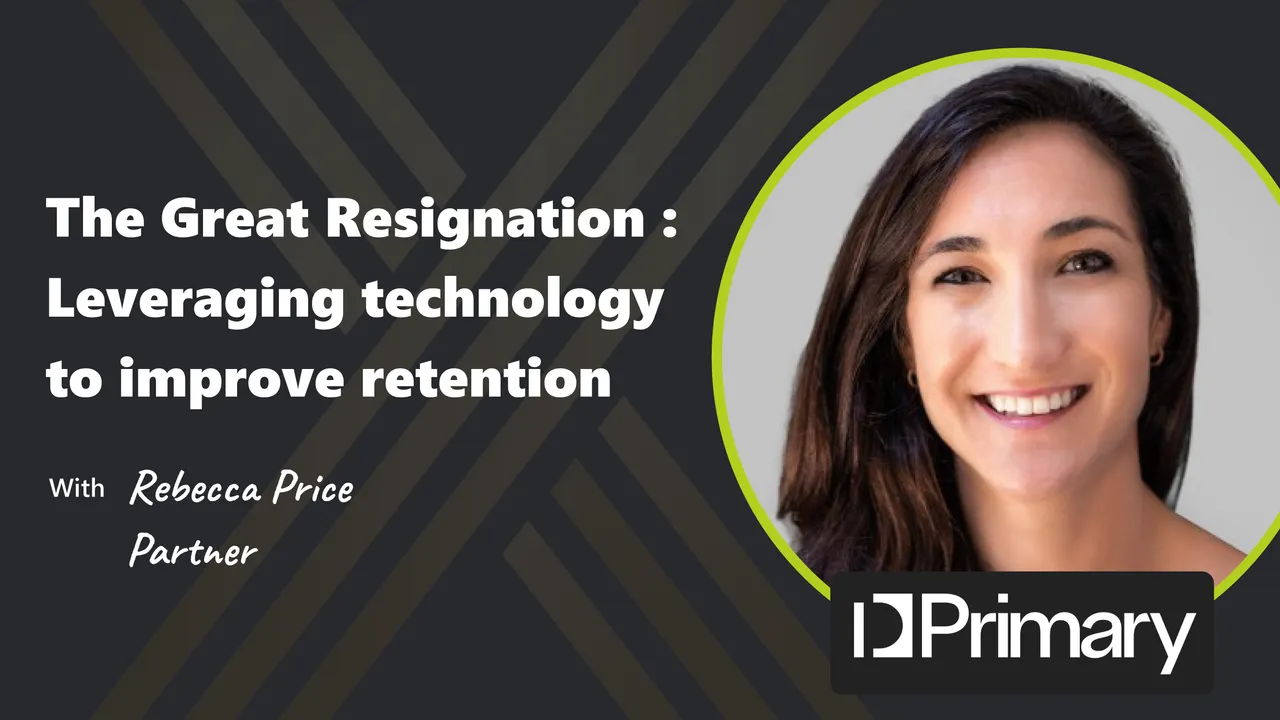
From purpose-driven work to flexible environments, Rebecca Price explains how technology empowers managers and connects employees, helping organizations retain top talent and navigate the challenges of the post-pandemic workforce.
TL;DR
What you need to know from this episode
- The Great Resignation had visible warning signs. Supply and demand had been tipping towards the talent market for years, and companies kept losing people to whoever paid more. The pandemic simply gave everyone forced permission to turn the whole thing upside down.
- Employees stay for one of three hooks: mission, work, or people. Rebecca Price asks leadership teams to articulate what motivates every single employee. Retention starts with knowing which hook keeps each person connected, because three people on one team can be driven by three different things.
- Intrinsic motivation beats perks. Autonomy, mastery, and purpose drive people's best work and truest fulfillment. Rewards and recognition have their place, but they are not what unlocks lasting engagement.
- Frontline managers are the most critical layer in any organization. Information flows up and down through them, yet the system routinely lets them down. Moving every manager one point up the scale matters more than chasing perfection.
- Treat departures as graduations, not failures. Stay interviews every six to 12 months mean no resignation comes as a surprise. The goal is not 100% retention; it is doing right by people while both sides get value from the time together.
What if the Great Resignation was never really a surprise? In this episode of CultureClub X powered by CultureMonkey, host Nicole Patrick sits down with Rebecca Price, partner at Primary Venture Partners, an early stage VC for startups, to dig into why employees have been leaving in record numbers and what leaders can actually do about it. In her current role, Rebecca focuses on people operations, talent, and networks, working closely with founders on their journey from founder to CEO.
She brings rare range to the question. A three-time former chief people officer who, in her own words, grew up in corporate America, Rebecca started out in Johnson & Johnson's rotational leadership development program and went on to become the first head of people and chief people officer at the startups Sailthru and Enigma Technologies. Today she helps seed stage companies get launched and build great places to work.
Her opening caveat frames the whole conversation: when it comes to people and talent, the answer is it depends. It depends on the person, their needs, the culture, the founders, and the product. Patterns exist across the industry, but humans are still individuals at the end of the day, and retention strategies that forget that are the ones that fail.
Were there warning signs before the Great Resignation
Rebecca is careful not to shame anyone who felt blindsided. It is easy to feel surprised in the moment and easy to have hindsight later, and the best any leader can do is adapt to the information available today and make smart decisions. That said, she believes the clues were there.
She watched the 2008 crash send well educated friends packing up their desks, which shaped a generation that values work as a stable paycheck covering the base of Maslow's hierarchy. But anyone who entered the workforce from 2009 onwards has only ever seen a rising economy, with venture capital creating ever more companies and jobs. The balance of supply and demand tipped steadily towards the talent market.
Inside tech companies, anyone with an in-demand skillset who picked their head up could find another job that paid more, so employers kept hunting for their lock on people. Employees were clearly seeking something more, and distributed pioneers like GitHub and InVision had already shown remote teams could work. The pandemic did not create the shift; it gave everyone forced permission to turn the whole thing upside down.
Why COVID stripped work down to its basics
Asked whether the Great Resignation is the linchpin pushing companies towards employee centric models, Rebecca reframes the question. She finds it hard to separate the resignation wave from the pandemic, because one is the result of the other. Stuck at home, perhaps alone or juggling childcare, people lost the commute, the colleagues, and the social, spiritual, and emotional aspects that surround office work.
What remained was a person and a computer, and an unavoidable question: is this what I want to be doing? COVID stripped work down to the basics and forced people to ask themselves hard questions. Much of the churn that followed was, in her view, a healthy shakeout, with individuals realigning their personal selves against mission, work, and community, then leaving where they found misalignment.
Her own story makes the stakes concrete. For 20 years she left home in the morning and got back around seven, sharing dinner with her two kids only on weekends. The pandemic gave her family dinner together almost every single day, and she is not willing to give that up. Leaders demanding a return to butts in seats, she argues, are simply tone deaf to what everyone has learned.
What actually hooks an employee to a company
Rebecca's retention model rests on three hooks. Some employees connect through mission: whatever their specific role, they love the product and the bigger purpose. Others connect through the work itself, the problems they solve and the code they write. The third group stays for the people and the community around them.
So as an employer, you need to have a true understanding of each employee. It's like, what's truly motivating them? Why are they here? Is it the mission? Is it the work? Is it the people?
As an HR leader, she required her leadership teams to hold a clear articulation, for every single employee, of what motivates them and why they are here. Three people on the same team might be driven by three different things, and each needs to be managed towards what drives them personally. Reading employee sentiment at that level of granularity is what separates companies that retain from companies that merely react.
How autonomy, mastery, and purpose drive retention
Beyond the hooks, Rebecca points to intrinsic motivation, an idea she believes leaders forget in every climate. Extrinsic motivators like rewards and recognition have their place, but people's best work and truest fulfillment comes from within. The theory reduces to three needs: autonomy, mastery, and purpose.
People want the right to self-govern, to pick their conditions and choose their work. They want to keep growing and learning. And they want to know how their work connects to something bigger. The pandemic created the perfect environment for intrinsic motivation to shine, as people realized that dropping the commute opened up more options and asked whether this was really the work, and really the people, they wanted.
For founders building culture from a blank page, her first piece of advice is amazing self-awareness: journaling, meditation, or therapy to understand what you value, how you act under stress, and what you need in conflict, because those attributes become the essence of why people join and stay. The same advice scales to giants like Johnson & Johnson, where micro cultures form around every single manager.
Why personas and stay interviews beat exit interviews
Before recruiting anyone, Rebecca says, you must be able to articulate why someone would come work for you, why they should take this job, and why they should stay. She borrows from marketing: just as sellers define an ideal customer profile, candidates have an ICP too, an ideal candidate profile describing the persona, where to find them, and why they would join.
At Enigma, where over 80% of the company were engineers and data scientists, her team studied their most successful people and found multiple personas: the mission-driven engineer, the hard problem solver, the team player, and the one connected to the product. Recruiters running phone screens had to bucket each candidate into a persona so the work could be aligned to their motivation from day one. Compensation theories back her up: more money does not actually drive retention; connection to the meaning of the work, the people, and the product does.
Exit interviews are as old as time, but that's too late. Rear view mirror, you've lost that person.
Motivation also changes over time, from first job to new parenthood to a move into tech, so the conversation has to be continuous. Stay interviews every six to 12 months, asking what excites you, what concerns you, and what advice you have, mean a resignation should never come as a surprise. The goal is not 100% retention; it is knowing where each person is headed.
Where technology genuinely helps managers retain people
Asked how leaders can leverage technology for retention at scale, Rebecca refuses to offer a silver bullet. If she could give only one answer, it would be this: help your frontline managers. Full stop. Most people in any company report to a frontline or middle manager, and executive information flows up and down through that layer, yet the system routinely lets them down.
Frontline managers, middle managers, they are the most important, critical layer in any organization.
Her approach as a one-person people team at a startup was incremental: rather than making every manager a 10 out of 10, move a two to a three and a seven to an eight. The toolkit includes clear expectations, guidance on running one-on-ones and giving feedback, manager cohorts that learn from each other, and 360 reviews. Building managerial effectiveness this way pays back across every team a manager touches.
Technology helps with the mechanics, but she cautions that engagement surveys are just data; you still need the brain power to understand what they are saying. And in a distributed world, the human side matters more than ever: GIFs that make people laugh, quick Loom videos, daily no-agenda touch points, and skip level conversations that make junior talent feel connected to the bigger purpose.
Why a resignation should feel like a graduation
At Johnson & Johnson's headquarters, Rebecca remembers a long hallway of plaques marking 25 year anniversaries, and remembers thinking in her early 20s that an entire career at one company was unimaginable. That is simply not how people work anymore, especially in tech roles and urban environments. If tenure may be short, both sides should get real value from the time together.
That means treating each role as one step on an employee's journey: training people towards their next job, helping them become ambassadors of your brand, and normalizing that people come and go. When someone's trajectory diverges from the company's, you reach an impasse, and that is okay. Handled with dignity, care, and respect, a departure feels more like a graduation than a resignation, and exits on good terms become role models for everyone who stays.
Rebecca also notes that the cycle never stops. Speaking in late May amid layoffs and a contracting market, she suggests the era of high demand and low supply may be tipping into a new wave that will reshuffle people's motivations, needs, and expectations all over again.
What this means for your employee listening strategy
Nearly every practice Rebecca describes runs on listening. Understanding each employee's hook, articulating their motivation, running stay interviews, and keeping frontline managers close to their teams all depend on hearing what people actually think, then acting on it. As Nicole notes in closing, the one solution for people leaders is an enhanced focus on listening to employees to understand their needs better.
The infrastructure matters precisely because, as Rebecca warns, surveys alone are just data. A pulse survey tool that surfaces how employees feel in real time gives managers the raw material, but leaders still supply the judgment, the honest conversations, and the follow-through. That combination of continuous listening and decisive action is what turns the lessons of the Great Resignation into durable retention.

About the guest
Rebecca Price
Partner, Primary Venture Partners
Rebecca is a seasoned CHRO and people leader. She has worked in HR at Johnson & Johnson’s esteemed rotational Leadership Development program across a wide range of HR specialty groups, business units, and cultures. She also moved to operate as the first Head of People and Chief People Officer at startups Sailthru and Enigma Technologies.
Rebecca has spent her career focused on bringing the best out of people, building strong teams and workplaces. She believes in laying the foundations for strong people processes on which companies can scale. An alumni of University of Pennsylvania and Columbia University, she holds a bachelor’s degree in Psychology and masters in Organizational Psychology.
Full episode transcript
Season 03, Episode 12 · Rebecca Price with Nicole Patrick · 41 min
Hello, everyone, and welcome to the latest episode of CultureClub X powered by CultureMonkey. I'm your host, Nicole Patrick. CultureMonkey is a complete employee engagement platform that helps people leaders to measure and improve their workplace culture.
In the 12th episode of this season of CultureClub X, we have with us Rebecca Price, partner at Primary Venture Partners, an early stage VC for startups. In her current role, Rebecca focuses on people operations, talent, and networks. She works closely with founders on their journey from founder to CEO and helps scale their businesses and teams.
Rebecca is a seasoned CHRO and people leader. She has worked in HR at Johnson & Johnson's esteemed rotational leadership development program across a wide variety of HR specialty groups, business units, and cultures. She also moved to operate as the first head of people and chief people officer at the startups Sailthru and Enigma Technologies. Rebecca has spent her career focused on bringing the best out of people, building strong teams and workplaces. She believes in laying the foundation for strong people processes on which companies can scale. An alumni of University of Pennsylvania and Columbia University, she holds a bachelor's degree in psychology and a master in organizational psychology.
Rebecca, it's great to have you with us today. Welcome again to the CultureClub X videocast on the great resignation and retention challenge, and its global impact on organizations. Before we begin, please tell us more about yourself and your organization.
Yeah, great. Well, thanks for having me. Anything that can help companies and teams build great places to work is a topic that I love to participate in and talk about. So that was a great introduction. I'm a three-time former chief people officer who grew up in corporate America, and I think that's the best way to sum it up. My work now is working with startups, seed stage companies at Primary, and helping those companies get launched and build great places to work, and helping those founders launch the products that they dream of launching.
And that's really it. I try to be as bespoke and custom as possible. So while this topic and many others, you can see pattern recognition across the industry, and I can learn from the multiple reps I have behind me, I also think when it comes to people and talent, the answer is it depends, right? It depends on the person, it depends on their needs, it depends on the culture, it depends on the founders, it depends on the product. So I want to keep that in mind as we talk today, because while there are themes and learnings, humans are still individuals at the end of the day.
Absolutely. And we're really excited to have your take on things. This is our 12th episode for this season, and this has been a topic we've spoken about a lot. And it's really interesting to see different people from different career paths and their take on things. So I'm very excited to hear your take on everything, especially right now when the landscape is changing so much. So let's get into it.
Many HR experts say that organizations were caught off guard by the great resignation. Were there signs of this drive that people ignored before the pandemic struck? What could be the factors that drove this paradigm shift in employee expectations?
Yeah, I think it's easy to feel surprised in the moment, and then it's easy to look back and have hindsight. So I just want to say, don't beat yourself up over this if you feel like you were surprised with something. The best that we can do is just adapt to the information we have today and make smart decisions.
All that being said though, I'm old enough, I don't know how old your listeners are, but I'm old enough to have experienced the economy crash in 2008. And to see friends and colleagues, I fortunately was in a role that was more stable, but I saw friends and colleagues, well educated, well in jobs, pack up their desks. Their companies totally crashed in 2008. And so there is a generation of people who appreciate work for just that it's a paycheck, that it's stable, that on Maslow's hierarchy of needs they're able to provide the food, water, shelter for their family and lives.
But anyone who entered the workforce 2009, 2010 and beyond has only ever seen a rising economy, and that's awesome. There's always been jobs, especially in tech, especially in cities. And then the venture money, more capital has entered in the system, which has also created more companies and more jobs. So particularly in the last several years, we've just seen the balance of supply and demand really tip towards the talent market.
Again, I know I'm talking about the tech industry and specific niches over there, because I know for services or other jobs it's quite different, but very specific on the tech industry, if you had a skillset that a tech company needed, you could likely find a job. If you picked your head up, you could likely find another job that paid more money, because another company could always pay more. And so I've been inside those organizations where I was challenged around engagement and retention. And another company could always provide more money, more perks. So we were always trying to find, what's our lock? And I think those were our signs that employees were seeking more, seeking something, and companies needed to be doing things differently.
I don't think it was until the pandemic that we really had forced permission to turn the whole thing upside down. But you saw companies like GitHub, InVision, these companies that were always distributed, started in a distributed way, pioneered that it could work. So I do think there are clues, but it's so easy to say that now.
It's kind of like the pandemic just sped things up a little bit. It was a black hole for us to bring us to the other side a little bit quicker.
Yeah, and I do think the pandemic forced people who were really scared of change, forced people who were really stuck in their ways, even more old fashioned thinkers who felt like butts in seats, nine to five, clock in, clock out, work has to be done in person. There's people who rigidly held those frameworks who otherwise would have been 100% resistant to anything, but COVID forced us to even try it. And I think a lot of people learned, maybe even shattered their ideas that they were so tightly held in the past, that work could even get done, that our product could continue, that our company could continue, that distributed teams could work.
I'm not saying distributed teams are perfect. I'm not saying all distributed teams are created equal, but you saw the economy continue, and sometimes some industries even thrive despite being distributed. So when faced with no choice, you can disrupt your tightly held beliefs.
Exactly, I completely agree.
Do you think the great resignation is the linchpin that will lead companies to adopt a more employee centric model?
I think it's really COVID. It's hard for me to separate the pandemic and the great resignation, because I think they're so tied together. The great resignation is a result of people being forced to their basic survival needs, right? People were faced with being at home, perhaps being alone, perhaps juggling childcare. And you have your home and you have your job, and you're not really getting out of your house and having these other pieces of your life that fulfill you, maybe your hobbies, your friends, your community, your activities, your extracurriculars.
And it just put everyone face to face with, what does my job mean at its core? Because I'm just sitting at home with my computer, versus getting dressed, which could be fulfilling, going into a city, commuting, which people may enjoy, getting out of the house, being with other people, colleagues. There's so many other social, community, spiritual, emotional aspects that involve going into an office. And when you strip it down to just being you and your computer at home, people really came face to face with, is this what I wanna be doing? Is this the work that I love? And so I think COVID really stripped work down to the basics and forced people to ask themselves hard questions.
While many companies saw people resign, in some ways I think it's a healthy shakeout. Every employee has to be hooked into the job for some reason, and not every employee has to have the same thing. So employees are either connected to the work through the mission, the bigger purpose. So regardless of the people they work with, regardless of their specific role, they love the product, they love the mission. So there's mission. Then there's the work: regardless of the people I work with, regardless of the bigger picture, I love the work that I'm doing, the problem I'm solving, the code I'm writing, I love solving hard problems. And then there's the third hook, which is just around the people or community. So regardless of the mission, regardless of work, I just love my people.
So as an employer, you need to have a true understanding of each employee. It's like, what's truly motivating them? Why are they here? Is it the mission? Is it the work? Is it the people? And whenever I've been an HR leader and I've done work with my leadership teams, I require them to have a clear articulation for every employee: what is motivating them? Why are they here? Because then you can manage them. People are still individuals, like I said, up top. And so you need to really motivate them towards what is driving them personally. You might have three people on your team, and they're driven by three different things. I think the great resignation just showed this: individuals realigning their personal selves against mission, work, community, and then leaving if they felt like there was a misalignment.
And that's what you would think that companies at the end of the day would actually want, is to make sure that they really do have those people there that are hooked in for the long run, and that for one reason or another want the company to succeed and to continue their journey with them. So I like how you said it's kind of a shakeout to get everyone where they're meant to be.
Yes, and I just wanna say, you don't want companies to be tone deaf either, right? Needs have shifted. People are realizing, oh, I can do my work from home. Maybe I don't wanna be living in the city. Maybe, wow, I like that I don't have to commute, or I have more time in my life, or I can be with my kids more. I can tell you, for me personally, I have two kids. For 20 years, up until 2020, my whole career, my kids' whole life, I would leave in the morning, I'd get home around seven, and we would only have dinner with each other on the weekends. And one of the gifts of COVID was I was able to be with them more, was able to pick them up from their school and activities. And we have had dinner together as a family almost every single day. And I don't wanna give that up.
And that's my story, right? And if anyone out on your podcast is listening to this, and they're managers and leaders, what are the stories of your employees? What do they want? And can you still achieve your business goals by giving your employees what they want? It's hard now to take that back. I wouldn't personally wanna work for a leader, a manager, a boss who said, oh yeah, no more having dinner with your family, back to butts in seats. That's just tone deaf to what we've learned. So even though there has been this shakeout, I think companies also need to adapt and incorporate the things we've learned, to be able to still achieve business goals while also helping people be true to their own values and needs.
Absolutely, and that is really one of the gifts that COVID gave to us. There obviously was a terrible thing that we've been through as a people together, but there are these silver linings that hopefully will last for much, much longer than the effects of COVID.
What role do you think lack of collaboration, flexibility, and freedom plays in people leaving an organization? How can companies combat the great resignation by creating a culture of connection?
Yeah, I might just repeat the things I said earlier about really understanding your employees and what's hooking them to your company, because connection is different for everyone, but it's being clear of where the connection is. So is it in the mission of our company? Is it in the work? Is it in the people? And then how can we be clear on that and make sure people's experience with work is aligned to their specific motivation?
The other thing I would say, and this has nothing to do with today's climate, but something that I think leaders forget, it's this idea of intrinsic motivation, right? Extrinsic motivation is when people are motivated by the things outside of it, like rewards, recognition. And it's not to say that shouldn't exist, but the people's best work and truest fulfillment comes from that intrinsic motivation. And that's really what, great resignation or not, all leaders and managers and individuals really, you're just asking, what's gonna unlock the intrinsic motivation? And you can read the theory of intrinsic motivation, but it comes down to autonomy, mastery, and purpose, right? People want autonomy, the right to self-govern themselves, pick their condition, make their choices on what work they're doing. But they want mastery. They wanna continue to grow and learn. And they want purpose. How does my work connect to something bigger? What is the reason for it?
So with the great resignation, COVID, people kind of assessing, my purpose on this earth, it's just me in my house, in my computer, what am I doing? Do I need to be doing this? And there's so many jobs. I think it only just facilitated the perfect environment for intrinsic motivation to have a slight shine on itself, right? People realize, okay, I don't have to commute. Wow, this opens up a whole new set of jobs. Is this really what I wanna be doing? Are these really the people I wanna be doing it with? So I think it's just a reminder that you wanna unlock that intrinsic motivation. You wanna create environments where people are getting that fire from what's meant to do that work.
Absolutely. And I think it's probably because you do work with so many founders that are on their way up in their journey, it's probably very interesting for you to be able to see, okay, how can I take this motivation and this intrinsic motivation that a founder might have and relay it to a large corporation where you've got all different levels of employees, all different people doing different things. And how can I pull that same fire out of them and give them that sort of stove to burn with?
Yes, yes, absolutely. And the exciting part, so my work at Primary is working with seed stage founders. We are at the very beginning where the page is blank. And I love that. I love beginnings, I love creating, I love building. And for these founders, there's so much opportunity to start from scratch, and you hire your first person and your second, and you can be really deliberate about that. So when people say, how do I build great cultures? My first piece of advice is you need to have some amazing self-awareness. Do some hard work, whether through journaling, meditation, partners and friends, therapy, whatever it is, but the self-reflection to know who you are as a founder, what you value, why you're starting this company, how you act under stress, how you make decisions, what you need in conflict. Because all those attributes are gonna come out as you build this company, and you're gonna have highs and lows, and that ultimately will be the essence of why people will wanna come work for you, why they'll stay, and your culture.
And so that feels, I guess, easier when you're at a seed stage company. But again, I've worked at companies like Johnson & Johnson that were hundreds of thousands of people. And I would give the same advice to managers and teams there too, because you have these micro cultures, micro needs. So even though it sits in a bigger vision, you're still managing people. If someone wakes up in the morning and they call you their boss, that is a significant, huge responsibility. You have to take that responsibility seriously, care for that person, understand what's motivating them, give them that sense of autonomy, mastery and purpose, and listen to them. And if it's not the right place for them, it's okay. And if it is, how can you nurture and cultivate it?
Exactly. I think that that's another topic that has come up in a lot of these videocasts that we've done, is having bosses on every level really be the head of their micro culture, and making sure that they're listening to their employees constantly and actually taking actions based on what they're finding, and not just saying, I'm just gonna leave it to somebody else to deal with, I'm not gonna actually invest my time and care. Because it's just so important.
Yeah, and sometimes just that listening is important, but sometimes the best answer is, this isn't the right place, right? It's that tough conversation, but where it isn't the right fit for whatever reason. So in my years of working with hundreds of managers and leaders, I've sometimes had that cynical manager who's like, why do I have to constantly cater? It's like, no, that's the wrong lens. You need to listen, you need to be authentic and real, and you need to have the honest conversation around where you need to change and adapt and meet them where they're at, but also where you need to be honest about the right fit. And obviously do that with dignity, care, and respect.
Yeah, absolutely.
The great resignation has forced organizations to take a hard look at their employee relationships. What can organizations do to truly improve the employee experience and retain top talent?
Yeah, I feel like these are the themes we've been talking about. And so when I first read this question, my immediate instinct was, it's different for everyone. And it's what I said at the top of the hour: it depends. So before you even recruit anyone, why would someone come work for you? That's the question you need to answer. Why should they work for you? Why should they take this job? Why should they stay? Why is this an important, critical job for someone? You need to be able to articulate that before you even recruit someone.
And then you start thinking about, if you're running a commercial funnel, you hear marketing and salespeople say all the time, ICP, ideal customer profile, right? Candidates have an ICP, your ideal candidate profile. What is the persona of the ideal person? Why would they come work here? What job do they have today? Where can I find them? What are they reading? How can I recruit them? And then why should they come work here? If you're very clear even before you start interviewing and recruiting people, you're more likely to get the right people in the job. And then once you get people further in your funnel, or you've been hiring them, like we talked about earlier, why are they here? What's motivating them? And then you've found the right person, because the work really aligns, and you're retaining them based on what's motivating them. Mission, community, work.
When I was the chief people officer at Enigma, Enigma was a very technical organization. We had over 80% engineers and data scientists. And that's a difficult talent pool. There's way more jobs for engineers and data scientists than there is talent. So we would put a ton of energy into recruiting top technical talent. And we started by looking at the employees who were already at our company. Who are they? Who are the most successful ones? Why are they successful? And what we realized is we had multiple personas of successful engineers. There was the mission-driven engineer. There was the one who loved to solve hard problems. There was the one who loved to be part of a team. There was the one who was really connected to our product. We were a data product, data driven. So it's like, what are the personas?
And then when we started meeting candidates, we would require our recruiters who did the phone screen to bucket their candidate into one of those personas, right? And then it's like, okay, well, this is the mission-driven candidate, but this is the one who loves to solve hard problems. Okay, then we can align the work for the team. And then that helps retain them. There's compensation theories that show that more money, it doesn't actually drive retention. It is around the connection to the meaning of the work, the people, the product. So it all starts from the very beginning. And it's not to say if you already have the teams, it's too late. This is an exercise that you should be doing. People can reach out to me, I can send you a quick template. You can hopefully work with your HR professionals, but you should be thinking about it from the lens of talent management: who everyone is, what's motivating them, and is there alignment between their work and team and their motivation?
I love that, and I think that's such a great exercise for organizations to be doing, especially if they're already established, and just for down the road also, for hiring. Very smart and very cool. So I hope that a lot of our viewers at home do take that opportunity to reach out to you and get a template, start using that.
And I would also say, it can change over time. I've been in the workforce for 20 years. If you could talk to me when I first started, it was different than when I was a new mom. It was different than when I moved to tech. It changes. So it's a continuous conversation. You need to keep checking in. And there's this concept of what's called stay interviews. Exit interviews are as old as time, but that's too late. Rear view mirror, you've lost that person. But this concept of stay interviews, where you can objectively check in every six to 12 months with your employees around, what makes you excited? What concerns you? What advice do you have? That's feedback you should be regularly getting so that there's no surprises. Of course, surprise if someone quits or resigns, that's a failure on the company.
Absolutely.
Yeah, the goal isn't 100% retention. The goal is that you're like, oh, of course you're going to grad school, or of course you're going to work at this company or that company. Yeah, we've been talking about that. That makes sense.
Exactly.
It's a given that for leaders to understand the pulse of their employees and retain them, they need to constantly listen to their employee's voice and take swift action. But if you have a large organization, it becomes extremely difficult to keep track of your employee's pulse. With that said, how can people leaders leverage technology to help companies with the retention process? And how do you think it can help in scaling an organization?
So there's no silver bullet answer here. If I was going to give one answer, one thing you can do, it's you can help your frontline managers. Full stop. If anyone out there manages people, you remember the day when yesterday you didn't manage a person, and then all of a sudden today you did. And hopefully someone explained to you how your days and weeks were different now that you were a manager of people. Unfortunately, the system lets frontline managers down. Frontline managers, middle managers, they are the most important, critical layer in any organization. They are the ones who most people report to. So they are most people's bosses. And they are where the executive team leadership information flows through. They flow up, they flow down. Keeping them healthy, happy, engaged, trained, skilled, supported, clear on mission and decisions is essential, and so often we let that group down.
So nurturing that group in a series of ways is something I'm personally very passionate about. And when I was a very small people team at a startup, I couldn't do everything, but that's where I spent my time. How can I make my people leaders better people leaders? On a scale of one to 10, rather than trying to make everyone a 10 out of 10, my mindset was, wherever they are, if they're a two out of 10, how do I get them to be a three? If they're a seven, how do I get them to be an eight? And it's a suite of tools: setting clear expectations, being very clear of how their days and weeks change, giving them the basic toolkit, how to run one-on-ones, how to give feedback, treat them like a cohort with each other so they can learn from each other. Give them not assessments, but 360 reviews, so they have a good sense of where they are and how to build their skills.
So I think there's a lot of technology that can help with this, but I also think it's human to human. Being at Primary, I see a lot of seed stage companies, and I've recently seen a bunch of newer technology companies try to crack this idea, going from training to be like a services to a tech. So if anyone out there is thinking about developing tech, I think this is a really ripe market. So I don't know that tech has solved it. There are engagement surveys, but engagement surveys are just data. You still need the brain power to understand what the engagement surveys are saying.
The other thing, that's not quite about keeping track of employee pulse, but I just thought I'd make a plug for it: especially in a distributed world, we can forget about the human side of people. We get so stuck in our emails, our Slacks, our Zooms. The more you can just humanize interactions, you have to find your way to do it, but using GIFs, for example, to make people laugh. Use Loom video, use Loom as a plugin, just do a quick video, personalizing it. Have fun activities, just small moments of connection. I think it just kind of reminds everyone that we're not these Zoom boxes, but we're real people.
I totally agree. And there are so many different ways that you can do it now, especially because we know, okay, everyone's gonna be home at this hour. My friend, she works for a large corporation, and they just sent her out of the blue a box, and on the box it said, don't open till Zoom meeting at two PM on Wednesday. And it was a whole fiesta party in the box when they opened it, and they still did their work and had their meeting, but it was just with a little personal touch that kind of made it like, okay, we can't all be together at the same time like we used to, but at least we can do something that will give us connection and fun, and kind of make us wanna stay and not just feel like, like you said, we're just a Zoom box and sort of a robot screen.
Totally. And one thing I like to do, so for the people who report to me directly and I'm their boss, I like to have a touch point with them every day that's not work. So in the morning, I'll try to send a message like, good morning, how's it going? What are you up to? If I'm taking my dog for a walk, I might give them a call just to chat, check in, no agenda, outside our set one-on-one, just that water cooler talk. I think they like it, and I think they appreciate it, but it kind of helps. I started this new job at Primary remotely. So I onboarded as a partner at a VC firm remotely. So that had its challenges. And I think I'm a very people person. I'm a very relationship first person. And it's taken extra time to build those human connections and human relationships. And I try to find low key ways where I'm like, I'm walking my dog, I'm folding my laundry, I have five minutes while walking to pick up my kids from school. How's it going? What are you up to? What's on your mind? Just open those connections where you would normally have, like walking by someone's desk or pouring a cup of coffee, the water cooler talk. I think that goes a long way.
And I think if you're a manager of managers, skip level is really good too, just to make people feel connected to the bigger purpose. Never underestimate the power of reaching out to people around the organization, especially people who are earlier career, junior talent. If you can make it sort of low stakes, high impact, relationship driven, not like, report this, give me this report, but kind of like, what are you working on? What's keeping you up at night? What's on your mind? That goes a very long way.
And I think especially now with this new landscape of work and working remotely, you are going to find more and more people, especially in the coming years, like yourself, that do onboard at new companies totally remotely. And so you're never going to have established that sort of water cooler talk in real life. So to do these things and take these actions are really important, to start making that just a regular thing to do now, so that in five years, when possibly 50% or 70% of your company has been onboarded remotely and maybe meet each other once or twice a week, if that. It's important to do that now, so that you're establishing real connection, even though we're not connected in a way.
Totally.
As a culture expert, how important is it for people leaders to understand the mindset of their employees to come up with retention strategies? What are your personal learnings in this space?
Yeah, so it's a two way street. It's what we've talked about before. It's being hyper clear and intentional around why someone would come work at this company, work on this team, work in this role. And then when you find that person, why do they want this? What's motivating them? And I always remember this. When I worked at Johnson & Johnson, there's this long hallway in their corporate headquarters. It had hundreds of plaques that indicated when someone had hit their 25 year anniversary. And I remember being in my early 20s being like, holy crap, 25 years at one company. That to me was just unimaginable. And I think that's not how people do work anymore. That is just not the expectation, especially tech roles, urban environments.
So knowing that people are going to stay at your company for multiple years, or maybe only stay for a short time, I think it's really important to make sure that both sides are getting value from that time together. You're one step on their journey. How is this job getting them to their next job? How can they be ambassadors of your brand, of your company? How can you have helped train them to get them to their next base? How can you feel more like a graduation than a resignation? And how can they have contributed to your product? I think it should be normalized that people are going to come and go. And we should be creating, not avoiding resignations or avoiding attrition, but living with it, celebrating it, and doing right by people. The people we want to stay, the people we feel like where the work is aligned, let's really invest in that. Where we find someone's hit the end of their road, or, my colleagues laugh at me because I say this a lot, sometimes you just reach an impasse. This person's trajectory is just not on the trajectory of this company. And that's okay. We can accept that, celebrate it. If people leave on good terms, it can be a role model for others at the company as well.
Totally. And this whole conversation that we've had just sounds exciting, because it sounds like things are moving into a more healthy space with work and with work life balances, and also just people's trajectories. And I absolutely agree that it's important that it feels like a graduation, and not like something that, even for the employee, they're just nervous to tell them that I'm resigning, I'm moving somewhere else. Just like you said, with those check-ins, if you know, okay, this person isn't going to be here forever and they are going to be moving, it helps you, A, to fill the role easier, but B, just to know, okay, I've had five people in this role, this is where they all seem to be going off to, this is how I can tell new employees that other employees have graduated from this position. It just helps everyone.
Yeah. And you and I were chatting about this earlier. There's been a rise in jobs, and with that, it allows people to have a lot of choice. Especially then you add the pandemic and distributed work, it opens up opportunities even outside our own commuting radius. When I was invited to speak with you, it was a couple of months ago. And what we've even seen in the last couple of weeks, because it's May 25th and where I am, there's lots of layoffs, right? The contracting market, people concerned about where the economy is going. And so I think when there's layoffs in a contracting market, it's interesting to think, if we talked in six months or a year, what is the next wave? When you think about talent and talent rhythms, you're always in a cycle. And so we've seen a market that's very high demand, low supply, but perhaps we're entering a new phase where there's layoffs and contraction, and there's gonna be more people looking for jobs. And then that will tip people's motivations, needs, requirements, expectations. So it's early days still, but it's possible that we're on the edge of a new wave.
Exactly, it's always moving, and you're right, it has changed a lot in these past few weeks. And it'll be very interesting, even when this episode airs, to see where things are at that point.
Yeah. With that though, I will give a plug to Primary. Primary Venture Partners has over 75 companies in our portfolio. You can go to primary.vc, you can look at our job board. There's over a thousand jobs open across all our portfolio companies. You can apply directly. You can find me there. If there's any job that you see, or any company in our portfolio that you see that you think you're a great fit for, hit me up. I can help make a warm introduction if you think you're a right fit. Because while bigger companies are contracting, the work that I do is early stage companies. And early stage companies, they still need their first founding engineer, their first marketer, their early sales team, their early ops people, recruiters, right? They still are in the growth phase. And so early stage companies need the right persona. If you have an appetite for comfort in ambiguity, comfort with some risks, if you love to build and create, check out those companies, even if you've gone through some sort of reduction at your own company.
So why don't you tell us now actually how our viewers can reach out to you? Because that sounds like an amazing opportunity for, I'm sure, some of our viewers.
Yes, so if you go to primary.vc, all the links are there. You'll be able to find a link directly to me. You'll be able to find a link directly to our job boards. And you can reach out to us directly from there.
Great. The great resignation is still an evolving topic, as we're seeing its domino effect across the globe. I think your answers are applicable to the real world and offer us a great perspective on how to deal with this challenge. The one solution for people leaders here, in my opinion, is enhanced focus on listening to employees to understand their needs better. This is where CultureMonkey can assist people leaders so beautifully. It enables them to constantly listen to their employee sentiments in real time and take decisive actions based on real time analytics. So if you want a super swift tool to improve your company culture, visit www.culturemonkey.io today.
With that said, thank you so much for your time, Rebecca. It was such a delightful conversation, and we learned so much from you today. And I'm sure our viewers at home will agree. That's all we have for you in this episode of CultureClub X powered by CultureMonkey. Until next time, this is your host, Nicole, signing off.
Frequently asked questions
What caused the Great Resignation?
Rebecca Price argues the pandemic and the Great Resignation cannot be separated. Years of a rising economy and venture funding had already tipped supply and demand towards talent, especially in tech, where anyone who picked their head up could find a better paying job.
COVID then stripped work down to a person and a computer at home, removing the commute, the colleagues, and the community around a job. Faced with what their work meant at its core, many people realigned around mission, work, and community, and left where they found misalignment.
How can companies improve employee retention after the pandemic?
Start by understanding what hooks each employee: the mission, the work itself, or the people. Rebecca asks leadership teams to articulate, for every employee, what motivates them and why they are here, then align their experience of work to that motivation.
Beyond that, unlock intrinsic motivation through autonomy, mastery, and purpose, and adapt to what employees learned during COVID instead of forcing a return to old rigid patterns.
What is a stay interview and how often should it happen?
A stay interview is an objective check-in with a current employee, asking what makes them excited, what concerns them, and what advice they have. Rebecca recommends running them every six to 12 months so leaders get regular feedback and no resignation comes as a surprise.
She contrasts them with exit interviews, which arrive too late: by then you are looking in the rear view mirror at a person you have already lost.
How can technology help with employee retention?
There is no silver bullet, but Rebecca's single biggest recommendation is to use tools and training to help frontline managers, the most critical layer in any organization. That includes toolkits for one-on-ones and feedback, manager cohorts, and 360 reviews.
She also cautions that engagement surveys are just data; companies still need the brain power to interpret them, plus human touches like quick videos and no-agenda check-ins to keep distributed teams connected.
Does paying more stop employees from leaving?
Not on its own. Rebecca cites compensation theories showing that more money does not actually drive retention, and in a hot market another company can always pay more.
What retains people is connection to the meaning of the work, the people, and the product, which is why she buckets candidates into motivation personas and aligns their work accordingly.
Read the cross-episode roundups
More from CultureClub X
 S07 E02change leadershipHR as Chief Disruption Officer: Why Supporting the Business Is a Ceiling, with Jennifer McClure
 Jennifer McClure
 S07 E01employee engagementWhy is employee wellbeing spending not paying off? | Gethin Nadin, Benifex
 Gethin Nadin
 S06 E18ai in hrShould HR use AI to cut jobs or make people more valuable? | Steve Cadigan, LinkedIn's first CHRO
 Steve Cadigan
Never miss an episode
Every new episode, plus the takeaways that matter, posted on the CultureMonkey LinkedIn page as soon as they drop.
Free on LinkedIn. Unfollow anytime.