

S03 E13
Attracting Talent With Culture in Hybrid Work
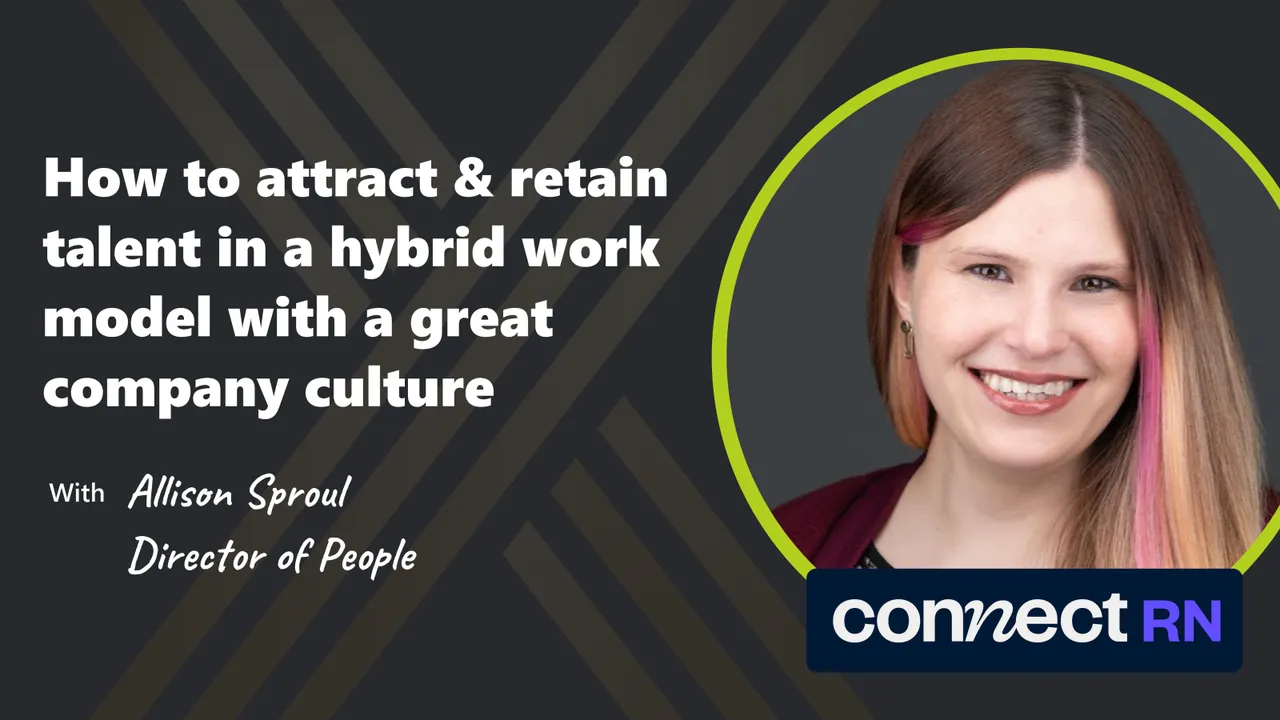
Allison Sproul discusses how a strong, inclusive company culture differentiates organizations in hybrid work, through flexible policies, real-time communication, manager enablement, and creating belonging for all employees.
TL;DR
What you need to know from this episode
- Optimize for remote employees and hybrid solves itself. Allison urges leaders to stop asking how to solve for hybrid. When meetings pause for the people on Zoom and big decisions collect remote buy-in, every group is served by default.
- Misalignment is a communication design problem. Agree with leadership on announcement channels and timing, set Slack norms around core hours, and keep business and development goals in one centralized place everyone can reference.
- Flexibility gets attention, culture wins the offer. Flexible PTO and inclusive parental leave are spreading fast, so the durable differentiator is a clearly articulated culture: what problem you solve and why it matters. Millennials and Gen Z are seeking that bigger purpose.
- Manager support is the number one retention lever. Employees leave bad bosses, and startups promote people into leadership earlier than most. Prioritize manager development from the start, and outsource facilitation if you lack the bandwidth.
- Ask before you act, then model the behavior you preach. Run an engagement survey or a listening tour before diagnosing problems, and actually read the comments. Then let leaders visibly take PTO and schedule-send their messages so burnout does not trickle down.
What makes a candidate pick one offer over another when almost every company now promises flexibility? In this episode of CultureClub X powered by CultureMonkey, host Nicole Patrick puts that question to Allison Sproul, Director of People at ConnectRN, an app that connects nurses and aides across the United States with flexible working opportunities that fit their lives.
Allison is a seasoned HR professional with more than a decade of experience in people management. She began her HR career in Shanghai, China, served as head of people at CozyKin, and worked on global talent acquisition teams at EF Education First and Cengage. At ConnectRN she led the organization through COVID-19 and spearheaded its transition to remote supportive work.
The conversation covers the practical mechanics of hybrid culture: meeting habits, Slack norms, goal alignment, manager enablement, and inclusion for neurodiverse employees. Underneath it all sits one argument. Flexibility is now table stakes, and the companies that win talent are the ones that can clearly articulate the problem their culture exists to solve.
Why solving for hybrid starts with optimizing for remote employees
Allison hears the same plea on webcast after webcast: how can we solve for hybrid? Her advice is to flip the question. Instead of treating hybrid as the puzzle to crack, optimize for your remote employees, especially anyone who is fully remote.
The logic is simple. People in the office can easily interject when a colleague is missing from a meeting, while a remote employee can quietly become out of sight, out of mind. Design for the person who is hardest to include, and everyone benefits.
If you are keeping up with the needs of your remote or especially if you have any fully remote employees, you are by default going to solve for all parties involved.
The tactics are deliberately granular. Pause before a meeting starts to confirm that everybody who should be in the room is there. Before a big group decision, check in with the people on Zoom or Teams who may have missed a fast-moving office conversation, and get their buy-in before moving forward.
Allison also engineers recovery time into the calendar itself. Her Google default sends invites for 25 or 50 minute meetings, building the buffer her executive coach recommends for mentally resetting between conversations. That same buffer quietly closes a gap for neurodiverse employees who need extra recoup time before the next meeting.
How can HR leaders fix misalignment between office and remote teams?
When misalignment shows up, Allison traces it to a disconnect somewhere in the internal communication strategy. Leadership teams need to decide deliberately how major announcements travel: asynchronously in Slack, via email rather than in person only, or recorded on Zoom, WebEx, or Teams so nobody misses the information.
Timing matters as much as channel. ConnectRN sets Slack norms that keep major announcements inside a 9 a.m. to 5 p.m. window, so people working core hours see them live, while a community support teammate on a midnight shift can reference them the next day without being pinged while trying to sleep.
The second fix is tying everything back to business goals in one centralized place, whether an intranet or HR technology. If Sarah hears one thing in the office and Mary reads another online, alignment collapses. A shared North Star lets a remote direct report and an in-office manager draw from the same source for both performance and development goals.
And step one is actually setting those goals. Allison warns that leaders who are just running, running, running skip the work of reverse engineering goals into smaller, more digestible chunks, which is precisely what creates alignment between the two employee groups.
Flexible policies attract talent, but culture is the real differentiator
On the policy side, Allison points to a pretty dramatic uptick in flexible PTO over the past few years, plus growing flexibility in working hours and schedules. She also highlights parental leave: the push toward 12 weeks of paid leave for all parents, not just primary caregivers or birth parents, is a shift that diversity and inclusion teams have helped drive across companies.
ConnectRN itself was born from a scheduling problem. Its co-founder, a nurse who had relocated his family from his home country, was juggling childcare, financial pressure, and a second round of school because his credentials had not carried over to the American healthcare system. He wanted an app that showed every shift available in his area for the hours he chose, instead of recruiters pitching whatever needed filling.
That origin story shapes her answer on differentiation. Culture is everything, she argues, because statistics show that millennial workers and Gen Z are seeking a bigger purpose over the long term. Her own career has moved intentionally through ed tech, childcare tech, and now health tech for exactly that reason.
The proof arrives in messages from nurses and caregivers: one bought her first home at the age of 50, another finally got his son everything on his Christmas wish list, all because flexible work made it possible. Companies that cannot name the problem their culture solves drift toward comfortable sameness, and comfortable sameness does not win offers.
What actually improves employee experience and retention in hybrid teams?
Allison starts from the old truth that employees don't leave bad companies, they leave bad bosses. The number one lever for retaining high performers is making sure the management team is incredibly well supported. That is doubly true in startups, where people get promoted into leadership faster and earlier in their careers than at larger, more established organizations.
She has lived the constraint herself, running a one-woman people team for her first year and a half at ConnectRN. Her advice for stretched HR leaders is to outsource: phenomenal facilitators are a LinkedIn message away, and you can commission one-off workshops or build a curriculum where each topic scaffolds the next.
On employee experience, her rule is to ask before acting. Employees have to tell you what is going on in their minds before you can play diagnostician, so she recommends starting with an engagement survey and actually reading the comments.
A dedicated pulse survey tool makes that listening rhythm sustainable, but budget is no excuse: a Google form works, and so does a listening tour of 25 or 50 minute one-on-ones asking everyone the same questions.
You don't have to have all of the answers offhand because you have to first ask the question before you can try to solve something.
The approach is already paying off at ConnectRN: goal setting surfaced as a gap in the company's most recent engagement survey and is now part of the action plan. Solve blindly, Allison warns, and you might not even be solving your real problem.
Did hybrid change the people leader role, or did the pandemic?
Allison offers a slightly controversial take: hybrid itself has not reshaped the people leader role so much as COVID-19 did. Leaders put on brand new hats, Kentucky Derby level hats with feathers, deciphering healthcare and compliance laws, CDC guidance, and the I-9 process while rules changed almost daily. Every morning brought another SHRM alert about something she had adjusted the day before.
The lasting lesson is permission to be human. You don't have to do all the things all the time, and it is okay to be burnt out, because it was a lot for everyone. People leaders skew selfless by nature, so the role now demands that they put on their own oxygen masks first in order to keep assisting everybody else.
That shift also widened the menu of support. Where leaning on the employee assistance program was the pre-pandemic norm, mental health and behavioral health providers have stepped up across both B2B and B2C, finding new ways to make caregiving affordable and accessible to everyone.
How can hybrid workplaces include neurodiverse employees?
Normalizing conversations about mental health has segued into greater openness with employees who identify as neurodiverse, a group Allison says has historically not felt as seen and heard. Companies furthering their diversity and inclusion efforts keep discovering areas of diversity where they never indexed enough.
ConnectRN builds gaps between meetings so employees with ADHD can mentally reset, and runs a Slack group that celebrates neurodiversity. Threads there help neurodiverse colleagues see they are just as normal as everyone else while celebrating that they think differently. It is a small structural choice that signals belonging more credibly than any office perk.
Why burnout prevention starts at the top
Burnout, in Allison's telling, trickles down. If the CEO, COO, or anybody in the C-suite is burning the candle at both ends, never taking time off and sending emails late, the whole employee population feels the pressure to respond just as quickly.
When you have that trickle down and people are starting to feel that pressure, they start to feel burnt out. People who are burnt out become disengaged and therefore oftentimes end up resigning.
The countermeasures are visible and mundane. Leaders should actually use their PTO and lean on the schedule feature in email and Slack, which Allison calls a game changer, especially for parents whose only productive window might be 5 a.m. Automation, task reminders, calendar blocks for breaks, and no meeting days round out the toolkit she has watched succeed across tech.
Where employee listening fits in a hybrid culture strategy
Strip away the specifics and one motif repeats through this episode: pause and ask. Ask the remote employee for input before the decision is made. Ask your people what is wrong before prescribing fixes. As Nicole puts it, sometimes the writing is on the wall and we just forget to actually read it and take action based upon it.
That is the discipline of employee listening: a continuous employee feedback loop where surveys, comments, and one-on-ones feed an action plan employees can watch moving. Allison's engagement survey story shows the mechanics at work: collect honestly, read thoroughly, commit publicly.
For hybrid organizations, listening is also the fairness mechanism. When half your workforce is not in the room, structured feedback is how their voice arrives with the same weight as a hallway conversation. Attracting talent with culture only works if that culture can hear the people already inside it.
About the guest
Allison Sproul
Director of people, ConnectRN
Allison is a seasoned HR professional and people leader with more than a decade of experience in people management. Currently leading the People & Talent function at ConnectRN, she has led the organization through COVID-19 and spearheaded the transition to remote-supportive work. She is a people centric leader who believes in a human-first approach, advocating for employee wellbeing, and amplifying voices from underrepresented groups.
Prior to her current role at ConnectRN, she served as the Head of People at CozyKin and worked on the global talent acquisition teams at EF Education First and Cengage. Allison is an alumni of Florida state university and she is also a SHRM-CP certified HR professional.
Full episode transcript
Season 03, Episode 13 · Allison Sproul with Nicole Patrick · 38 min
Hello everyone and welcome to the latest episode of CultureClub X powered by CultureMonkey. I'm your host, Nicole Patrick. CultureMonkey is a complete employee engagement platform that helps people leaders to measure and improve their workplace culture. In the 13th episode of this season of CultureClub X, we have with us Allison Sproul, Director of People at ConnectRN.
Allison is a seasoned HR professional and people leader with more than a decade of experience in people management. Currently leading the talent and people function at ConnectRN, she has led the organization through COVID-19 and spearheaded the transition to remote supportive work. Allison is a people centric leader who believes in a human first approach, advocating for employee wellbeing and amplifying voices from underrepresented groups. Prior to her current role at ConnectRN, she served as the head of people at CozyKin and worked on the global talent acquisition teams at EF Education First and Cengage. Allison is an alumni of Florida State University and she's also an SHRM-CP certified HR professional.
Allison, it's a pleasure to have you here with us, and welcome again to CultureClub's video cast on the impact of remote hybrid work culture on the modern workforce.
Thanks for the invite, Nicole. I appreciate you asking me to be here.
Yeah, so before we begin, please tell us a little bit more about yourself and your organization.
Yeah, so I think you just covered most things about me. My name is Allison Sproul. Although I am from Florida in the United States, a very small town that most people haven't heard of, I've been living in the greater Boston area now for the past eight-ish years. I began my HR career actually over in Shanghai, China before moving here. So that's where some of the international elements come in. And currently I am leading the people and talent function here at ConnectRN. We have an app that connects nurses and aides across the United States to each other, as well as flexible working opportunities that make the most of their life schedules and creating work-life balance for themselves.
That's amazing, and that's very important work and a really great app that's out there as a resource. So we're very excited to have you and hear more from you. So let's begin. In view of the pandemic, what do you think are the challenges faced by people leaders when it comes to company cultures with organizations switching to a hybrid work culture?
I think that we see so many of the questions across many webcasts like this saying, how can we solve for hybrid? How can we solve for hybrid? We were so used to these in-person interactions. And I think that instead of trying to solve for hybrid, if you instead think about how can I optimize for my remote employees, you'll be able to really solve that point pretty effectively. Because obviously when you have those folks who are in person, it's a lot easier to be able to interject in a meeting and say, oh, hey, Lexi or Allison isn't here yet, let's hold to wait on them. Whereas if someone is fully remote, it can be a little bit easier to be out of sight, out of mind. And so if you are keeping up with the needs of your remote or especially if you have any fully remote employees, you are by default going to solve for all parties involved.
And so things about getting a little more granular, right? If you're in a meeting, making sure that you're pausing before starting to make sure that everybody in the room who should be in the room is there. If you're making a big group decision but you haven't heard from those parties online, because maybe there has been a really quick revolving conversation in the office in person, taking a pause to say, hey, I know we've got a few folks on Zoom or Teams or whatever video platform your company uses here, and want to get some of their feedback too. And so by taking that quick pause and getting that buy-in from those who aren't physically in the room, I think helps to really solve a lot of those challenges.
Totally. I was speaking with another guest probably like five episodes earlier, and they mentioned that they had all of their meetings start on the five. So 1:05, 2:05, so that their remote employees who might be in a really quick turnaround would have that time to take a second, maybe say hello to everyone if they're there at one, but make sure that everything starts a few minutes later so that really everybody can be present and not be flustered like, oh my gosh, I just got out of the Zoom. Now I'm going onto the next Zoom. Everyone else is in the office right now. I'm the odd one out, I'm just gonna be quiet and sort of sit in the corner right now.
That's interesting, I do the exact opposite in my calendar, where I have the default in Google set to sending invites for only 25 minute or 50 minute meetings. So that way it builds out that buffer. I'm working with an executive coach who has a lot of degrees, but one thing that she's really preached, to help reinforce with me and to help reinforce with our team, is that by building in that buffer time, it really helps you be able to mentally reset and also prepare for that next meeting. And an additional, not consequence, but the positive form of consequence, is that by creating in that buffer time, you're also actually addressing a gap for your neurodiverse employees who may need that extra recoup time to be ready for their next meeting too.
Absolutely, totally.
Just adds a nice extra layer.
Yeah, exactly. And that should be something that nowadays, regardless of if you're working remote or not, you should have that little bit of time to sort of reset for everybody. It's important.
How do you think HR leaders can solve the misalignment between in-office and remote employees in a hybrid work setup?
Yeah, so easier said than done is the short answer, right? But I think really in two ways. So when you start to see misalignment, oftentimes it's because there's been a disconnect somewhere within your internal communication strategy. And so if you haven't sat down with the rest of the leadership within your organization and determined, okay, and of course it'll vary if you are an earlier stage startup versus a massive global workforce, right? Some may choose to do asynchronous announcements in Slack. Some may choose to make major announcements via email as opposed to just in person, so you're not having anybody miss that information. You can also make sure that some of those big ticket items are recorded on a Zoom meeting, a WebEx, Teams, whatever. And so really thinking about not only am I able to deliver this message to all parties, but also thinking about the timing of it as well.
So one thing that has been really helpful to us to help solve for some misalignment is setting some Slack norms. We're very much big fans and users of the Slack app at ConnectRN. And so by putting some of those guardrails in to say, hey, let's not make any major announcements outside of the windows of 9 a.m. to 5 p.m., it makes sure that those who are working those core hours are able to see it. And if somebody from, for example, our community support team is working a midnight to 8 a.m. shift, they'll still be able to reference that back the next day, but also not be worried about getting pings when people are sleeping or trying to sleep, when the vast majority are gonna be within that working hour window.
And then another piece of addressing that misalignment too is really tying everything back to the business goals. So if you don't have a consistent capture method or a place where your goals live, it makes it really difficult for employees to reference back to, oh, okay, well, Sarah was told this in the office, but I was told this online. And so if Sarah and Mary don't have the same place to reference back to and be able to draw from, this is our North Star, it makes a lot of difficulty. So having that centralized place, whether that be an intranet, or a lot of folks will utilize HR technology to put our goals in there, not only for performance goals of business needs, but also individual developmental goals, is another piece there too. To make sure that if you have a manager and direct report who are maybe remote versus in-person, they're still able to connect and still see in that one centralized place where to go for their answers, and just help create that alignment a little bit better.
It's so great that nowadays there are those technologies that you're able to really have everything centralized and streamlined into one place. Especially when the rest of the world is so disaligned right now, it's good to have one place that, even if you're at work in the office or if you're at home, you can have, like you said, that North Star.
For sure. And even backing up a little bit further from that too, kind of step one of that is obviously setting the goals, right? So, I mean, it sounds kind of obvious, but if you're just running, running, running, and not taking the time to reverse engineer it and break it into those smaller, more digestible chunks for folks, that will also aid in creating that greater alignment between the two employee groups as well.
Absolutely. And especially now that there are people that are onboarding fully remote, and they haven't gotten to be in that office and kind of see, okay, well, everyone is sort of following this path, this is the path that I should be on. These are the things that seem like the major goals of the company or goals of our office. It's now more important than ever to sort of break it down and say, okay, so you can see everything. This is what's going on.
In this hybrid work setup, where do most organizations offer flexible work policies to lure top talent? How can company cultures be a differentiator?
Yeah, with regards to the first portion of the question, I think that, of course, being able to offer flexibility of where you're working is kind of like the whole point in this call, so I won't stress on that too terribly much. But also you've seen a pretty dramatic uptick in flexible PTO policies over the past few years, as opposed to it being titled unlimited, right? And so I can only assume that's being done with the intention of creating that greater work-life balance for the employee, but also requesting some flexibility on behalf of the company's business needs too, because it is needing to be symbiotic. And I think that outside of providing that paid time off flexibly, also thinking about working hours and schedules.
So, I mean, the whole reason why ConnectRN was founded back in 2014 was that a nurse had relocated from his home country, our co-founder, and at the time he was working with staffing agencies to pick up shifts at local skilled nursing facilities. And in doing so, he had relocated his whole family. So he was juggling some childcare needs, the need to financially support his family. And then also too, because his credentials from his home country hadn't carried over to that of the American healthcare system, he actually had to go back to school for a second time. So his schedule was nothing short of chaotic. I'm sure a lot of folks can relate to some of that plate. And so he said to his brother-in-law over dinner one night, wouldn't it be cool if there was an app that would just show me what were all of the shifts available in my geographic area, based on the time that I set and want to work, instead of relying on recruiters who are just trying to pitch any shift because they really need to get it filled. And so by looking specifically at the employees' needs, and in this case, the nurses' needs, it's really helped our business to flourish a lot by prioritizing the actual humans' needs and their schedule.
And outside of some of the schedule too, just supporting them holistically as humans. And so we talk about these flexible work policies rather to attract in top talent. Also, we need to be flexible in terms of our parental leave offerings. Thinking back to at least a decade ago, I don't think it was nearly as open, at least in the American view, to see a big push now towards having 12 weeks of paid leave for all parents, not just primary caregivers versus secondary caregivers, or birth parents versus non-birth parents, adoptive parents versus standard birthing parents, right? It's now getting to the point where the diversity and inclusion teams have been able to influence some of these more flexible working policies across the company, which is really exciting to see.
And then for the second portion, with regards to the question of how can company culture be a differentiator, I really think that culture is everything, right? So when you are looking at joining a new company, if you're not gonna be excited about the product or the service that they're offering, it's much less likely that you're gonna wanna move forward with that job. I mean, of course that does happen, right? If you can see enough dollar signs, you're like, well, let me try this out. But a lot of statistics show that in the long term, particularly for millennial workers and Gen Z, they're really seeking that bigger purpose.
And I mean, even me myself, right? So the majority of my career has been in ed tech, childcare tech, and now health tech. And I've done that very intentionally, because I found that when I did take a brief pivot away from that mission driven purposeful work with these really strong motivating cultures, it was just not as exciting to me to get up in the morning and say, all right, let me do the same old, same old. But when I think and pause, even today, if I'm dealing with a tricky employee relations issue or some kind of baffling question on compliance policy, I think back and say, okay, I'm going through this because I'm really committed to creating better lives for nurses in the U.S. And so that really keeps me going with my little drum beat, right? And so we have a very nurse centric and high advocacy culture for them, which really, really makes that difference.
I think that if, for example, we attempted to approach the business from more of a B2B mindset and solving needs just for facilities without keeping the nurse in mind, I don't know that I would be as personally fulfilled. Because I see messages from nurses, caregivers, all the time saying, wow, because of this flexible work, I was able to buy my first home at the age of 50. Or, wow, because of these flexible working opportunities, I was finally able to get my son everything on his Christmas wish list this year. And that's freaking powerful, right? So in the absence of not having the culture that is really driving to solve a big problem, I think that you can just get into the habit of becoming a little bit more comfortable. And yes, that is one way to live. But if you really wanna be a differentiator, you need to clearly articulate what is your culture? What problem are you aiming to solve? Because that'll really help to articulate what your employee value proposition is.
Absolutely, and you put that so eloquently. You've hit the nail on the head. Nowadays people really are not working for a paycheck the same way that they used to and that the generations before us did. And so it's so important nowadays that you really do have that North Star and something that means something to you. And I know at least myself and most of my peers are willing to take a job, maybe that's not the higher paying job, but it actually means something, the work they're doing, than being at a higher paying job and getting probably burnt out within a year or two and having to then step back. So very well said.
The hybrid work culture has forced organizations to take a hard look at their employee relationships and cultural practices. What can organizations do to truly improve the employee experience and retain top talent?
Yeah, I mean, we've all heard the phrase that employees don't leave bad companies, they leave bad bosses, right? And so I think the number one lever to retaining your high performers is by making sure that your management team is incredibly well supported. If you are a rapidly growing startup and you're just trying to catch your bearings, I have 100% been there. I was a one-woman people team for the first year and a half here at ConnectRN in my time. And it was a doozy to be running talent acquisition as well as benefits and compensation and everything under the sun.
But one piece that really stood out to us was that, particularly in earlier stage companies, folks get promoted a little bit faster and oftentimes earlier in their careers into leadership roles than larger, more established organizations, and therefore need perhaps even more support than those of those bigger organizations. So really taking the time to prioritize that early on I think is absolutely mission critical. And if you personally do not have the bandwidth as the HR people operations leader of that company to facilitate it, or perhaps you are earlier in your own management journey, you can always look into outsourcing that, because there are just so many phenomenal facilitators that you can network with on LinkedIn and elsewhere to help build out content or workshops for your team. And that can be done as one-off topics that you highlight, but you can also come up with curriculum yourself and think about how each topic can build upon each other, particularly if you're using the same facilitator, to be able to scaffold that learning.
With regards to the employee experience as part of the question, I think there are many ways you can address trying to improve the employee experience. And I think that before asking what can I do to truly improve the employee experience, you need to pause and instead ask your employees, right? So they have to be able to tell you what's going on in their minds for you to become that diagnostician and determine, okay, what are our areas of opportunity here to address? And so I would really strongly recommend kicking things off with an engagement survey, and then not just sitting on that data, but actually reading the comments, utilizing the answers that your employees arm you with to highlight. And even going back to my earlier example of goal setting, that was something that we connected around. We're like, yeah, we could probably be better at this. And that was highlighted in our most recent engagement survey. And so that's a part of our action plan now to address that, to create further alignment, right? So you don't have to have all of the answers offhand because you have to first ask the question before you can try to solve something. Because otherwise you're just going to try and solve blindly, and that might not even be your problem.
So I think it's really important for HR practitioners to take a pause and put on their listening ears. And so even if you don't have the funding to be able to get a piece of technology to facilitate an engagement survey, and you're working in Google, you can use a Google form and go that route. You can also really go in, depending upon the size of your company, right? And how much time you want to allocate to this, setting up 25 or 50 minute one-on-ones with individuals throughout the company and really diving in deep and asking the same set of questions, so you can then build out some reporting yourself for that listening tour. But basically the overarching thing is not to just assume what the issues are, and take the pause to ask your people first what's going on in their world.
Totally, sometimes the writing is on the wall and we just forget to actually read it and take action based upon it.
How do you think the hybrid workplace culture has impacted the role of people leaders? And what are the additional things leaders should be open to embracing to cater to the needs of their employees in a hybrid work setup?
Yeah, so I think that the hybrid workplace culture has not, and maybe this is a little controversial, really impacted the role of people leaders so much as the COVID-19 pandemic. Because so many people leaders have had to put on brand new hats, like Kentucky Derby level hats with feathers and all sorts of craziness, figuring out different healthcare and compliance laws and what's going on with the CDC, and determining what is and isn't legal within the bounds of the I-9 process with ICE, and what changes are happening. Because in the earlier days of the pandemic, things were changing on almost a daily basis. And so just keeping up with everything was incredibly overwhelming. I just remember every day seeing a new email from SHRM in my inbox, the Society of Human Resources Management, saying, alert, there's this new thing. And I'm like, oh my gosh, I just adjusted this thing yesterday.
So the really big piece, honestly, I think has just been realizing that you don't have to do all the things all the time, and that it's okay to be burnt out, because it was a lot for everyone. And I think that people leaders in particular tend to think about the people. By nature, we tend to be more on the selfless side, at least most of us, than thinking about the individual, because we have to think about the collective group of our employees. And so the way it's really impacted the role is by acknowledging that we need to take care of ourselves as leaders, so that way we can then assist others to put on their oxygen masks, to use the reference that I've heard a handful of times. And then by being able to do that, you can look at a variety of mental health offerings, as opposed to just leaning simply into your employee assistance program, your EAP, which I think probably was more of the norm pre-pandemic. But now we've seen just such a huge uptick across the board with various mental health providers, behavioral health providers stepping up and finding new ways to innovate in this space. And also not just from a B2B lens, but also a B2C lens, and finding ways to make that caregiving affordable and accessible to everyone has been really, really huge.
And then for the latter half of your question, about additional things that leaders should be open to embracing to cater to the needs of their employees in a hybrid work setup, I think that in addition to the piece of normalizing conversations about mental health, that has also really segued nicely into greater openness and discussion of employees who identify as neurodiverse. And so I think historically those who are neurodiverse have often not felt as seen and heard. And I think that people leaders have really, especially over the past two years, found ways to open up for the entire employee population, but also in furthering the diversity and inclusion efforts have found that, oh, maybe we over-indexed or didn't index enough in this particular area of diversity, and finding ways to address that in the hybrid work setup. So like I mentioned earlier, building in gaps between meetings for those who do have ADHD to be able to mentally reset before their next meeting has been a really big one for us.
And also highlighting some behaviors. So what we do, we have a Slack group to celebrate neurodiversity at ConnectRN. And so there's this thread about how, oh, I do this as a neurotypical person, but I feel like this is sometimes attributed in other ways, and just helping those who are neurodiverse see that they're just as normal as the rest of us, right? But also celebrating that they do have that way of thinking differently, and really pausing to acknowledge and celebrate that I think is something that we have been able to address a little bit more as we've shifted from a strictly in-person office environment.
I love this Slack group. That's so cool, that is a very good idea.
How do you think leaders can address burnout and attrition issues in the hybrid work environment, and how can technology solve that problem from your perspective?
Yeah, so kind of timely with what we were just talking about. Being able to model the behavior that you want to see from the top down is absolutely critical. If your CEO, COO, anybody in your C-suite really, is burning the candle at both ends, never taking any time off, sending emails really late, the employee population will feel that. It will trickle down and there will be pressure to respond that quickly, right? And when you have that trickle down and people are starting to feel that pressure, they start to feel burnt out. People who are burnt out become disengaged and therefore oftentimes end up resigning. The great resignation.
So I think that by modeling that behavior at the top, utilizing that PTO, using the schedule feature in emails and for Slack, game changer. I think especially for parents who end up working odd hours, right? If you have younger children who are keeping you up at random hours, and maybe the only productive time that you have is like 5 a.m. before they wake up, but perhaps some other employees aren't in that stage of life and are looking to clock in around nine, they're probably still asleep at that point. Maybe they're working out, who knows? But being able to schedule those messages can really be super helpful, especially if you're in a managerial role.
And using technology to solve those problems, I mean, you can automate so many things now, whether that be a Slack message to go out, you can have reminders for different tasks. And so by taking the time to block out your calendar efficiently, even if you do have something come through, you won't necessarily be able to mentally reset in time for your next meeting at all times. So by taking that time to pause and utilize task reminders, put it in your calendar for a later time, include blocks for breaks within there too, I think will really be incredibly helpful. Some companies have issued no meeting days or no meeting hours to help address some pieces of burnout. So those are just a couple of things that I've seen across at least the tech industry that have been pretty successful.
Absolutely. And that's where tools like CultureMonkey come in, where just like we were saying earlier, you can use pieces of tech to constantly check the pulse of your employees and actually take that feedback, and most importantly, act upon it once you receive it. So it's an exciting time to be in this place right now and have all these tools to help and actually put them into action in real time.
Well, those were indeed some very great insights that you've covered about managing employees in a hybrid work setup. And it was so interesting to hear your take on a topic that's so relevant today. Balancing a remote hybrid workforce and catering to the diverse needs is one of the major topics on the minds of people leaders across the globe today. With changing times and workforces, people leaders need to adopt frequent listening techniques to understand the sentiment and pulse of their organization. This is where a platform like CultureMonkey steps in and saves the day. CultureMonkey's employee engagement platform seamlessly enables HR leaders and managers to listen to their employees' needs, analyze their feedback and act on them in real time. So if you want a super swift tool to improve your company culture, visit www.culturemonkey.io today.
With that being said, thank you so much for your time, Allison. This has been such an engaging and interesting discussion. I'm sure our viewers will agree too.
Definitely, thank you so much, Nicole.
Yeah, and so before we finish, please let our viewers know how they can reach out to you or contact you in case they want to share their thoughts.
Yeah, so LinkedIn is always the best way to reach me. Since I kind of grew up on the talent acquisition side of HR, I basically live on LinkedIn. I had somebody ping me at 9 p.m. on a Friday night a couple of weeks ago saying, hey, saw you were online too, what's up? And I'm like, oh no, why am I doing this to myself? But LinkedIn, you can search my first name, Allison, A-L-L-I-S-O-N, last name, Sproul, S-P-R-O-U-L. And the username is just People X Enthusiast. So yeah, look forward to connecting.
Great, well, thank you so much again. This was a really interesting episode, and that's all we have for you in this episode of CultureClub X, powered by CultureMonkey. Until next time, this is your host, Nicole, signing off.
Frequently asked questions
How can companies solve culture challenges in a hybrid work model?
Allison Sproul suggests reframing the problem: instead of trying to solve for hybrid, optimize for your remote employees. If you keep up with the needs of remote and fully remote staff, you solve for all parties by default.
Practically, that means pausing before meetings to confirm everyone is present, collecting feedback from people on Zoom or Teams before big group decisions, and building buffer time between meetings so everyone, including neurodiverse employees, can mentally reset.
How do you fix misalignment between remote and in-office employees?
Misalignment usually signals a disconnect in the internal communication strategy. Decide with leadership how major announcements travel, use asynchronous channels like Slack or email so in-person conversations do not become the only source, and record big-ticket items. Setting Slack norms, such as no major announcements outside 9 a.m. to 5 p.m., protects employees on non-standard shifts.
Then tie everything back to business goals kept in one centralized place, such as an intranet or HR technology, so remote and in-office employees reference the same North Star.
How does company culture help attract and retain talent in hybrid work?
Flexible work policies, from flexible PTO to 12 weeks of paid parental leave for all parents, are increasingly common, so they no longer differentiate on their own. Allison argues culture is everything: millennial and Gen Z workers in particular seek a bigger purpose, not just a paycheck.
To stand out, clearly articulate what your culture is and what problem you are aiming to solve, because that articulates your employee value proposition.
What is the most effective way to improve employee experience and retention?
Support your managers first. Employees don't leave bad companies, they leave bad bosses, and in early stage companies people are promoted into leadership earlier, so they need even more support. Workshops and outside facilitators can scaffold that development.
Then ask employees directly instead of assuming. Kick off with an engagement survey, read the comments, and turn what you learn into a visible action plan. Even a Google form or a structured listening tour works if budget is tight.
How can leaders prevent burnout in a hybrid work environment?
Model the behavior you want to see from the top down. When executives burn the candle at both ends, the pressure trickles down, people burn out, disengage, and often resign. Leaders should use their PTO and schedule-send emails and Slack messages, which especially helps parents working odd hours.
Technology helps too: automate reminders, block out calendars with breaks included, and consider no meeting days or no meeting hours.
Read the cross-episode roundups
More from CultureClub X
 S07 E02change leadershipHR as Chief Disruption Officer: Why Supporting the Business Is a Ceiling, with Jennifer McClure
 Jennifer McClure
 S07 E01employee engagementWhy is employee wellbeing spending not paying off? | Gethin Nadin, Benifex
 Gethin Nadin
 S06 E18ai in hrShould HR use AI to cut jobs or make people more valuable? | Steve Cadigan, LinkedIn's first CHRO
 Steve Cadigan
Never miss an episode
Every new episode, plus the takeaways that matter, posted on the CultureMonkey LinkedIn page as soon as they drop.
Free on LinkedIn. Unfollow anytime.